

Charcoal Toothpaste: The Whitening Claim vs the Enamel Risk
Key Takeaways
- A 2017 review of 118 publications in the Journal of the American Dental Association found no reliable evidence that charcoal toothpaste whitens, disinfects or detoxifies teeth.
- A 2019 analysis of 50 charcoal toothpastes sold online found only around one in twelve contained fluoride, the single best-evidenced ingredient for preventing decay.
- Charcoal removes surface stain by abrasion, the same mechanism as any polishing paste; it cannot reach the intrinsic yellow of dentin that only supervised peroxide bleaching changes.
- Toothpaste abrasivity is measured on the RDA scale with an accepted upper limit of 250, yet many charcoal products publish no RDA value at all.
- Enamel does not regenerate, and thinning it lets more yellow dentin show through, so aggressive whitening can leave teeth a shade darker over time.
- New cold sensitivity within weeks of starting a whitening paste is an early warning of dentin exposure and a reason to stop and see a dentist.
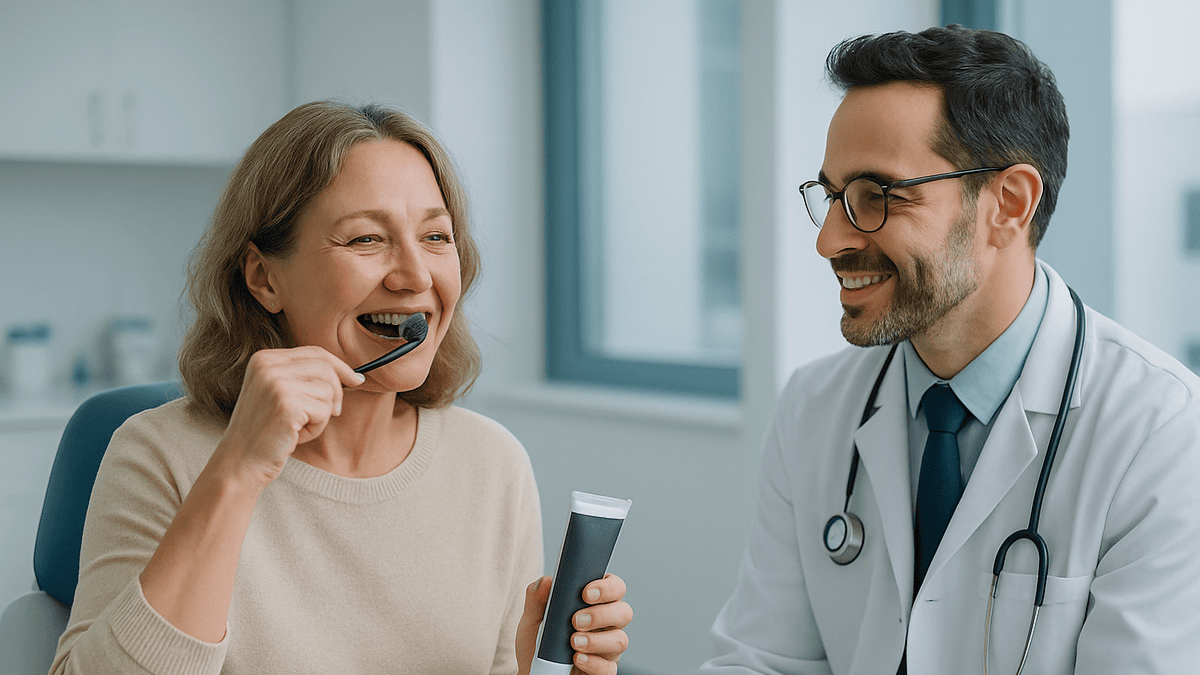
Charcoal toothpaste can lift some surface stains because activated charcoal is abrasive, but reviews in dental journals have found no good evidence that it whitens teeth better than ordinary fluoride toothpaste, and most charcoal products contain no fluoride. Because the abrasive particles can wear enamel and expose dentin over time, dentists generally advise against daily use and recommend asking a dental professional before whitening.
Scroll for thirty seconds and you will find it: a kitchen sink, a jar of black powder, a brush that looks dipped in soot, and a grin that goes from grey to glowing in one jump cut. As of spring 2025, those before-and-after clips are driving another surge of searches for charcoal toothpaste, pushed along by a wave of pharmacy own-brand launches and a handful of viral videos from creators who swear the gritty paste replaced their whitening strips.
The appeal is easy to understand. Charcoal looks ancient and clean at the same time, and the mouth really does feel scrubbed afterwards. That feeling is doing a lot of the persuading.
What the clips leave out is the part dental researchers have been saying since 2017: the whitening is mostly stain removal by friction, the enamel that friction wears down does not grow back, and the fluoride that protects against decay is usually missing from the tube. This piece walks through the claim and the risk, in that order, with the evidence graded honestly.
Why charcoal toothpaste is trending right now
Charcoal toothpaste has been on shelves for about a decade, so the current spike is not about novelty. It is about format. Short-form video rewards a dramatic visual, and nothing on a bathroom counter photographs more dramatically than a black paste on white teeth. The contrast makes any result look larger than it is, and the camera cannot show the one thing that matters most: what happened to the enamel.
Three forces are stacking up at once. First, supermarket and pharmacy lines have expanded, so the product sits next to familiar brands rather than in a specialist aisle. Second, ‘clean beauty’ marketing has folded charcoal into the same aesthetic as bamboo brushes and glass jars, which reads as gentle even when the ingredient is not. Third, the price of professional whitening pushes people toward anything that promises a shortcut at home.
Underneath all that sits a genuine gap in public knowledge. Most adults cannot say what enamel is made of, how thick it is, or whether it repairs itself. (It is a mineral shell, roughly 2.5 millimetres at its thickest on a molar, and it does not regenerate.) Without that baseline, a claim like ‘naturally detoxifies and whitens’ sounds plausible.
This article treats the trend as a question worth answering properly. Charcoal toothpaste is not dangerous in the way a mislabelled supplement can be. The risks are slow, cumulative and quiet, which is exactly why they deserve a clear explanation rather than a scare headline.
What changed recently
The science has been remarkably steady; what has shifted is the market around it. The anchor study remains a 2017 literature review in the Journal of the American Dental Association, which examined 118 published papers and product claims on charcoal dentifrices and concluded there was insufficient clinical or laboratory evidence to support claims of whitening, antibacterial action or detoxification. It also flagged that abrasivity was often untested.
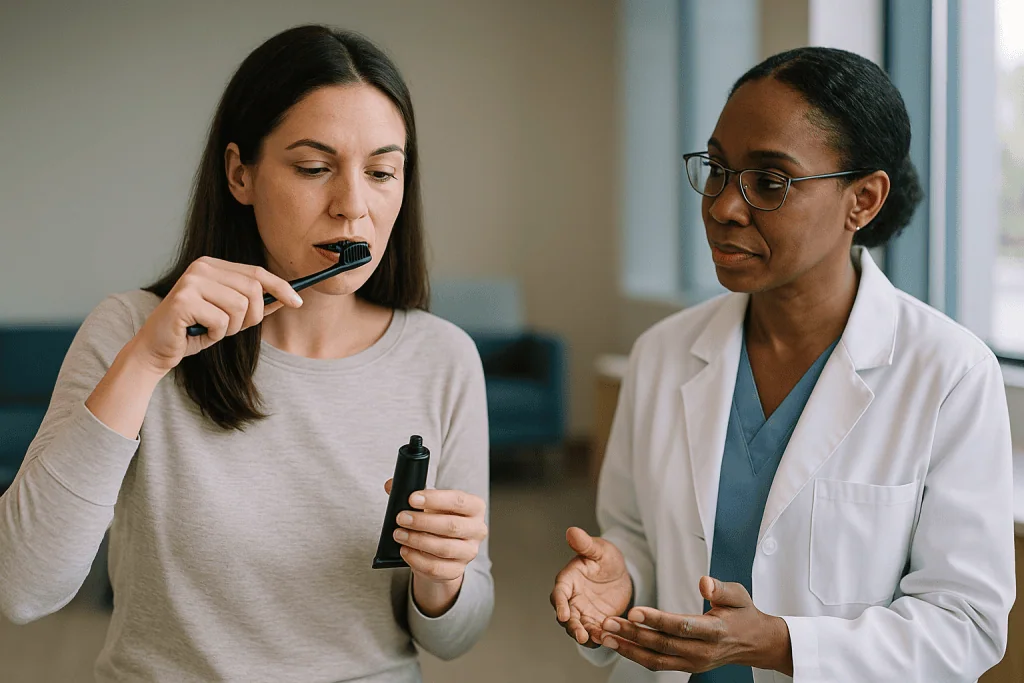
In 2019, a review in the British Dental Journal pushed the point further. The authors analysed 50 charcoal toothpastes available online and found that only a small minority, around one in twelve, contained fluoride. Many marketed themselves with words like ‘whitening’, ‘antibacterial’ and ‘detoxifying’ without published data to back any of them.
Since then, the notable development is reformulation. A growing number of charcoal pastes now list fluoride on the label, and some have moved from powders to conventional paste bases that are easier to control. That is progress, but a fluoride-containing charcoal paste is still an abrasive paste, and the whitening evidence has not improved alongside the ingredient list.
Public health bodies have not changed their position. The NHS continues to describe fluoride toothpaste as the foundation of tooth care and places whitening firmly in the hands of registered dental professionals. Mayo Clinic’s guidance on whitening toothpastes, including charcoal versions, remains that they may remove surface stains but cannot change the underlying colour of a tooth and may harm enamel when abrasive.
So the honest summary of ‘what changed’ is this: more products, slightly better labels, same evidence, same cautions.
What activated charcoal actually does on a tooth
Activated charcoal is carbon that has been heated with gas or chemicals to riddle it with microscopic pores, giving a single gram the internal surface area of several tennis courts. In an emergency department, that porosity lets it adsorb certain swallowed poisons. Adsorb, with a ‘d’, means molecules stick to a surface rather than soaking in.
That hospital use is the origin of the ‘detox’ story on toothpaste labels. The leap does not survive contact with a mouth. Adsorption needs time and contact; a two-minute brush, followed by rinsing, offers neither in any meaningful way. Stain molecules that have bonded to the tooth pellicle (the thin protein film that coats enamel within minutes of brushing) are not floating free waiting to be collected.
What charcoal does do, reliably, is scrub. The particles are hard and irregular, and dragged across a tooth by a brush they shear off some of the pellicle and the pigments attached to it. This is the same mechanism as the chalk in a 1950s tooth powder or the baking soda in a modern ‘whitening’ paste. It works on the outside of the tooth only.
There is a second, less welcome effect. Fine black particles can lodge in places a brush does not clear: the edge of a filling, the margin where a crown meets the tooth, the small gaps that open along a receding gum line. Dentists report seeing a grey tide line in exactly these spots in long-term users. The paste meant to whiten can, in the wrong mouth, leave the opposite mark.
Where tooth stains come from, and why that matters
Not all discolouration is the same, and the distinction decides whether any toothpaste can help.

Extrinsic stain sits on the surface. Coffee, black tea, red wine, curry spices and tobacco deposit pigments onto the pellicle, and the longer they sit, the more they darken. This layer is reachable by anything that polishes: a dental hygienist’s paste, a standard whitening toothpaste, or charcoal. Remove the pigment and the tooth looks brighter because you are seeing the enamel again.
Intrinsic colour lives inside. Enamel is semi-translucent, so what you see is partly the dentin underneath, which is naturally yellowish and darkens with age. Trauma, certain antibiotics taken in childhood, excess fluoride during tooth development and some genetic conditions can also shade the tooth from within. No abrasive reaches this. Only a bleaching agent, typically hydrogen peroxide or carbamide peroxide used under dental supervision, can break down those internal chromogens (the colour-bearing molecules).
Here is the uncomfortable twist. Thinning enamel by over-scrubbing lets more of the yellow dentin show through. A person who brushes aggressively with an abrasive paste for years can end up with teeth that are smoother, cleaner of surface stain, and a shade more yellow overall. The whitening habit becomes the yellowing cause.
This is why dentists ask what kind of stain you have before suggesting anything. If your teeth were pale before you started drinking three espressos a day, a surface approach may genuinely help. If they have always been warm-toned, charcoal is aiming at the wrong layer.
Does charcoal toothpaste work for whitening?
Taken literally, yes, a little, and only for surface stain. Taken as advertised, no.
Laboratory studies that stain extracted teeth with tea or coffee and then brush them with charcoal pastes do show measurable lightening. The problem is that the same studies, when they include a control group brushed with an ordinary fluoride toothpaste, usually find a similar result. The charcoal is not adding a special effect; the brushing is doing the work. A few in-vitro trials have found charcoal pastes slightly less effective than conventional whitening pastes containing silica or peroxide.
Clinical trials in living people are scarce and small. The 2017 JADA review could not identify a single well-designed human trial demonstrating that charcoal whitened teeth beyond the effect of standard brushing. The 2019 BDJ review reached the same conclusion two years later. That is a long time for a trending product to go without a convincing study.
Compare this with what we do know works. Mayo Clinic notes that whitening toothpastes can remove surface stains but cannot change the natural colour of teeth; for that, peroxide bleaching supervised by a dentist has decades of randomised trial support. The NHS describes professional whitening as the route that is both regulated and effective.
So the fair answer to ‘does charcoal toothpaste work’ is this: it polishes, as most toothpastes do, and the dramatic before-and-after images reflect lighting, wet versus dry teeth and the shock of the black contrast more than any chemistry unique to charcoal. If you have tried it and felt your teeth looked brighter, you were probably seeing a clean surface, which a fluoride paste would also have given you.
Does teeth whitening powder work any better than paste?
Powders are the purist’s version of the trend: loose activated charcoal, sometimes mixed with clay, baking soda or essential oils, dipped onto a wet brush. Followers argue the higher concentration makes them stronger. In one sense they are right, which is exactly the concern.
A toothpaste suspends its abrasive in a gel with water, humectants and detergents, which spreads the particles and cushions the tooth. A powder delivers them neat. There is no standardised dose per brush, no consistency between the first dip and the tenth, and no way for the user to know how hard the particles are. Abrasivity testing, the laboratory measure of how much a product wears dentin, is rarely published for powders at all.
Powders also almost never contain fluoride, because fluoride is unstable in a dry mix without the stabilisers a paste provides. Someone who switches entirely to a charcoal powder has, without realising it, stopped using fluoride.
On effectiveness, the evidence is no better than for pastes. The whitening is still surface polishing. Any extra ‘result’ from a powder comes from scrubbing harder with a coarser product, which is the trade that damages enamel fastest. Several case reports describe gum irritation and black staining around restorations in frequent powder users.
If a reader insists on trying a whitening powder, the safest honest advice is: not as a replacement for fluoride toothpaste, not daily, not with firm pressure, and not without checking with a dentist first, particularly if there are fillings, crowns, veneers or any gum recession. A powder cannot whiten dental work, and it can stain the join where that work meets the tooth.
What the evidence actually says, graded honestly
Readers deserve to know not just what the research found but how much weight it carries. Here is the picture by strength of evidence.
Randomised controlled trials in people: essentially none of good quality for charcoal whitening. This is the highest tier, and it is empty. Any product claiming ‘clinically proven’ should be able to point to one; the two major reviews could not find it.
Laboratory (in-vitro) studies: several, mostly on extracted teeth. These consistently show that charcoal pastes remove some extrinsic stain, usually no better than conventional pastes, and that abrasivity varies widely between brands. Lab studies are useful for mechanism but cannot capture years of real use in a wet, warm, acidic mouth.
Systematic and narrative reviews: the 2017 JADA review and the 2019 BDJ review. Both are well conducted syntheses of what exists, and both conclude the evidence is insufficient to support marketing claims. A review is only as strong as its inputs, and the inputs here are thin.
Expert opinion and clinical observation: dentists widely report seeing enamel wear, gum recession and dark staining at restoration margins in heavy users. This is the lowest tier of evidence, but it is consistent across countries and matches what the mechanism would predict.
Putting it together: the claim (whitening) has weak support, and the risk (abrasion, missing fluoride) has moderate support from laboratory measures plus a sound biological rationale. That asymmetry is the whole story. When the upside is unproven and the downside is plausible and irreversible, the cautious position is not timid; it is simply following the evidence where it is strongest.
Is charcoal toothpaste safe for enamel? The abrasivity question
Enamel is the hardest substance in the human body, which sounds reassuring until you remember that it is also finite. Once the outer layer is worn, the body cannot lay down more.
Toothpaste abrasivity is measured on the Relative Dentin Abrasivity scale, or RDA, a laboratory test that compares how much dentin a product removes against a standard reference. The American Dental Association’s accepted upper limit for a safe toothpaste is 250. Most everyday fluoride pastes sit far below that. The difficulty with charcoal is that many products publish no RDA value at all, and independent testing has found the range to be wide, with some well within normal limits and others toward the upper end.
| Toothpaste type | Typical RDA range | What it means for enamel |
|---|---|---|
| Low-abrasion or sensitivity paste | Roughly 30–70 | Gentle; suitable for daily use even with exposed dentin |
| Standard fluoride paste | Roughly 70–120 | Removes plaque and light stain; safe for daily use |
| Marketed whitening paste | Roughly 100–200 | Polishes harder; fine for most healthy enamel |
| Charcoal paste or powder | Often unpublished; tested samples vary widely | Unknown wear rate is the core concern |
| ADA upper limit | 250 | Above this is considered unsafe for routine use |
Ranges are illustrative, drawn from published laboratory testing, and individual products vary.
The missing number matters more than any single high one. You cannot judge a daily habit against a limit you are not shown. Add a hard-bristled brush and heavy pressure, both common among people chasing whiteness, and the realistic wear per year climbs further. Enamel loss is painless until it is not.
The fluoride gap most charcoal labels do not mention
Fluoride is a mineral that hardens enamel and helps reverse the earliest stage of decay by pulling calcium and phosphate back into the tooth surface. It is the single best-evidenced ingredient in oral care, supported by decades of randomised trials and population data, and it is the reason toothpaste is recommended twice a day rather than simply brushing with water.
The 2019 British Dental Journal review found that the overwhelming majority of charcoal toothpastes sold online contained no fluoride. Some went further and advertised ‘fluoride-free’ as a benefit, borrowing from a wellness trend that treats a protective mineral as a contaminant. The NHS is unambiguous on this point: adults should use a toothpaste that contains fluoride, and brushing without it forfeits the main protection against cavities.
There is also a theoretical wrinkle specific to charcoal. The same porous structure that makes it adsorb poisons may bind fluoride ions in the paste, reducing the amount available to the tooth even when fluoride is listed. This has been raised in reviews as a plausible concern rather than a proven effect; the evidence is laboratory-level and limited. It is worth knowing about, not panicking over.
The practical consequence is simple. Someone who swaps a fluoride paste for a fluoride-free charcoal product has made a trade: a possible, unproven cosmetic gain against a well-documented loss of decay protection. Over a year, with the average adult diet, that trade usually ends in the dentist’s chair for a reason that has nothing to do with whiteness.
If a charcoal product does list fluoride, that is a meaningful improvement. It still does not address abrasivity, and it still should not be assumed to whiten.
Can charcoal toothpaste cause sensitive teeth?
It can, and the route is predictable. Dentin, the layer beneath enamel, is threaded with thousands of microscopic tubules that run toward the nerve. While enamel covers them, cold water and sweet food pass unnoticed. Expose them, by wearing enamel thin or by scrubbing the gum line until the gum recedes and the softer root surface is bare, and those tubules conduct every temperature change straight to the pulp.
The sensation is a short, sharp zing rather than a throbbing ache. It often begins at the gum line of the canines and premolars, the teeth that take the most brushing force because they sit where the hand naturally pushes hardest.
Charcoal does not have a unique chemical effect on nerves; the problem is mechanical. An abrasive product, used with vigour by someone motivated to see fast results, accelerates the wear that any over-brushing causes. People who were already prone to recession, grinders, those with acid reflux or a fizzy-drink habit that softens enamel, are the most vulnerable.
Sensitivity is also the one warning sign the body offers before the damage becomes visible. A good rule: if a new toothpaste makes cold drinks uncomfortable within a few weeks, the paste is telling you something, and the answer is to stop and ask a dentist, not to push through for the whiter result.
Standard sensitivity toothpastes work by blocking those tubules or calming the nerve, and they tend to be low on the abrasivity scale precisely so they do not reopen what they seal. Alternating them with a charcoal product undoes the benefit. This is one place where more products in the bathroom cabinet genuinely means worse outcomes.
Is it okay to use charcoal toothpaste every day?
Dental organisations do not recommend it, and the reasoning follows directly from everything above. Daily use multiplies an abrasive exposure of unknown size across roughly 730 brushings a year, and in most cases removes fluoride from the routine entirely.
The frequency question is where people look for a compromise, and some dentists do offer one: if a patient is determined to use charcoal, keep a fluoride paste as the main twice-daily product and treat the charcoal as an occasional polish, perhaps once a week, with a soft brush and light pressure. That is a harm-reduction suggestion based on clinical judgement, not a tested protocol, and it is worth being honest that there is no trial showing a ‘safe’ frequency.
Several factors make even occasional use a poor idea for particular mouths:
- Existing enamel wear, visible as flattened edges or a glassy, yellowed look near the gum.
- Gum recession, where the root surface is exposed and far softer than enamel.
- Fillings, crowns, veneers or bonding, which cannot be whitened and can collect dark particles at their margins.
- Orthodontic brackets or retainers, which trap powder.
- Any current tooth sensitivity.
For a healthy mouth with no restorations and no sensitivity, the risk of a rare use is low. The honest difficulty is that few people buy charcoal toothpaste for a monthly treat; they buy it to replace the ordinary tube, and that is the pattern the evidence warns against.
The decision about what belongs in a daily routine is best made with a dentist who has looked at the actual teeth, measured the gum line and seen the wear pattern. A label cannot do that.
What is the healthiest toothpaste to use?
The least glamorous answer is also the best supported: a fluoride toothpaste, used twice a day with a soft or medium brush, spat out rather than rinsed away so the fluoride lingers. The NHS advises that adult toothpaste should contain between 1,350 and 1,500 parts per million of fluoride, a figure printed on the back of the tube, and that children’s pastes follow age-specific guidance a dentist or pharmacist can explain.
Beyond fluoride, the evidence supports a short list of extras, each for a specific problem rather than for everyone:
- Potassium nitrate or stannous fluoride formulations for sensitivity, which have randomised trial support for reducing cold pain.
- Low-abrasion pastes for people with worn enamel or exposed roots.
- Pastes with a seal of acceptance from a national dental association, which indicates the manufacturer has submitted safety and abrasivity data for independent review.
What the healthiest toothpaste does not need is a whitening claim, a ‘detox’ promise, charcoal, or the absence of fluoride marketed as a virtue. MedlinePlus frames adult dental care around three habits that outperform any ingredient: brushing twice daily with fluoride, cleaning between the teeth once a day, and regular professional check-ups. Technique beats formula every time; a gentle two minutes with a basic paste does more for enamel than thirty vigorous seconds with the latest trend.
If the goal behind the question is a brighter smile rather than a healthier mouth, the healthiest route is still the same paste for daily care, with any whitening handled separately and supervised. The two aims are not in conflict unless a product tries to do both and ends up compromising the one that matters.
Common myths about activated charcoal teeth whitening
The viral claims tend to repeat. Here is what the evidence does with each.
‘Charcoal pulls toxins and stains out of your teeth.’ Adsorption needs time and free-floating molecules. Stains are bonded to the tooth surface, and brushing lasts two minutes. Whatever charcoal removes, it removes by scrubbing, not by chemistry. No study has shown a detoxifying effect in the mouth, and ‘toxins’ is never defined.
‘It is natural, so it cannot harm enamel.’ Pumice is natural. Sand is natural. Hardness, not origin, determines wear, and charcoal particles are hard and irregular. Reviews flag abrasivity as the central safety concern precisely because ‘natural’ persuades people to brush without caution.
‘Fluoride-free is healthier.’ Fluoride is the single most evidence-backed ingredient in oral care, supported by randomised trials and decades of population data. Removing it is not neutral; it removes the main defence against decay. The NHS and MedlinePlus both place fluoride at the centre of daily care.
‘Dentists use charcoal, so it must work.’ Emergency physicians use activated charcoal for certain poisonings, in a completely different setting and dose. Dental professionals use peroxide-based bleaching and polishing pastes with published abrasivity values, not charcoal.
‘The before-and-after photos prove it.’ Black paste on teeth creates an extreme contrast that makes any tooth look whiter in the next frame. Add changed lighting, dried teeth (which look lighter) and a wider smile, and the result is persuasive without being evidence. The two dental journal reviews looked for controlled trials behind these images and found none.
‘It is antibacterial.’ Some products claim this; neither review found clinical support, and ordinary brushing already disrupts plaque mechanically.
When to see a doctor or dentist
Most people who try charcoal toothpaste will not come to harm from a few uses. The point of this section is to catch the slow damage early, when a dentist can still protect what remains, and to flag the rare situations that need prompt attention.
Book a routine dental visit if any of these have appeared since you started a whitening product:
- New or worsening sensitivity to cold, sweet or air, particularly near the gum line.
- Teeth that look more yellow or glassy at the edges despite regular brushing, which can indicate thinning enamel.
- Gums that bleed, look receded, or expose a darker band of root surface.
- Grey or black lines along fillings, crowns or veneers that do not brush away.
- Rough or chipped edges on front teeth.
Seek care sooner, within days, for a toothache that throbs or wakes you at night, swelling of the gum or face, a tooth that has darkened suddenly, or pain on biting. These are not typical effects of toothpaste and may signal decay, a cracked tooth or infection that needs treatment regardless of what caused it.
If you have swallowed significant amounts of a charcoal powder and feel unwell, or a child has eaten a quantity of any toothpaste, contact a poison control service or seek urgent medical advice.
Whitening decisions belong in the same conversation. A dentist can tell you whether your discolouration is surface or internal, whether your enamel can tolerate polishing, and what supervised options exist. Tell them exactly which products you have been using and how often; it changes the advice. Anyone already on prescribed high-fluoride toothpaste or treatment for gum disease should not switch products without checking with the clinician who prescribed it.
Frequently asked questions
Does charcoal toothpaste work for whitening teeth?
Only for surface stains, and no better than ordinary fluoride toothpaste in the studies that compared them. Charcoal particles scrub pigments from coffee, tea and tobacco off the tooth surface, which can make teeth look brighter, but two dental journal reviews found no controlled human trials showing a whitening effect unique to charcoal. It cannot change the internal colour of a tooth.
Is charcoal toothpaste safe to use?
Occasional use in a healthy mouth is unlikely to cause harm, but routine use raises two concerns dentists take seriously. The particles are abrasive and many products do not publish how abrasive, so enamel wear is unmeasured. Most charcoal pastes also lack fluoride. People with fillings, crowns, gum recession or sensitivity should ask a dentist before using it at all.
Can charcoal toothpaste cause sensitive teeth?
Yes, through enamel wear and gum recession rather than any direct effect on nerves. When abrasive paste and firm brushing thin the enamel or expose the softer root surface, the tubules in dentin conduct cold and sweet sensations to the pulp, producing a sharp, short pain. New sensitivity after starting a whitening product is a signal to stop and get a dental check.
Is it okay to use charcoal toothpaste every day?
Dental organisations do not recommend daily use. Every day multiplies an abrasive exposure of unknown size and usually removes fluoride from the routine. Some dentists suggest keeping fluoride paste as the twice-daily product and using charcoal rarely, with a soft brush and light pressure, but that is clinical judgement rather than a tested protocol. A dentist who has examined your teeth is the right person to advise.
What is the healthiest toothpaste to use?
A fluoride toothpaste used twice daily, spat out and not rinsed, with a soft or medium brush. The NHS advises adult pastes contain 1,350 to 1,500 parts per million fluoride, printed on the tube. Add a low-abrasion or sensitivity formulation if you have worn enamel or cold pain. A seal from a national dental association indicates independent safety review. No whitening or charcoal claim is needed.
Does teeth whitening powder work better than charcoal paste?
No, and it carries more risk. Powders deliver abrasive particles neat, without the gel that spreads and cushions them, with no consistent amount per brush and almost never any fluoride. Any extra brightness comes from scrubbing harder with a coarser product, which is the fastest route to enamel wear. Powders also cannot whiten fillings or crowns and can stain their margins.
Does charcoal toothpaste damage enamel?
It can, depending on the product’s hardness, how hard you brush and how often. Enamel wear from any abrasive paste is slow and painless at first, then shows as glassy, yellowed edges and cold sensitivity. Because many charcoal products do not publish an abrasivity (RDA) value, the wear rate is unknown. Enamel does not grow back, which is why dentists advise caution.
Why do most charcoal toothpastes not contain fluoride?
Partly marketing and partly chemistry. Many brands advertise fluoride-free as a wellness benefit, and dry powders cannot keep fluoride stable without the stabilisers a paste provides. A 2019 review found only a small minority of charcoal products contained it. Fluoride is the main protection against decay, so switching to a fluoride-free paste removes that benefit even if a few surface stains lift.
Can charcoal toothpaste stain fillings or crowns?
It can leave a grey or black line where dental work meets the tooth. Fine particles lodge in the microscopic margin around fillings, crowns and veneers and along a receding gum line, places a brush does not clear. Charcoal also cannot whiten restorative materials, so natural teeth may lighten while the dental work does not, making the mismatch more visible.
What is a safer way to whiten teeth?
Remove surface stain first with regular brushing and a professional clean, then ask a dentist about supervised bleaching if internal colour is the issue. Peroxide-based whitening carried out or prescribed by a dental professional has decades of randomised trial support and includes a check that enamel and gums can tolerate it. The NHS advises that whitening be done only by registered dental professionals.
References
This article is for general information only and is not a substitute for professional medical advice. Please consult a qualified doctor about your individual situation.

More from the Blog
Sensitive Teeth and Enamel Erosion: Causes and What Actually Helps
Sensitive teeth usually happen when protective enamel wears thin or gums recede, exposing dentin, the porous layer that carries sensations toward the tooth's nerve.…
BPPV: The Most Common Cause of Vertigo and the Maneuver That Fixes It
BPPV (benign paroxysmal positional vertigo) is the most common cause of vertigo. Loose calcium crystals drift into an inner-ear canal and send false motion…

Bad Breath: The Causes Beyond Brushing, From Tonsil Stones to Reflux
Most bad breath, roughly nine in ten cases by dental estimates, begins in the mouth: sulfur-producing bacteria on the back of the tongue, gum…
TMJ Exercises: The Jaw Routine Physiotherapists Use
TMJ exercises are gentle jaw movements physiotherapists teach to relax the chewing muscles, restore smooth opening and retrain jaw posture. Small randomized trials and…
How Often Should You Have an Eye Exam? The Schedule by Age and Risk
Healthy adults without symptoms or risk factors are generally advised to have a baseline comprehensive eye exam at age 40, then one every two…
OTC Hearing Aids and AirPods as Hearing Aids: What Changed and Who Benefits
OTC hearing aids are FDA-regulated devices that adults 18 and older can buy and fit themselves for perceived mild to moderate hearing loss, a…