

Chemical Peels for Sensitive or Darker Skin: Why Gentle Enzymatic Options Are Often Chosen
Key Takeaways
- Light chemical peels typically heal in about one to seven days while medium peels take seven to fourteen, and pigment risk climbs steeply across that gap.
- Enzymatic peels rely on fruit-derived proteins such as papain and bromelain that digest dead surface cells at near-neutral pH and cannot reach living tissue.
- Post-inflammatory hyperpigmentation is more likely in Fitzpatrick types IV to VI because melanocytes release extra pigment in response to inflammation.
- Controlled trial evidence for enzyme peels is sparse, so they are best understood as low-risk exfoliation rather than treatment for melasma or scarring.
- Mayo Clinic advises that peels are generally postponed for six months after oral isotretinoin and for a week after facial hair removal.
- Daily broad-spectrum sunscreen with SPF 30 or higher after a peel is the single measure most closely tied to preventing lasting discoloration in darker skin.
Chemical peels for sensitive or darker skin are usually kept superficial, because deeper peels raise the risk of post-inflammatory hyperpigmentation, the dark patches that can follow skin inflammation. Gentle enzymatic peels, which loosen dead surface cells with fruit-derived proteins rather than acids, are often chosen for their low irritation, although controlled evidence for them remains limited. A dermatologist's assessment, patch testing and strict sun protection guide every decision.
She has booked and cancelled the same appointment twice. Her skin is the kind that flushes in a cold wind, and her mother’s cheeks still carry the brown shadows of acne from decades ago, so the idea of deliberately applying acid to her face sounds less like self-care than a dare. Yet the friend who suggested it has visibly smoother skin, and every brochure keeps mentioning something gentler, an enzyme treatment that supposedly “works with the skin”.
That hesitation is sensible. Chemical peels for sensitive skin, and for the darker skin tones that pigment easily after any irritation, sit in a genuinely different risk category from peels on fair, robust skin. The same procedure that evens one person’s complexion can leave another with months of discoloration.
This explainer sets out what actually happens in a peel, why enzymatic and mild acid options are so often chosen for reactive and darker skin, what the evidence does and does not support, and the signs that mean a phone call rather than patience.
What chemical peels for sensitive skin actually do to the surface layers
Every peel, however mild, works on one principle: a controlled, deliberate injury that the skin repairs more evenly than it was before. The chemical is applied, loosens or removes a measured depth of tissue, and the body replaces what was lost with fresher cells. Clinicians group peels by how far that injury reaches. A superficial peel stays within the epidermis, the thin outer layer of skin; a medium peel reaches into the upper dermis, the deeper layer that holds collagen; a deep peel goes further still and is a different undertaking altogether.
For sensitive skin, nearly all of the useful work happens in the top fraction of a millimeter. The outermost sheet of the epidermis, called the stratum corneum, is made of flattened dead cells held together by lipids and protein bonds. Acid peels lower the surface pH and dissolve those bonds so the dead cells shed over a few days. Enzymatic peels do something related but narrower: they digest the keratin protein in those same dead cells without the acidity. Either way, nothing living is meant to be touched in a gentle peel.
Why does depth matter so much for reactive skin? Because redness, stinging and pigment change are all driven by inflammation, and inflammation scales with how deeply the skin is wounded. Mayo Clinic describes light peels healing in roughly one to seven days, while medium peels take closer to seven to fourteen days and bring more swelling and color change along the way. Keeping the injury shallow is not a compromise for sensitive skin. It is the entire strategy.
Chemical peel for dark skin: why melanin changes the risk equation
Dermatologists often describe skin using the Fitzpatrick scale, a six-point system that ranks how skin responds to sunlight, from type I, which always burns and never tans, to type VI, which rarely burns and is deeply pigmented. Types IV to VI cover most people of South Asian, East Asian, Middle Eastern, Hispanic, Indigenous and African heritage. The pigment itself is not the issue. The behavior of the cells that make it is.

Melanocytes, the pigment-producing cells in the lower epidermis, are more easily provoked in darker skin. When the skin is irritated, these cells can release extra melanin into the surrounding tissue, leaving a brown or gray-brown patch that outlasts the original irritation. This is post-inflammatory hyperpigmentation, usually shortened to PIH. Cleveland Clinic lists it among the common causes of uneven tone, with acne, eczema and procedural injury among its triggers, and Mayo Clinic notes that pigment changes after a chemical peel are more common in people with brown or Black skin.
The opposite problem exists too. Deeper peels can damage melanocytes outright and leave lighter patches, called hypopigmentation, which may be permanent and are often more visible against a darker background. The clinician treating darker skin is therefore steering between two risks at once: over-stimulating pigment with too much inflammation, and destroying it with too much depth.
That is why the planning conversation for a chemical peel for dark skin tends to be longer and more conservative. Lower strengths, shorter contact times, careful pre-treatment and strict sun protection are not optional extras. They are what makes the procedure reasonable for these skin types at all, and a good care team will say so plainly.
Enzyme peel vs chemical peel: what is the real difference?
The word “peel” covers two quite different chemistries, and the distinction matters most for exactly the people this article is about.
A conventional chemical peel uses an acid. Alpha hydroxy acids such as glycolic and lactic acid, the beta hydroxy acid salicylic acid, and trichloroacetic acid, usually shortened to TCA, all work through acidity: they lower the skin’s surface pH and break the bonds holding dead cells together, and at higher strengths they denature protein in living layers. Strength, pH, contact time and the number of layers applied together determine depth. Medium and deep acid peels produce a visible whitening called frosting, which is protein coagulating in the dermis.
An enzymatic peel instead uses proteolytic enzymes, proteins whose job is to cut other proteins apart. The common ones come from fruit: papain from papaya, bromelain from pineapple, and enzymes from pumpkin and fig. Formulated at a pH close to the skin’s own, they digest keratin in the dead surface cells but lack the chemistry to penetrate living tissue. There is no frosting, usually no neutralizing step, and typically only a mild warmth or tingling.
In the enzyme peel vs chemical peel comparison, the honest summary is this: enzymes are a form of exfoliation that stops at the surface by design, while acids can be dialed anywhere from the surface to the dermis depending on how they are used. That built-in ceiling is the enzyme peel’s main safety feature and also its main limitation. It cannot be pushed deeper even if a clinician wanted it to be, which is reassuring for a reactive complexion and frustrating for anyone hoping to treat scarring or deep pigment.
Why gentle enzymatic options are often chosen, and what the evidence actually shows
Ask practitioners why they reach for enzymatic options with reactive or darker skin and the answers cluster around three points. The first is predictability: because the enzyme cannot penetrate living tissue, the inflammatory response is small and roughly the same from one visit to the next. The second is comfort: there is rarely stinging, so a nervous first-time patient can experience an in-clinic procedure without dreading it. The third is flexibility: an enzyme treatment can often be done near areas of rosacea or on skin that has reacted badly to acids before, where even a low-strength glycolic peel would be unwise.
What the evidence actually shows is thinner than the marketing around these products implies. Enzymatic peels are mostly cosmetic-grade treatments, and the published literature consists largely of small studies, manufacturer-sponsored reports and narrative reviews rather than randomized trials against standard acid peels. Mayo Clinic and Cleveland Clinic, which both describe the evidence base for chemical peels in detail, do not list enzyme peels as an established medical treatment for pigment disorders, acne or photoaging. That absence is informative.
So it is fair to say enzymatic peels are gentle, and fair to say they produce a smoother, brighter surface for a short while by lifting dead cells. It is not fair to say they treat melasma, fade established post-inflammatory hyperpigmentation or soften scars, because no robust trial supports those claims. A truthful clinician will frame them as a low-risk exfoliating step, sometimes a way to test how a sensitive complexion tolerates treatment before anything stronger is considered, rather than a therapy with proven outcomes. Chosen for the right reasons, that is a perfectly respectable role.
Lactic acid peel for sensitive skin: which acids clinicians consider gentler
Among the acids, molecule size and the way an acid interacts with water largely decide how it feels on sensitive skin.
Glycolic acid is the smallest alpha hydroxy acid and penetrates fastest, which makes it effective and also the most likely to sting and to penetrate unevenly. Lactic acid, historically derived from milk, is a larger molecule that moves into the skin more slowly and also acts as a humectant, drawing water into the stratum corneum. That pairing of slower action and added hydration is why a lactic acid peel is often the first acid a clinician considers for sensitive skin.
Mandelic acid, from bitter almonds, is larger still, and polyhydroxy acids such as gluconolactone are larger again; both penetrate so gradually that irritation is usually minimal. Salicylic acid is oil-soluble, so at low strengths it can clear pores in acne-prone skin, and some clinicians favor it in darker skin because it carries a mild anti-inflammatory effect of its own. Trichloroacetic acid at medium strengths is the agent most often avoided for Fitzpatrick types IV to VI, since its depth is harder to control and pigment complications rise with it.
Two cautions belong here. None of these agents is a recommendation; which one, at what strength and for how long is a clinical judgment made after examining your skin and history. And “gentler” is relative, not absolute. A lactic acid peel at high strength left on too long will cause more damage than a glycolic peel applied correctly. The agent matters less than the hands and the plan around it.
Who chemical peels for sensitive skin are usually for, and who is asked to wait
The person most likely to be offered a gentle peel has a sensitive or darker complexion and a surface-level concern: mild uneven tone, dullness, early fine lines, rough texture, or non-inflamed comedonal acne. The goal is modest and the expectation is a series rather than a single transformation. Cleveland Clinic describes light peels as suited to exactly these mild changes, with repeated sessions needed to build a result.
A longer list of people are usually asked to wait, and the reasons are worth understanding rather than simply obeying.
- Anyone with an active flare of eczema, rosacea or psoriasis on the treatment area, because inflamed skin has a weakened barrier and reacts unpredictably.
- People with open wounds, sunburn, a cold sore outbreak or any skin infection on the face.
- Those who have recently taken the oral acne medicine isotretinoin; Mayo Clinic advises that peels are generally not performed within six months of this medication because healing can be impaired.
- Anyone who has had facial waxing, threading or laser hair removal in the preceding week, since Mayo Clinic notes these can heighten irritation.
- People with a history of keloid or hypertrophic scarring, where any skin injury carries a scarring risk that needs separate discussion.
- Those who are pregnant or breastfeeding, where evidence on many topical agents is limited and most clinicians defer elective treatment.
Waiting is not a refusal. In most of these situations the peel becomes reasonable once the flare settles, the infection clears or the medication interval passes. The treating clinician decides timing, and a thoughtful one will explain what needs to change before the appointment can go ahead.
How superficial, medium and deep peels compare for sensitive or darker skin
The table condenses what the major patient-information sources describe about peel depth, healing and pigment risk. Healing ranges are drawn from Mayo Clinic and Cleveland Clinic and are typical, not guaranteed.
| Peel type | Typical agents | Usual healing time | Pigment-change risk | Usual place for sensitive or darker skin |
|---|---|---|---|---|
| Enzymatic | Papain, bromelain, pumpkin enzymes | Same day to about 2 days of mild pinkness | Very low | Frequently used; surface exfoliation only |
| Superficial acid | Lactic, mandelic, low-strength glycolic or salicylic acid | 1–7 days | Low, rising with strength | Commonly used with patch testing and sun protection |
| Medium | Higher-strength glycolic, medium-strength TCA | 7–14 days | Moderate to high in types IV to VI | Selectively, by experienced clinicians, with pre-treatment |
| Deep | Phenol-based solutions | 2–3 weeks, redness for months | High, including permanent lightening | Generally avoided |
Two things stand out. The first is how steeply both downtime and pigment risk climb between the superficial and medium rows; that gap is where most of the caution for darker skin lives. Mayo Clinic notes that deep peels can leave treated skin permanently unable to tan, a far more consequential change for someone with a rich natural color than for someone with very fair skin.
The second is that enzymatic peels sit in a category of their own, with almost no downtime and almost no capacity to treat anything beyond the surface. Reading across the rows, the question for a sensitive or darker complexion is rarely “which peel is strongest” but “which option offers a meaningful change at a risk I am prepared to accept.” That is a conversation, not a menu.
What actually happens during a gentle peel appointment
A gentle peel appointment is undramatic, and that is the point.
It begins with a conversation rather than a product. The clinician asks about allergies, including to fruit or latex, since papain and bromelain can cross-react in people sensitive to those; about medicines, especially retinoids and anything that increases sun sensitivity; and about cold sores, scarring tendency and previous reactions to skincare. They examine the skin under good light, often grade it on the Fitzpatrick scale, and may photograph it. For a first visit on reactive or darker skin, many clinicians apply a small test patch behind the ear or along the jaw and review it a day or two later.
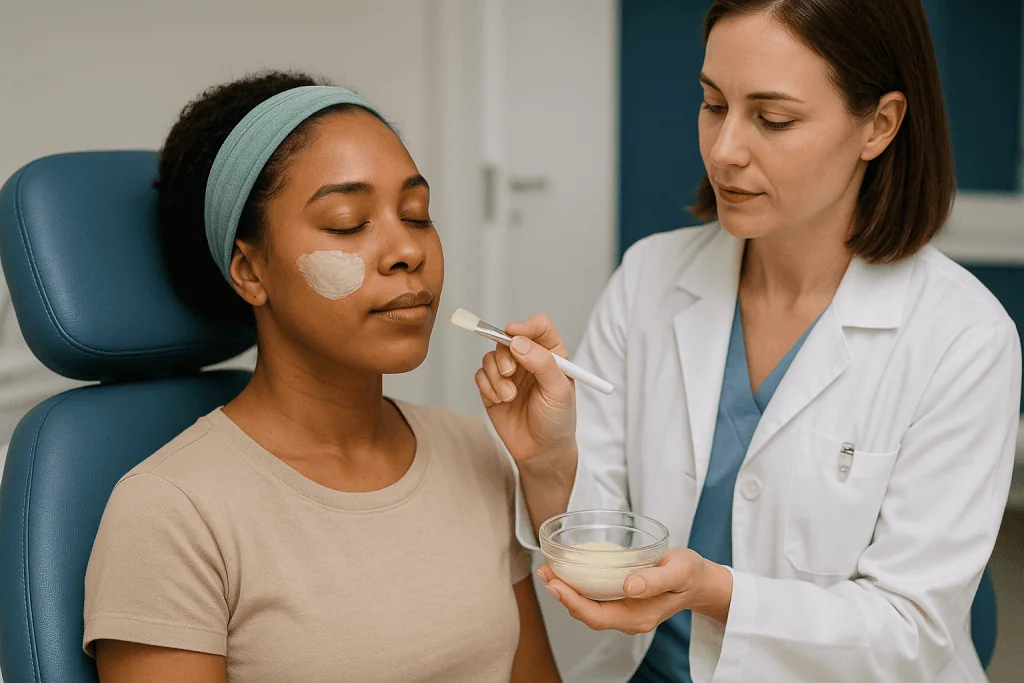
On the treatment day the face is cleansed and sometimes degreased with an alcohol-based solution so the peel spreads evenly. Eyes and lips are protected. The solution is brushed on in thin layers while the clinician watches the clock and the skin together: timing is measured in minutes, and the expected signs of a superficial acid peel are even pinkness and mild stinging, not frosting. Enzymatic peels are usually left for a short set time and removed with water or a damp cloth, with no neutralizer needed. Acid peels may be neutralized or simply rinsed, depending on the agent.
Afterward comes a bland moisturizer and a broad-spectrum sunscreen, and the person leaves looking slightly flushed, as if after a brisk walk. Mayo Clinic notes that light peels need no anesthesia and that any stinging during treatment usually settles quickly. Most people return straight to their day, having been told what to expect and whom to call.
What the following days and weeks usually look like
With a superficial peel the calendar is short. The first evening often brings tightness and the look of a mild sunburn. Over the next two to four days the surface may feel dry and begin to flake, more like fine dandruff than sheets of skin. Mayo Clinic puts healing from a light peel at around one to seven days, and by the end of that window most people see a smoother, slightly brighter surface. An enzymatic peel is briefer still: a little pinkness the same day and perhaps faint flaking the next, often nothing at all.
During that week the instructions are mostly about restraint. Wash with a gentle, non-foaming cleanser, moisturize, and leave flaking skin alone; picking is the single commonest way a harmless peel turns into a pigment problem. Hold off on retinoids, exfoliating acids, scrubs and strong actives until the clinician says otherwise, and treat sunscreen as the most important product on the shelf. Mayo Clinic advises daily broad-spectrum sunscreen with an SPF of 30 or higher after any peel, and for darker skin this matters even more, because ultraviolet exposure is what converts transient inflammation into lasting discoloration.
Results from gentle peels accumulate rather than arrive. Mayo Clinic describes light peels as repeatable roughly every two to five weeks, with a series needed to reach the intended result; medium peels are spaced months apart. Realistically, a person with sensitive or darker skin should expect a plan measured in months, with each session judged on how the previous one settled. If redness persists beyond a week, if new brown patches appear, or if the skin is darkening rather than evening out, contact the clinician rather than wait for the next scheduled visit.
Chemical peel hyperpigmentation risk: how clinicians try to lower it
Because post-inflammatory hyperpigmentation is the complication people with darker skin fear most, clinicians have developed a set of habits around it. None eliminates the chemical peel hyperpigmentation risk; together they reduce it.
Preparation often starts weeks before the appointment. Some clinicians prescribe a topical regimen beforehand, which may include a retinoid, a vitamin A derivative that speeds cell turnover and helps the peel spread evenly, or a pigment-regulating agent such as hydroquinone or azelaic acid, which slow the enzyme melanocytes use to make melanin. Mayo Clinic describes pre-treatment creams as a way to improve healing and reduce the risk of color changes. These are prescribing decisions made for an individual, mentioned here only so the suggestion does not come as a surprise.
At the appointment, the levers are strength, time and layers. A lower concentration left on for a shorter period, in a single layer, keeps the injury shallow and even. Patch testing a small area first is standard for reactive and darker skin. Clinicians also tend to avoid treating over active inflammatory acne lesions, since each one is already a small patch of inflammation primed to pigment.
Afterward, the two measures with the strongest rationale are sun protection and not picking. Cleveland Clinic lists sun exposure among the main drivers of hyperpigmentation and notes that it darkens existing patches as well as creating new ones. Hats, shade and reapplied sunscreen for several weeks are therefore part of the procedure, not an afterthought. Spacing sessions until the skin has fully calmed, rather than stacking them on a fixed schedule, gives melanocytes no reason to overreact. Should pigment appear anyway, early review matters, because PIH addressed promptly tends to respond better than PIH left for months.
Rosacea, eczema and reactive skin: when “sensitive” means a diagnosis
“Sensitive skin” is sometimes a description and sometimes a diagnosis, and the difference changes the advice.
Rosacea is a chronic inflammatory condition that causes persistent facial redness, visible small blood vessels and sometimes acne-like bumps, most often across the nose, cheeks and forehead. Mayo Clinic lists heat, alcohol-based products, exfoliants and sun exposure among common triggers, and all four can appear during a peel appointment. The barrier in rosacea is already fragile, and a flare after treatment can last weeks. That does not make peels impossible; it means the practitioner needs to know the diagnosis, treat only when the condition is quiet, choose the mildest option and steer clear of the most reactive zones.
Eczema, or atopic dermatitis, is a condition in which the skin’s barrier fails to hold water in or keep irritants out effectively, producing dryness, itch and inflammation. A peel deliberately strips part of that barrier, so timing matters even more: active patches are a reason to wait, and even quiet eczematous skin tends to tolerate enzyme treatments and the largest-molecule acids better than glycolic acid.
Some people have no named condition but react to many products with stinging, flushing or small bumps. For them the useful step before any peel is a clinician’s assessment, because stinging skin can conceal mild rosacea, contact allergy or a barrier worn thin by an over-enthusiastic skincare routine. The pragmatic path in all three situations is the same: see a dermatologist first, settle the underlying condition, and let the peel be a later step rather than the first one. A gentle enzymatic treatment often becomes the test case, precisely because its ceiling is low.
What people often get wrong about chemical peels for sensitive or darker skin
Several beliefs circulate about peels for reactive and darker skin, and most of them push people toward either too much treatment or none at all.
The first is that a stronger peel is a better peel. In sensitive or darker skin the opposite is usually true, because benefit plateaus while pigment risk keeps climbing. The second is that “natural” enzyme peels cannot cause reactions. Papain and bromelain are plant proteins, and plant proteins can provoke allergy, particularly in people sensitive to latex, papaya, pineapple or kiwi; a gentle chemistry is not an allergy-free one.
A third misconception is that peels lighten skin tone. They do not. A well-performed superficial peel removes dull surface cells and can even out patchy discoloration, but it does not alter the baseline color a person’s melanocytes produce, and any treatment promising otherwise is describing damage rather than a result. Closely related is the belief that darker skin should never be peeled. Fitzpatrick types IV to VI can be treated appropriately; what changes is the depth, the preparation and the margin for error.
Fourth, people assume a high-strength at-home acid equals a clinic peel. Over-the-counter exfoliants are formulated at low strengths for a reason, and layering several does not replicate a supervised procedure; it mostly produces an irritated barrier that then reacts badly to everything. Fifth, some expect a single session to undo years of sun damage or melasma. Light peels, as Cleveland Clinic and Mayo Clinic both note, need repeating to build a result, and melasma in particular is a hormonally influenced condition for which peels are at most one part of a longer plan.
The last myth is quieter: that nothing can go wrong with a “light” treatment. Something can, which is why the final two sections exist.
Questions to ask your care team
A good consultation leaves you knowing why a particular approach was chosen, not just what it is called. These questions tend to surface that reasoning.
- How would you grade my skin on the Fitzpatrick scale, and how does that change your plan?
- Are you suggesting an enzymatic treatment, a superficial acid peel or something deeper, and what specifically makes that the right depth for my concern?
- Will you patch test first, and what reaction would make you change course?
- Do you want me on any preparatory skincare in the weeks beforehand, and what is each product for?
- Which of my current products or medicines might need pausing, and for how long? I will confirm this with my prescribing doctor as well.
- What should my skin look like on day one, day three and day seven, and what would be abnormal?
- If I develop dark patches afterward, what is your plan for managing them?
- How many sessions do you anticipate, and how will you decide whether to continue?
- Whom do I contact after hours if something worries me?
Pay attention to how the answers are framed. Phrases like “we’ll see how your skin responds” and “I’d rather start lower and adjust” are signs of someone taking a reactive or darker complexion seriously. Guarantees of specific results, pressure to commit to a package before a test patch, or dismissal of your pigment concerns are reasons to slow down. You are allowed to leave a consultation without booking anything, and a clinician confident in their plan will not mind.
When to call your doctor
Most gentle peels pass without incident, and mild pinkness, tightness and a few days of flaking are expected. A smaller set of signs are not, and they warrant a same-day call to the clinician who treated you or to your doctor rather than a wait-and-see approach.
Seek advice promptly if you notice any of the following:
- Redness that is spreading, deepening or hot to the touch rather than fading after the first two or three days.
- Blistering, weeping, crusting or yellow discharge, which can indicate a bacterial infection in freshly exfoliated skin.
- Clusters of small painful blisters, especially around the mouth, which may be a cold sore outbreak; Mayo Clinic notes that peels can trigger flares of the herpes virus in people who carry it.
- Pain that is increasing instead of settling, or that interferes with sleep.
- Fever, chills or feeling generally unwell.
- Swelling of the eyelids or lips that worsens after the first day, or any hives, widespread itching or difficulty breathing, which could signal an allergic reaction and needs urgent care.
- New brown or gray patches appearing, or treated areas turning lighter than the surrounding skin.
Mayo Clinic lists infection, scarring and pigment change among the recognized complications of chemical peels, and all three are easier to manage when seen early. Keep the treating team’s contact details to hand, photograph anything that concerns you so change can be judged, and do not pile new products onto a reacting face in the hope of calming it. Call. Every decision about managing a complication, from antiviral or antibiotic therapy to pigment treatment, belongs with the clinician who can see your skin.
Frequently asked questions
Are chemical peels safe for sensitive skin?
Superficial peels can be used on sensitive skin when a clinician selects a mild agent, patch tests first and keeps contact time short. Risk rises with depth, so medium and deep peels are usually avoided. People with active rosacea, eczema or a damaged barrier are generally asked to wait until the skin is calm. Safety depends on assessment and technique rather than on the label “gentle.”
Can you get a chemical peel for dark skin without hyperpigmentation?
Risk can be lowered but not removed. Clinicians treating Fitzpatrick types IV to VI typically use superficial peels, sometimes prescribe pre-treatment creams, patch test, avoid treating over inflamed acne and insist on daily sunscreen. Mayo Clinic notes that pigment changes after peels are more common in brown and Black skin, which is why conservative depth and careful aftercare matter more for these skin types.
Enzyme peel vs chemical peel: which is gentler?
Enzyme peels are gentler by design. They use proteolytic enzymes from fruits such as papaya and pineapple that digest dead surface cells at near-neutral pH and cannot penetrate living tissue, so irritation is minimal. Acid peels can be made very mild too, but their depth depends on strength and timing. The trade-off is that enzyme peels cannot address deeper concerns such as scarring or established pigment.
How long does chemical peel hyperpigmentation risk last after treatment?
The skin remains vulnerable while it is inflamed and freshly exfoliated, which for a light peel is roughly the first one to seven days of healing described by Mayo Clinic, with sun sensitivity lasting longer. Clinicians generally advise strict sun protection for several weeks afterward. If brown patches do develop, they often appear within the first two to four weeks, so early review is worthwhile.
What does a lactic acid peel do for sensitive skin?
Lactic acid is an alpha hydroxy acid with a larger molecule than glycolic acid, so it penetrates more slowly and tends to sting less. It loosens the bonds between dead surface cells while also drawing water into the outer skin layer, which is why it is often the first acid considered for reactive skin. Strength, timing and suitability remain decisions for the treating clinician.
How often can a light peel be repeated?
Mayo Clinic describes light chemical peels as repeatable roughly every two to five weeks, with a series usually needed to achieve the intended result. For sensitive or darker skin, many clinicians prefer to wait until any redness or flaking has completely resolved before the next session rather than following a fixed interval. Medium peels are spaced months apart because of their longer healing.
Can I have a peel if I have rosacea?
Sometimes, but only when the rosacea is quiet and the practitioner knows the diagnosis. Mayo Clinic lists heat, exfoliants, alcohol-based products and sun among common rosacea triggers, all of which can feature in a peel appointment. Enzymatic treatments or the mildest acids are usually preferred, reactive zones are often avoided, and a dermatologist’s input beforehand is sensible.
Do gentle peels help melasma in darker skin?
Evidence for enzyme peels in melasma is lacking, and superficial acid peels are at most one component of a broader plan that typically includes strict sun protection and prescription topical agents chosen by a dermatologist. Melasma is hormonally influenced and prone to recurrence, and aggressive peeling can worsen it through post-inflammatory pigment, so expectations should be modest and decisions left to the treating team.
Do I need to stop my retinoid before a peel?
That depends on the peel, your skin and the reason the retinoid was prescribed, so ask both the person performing the peel and your prescribing clinician rather than changing anything yourself. Some clinicians use a retinoid as pre-treatment to even out penetration; others pause it briefly beforehand. Mayo Clinic notes that oral isotretinoin is a separate matter, with peels generally deferred for six months after it.
What should I avoid in the week after a gentle peel?
Avoid picking or peeling flaking skin, scrubs, exfoliating acids, retinoids and other strong actives until your clinician clears them, along with saunas, intense heat and unprotected sun exposure. Mayo Clinic advises daily broad-spectrum sunscreen of SPF 30 or higher. Stick to a mild cleanser and a plain moisturizer, and contact your clinician about anything that looks or feels worse rather than better.
References
- Cleveland Clinic: Chemical Peels
- Cleveland Clinic: Hyperpigmentation
- MedlinePlus: Skin Pigmentation Disorders
This article is for general information only and is not a substitute for professional medical advice. Please consult a qualified doctor about your individual situation.

More from the Blog
Who Is a Candidate for Laser Resurfacing? Skin Tone, Recent Tanning and Healing History
Typical laser resurfacing candidates have skin concerns such as fine lines, sun damage, uneven texture or certain scars, no active tan, no recent isotretinoin…
Microneedling vs Chemical Peels for Texture and Scars: Which Approach Fits Which Skin
Microneedling and chemical peels both improve skin texture and shallow scarring, but through different routes. Microneedling creates controlled micro-injuries that prompt new collagen and…
Which Collagen Treatment Fits Your Skin Concern? How Dermatologists Match Method to Goal
The right collagen treatment depends on the specific concern, not on the popularity of the method. Fine lines and texture usually point toward topical…
Cryotherapy Healing: Blistering, Crusting and How Long Treated Skin Takes to Settle
After skin cryotherapy, the treated spot typically reddens and swells within hours, may blister within a day, then forms a crust that separates over…

Subcision and Acoustic Wave Therapy for Cellulite: What Happens During Each Session
Subcision treats cellulite by using a small needle or blade to cut the fibrous bands that pull skin downward and create dimples, allowing the…
What Happens in a Mesotherapy Session: Microinjections, Timing and How It Feels
A mesotherapy session is a short cosmetic procedure in which a practitioner places many tiny, shallow injections of a liquid mixture, often containing hyaluronic…