

CO2 Laser and IPL: How Resurfacing and Light Treatments Differ and Who They Suit
Key Takeaways
- A CO2 laser is absorbed by water and removes the skin surface, which is why it improves wrinkles and acne scars but demands one to two weeks of raw, peeling recovery.
- IPL is broad-spectrum light, not a laser; it is absorbed by melanin and hemoglobin, so it treats brown spots and redness with hours of downtime and little effect on texture.
- Fractional CO2 treats only a percentage of the surface at once, typically 10 to 40 percent per pass, which is what cut recovery from months to roughly two weeks.
- IPL cannot distinguish a sun spot's melanin from the surrounding skin's, so tanned skin and darker skin tones carry a much higher risk of burns and lasting pigment change.
- Evidence for CO2 on scars and wrinkles and for IPL on redness and spots is moderate, drawn mostly from small split-face trials; evidence for IPL improving wrinkles is weak.
- Home IPL devices are deliberately low-power and cleared mainly for hair reduction; they cannot produce resurfacing, and any flashing over a changing mole should stop until a doctor has seen it.
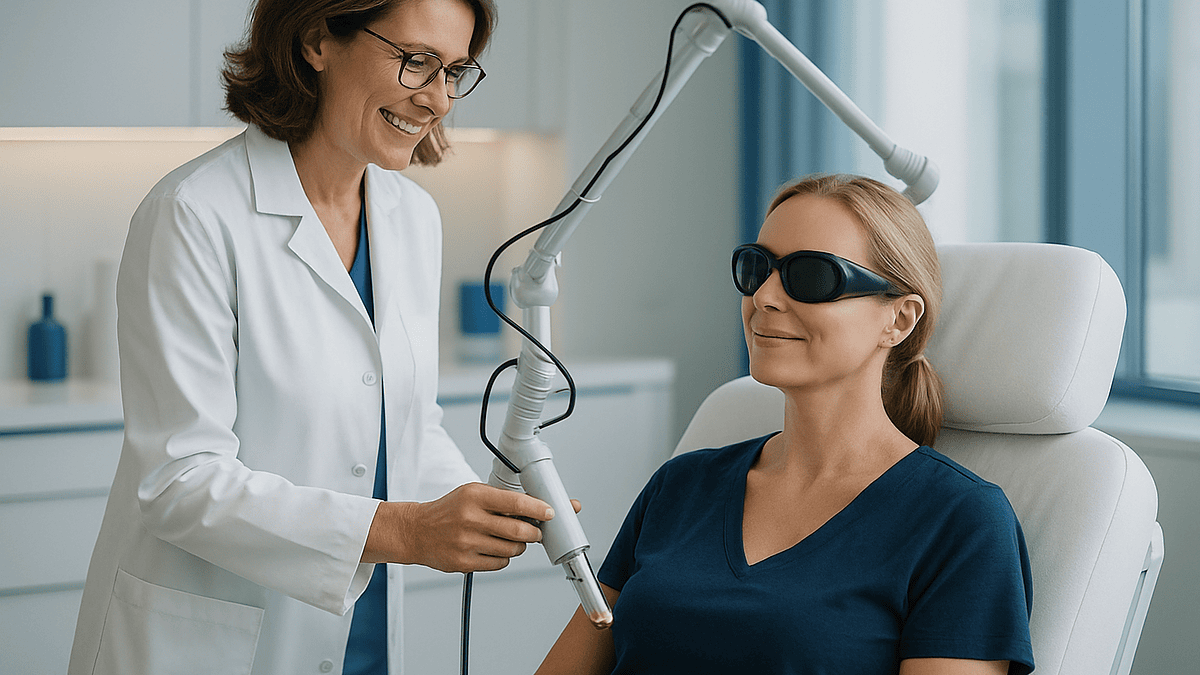
A CO2 laser resurfaces skin by vaporizing thin layers and heating the tissue beneath, so it treats deeper wrinkles, acne scars and sun damage but needs one to two weeks of healing. IPL is broad-spectrum light, not a laser; it targets brown spots, redness and visible vessels with little downtime but little effect on texture. A dermatologist matches the device to skin tone, goals and tolerance for recovery.
The video has eleven million views. A woman peels a gauze mask from a face that looks sunburned to the point of weeping, then cuts to day 14: glassy, even, suspiciously unlined. The caption reads “CO2 laser changed my life.” Scroll two posts further and a different creator waves a handheld flashing device at her cheek, promising the same result over coffee, with no peeling at all.
As of mid-2025, searches for “co2 laser” and “ipl treatment” are climbing together, and the reason is not a new trial or a regulatory decision. It is social video, where two very different technologies are being discussed as if they were interchangeable. They are not. One removes tissue. The other heats pigment and blood vessels without breaking the surface.
That distinction decides who heals well, who risks a scar, and who spends a fortnight indoors for a change they could have had in a lunch break. Here is what the evidence says, and how strong that evidence actually is.
What does a CO2 laser actually do to skin?
A CO2 laser produces a single wavelength of infrared light, 10,600 nanometers, that is absorbed almost entirely by water. Skin is mostly water, so the beam does not hunt for a target; it simply converts to heat wherever it lands. In the fraction of a second the pulse lasts, the outermost cells vaporize and the tissue just below is heated enough to injure it in a controlled way. Dermatologists call this an ablative treatment, meaning it physically removes the top layer rather than working through it.
The removal is the point, but the heat is the mechanism that matters most. Heated collagen fibers contract immediately, which is why faces look tighter the same day, and the deeper wound triggers weeks of new collagen production as the skin repairs itself. Mayo Clinic describes the result as skin that regrows smoother and firmer, with improvement in fine lines, deeper wrinkles around the mouth and eyes, acne scars, uneven tone and sun-damaged texture.
Early CO2 lasers treated the whole surface at once, a fully ablative approach that left raw skin and sometimes months of redness. Most modern treatments are fractional: the beam is split into thousands of microscopic columns, each surrounded by untouched skin. Those healthy islands repopulate the wounds quickly, so recovery drops from several weeks to roughly one or two.
The trade-off is honest. A CO2 laser can reach problems that live in the deeper skin, where IPL cannot go. It also creates a genuine wound, with everything that implies for pain, infection risk and the possibility of pigment change. Nobody should call it a facial.
IPL treatment: why it is not a laser at all
Intense pulsed light, or IPL, is often filed under “laser” in clinic menus and search results, but the physics are different. A laser emits one wavelength in a tight beam. An IPL device fires a flash lamp that releases a broad spread of wavelengths, typically from about 500 to 1,200 nanometers, through a filter that blocks the ranges the operator does not want. Think of a laser as a single note and IPL as a chord.
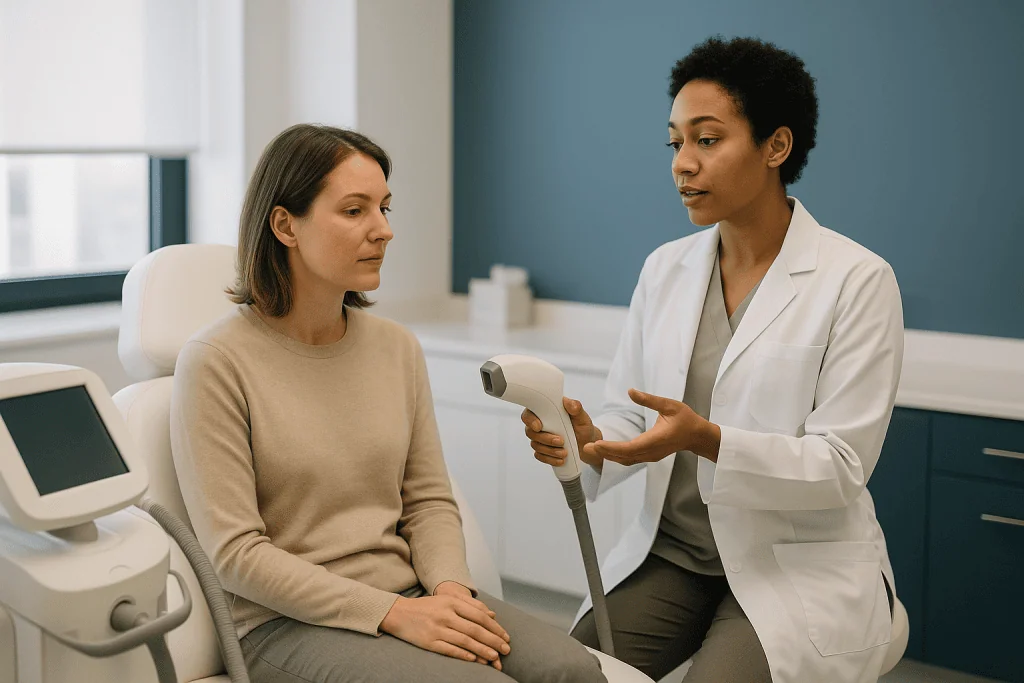
Because the light is broad, it can be absorbed by several targets at once. The two that matter clinically are melanin, the pigment in brown spots and freckles, and hemoglobin, the red pigment in blood vessels. These absorbing molecules are called chromophores, and the principle of heating a chromophore faster than the surrounding tissue can cool is known as selective photothermolysis. The pigment or vessel is damaged; the water-rich skin around it mostly is not.
That is why IPL treatment is non-ablative. The surface stays intact, so there is no open wound, no gauze, and usually no more than a few hours of pinkness. Brown spots often darken, look like coffee grounds for a week, then flake away. Dilated vessels fade over several sessions. Mayo Clinic lists both laser and intense pulsed light among the options for age spots and for the persistent redness of rosacea.
What IPL does not do is remodel texture in any meaningful way. Some mild heating of the upper skin occurs, and small studies report modest softening of fine lines, but the effect on wrinkles and scars is minor compared with ablative resurfacing. People who book an IPL “photofacial” expecting the day-14 glass-skin video are buying the wrong ticket.
CO2 laser vs IPL at a glance
The simplest way to see the difference is to line the two up against the questions a patient actually asks: what it fixes, what it costs in recovery, and where it can go wrong. The table below summarizes mainstream clinical descriptions from Mayo Clinic and Cleveland Clinic; individual devices and settings vary, so treat the ranges as typical rather than guaranteed.
| Feature | CO2 laser (fractional ablative) | IPL treatment |
|---|---|---|
| Type of energy | Single infrared wavelength absorbed by water | Broad-spectrum light absorbed by pigment and blood |
| Skin surface | Removed in microscopic columns; open wound | Left intact; no wound |
| Best targets | Wrinkles, acne scars, rough texture, deep sun damage | Sun spots, freckles, redness, visible vessels |
| Typical sessions | Often one; occasionally two or three for scars | Usually a series of three to six |
| Downtime | About 1–2 weeks of peeling and raw skin, redness for weeks to months | Hours to a few days of pinkness |
| Pain control | Topical numbing, often nerve blocks or sedation | Usually cooling gel alone |
| Darker skin tones | Higher risk of pigment change; needs expert settings | Significant burn and pigment risk; many devices unsuitable |
| Main complications | Infection, cold sore flare, pigment change, scarring | Burns, blistering, pigment change, unintended hair loss |
Two things stand out. First, these are not steps on a ladder, where IPL is the gentle version of a CO2 laser. They are different tools for different problems, and many people are best served by neither or by a sequence of both. Second, the downtime gap is wide, and that single row probably decides more treatment choices than any other.
What changed recently
The honest answer is that the science underneath both treatments is mature. CO2 lasers have been used on skin since the 1960s and for cosmetic resurfacing since the early 1990s. IPL devices entered clinical use in the mid-1990s, originally for leg veins. The fractional approach, which splits the beam into microscopic columns and transformed CO2 resurfacing from a rare, heavy procedure into a common office one, was described in 2004 and reached CO2 devices within a few years.
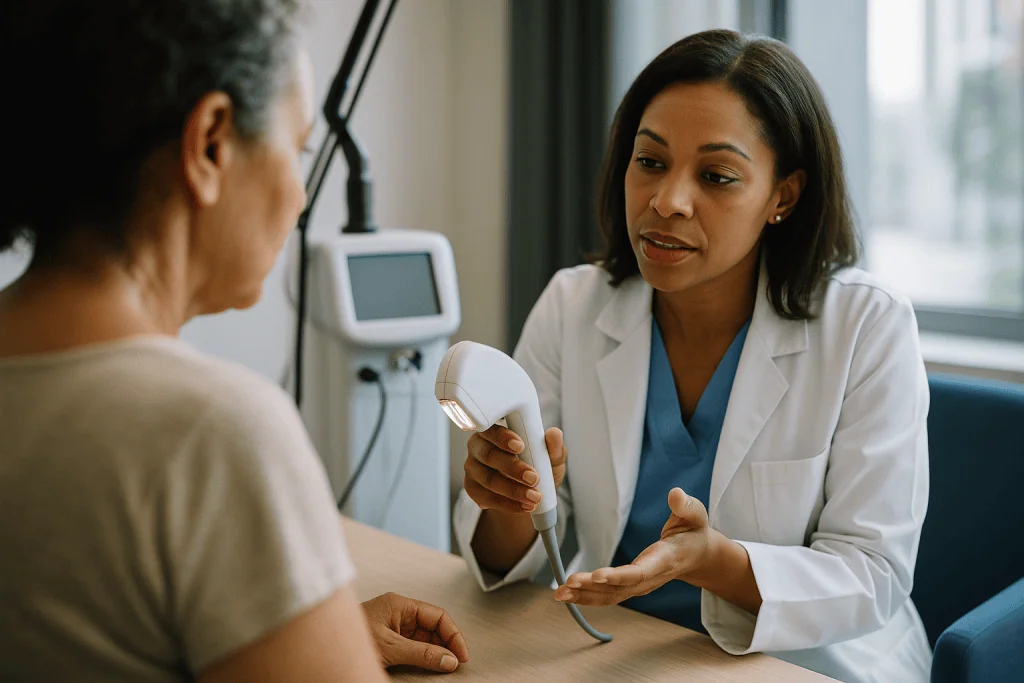
What has shifted is who is talking about them. As of mid-2025, three currents are driving search interest. The first is short-form video documenting CO2 recovery day by day, which has made the healing process visible to people who previously only saw polished after photos. The second is the spread of handheld IPL devices sold for home hair removal and marketed, often loosely, for “skin rejuvenation.” The third is a vocabulary problem: the phrase “laser facial” now covers everything from a true ablative CO2 laser to a 20-minute IPL session, and readers are trying to work out which one a creator actually had.
Clinical reference pages have kept pace in tone rather than in substance. Mayo Clinic’s current laser resurfacing overview separates ablative from non-ablative approaches and is explicit that ablative treatment, including CO2, carries more risk and longer recovery than non-ablative options. Cleveland Clinic’s resurfacing material makes the same split. The NHS pages on non-surgical cosmetic procedures continue to stress that laser and light treatments should be carried out by trained practitioners and that results and risks depend heavily on skin type.
No major guideline has changed in the past year. The news is cultural, not clinical, and that is worth knowing before a viral video sets your expectations.
What the evidence actually says, and how strong it is
Cosmetic dermatology is a field with many devices, many settings and relatively few large randomized trials, so it pays to grade the evidence rather than quote it.
For the CO2 laser, the strongest evidence concerns wrinkles and acne scars. Fully ablative resurfacing has decades of observational data and smaller comparative studies showing clear improvement in moderate to deep wrinkles and sun-damaged texture. Fractional CO2 has randomized split-face trials, in which one half of the face is treated and the other serves as control, and these consistently show meaningful improvement in acne scarring and perioral lines. The honest caveat is that most trials are small, often fewer than 50 participants, and outcomes are usually scored by clinician assessment rather than hard measures. Grade: moderate, strongest for scars and wrinkles.
For IPL treatment, the best-supported uses are pigmented sun spots and the redness and visible vessels of rosacea. Several randomized and controlled comparisons against vascular lasers show IPL reduces redness and vessel visibility over a course of sessions, with effects lasting months. Evidence for pigment is largely observational but consistent. Evidence that IPL improves wrinkles or pore size is weak: small studies, modest effects, short follow-up. Grade: moderate for redness and spots, weak for texture.
Comparing the two directly, there is little head-to-head data, because they rarely treat the same complaint. Where they overlap, on diffuse sun damage, small comparisons favor the CO2 laser for texture and IPL for color, which matches the mechanisms described above.
Finally, the safety data on darker skin tones is mostly case series and expert consensus. That is thinner evidence than anyone would like, which is itself a reason for caution.
Who is a good candidate for CO2 laser resurfacing?
Picture the person dermatologists describe as the classic candidate: lighter skin that burns before it tans, visible lines around the mouth and eyes, rough or mottled texture from years of sun, and perhaps the shallow, rolling depressions left by teenage acne. That person is being asked to trade two weeks of looking frankly alarming for a structural change that non-ablative treatments cannot match.
Beyond skin type, the deciding factors are practical. Can you take time away from work and sun? Fractional CO2 means at least a week of swelling, oozing and peeling, followed by weeks of pinkness that make-up can cover but not hide. Do you have a tendency to form thick or raised scars? Keloid-prone skin is a serious concern. Is there any active infection, acne flare or eczema in the treatment area? These generally need to settle first.
Medication history matters, and this is where the conversation belongs with the treating clinician rather than a comments section. Mayo Clinic notes that people who have taken isotretinoin, the oral acne medicine, are often asked to wait before ablative resurfacing because of concerns about healing, and that anyone with a history of cold sores may be offered antiviral medicine around the procedure, since the raw skin is an open door for the herpes simplex virus to spread across the face. Whether, when and how any of that applies to you is a prescribing decision.
Candidates who do well also share a mindset. They expect improvement, not perfection. Deep smile lines soften rather than vanish. Ice-pick acne scars, the narrow deep ones, respond less than rolling scars. Skin that has been resurfaced still ages, and still burns.
Who does IPL treatment suit, and who should skip it?
IPL treatment is at its best when the complaint is color rather than contour. The classic candidate has fair to medium skin with a scattering of brown sun spots across the cheeks and chest, or the persistent flush, broken capillaries and background redness of rosacea. For that person, a series of sessions a few weeks apart can produce a visibly more even complexion with no time off.
It suits people whose schedules and tolerance will not stretch to ablative recovery, and people whose main goal is maintenance. Many dermatologists use IPL as a once- or twice-yearly refresh after sun damage has been treated more aggressively, precisely because it is low-commitment.
The list of people who should skip it, or at least pause, is longer than the marketing suggests. A recent tan is the most common disqualifier: tanned skin carries extra melanin that competes with the brown spots for the light, so the surface itself heats and can blister. People with melasma, the patchy hormonal pigmentation often seen in pregnancy, are a cautious group; IPL can lighten it in the short term but the heat can also provoke a rebound that leaves things worse. Cleveland Clinic lists photosensitizing medicines and certain skin conditions as reasons to avoid light-based treatment, and that assessment belongs to the prescriber.
Anyone hoping IPL will flatten acne scars, tighten jowls or erase etched-in wrinkles should be told plainly that the evidence does not support those expectations. And in darker skin tones, discussed next, many IPL devices are simply not the right tool.
Skin tone, melanin and why burn risk is not evenly shared
Both treatments carry risk for everyone, but the risk is not distributed equally across skin tones, and this is the part of the conversation that viral videos tend to leave out.
Clinicians often describe skin using the Fitzpatrick scale, a six-point classification from skin that always burns and never tans (type I) to deeply pigmented skin that never burns (type VI). The scale is imperfect, but it captures the relevant variable: how much melanin the surface holds. IPL cannot tell the difference between the melanin in a sun spot and the melanin in the surrounding skin. In types IV to VI, the whole surface absorbs energy, which is why burns, blistering and lasting dark or light patches are far more common. Many practitioners will not use IPL on darker skin at all, and the NHS laser hair removal guidance makes the same point about light-based hair removal being less suitable and higher risk for darker skin.
CO2 lasers behave differently because they target water, not pigment, so the beam itself is colorblind. The problem comes afterward. The healing skin of people with more melanin is more likely to over-produce pigment in response to injury, a reaction called post-inflammatory hyperpigmentation, meaning dark patches that appear weeks after any inflammation and can persist for months or longer. The reverse, patchy lightening, is less common but harder to treat.
None of this means people with darker skin are excluded from resurfacing. It means settings are lowered, test patches are more valuable, pre-treatment skin preparation matters more, and experience with a wide range of skin tones is a legitimate question to ask any practitioner before booking.
CO2 laser recovery: what the two weeks really look like
The before-and-after format skips the part that determines whether people are happy. Here is the middle, drawn from standard post-procedure guidance such as Mayo Clinic’s.
Day one after fractional CO2 feels like a hard sunburn, often with significant swelling, particularly around the eyes. The skin weeps a clear or straw-colored fluid for the first two to three days and may crust. Most clinics ask patients to keep the surface continuously moist with ointment and to cleanse gently with a dilute vinegar or saline soak several times a day. Pain is usually manageable but real for 48 hours.
Days three to seven bring a bronze, sandpaper texture as the treated columns of skin dry and begin to slough. Picking is the enemy here; it is how scars happen. By the end of the first week most of the peeling is done, and the new skin underneath is bright pink and tight.
Weeks two to eight are about redness. Pink fades to blotchy and then to normal over a period that varies widely, from two weeks for light fractional settings to several months for deeper or fully ablative treatment. Sun avoidance in this window is not optional: new skin burns fast and pigments unevenly. Mayo Clinic advises against sun exposure for an extended period and daily broad-spectrum sunscreen once the surface has healed.
Collagen remodeling continues quietly for three to six months, which is why final results are judged at that point, not at day 14. The video did not lie. It simply stopped filming too soon, and started the clock at the wrong moment.
Side effects and complications: CO2 laser and IPL compared
Every energy-based skin treatment has a predictable set of expected effects and a shorter list of true complications. Knowing which is which keeps a normal recovery from feeling like an emergency, and stops a real problem from being waved away.
After a CO2 laser, redness, swelling, oozing and peeling are expected. Acne-like bumps and small white cysts called milia are common in the first weeks as glands reopen. Itch is nearly universal. Complications are less common but serious. Mayo Clinic lists infection, both bacterial and viral, with reactivation of cold sores being the classic example; changes in skin color, which can be darkening or lightening and are more frequent in darker skin; and scarring, which is uncommon but permanent. Fully ablative treatment adds a small risk of the lower eyelid pulling away from the eye if skin tightens too much, which is one reason fully ablative work is now reserved for specific cases.
After IPL, expected effects are mild pinkness and darkening of spots before they flake. Complications are burns and blistering, usually from settings too high for the skin tone or a recent tan; pigment change, in either direction; and, less often discussed, loss of hair in the treated area. The last matters when IPL is used on a man’s cheeks or near a hairline, because the device is also a hair-removal tool and does not know the difference.
Both carry a risk of disappointment, which is not trivial. Resurfacing that does less than hoped, or spots that return after a summer, are the most common reasons people are unhappy. Neither device is a one-time purchase of permanent skin.
Fractional, fully ablative or erbium: the choices inside the CO2 laser decision
Booking “a CO2 laser” is a bit like booking “surgery.” The category hides decisions that change the result and the recovery more than the brand on the machine does.
Fully ablative CO2 treats one hundred percent of the surface. It produces the most dramatic improvement in deep wrinkles and the longest, riskiest recovery, with redness that can last months and a higher chance of permanent lightening. It is now used selectively, often around the mouth or eyes rather than across the whole face.
Fractional CO2 treats a percentage of the surface, often somewhere between 10 and 40 percent in a single pass, leaving the rest intact to speed healing. Density, the proportion of skin treated, and depth, how far each column penetrates, are the two settings that matter. Higher density and depth mean more improvement and more downtime, and more risk. A conservative first session followed by a second months later is a common, lower-risk route to a similar end point.
Erbium:YAG is the other ablative laser, at a wavelength absorbed even more strongly by water. It vaporizes with less heat spread into surrounding tissue, so healing is typically faster and pigment problems somewhat fewer, at the cost of less immediate tightening. Mayo Clinic describes erbium as a reasonable alternative for people with darker skin tones or those wanting shorter recovery.
Non-ablative fractional lasers heat columns of deeper skin without removing the surface at all. They sit between IPL and CO2: more texture benefit than IPL, far less than CO2, with a few days of redness. For many people the right question is not “CO2 or IPL?” but “how much change do I need, and how much recovery can I honestly accept?”
At-home IPL devices and the viral claims around them
The handheld devices in the second kind of video are real IPL, in the sense that they use a filtered flash lamp. They are also, by design, a fraction of the power of a clinic machine, with built-in sensors that refuse to fire on skin tones the manufacturer judges too dark. Those limits exist because an unsupervised device that could deliver clinic-level energy would burn people. The result is a product that is useful for its cleared purpose, reducing hair regrowth on lighter skin with darker hair, and limited for almost everything else.
The claim that such a device will “fade sun spots and tighten skin like a professional photofacial” is not supported by good evidence. The energy is usually too low to treat vessels effectively, and any pigment effect is modest and slow. The claim that it can replace a CO2 laser is not supported by physics; a non-ablative light source cannot produce ablative resurfacing, regardless of how many sessions are stacked.
Safety is more nuanced than either camp admits. Serious burns from home devices are uncommon when instructions are followed, but they do happen, usually in people who used the device over tanned skin, over a tattoo, or on a part of the body with more melanin than the face they tested on. Eye protection is not optional; the flash is bright enough to be a hazard. The NHS advises that light-based hair removal is less effective and higher risk on darker skin, and that advice applies at home as much as in clinic.
If you own one and have a persistent brown or red patch that is not behaving like a typical sun spot, do not keep flashing it. Have it looked at first.
Common myths about CO2 laser and IPL, corrected
“IPL is just a mild laser.” It is not a laser at all. Broad-spectrum light absorbed by pigment and blood is a different mechanism from a single wavelength absorbed by water. That is why IPL is good at color and poor at texture, and why its skin-tone limits are stricter.
“One CO2 laser session erases ten years.” Fractional CO2 produces real, measurable improvement in wrinkles and scars in small randomized split-face studies, but “erases” is marketing. Deep folds soften; etched lines fade; skin still ages. Results are judged at three to six months, not at the two-week reveal.
“Downtime means it worked better.” Downtime tracks depth and density of treatment, not success. An unnecessarily aggressive setting raises the risk of pigment change and scarring without guaranteeing a better outcome. More is not more.
“Darker skin can’t have any of this.” Darker skin faces higher pigment risk after CO2 and is often unsuitable for IPL, but erbium lasers, conservative fractional settings and non-ablative options are used safely by experienced practitioners. The myth is that it is simple; the truth is that it needs more care, not exclusion.
“At-home IPL does what a clinic does, just slower.” Home devices are lower-energy by design and are cleared primarily for hair reduction. Evidence for pigment and redness is weak, and no amount of repetition turns non-ablative light into resurfacing.
“Once the spots are gone, they’re gone.” Sun spots treated with IPL often return after unprotected sun exposure, and new ones form. Daily sunscreen is what makes either treatment hold.
When to see a doctor
Start with a consultation, not a booking. Any ablative CO2 laser, and any IPL beyond cosmetic hair removal, should be assessed by a dermatologist or a clinician trained in laser medicine who examines your skin in person, asks about medicines, pregnancy, scarring tendency, cold sores and sun exposure, and explains the specific device and settings planned. Every decision about preparation, including whether antiviral or other medicines are appropriate for you, belongs to that prescribing clinician.
See a doctor promptly, the same day where possible, if any of the following happens after either treatment:
- Pain that increases after the first 48 hours rather than easing, or pain that feels out of proportion to the visible skin.
- Spreading redness, warmth, yellow or green discharge, or a fever, which can signal bacterial infection in a resurfaced face.
- Clusters of small blisters or sores spreading across treated skin, especially with tingling or burning, which can indicate a cold sore virus flare.
- Blistering, grey or white patches, or skin that looks waxy after IPL, which suggests a burn deeper than intended.
- Any change in vision, eye pain or light sensitivity after a treatment near the eyes.
- Healing that stalls, with raw areas still open beyond two weeks, or skin that becomes thick, raised or rope-like as it heals.
Separately, see a doctor before any treatment if a brown spot has changed shape, color or size, has an irregular border, bleeds, or looks different from the others. Light treatments can fade pigment that should have been biopsied. Mayo Clinic’s age spot guidance is clear that spots that change should be evaluated first, and no cosmetic device should be aimed at a lesion nobody has examined.
Frequently asked questions
Is IPL treatment the same as a CO2 laser?
No. A CO2 laser emits one infrared wavelength absorbed by water and vaporizes the skin surface, which makes it an ablative resurfacing treatment for wrinkles and scars. IPL emits a broad band of light absorbed by pigment and blood vessels, leaves the surface intact and works on brown spots and redness. They are different tools for different problems rather than strong and mild versions of the same thing.
How long does CO2 laser recovery take?
Fractional CO2 typically means about one to two weeks of swelling, oozing and peeling, followed by pinkness that fades over two weeks to several months depending on depth and settings. Fully ablative treatment heals more slowly and can stay red for months. Collagen keeps remodeling for three to six months, so the final result is judged then, not at the two-week mark.
Who should not have a CO2 laser?
People with active skin infections, uncontrolled acne or eczema in the area, a history of raised or keloid scars, or who cannot avoid sun during healing are generally poor candidates. Recent use of oral isotretinoin and a history of cold sores need discussion with the prescribing clinician. Darker skin tones are not excluded but carry higher pigment risk and need experienced, conservative treatment.
Does IPL treatment work on wrinkles?
Only modestly. IPL’s targets are melanin and hemoglobin, not the collagen that gives skin structure, so its effect on fine lines is small and on deeper wrinkles essentially nil. Small studies report slight textural softening, but the evidence is weak and short-term. For wrinkles and acne scars, ablative options such as a CO2 or erbium laser have far stronger support.
Is IPL safe for dark skin?
Often not. IPL heats melanin wherever it finds it, so in darker skin tones the whole surface absorbs energy and burns, blisters and lasting dark or light patches are considerably more common. Many practitioners decline to use IPL on Fitzpatrick types IV to VI and offer alternatives instead. Anyone with darker skin should ask specifically about a practitioner’s experience with their skin tone before any light treatment.
How many IPL sessions are needed?
A course of three to six sessions spaced a few weeks apart is typical for redness or widespread sun spots, with maintenance once or twice a year if sun exposure continues. Individual spots sometimes clear in one or two treatments. The exact number depends on the device, the settings and how the skin responds, which is a judgment for the treating clinician.
What is the difference between fractional and fully ablative CO2 laser?
Fully ablative CO2 removes the entire skin surface in the treated area, giving the biggest improvement in deep wrinkles with the longest recovery and the highest risk of permanent lightening. Fractional CO2 treats only a percentage of the surface in microscopic columns, leaving healthy skin between them to speed healing. Most modern treatments are fractional, sometimes repeated, as a safer route to a similar result.
Can an at-home IPL device replace professional treatment?
Not for skin concerns. Home IPL devices are deliberately low-energy and are cleared mainly to reduce hair regrowth on lighter skin with dark hair. Evidence that they fade sun spots or redness meaningfully is weak, and they cannot resurface skin the way a CO2 laser does. They can still cause burns if used over tanned skin or tattoos, and eye protection is essential.
Can CO2 laser or IPL be done in summer?
Technically yes, practically it is harder. Both treatments require avoiding sun before and after: tanned skin raises IPL burn risk, and freshly resurfaced skin after a CO2 laser burns quickly and pigments unevenly. Mayo Clinic advises strict sun avoidance during healing and daily broad-spectrum sunscreen afterward. Many people schedule treatment for autumn or winter for that reason.
Why do sun spots look darker right after IPL treatment?
That darkening is expected. IPL heats the melanin in the spot, which rises to the surface and looks like coffee grounds or dark flecks for roughly a week before flaking off, leaving lighter skin underneath. It is a sign the pigment absorbed the energy. Spots that darken and then do not flake, or that blister, should be reviewed by the treating clinician.
References
This article is for general information only and is not a substitute for professional medical advice. Please consult a qualified doctor about your individual situation.

More from the Blog

What Folliculitis Looks Like, and Does It Go Away on Its Own?
Folliculitis usually looks like clusters of small red, pink, or skin-colored bumps, each centered on a hair, sometimes with a white or yellow pus-filled…
Is It Dandruff, Dry Scalp or Scalp Psoriasis? How Dermatologists Tell Flaking Causes Apart
Dandruff, dry scalp and scalp psoriasis all cause flaking but differ in how the flakes look and where they appear. Dandruff produces oily, yellowish…
Why Does Folliculitis Keep Coming Back? How Dermatologists Investigate Recurrent Bumps
Folliculitis usually keeps coming back for an identifiable reason: bacteria such as Staphylococcus aureus carried on the skin or in the nose, repeated shaving…

When Alopecia Areata Returns After Regrowth: What a Relapse Means for the Next Treatment Step
An alopecia areata relapse means the immune system has again targeted hair follicles that had recovered. Relapse is common in this condition and does…

Fungal Acne: Why It Is Not Acne at All and Why Acne Treatments Make It Worse
Fungal acne is the everyday name for Malassezia folliculitis, an inflammation of hair follicles driven by overgrowth of a yeast that lives on nearly…

Does Psoriasis Affect the Joints? Why Dermatologists Ask About Stiffness and Adjust the Plan
Yes. Psoriasis can affect the joints through a related condition called psoriatic arthritis, which develops in up to about 30 percent of people with…