

CPM Machines: What Continuous Passive Motion Does After Knee Surgery
Key Takeaways
- A Cochrane review of 24 trials and about 1,445 patients found CPM added roughly 2 degrees of knee bend after knee replacement, too small a difference for anyone to feel.
- CPM grew out of 1970s animal research showing motion helps cartilage heal, in an era when knee-replacement patients spent a week or more in bed; today many walk within hours.
- The machine still has legitimate roles after cartilage-restoration procedures, after manipulation for a stiff knee, and for patients who temporarily cannot exercise on their own.
- Passive motion cannot contract the quadriceps, and quadriceps strength, not machine hours, is among the better predictors of how well a knee functions months after surgery.
- CPM has not been shown to reliably prevent blood clots, because it barely activates the calf muscles that pump blood back toward the heart; follow your team's clot-prevention plan instead.
- If CPM is prescribed, insist on professional fitting so the machine's hinge aligns with your knee, check the skin at every session, and report calf pain, numbness, or pressure sores promptly.
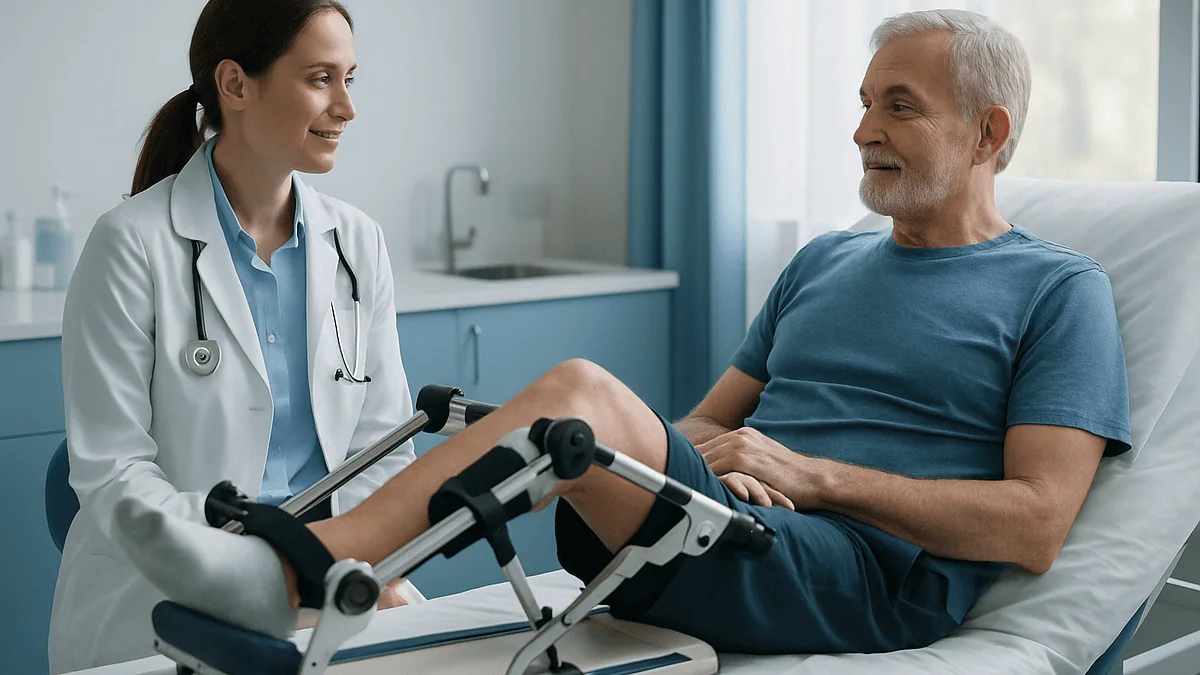
A CPM (continuous passive motion) machine slowly bends and straightens the knee on a motorized cradle, with no effort from the patient. Large reviews find it adds little measurable benefit after routine knee replacement, about two degrees of extra bend on average, so most rehabilitation programs now favor early walking and active exercise instead. Surgeons may still order CPM after certain cartilage procedures or when active movement isn't yet safe.
Ask anyone who had a knee replaced in the 1990s and they will describe the same scene: lying in a hospital bed, leg strapped into a humming metal cradle that bent the knee up, eased it back down, and repeated the cycle for hours, sometimes six or eight of them a day. The machine did the work. The patient watched television.
That device, the continuous passive motion machine, was once as standard as crutches. Today, a person can walk into surgery in the morning and shuffle down a hospital corridor on a new knee that same afternoon, often without ever seeing one.
What happened in between is one of medicine’s better stories about testing a plausible idea against real data. The short version: the machine wasn’t wrong so much as overtaken. The longer version is worth knowing, because CPM hasn’t disappeared entirely, and if your surgeon prescribes one, you deserve to understand why.
What is a CPM machine, exactly?
A continuous passive motion machine is a motorized frame that cradles the leg from thigh to foot and moves the knee through a preset arc, bending it, straightening it, then starting over. The word to focus on is passive. The motor does everything; the muscles around the knee stay quiet. That is by design, since the goal was never strengthening but simply keeping the joint moving during the fragile first days after surgery.
The user or a therapist sets two things: the range of motion, measured in degrees, and the speed of each cycle. A fresh postoperative knee might start with a gentle arc, and the range widens gradually as swelling settles and tissues tolerate more. Most units have a handheld control with a stop button, so the patient can pause the movement instantly if something hurts.
Machines exist for shoulders, elbows, and ankles too, but the knee version is by far the most familiar, because it was tied for decades to one of the most common operations in orthopedics: total knee replacement. In the United States alone, hundreds of thousands of knees are replaced each year, which explains why a single piece of rehabilitation equipment became a small industry, and why researchers eventually put it under such a bright light.
If you have seen one recently, it was probably in one of two places: a rental unit delivered to a patient’s home, or a hospital room after a procedure where the surgeon specifically wants motion without muscle effort.
How does continuous passive motion work in theory?
The logic behind CPM is genuinely elegant. Joint cartilage has no blood supply of its own; it feeds on synovial fluid, the slippery liquid inside the joint capsule, and movement is what pumps that fluid across the cartilage surface. A joint that sits still after surgery is, in a sense, a joint being starved of its nutrition.
Motion was thought to do several other useful things at once:
- Discourage adhesions, bands of scar tissue that can tether healing structures together and stiffen the joint.
- Reduce swelling by gently milking fluid out of the tissues with each cycle.
- Keep the joint capsule and surrounding soft tissue supple while they heal.
- Provide movement without the pain of muscle contraction, at a stage when actively bending the knee feels daunting.
None of this is far-fetched. Immobilization really does harm joints; that part of the science holds up well. Casted joints lose cartilage quality, capsules tighten, and range of motion becomes hard to win back. The open question was never whether motion matters, it clearly does, but whether motion delivered by a machine, hour after hour, adds anything once a patient is already up, walking, and doing exercises on their own.
That distinction turns out to be the whole story. A theory can be biologically sound and still fail to change outcomes in practice, because another intervention, in this case, early active rehabilitation, already captures the benefit.
Where did the CPM machine come from?
The idea traces back to laboratory research in the 1970s, when a Canadian orthopedic surgeon demonstrated that continuous gentle motion helped injured joint cartilage heal in rabbits far better than immobilization did. The findings challenged a century of orthodoxy, rest the injured part, splint it, wait, and they were persuasive enough to launch a device industry.
Context matters here. When CPM entered hospitals in the 1980s, a knee replacement meant a hospital stay of a week or two, much of it in bed. Anesthesia techniques were cruder, pain control was less refined, and nobody expected a patient to stand on the first day. Against that backdrop, a machine that moved the knee while the patient recovered in bed filled a real gap. Early studies were encouraging, and CPM spread quickly through orthopedic wards and then into home rentals.
Then the backdrop changed. Over the following decades, surgery became less traumatic to soft tissue, regional anesthesia improved, and “enhanced recovery” programs began getting patients on their feet within hours of leaving the operating room. Hospital stays shrank from weeks to a night or two, sometimes to same-day discharge. The window during which a patient lay in bed with nothing moving their knee, the exact window CPM was built for, nearly closed.
The machine stayed the same. The world around it didn’t. That is why studies from different eras seem to disagree: the older ones tested CPM against bed rest, and the newer ones tested it against a patient who is already walking.
Does a CPM machine improve results after knee replacement?
This question has been studied more thoroughly than almost any other in rehabilitation. A Cochrane systematic review pooled 24 randomized trials involving roughly 1,445 people recovering from knee replacement, comparing standard care with CPM against standard care without it. The results were strikingly modest.
| Outcome | What the pooled evidence showed | What that means in practice |
|---|---|---|
| Knee bend (active flexion) | About 2 degrees more with CPM | Too small for a patient, or a goniometer-wielding therapist, to reliably notice |
| Pain | Less than half a point lower on a 10-point scale | Below the threshold people can actually feel |
| Function and quality of life | No clinically important difference | Walking, stairs, and daily life recovered at the same pace either way |
| Need for manipulation under anesthesia | Possibly fewer procedures, but very low-certainty evidence | An intriguing signal, not strong enough to change practice on its own |
The reviewers’ conclusion was blunt: CPM does not have clinically important effects on knee motion, pain, function, or quality of life after knee replacement. Two degrees of flexion is roughly the difference between bending your knee to 118 degrees versus 120: a distinction with no bearing on whether you can climb stairs, ride a bike, or get out of a low chair.
Major orthopedic practice guidelines followed the data, and routine CPM after knee replacement has been fading ever since. Many surgeons stopped ordering it; many insurers stopped paying for it in that setting. This is evidence-based medicine working as intended: a reasonable idea, tested at scale, retired from routine use when the numbers came in small.
Why do some surgeons still prescribe CPM?
Retired from routine use is not the same as useless. There are situations where the original logic of CPM, motion without muscle effort, still fits the clinical problem, and surgeons continue to order it selectively.
- Cartilage restoration procedures. After operations that coax new cartilage to grow, such as microfracture or cartilage cell implantation, surgeons often restrict weight-bearing for weeks while still wanting the joint to move. CPM lets the healing surface glide under synovial fluid without loading it. This is the setting closest to the original animal research, and it remains the most common modern indication.
- After manipulation for a stiff knee. When scar tissue locks a knee and a surgeon breaks up adhesions under anesthesia, keeping the hard-won range moving in the days afterward matters, and CPM is sometimes part of that plan.
- When active exercise isn’t possible. A patient who cannot safely participate in exercise, because of another medical condition, certain repairs that must not be contracted against, or profound weakness, may benefit from motion delivered externally.
- Selected tendon and ligament repairs. Some protocols call for controlled passive motion within a protected arc while the repair heals.
Notice the pattern: every legitimate niche involves a knee that needs motion but cannot yet generate its own. If you can do heel slides and walk to the mailbox, you are already producing more useful movement than the machine can. If you can’t, for a specific surgical reason, CPM may still earn its place.
The takeaway isn’t that CPM is obsolete. It’s that the prescription should come with a reason, and it’s fair to ask what that reason is.
What does a typical CPM session look like?
If your surgeon does prescribe CPM, here is roughly what to expect. A therapist or equipment technician fits the machine to your leg length, aligning the machine’s hinge with the center of your knee: a detail that matters, because a misaligned hinge drags the joint through an awkward arc and can cause pain or skin rubbing.
Protocols vary by procedure and surgeon, but a common pattern runs like this: the machine starts with a modest range, often somewhere around full extension to 30 or 40 degrees of bend, and the arc is increased gradually, typically a few degrees a day, as comfort allows. Speed is set slow enough that each cycle feels like a lazy wave rather than a workout. Sessions may run from a couple of hours daily to considerably longer for cartilage procedures, sometimes split into blocks.
A few practical realities that patients rarely hear in advance:
- The first minutes of a session, when the knee is coolest and stiffest, are usually the least comfortable. It typically eases as the tissue warms.
- The machine has a pause and stop control. Use it. Sharp pain is a signal, not a challenge.
- You will still do everything else in your program, walking, exercises, icing, elevation. CPM is an addition, never a substitute.
- The leg should be positioned with the kneecap facing the ceiling, not rolled inward or outward, and padding should protect bony spots.
Keep a simple log of the range settings each day. It gives your therapist concrete numbers to work with and turns a monotonous machine session into visible progress.
Does CPM reduce pain and swelling?
Less than people hope, according to the trials. In pooled data from knee-replacement studies, patients using CPM reported pain scores less than half a point lower on a 10-point scale than those without it: a difference smaller than what researchers consider perceptible. Some individuals do find the rhythmic motion soothing, the way rocking soothes a sore back, and there is nothing wrong with that experience being real for them. It simply doesn’t show up as a consistent, meaningful effect across hundreds of patients.
Swelling tells a similar story. The theory, that cyclical motion pumps fluid out of the joint and surrounding tissue, is plausible, and small studies have pointed in both directions. What the aggregate evidence has not shown is that knees treated with CPM end up measurably less swollen at the milestones that matter: two weeks, six weeks, three months.
Compare that with the tools we know earn their keep. Elevation uses gravity, which never takes a day off. Cold reduces local blood flow and dulls pain signaling. Walking and ankle pumps contract the calf, which is the body’s own return pump for fluid in the leg. Each of these has a clearer mechanism-to-outcome connection than a machine passively moving a relaxed limb.
My honest read of the literature: if CPM feels good to you and it’s been prescribed for a legitimate reason, enjoy the comfort as a side benefit. Just don’t let hours in the machine crowd out the twenty minutes of active exercise that will actually change your six-week outcome.
Can CPM prevent blood clots or a permanently stiff knee?
Two fears loom over every knee surgery: a blood clot in the deep veins of the leg, and a knee that heals stiff. CPM has been proposed as a defense against both. The evidence deserves a careful look, because the stakes are different for each.
On clots, the theory is that machine-driven motion keeps blood from pooling. But passive motion barely engages the calf muscles, and it’s the calf’s contraction that squeezes blood back toward the heart. Studies have not established CPM as a reliable clot-prevention tool, and no one should treat it as one. Clot prevention after knee surgery rests on the measures your surgical team prescribes, early walking, compression strategies, and any medication your doctors order, not on a bedside machine.
Stiffness is more interesting. A small fraction of knee replacements, estimates generally fall in the low single digits, develop enough scar tissue that the surgeon must bend the knee under anesthesia to break adhesions loose. The Cochrane review found a hint that CPM might reduce how often this happens, but graded the evidence very low certainty, meaning the true effect could easily be nothing. It remains a fair question for future research rather than a settled benefit.
What clearly does protect against stiffness is achieving full extension early, getting the knee completely straight, and steadily reclaiming bend through daily active work. A knee that straightens fully and bends past 90 degrees by the early weeks is on track, machine or no machine. That is where your energy belongs.
CPM machine vs. early active exercise: which matters more?
If rehabilitation were a household budget, active exercise would be the mortgage and CPM would be a streaming subscription you forgot you had. One is foundational; the other is optional and easy to overrate because it arrives with impressive hardware.
The difference comes down to muscle. A CPM machine moves the joint, but it cannot contract the quadriceps, and quadriceps strength is one of the better predictors of how well people function after knee surgery. Standing up from a chair, controlling a step down, catching yourself on uneven pavement: all quadriceps. A muscle that isn’t asked to work begins losing strength within days of surgery, and no amount of passive motion interrupts that slide. Only contraction does.
Active movement also trains something machines can’t touch: the nervous system’s map of the joint. After surgery, the brain is understandably reluctant to trust the new knee. Every heel slide, every assisted squat, every lap of the hallway is a small renegotiation of that trust. Passive motion, by definition, leaves the patient a spectator.
None of this makes the two approaches enemies. In the niche cases where CPM is prescribed, cartilage repair, post-manipulation, patients who can’t yet exercise, it complements the plan rather than competing with it. The trouble historically was substitution: patients who believed the machine was doing their rehabilitation for them, and clinicians who let hours of CPM stand in for supervised, progressive exercise.
Where the evidence and common sense agree is here: motion you generate yourself, even a little of it, outperforms motion done to you. The machine was always meant to be a bridge to active movement, never the destination.
What are the downsides of a CPM machine?
CPM is a low-drama intervention, serious complications are rare, but downsides exist, and they’re worth naming plainly.
- Time in bed. Hours strapped into a machine are hours not spent upright, and early mobility is one of the most protective things a postoperative patient can do, for circulation, for lungs, for morale. Any tool that anchors a person to bed carries a hidden cost.
- Skin and nerve pressure. A poorly padded frame or misaligned hinge can rub skin raw or press on the nerve that wraps around the outside of the knee, causing numbness or tingling toward the foot. Report either promptly.
- False reassurance. The most consequential risk is psychological: the sense that recovery is happening because the machine is running. Patients who outsource their rehabilitation to a motor tend to under-invest in the exercises that actually determine the outcome.
- Cost and logistics. Home rental units cost real money, coverage varies widely, and setup mistakes at home are common without a professional fitting.
- Discomfort at range limits. Pushing the arc too aggressively can inflame a healing knee, setting progress back rather than advancing it.
There are also people who should be cautious or avoid CPM in a given limb, unstable fractures, certain wound problems, active infection concerns, or uncontrolled clotting issues, which is why the decision belongs with the surgical team, not the rental catalog.
Weighed honestly: modest risks, modest benefits, specific indications. That’s the fair summary of the machine in 2020s practice.
How to use a CPM machine safely at home
Home is where most CPM hours now happen, usually after a cartilage procedure, and home is where small setup errors compound. A short checklist keeps things on track.
- Get fitted by a professional. The machine’s pivot must line up with your knee’s own hinge point, and the frame must match your leg length. Have a therapist or technician set it up and watch a full cycle before they leave.
- Follow the prescribed arc, no freelancing. Increase range only on the schedule your surgeon or therapist set. More degrees today is not a shortcut; an inflamed knee moves less tomorrow.
- Check your skin at every session. Look at the heel, calf, and the back of the knee for redness or pressure marks. Pad bony spots. Broken or angry skin needs a call to your care team, not a towel stuffed under it.
- Keep the leg aligned. Kneecap toward the ceiling, foot secured, hip relaxed. A leg that rolls outward turns a knee exercise into a hip strain.
- Never sleep in the machine unless explicitly told to. Some cartilage protocols do call for long or overnight use; most do not. If you weren’t given that instruction in writing, assume it doesn’t apply to you.
- Log everything. Date, degrees, minutes, and how the knee felt afterward. Five seconds of note-taking gives your follow-up visits real data.
And keep the remote within reach. The stop button exists because healing tissue occasionally objects mid-cycle, and you should never have to ride out sharp pain waiting for the arc to finish.
What actually speeds recovery after knee surgery?
Strip away the equipment and the recovery formula after knee surgery is almost embarrassingly simple. It just isn’t easy.
Walk early and often. Modern programs get knee-replacement patients standing within hours because upright time pays dividends everywhere: circulation, digestion, lung function, confidence. Short, frequent walks beat one heroic march.
Chase full extension first. A knee that won’t fully straighten changes how you walk and loads the joint badly. Simple habits help, resting with the heel propped so the knee hangs straight, and avoiding the tempting pillow tucked under the knee, which quietly trains the joint to stay bent.
Rebuild the quadriceps daily. Tightening the thigh muscle to press the knee flat, straight-leg raises when cleared, sit-to-stands from a firm chair. These unglamorous drills are the single best investment in how the knee will function at three months.
Win bend gradually. Heel slides, seated knee bends, gentle stationary cycling once range allows. Most programs aim for roughly 90 degrees of bend in the early weeks and keep building from there.
Manage swelling like a job. Elevation above heart level, cold packs as advised, ankle pumps by the dozen. A swollen knee is a stiff knee; controlling the one buys you the other.
Show up for physical therapy. A therapist’s real value isn’t the exercises themselves: it’s the progression, the correction of small compensations before they become habits, and the honest answer to “is this normal?”
Every item on this list requires your participation. That’s not a flaw in the plan; it’s the mechanism. Active recovery works precisely because it is active.
When should you see a doctor after knee surgery?
Most postoperative knees follow a bumpy but predictable arc: sore, swollen, gradually better. A few developments fall outside that arc and deserve prompt attention, whether or not a CPM machine is part of your recovery.
Call emergency services or seek urgent care immediately for:
- Sudden shortness of breath, chest pain, or coughing up blood, possible signs a clot has traveled to the lungs.
- New calf pain, tightness, warmth, or one-sided swelling in the lower leg, which can signal a deep vein clot. Do not massage the area; get evaluated.
Contact your surgical team promptly for:
- Fever, shaking chills, or a wound that becomes increasingly red, hot, or drains fluid, infection around a new joint is uncommon but time-sensitive.
- Pain that is escalating day over day rather than easing, or pain unrelieved by your prescribed plan.
- Numbness, tingling, or a foot that feels weak or drags, especially if it began after starting a machine or brace.
- A knee whose range of motion has stalled or gone backward for more than a few days despite consistent exercise, stiffness caught early has far more options than stiffness caught late.
- Skin breakdown, blisters, or pressure sores anywhere the CPM frame or straps contact the leg.
One reassurance worth stating: warmth and swelling in the knee itself are normal for weeks, and mild morning stiffness can linger for months. The red flags above are about trajectory and pattern, symptoms that are new, worsening, or affecting the calf, chest, or wound. When in doubt, call. Surgical teams would far rather answer an unnecessary question than miss a necessary one.
Questions worth asking your surgical team about CPM
If a CPM machine appears in your discharge plan, or conspicuously doesn’t, a five-minute conversation can replace hours of internet speculation. These questions tend to produce useful answers:
- Why this machine for my specific procedure? “We use it after cartilage repair to protect the healing surface” is a substantive answer. “It’s just what we do” invites a follow-up question.
- What range should I start at, and how fast should it progress? Get the numbers in writing. Vague instructions produce either timid arcs that accomplish nothing or aggressive ones that inflame the knee.
- How many hours a day, and can they be split? Protocols vary enormously between a knee replacement afterthought and a cartilage-restoration regimen.
- What takes priority if time is short: the machine or my exercises? The answer will almost always be the exercises, and hearing your surgeon say so recalibrates expectations usefully.
- What symptoms should make me stop and call? Ask for specifics: skin changes, calf pain, numbness, escalating pain.
- How long will I use it, and what’s the plan for weaning off? An endpoint keeps the machine a tool rather than a habit.
- What will it cost, and is it covered for my procedure? Coverage for CPM has narrowed considerably as the evidence for routine use weakened; better to learn this before the rental truck arrives.
A good surgical team welcomes these questions. The evidence on CPM shifted over a generation, and clinicians who follow that evidence are usually glad to explain exactly where you fall within it, and why your plan looks the way it does.
Frequently asked questions
Do I need a CPM machine after knee replacement?
Most people do not. Large pooled analyses found CPM adds no clinically meaningful improvement in motion, pain, or function after routine knee replacement, and most modern recovery programs rely on early walking and active exercise instead. Some surgeons still prescribe it in specific circumstances, such as significant stiffness risk or an inability to exercise actively. If it appears in your plan, ask what specific problem it is meant to solve.
How many hours a day is a CPM machine typically used?
It varies widely by procedure and protocol. Historic knee-replacement regimens ran several hours daily, while some cartilage-restoration protocols call for considerably longer sessions, occasionally split into blocks across the day. There is no universal number, which is exactly why you should get your prescribed hours and range progression in writing from your surgical team and follow their schedule rather than a rental company’s default settings.
Does a CPM machine hurt?
It shouldn’t cause sharp pain. A stretching sensation at the ends of the arc is normal, and the first minutes of a session often feel stiffest before the tissue warms up. Sharp, escalating, or lingering pain means the range is set too aggressively or the machine is misaligned with your knee, pause the session and contact your therapist. Every unit has a stop control within reach for precisely this reason.
Can a CPM machine replace physical therapy?
No. CPM moves the joint but cannot contract muscle, and rebuilding quadriceps strength is central to walking, stairs, and standing from a chair. It also cannot progress your program, correct movement compensations, or restore your confidence in the knee the way active, supervised exercise does. In every setting where CPM is legitimately used, it functions as an addition to physical therapy, never a substitute for it.
Is CPM used after ACL surgery?
Rarely in modern practice. Most ligament-reconstruction protocols emphasize early active range of motion, quadriceps activation, and progressive weight-bearing, which achieve the goals CPM was designed for without the machine. Studies in ligament surgery have not shown meaningful advantages for routine CPM. Some surgeons use it in select cases, combined procedures, cartilage work done at the same time, or patients unable to move the knee actively, but it is the exception.
Can I sleep with a CPM machine running?
Only if your surgeon has explicitly instructed you to. Certain cartilage-restoration protocols do include long or overnight use, but most prescriptions assume daytime sessions when you are awake and able to feel problems developing, skin pressure, nerve tingling, or pain at the range limits. Sleeping through those warning signs is how minor irritations become real injuries. If overnight use isn’t written into your instructions, assume it is not intended.
What range of motion does a CPM machine start at?
A common starting arc after knee surgery runs from full extension to somewhere around 30 or 40 degrees of bend, increasing by a few degrees a day as comfort and swelling allow. The exact numbers depend on your procedure and your surgeon’s protocol, so treat any figures you read online as illustrations, not instructions. Your prescription should specify the starting arc, the progression schedule, and the target range.
Does insurance cover CPM machine rental?
Coverage has narrowed as evidence for routine use after knee replacement weakened, and many insurers now cover CPM only for specific indications, limited durations, or not at all in that setting. Coverage tends to be more favorable after cartilage-restoration procedures, where the clinical rationale is stronger. Before accepting a rental, confirm with your insurer and the equipment supplier what is covered, for how long, and what you would owe out of pocket.
Will my knee get stiff without a CPM machine?
Very unlikely, provided you do your exercises. Only a small fraction of knee replacements develop stiffness severe enough to need manipulation under anesthesia, and the strongest protections are achieving full extension early, working on bend daily, controlling swelling, and walking regularly. The evidence hinting that CPM reduces stiffness procedures was graded very low certainty. A stalled or worsening range of motion despite consistent effort is a reason to call your surgeon promptly.
How long do people use a CPM machine?
When prescribed at all, use typically spans days to a few weeks after knee replacement, while cartilage-restoration protocols can extend to six weeks or so, reflecting the slower biology of healing cartilage. Your surgeon should define an endpoint from the start, either a calendar date or a range-of-motion milestone. If you find yourself using the machine indefinitely without a stated goal, that is worth raising at your next follow-up visit.
References
This article is for general information only and is not a substitute for professional medical advice. Please consult a qualified doctor about your individual situation.

More from the Blog
What a Pulmonary Rehabilitation Session Involves: Exercise, Breathing Training and Education
Pulmonary rehabilitation is a supervised program for people with chronic lung disease that combines exercise training, breathing techniques and education. A typical session includes…
Daily Life After Vision Rehabilitation: Practicing Contrast Strategies and Orientation Skills
Living with low vision after rehabilitation works best when contrast and orientation skills become daily habits: use dark-on-light or light-on-dark pairings for food, stairs,…
Shockwave Therapy for Plantar Fasciitis: What the Trials Show
Shockwave therapy shows moderate evidence of benefit for chronic plantar fasciitis. Randomized trials and meta-analyses find it relieves heel pain better than sham treatment…

Inside a Bobath Treatment Session: Guided Handling, Positioning and Task Practice
A Bobath therapy session is a hands-on neurological rehabilitation appointment, usually with a physiotherapist or occupational therapist, in which the therapist guides your movement,…

Who Is Vision Rehabilitation For? Making the Most of Remaining Sight After Vision Loss
Vision rehabilitation is for anyone whose sight loss cannot be fixed with glasses, contact lenses, medicine or surgery, and who finds reading, moving around,…
Physical Therapy Myths: No Pain No Gain, Machines Do the Work and Other Misconceptions
Physical therapy myths often come from a kernel of truth stretched too far. Some effort and mild, short-lived soreness can be part of rehabilitation,…