

Cradle Cap, Baby Eczema and Diaper Rash: The Three Baby Skin Problems, Sorted
Key Takeaways
- Cradle cap is driven by maternal hormones switching on a newborn's oil glands plus a normal skin yeast, not by hygiene or allergy, and it typically fades by 6 to 12 months.
- The safe way to clear cradle cap is to soften scales with plain baby oil, shampoo, then brush with a soft baby brush; dry scraping risks infection and offers no advantage.
- There is no clinical trial evidence that breast milk treats cradle cap, and milk left on an oily scalp can feed the yeast already living there.
- Itch is the fastest way to tell eczema in babies from cradle cap: eczema babies rub and scratch, cradle cap babies do not.
- Two large 2020 randomized trials found daily moisturizing of healthy newborns does not prevent eczema, though emollients remain the first-line treatment once eczema exists.
- A diaper rash that involves the skin folds, has a raised edge and scattered satellite spots, or lasts more than three days despite barrier cream is a pattern that warrants a clinician's look for yeast.
Cradle cap is a harmless, common form of seborrheic dermatitis that causes greasy yellow or white scales on a baby's scalp in the first months of life. It is not caused by poor hygiene or allergy, rarely itches, and usually clears on its own by 6 to 12 months. Regular washing, softening the scales with a little baby oil and a soft brush help; picking, hard scrubbing and unproven home remedies do not.
Scroll for thirty seconds through parenting videos this spring and you will meet the same scene on repeat: a tiny scalp, a fine-toothed comb, and a satisfying sheet of yellow flakes lifting away to a soundtrack of oohs. As of early 2025 these “cradle cap removal” clips are drawing tens of millions of views, and the comments underneath are a mess of confident advice. Rub breast milk on it. Never touch it. It’s a milk allergy. It’s eczema. It’s the detergent.
Most of that is wrong, and some of it is unkind to babies’ skin. Cradle cap, eczema in babies and diaper rash are three different problems with three different causes, and they answer to three different routines.
What follows is the version a pediatric dermatologist would tell you across the kitchen table: what each one is, what the trials and observational studies actually show, where the evidence is thin, and the handful of signs that mean the phone call cannot wait until Monday.
What does cradle cap look like, and is it dangerous?
Picture a newborn a few weeks old with what looks like a patch of dried oatmeal glued to the crown of the head. The scales are thick, greasy and yellow-white, sometimes with a faint pink skin tone underneath. They can spread across the whole scalp, sneak into the eyebrows, behind the ears and along the sides of the nose. That is cradle cap, and the medical name is infantile seborrheic dermatitis: an inflammation of the oil-rich (“seborrheic”) areas of skin.
Two features separate it from the other conditions in this article. The first is the almost total absence of itch. A baby with cradle cap does not rub the back of the head raw against the mattress or wake screaming at 2 a.m. The second is timing. Cradle cap typically appears between two weeks and three months of age and, according to the NHS and Mayo Clinic, fades by itself somewhere between 6 and 12 months. Observational surveys suggest roughly 1 in 10 babies have noticeable scaling at some point in the first year.
It is not contagious, it does not scar, and it does not damage hair follicles. Some hair may come away attached to a flake; it grows back. The scalp under a stubborn plaque can look surprisingly red once the scale lifts, which alarms parents, but that redness is the mild inflammation that was always there, simply uncovered.
The honest summary: cradle cap is a cosmetic problem with a built-in expiration date. The main reason to manage it at all is that heavy scale can trap moisture and, rarely, allow a secondary yeast or bacterial infection to take hold.
What is cradle cap caused by?
Nobody has proven a single cause, and it is worth saying that plainly, because the internet has not been so modest. What dermatologists broadly agree on, based on observational studies and expert consensus rather than randomized trials, is a three-part story.

Part one is oil. In the final weeks of pregnancy, maternal hormones cross the placenta and switch on the baby’s sebaceous glands, the tiny structures beside each hair follicle that produce sebum, the skin’s natural oil. Newborn scalps are briefly as oily as a teenager’s, and the hormone effect wears off over months, which lines up neatly with the age at which cradle cap resolves.
Part two is a yeast. Malassezia is a fungus that lives on virtually every human’s skin and feeds on sebum. It is not an infection in the usual sense; it is a normal resident that can provoke a mild inflammatory reaction in some people when oil is plentiful. The same organism is linked to adult dandruff.
Part three is immaturity. A newborn’s skin barrier and immune system are still calibrating, and skin cells on the scalp appear to turn over faster than they are shed, so they pile up in oily clumps rather than flaking off invisibly.
Now the list of things cradle cap is not caused by: poor washing, over-washing, a milk or food allergy, laundry detergent, breastfeeding, formula, or anything a parent did. It is not “trapped bacteria.” Babies with cradle cap are no more likely to be unwell in any other way, and studies have not shown it predicts eczema or allergy later on.
How do I get rid of my baby's cradle cap?
The most evidence-honest answer is: patiently, gently, and with the understanding that time is doing most of the work. Guidance from the NHS, Mayo Clinic and Cleveland Clinic converges on a simple routine.
- Wash the scalp regularly with a mild, fragrance-free baby shampoo, daily or every other day while scale is heavy. Warm water and massage with your fingertips loosen flakes far better than force.
- Soften before you lift. Rub a small amount of plain baby (mineral) oil or a bland vegetable oil into the scales and leave it for 15 minutes to an hour, or overnight if the plaque is thick. Then shampoo it all out. Oil left in without washing can actually feed the yeast and make scaling worse.
- Brush softly after the scale has softened, using a soft baby brush or a clean, soft toothbrush, working in one direction. Rinse and repeat over several days rather than trying to clear everything in one session.
- Moisturize sparingly if the underlying skin looks dry once the scale is gone.
Most babies improve within a couple of weeks of this routine, and if you stop, the scale may return until the hormone-driven oiliness settles, which is normal rather than failure. For the minority with widespread or persistent scaling, a pediatrician may prescribe a medicated antifungal shampoo or a very mild anti-inflammatory cream for short use. Those are prescription decisions based on your child’s age and pattern of scaling; the strength, frequency and duration belong to the clinician, and adult dandruff shampoos should not be substituted.
What has no place in this routine: picking, scratching with a fingernail, adult exfoliating products, essential oils, or anything with alcohol or salicylic acid, which can be absorbed through infant skin.
Should you brush out the cradle cap?
Yes, with two conditions the viral videos usually skip. The scale has to be softened first, and the tool has to be soft.
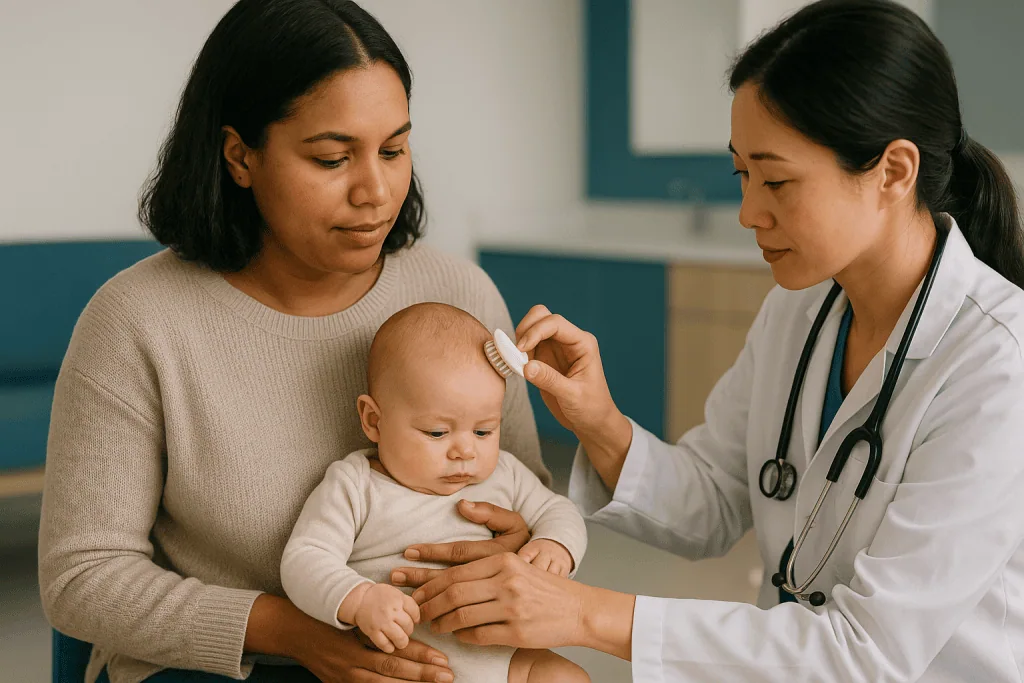
Watch the trending clips closely and you will often see a dry scalp, a rigid fine-toothed comb, and flakes coming away with skin attached. That is the mistake. Dry scale is bonded to the scalp; forcing it off creates micro-abrasions, exactly the openings that bacteria such as Staphylococcus aureus, which lives harmlessly on many people’s skin, use to cause infection. Pediatric guidance from the NHS and Mayo Clinic is consistent: loosen with oil and shampoo, then brush gently, and never pick.
A practical way to think about it is nail polish, not paint. You would not scrape polish off with a blade; you would dissolve it first and let it come away easily. Cradle cap responds the same way. After oil and a warm wash, a soft-bristle baby brush passed slowly over the scalp lifts flakes that are ready to go and leaves the rest for another day. Flakes that resist are not ready.
The special “cradle cap combs” sold online are not harmful if they are soft, but there is no trial evidence that they outperform a soft toothbrush or a washcloth. What matters is the sequence, not the gadget.
One more reassurance for the squeamish: if brushing pulls a few hairs, that is hair that was already loosely anchored in a flake. Cradle cap does not cause lasting hair loss, and hair returns as the scalp clears. If you see bleeding, oozing, or the baby is clearly bothered by the brushing, stop and let the skin recover before trying again.
Can breast milk help with cradle cap?
This is one of the most-searched questions about cradle cap, and the straightforward answer is that there is no clinical trial showing breast milk treats it. Nor is there evidence that it harms.
The idea is appealing for good reasons. Breast milk contains antibodies, antimicrobial proteins such as lactoferrin, and fats, and it has been studied for a few skin-adjacent uses. Small trials have compared expressed breast milk to lanolin for sore nipples and to other treatments for infant diaper rash, with mixed results and small numbers. None of that translates automatically to a hormone-driven, yeast-associated scaling condition on the scalp.
Mechanistically, a wash with breast milk might modestly soften scale the way any warm liquid does, and some of its fats could act as a weak emollient. Those effects are not unique. Plain water and baby oil do the same job more predictably, and, importantly, milk left drying on an oily scalp is a food source for the yeast and bacteria already living there, so if you do try it, rinse it off within a short time rather than leaving it to sit.
The evidence grade here is expert opinion informed by biology, with no randomized data either way. What this means in practice: breast milk is not a treatment a clinician would recommend for cradle cap, it is unlikely to cause problems if rinsed away, and its use should never replace the routine that does have professional backing, or delay a visit for scaling that is spreading, weeping or inflamed.
Parents who want to “do something” can channel that impulse into the oil-wash-brush cycle, which has the virtue of being safe, cheap in effort, and endorsed by every major pediatric source.
Eczema in babies: how do you tell it apart from cradle cap?
Cradle cap and eczema in babies get confused constantly, partly because both can appear in the first months and both can involve the face and scalp. The differences are clear once you know where to look.
Atopic eczema, often shortened to eczema or atopic dermatitis, is a chronic inflammatory skin condition in which the barrier that keeps water in and irritants out is weakened. It affects about 1 in 5 children in the US and UK, and most cases begin before the first birthday.
Itch is the giveaway. A baby with eczema rubs their cheeks against your shoulder, scratches with mittened hands, drags their face along the crib sheet and sleeps badly. Cradle cap babies do none of that. Texture is the second clue. Eczema is dry, rough and red (or grayish-purple on darker skin), sometimes with tiny weeping spots when scratched; cradle cap is greasy and thick.
Location matters too. In infants under a year, eczema favors the cheeks, forehead, chin and the outer surfaces of arms and legs, and it tends to skip the diaper area because that skin stays moist. Cradle cap sticks to the oily zones: scalp, eyebrows, behind the ears, the folds beside the nose.
Timing helps as well. Cradle cap peaks around three months and then fades. Eczema flares, calms and flares again, often for years, and frequently runs in families alongside asthma and hay fever.
The two can coexist, which is where confusion peaks: a baby can have greasy scale on the scalp and dry itchy patches on the cheeks at the same time. When you cannot tell, a pediatrician usually can in a single look, and the distinction matters because the day-to-day management is different.
What causes eczema in babies, and what doesn't?
Eczema is best understood as a leaky roof plus an overreactive alarm system. The roof is the skin barrier, and its weakness is largely inherited. The best-studied example is the gene for filaggrin, a protein that helps skin cells lock together and hold water; children carrying certain filaggrin variants have roughly three times the odds of developing eczema. Water escapes, skin dries and cracks, and irritants and microbes get in.
The alarm system is the immune response. In eczema-prone skin, immune signals that normally fight parasites are switched on inappropriately, driving inflammation and the itch that makes scratching almost irresistible. Scratching damages the barrier further, which invites more inflammation. Breaking that cycle is the whole point of treatment.
Triggers are individual. Heat, sweat, dry indoor air, wool, fragranced products, saliva around the mouth, and viral illnesses are all common flare triggers. Food is a more complicated story than social media suggests. Genuine food allergy is more common in babies with severe eczema, but in most infants food is not the cause of the eczema itself, and removing foods from a breastfeeding parent’s diet or switching formula without medical advice has not been shown to help in trials and can carry nutritional risk.
What the evidence has overturned is the old advice to delay allergenic foods. The LEAP trial, a randomized study of 640 high-risk infants published in 2015, found that introducing peanut early and regularly cut later peanut allergy by about 80% compared with avoidance. The National Institutes of Health guidelines that followed in 2017 recommend that infants with severe eczema be evaluated by a clinician about introducing peanut-containing foods around 4 to 6 months. The timing and any prior allergy testing are decisions for your child’s doctor.
Managing baby eczema day to day: moisturizer first
If eczema is a leaky roof, moisturizer is the tarp, and it is the one intervention every guideline puts first. For babies with established eczema, generous, frequent use of a bland, fragrance-free emollient (a cream or ointment that traps water in the skin) is supported by randomized trials showing fewer flares and less need for medicated creams. Ointments hold water better than lotions; the tube that gets used is better than the one that sits.
Bathing is a trigger for some parents’ anxiety, but short, lukewarm baths with a gentle cleanser are fine and help remove irritants and crusts. The trick is the three-minute rule most dermatologists teach: pat dry and apply moisturizer while the skin is still damp.
When moisturizer is not enough, clinicians prescribe anti-inflammatory creams, most commonly topical corticosteroids in the lowest strength that works, and sometimes non-steroid options for delicate areas. Here the viral landscape has done real damage. Videos about “topical steroid withdrawal” have frightened many parents away from treatments with decades of safety data when used as prescribed. The evidence: short, intermittent courses of mild steroid creams in infants, applied where and for as long as a clinician directs, have not been shown to thin skin or affect growth in trials. Problems are associated with potent products used continuously over large areas for long periods, which is not how they are prescribed for babies. If a cream worries you, ask the prescriber rather than stopping it; untreated eczema has its own costs, including infection and lost sleep for the whole household.
Small everyday moves help too: soft cotton clothing, cool bedrooms, keeping nails short, and wiping milk and drool from the chin with water rather than wipes.
Diaper rash: what is really happening under the diaper?
Diaper rash, the dermatology term is irritant diaper dermatitis, is not one condition but a predictable chain of events. A diaper holds moisture against skin. Wet skin swells and becomes fragile. Friction from movement rubs it. Urine raises the skin’s pH, which activates digestive enzymes in stool that begin, quite literally, to digest the skin’s surface. The result is pink-to-red, sometimes shiny or slightly raised skin on the buttocks, lower belly and inner thighs, classically sparing the deep creases where the diaper does not touch.
It peaks between 9 and 12 months, when babies sit for long stretches and eat solid foods that change stool chemistry, and it is more common during diarrhea, teething drool days, and courses of antibiotics.
Two look-alikes matter. The first is yeast (Candida) diaper rash: bright red, often with a raised edge, tiny “satellite” spots beyond the main patch, and crucially it does involve the skin folds. It often follows a rash that has lingered more than three days, or antibiotics. The second is eczema or seborrheic dermatitis in the diaper area, which usually appears alongside the same rash elsewhere on the body.
Home care rests on principles that every pediatric source shares. Change diapers promptly, and more often than feels necessary during a rash. Clean with water or fragrance- and alcohol-free wipes, and pat rather than rub. Give the skin bare-bottom air time on a towel. Apply a thick barrier of zinc oxide or petroleum jelly at every change; more is fine, and you do not need to scrub it all off each time. Skip talc powders, which can be inhaled. Most uncomplicated rashes fade within two to three days of this routine.
Over-the-counter antifungal creams exist for yeast rashes, but confirming the pattern and choosing a product is a job for a clinician, especially in babies under a few months old.
Cradle cap vs eczema vs diaper rash: the side-by-side table
When you are standing over the changing table at midnight, a quick comparison is worth a thousand words. The table below distills what the major pediatric sources describe, and the same three columns of questions, where, how it feels, and how it behaves over time, will sort most baby rashes you will meet.
| Feature | Cradle cap | Eczema in babies | Diaper rash |
|---|---|---|---|
| Typical age | 2 weeks to 3 months; fades by 6–12 months | Usually starts before age 1; comes and goes for years | Any age in diapers; peaks 9–12 months |
| Where | Scalp, eyebrows, behind ears, beside nose | Cheeks, forehead, outer arms and legs; spares the diaper area | Buttocks, thighs, lower belly; irritant type spares creases, yeast type involves them |
| Texture | Greasy, thick, yellow-white scale | Dry, rough, red or gray-purple patches; may weep if scratched | Shiny pink-red skin; yeast type has raised edge and satellite spots |
| Itch | Little or none | Intense; disturbs sleep | Sore rather than itchy; pain with wiping |
| Main driver | Hormone-boosted oil plus normal skin yeast | Inherited weak barrier plus immune overreaction | Moisture, friction, urine and stool enzymes |
| First-line home care | Oil to soften, gentle shampoo, soft brush | Frequent bland emollient; avoid triggers | Frequent changes, air time, thick zinc oxide or petroleum barrier |
| Usually needs a prescription? | Rarely | Often, for flares | Sometimes, for yeast or persistent rash |
Two caveats keep the table honest. Conditions overlap, so a baby can carry two at once, and skin tone changes how redness reads: on deeper skin, inflammation often looks purple, brown or gray rather than pink, and dryness or scale may be the more visible sign. If the table leaves you uncertain, that itself is a reasonable reason to have a clinician look.
What changed recently
Baby skin care moves slowly, but several genuinely important shifts have landed in the last decade, and they explain why some older advice online now conflicts with what pediatricians say.
2015 to 2017: early peanut introduction. The LEAP trial, published in 2015, upended decades of avoidance advice by showing that early, regular peanut exposure in high-risk infants markedly reduced later allergy. The National Institutes of Health issued clinician guidelines in 2017 recommending evaluation and early introduction for babies with severe eczema. If a grandparent tells you to wait until age three, the guidance has changed.
2020: the moisturizer-prevention hope fades. Two large randomized trials, BEEP in the UK (1,394 newborns) and PreventADALL in Norway and Sweden (2,397 newborns), tested whether daily emollient from birth could prevent eczema in babies at risk. Neither found a benefit; in BEEP, 23% of the emollient group and 25% of controls had eczema at age two, and the emollient group had slightly more skin infections. Moisturizer remains central for treating eczema, but not as a preventive ritual for healthy newborn skin.
2022: specialist options for the youngest patients. US regulators extended approval of the first injectable biologic medicine (a treatment that blocks specific immune signals) to children from six months with moderate-to-severe eczema not controlled by creams. This is specialist territory and not relevant to typical infant eczema, but it means severe cases have evidence-based routes that did not exist a few years ago.
Ongoing: caution about olive oil. UK guidance has moved away from recommending olive oil on baby skin after small studies suggested it may weaken the skin barrier; plain mineral baby oil or other bland oils are now preferred for softening cradle cap.
What the evidence actually says, graded honestly
Not every recommendation in this article stands on the same footing, and readers deserve to know which is which. Here is the grading, using three tiers: randomized trials (the strongest), observational data (useful but prone to confounding), and expert opinion (informed consensus in the absence of trials).
Cradle cap: mostly expert opinion. There are no large randomized trials of oil-and-brush routines, partly because the condition resolves on its own and is hard to justify studying. The link to sebum and Malassezia rests on observational and laboratory data. Small trials of medicated antifungal shampoos in infants show reduced scale, which is why clinicians reach for them in stubborn cases. The advice to avoid picking is common sense backed by case reports of infection.
Eczema treatment: randomized trials. Daily emollients reduce flare frequency and steroid use in children with established eczema, shown in multiple trials. Topical corticosteroids and non-steroid anti-inflammatory creams have decades of trial and safety data in children. Early peanut introduction for high-risk infants is supported by a well-designed randomized trial.
Eczema prevention: randomized trials, negative. The 2020 BEEP and PreventADALL trials are high-quality evidence that routine newborn moisturizing does not prevent eczema.
Diaper rash: mixed. Frequent changes, gentle cleansing and barrier products are supported by physiology and observational studies rather than large trials; no one has randomized babies to sit in wet diapers. Comparisons between barrier ingredients show small or no differences. Treatment of yeast rashes with antifungal creams is supported by small trials.
Breast milk, coconut oil, essential oils, dietary elimination: expert opinion at best, with either no trials or small, inconclusive ones. That does not make every idea worthless, but it does mean none should displace the measures above.
Common myths about cradle cap, eczema in babies and diaper rash
Viral confidence and medical evidence rarely travel together. These are the claims that circulate most, corrected with what the sources actually support.
“Cradle cap means I’m not washing my baby enough.” False. Hygiene has no role in causing it; hormone-driven oil and a normal skin yeast do. Washing more often helps only because it removes oil and scale, not because anything was dirty.
“Cradle cap is a sign of allergy or eczema.” Not supported. It is a separate condition, does not itch, and observational studies have not shown it predicts eczema or food allergy.
“You should pick or comb it off dry so the skin can breathe.” The opposite of pediatric guidance. Dry scraping opens the skin to infection. Soften, wash, then brush softly.
“Breast milk treats cradle cap.” No trial evidence. Probably harmless if rinsed off, but not a treatment.
“Moisturizing a newborn every day prevents eczema.” Tested in two large trials in 2020 and found not to work. Moisturizer treats eczema; it does not prevent it in babies without it.
“Baby eczema is caused by dairy, so cut it out.” Rarely true. Food allergy is more common in babies with severe eczema, but eliminating foods without evaluation has not helped in trials and can compromise nutrition. Any dietary change belongs with your child’s clinician.
“Steroid creams thin a baby’s skin.” Trials of mild creams used briefly as prescribed in infants have not shown this. Risk rises with potency, duration and unsupervised use, which is why prescribers set the terms.
“Cornstarch or talc powder keeps diaper rash away.” Talc can be inhaled and is discouraged; powders in general are not recommended by major pediatric sources. A thick barrier ointment does the job safely.
“Cloth diapers prevent rash.” Studies comparing modern disposables and cloth show no consistent advantage for either; change frequency matters far more than material.
When to see a doctor
Most of what this article covers will never need a clinic visit. Cradle cap resolves, mild eczema settles with moisturizer, and a two-day diaper rash fades with barrier cream and air. A short list of signs, drawn from NHS, Mayo Clinic and Cleveland Clinic guidance, should move you from home care to a same-day call or, in a few cases, urgent care.
Call your pediatrician promptly if:
- Any rash is spreading quickly, weeping, crusting yellow, oozing pus, or has increasing redness, warmth or swelling, which can signal bacterial infection.
- Cradle cap persists well beyond the first year, spreads to the body, or the underlying skin is raw, bleeding or bothering the baby.
- A diaper rash has not improved after three days of diligent home care, involves the creases with satellite spots, blisters, or open sores.
- Eczema is disrupting sleep or feeding, covers large areas, or is not controlled by regular emollient, since prescription treatment may be appropriate.
- Your baby has eczema and you are planning to introduce peanut or egg; timing and any testing should be discussed first.
- Any rash appears in a baby under six weeks old, when infections behave differently and thresholds for review are lower.
Seek urgent or emergency care if:
- A rash comes with fever, unusual drowsiness, poor feeding, or a baby who is hard to console.
- You see clusters of small fluid-filled blisters or punched-out sores on eczema, especially near the face, which can indicate a viral (herpes) infection needing urgent treatment.
- A rash does not fade when pressed with a glass, or is accompanied by breathing difficulty or swelling of the lips or face.
Every treatment decision in this piece, from which cream to which shampoo to whether a food is safe to introduce, belongs to the clinician who knows your child. This article can help you ask better questions; it cannot examine a baby.
Frequently asked questions
How do I get rid of my baby's cradle cap?
Soften the scales with a little plain baby oil for 15 minutes to an hour, wash with a mild fragrance-free baby shampoo, then brush gently with a soft baby brush, repeating over several days. Most scale clears within a couple of weeks, though it can return until your baby’s oil glands settle around 6 to 12 months. Persistent or widespread scaling may warrant a prescription shampoo, chosen by your pediatrician.
What is the cradle cap caused by?
Cradle cap is most likely caused by maternal hormones that briefly switch on a newborn’s oil-producing glands, combined with Malassezia, a yeast that lives on everyone’s skin and feeds on that oil, in a baby whose skin is still maturing. It is not caused by poor washing, allergy, formula, breastfeeding or detergent, and it is not contagious. The exact mechanism rests on observational and laboratory evidence rather than trials.
Should you brush out the cradle cap?
Yes, but only after softening the scale with oil and a warm wash, and only with a soft baby brush or clean soft toothbrush. Brushing dry scale off with a hard comb, as many viral videos show, can tear the skin and open the door to infection. Flakes that do not lift easily are not ready; leave them for the next wash. Never pick with fingernails.
Can breast milk help with cradle cap?
No clinical trial has shown breast milk treats cradle cap. It contains antibodies and fats, and a warm liquid may soften scale slightly, but plain water and baby oil do that more reliably. If you try it, rinse it off promptly, because milk drying on an oily scalp can feed the yeast and bacteria already there. It should not replace the oil, shampoo and soft-brush routine that pediatric sources recommend.
Is cradle cap the same as eczema in babies?
No. Cradle cap is seborrheic dermatitis: greasy yellow scale in oily areas like the scalp and eyebrows, with little or no itch, that fades by the first birthday. Eczema is a chronic inherited barrier problem that produces dry, rough, intensely itchy patches, most often on the cheeks and outer limbs, and tends to flare on and off for years. A baby can have both at once, and management differs.
Does cradle cap itch or hurt my baby?
Usually not. Cradle cap is famous for looking far worse than it feels, and babies with it typically sleep and feed normally without rubbing their heads. If your baby seems bothered by the scalp, is scratching, or the skin underneath is raw, red and weeping, that points toward eczema, infection or another condition rather than simple cradle cap, and it is worth having a pediatrician take a look.
Can cradle cap spread to the face or body?
Infantile seborrheic dermatitis can extend beyond the scalp to the eyebrows, behind the ears, the sides of the nose, the neck folds, armpits and sometimes the diaper area, usually as pinkish patches with lighter greasy scale. That is still within the normal range. Widespread scaling over the trunk, rapid spread, oozing or fever is not typical and should be assessed by a clinician.
How long does diaper rash take to clear up?
An ordinary irritant diaper rash usually improves noticeably within two to three days once diapers are changed promptly, the skin is cleaned gently with water or fragrance-free wipes, allowed regular air time, and protected with a thick layer of zinc oxide or petroleum jelly at every change. A rash that persists past three days, involves the skin creases, shows satellite spots or blisters, or comes with fever needs a pediatrician’s review.
Is diaper rash or baby eczema a sign of a food allergy?
Rarely. Most diaper rash is caused by moisture, friction and stool enzymes, and most infant eczema is an inherited barrier problem rather than a food reaction. Genuine food allergy is more common in babies with severe eczema, which is why guidelines advise those babies be evaluated before allergenic foods are introduced. Removing foods from a baby’s or breastfeeding parent’s diet without medical advice has not helped in trials.
Does daily moisturizer prevent eczema in babies?
Current evidence says no. Two large randomized trials published in 2020, BEEP in the UK and PreventADALL in Scandinavia, found that moisturizing healthy newborns daily from birth did not reduce eczema by age two, and one noted slightly more skin infections. Emollients remain the first-line treatment for babies who already have eczema, where trials show they reduce flares, but they are not a preventive ritual for babies with normal skin.
References
- NHS – Cradle cap
- NHS – Atopic eczema
- PubMed – Daily emollient during infancy for prevention of eczema: the BEEP randomised controlled trial (Lancet 2020)
This article is for general information only and is not a substitute for professional medical advice. Please consult a qualified doctor about your individual situation.

More from the Blog

Supporting a Child Emotionally Through Pediatric Plastic Surgery: Words and Routines
Supporting a child emotionally before surgery works best when honest, age-matched words are paired with steady routines. Tell younger children a day or two…

Tummy Time and Flat Head: How Much, How Early and When a Helmet Is Discussed
Tummy time can begin in the first days at home, in short supervised sessions of a few minutes, building toward roughly 30 minutes spread…

How Do Pediatric Ophthalmologists Choose Between Laser and Injection Treatment for ROP?
Pediatric ophthalmologists choose between laser and anti-VEGF injection for retinopathy of prematurity based mainly on where the disease sits in the retina, how aggressive…

How Pediatric Plastic Surgery Is Timed: Growth, Function and Why Some Repairs Are Staged
There is no single right age for pediatric plastic surgery. Surgeons time each operation around growth and function: cleft lip is commonly repaired at…
Supporting a Child Through Pediatric Cancer Treatment: Infection Care, Nutrition and Routine
Supporting a child through cancer treatment rests on three everyday habits: protecting against infection when blood counts are low, keeping food and fluids going…

Preparing for a Developmental Delay Visit: Reports, School Notes and Observations to Bring
Preparing for developmental evaluation mostly means gathering evidence: your child's medical and birth history, any prior screening results, hearing and vision reports, school or…