

Cryotherapy for Children: Comfort, Preparation and Which Lesions Are Treated This Way

Key Takeaways
- Clinic cryotherapy uses liquid nitrogen at roughly minus 196 degrees Celsius, far colder than any pharmacy freezing kit, which is why the two are not interchangeable.
- Mayo Clinic states that because freezing is painful it usually is not used for the warts of young children, so being asked to wait is standard practice rather than a brush-off.
- The black dots in a so-called seed wart are clotted capillaries, not seeds or roots, and cutting into them at home spreads virus and scars the skin.
- After a freeze, a blister forms within a day or two and the dead tissue sloughs within about a week, and several sessions are commonly needed before a wart clears.
- The NHS and Mayo Clinic both describe most warts clearing on their own within months to a year or two, which makes watchful waiting a legitimate option for a painless wart.
- Pigment lightening after freezing is more visible on facial skin and in darker skin tones, one reason clinicians often choose other approaches for warts on a child's face.
Cryotherapy for children is the controlled freezing of a skin lesion, usually with liquid nitrogen, to destroy wart tissue and trigger an immune response. It is used mainly for common warts and verrucas in older children who can tolerate a brief, sharp cold sting; younger children are often advised to wait or try gentler options first. Repeat sessions are common, and the treating team decides suitability.
A nine-year-old sits on the edge of the exam couch with one sock off, studying the small, rough bump on her heel as if it has personally offended her. It has, in a way: it hurts when she lands from a cartwheel, her swimming teacher asked about it, and the pharmacy paint she has been using for weeks has not shifted it. Her mother has one question written on her phone, and it is not a medical one. It is, will this hurt?
That is the honest starting point for any conversation about cryotherapy for children. Freezing is one of the oldest and most widely used clinic treatments for warts, and it works on a simple physical principle. It is also, by most accounts, uncomfortable for a few seconds and tender for a few days, which is why doctors think carefully before offering it to younger patients.
This explainer walks through what freezing actually does, which lesions it suits, how to prepare a child, what healing looks like and where the evidence is thinner than the confident marketing suggests.
What is cryotherapy for children, and how does freezing actually work?
Cryotherapy means deliberately freezing a small patch of skin so that the abnormal tissue dies and the body clears it away. In a pediatric skin clinic it almost always involves liquid nitrogen, a liquid so cold, roughly minus 196 degrees Celsius or minus 321 degrees Fahrenheit, that it boils and turns to vapor the moment it touches room-temperature air. The clinician applies it either with a cotton-tipped applicator dipped in a flask or with a handheld spray device that produces a fine, controlled jet.
Three things happen inside the frozen tissue. Ice crystals form within the cells and rupture their membranes. Tiny blood vessels constrict and then clot, cutting off the lesion’s blood supply. Finally, the thaw triggers inflammation, and Mayo Clinic notes that this inflammatory burst may help the immune system recognize and attack the wart virus itself. The visible result, as Mayo describes it, is a blister that forms under and around the wart, after which the dead tissue sloughs off within a week or so.
The skill lies in the margin. The clinician watches a white halo, often called the ice ball, spread outward from the applicator until it extends a millimeter or two beyond the edge of the lesion, then stops. A longer freeze reaches deeper but raises the risk of blistering, pigment change and scarring. Some clinicians allow the skin to thaw and then freeze a second time, because a freeze-thaw-freeze cycle is thought to be more destructive to the target tissue.
One distinction matters for parents. Over-the-counter freezing kits use a propellant mixture that is far less cold than liquid nitrogen, so they are not the same treatment, and most product leaflets restrict their use in young children. Clinic cryotherapy is a different tool in experienced hands.
Which lesions are treated with cryotherapy for warts in children, and which are not?
Freezing is a destructive treatment, so it is reserved for lesions where the diagnosis is clear and destroying the tissue is the goal. In children that list is short.

- Common warts (verruca vulgaris) on the hands, fingers, knees and elbows are the classic indication. They are raised, rough and well defined, which makes the ice ball easy to control.
- Plantar warts (verrucas) on the soles are treated by cryotherapy too, although the thick skin of the heel makes them harder to freeze effectively and the clinician usually pares the overlying callus first.
- Filiform warts, the thread-like ones that favor the lips, eyelids and nostrils, are sometimes frozen, but many clinicians prefer other methods near the eyes.
- Molluscum contagiosum, a poxvirus infection that produces pearly, dimpled bumps, can be frozen, yet Mayo Clinic notes it usually clears on its own within 6 to 12 months and that treatment is often not needed in children.
Lesions that are not frozen in children include moles and any pigmented spot whose nature is uncertain, because freezing destroys the tissue a pathologist would need to examine. Birthmarks, cysts and lumps under the skin are not cryotherapy targets. Skin tags are occasionally frozen but are uncommon in childhood.
Location matters as much as diagnosis. Facial skin and the skin folds around the nail are approached cautiously, because cold injury there can leave lasting lightening or darkening of the skin, or a ridged nail. This is why a wart that seems identical to one on a friend’s hand may be managed differently if it sits on a child’s cheek. The treating team weighs the lesion, the site and the child before deciding whether freezing is the right tool at all.
What is verruca vulgaris, and why do children get warts so often?
Verruca vulgaris is simply the Latin name for the common wart. It is a small, rough, skin-colored growth caused by human papillomavirus, usually shortened to HPV, a large family of viruses that infect the outer layer of skin. The strains behind common warts are different from those linked to cervical cancer, and the NHS describes warts as non-cancerous growths that are very common and usually harmless.
The virus enters through tiny breaks in the skin: a scraped knuckle, a bitten nail, the softened skin of a foot that has spent an hour in a swimming pool. Once inside, it hijacks skin cells and makes them multiply faster than they shed, building the thickened, cauliflower-textured bump that parents recognize. The process is slow. Weeks or months can pass between exposure and a visible wart, which is why it is rarely possible to say where a child picked one up.
Children get more warts than adults for an unglamorous reason: their immune systems have not met these viruses before. Mayo Clinic notes that common warts are most frequent in children and young adults, and that the body gradually builds a defense that clears them. The NHS puts the natural history plainly: most warts and verrucas go away on their own, although it can take months or years.
That fact shapes every treatment decision. A wart is a nuisance that will almost certainly resolve, not a disease that must be eradicated. Freezing speeds things up at the cost of some pain and a small risk of marking the skin. For a child who is embarrassed, in pain or spreading warts across both hands, that trade can be worth it. For a child with a single painless bump on a knee, patience is a legitimate medical choice, and many doctors will say so.
Plantar warts in children, seed warts and flat warts: what the pattern tells you
Not all warts look alike, and the pattern changes how, or whether, cryotherapy is used.
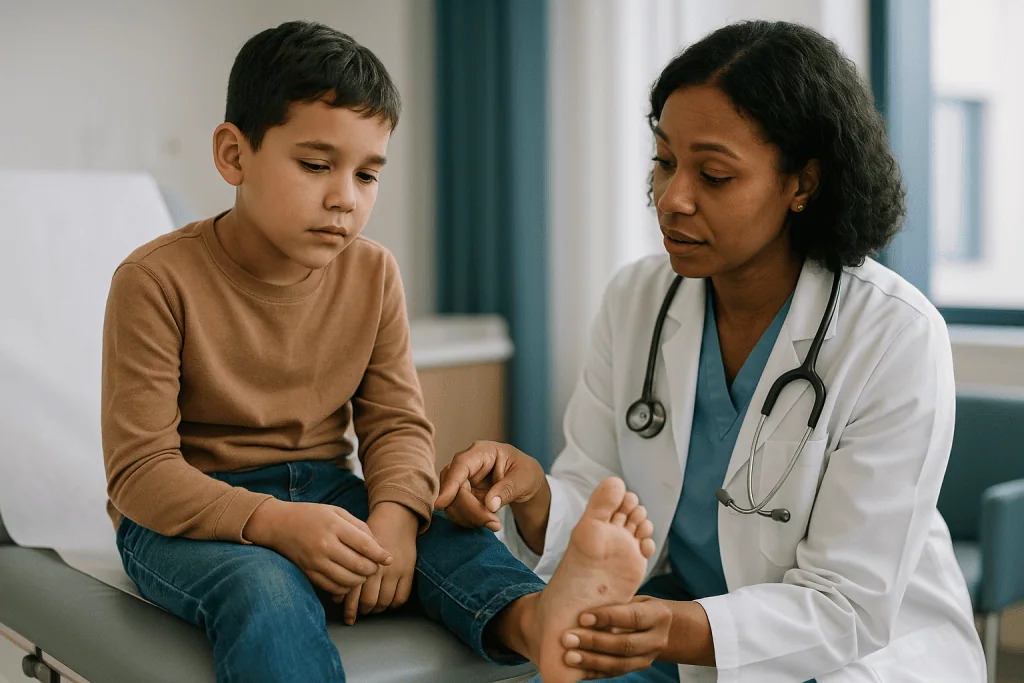
Plantar warts grow on the sole, where the weight of the body pushes them inward instead of letting them rise. Mayo Clinic describes them as small, rough, grainy growths that often sit under a layer of hardened skin and may feel like a pebble lodged in the shoe. Because the heel’s skin is so thick, a clinician usually shaves away the callus with a blade before freezing, a painless step that lets the cold reach the living wart tissue. Several plantar warts can merge into a cluster called a mosaic wart, which is notoriously stubborn and often managed with repeated home treatment rather than freezing alone.
Seed warts is the everyday name for common warts dotted with tiny black specks. Those specks are not seeds and not roots. Mayo Clinic explains they are small clotted blood vessels that have grown into the wart and thrombosed. Their presence actually helps diagnosis, because a callus or corn has no such dots. Removing the top of a wart does not pull out a root; the virus lives in the surrounding skin cells.
Flat warts are smaller, smoother and paler than common warts, and they tend to arrive in dozens on the face, backs of hands or shins. Cryotherapy is often avoided here, both because freezing dozens of spots is distressing for a child and because flat warts sit on cosmetically sensitive skin where pigment change would show.
Periungual warts cluster around the nail, often in children who bite their nails. Freezing close to the nail root risks a permanently ridged nail, so clinicians tread carefully.
Reading the pattern first is what separates thoughtful treatment from reflexive freezing.
Who is cryotherapy for children usually offered to, and who is asked to wait?
Most dermatology and pediatric services apply a rough mental checklist before freezing a child’s wart. The candidates who tend to be offered cryotherapy share a few features.
The child is old enough to understand what is coming and to hold still for several seconds; in practice that often means school age or older, though temperament matters more than birthdays. The wart is causing a real problem: pain on walking, bleeding when knocked, spreading to new sites, or genuine embarrassment that is affecting school or sport. A reasonable course of a home salicylic acid preparation has already been tried without result. Critically, the child, not only the parent, wants it treated.
Other children are usually asked to wait or steered toward alternatives. Mayo Clinic is candid that because freezing can be painful, it usually is not used to treat the warts of young children. Toddlers and preschoolers rarely cooperate with a sustained freeze, and a traumatic first clinic visit casts a long shadow. Lesions on the face, especially in children with darker skin tones, carry a higher chance of visible pigment change, so teams often prefer gentler approaches there.
Some medical situations change the picture. Children with weakened immunity, whether from a condition or from medicines, may develop numerous or persistent warts and are generally seen by a specialist before any destructive treatment. Rare disorders that react badly to cold, such as cold-induced hives, are a reason to avoid freezing altogether. Any lesion whose diagnosis is unclear should be assessed, not frozen.
None of these are rigid rules. They are the factors a clinician weighs, and the final decision rests with the treating team after examining the child.
Does freezing warts hurt kids? An honest look at comfort
Yes, it hurts. Any explainer that says otherwise is not being straight with you. During the freeze most children describe a sharp, burning cold, a bit like pressing an ice cube hard against the skin and then some. Mayo Clinic lists pain, blistering and discolored skin as the expected side effects of cryotherapy, and the stinging commonly continues for a few minutes after the applicator lifts and the tissue thaws. Over the following day the area can throb, particularly on a weight-bearing heel.
What a good team does is shrink that discomfort rather than deny it. A topical anesthetic cream, a numbing preparation applied to the skin some time before the procedure, can dull the sensation; whether it is appropriate, and how it is used, is the prescribing clinician’s call. Shorter freeze cycles reduce pain at the price of needing more sessions, and many pediatric clinicians deliberately choose that trade for a child’s first visit.
Distraction genuinely helps. A tablet with a favorite show, blowing bubbles, counting backward from twenty, squeezing a parent’s hand with a job to do: these are not gimmicks but tools that child life specialists use daily. Giving the child a role, such as choosing which wart goes first or calling a pause, restores a sense of control that lowers distress.
Preparation is a comfort measure in its own right. Children cope better with pain they expected than with pain that ambushed them. Telling a child it will not hurt, and then watching it hurt, damages trust for every future appointment.
After the freeze, cool compresses and gentle padding around a plantar wart ease the ache. If the team suggests pain relief, follow their instructions rather than improvising, and never apply anything to the blister without asking.
How to prepare a child for cryotherapy: the week before and the morning of
Preparation for cryotherapy is mostly about skin and about nerves, and both reward a little planning.
For a plantar wart, teams often ask that the area be soaked in warm water and gently filed with an emery board for a few evenings beforehand so the overlying callus is thinner on the day. Use a file reserved for the wart alone, never shared, and stop if the skin bleeds. For warts on the hands, keeping nails short reduces picking and spreading. If the child has been using a salicylic acid paint, ask whether to continue or pause it; some clinicians prefer the skin to be un-macerated when they freeze.
There is no fasting and no special diet. A normal breakfast and a full water bottle make for a steadier child. Dress for access: shorts for a knee, slip-on shoes and clean socks for a foot. Bring a spare sock, since a dressing may be applied.
Talk to the child in age-appropriate, truthful language. Something like, the doctor is going to make the wart very cold so it falls off; it stings for about as long as it takes to sing a verse of a song, then it stops. Let them practice holding still while you count. Choose a comfort object and a distraction and pack both.
Timing matters too. Avoid booking the session the day before a swimming gala, a long hike or a school trip, because a tender blister on the heel is miserable on a coach. Tell the team in advance if your child is particularly anxious about medical settings or has a history of fainting, so they can plan positioning and pace.
Finally, write down your questions. The appointment itself is short, and the quiet minutes before the freeze are the best time to ask them.
What actually happens in the clinic room, step by step
The whole encounter usually takes less time than the walk from the car park, which surprises many families expecting a surgical set piece.
The clinician begins by looking at the lesion closely, sometimes with a handheld magnifier, confirming it is a wart and not a corn, callus or something that needs a different approach. For a verruca, the next step is paring: a sterile blade shaves away the dead, thickened surface. This looks alarming and feels like nothing, because the tissue removed has no nerve endings. The black dots that appear as the callus thins confirm the diagnosis.
Then comes the freeze. With the applicator method, a cotton swab is dipped into a flask of liquid nitrogen and pressed onto the wart. With a spray device, the nozzle hovers a short distance above the skin and delivers a fine jet. In either case the clinician watches the white ice ball form and spread just past the wart’s edge, holds for a matter of seconds, then stops. The skin thaws over the next half-minute, often turning red and swelling slightly. Some clinicians repeat the cycle once.
A dressing is optional. Hands are often left uncovered; heels may get a small pad to cushion walking. The team gives aftercare instructions, explains what the blister will look like, and books a review, since Mayo Clinic notes that repeat treatments are often needed before a wart clears.
For a child, the most valuable thing in the room is predictability. Clinicians who narrate each step, count aloud during the freeze and stop exactly when they said they would are doing more for comfort than any cream. Parents help most by staying calm, staying close and letting the clinician lead the conversation.
What the following days and weeks usually look like after freezing
Healing after cryotherapy follows a fairly predictable script, and knowing it in advance spares a lot of worry.
In the first hours the area is red, puffy and sore. Within a day or two a blister typically forms, sometimes clear and sometimes filled with dark blood, which looks dramatic but is expected because the wart’s small vessels have ruptured. Leave it alone. Popping a blister opens a door to infection and does not speed the result. If it bursts on its own, keep the area clean, pat it dry and cover it with a simple dressing.
Over the next several days the blister dries into a dark scab. Mayo Clinic describes the dead tissue sloughing off within a week or so, taking some or all of the wart with it. Underneath, the new skin may be pink and slightly shiny for a few weeks before blending in.
School and ordinary play can continue. A plantar blister is best cushioned with a padded dressing, and some teams suggest covering a treated verruca in communal showers and pools to limit spread while the skin is open. Pools do not need to be avoided altogether unless the care team says so.
Repeat visits are the norm rather than the exception. Mayo Clinic notes that several treatments are often required, and clinics usually space them a few weeks apart so the skin can recover fully between freezes. If, after an agreed number of sessions, the wart shows no change, that is a signal to revisit the plan rather than to keep freezing indefinitely. Combining cryotherapy with a home salicylic acid preparation between visits is a common strategy, but only when the treating team has recommended it.
Cryotherapy, salicylic acid or watchful waiting: how the options compare
Parents often arrive believing freezing is the serious option and everything else is a half-measure. The evidence does not support that hierarchy. Here is how the mainstream choices for a child’s wart line up.
| Option | Where it happens | What it involves | Typical timeline (source) | Main drawbacks |
|---|---|---|---|---|
| Watchful waiting | Home | Keep the wart covered if it is spreading; avoid picking; file gently if thick | Most warts clear on their own, though it can take months or years (NHS; Mayo Clinic) | Slow; wart may spread or hurt meanwhile |
| Salicylic acid preparation | Home, daily | Soak, file, apply the pharmacy paint or plaster to the wart only | Up to about three months of regular use (NHS) | Needs persistence; can irritate surrounding skin; not for the face |
| Cryotherapy | Clinic | Liquid nitrogen freeze, often repeated | Blister and slough within a week or so; several sessions often needed (Mayo Clinic) | Painful; blistering; possible pigment change or scarring |
| Other clinic treatments | Specialist clinic | Options include scraping under local anesthetic, laser, or topical immune-stimulating agents | Variable; discussed case by case | Usually reserved for stubborn or numerous warts |
Two honest points about the evidence. First, trials comparing freezing with salicylic acid for common warts have generally found them broadly similar in effectiveness, which is why both the NHS and Mayo Clinic present the pharmacy preparation as a reasonable first step for many people. Second, no method prevents a wart from returning, because the virus can persist in nearby skin cells that looked normal at the time.
The right choice therefore depends less on which treatment is strongest and more on which the child can realistically complete. A ten-year-old who will not tolerate a daily paint ritual may do better with three brief clinic visits. A shy six-year-old with one painless wart may be best served by doing nothing at all.
What are the risks and side effects of cryotherapy in children?
Cryotherapy is a minor procedure, but minor is not the same as risk-free, and families deserve the full list in neutral terms.
The common effects are the ones already described: pain during and after the freeze, redness, swelling and a blister that may be blood-filled. Mayo Clinic groups pain, blistering and skin discoloration together as the expected side effects. Occasionally a blister becomes large enough to be uncomfortable; the care team can advise whether it should be drained under clean conditions rather than left to burst at school.
Pigment change is the effect most often underestimated. Cold damages the melanin-producing cells in the skin more readily than it damages other cells, so a treated patch can heal paler than its surroundings. On a knee this is trivial. On a cheek, or on skin that tans deeply or has a darker baseline tone, it can be noticeable for months and occasionally permanent. Darkening of the skin can also occur as inflammation settles.
Scarring is uncommon when the freeze is kept shallow and brief, which is one reason pediatric clinicians lean toward lighter treatments. Freezing near the nail root can leave a ridge or groove in the growing nail. On the sides of fingers, where nerves run close to the surface, an overly aggressive freeze can cause temporary numbness or tingling.
Infection is rare but possible if a burst blister is not kept clean. A curious phenomenon called a ring wart, where new wart tissue appears in a halo around the treated site, can follow blistering because the virus is spread into the blister margin.
Lastly, recurrence. Any wart treatment, freezing included, can be followed by the wart returning in the same spot. That is not a sign of a failed clinician; it is the biology of a virus that lives in skin cells that looked healthy.
What people often get wrong about cryotherapy for children
A surprising amount of wart folklore survives in school corridors and online forums. Clearing it up makes treatment decisions easier.
One freeze will finish it. Occasionally, yes, but Mayo Clinic is explicit that repeat treatments are often needed. Expecting a series of visits from the outset prevents disappointment and the temptation to abandon the plan after one session.
Home freezing kits are the same as clinic cryotherapy. They are not. Pharmacy kits use a propellant blend that reaches nowhere near the temperature of liquid nitrogen, and most carry age restrictions. They are a different, milder product with their own instructions.
The black dots are seeds or roots that must be dug out. They are clotted capillaries, according to Mayo Clinic. Warts have no roots. Cutting into a wart at home spreads virus, invites infection and leaves a scar where none was needed.
Warts come from dirt, frogs or poor hygiene. They come from a virus that most people meet in childhood. Clean children get warts.
Freezing sterilizes the virus, so the child is no longer contagious. Freezing destroys the visible wart. Virus can persist in nearby skin and in the fluid of the blister, which is why covering a treated verruca in communal wet areas still makes sense.
A wart left alone will never go. The NHS and Mayo Clinic both describe spontaneous clearance as the usual outcome over months to a year or two. Doing nothing is a medical option, not neglect.
Duct tape is a proven alternative. The evidence for occluding warts with tape is mixed and of low quality. Mayo Clinic mentions it as a home remedy some people try, not as a treatment with reliable support.
The thread running through all of these is the same: warts are a slow, benign viral nuisance, and treatment is a convenience for the child, not a race against danger.
Questions to ask your care team before agreeing to cryotherapy
Short appointments reward prepared parents. The following questions cover the ground that most families later wish they had asked, and they signal to the team that you want to share the decision rather than hand it over.
- Is this definitely a wart, and is there any reason you would want it examined differently before freezing?
- Given my child’s age, temperament and the position of the lesion, do you think cryotherapy is the right first step, or would you try a home preparation or simply wait?
- How will you manage the discomfort, and is a numbing cream appropriate for my child?
- How many sessions do you expect, how far apart, and at what point would you stop and reconsider?
- What exactly should the skin look like over the next week, and what would worry you?
- Should we keep using the pharmacy paint between visits, or pause it?
- Can my child swim, play sport and attend school as normal, and does the wart need covering?
- What is the chance of a pale or dark mark afterward, and does that change your advice for a lesion on the face or hand?
- If the wart returns, what would the plan be?
- Is there anything about my child’s health or medicines that makes freezing a poor choice?
Two further points are worth raising if they apply. If your child has a condition affecting immunity, ask whether a specialist should be involved before any destructive treatment. If your child has had a distressing medical experience before, say so plainly; teams can adjust pace, positioning and the number of warts treated in one sitting.
Write the answers down. The reassurance that felt solid in the room evaporates by bedtime when a blood blister appears, and your notes will be the thing that stops a needless late-night search.
When to call your doctor after cryotherapy: red-flag signs
Most children sail through cryotherapy with nothing more than a sore spot and an impressive blister to show their friends. A small number develop problems that need a clinician’s eye, and the signs are worth knowing before you need them.
Contact the care team promptly if you notice any of the following:
- Redness spreading outward from the treated area, increasing warmth, or red streaks tracking up the limb, which can indicate infection.
- Yellow or green discharge, an unpleasant smell from the wound, or a fever developing in the days after treatment.
- Pain that worsens after the first day or two instead of easing, or pain that keeps the child from walking or sleeping despite the measures the team suggested.
- Bleeding from the site that does not stop with ten minutes of firm pressure.
- Numbness or tingling in a finger or toe that persists beyond the day of treatment.
- A blister so large or tense that it is splitting the surrounding skin.
- Any treated lesion that grows back quickly, changes color, becomes irregular at the edges, or bleeds without being knocked, since a lesion that behaves unexpectedly should be re-examined.
Seek urgent care if a child with a known immune condition develops spreading redness or fever, or if any child appears unwell, drowsy or unusually pale alongside a wound problem.
Call as well if the course of treatment has reached the number of sessions the team agreed and the wart is unchanged. That is not a failure to report with embarrassment; it is useful information that prompts a change of plan. The treating team remains the right place for every decision about continuing, pausing or switching treatment, and no article, this one included, can replace a clinician looking at the skin in front of them.
Frequently asked questions
Can I use an over-the-counter wart remover while pregnant?
Check with your pharmacist, midwife or doctor before using any wart product in pregnancy. Most pharmacy wart treatments contain salicylic acid applied to a small area of skin, and the NHS advises asking a pharmacist for guidance if you are pregnant or breastfeeding. They will consider the product, the size of the area and your circumstances; this is a decision for your care team, not a label.
What are plantar warts, and are they different from other warts?
Plantar warts are common warts that grow on the sole of the foot. Body weight pushes them inward, so they sit flat under a layer of hard skin rather than rising like a wart on a hand. Mayo Clinic describes them as grainy growths that can feel like a pebble in the shoe. The same virus causes them, but their thick covering makes treatment slower and often requires paring before freezing.
What is verruca vulgaris in plain language?
Verruca vulgaris is the medical name for a common wart. It is a rough, raised, benign skin growth caused by human papillomavirus infecting the outer skin layer. The NHS notes warts are very common, usually harmless and typically clear on their own, although that can take months or years. The term verruca alone is often used in everyday speech for a wart on the foot.
What are seed warts on fingers?
Seed warts are ordinary common warts on the fingers that show tiny black specks on their surface. According to Mayo Clinic those specks are small clotted blood vessels, not seeds. They appear because the wart grows its own capillaries that then thrombose. Their presence helps distinguish a wart from a callus. They do not mean the wart is deeper or harder to treat than any other common wart.
How many cryotherapy sessions does a child usually need?
There is no fixed number. Mayo Clinic notes that repeat treatments are often needed, and clinics typically space sessions a few weeks apart so the skin can heal between freezes. Some warts clear after one or two visits; stubborn plantar warts may need more. Most teams agree an upper limit in advance and reconsider the plan if the wart has not changed by then.
Does freezing warts hurt kids more than adults?
The sensation is similar, but children tolerate it less well because they have less context for pain and less ability to sit through it. Mayo Clinic acknowledges cryotherapy is painful enough that it usually is not used in young children. Numbing creams, shorter freezes, distraction and honest preparation reduce distress, and the clinician will tailor the approach to the child’s age and temperament.
Can my child go swimming after cryotherapy?
Usually yes, unless the care team advises otherwise. The main concerns are keeping a burst blister clean and limiting spread of virus in communal wet areas, so a treated verruca is often covered with a waterproof dressing or sock for pool use while the skin is open. Ask the team for their specific advice, since recommendations vary by site and healing stage.
Will cryotherapy leave a scar on my child's skin?
Scarring is uncommon when the freeze is brief and shallow, which is the approach most pediatric clinicians take. The more likely lasting change is a patch of lighter or darker skin, which Mayo Clinic lists among the expected side effects. This is more noticeable on the face and in darker skin tones, so clinicians often weigh alternatives for warts in those locations.
Is cryotherapy used for molluscum contagiosum in children?
It can be, but often it is not. Molluscum is a viral infection producing small pearly bumps, and Mayo Clinic notes it usually clears on its own within 6 to 12 months and that treatment is often unnecessary in children. Freezing is one option when lesions are troublesome, but the discomfort and the number of spots involved mean many teams prefer to wait or use other approaches.
Can I use a home freezing kit on my child instead of going to a clinic?
Home freezing kits are a different, milder product from clinic liquid nitrogen, and most carry age restrictions and site limitations printed on the leaflet. They are not suitable for the face or for anything you have not had diagnosed as a wart. If you are considering one, ask a pharmacist or your child’s doctor first rather than treating a child’s lesion on your own judgment.
References
This article is for general information only and is not a substitute for professional medical advice. Please consult a qualified doctor about your individual situation.
Add us as a Preferred Source to see more of our trusted health content across Google Search, AI Overviews and Discover.

More from the Blog

Laser Resurfacing Recovery Timeline: Swelling, Peeling, Crusting and the Return of Makeup
After ablative laser resurfacing, the treated skin is typically raw, swollen and weeping for the first few days, then peels and crusts as new…
How a Carbon Peel Session Works: The Carbon Layer, the Laser Pass and the Feeling of Warmth
A carbon laser peel works in two steps. A thin layer of liquid carbon is painted onto cleansed skin, left to dry and settle…

The First Day After Masseter Botox: Why You Avoid Rubbing, Saunas and Lying Face Down
On the first day after masseter Botox, clinicians usually ask you to avoid rubbing or massaging the jaw, saunas and other strong heat, and…
Who Is a Candidate for Plexr Eyelid Tightening and Why Isotretinoin Use Changes the Plan
Plasma eyelid tightening, often searched as Plexr, usually suits adults with mild to moderate loose skin on the upper or lower eyelids, realistic expectations…
Life After Laser Eye Surgery: Eye Rubbing, Swimming, Makeup and Sports Explained
After LASIK, rubbing your eyes is discouraged because the corneal flap is held in place mainly by suction and a thin layer of healing…

What Follow-Up Imaging After Cryoablation Shows and Why the Treated Area Changes Slowly
Follow-up imaging after cryoablation checks whether the frozen zone fully covered the target and watches for any regrowth at its edge. The treated area…