

How a Carbon Peel Session Works: The Carbon Layer, the Laser Pass and the Feeling of Warmth
Key Takeaways
- The 1064 nm Nd:YAG laser used in a carbon peel is poorly absorbed by skin pigment, which is why a black carbon layer is needed to give the light something to act on.
- The crackling sound and feeling of warmth come from carbon particles heating and bursting at the skin surface, not from the laser removing skin.
- Published evidence is limited to small, short-term studies, with the most consistent findings being temporary reductions in oiliness and mild inflammatory acne.
- Reported improvements in those studies followed a course of several sessions spaced a few weeks apart, and benefits generally fade without maintenance.
- You can usually wash your face gently with lukewarm water the same day, but strong actives, scrubs and deliberate sun exposure should wait, with sunscreen of SPF 15 or higher used daily as the CDC advises.
- The one complication that can last is pigment change, most often in darker skin tones or after sun exposure, which is why sun protection matters more than any other aftercare step.
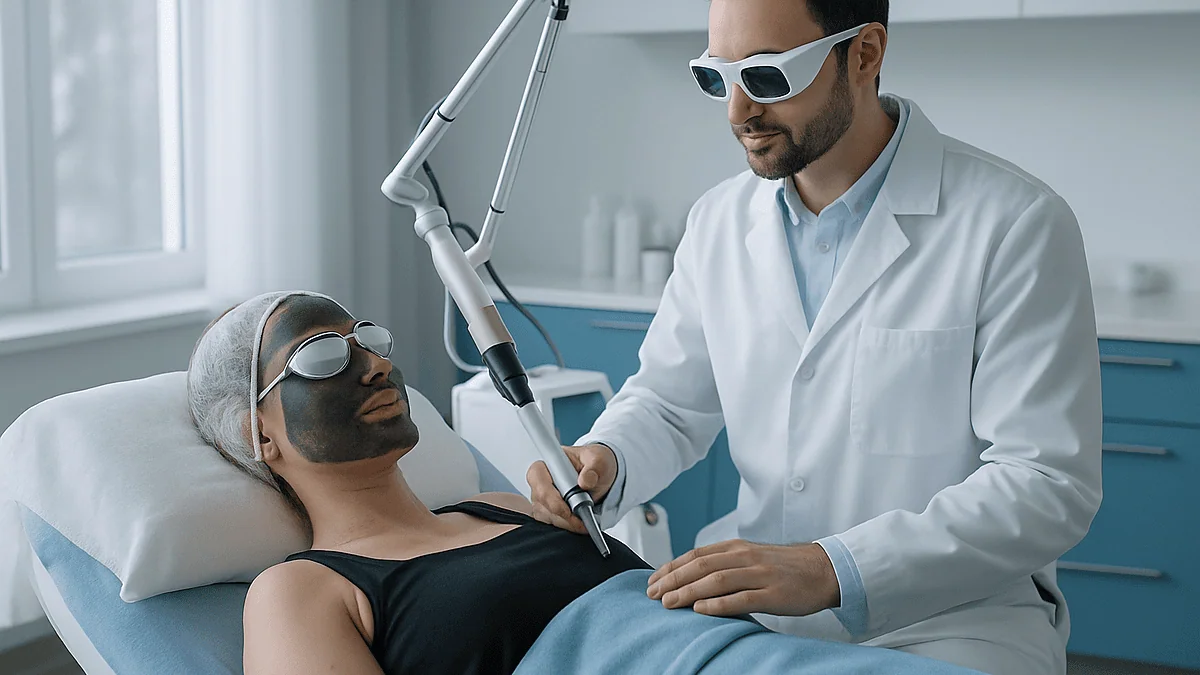
A carbon laser peel works in two steps. A thin layer of liquid carbon is painted onto cleansed skin, left to dry and settle into the pores, and then a Q-switched laser, usually a 1064 nm Nd:YAG, is passed over the face. The carbon absorbs the light and is vaporized with a soft crackle and a feeling of warmth, lifting surface debris and briefly heating the upper skin. Evidence for lasting benefit comes mainly from small studies.
The video is always the same. A face painted matte black, a handpiece gliding across it, a sound like rice crackling in a hot pan, and then a clean, slightly flushed cheek at the end. Thirty seconds, no voiceover, a million views. If you are sitting in a consultation chair with that clip in your head, you probably have a more practical question than the video answers: carbon laser peel, how it works, and what it feels like from the inside of the chair rather than the outside of the screen.
That is a fair thing to want to know before anyone points a laser at your face. The procedure has an unusually clear mechanism, which makes it easy to explain honestly. It also has a thinner evidence base than its popularity suggests, which makes it worth explaining carefully.
So this is the long version. What the black layer does, why the laser needs it, where the warmth comes from, and what the days afterward usually look like, with the limits of the research stated plainly rather than smoothed over.
What is a carbon laser peel, and what is it good for?
A carbon laser peel is a non-ablative skin treatment, meaning it does not remove the surface layer of skin the way a chemical peel or a resurfacing laser does. Two things happen in sequence. A water-based liquid containing very fine carbon particles is spread over the face. Then a laser whose light is strongly absorbed by that carbon is passed across the skin. The carbon is vaporized, and in the process the skin surface is cleared of debris and the upper layers receive a brief dose of heat.
You will also see it called a carbon facial, a charcoal laser peel, or a Hollywood peel, a nickname that owes more to marketing than to any particular technique. The equipment is almost always a Q-switched Nd:YAG laser. Q-switched means the laser releases its energy in extremely short, high-powered bursts, measured in billionths of a second. Nd:YAG refers to the crystal that generates the light, which has a wavelength of 1064 nanometers, in the invisible near-infrared range. The same laser family is used for tattoo removal and for some pigmented lesions, which tells you something about its intended target: dark particles.
What is it usually offered for? Oily skin, enlarged-looking pores, mild acne, uneven surface texture and a dull complexion are the common reasons people are offered it. Some practitioners also suggest it for mild, superficial pigmentation. The honest framing, which the later sections unpack, is that the published studies are small, mostly short in follow-up, and concentrate on acne and oiliness. Mainstream references on laser treatment of skin, such as the Mayo Clinic and Cleveland Clinic overviews cited below, place non-ablative lasers in the gentle, low-downtime, modest-effect category, and a carbon peel sits at the gentle end even of that group.
Carbon laser peel how it works: the physics in plain language
Lasers only do something useful when their light is absorbed. Skin on its own absorbs 1064 nm light rather weakly, which is why this wavelength can be used safely across a wide range of skin tones: it mostly passes through melanin, the pigment that gives skin its color, without heating it much. That gentleness is also a problem if your goal is to treat the very top of the skin. There is simply not enough absorption up there to matter.
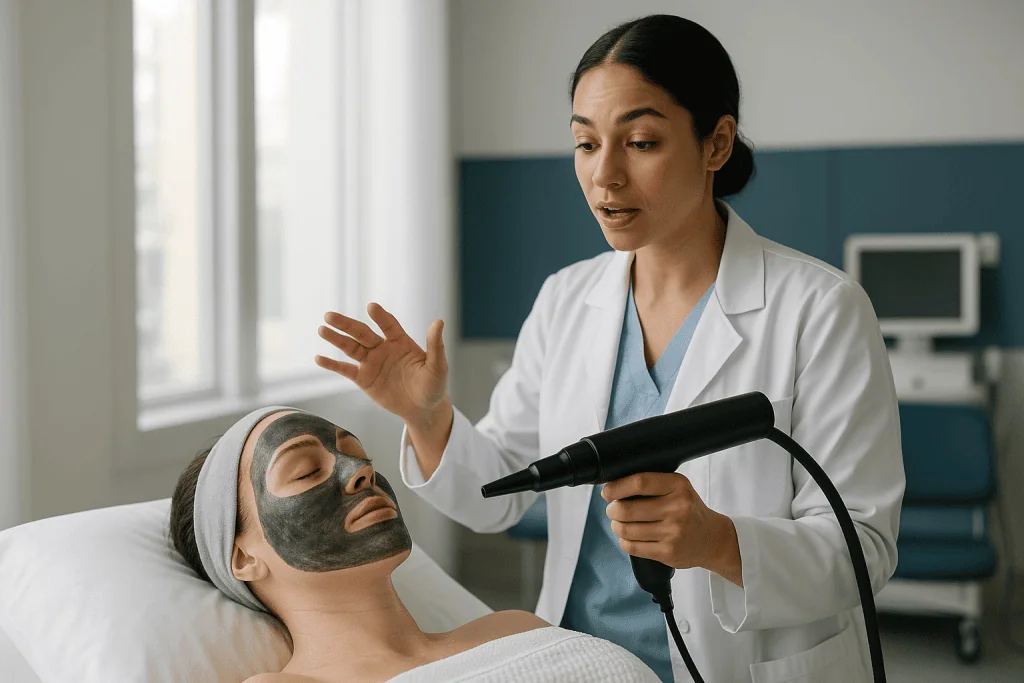
The carbon layer solves that. Carbon is black, and black absorbs across the whole spectrum, including 1064 nm. By painting a layer of carbon onto the surface and letting it settle into pores and fine lines, the practitioner creates a target exactly where they want the energy to land. When the laser fires, each pulse is absorbed almost entirely by the carbon particles rather than by the skin beneath them.
Two effects follow from that absorption. The first is photothermal: the carbon heats instantly and transfers a small amount of heat to the surrounding surface skin, the warmth you feel. The second is photomechanical, sometimes called photoacoustic: the particles heat so quickly that they expand and vaporize in a tiny burst, producing the crackling sound and a mild snapping sensation. That burst lifts the carbon away along with whatever was bound to it, including surface oil, loosened dead cells and debris sitting in pore openings.
The proposed deeper effects, on oil glands and on collagen, rest on the heat reaching a little below the surface. Laboratory and small clinical studies suggest some temporary reduction in oil production and mild changes in the upper dermis, but the depth of heating from a single carbon-assisted pass is modest compared with fractional or ablative lasers. That difference in depth is the root of both the main advantage, minimal downtime, and the main limitation, modest and often temporary results.
Carbon laser peel, how it works step one: the carbon layer
The session begins with cleansing. Makeup, sunscreen and surface oil are removed, because anything sitting between the carbon and the skin blunts the effect and can also be heated unpredictably. Some practitioners degrease the skin further with an alcohol-based toner. Protective eyewear goes on next; this matters more than it sounds, because 1064 nm light is invisible and the eye cannot blink in defense of something it cannot see.
The carbon lotion is then applied with a brush or gloved fingers in a thin, even film. It looks like black paint and feels cool and slightly tacky. Thickness is a judgement call that comes with training. Too thin, and there is not enough target for the laser to act on. Too thick, and the laser vaporizes the outer carbon without reaching the layer that has settled into the pores, leaving residue and wasting the pass.
Drying usually takes several minutes, and it is part of the mechanism rather than a pause. As the water in the lotion evaporates, the carbon particles concentrate and work into pore openings and surface irregularities. A fan or simply waiting does the job. Lying there with a black face is, by general agreement, the strangest part of the appointment.
A plain-language definition helps here. A pore is the opening of a hair follicle onto the skin surface, and the oil gland attached to that follicle empties through it. When people say a carbon peel “cleans the pores,” they mean the carbon has lodged in those openings and will be blasted out along with loose oil and debris. It does not shrink the structure of the pore itself; pore size is largely set by genetics and the size of the gland beneath, and no surface treatment permanently changes that.
Carbon laser peel, how it works step two: the laser pass and the warmth
Once the carbon is dry, the practitioner picks up the handpiece. Many protocols use two kinds of pass, and understanding the difference explains the two different sensations people report.
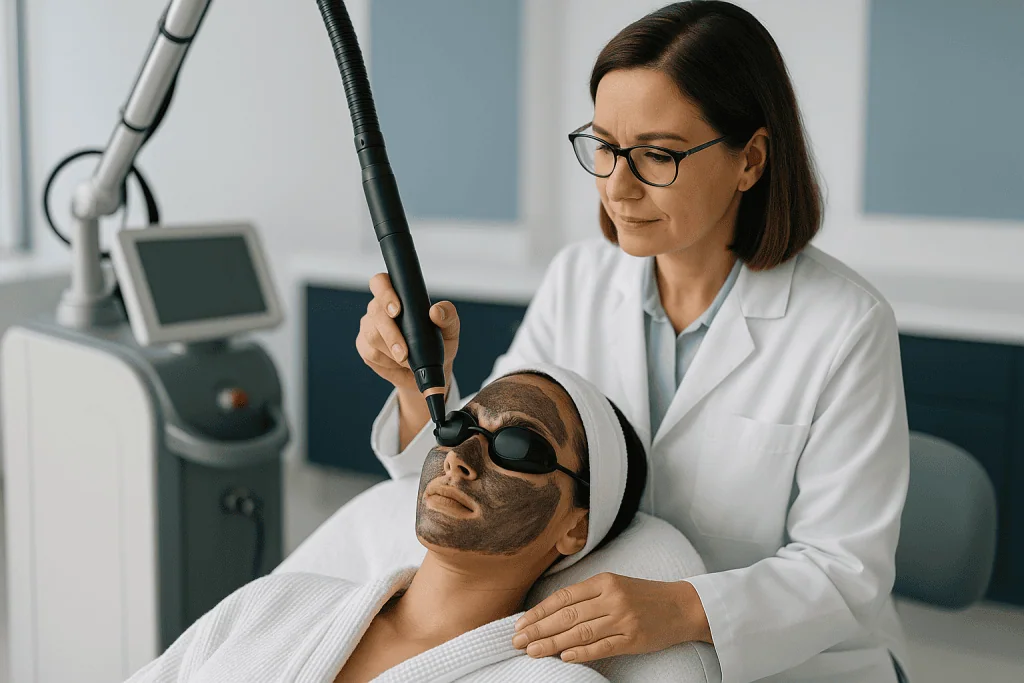
The first is often a warming pass. The laser is set to a longer pulse and a gentler energy, and the handpiece is swept across the skin without quite reaching the point of vaporizing the carbon. The particles absorb the light and release heat gradually. This is the part that feels like a warm cloth or a hair dryer held at a polite distance. Most people describe it as pleasant. The stated purpose is to deliver mild, diffuse heat to the upper skin and oil glands.
The second pass is the one from the videos. The laser switches to its true Q-switched mode, with pulses so brief that the carbon cannot shed heat before it vaporizes. Each pulse produces a tiny pop, and across the face that becomes the familiar crackle. The sensation is a light snap, sometimes compared to a rubber band flicked very gently, with a pinprick of heat. A faint smoky smell is normal; it is the carbon, not the skin. A smoke evacuator or a fan is often used to draw the plume away.
The handpiece moves in overlapping lines until the carbon has lifted from every area. Any residue is wiped away with saline or a damp pad. The whole laser portion commonly takes well under half an hour, though the total visit is longer because of preparation and drying.
Discomfort is generally low enough that numbing cream is not needed, and most practitioners avoid it because it would sit between the carbon and the skin. The warmth you feel is the direct, physical evidence that the mechanism is working as designed: light going into black particles and coming out as heat.
What the evidence actually shows, and what it does not
This is where honesty matters most, because the clinical research does not match the online enthusiasm. The published literature on carbon-assisted Q-switched Nd:YAG treatment consists largely of small trials, often with a few dozen participants, split-face designs, and follow-up measured in weeks. The most consistent findings concern inflammatory acne and skin oiliness, where several small studies have reported reductions in lesion counts and in measured sebum, the oil produced by skin glands, after a course of sessions. Reported improvements in pore appearance and overall texture are also common in these studies, usually judged by clinicians or participants rather than by objective instruments.
What is missing is just as important. There are few large randomized trials, little long-term follow-up to show how durable any change is, and almost no head-to-head comparison against the standard medical treatments for acne described by the NHS, such as topical retinoids, benzoyl peroxide or antibiotics. Where sebum reduction has been measured, it has tended to return toward baseline over time, which fits the modest depth of heating described earlier.
Claims about collagen stimulation, skin tightening and lifting rest on even thinner ground. Non-ablative lasers in general can produce subtle collagen changes with repeated treatment, as the Mayo Clinic overview of laser resurfacing notes, but the carbon-assisted version delivers less energy to the dermis than the fractional non-ablative devices usually studied for that purpose. Treating a carbon peel as an anti-aging procedure is therefore an extrapolation, not an evidence-based claim.
A fair summary, in guideline-style language, would be this: low-certainty evidence suggests short-term benefit for oily and mildly acne-prone skin; evidence for pigmentation, wrinkles and tightening is insufficient to draw conclusions. That is not a dismissal. It is simply the size of the claim the data can carry.
Who a carbon peel is usually for, and who is usually asked to wait
Because the 1064 nm wavelength is poorly absorbed by melanin, a carbon peel is one of the laser treatments that can be considered across a wide range of skin tones, including darker skin where many other lasers carry a higher risk of pigment change. That does not make it risk-free in darker skin, and the warming pass in particular needs careful settings, but it widens the group for whom it is a reasonable conversation.
People most often offered it have oily or combination skin, visible pores, mild comedonal or inflammatory acne without deep cysts, dull or rough surface texture, or want a low-downtime treatment before an event. It is frequently positioned as a maintenance treatment rather than a solution to a defined medical problem.
Several groups are usually asked to wait or to consider something else. Anyone with an active skin infection on the face, including a current cold sore, is typically postponed, since laser treatment can spread or worsen it. A history of cold sores may prompt a discussion with a clinician about preventive antiviral medication; that decision belongs to the prescriber. Recent sun exposure or tanning, including self-tanner, changes how the skin absorbs light and usually means rescheduling. People with a tendency to form keloids, which are raised, overgrown scars, are approached cautiously with any skin procedure.
Medicines matter too. Oral isotretinoin, a retinoid used for severe acne, has traditionally led practitioners to defer laser and resurfacing treatments for a period after the course because of concerns about healing, and although newer evidence has questioned how long that period needs to be for gentle treatments, the call sits with the prescribing clinician. Photosensitizing medicines, which make skin react more strongly to light, are another reason for review. Pregnancy and breastfeeding are usually treated as reasons to postpone on precautionary grounds, as there is no safety data either way. A frank medical history before the first session is not bureaucracy; it is the main safety step.
How many carbon peel sessions are usually needed?
The short answer is that one session shows you what the treatment feels like and gives a temporary freshness; the studies that report measurable change used a course. Most published protocols treated participants several times at intervals of a few weeks, and the improvements in acne and oiliness described in the previous section were recorded after that series rather than after a single visit. No major guideline body has issued a recommended number, so any specific figure you are quoted is a practitioner’s protocol, not a standard.
Why a series? The mechanism explains it. Each session clears surface debris and delivers a brief, shallow dose of heat. The surface effect is immediate but short-lived, because skin keeps producing oil and shedding cells. The deeper effects on oil glands, where they occur, appear to accumulate with repetition and to fade without it. A course spaced a few weeks apart gives the skin time to settle between treatments while keeping the stimulus going.
Spacing matters for safety as well. Treating again before any redness or sensitivity has fully resolved increases the chance of irritation and, in deeper skin tones, of post-inflammatory hyperpigmentation, which is darkening that follows skin inflammation. A reasonable practitioner will look at your skin before each session and delay if it has not recovered.
What happens after a course is the question people forget to ask. Because the condition being treated, oily or acne-prone skin, is ongoing, benefits are generally described as needing maintenance sessions to persist. That is worth weighing against the alternatives. The NHS notes that standard acne treatments also take time, often several months, before improvement shows, but they address the underlying process rather than the surface. For many people, a carbon peel sits alongside medical treatment rather than replacing it, and the sequencing is best agreed with whoever is managing the acne.
Carbon peel aftercare: can you wash your face after a carbon laser?
Yes, and you will want to, because a faint grey residue sometimes remains in the hairline or around the nose. The usual guidance is to wait until the skin feels calm, often the same day, then wash gently with lukewarm water and a mild, fragrance-free cleanser using fingertips only. Hot water, scrubs, cleansing brushes and anything that foams aggressively are better avoided for a few days, since the surface is temporarily more reactive. Pat dry rather than rub.
The rest of aftercare follows the same logic: the skin has been mildly heated and lightly exfoliated, so treat it as you would a day of mild sunburn.
- Moisturize with a simple, bland product to support the skin barrier, the outer layer that holds water in and irritants out.
- Apply broad-spectrum sunscreen every morning and avoid deliberate sun exposure. The CDC advises broad-spectrum protection of SPF 15 or higher for everyday use, and after a laser treatment most practitioners recommend the higher end of what you tolerate, reapplied if you are outdoors.
- Pause active ingredients for several days: retinoids, exfoliating acids, vitamin C serums and benzoyl peroxide can all sting on freshly treated skin. Resume on the schedule your practitioner gives you, and if a prescribed acne treatment is involved, confirm the pause with the prescriber rather than deciding alone.
- Skip makeup for the rest of the day if you can; mineral powder the next day is usually fine.
- Avoid saunas, steam rooms, hot yoga and heavy workouts for a day or two. Heat and sweat on reactive skin invite irritation.
- Do not pick at any small flakes, and do not extract spots that surface in the days afterward.
None of this is complicated, and that simplicity is the genuine appeal of a non-ablative treatment. The Mayo Clinic description of non-ablative laser recovery, essentially minimal, applies here. The aftercare that matters most, by a wide margin, is sun protection, because the one complication that can last is pigment change, and sun exposure is its biggest driver.
What the following days and weeks usually look like
Immediately afterward, most faces are pink, warm and faintly tight, roughly the look of having walked briskly on a cold day. Some people notice a slight sheen as the skin’s natural oil re-emerges, and a few see tiny pinpoint dots where pores were most loaded with carbon. Mainstream references on non-ablative laser treatment describe this kind of redness as typically settling within hours to a few days, and that matches what carbon peel patients generally report: most are comfortable going about their day once the appointment ends.
Over the first week, the skin usually feels smoother and looks slightly brighter, mainly because surface debris and loose cells have been cleared. This is the honeymoon effect, and it is real but superficial. In acne-prone skin, a handful of small spots may surface in the days after treatment as pore contents are disturbed; this is usually mild and self-limiting, though persistent or worsening breakouts are a reason to check in.
By two to four weeks, if the treatment is going to do more than polish the surface, the measured changes reported in small studies, chiefly reduced oiliness and fewer inflammatory lesions, begin to show after repeated sessions. A single session rarely produces a change anyone else would notice at this point. Patients who photograph their skin in consistent lighting tend to be the most realistic judges, because memory is a poor instrument for subtle improvement.
Beyond a course, the picture depends on maintenance and on what else is being done. Oil production tends to return toward baseline once sessions stop, which is why practitioners describe results as temporary. Any pigment darkening that appears, usually in deeper skin tones and usually in sun-exposed areas, can take weeks to months to fade and is the one timeline worth planning around. If your goal is a specific event, scheduling the last session with time to spare for any redness or flare is sensible, and your practitioner can advise on what that means for your skin.
Carbon peel side effects and the disadvantages of carbon laser treatment
Side effects of a correctly performed carbon peel are mostly minor and brief, which is accurate but incomplete. The fuller list looks like this.
- Redness, warmth and mild swelling, nearly universal and usually gone within hours to a few days.
- Dryness, tightness or fine flaking over the following days.
- A temporary acne flare, more likely in actively breaking-out skin.
- Post-inflammatory hyperpigmentation or, less commonly, lightening, both more likely in darker skin tones, with sun exposure or with overly aggressive settings.
- Small blisters, crusts or burns from excessive energy, thick carbon residue heating unevenly, or treating over tanned skin. These are uncommon but they are the ones that can scar.
- Reactivation of cold sores in people who carry the virus.
- Eye injury if protective eyewear is inadequate, a rare but serious risk shared by all lasers.
The disadvantages are a different category from side effects, and they deserve equal weight. First, the evidence is limited to small, short studies, so you are accepting uncertainty about how much benefit to expect. Second, results are modest and generally temporary, which means repeated sessions and ongoing commitment. Third, it does not treat the causes of acne the way medical therapy does; the NHS treatment pathway for acne is built around topical and oral medicines because they act on the underlying process, and a surface laser cannot substitute for that in moderate or severe disease. Fourth, the procedure is operator-dependent: the same device produces very different outcomes depending on carbon thickness, settings and skin assessment, and in many places the people offering it are not required to have medical training.
Fifth, and easily overlooked, is the opportunity cost. Spending months on a treatment with surface-level effect can delay proper assessment of persistent acne or pigmentation, both of which have well-established medical options. A conversation with a dermatologist or your primary care clinician about what is driving the problem is often the more useful first step.
Carbon laser facial benefits compared with other options
Context helps. The table below sets a carbon peel beside the treatments it is most often confused with, using the categories mainstream references use to describe lasers and peels. It is a summary of typical characteristics, not a ranking, and the right choice depends on skin type, diagnosis and goals that only your treating team can weigh.
| Treatment | Surface removed? | Typical downtime | Usual targets | Evidence base |
|---|---|---|---|---|
| Carbon laser peel (Q-switched Nd:YAG with carbon) | No; non-ablative | Hours to a few days of redness | Oiliness, mild acne, pore appearance, dullness | Small short-term studies |
| Superficial chemical peel (e.g., low-strength hydroxy acids) | Yes; outermost layer | Days of flaking | Texture, mild pigmentation, mild acne | Established, moderate |
| Non-ablative fractional laser | No; heats columns beneath surface | Several days of redness and swelling | Fine lines, acne scars, texture | Established, moderate |
| Ablative laser resurfacing (CO2, erbium) | Yes; removes surface layers | One to two weeks or more of healing | Deeper wrinkles, scars, sun damage | Established, stronger |
| Standard medical acne treatment (topical retinoids, benzoyl peroxide, antibiotics, hormonal or oral therapy as prescribed) | No | None, but months to see effect | Acne itself, including moderate and severe | Guideline-supported |
Two patterns stand out. The gentler a treatment, the quicker the recovery and the smaller and shorter-lived its effect; a carbon peel is at the gentle end of that line. And the only row that addresses acne as a disease rather than as a surface appearance is the medical one, which is why the NHS and other bodies describe medicines, not lasers, as first-line treatment. Downtime figures reflect the descriptions in the Mayo Clinic and Cleveland Clinic resurfacing overviews and vary with settings and skin.
The benefits people most reliably report after a carbon peel are a smoother feel, a brighter look and less shine for a while. Those are reasonable things to want. They are simply not the same as treating a condition.
What people often get wrong about carbon laser peels
“The laser burns off a layer of skin.” It does not. The carbon is what gets vaporized; the skin underneath is warmed and lightly exfoliated, not removed. That is the whole point of choosing a wavelength the skin barely absorbs.
“It shrinks pores permanently.” Pores can look smaller when they are emptied and the surrounding skin is less oily, but the structure of a pore is set by the follicle and gland beneath it. The appearance tends to return as oil production resumes.
“It is a treatment for acne.” It may reduce oiliness and inflammatory spots for a period in mild acne, according to small studies. It does not replace the medical treatments that act on the causes, and using it instead of those in moderate or severe acne risks scarring that proper treatment could have prevented.
“One session is enough.” One session gives a temporary polish. The reported measurable changes came from courses of several sessions, with maintenance afterward.
“It is safe for every skin tone, no precautions needed.” The 1064 nm wavelength is one of the safer choices for darker skin, but post-inflammatory pigment change remains the main risk, and settings, sun avoidance and spacing all still matter.
“The crackling means it is working deeply.” The sound is carbon particles bursting at the surface. It is evidence of absorption, not of depth. Deeper collagen remodeling is the domain of fractional and ablative lasers.
“It lifts and tightens.” There is no reliable evidence for tightening from a carbon peel. Any immediate firmness is swelling and hydration, and it passes.
“Anyone with a laser can do it.” Outcomes and complications depend heavily on assessment and technique. Asking who will perform the treatment, what their qualifications are and who handles complications is not rude; it is the most protective question on the list.
Questions to ask your care team
A good consultation leaves you knowing why this treatment, for your skin, now. These questions tend to produce the most useful answers.
- What specifically are you expecting this to improve in my skin, and how will we judge whether it has?
- Have I been assessed for the underlying cause? If my concern is acne or pigmentation, should I see a dermatologist first or alongside this?
- Which device and wavelength will be used, and what settings do you use for my skin tone?
- Will there be a warming pass, a vaporizing pass or both, and what should each feel like?
- How many sessions does your protocol involve, how far apart, and what happens to results when the course ends?
- What is your plan if I develop pigment darkening, a flare or a burn, and who do I contact out of hours?
- Which of my current skincare products or prescribed medicines need to be paused, and for how long? Should my prescribing clinician be involved in that decision?
- I have a history of cold sores, keloids, recent sun exposure or a recent course of oral acne medicine. Does any of that change the plan or the timing?
- What training and qualifications does the person performing the treatment have, and is a medical practitioner available if something goes wrong?
- Can you show me photographs of outcomes in skin similar to mine, including any complications you have managed?
- What would you suggest instead if you did not think a carbon peel was the right fit?
The last question is the revealing one. A practitioner who can describe when they would steer someone away from this treatment is one who is assessing your skin rather than selling a procedure. Take notes, take the information home, and expect the decision to be yours and your treating team’s together, not something settled in the chair.
When to call your doctor
Most people need no medical follow-up after a carbon peel. Mild pinkness, warmth and a day or two of dryness are expected, and the gentle aftercare already described is enough. A short list of signs, though, should prompt a call to the practitioner who treated you, your primary care clinician or a dermatologist, and in some cases urgent care.
- Blistering, open areas, oozing or crusting, which suggest a burn rather than ordinary redness.
- Pain that increases after the first day instead of easing, or redness that spreads beyond the treated area.
- Signs of infection: warmth with swelling, pus, yellow crusting, or a fever.
- A cluster of small painful blisters, particularly around the lips, which may indicate a cold sore outbreak that can spread across treated skin.
- Any eye symptoms after the session, including pain, light sensitivity, a change in vision or a feeling that something is in the eye. These need same-day assessment.
- Darkening or lightening patches that appear in the weeks afterward and are not fading, since early management of pigment change gives the best chance of limiting it.
- Swelling of the lips, tongue or throat, difficulty breathing, or widespread hives, which can signal an allergic reaction and require emergency care.
- An acne flare that is severe, painful or forming deep cysts rather than small surface spots.
Scarring after a non-ablative treatment is rare, but when it happens it almost always begins with a burn or an infection that was not treated promptly. That is why the threshold for calling should be low. Describe what you see, say exactly which treatment you had and when, and mention any medicines you are taking. The people who treated you should want to know, and a clinician can decide whether you need to be seen. Whether to continue with further sessions after any complication is a decision for the treating team, informed by how your skin has recovered.
Frequently asked questions
What is a carbon laser peel good for?
It is most often used for oily skin, visible pores, mild acne and a dull or rough surface. Small studies report short-term reductions in oiliness and inflammatory spots after a course of sessions. Evidence for pigmentation, wrinkles and tightening is insufficient. It is a surface-level, low-downtime treatment, not a replacement for medical acne care, and suitability depends on an assessment of your skin.
Can you wash your face after a carbon laser?
Yes. Most practitioners advise gentle washing with lukewarm water and a mild, fragrance-free cleanser once the skin feels calm, often the same day. Avoid hot water, scrubs, cleansing brushes and exfoliating acids for a few days, pat dry, moisturize with a bland product and apply sunscreen each morning. Follow the specific aftercare instructions you were given, since they reflect the settings used on your skin.
How many carbon peel sessions are needed?
No guideline sets a number. The small studies that reported measurable change treated participants several times, a few weeks apart, and improvements were recorded after the course rather than after one visit. A single session mainly gives a temporary freshness. Because oil production returns toward baseline once treatment stops, practitioners usually describe maintenance sessions as necessary to keep any benefit.
What are the disadvantages of carbon laser treatment?
The main drawbacks are limited evidence from small, short studies, modest and temporary results that require repeated sessions, and the fact that it does not address the causes of acne the way prescribed treatments do. Outcomes depend heavily on the operator. Side effects are usually mild, but pigment change, burns and cold sore reactivation can occur, and relying on it may delay proper assessment of a persistent skin problem.
What does a carbon laser peel feel like during the session?
The carbon lotion feels cool and tacky, then tightens as it dries. A warming pass feels like gentle, diffuse heat. The vaporizing pass produces a crackling sound and a light snapping sensation, sometimes compared to a rubber band flicked softly, with a faint smoky smell from the carbon. Discomfort is generally low enough that numbing cream is not used, and the skin feels warm and slightly tight afterward.
Is a carbon peel safe for dark skin?
The 1064 nm wavelength is poorly absorbed by melanin, which makes it one of the laser options more often considered across a range of skin tones. It is not risk-free. Post-inflammatory hyperpigmentation remains the most important possible complication in deeper skin, and conservative settings, adequate spacing between sessions, strict sun avoidance and an experienced practitioner all matter. Discuss your skin type and history openly before treatment.
Does a carbon laser peel help with acne scars?
Not meaningfully. A carbon peel is non-ablative and delivers only shallow heat, whereas acne scars involve changes in the deeper dermis. Treatments studied for scars include fractional non-ablative and ablative lasers, microneedling and certain peels, each with its own trade-offs. Some people notice a smoother look from surface exfoliation, but that is different from scar remodeling. A dermatologist can advise on what suits a particular scar type.
Can I have a carbon peel if I take acne medication?
It depends on the medicine, and the decision belongs to your prescribing clinician. Oral isotretinoin has traditionally led practitioners to defer laser treatments for a period after the course, although newer evidence questions how long that needs to be for gentle procedures. Topical retinoids and benzoyl peroxide are usually paused around sessions. Never stop or alter a prescribed treatment on your own to fit in a cosmetic appointment.
How long does carbon peel redness last?
Mainstream references describe recovery from non-ablative laser treatment as minimal, with redness typically settling within hours to a few days, and that matches what carbon peel patients usually report. Dryness or fine flaking may follow for a few days. Redness that spreads, worsens after the first day, or comes with blistering, crusting or pus is not typical and should be reported to the practitioner or a doctor.
What is the difference between a carbon peel and a chemical peel?
A chemical peel applies an acid that removes the outermost skin layer, producing days of visible flaking and a more established evidence base for texture and mild pigmentation. A carbon peel is non-ablative: the laser vaporizes a carbon layer, lightly exfoliating and warming the skin without removing it, with less downtime and a smaller, shorter-lived effect. Which is appropriate depends on skin type, concern and tolerance for recovery.
References
This article is for general information only and is not a substitute for professional medical advice. Please consult a qualified doctor about your individual situation.
Add us as a Preferred Source to see more of our trusted health content across Google Search, AI Overviews and Discover.

More from the Blog

The First Day After Masseter Botox: Why You Avoid Rubbing, Saunas and Lying Face Down
On the first day after masseter Botox, clinicians usually ask you to avoid rubbing or massaging the jaw, saunas and other strong heat, and…
Who Is a Candidate for Plexr Eyelid Tightening and Why Isotretinoin Use Changes the Plan
Plasma eyelid tightening, often searched as Plexr, usually suits adults with mild to moderate loose skin on the upper or lower eyelids, realistic expectations…
Life After Laser Eye Surgery: Eye Rubbing, Swimming, Makeup and Sports Explained
After LASIK, rubbing your eyes is discouraged because the corneal flap is held in place mainly by suction and a thin layer of healing…
What Follow-Up Imaging After Cryoablation Shows and Why the Treated Area Changes Slowly
Follow-up imaging after cryoablation checks whether the frozen zone fully covered the target and watches for any regrowth at its edge. The treated area…

Preparing for Reconstructive Surgery: Imaging, Anesthesia Review and Medication Adjustments
Preparing for reconstructive surgery usually involves three strands: imaging such as CT or MRI so the surgeon can plan bone and soft-tissue repair, an…
Skincare After Microdermabrasion: Moisturizer, Sunscreen and When Retinoids Can Restart
Skincare after microdermabrasion is deliberately simple: cleanse gently, apply a plain fragrance-free moisturizer several times a day, and wear broad-spectrum sunscreen every morning, because…