

Daily Care for Removable Dentures: Rinsing, Brushing, Overnight Soaking and Gum Health
Key Takeaways
- Prosthodontic guidelines call for dentures to be cleaned daily by both brushing and soaking, because a chemical soak alone does not remove biofilm.
- Regular and whitening toothpastes contain abrasives that scratch acrylic, which is why denture paste or plain unperfumed soap is the recommended cleaner.
- Dentures should not be worn twenty-four hours a day; overnight removal is the most consistently cited way to lower the risk of denture stomatitis.
- Acrylic that dries out can change shape, so a denture that is out of the mouth should sit in water, never on a dry surface or in hot water.
- Soaking solutions can cause vomiting, pain or burns if swallowed, so the denture must be rinsed before it goes back in and the cup kept away from children and pets.
- The jawbone under a denture keeps shrinking after tooth loss, which is why fit drifts over time and guidelines recommend at least a yearly dental check.
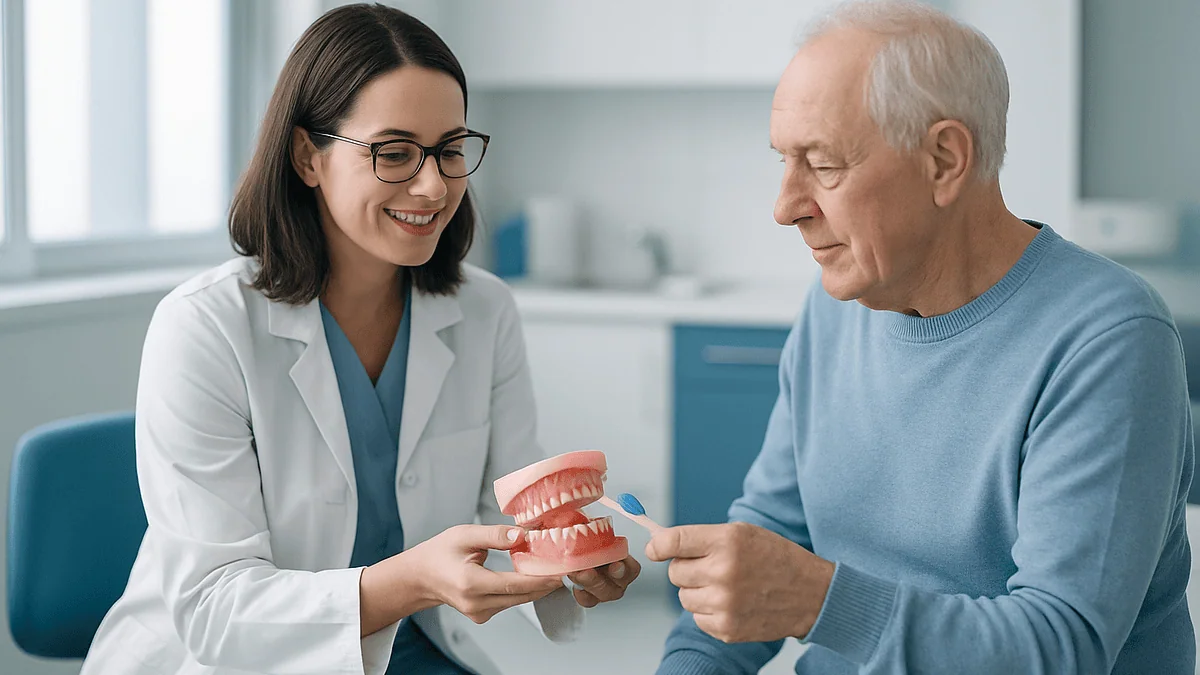
A sound denture care routine has four daily steps: rinse the denture after meals, brush it once a day with a soft denture brush and a non-abrasive cleaner, take it out overnight and soak it in water or a denture-soaking solution, and gently clean your gums, tongue and palate. Add regular dental check-ups, and call your dentist about sore spots, looseness or persistent redness.
The first night is the awkward one. The bathroom light is on, the new denture is sitting on a folded towel, and a question nobody quite answered at the fitting appointment hangs in the air: does this thing go back in my mouth, or into a cup? Most people improvise. Some sleep in their dentures for years because taking them out feels like admitting something. Others scrub them with a stiff toothbrush and a smear of whitening toothpaste, then wonder why the pink acrylic looks dull by spring.
A denture is not a tooth, and it does not want to be treated like one. It is a piece of shaped resin, sometimes with a metal framework, resting on living tissue that changes shape year by year. That is why a denture care routine is really two routines: one for the appliance, one for the mouth underneath.
What follows is the evidence behind both, drawn from prosthodontic guidelines and mainstream health sources, with the myths sorted from the mechanics.
What a daily denture care routine actually involves, and why the order matters
Strip away the product aisle and a denture care routine comes down to four verbs: rinse, brush, soak, and tend. The American College of Prosthodontists published evidence-based guidelines for complete dentures that boil down to the same list, and the Mayo Clinic and the NHS describe near-identical steps for anyone with a removable appliance.
Rinsing happens after meals. Brushing happens once a day, on a denture that is out of the mouth, with a soft brush and something that will not scratch. Soaking happens overnight, in water or a soaking solution, while the denture is out and the gums rest. Tending is the step most people skip: cleaning the gums, tongue and roof of the mouth with a soft brush or damp cloth so the tissue that carries the denture stays healthy.
The order is not decoration. Rinsing first clears loose food so the brush is not grinding crumbs across the surface. Brushing before soaking matters because a soaking solution is not a substitute for physical removal of biofilm; the guidelines are explicit that dentures should be cleaned daily by soaking and brushing, not one or the other. Biofilm is the sticky film of bacteria and yeast that forms on any surface in the mouth, and on acrylic it grips slightly rougher texture than it does on enamel.
One more piece belongs in the routine even though it is not daily: a professional check. The prosthodontic guidelines recommend that denture wearers see a dentist at least once a year so the fit can be checked, the appliance professionally cleaned, and the soft tissue examined. A routine that never includes a dentist is a routine with a blind spot.
How a denture and the gum beneath it actually work together
Understanding the materials explains half the rules. Most removable dentures are made from acrylic resin, a hard plastic that can be shaped precisely and tinted to match gum tissue. Partial dentures often add a cast metal framework and small clasps that grip remaining teeth. Acrylic is strong but not indestructible: it is porous at a microscopic level, it can warp if heated, and it scratches under abrasive pastes, which is why the cleaning advice differs so sharply from advice for natural teeth.

Underneath sits the alveolar ridge, the bony arch that once held tooth roots, covered by a thin layer of gum tissue. A full upper denture stays put largely through suction and a film of saliva between the acrylic and the palate. A lower denture has less surface to work with and relies more on muscle control and, for some people, adhesive.
Here is the part that surprises new wearers: the ridge does not stay still. Once teeth are gone, the bone that supported them slowly remodels and shrinks, a process called resorption. Cleveland Clinic and MedlinePlus both note that this gradual change is why dentures loosen over time and periodically need relining, which means adding new material to the fitting surface, or eventually remaking.
Meanwhile the gum tissue is doing something it was never designed for: bearing chewing load through a plastic plate for most of the day. Tissue under constant cover stays warm, damp and slightly deprived of the self-cleaning action of the tongue and saliva. That is the environment in which yeast and bacteria thrive, and it is the reason every credible source insists the denture come out for part of the day.
How to clean dentures: rinsing after meals and brushing without scratching them
Rinsing is the low-effort habit with a high return. The Mayo Clinic advises removing the denture after eating and running water over it to clear food particles and loose debris. Two practical notes make the difference between a good habit and a chipped denture. First, use cool or lukewarm water, never hot; heat can distort acrylic. Second, fold a towel in the basin or fill the sink partway with water. Dentures fracture on porcelain sinks with disappointing regularity, and a soft landing costs nothing.
Brushing is where most damage happens, and almost all of it is avoidable. The tools recommended by the prosthodontic guidelines, the NHS and Mayo Clinic are the same: a soft-bristled brush, ideally a denture brush with a shape that reaches the fitting surface, and a non-abrasive cleaner. That can be a paste made for dentures, or plain unperfumed liquid soap. Ordinary toothpaste is the wrong tool. It contains abrasives designed to polish enamel, which is far harder than acrylic; on a denture, those particles leave microscopic scratches that dull the surface and give biofilm a foothold. Whitening pastes are worse for the same reason.
Hold the denture over the towel or water-filled sink, cup it in your palm rather than pinching a thin edge, and brush every surface: the teeth, the polished outer side, and especially the fitting surface that rests on the gum. Rinse thoroughly afterward.
If you use adhesive, brushing is also when you remove the residue from the grooves of the denture. Leftover adhesive is a common reason a denture feels tacky or smells stale by evening. Adhesive left on the gums should be wiped away with a warm damp cloth, not scraped.
Should you soak your dentures every night?
Yes, and the reason is not only hygiene. Acrylic that dries out can lose its shape, so a denture left on a nightstand overnight may fit slightly differently in the morning. The prosthodontic guidelines recommend that dentures be stored in water when they are not being worn, and the Mayo Clinic describes overnight soaking in water or a mild denture-soaking solution as a standard part of care.

Soaking dentures overnight does two things at once. It keeps the material hydrated, and it gives a chemical cleanser time to work on the biofilm that brushing loosens but never fully removes. Effervescent cleansing tablets, the kind that fizz when dropped in water, are the most common option and are considered an acceptable adjunct to brushing in the prosthodontic guidelines. They are not a replacement for the brush.
Two cautions come straight from the sources. Follow the manufacturer’s directions for the product you use, because soaking times and suitability vary, particularly for dentures with metal parts or soft linings. And rinse the denture thoroughly before it goes back in the mouth. Mayo Clinic warns that soaking solutions can cause vomiting, pain or burns if swallowed, which is also why the cup should be kept out of reach of children and pets.
A question people search constantly is whether a tablet labeled for a three-minute soak can be left in overnight. The honest answer is that the label governs. Some cleansers are formulated for a short soak and specify that longer contact is not recommended for certain materials; others are designed for overnight use. If the product you have is a short-soak type, plain water overnight is the safe default, and your dentist can tell you which approach suits your particular denture.
Why can't you wear your dentures at night?
Nothing physically stops you, which is exactly why so many people do it. The case against wearing dentures at night comes from what happens to tissue that never gets a break. The prosthodontic guidelines state plainly that dentures should not be worn continuously, twenty-four hours a day, in order to reduce the risk of denture stomatitis, the inflammation of the gum and palate under a denture. The NHS gives the same instruction in plainer language: taking dentures out at night gives your gums a rest.
The mechanism is straightforward. Saliva flow drops during sleep. A denture covering the palate traps whatever is under it in a warm, low-oxygen, low-saliva pocket for seven or eight hours. Yeast, particularly the Candida species that live harmlessly in most mouths, multiply in that environment. Add the mechanical pressure of an appliance that is never removed and you have both irritation and infection working on the same patch of tissue.
There is a second, less discussed concern. Observational research in frail older adults has linked sleeping in dentures with a higher risk of pneumonia, presumably because bacteria on the appliance can be inhaled. This shows an association rather than proof of cause, and it is most relevant for people who are elderly or have swallowing difficulties, but it strengthens the case for a clean denture and a night off.
Some people cannot imagine being seen without teeth, even by a partner. That is a real concern and worth raising with your dentist rather than solving by wearing the denture around the clock. Options such as removing it for several hours during the day instead are worth discussing, though they are not equivalent to overnight rest.
How many hours a day should you wear new dentures?
For a brand-new denture the usual advice is almost the opposite of the long-term rule, which confuses people. Many dentists ask patients to keep a new set in for most of the first day or two, sometimes including the first night, so that pressure points show up quickly as sore spots that can be adjusted. MedlinePlus and Cleveland Clinic both describe this adjustment period as a normal phase of getting used to dentures. Your own dentist’s instruction takes precedence here, because it depends on whether the denture is a conventional set, an immediate denture placed on the day of extractions, or a replacement for one you have worn for years.
After that settling-in window, the standard pattern applies: wear the denture during waking hours and remove it for sleep. There is no fixed number of hours written into the guidelines for the daytime; the principle is that the denture should be out for a meaningful daily rest, and overnight is the practical time to do it.
Getting to comfortable all-day wear is gradual. Cleveland Clinic notes that it is normal for new dentures to feel bulky or loose, to increase saliva, and to make speech and chewing awkward for a few weeks while the muscles of the cheeks and tongue learn to hold the appliance in place. Starting with soft foods cut small, chewing on both sides at once, and reading aloud are the standard ways people speed the adaptation.
If you find yourself removing a new denture for most of the day because it hurts, that is not a sign to push through. Persistent pain usually means a spot that needs adjusting, which is a short chairside procedure.
Denture cleaning methods compared: what helps and what harms
The market for denture products is large and the advice is not always consistent, so it helps to see the evidence side by side. The table below reflects the prosthodontic guidelines and the guidance from Mayo Clinic and the NHS.
| Method or product | Evidence-based position | Why |
|---|---|---|
| Soft denture brush with denture paste or plain soap | Recommended daily | Removes biofilm mechanically without scratching acrylic |
| Rinsing under cool water after meals | Recommended | Clears food before it dries onto the surface |
| Overnight soak in water | Recommended when not wearing | Keeps acrylic hydrated and shape-stable |
| Effervescent cleansing tablets | Acceptable adjunct, per label | Chemical loosening of biofilm; does not replace brushing |
| Regular or whitening toothpaste | Avoid | Abrasives scratch acrylic, dulling it and trapping microbes |
| Hot or boiling water | Avoid | Heat warps acrylic and ruins fit |
| Household bleach solutions | Avoid unless a dentist directs | Can corrode metal parts and discolor acrylic with prolonged contact |
| Hard-bristled brushes, wire brushes, toothpicks | Avoid | Scratch or chip the surface |
| Ultrasonic cleaning devices | Optional adjunct | Helpful for some; still requires brushing |
Two entries deserve a footnote. The prosthodontic guidelines note that dentures with metal components should not be soaked in solutions containing bleach because of corrosion, and that even for all-acrylic dentures prolonged bleach contact is not recommended. And the ultrasonic row is there because such devices are often marketed as a complete solution; the guidelines position them as a supplement to, not a replacement for, daily brushing.
The pattern across the table is simple. Gentle, frequent and hydrated beats aggressive, occasional and dry.
How do you keep the gums, palate and tongue healthy under a denture?
The mouth does not stop needing care because the teeth are gone. In fact the tissue under a denture works harder than it ever did around natural teeth, and it deserves its own minute in the routine.
Once the denture is out, the Mayo Clinic recommends cleaning the gums, tongue, cheeks and roof of the mouth with a soft-bristled toothbrush or a piece of gauze wrapped around a finger. The goal is to sweep away the biofilm and food film that accumulate under the appliance, and to stimulate blood flow in tissue that has been compressed all day. A gentle circular motion is enough; scrubbing red, tender gums makes them redder.
People who wear partial dentures have a second job. The natural teeth that remain, especially the ones that carry clasps, are at higher risk of decay and gum disease because they collect plaque where the clasp rests. Those teeth need brushing twice daily with fluoride toothpaste and flossing, exactly as before, and the NHS specifically notes that partial denture wearers should keep up regular dental visits for this reason.
Dry mouth is a common complication that undermines everything else. Saliva lubricates the denture, helps it seal, and washes away microbes. Many medicines reduce saliva as a side effect, and dry mouth makes both sore spots and yeast overgrowth more likely. If your mouth feels persistently dry, mention it to your dentist and prescriber; the decision about any medicine change belongs with the clinician who prescribed it, but sipping water, avoiding tobacco and limiting alcohol-based mouthwashes are reasonable self-care steps.
Finally, look. Once a week, in good light, check the gums where the denture rests for redness, white patches, ulcers or swelling. You are not diagnosing; you are noticing what to mention.
What is denture stomatitis, and how does a denture care routine help prevent it?
Denture stomatitis is inflammation of the mucous membrane under a denture, most often the roof of the mouth beneath a full upper set. It is one of the most common problems denture wearers develop, and it is frequently painless, which is why many people have it without knowing. The typical appearance is a smooth or pebbly area of redness that matches the outline of the denture, sometimes with a burning sensation or an altered taste. A dentist confirms the diagnosis; a mirror does not.
The cause is a partnership. Candida yeast colonizes the porous fitting surface of an acrylic denture, forming a biofilm that is hard to shift. The tissue under the denture, deprived of saliva flow and oxygen for long hours, becomes inflamed in response. Poor denture hygiene, continuous wear, an ill-fitting denture that traps debris, dry mouth, diabetes, smoking and some medicines all raise the likelihood. The prosthodontic guidelines identify overnight wear and inadequate cleaning as the two modifiable risk factors that matter most.
Prevention therefore looks exactly like the routine already described. Daily brushing physically disrupts the yeast biofilm. Overnight removal lets the tissue recover. Soaking helps chemically. Cleaning the palate itself removes the organisms living on the tissue side. When these steps are followed consistently, the environment that stomatitis needs largely disappears.
When it does develop, management is decided by the dentist. It usually begins with intensifying the hygiene measures above and correcting any fit problem, because a denture that rocks or traps food will keep re-seeding the infection. In persistent cases a dentist or physician may prescribe an antifungal, a class of medicine that suppresses yeast; how it is given and for how long is a clinical decision, and stopping early because the redness has faded is a common reason it returns.
Who this routine is for, and who is usually asked to adjust it
The core routine applies to anyone with a removable appliance: full dentures, partial dentures, and the removable overdentures that clip onto dental implants. The details shift with the type, and a few groups are given different instructions, at least for a while.
People with partial dentures follow the same rinse-brush-soak sequence for the appliance, but the metal framework changes two things. Bleach-based soaks are off the table because of corrosion, as the prosthodontic guidelines note, and the remaining natural teeth need their own full cleaning. The clasps also need a look now and then; a bent clasp can loosen the fit or wear a groove in a tooth.
People with implant-retained overdentures have the most to clean. An overdenture is a removable denture that snaps onto small attachments fixed to implants in the jaw. The denture itself is cared for as usual, but the attachments and the gum around each implant must be brushed daily with a soft brush, and many dentists recommend small interdental brushes or floss designed for implants. Neglect here risks peri-implant inflammation, the implant equivalent of gum disease.
People with immediate dentures, placed on the same day teeth are extracted, are the ones typically asked to wait before adopting the standard pattern. The healing sockets change shape quickly, and the dentist usually gives specific instructions about when the denture can first be removed, how to rinse the mouth, and when to return for adjustments. Following those instructions rather than general advice matters most in the first week.
People with limited hand dexterity, cognitive impairment, or who rely on a caregiver benefit from adapted tools such as brushes with wide handles, and from a written routine posted where the cleaning happens. The steps do not change; the support around them does.
What the first days and weeks with new dentures usually look like
Expect a stretch of mild annoyance rather than a single dramatic day. MedlinePlus and Cleveland Clinic describe a typical adjustment period lasting several weeks, during which the denture feels large, saliva increases, some words sound different, and chewing takes concentration. None of that means the denture is wrong. It means your tongue and cheeks are learning a new object.
Days one to three are usually about pressure. Sore spots appear where the denture presses harder than the tissue likes, often along the edge or over a bony bump. This is expected, and it is the reason for the early follow-up appointment most dentists book. Adjusting a sore spot takes minutes; suffering through it for weeks helps no one. Keep the denture in as instructed before that appointment so the dentist can see exactly where the pressure marks are.
Week one to two is about eating and speaking. Soft foods, small pieces, both sides of the mouth at once. Reading aloud for a few minutes a day helps speech settle. Some people notice a gag reflex from an upper denture covering the palate; this usually fades, and if it does not, the dentist can sometimes trim the rear edge.
By the end of the first month most people wear their dentures comfortably through the day and have the cleaning routine on autopilot. If you are still removing them for pain, still unable to eat anything with texture, or developing new sore spots after the early adjustments, book another visit rather than assuming this is how dentures feel.
Over the longer term, expect fit to drift. Bone resorption continues, and MedlinePlus notes that dentures generally need relining or remaking as the ridge changes. That is not failure; it is anatomy, and it is one more argument for the yearly check.
What people often get wrong about denture care
Some of these errors are handed down from a parent’s generation; others come from the product aisle. All are correctable.
Toothpaste is toothpaste. It is not. Regular and whitening pastes are engineered to abrade enamel, a substance many times harder than acrylic. On a denture they leave scratches that dull the finish and shelter biofilm. Denture paste or plain unperfumed soap is what the Mayo Clinic and the NHS recommend.
A soak does the cleaning. The fizzing tablet is satisfying to watch, but the prosthodontic guidelines are clear that chemical soaking is an adjunct to brushing, not a substitute. Biofilm has to be physically disrupted.
Hot water sterilizes. It warps. A denture dropped in boiling water can come out subtly misshapen and never fit the same way. Cool or lukewarm water only.
Sleeping in dentures keeps the gums used to them. Continuous wear is the single most consistent risk factor for denture stomatitis in the guidelines, and it deprives compressed tissue of the recovery it needs.
Loose means more adhesive. Adhesive can improve retention of a well-fitting denture, but a denture that needs increasing amounts of it is usually telling you the ridge has changed. That is a relining conversation, not a shopping one.
No teeth, no dentist. The tissue under a denture, the fit of the appliance, and the soft tissues of the mouth all need professional review. The prosthodontic guidelines recommend at least yearly visits for full denture wearers; partial wearers still have teeth at risk.
Whitening a stained denture at home. Bleach products can corrode metal and discolor acrylic, and abrasive polishing damages the surface. Stubborn stains are a job for the dental office, where professional cleaning is part of the recall visit.
Questions to ask your care team about your denture care routine
The fitting appointment is busy, and the practical questions tend to surface later at the bathroom sink. Writing them down for the follow-up visit is worth the effort. These are the ones that most often go unasked.
- Which cleaner do you recommend for my specific denture, given its materials and any soft lining or metal parts?
- Is it safe to leave my denture in a cleansing solution overnight, or should it sit in plain water?
- For this new denture, should I keep it in overnight for the first night or two, and when should I switch to removing it?
- How should I clean the gums, palate and tongue, and is there anything I should be watching for?
- If I use adhesive, how much is reasonable, and at what point does needing more suggest the fit has changed?
- How often do you want to see me for a check, and what does that visit include?
- Roughly how often do dentures like mine tend to need relining or remaking?
- Are any of my current medicines likely to cause dry mouth, and should I mention this to the prescriber?
- What should I do if the denture cracks or a tooth comes off, and is home repair ever appropriate?
- If I have remaining teeth or implants, what extra cleaning do they need?
Two of those deserve emphasis. The question about overnight soaking in a cleanser is where general advice runs out and product-specific and denture-specific detail begins; only your dentist knows what your denture is made of. And the question about home repair has a consistent answer from every source: do not glue it. Household adhesives are not safe in the mouth and usually make a professional repair harder. A dentist or the laboratory they work with can often repair a fracture quickly.
When to call your doctor
Most denture problems are mild and slow. A few are not, and knowing the difference saves both tissue and worry. Your dentist is the first call for anything to do with the denture or the mouth; your physician becomes relevant when symptoms suggest something beyond the appliance.
Contact your dentist promptly if you notice a sore spot or ulcer under the denture that has not healed within about two weeks, since persistent ulcers on the gum or palate need professional examination. Call about persistent redness, soreness or a burning sensation of the palate, white patches on the gums or tongue that do not wipe away, or cracked, sore corners of the mouth, all of which may point to denture stomatitis or a related yeast problem that a dentist can assess. A denture that has become noticeably loose, rocks when you chew, or needs steadily more adhesive should be checked for fit, as should any crack, chip or missing tooth on the appliance. New clicking, difficulty speaking, or repeated biting of the cheek after months of comfortable wear also warrants a visit.
Seek same-day care if you develop swelling of the face or jaw, fever with mouth pain, difficulty swallowing or breathing, or bleeding from the gums that does not stop with gentle pressure; these are red-flag signs that need urgent assessment, not a wait for the next routine appointment.
Any lump, thickened area, or patch of red or white tissue anywhere in the mouth that persists for more than a few weeks should be examined by a dentist or doctor even if it is painless. Denture wearers sometimes attribute every change to the appliance; a professional look is the way to be sure.
Every decision about adjusting, relining or replacing a denture, and about any medicine for a mouth infection, rests with the treating team. A well-kept routine at home makes those decisions easier, but it does not replace them.
Frequently asked questions
Should you soak your dentures every night?
Yes, unless your dentist has told you otherwise. Dentures should be stored in water whenever they are out of the mouth so the acrylic does not dry and change shape, and overnight is the natural time. You can soak in plain water or a denture-soaking solution used according to its label, but soaking is an addition to daily brushing, not a replacement for it. Rinse the denture well before wearing it again.
Can I leave my dentures in a three-minute cleansing tablet solution overnight?
Follow the product label, because it depends on the formulation and on what your denture is made of. Some effervescent cleansers are designed for a short soak and advise against prolonged contact, particularly for dentures with metal parts or soft linings; others are labeled for overnight use. If yours is a short-soak type, soak for the stated time, then keep the denture in plain water overnight, and ask your dentist which approach suits your appliance.
Why can't you wear your dentures at night?
Continuous wear traps the gum and palate under a warm, low-saliva plastic cover for hours, which is the ideal environment for yeast overgrowth and the inflammation called denture stomatitis. Prosthodontic guidelines specifically advise against wearing dentures twenty-four hours a day for this reason, and the NHS describes overnight removal as giving your gums a rest. Observational research in frail older adults has also linked sleeping in dentures with pneumonia, though that shows association rather than proof.
How many hours a day should you wear new dentures?
For the first day or two, many dentists ask you to keep a new denture in for most of the time, sometimes including the first night, so pressure points show up and can be adjusted at the follow-up visit. After that, the usual pattern is to wear the denture during waking hours and remove it for sleep. There is no fixed hourly figure in guidelines; the principle is daytime wear with a nightly rest, and your dentist’s specific instructions take priority.
How to clean dentures properly without damaging them?
Remove the denture, rinse it under cool water, then brush every surface with a soft denture brush and a non-abrasive cleaner such as denture paste or plain unperfumed soap. Do this over a towel or a partly filled sink to cushion any drop. Avoid regular toothpaste, whitening paste, hard brushes and hot water, all of which scratch or warp acrylic. Soak overnight in water or a labeled solution, and rinse before reinserting.
Can I use regular toothpaste on my dentures?
No. Ordinary toothpaste contains abrasive particles designed to polish enamel, which is far harder than denture acrylic. On a denture they create fine scratches that dull the finish and give bacteria and yeast a surface to cling to. Whitening pastes are more abrasive still. Use a paste formulated for dentures or a mild liquid soap, applied with a soft brush, and reserve fluoride toothpaste for any natural teeth you still have.
What is denture stomatitis and how do I know if I have it?
Denture stomatitis is inflammation of the tissue under a denture, usually the roof of the mouth, driven largely by yeast biofilm on the appliance and continuous wear. It often looks like a smooth or pebbly patch of redness matching the denture outline and is frequently painless, so many people are unaware of it. Only a dentist can confirm it. Daily brushing, overnight removal and cleaning the palate itself are the main ways guidelines suggest preventing it.
Do I still need to see a dentist if I have no natural teeth?
Yes. Prosthodontic guidelines recommend at least a yearly visit for full denture wearers so the fit can be assessed, the denture professionally cleaned, and the gums, palate and tongue examined for inflammation or other changes. The bone under a denture keeps remodeling after tooth loss, which is why fit drifts and relining becomes necessary. Partial denture wearers have the added need to protect the remaining teeth that carry clasps.
Why do my dentures feel loose and does more adhesive fix it?
Looseness that develops over months usually reflects the slow shrinkage of the jaw ridge after tooth loss, not a fault in the denture. Adhesive can improve the hold of a denture that already fits well, but needing steadily more of it is a sign the fitting surface no longer matches the ridge. That is a conversation about relining or remaking with your dentist. Loose dentures also trap food and rub, which raises the risk of sore spots and stomatitis.
What should I do if my denture cracks or a tooth falls off?
Stop wearing it if it has sharp edges and contact your dentist. Do not use household glue; it is not safe in the mouth and often makes a proper repair harder. Dentists and the laboratories they work with can frequently repair a fracture or replace a tooth quickly. Keep all the pieces in a container with a little water, and avoid trying to bend or reshape any metal clasps yourself.
References
This article is for general information only and is not a substitute for professional medical advice. Please consult a qualified doctor about your individual situation.

More from the Blog
Are Zirconium Teeth Right for You? Bite Force, Smile Goals and When Another Ceramic Fits Better
A good zirconium teeth candidate usually needs a strong restoration for a back tooth, an implant crown, or a bridge, especially with a heavy…

All-on-4 vs All-on-6: When Two More Implants Make Sense
All-on-4 and All-on-6 both anchor a full arch of fixed replacement teeth; the difference is how many implants carry the load. Four implants suit…
What to Ask Before a Dental Crown: Material, Margin Placement and What Happens to the Nerve
Before agreeing to a dental crown, ask what the crown is for, which material is proposed and why, where the edge of the crown…
Dental Implants After Gum Disease: When They Are Possible, and What Comes First
Yes, people with periodontal disease can often get dental implants, but not while the disease is active. Infection and inflammation must be treated first,…

How Long Do All-on-4 Implants Last? Longevity, Care and What Can Go Wrong
With diligent daily cleaning and regular professional maintenance, the four titanium implants supporting an All-on-4 restoration commonly last 20 years or longer, and long-term…

When Removable Dentures Stop Fitting: Relining, Rebasing and When a Remake Is Needed
Removable dentures usually stop fitting because the jawbone and gum underneath slowly shrink, not because the denture itself changes much. Dentists first assess the…