

Daily Life After Vision Rehabilitation: Practicing Contrast Strategies and Orientation Skills

Key Takeaways
- Low vision is sight that cannot be corrected with glasses, contacts, medicine, or surgery, and rehabilitation teaches use of remaining vision rather than treating the disease.
- Many eye diseases reduce contrast sensitivity before sharpness, which is why a clear glass on a white counter can vanish while large print stays readable.
- The pouring rule, light liquids into dark containers and dark into light, prevents more spills than any magnifier because it changes the target rather than the eye.
- Task lighting placed to the side and slightly below eye level, aimed at the page, increases usable contrast while avoiding the glare that overhead light and bare bulbs create.
- Orientation skills such as trailing, systematic search, and landmark counting are memory-based and fade unless practiced on the routes you actually use.
- New distortion of straight lines, a curtain across vision, sudden floaters or flashes, or vision loss with one-sided weakness are red flags that need same-day or emergency care.
Living with low vision after rehabilitation works best when contrast and orientation skills become daily habits: use dark-on-light or light-on-dark pairings for food, stairs, and switches; place task lighting to the side to cut glare; and rehearse landmarks, trailing, and systematic scanning until routes feel automatic. Low vision itself is not reversed by these strategies, but they can reduce falls, spills, and effort. Report any sudden change in sight to your eye team.
The last session ends with a handshake, a folder of handouts, and a new white cane leaning against the chair. Then the front door closes and the house looks exactly the way it did before: the same beige carpet meeting the same beige stairs, the same clear glass on the same pale counter. The therapist is gone. The habits are supposed to stay.
That gap between the clinic and the kitchen is where most people living with low vision either consolidate what they learned or quietly let it slide. Nobody warns you how odd it feels to deliberately buy a black cutting board, or to count doorways on the way to the bathroom at night, when a month ago you simply walked.
This article is about the practicing part. It covers what contrast strategies and orientation skills actually do in the eye and brain, how to build them into ordinary days, and when a change in your sight means the practice should pause and a phone call should happen instead.
How does vision rehabilitation work, and what does it leave you with?
Vision rehabilitation is a set of services that teach people with irreversible sight loss to use the vision they still have, plus other senses and tools, to do what they need to do. It does not treat the eye disease; that remains the job of the ophthalmologist. The National Eye Institute describes low vision as sight that cannot be corrected with standard glasses, contact lenses, medicine, or surgery, and rehabilitation as the way people adapt to it.
A program usually has three strands. A low vision specialist measures what you can see and matches magnifiers, filters, and electronic devices to specific tasks. An occupational therapist works on daily activities, from pouring coffee to reading a pill label, and reorganizes the home around contrast and lighting. An orientation and mobility specialist, sometimes called an O&M instructor, teaches safe movement indoors and out, including cane skills if they are needed.
What actually happens in the brain matters here. When central vision is damaged, as in age-related macular degeneration, the eye can be trained to aim a healthier patch of retina at what you want to see. This is called eccentric viewing: looking slightly above, below, or beside a target so the image lands on working cells. It feels wrong at first, like looking past someone to see their face, and it only becomes reliable through repetition.
So what you leave with is not restored eyesight. You leave with a measured understanding of your own field and acuity, a handful of devices, a home that has been partly reconfigured, and a set of motor habits that are still fragile. The weeks that follow decide whether those habits become permanent. Rehabilitation, in that sense, is less like a course and more like learning an instrument: the lessons end, the practice does not.
Who is usually referred for vision rehabilitation, and who is asked to wait?
Referral generally follows a diagnosis that the eye team expects to be permanent or progressive. The most common paths are age-related macular degeneration, glaucoma, diabetic retinopathy, and inherited retinal conditions, along with vision loss after stroke or brain injury. MedlinePlus notes that low vision is often defined by best-corrected acuity of 20/70 or worse in the better eye, or a significantly narrowed visual field, though many services accept anyone whose sight limits daily tasks regardless of the number.
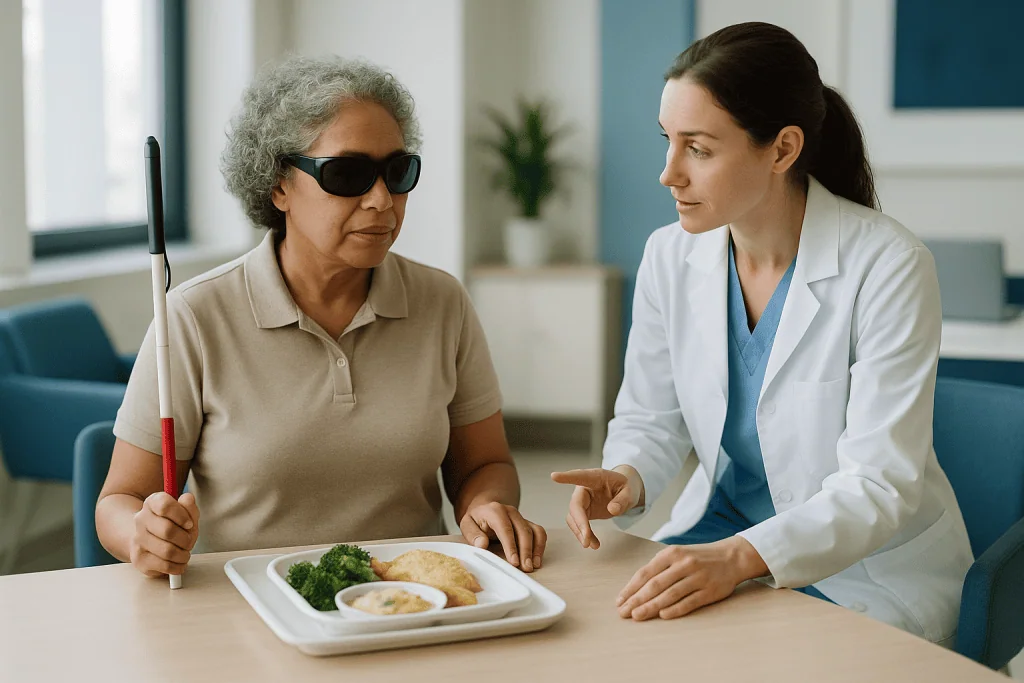
People who are usually asked to wait fall into a few groups. Someone with an active, treatable process, such as a cataract awaiting surgery or a retinal condition being treated with injections, may be told to complete that treatment first, because the final level of sight is not yet known and equipment fitted too early may not suit the outcome. Anyone in the acute phase after a stroke is often assessed later, once swelling has settled and the visual field has stabilized. Children are referred through pediatric ophthalmology and educational services, where the emphasis is on development and school rather than adult independence.
Waiting is not the same as doing nothing. Basic contrast and lighting changes at home carry no risk and are frequently suggested while treatment continues. The decision about timing, and about which strands of rehabilitation are appropriate, sits with the treating eye team, who will weigh how stable the condition is, what the person needs to do, and what other health issues, such as hearing loss, hand tremor, or memory problems, might shape the training.
One point worth pressing: you do not have to be registered as legally blind to qualify. Many people struggle for years assuming they are not bad enough, when the threshold for help is functional difficulty, not a label.
Why contrast often matters more than magnification when living with low vision
Ask most people what would help failing sight and they say bigger. Bigger print, bigger screens, a stronger magnifier. Magnification does help with fine detail, but a surprising amount of daily frustration comes from a different problem: contrast sensitivity, the ability to tell an object from its background when the two are similar in brightness or color.
Contrast is the difference in light reflected by an object and what sits behind it. Black print on white paper is high contrast. Grey text on a pale grey website is low contrast. Many eye diseases, including macular degeneration, glaucoma, and diabetic retinopathy, reduce contrast sensitivity before or alongside the loss of sharpness. Cataract scatters light inside the eye, washing everything toward a uniform haze. The result is that a person may read a large-print book perfectly well yet fail to see a clear glass of water on a white tablecloth, or the edge of a cream-colored step.
This explains why a magnifier does nothing for the step. Making the step bigger does not make its edge darker. Contrast strategies work by changing the environment rather than the eye: choosing objects and backgrounds that differ sharply in brightness, and lighting them so that difference is visible. The Mayo Clinic notes that people with dry macular degeneration commonly report needing brighter light and struggling to adapt to dim rooms, which is the same mechanism seen from the inside.
There is an opinion buried in this section, and it is this: if you can only change one thing this month, change contrast before you buy another device. It is cheaper in effort, it prevents falls as well as spills, and it works for everyone in the household, including visitors whose eyes are fine but whose attention is elsewhere.
Contrast strategies for the kitchen and table
The kitchen is where contrast lessons are easiest to test, because the feedback is immediate: the coffee either lands in the cup or it does not.

Start with the pouring rule. Light liquids go into dark containers and dark liquids into light ones. Milk in a navy mug, coffee in a white one, water in a colored glass. If you own a set of clear glasses, one dark placemat under them restores the edge. For hot drinks, a liquid level indicator, a small device that hangs on the rim and buzzes when fluid reaches its prongs, removes the guesswork entirely and is safer than watching steam.
Cutting boards should come in pairs, one dark and one light, so that onions are chopped on the dark one and beets on the light one. The same logic applies to plates. A plain dark plate on a pale cloth makes rice and chicken visible; a patterned plate destroys contrast whatever its color. Some people keep one colored plate for themselves without changing the family set, which avoids the feeling that the whole house is being redecorated around a diagnosis.
Labels are the third front. Tactile bump dots, small raised stickers, on the stove dial at the settings you use most, on the microwave start button, and on the salt rather than the sugar, let fingers confirm what eyes suspect. Elastic bands around one of two similar bottles do the same job at no cost in equipment. When you decant dry goods, use containers that differ in shape, not just labels that differ in print.
Practice deliberately for the first week or two: pour with the indicator, then check by touch. Chop on the dark board, then look at the pale one and notice what you would have missed. The point is to feel the difference, because habits built on a felt difference last longer than habits built on a handout.
Contrast around the home: stairs, doorways, and bathrooms
Outside the kitchen, contrast mainly prevents falls and speeds up wayfinding. Stairs are the priority. A strip of high-contrast, non-slip tape along the leading edge of each step, or at minimum the top and bottom steps, turns a beige blur into a series of readable lines. Choose a color that differs from both the tread and the wall; yellow on dark carpet or dark on pale carpet both work, but the tape must run the full width so the edge reads as a continuous line.
Doorways and switches come next. A dark frame around a light door, or a contrasting plate around a light switch, lets you find them from across the room instead of by touch. In the bathroom, a colored bath mat, a dark toothbrush against a white sink, and a strip of contrast at the edge of the tub can prevent the hesitations that lead to slips on wet tile.
| Everyday task | Typical low-contrast problem | Contrast fix to practice |
|---|---|---|
| Climbing stairs | Tread and riser same color | Non-slip tape on step edges, full width |
| Finding the light switch | White plate on white wall | Dark switch plate or contrasting frame |
| Pouring water | Clear glass on pale counter | Dark placemat or colored glass |
| Reading a pill label | Small grey print on white | Large black label on white card, kept in one place |
| Stepping into the tub | White tub, white floor | Colored mat and contrast strip on tub rim |
| Sitting down | Pale chair on pale carpet | Dark throw over seat edge |
None of this requires renovation. It requires walking through the house with one question: where does an edge disappear? Do it once in daylight and once after dark, because the answers differ.
Lighting and glare: the other half of contrast
Contrast is only half the story, because contrast is invisible without the right light and destroyed by the wrong kind. Many people with low vision need more light than before, yet find bright light painful. Both are true, and the solution lies in where the light comes from rather than how much there is.
For reading and close work, an adjustable task lamp positioned to the side of the reading hand, a little below eye level and pointed at the page rather than the face, gives strong illumination without shining into the eye. Overhead light alone tends to cast the reader’s own shadow on the page. A gooseneck lamp that can be moved is more useful than a fixed fitting, because the ideal position changes with the task.
Glare is scattered light that washes out detail. It comes from shiny floors, glossy magazine paper, uncovered windows, and bare bulbs. Matte surfaces, a sheet of dark paper under a glossy page, and blinds that can be angled all reduce it. Outdoors, a wide-brimmed hat and tinted lenses cut the glare that makes a sidewalk curb vanish on a sunny day; the low vision specialist can advise on tint color, since preferences vary by condition.
Night is its own problem. Eyes with retinal disease adapt slowly to darkness, so a hallway that is fine at noon becomes a hazard at two in the morning. Plug-in night lights along the route from bed to bathroom, left on all night, are among the highest-value changes a household can make. Pause for a moment at the doorway when moving from a lit room to a dark one; the brain needs a few seconds to adjust, and hurrying that step is how ankles get turned.
Practice tip: sit in your usual reading chair, turn the lamp through several positions, and notice at which angle the print seems darkest. That angle is your setting. Mark the lamp’s base with tape so it goes back there.
What is orientation and mobility training, and why does it continue at home?
Orientation and mobility training, often shortened to O&M, teaches two linked skills. Orientation is knowing where you are and where you are going, using landmarks, mental maps, and clues from sound, smell, and touch. Mobility is moving there safely, with or without a cane, guide dog, or human guide. The NHS describes this kind of training as one of the core supports offered to people with sight loss, alongside help with daily living and emotional support.
The indoor skills come first. Trailing means running the back of the hand lightly along a wall or counter to follow a line and detect openings. Protective techniques use a forearm raised across the upper body, or a hand held low, to find obstacles before the face or shins do. Systematic search means sweeping a surface in an organized pattern, left to right, near to far, instead of patting randomly for the dropped keys. Room familiarization means walking the perimeter once, then the middle, building a map by touch and step count.
Outdoor skills add the long cane, street-crossing analysis, using traffic sound to judge parallel and perpendicular flow, and the sighted guide technique, in which the person with low vision holds the guide’s arm just above the elbow and walks half a step behind.
Why must this continue at home? Because orientation is memory, and memory fades without use. A route walked with an instructor twice is a route half-learned. The instructor’s role is to teach the method; your role is to apply it to your own hallway, your own bus stop, your own grocery store. Skills practiced in the environment where they will be used stick far better than skills practiced in a corridor at the clinic. That is not a criticism of clinics. It is how motor learning works.
Practicing orientation skills indoors and out: landmarks, trailing, and routes
Begin with one route you use every day and make it perfect before adding another. For most people that is bed to bathroom at night. Walk it with eyes open in daylight and name the landmarks aloud: the edge of the bed, the dresser corner, the change from carpet to tile, the door frame. Then walk it in dim light, trailing the wall with the back of the hand, counting steps between landmarks. Then walk it as you would at night. Do this for several days until the count is stable and the hand finds the frame without searching.
Indoors, keep landmarks permanent. A chair that migrates is a landmark that lies. Households where furniture stays put and doors are kept fully open or fully closed, never ajar, are safer for everyone. Cabinet doors left half open at head height are a classic cause of cuts.
The clock-face method transfers from the plate to the room. Describe positions as hours: the sink is at twelve, the fridge at three, the door at nine. Family members can use the same language, which is more useful than the vague gesture that usually accompanies the phrase over there.
Outdoors, choose one route, perhaps to a mailbox or a neighbor’s house, and analyze it the way the instructor did. Where does the sidewalk change texture? Which driveway slopes? Where does traffic noise change direction? Walk it at the same time of day several times before varying conditions, then try it in overcast light, then in bright sun with glare, then at dusk. If a cane was prescribed, use it on every outdoor trip, not only the difficult ones; a cane used occasionally never becomes an extension of the arm. The sighted guide technique deserves practice too, ideally with the family member who most often walks with you, so both of you learn the pause before a curb and the narrowing of the arm before a doorway.
How can I cope with vision loss in one eye?
Losing sight in one eye is a distinct situation, and people often feel it is dismissed because the other eye still sees well. Acuity may be perfectly normal on the chart. The difficulties are elsewhere: depth perception and the width of the visual field.
Depth perception comes partly from the two eyes viewing an object from slightly different angles, a process called stereopsis. With one eye, that cue is gone, and the brain leans on others: relative size, shadows, perspective, and the way objects move against each other as the head turns. These cues can be learned to compensate to a useful degree, though judging fine distances, such as a pouring stream into a cup or a step down from a curb, stays harder than it was. Contrast strategies help here directly, because a clear edge gives the remaining cues more to work with.
The field loss is on the side of the affected eye. Objects approaching from that side appear later, so people bump shoulders in doorways and are startled by cars at crossings. The practical answer is a deliberate head turn toward the blind side, made a habit at every doorway, every intersection, and before every lane change if driving is still permitted. Whether it is permitted depends on local licensing rules and the treating team’s assessment; monocular vision alone does not automatically bar driving in many places, but it does require honest review.
Everyday tactics: touch the rim of the cup with the spout before pouring; use handrails on the blind side; place items on a shelf by sliding them along the surface rather than lowering them through air. Protective eyewear for the good eye during sports, yard work, and anything involving flying debris becomes non-negotiable, because there is no longer a spare. Ask the eye team specifically about this; it is the single most important piece of advice for anyone with one working eye.
Keeping low vision aids in daily use rather than in a drawer
Every low vision specialist knows the drawer. It is where the magnifier fitted at assessment ends up when it turns out to be slightly awkward, and the person goes back to squinting. Devices only help when they are within reach at the moment of need, so the practice challenge is not learning to use them but arranging life so that using them is easier than not.
Place-based storage is the answer. The hand magnifier lives beside the reading chair, not in a bag. A second, cheaper one lives in the kitchen for labels. A pocket magnifier lives in the coat that goes shopping. Electronic video magnifiers, which enlarge text on a screen and can reverse it to white-on-black for higher contrast, stay set up on a desk with the lamp already positioned. If a device is used for one task, keep it where that task happens.
Matching the device to the task matters more than owning the strongest one. Higher magnification means a smaller field of view and a shorter working distance; a very strong magnifier that shows three letters at a time is exhausting for a novel and perfect for a serial number. The specialist will have explained this, but the lesson tends to be relearned by trial, and that is fine.
Non-optical aids deserve the same treatment. Large-print calendars, bold felt-tip pens, high-contrast keyboard stickers, talking clocks, and smartphone accessibility settings such as enlarged text, voice output, and inverted colors all count. Set the phone up once, properly, and it becomes the most-used low vision aid you own. Ask a family member or the rehabilitation service to walk through the settings; most operating systems have a dedicated accessibility menu, and the changes are reversible.
Review what you actually use after a month. Anything untouched should go back to the specialist with an honest report of why, because a different device or a different technique may fit better.
What the first weeks after rehabilitation usually look like
The pattern is familiar to therapists and worth knowing in advance so it does not feel like failure. The first days are often marked by enthusiasm and fatigue in equal measure. New habits demand conscious attention, and conscious attention is tiring in a way that automatic movement is not. People describe being worn out by lunchtime after a morning of deliberately trailing walls and checking contrast. That tiredness is the cost of learning, not a sign the strategies are wrong.
Somewhere in the second or third week the novelty fades and the temptation to revert appears. The cane stays by the door because the trip is short. The magnifier stays in the drawer because the label is probably fine. This is the moment that decides most outcomes, and the useful move is to shrink the task rather than abandon it: practice one route, not four; fix one room’s lighting, not the whole house.
Emotional weather is variable. Grief for lost sight can resurface precisely because rehabilitation makes the loss concrete; there is nothing like buying a dark cutting board to confirm that your eyes are not going back. Frustration, irritability, and low mood are common, and the NHS lists emotional support and talking to others with sight loss among the recommended supports, not optional extras.
Follow-up is usually built in. Many services schedule a review to adjust devices and check on skills, and most welcome a call between appointments when something is not working. Use it. A cane technique that hurts the wrist, a lamp that still glares, a route that never feels safe, all have solutions that are faster to find with the instructor than alone.
By the end of the first couple of months, the goal is not perfection. It is that the night route, the coffee, and the stairs no longer require thought. Everything else builds from there.
Is low vision a disability? Coping with vision loss and the emotional side
Yes, in both the legal and the practical sense. Low vision that cannot be corrected and that limits daily activities meets the definition of disability in most legal frameworks, which is why people are entitled to workplace and educational accommodations, accessible formats, and, in many countries, registration that unlocks specific services. The NHS describes two levels of registration in the United Kingdom, sight impaired and severely sight impaired, both of which bring practical entitlements. Other countries have parallel systems.
Many people resist the word because it sounds like a verdict. It is better understood as a key. Registration and disclosure open doors: audio-described television, reduced-fare transport, screen-reader software at work, priority seating, and access to the very rehabilitation services described here. Refusing the label often means refusing the help.
How do people cope? The honest answer from those who have done it is that coping is not a single act but a set of small routines, and that the routines get easier. Structure helps: a predictable home layout, fixed places for keys and glasses, a phone set up for voice. Connection helps: peer groups, whether in person or online, where the tricks are traded and the frustrations are understood without explanation. Purpose helps: continuing to cook, garden, work, or volunteer, adapted rather than abandoned.
Depression and anxiety are more common after sight loss than in the general population, and they are treatable. If low mood lasts more than a couple of weeks, interferes with sleep or appetite, or brings a sense of hopelessness, it warrants a conversation with a doctor in its own right. Charles Bonnet syndrome, in which people with sight loss see vivid images that are not there, is a recognized phenomenon of the visual brain adapting, not a psychiatric illness, but it frightens people who have never heard of it. Ask about it. Knowing the name usually takes most of the fear away.
What people often get wrong about living with low vision
Using your eyes wears them out. It does not. Reading, watching television, and doing close work with low vision are tiring because of the effort, but they do not accelerate the underlying disease. Resting the eyes gives no protection, and avoiding tasks simply loses skills.
Stronger glasses would fix it. By definition, low vision is what remains after the best possible glasses or contact lenses. A new prescription may fine-tune things, but it cannot replace retinal cells that have stopped working. Magnifiers and contrast do a different job.
Rehabilitation is for people who are blind. Most people who use these services have some sight, often quite a lot. The threshold is difficulty with daily tasks, not darkness.
A white cane means you cannot see anything. Many cane users have useful vision. The cane detects surface changes and drop-offs that residual vision misses, especially in glare or at dusk, and it signals to others that a person may not see them coming.
Contrast is about color. It is mostly about brightness. A red plate and a green cloth can be nearly identical in brightness and therefore invisible to someone with reduced contrast sensitivity. Dark against light, or light against dark, is the rule; the hue matters much less.
Supplements or exercises can restore lost sight. For certain stages of age-related macular degeneration, a specific antioxidant and mineral formulation studied in large NIH trials was associated with slowing progression, and the treating ophthalmologist can advise whether it applies; it does not restore vision already lost. Eye exercises marketed for vision loss have no good evidence behind them. Eccentric viewing training is different: it teaches the brain to use remaining retina, and it is part of legitimate rehabilitation.
Sudden changes are just the condition progressing. Sometimes. Sometimes they are something new and time-sensitive. That is the subject of the final section.
Questions to ask your care team
Rehabilitation appointments move quickly, and the questions that matter most tend to surface on the drive home. Writing them down in large print beforehand, or recording the answers with permission, helps.
- Which part of my vision is affected, central or peripheral, and what does that mean for the strategies I should prioritize?
- Is my condition expected to stay stable, and how often should my sight be rechecked?
- Would eccentric viewing training help me, and who teaches it?
- Which contrast and lighting changes should I make first, given my particular condition?
- Do I need orientation and mobility training, and is a cane appropriate for the places I go?
- Which of my devices is meant for which task, and what should I do if one is not working for me?
- How do I protect my remaining vision, including eye protection for the better eye if one is weaker?
- Am I safe to drive, and if not, what alternatives and entitlements are available?
- Should I be registered as sight impaired, and what does registration provide where I live?
- Whom do I contact between appointments if a technique is not working or a device needs adjusting?
- What symptoms should make me call urgently rather than wait for the next review?
- Are there peer support groups or counseling services connected to this service?
Bring a family member who shares the home if you can. Contrast changes, furniture placement, and the sighted guide technique all work better when the whole household understands the reasoning, and a second set of ears catches details that fatigue causes the first to miss. Ask, too, for written summaries in a format you can actually read, whether that is large print, an emailed document you can enlarge, or an audio recording. Services that support low vision should be able to supply their own information accessibly, and it is reasonable to say so.
When to call your doctor
Rehabilitation assumes a stable condition. When the picture changes, the practice should stop and the eye team should hear about it, because several causes of new symptoms are time-sensitive and treatable only if caught quickly.
Contact your eye doctor or an urgent care service the same day if you notice any of the following: a sudden drop in vision in either eye; a new shadow, curtain, or dark area moving across part of your sight; a sudden shower of new floaters or flashes of light, which can signal a retinal tear or detachment; straight lines that have newly become wavy or distorted, which in someone with macular degeneration can indicate the wet form developing and, as the Mayo Clinic notes, warrants prompt review; sudden double vision; or severe eye pain with redness, nausea, or haloes around lights, which can indicate a sharp rise in eye pressure.
Seek emergency care immediately, and call emergency services, if vision loss comes with weakness or numbness on one side of the body, facial drooping, slurred speech, confusion, or a sudden severe headache. These are possible signs of stroke, and every minute matters.
Less dramatic changes still deserve a call within a few days: a gradual sense that a familiar route has become harder, that print you could read last month now defeats the magnifier, that glare has become intolerable, or that you have started seeing images or patterns that are not there. The first may reflect progression that needs reassessment of your devices; the last is often Charles Bonnet syndrome, which is not dangerous but should be confirmed by a clinician.
Call as well if you fall, even without injury, or if low mood or anxiety has settled in for more than a couple of weeks. Both are part of living with low vision and both are within the care team’s remit. Whether a change means a new treatment, an adjusted device, or simply reassurance is a judgment for the clinicians who know your eyes, and no strategy in this article replaces that conversation.
Frequently asked questions
Is having low vision a disability?
Yes. Low vision that cannot be corrected and limits everyday activities meets the definition of disability under most legal frameworks, which entitles people to workplace and educational accommodations and, in many countries, to formal registration. The NHS describes sight impaired and severely sight impaired categories in the UK. Treating the label as a key rather than a verdict opens access to rehabilitation, accessible formats, and transport and financial supports.
Can low vision be improved?
The eye condition itself usually cannot be reversed once the damage is permanent, but how well a person functions can improve substantially. Rehabilitation trains the brain to use healthier parts of the retina, matches devices to tasks, and reorganizes the home around contrast and lighting. If an active, treatable cause such as cataract is present, the eye team addresses that first. Ask your ophthalmologist what is realistic for your specific diagnosis.
How do blind people cope with life day to day?
Mostly through routine, structure, and skills learned in rehabilitation: fixed places for belongings, consistent home layouts, tactile labels, audio and screen-reader technology, cane or guide-dog mobility, and a network of family and peers who understand the adaptations. Most people described as blind have some usable vision, so contrast and lighting strategies still matter. Emotional adjustment takes time, and peer support and counseling are recognized parts of the process.
How can I cope with vision loss in one eye?
Concentrate on the two things that change: depth judgment and the field on the affected side. Touch the cup rim before pouring, use handrails on the blind side, and make a deliberate head turn toward that side at every doorway and crossing. Protective eyewear for the good eye during sports and yard work is essential because there is no spare. Ask your eye team about driving rules where you live.
What is orientation and mobility training?
It is instruction in knowing where you are and moving safely there when sight is limited. Orientation covers landmarks, mental maps, and clues from sound and touch; mobility covers techniques such as trailing a wall, protective arm positions, long cane use, street-crossing analysis, and the sighted guide method. Specialists teach the methods, but the skills only become automatic when practiced on the routes you use every day.
Which low vision aids for daily living actually get used?
The ones kept where the task happens. A hand magnifier beside the reading chair, a second one in the kitchen, a pocket version in the coat, and a smartphone set up with enlarged text and voice output tend to stay in use. Devices stored in a bag or drawer are usually abandoned. Match magnification to the task, since stronger lenses show less at a time, and return anything unused to the specialist for a rethink.
Why can I read large print but still miss steps and spills?
Because sharpness and contrast sensitivity are separate abilities. Many eye conditions reduce the ability to distinguish an object from a similar-brightness background while leaving some capacity to resolve detail. A large black word on white paper is high contrast; a beige step edge against beige carpet is not. Magnification does nothing for the step, but a contrasting strip along its edge does.
What lighting is best for reading with low vision?
An adjustable task lamp positioned to the side, slightly below eye level and aimed at the page rather than the face, usually gives the most usable contrast with the least glare. Overhead lighting alone casts your own shadow on the page. Matte surfaces and angled blinds reduce reflected glare, and night lights along the bedroom-to-bathroom route help eyes that adapt slowly to darkness. Test lamp positions and mark the one that works.
Does coping with vision loss get easier over time?
For most people, yes, though not in a straight line. The first weeks after rehabilitation are tiring because every new habit needs conscious attention, and grief or frustration often resurfaces as the loss becomes concrete. Practicing one route or one room at a time, staying in touch with the rehabilitation service, and connecting with others who have sight loss all help. Persistent low mood should be discussed with a doctor.
Do eye exercises or supplements restore lost vision?
No. Eye exercises marketed for vision loss lack good evidence. For specific stages of age-related macular degeneration, an antioxidant and mineral formulation studied in NIH trials was linked to slower progression, and the ophthalmologist can say whether it applies to you; it does not bring back sight already lost. Eccentric viewing training is different: it teaches the brain to use remaining retina and is part of evidence-based rehabilitation.
References
- National Eye Institute (NIH): Low Vision
- MedlinePlus: Vision Impairment and Blindness
- NHS: Vision loss
- WHO: Blindness and vision impairment fact sheet
This article is for general information only and is not a substitute for professional medical advice. Please consult a qualified doctor about your individual situation.

More from the Blog

Shockwave Therapy for Plantar Fasciitis: What the Trials Show
Shockwave therapy shows moderate evidence of benefit for chronic plantar fasciitis. Randomized trials and meta-analyses find it relieves heel pain better than sham treatment…

Inside a Bobath Treatment Session: Guided Handling, Positioning and Task Practice
A Bobath therapy session is a hands-on neurological rehabilitation appointment, usually with a physiotherapist or occupational therapist, in which the therapist guides your movement,…
Who Is Vision Rehabilitation For? Making the Most of Remaining Sight After Vision Loss
Vision rehabilitation is for anyone whose sight loss cannot be fixed with glasses, contact lenses, medicine or surgery, and who finds reading, moving around,…

Physical Therapy Myths: No Pain No Gain, Machines Do the Work and Other Misconceptions
Physical therapy myths often come from a kernel of truth stretched too far. Some effort and mild, short-lived soreness can be part of rehabilitation,…

Magnifiers, Lighting and Electronic Aids: How Vision Rehabilitation Training Works
Low vision aids training is a rehabilitation program that teaches people with permanent, uncorrectable vision loss to use magnifiers, task lighting, contrast changes and…

What a Brain Injury Rehabilitation Program Covers: Movement, Thinking, Speech and Daily Skills
A brain injury rehabilitation program is a coordinated course of therapy that helps a person relearn movement, thinking, communication and everyday skills after a…