

Deep Brain Stimulation for Essential Tremor: What the Device Changes in Daily Tasks
Key Takeaways
- DBS for essential tremor places a lead in the ventral intermediate nucleus of the thalamus, the relay point in the brain circuit that generates action tremor.
- One lead steadies the opposite hand only, so people wanting both hands treated need two leads, which raises the chance of speech and balance side effects.
- Eating, drinking, writing, and dressing are the tasks that typically change most; head, voice, and leg tremor respond far less predictably.
- The device is usually switched on a few weeks after surgery, and a temporary lull in tremor before that comes from swelling around the lead, not from treatment.
- Focused ultrasound treats the same thalamic target by creating a permanent lesion without an incision, while DBS is reversible and adjustable but needs programming and battery care.
- Essential tremor keeps progressing after surgery, and the brain can adapt to stimulation over years, so benefit may lessen and require reprogramming.
Deep brain stimulation for essential tremor uses a thin electrode placed in the thalamus, connected to a small pulse generator under the skin, to deliver steady electrical pulses that quiet arm and hand tremor. Most people notice steadier eating, drinking, writing, and dressing once programming settles, while head, voice, and balance problems change far less. It manages tremor rather than treating its cause, and benefit can fade over years.
The soup arrives, and she looks at it the way other people look at a steep staircase. Two hands on the spoon, elbows braced on the table, a napkin already in her lap for the spill she knows is coming. Across from her, a friend keeps talking, kindly pretending not to watch. Later there is a form to sign at the pharmacy counter, and the clerk offers to fill it in for her.
Moments like these, more than any tremor score on a clinic chart, are what bring people to a neurologist’s office asking about deep brain stimulation for essential tremor. The question is rarely phrased in medical language. It sounds more like: would I be able to drink coffee from a full mug again?
This explainer answers that question task by task, without overselling. It covers what the device does inside the brain, what it changes at the breakfast table and the bathroom mirror, what it leaves untouched, and how to weigh the risks with the team who knows your history.
How deep brain stimulation for essential tremor actually works
Essential tremor is an action tremor, meaning the shaking appears when a limb is working, such as reaching for a glass, and eases when the arm is resting. The rhythm is generated by an overactive loop of nerve cells running between the cerebellum, the thalamus, and the motor cortex. The thalamus is a relay station deep in the center of the brain that passes movement signals up to the surface. One small part of it, the ventral intermediate nucleus, sits squarely in that tremor loop.
Deep brain stimulation, usually shortened to DBS, places a thin insulated wire called a lead into that nucleus. The lead carries several metal contacts at its tip. A cable runs under the skin of the scalp and neck to a pulse generator, a device about the size of a stopwatch that sits beneath the skin below the collarbone. The generator sends a continuous train of tiny electrical pulses, many per second, into the tremor circuit.
Why would adding electricity calm an overactive circuit? The honest answer, according to the National Institute of Neurological Disorders and Stroke, is that the mechanism is not fully settled. The leading explanation is that high-frequency pulses override the abnormal rhythmic firing, a bit like white noise drowning out a repeating drumbeat. The cells do not stop working; they stop synchronizing into a tremor.
Three features of this design matter for daily life. The effect is adjustable, because a clinician can change which contacts are active and how strong the pulses are. It is reversible, because the device can be turned off and the leads removed. And it is one-sided in effect: a lead in the left thalamus quiets the right hand, so someone who wants both hands steadier needs two leads or a second surgery later.
Eating and drinking: what changes at the kitchen table
Ask people what they most want back and the answer is usually not dramatic. A full cup of coffee. Soup without a straw. Peas that stay on the fork. These are the tasks essential tremor attacks first, because they demand a steady hand held away from the body, exactly the posture that provokes an action tremor.

This is also where stimulation of the thalamus tends to show its clearest effect. Mayo Clinic and Cleveland Clinic both describe DBS as most helpful for arm and hand tremor, and clinical rating scales used in studies include pouring water and drinking from a cup for that reason. Once programming has been adjusted over the first weeks, many people describe lifting a mug one-handed for the first time in years, or eating cereal without leaning their face down toward the bowl.
A few caveats keep this realistic. Fine finger movements, such as picking up a single pill or peeling a hard-boiled egg, often improve less than the larger arm movements. Fatigue, stress, caffeine, and a poor night’s sleep still amplify whatever tremor remains, just as they did before surgery. And because the device treats one side at a time, someone with a single lead may find the dominant hand steady while the other still shakes, which changes how they set the table rather than eliminating the problem.
Families sometimes notice a quieter shift: the person begins accepting dinner invitations again. Clinicians hear this often enough that some tremor questionnaires now ask about social eating alongside spilling. It is not a medical outcome in the strict sense, but for many households it is the one that matters most.
Handwriting, typing, and the signature problem
A signature is a small daily humiliation for many people with essential tremor. Banks question it. Pharmacies ask for a witness. Birthday cards go unsigned. Handwriting is a good test of the tremor because it combines a sustained arm posture with fine, rhythmic finger control, so it is one of the standard tasks assessed before and after treatment.
With DBS, handwriting frequently becomes legible again, and Archimedes spirals, the coiled drawing neurologists ask patients to trace, typically lose their sawtooth edges. Yet handwriting is also where two limits of the therapy show up plainly.
First, stimulation strength is a trade. Turning the pulses higher quiets more tremor but can spill current into neighboring fibers, causing tingling in the fingers or face, a pulling sensation, or slightly slurred speech. The programming clinician is always looking for a setting that steadies the pen without introducing those effects, and for some people the sweet spot leaves a little tremor behind.
Second, the thalamus does not know what a signature is. It reduces the oscillation; it does not restore practice. People who stopped writing by hand years ago often need weeks of deliberate use before their script looks like their own again. Occupational therapists sometimes suggest heavier pens or wider grips during that period, tools that still help even when tremor is well controlled.
Typing and phone use follow a similar pattern. Hitting one key instead of three becomes easier; touch screens stop registering double taps. Voice-to-text, which many people adopted out of necessity, often stays in the toolkit simply because it became a habit.
Grooming, dressing, and the bathroom mirror
The bathroom is a room of small precision tasks performed with the arms raised, and raised arms are where an action tremor is at its worst. Shaving with a blade, applying eyeliner, brushing teeth without hitting the gums, fastening a necklace clasp behind the neck: these are the jobs people quietly abandon or hand to a partner.
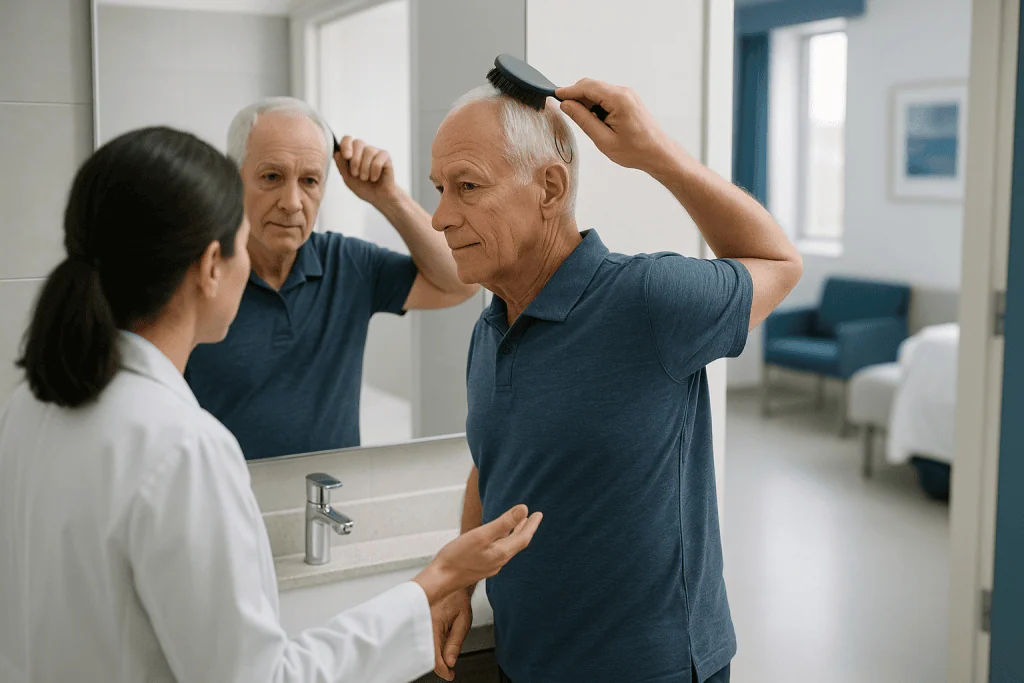
Because DBS targets arm tremor directly, this room often changes early. Cleveland Clinic lists improved ability to perform daily activities as a central goal of the procedure for essential tremor, and grooming sits at the heart of that. Someone who switched to an electric razor for safety may return to a blade; someone who stopped wearing earrings may put them back in. Buttons, zippers, and shoelaces, which require both hands to cooperate, depend on which side is stimulated. With one lead, the steady hand can stabilize the shaky one; with two, both improve.
The tremor’s response to posture matters here. Holding the arms up against gravity for a full minute, as when blow-drying hair, tires the muscles, and fatigue brings out residual tremor even in a well-programmed patient. Sitting at the mirror rather than standing is a low-tech adjustment that many people keep.
One less obvious change involves the settings themselves. Some pulse generators allow the person to switch between programs a clinician has saved, for example a slightly stronger program for a wedding day when steadiness matters most and a gentler one for ordinary days. How much control a patient has over this is decided by the treating team, and it is worth asking about before surgery rather than after.
What DBS usually does not change: head, voice, and legs
Essential tremor is not only a hand problem. Roughly half of people with it also have some head tremor, a nodding or side-to-side movement, and a smaller group notice a quaver in the voice or a tremor in the chin, trunk, or legs. Mayo Clinic notes that the condition can affect the head, voice, and other body parts alongside the hands.
Here the news is more muted. Head and voice tremor arise from midline muscles, and stimulating one thalamus affects one side of the body, so one-sided DBS typically does little for them. Two-sided stimulation can help head tremor in some people, but it carries a higher chance of speech and balance side effects, which is why teams weigh it carefully. Voice tremor responds least reliably of all, and clinicians usually caution against expecting much change.
Balance deserves its own mention. Some people with long-standing essential tremor already walk a little unsteadily, and stimulation, especially on both sides, can worsen that. Someone hoping the procedure will fix a wobbly gait is likely to be disappointed, and a candid team will say so during the evaluation.
What does this mean for daily tasks? Drinking, eating, writing, and dressing are arm tasks, and those are the ones that shift. Reading without the page bobbing, speaking on the phone without a shaky voice, or feeling secure on stairs are different problems with different solutions, ranging from botulinum toxin injections into neck muscles to physical therapy. Knowing which category your most troublesome task falls into is the single most useful thing to work out before committing to surgery.
Who is usually offered deep brain stimulation for essential tremor, and who is asked to wait
DBS is not a first step. Mayo Clinic describes it as an option for people whose tremor is disabling and who have not had enough relief from medicines, or who cannot tolerate them. Two medicine classes are the usual starting point: beta blockers such as propranolol, which dampen the tremor circuit’s response to adrenaline, and certain anticonvulsants such as primidone. Whether, how, and for how long to try them is a decision for the prescribing clinician; this article describes the pathway, not a plan.
Teams generally look for several things before recommending surgery. The diagnosis should be secure, because tremors from other causes, including Parkinson’s disease, medication side effects, and thyroid disease, need different treatment. The tremor should be interfering with real tasks, not just visible. Brain imaging should show no structural reason the leads cannot be placed safely. And the person should be well enough to tolerate a surgical procedure and its recovery.
Who is asked to wait? People whose tremor is still mild and manageable with adjustments. People with untreated depression or memory problems, because those can worsen after brain surgery and cloud the ability to weigh risks. People taking blood thinners that cannot be paused safely, since bleeding is the main surgical danger. And people whose main complaint is head, voice, or gait tremor, for whom the expected benefit is smaller.
Age alone is rarely the deciding factor. Essential tremor tends to worsen slowly over decades, and many people are evaluated in their seventies or beyond. What matters more is overall health, realistic goals, and a support network for the weeks of programming visits that follow.
What happens on the day of DBS surgery, in plain language
The operation is usually done in two parts, sometimes on the same day and sometimes separated by days or weeks, depending on the team’s practice. The first part places the lead in the brain; the second connects it to the pulse generator in the chest.
Placing the lead relies on stereotactic surgery, a method that uses a rigid frame or a set of markers fixed to the skull, combined with MRI and CT scans, to map coordinates in the brain to within a millimeter or two. A small opening, roughly the diameter of a coin, is made in the skull. Through it the surgeon advances the lead toward the ventral intermediate nucleus.
Many centers do this part with the person awake but sedated, using local anesthetic on the scalp, because the brain itself does not feel pain and because an awake patient can be tested. The surgeon may ask the person to hold out an arm or draw a spiral while a test current is delivered. Watching the tremor fade in real time confirms the target; tingling in the lips or a slurred word tells the team the lead is a fraction too close to neighboring pathways and should be nudged. Some centers now place leads under general anesthesia using imaging alone, and either approach is standard.
The second part, connecting the generator, is done under general anesthesia. A pocket is made under the skin below the collarbone, and the cable is tunneled beneath the skin of the neck to join the lead. Mayo Clinic and Johns Hopkins both note the device is usually not switched on immediately, so the tremor is typically unchanged when the person wakes, apart from a temporary lull some people experience from swelling around the lead.
The following days and weeks: healing, programming, and the early lull
Most people go home within a day or two, with a sore scalp, a tender chest incision, and instructions to keep both dry. Headache and fatigue are common for the first week. Hair grows back over the small incisions, and the scar under the collarbone fades to a thin line.
Some people notice something puzzling in this stretch: their tremor is markedly better before the device is even turned on. This is often called the microlesion effect, a temporary calming caused by mild swelling around the freshly placed lead. It usually fades within days to weeks, and the tremor returns. Knowing this in advance spares a lot of alarm.
The device is typically switched on a few weeks after surgery, once swelling has settled, according to Mayo Clinic’s description of the process. That first programming visit is where daily life starts to change. A clinician uses a handheld programmer to try different contacts and pulse settings, watching the arm, asking the person to drink from a cup or draw a spiral, and adjusting until tremor drops without side effects. It is unhurried, and it is rarely finished in one session. Several visits over the following months are normal as the brain adapts and settings are refined.
What people can do during this period is largely ordinary. Walking, light housework, and desk work resume within days for most. Heavy lifting, contact sports, and anything that risks a blow to the head or chest are usually restricted for a few weeks while incisions heal. Driving depends on local rules, the anesthesia used, and how steady the person feels, so it is a question for the team rather than a fixed rule.
Focused ultrasound vs DBS vs medicines: essential tremor surgery options side by side
DBS is one of several ways to treat essential tremor, and people asking about the newest treatment usually mean focused ultrasound. That procedure uses hundreds of beams of high-intensity sound, guided by MRI, to heat and permanently destroy a small spot in the same thalamic nucleus that DBS stimulates. Because it creates a lesion, it is a form of thalamotomy, a term for any procedure that deliberately damages tremor-generating tissue. Older thalamotomies used a heated probe or focused radiation; the ultrasound version needs no incision.
The table below summarizes the trade-offs as described by the National Institute of Neurological Disorders and Stroke and Mayo Clinic. It compares approaches, not products or providers.
| Feature | Deep brain stimulation | Focused ultrasound thalamotomy | Medicines |
|---|---|---|---|
| What it does | Continuous electrical pulses interrupt the tremor circuit | Heat destroys a small area of thalamus | Dampen tremor signaling chemically |
| Reversible | Yes; adjustable and removable | No; the lesion is permanent | Yes; effects stop when stopped |
| Incision | Small skull opening plus chest pocket | None; scalp is shaved | None |
| Sides treated | One or both, in stages | Usually one side; second side considered cautiously | Both, to the extent it works |
| Ongoing needs | Programming visits, battery replacement | Few after recovery | Daily use, monitoring for side effects |
| Main concerns | Bleeding, infection, hardware problems, speech or balance changes | Numbness, unsteadiness, speech change; permanent if they persist | Fatigue, dizziness, sedation, limited effect |
Neither surgical approach is simply better. Reversibility and adjustability favor DBS, especially for people who may later need both sides treated. Avoiding implanted hardware and repeat programming favors ultrasound. Which fits a given person depends on their anatomy, other health conditions, and priorities, and that judgment belongs to the treating team.
Is DBS worth the risk? Complications in plain words
Every honest conversation about DBS includes a moment when the surgeon describes what can go wrong, and it is worth hearing that list before deciding rather than after. Cleveland Clinic and Mayo Clinic group the risks into three kinds.
The first is surgical. Passing a lead through brain tissue carries a small but real chance of bleeding, which can cause stroke-like symptoms ranging from temporary weakness to lasting disability. Infection can occur at the scalp, chest, or along the cable, and if it reaches the hardware the device sometimes has to be removed until the infection clears. Seizures around the time of surgery are uncommon but reported. These risks are why blood thinners, uncontrolled diabetes, and frailty prompt caution during evaluation.
The second is hardware. Leads can shift or break, cables can fracture, and generators can fail. Skin over the device can thin or erode, especially in slim people. Any of these may mean another operation.
The third is stimulation itself, and these are the effects people live with day to day. Tingling, slurred or softer speech, unsteadiness when walking, and a sense of muscle pulling are all possible, particularly at higher settings and with two-sided stimulation. Most can be reduced by reprogramming, but sometimes only at the cost of allowing more tremor back.
So is it worth it? That is not a question evidence can answer for an individual. What evidence can say is that DBS has been used for tremor for decades, that serious complications are uncommon in experienced hands, and that most people who proceed do so because their tremor has already taken more from them than the risks are likely to. A good team will help you hold both halves of that sentence at once.
Life after DBS surgery: batteries, magnets, airports, and MRI
Once programming settles, the device fades into the background of most days. It runs silently and continuously; there is nothing to feel. But an implanted electronic system does bring a few permanent housekeeping tasks.
Batteries are the main one. Pulse generators come in two broad types. Non-rechargeable units are replaced in a minor operation when they run low, a timeline Johns Hopkins describes as typically several years and Cleveland Clinic frames as roughly three to five for many devices, though it varies with settings. Rechargeable units last longer but require the person to hold a charger against the chest regularly, a routine that suits some people and irritates others. Which type is used is a discussion with the team, not a choice made from a brochure.
Electromagnetic fields deserve respect but not fear. Ordinary household appliances are fine. Strong magnets, some industrial equipment, and certain medical procedures such as diathermy, a deep-heating treatment, can interfere with or damage the device. Airport security arches and store theft detectors are generally passable, though people are often given an identification card to show and advised to walk through rather than linger. Mayo Clinic advises telling every clinician, including dentists, about the device before any procedure.
MRI is the question people ask most. Many modern systems are designed to allow MRI under specific conditions, but those conditions are strict, and older systems may not permit it at all. The rule is simple: never assume, always ask the DBS team first, and keep the device documentation somewhere findable.
People also carry a small patient controller. Depending on what the team has enabled, it may let them check the battery, turn the device off and on, or switch between saved programs.
DBS for essential tremor success rate: what the numbers really measure
Search for a success rate and you will find a range of figures, and it helps to know what they are measuring before trusting any of them. Most studies score tremor on a clinical rating scale, with items for arm posture, spirals, pouring, and handwriting, then report how much the score falls with stimulation switched on compared with off. Those studies, summarized in overviews from the National Institute of Neurological Disorders and Stroke and Johns Hopkins, consistently show large reductions in arm tremor for most people, which is why DBS remains an established therapy. They do not show elimination, and a percentage drop in a rating scale is not the same as a percentage of people who are satisfied.
Three things complicate a single headline number. First, essential tremor is progressive. A person who is steady at one year may find tremor creeping back over the following years, partly because the disease continues and partly because of a phenomenon often called habituation, in which the brain seems to adapt to the stimulation and the same setting produces less effect. Reprogramming can often recover some benefit; sometimes it cannot.
Second, published series come from specialized centers with careful patient selection, so results in a broad population may differ.
Third, the tasks that matter to you may not be the ones the scale weights heavily. Someone whose disability is mostly head tremor can have an excellent arm score and feel little better.
The most useful way to hear a success rate, then, is as a question back to the team: for someone with my pattern of tremor, my other conditions, and my goals, what has your own follow-up shown, and how long has it held?
What people often get wrong about deep brain stimulation
Because DBS sounds futuristic, it collects myths. A few come up in almost every consultation.
It is brain surgery, so it must damage the brain. The lead is thinner than a strand of spaghetti and is placed into a target that does not carry memory or personality. The surgical risks described earlier are real, but stimulation itself does not destroy tissue, which is one reason the effects can be reversed.
It fixes the tremor for good. Essential tremor keeps progressing after surgery, and stimulation may lose some effect over years. DBS manages the symptom; it does not change the underlying condition, and the word fix belongs nowhere in the conversation.
It is only for Parkinson’s disease. DBS was in fact first widely used for tremor, and essential tremor remains one of its most established indications, alongside Parkinson’s disease and dystonia.
You will feel the electricity. The pulses are far below the threshold of sensation when correctly programmed. Feeling tingling is a sign the settings need adjusting, not a normal part of the therapy.
The device does everything; nothing else is needed. Many people continue some medicine, use adaptive tools, or have physical therapy for balance. Stimulation is one component of a plan, and the plan is set by the team.
It works instantly. Many people expect to wake from surgery steady. The device is usually switched on weeks later and then refined over months. The lull some experience right after surgery is temporary swelling, not the treatment working.
Head and voice tremor will vanish too. As covered earlier, these respond much less predictably, and expecting otherwise is the most common route to disappointment.
Questions to ask your care team before deciding
A consultation goes better when you arrive with questions written down, because the conversation moves quickly and the answers shape everything that follows. These are the ones experienced tremor nurses say they wish more people asked.
- Which of my daily tasks do you expect to improve most, and which do you expect to change little? Ask specifically about head, voice, and balance.
- Are you recommending one side or both, and why? If one, which hand, and what would prompt a second lead later?
- Would focused ultrasound or another approach be reasonable for me, and what makes you favor one over the other in my case?
- Will the lead be placed awake or asleep, and how do you confirm the target?
- How many programming visits are typical in the first year, and how far will I need to travel for them?
- What type of pulse generator do you use, and what does that mean for battery replacement or charging?
- What are your own team’s complication figures for bleeding and infection?
- Which of my current medicines would change around surgery, and who manages that?
- Can I have MRI scans afterward, and under what conditions?
- What should my family watch for in the first weeks, and who do we call?
Bring someone with you. People consistently retain more when a second set of ears is in the room, and a partner often asks the practical question the patient forgot, such as who will drive to the programming appointments.
Finally, ask what happens if you decide not to proceed now. A good answer explains how the tremor is likely to change over time and what would make the team revisit the question. No decision about surgery should feel like a door closing.
When to call your doctor after DBS for essential tremor
Most recoveries are uneventful, but the team will want to hear about certain things straight away rather than at the next scheduled visit. Treat the following as reasons to call the same day or, for the most serious, to seek emergency care.
Emergency signs, because they may indicate bleeding in the brain or a stroke: sudden weakness or numbness of the face, arm, or leg, especially on one side; sudden trouble speaking or understanding; sudden severe headache unlike any before; confusion; a seizure; or a fall with a blow to the head.
Same-day calls, because they may indicate infection or hardware trouble: redness, warmth, swelling, or fluid leaking from the scalp or chest incision; fever; new pain along the cable in the neck; skin over the device becoming thin, shiny, or open; or a sudden return of full tremor, which can mean a lead has moved, a wire has broken, or the battery has failed.
Prompt but non-emergency calls: new or worsening slurred speech, tingling that does not fade, unsteadiness when walking, or a persistent pulling sensation in the face or limb. These often mean the settings need adjusting and can usually be handled at a programming visit brought forward.
Mood changes belong on the list too. Low mood, anxiety, or unusual irritability after DBS should be mentioned, not endured. They are recognized, usually manageable, and easier to address early.
Keep the team’s contact number and the device card together, and make sure whoever lives with you knows where they are. Every decision about adjusting, pausing, or removing the device, and about any medicine you take alongside it, rests with the clinicians who placed it and know your history.
Frequently asked questions
What is the success rate of DBS for essential tremor?
There is no single number, because studies measure change on tremor rating scales rather than counting satisfied people. Those studies, summarized by the NIH and Johns Hopkins, consistently show large reductions in arm tremor for most people, with head and voice tremor improving much less. Benefit can lessen over years as the condition progresses and the brain adapts to stimulation. Ask your team about their own follow-up results for people with your tremor pattern.
Is DBS worth the risk?
That depends on how much tremor is taking from your life and how you weigh uncommon but serious risks such as bleeding in the brain, infection, and hardware failure against the likely gain in arm steadiness. Stimulation side effects like tingling, speech change, and unsteadiness are usually adjustable. The procedure is well established, and most people who proceed do so after medicines have failed. The judgment is individual and belongs with you and your treating team.
What is the newest treatment for essential tremors?
Focused ultrasound thalamotomy is the newest widely available procedure. It uses MRI-guided sound beams to heat and permanently destroy a small area of the thalamus, with no incision. It treats one side at a time and cannot be adjusted or reversed. Newer DBS systems with directional contacts and sensing features are also in use. None of these is simply better; suitability depends on anatomy, other conditions, and priorities, which your care team will assess.
What is life like after deep brain stimulation surgery for essential tremor?
After the first weeks of healing and programming, most people describe the device fading into the background. Drinking from a full cup, eating soup, signing forms, and shaving or applying makeup often become manageable again. Ongoing tasks include programming visits, battery replacement or regular charging, carrying a device card, and checking before any MRI or medical procedure. Fatigue and stress still bring out residual tremor, and head or voice tremor may be unchanged.
Does DBS help head tremor and voice tremor?
Much less reliably than hand tremor. Head and voice tremor come from midline muscles, and one-sided stimulation has little effect on them. Two-sided stimulation can help head tremor in some people but raises the chance of speech and balance problems. Voice tremor is the least responsive. If head or voice tremor is your main problem, ask your team about alternatives such as botulinum toxin injections before deciding on surgery.
Is deep brain stimulation reversible?
Yes, in the sense that the device can be switched off and the leads and generator can be surgically removed, and stimulation itself does not destroy brain tissue. This distinguishes it from thalamotomy procedures, including focused ultrasound, which create a permanent lesion. Reversal is still surgery with its own risks, and the small track left by the lead remains. Reversibility is one reason teams may favor DBS when both sides might eventually need treatment.
Does DBS surgery hurt if I am awake?
The scalp is numbed with local anesthetic and sedation is given, so most people describe pressure and noise rather than pain during lead placement. The brain itself has no pain receptors. Being awake lets the surgeon test the target by watching your tremor fade as a test current is applied. The second stage, placing the generator in the chest, is done under general anesthesia. Some centers place leads entirely asleep using imaging.
How long does a DBS battery last for essential tremor?
Non-rechargeable pulse generators typically last several years, often quoted as roughly three to five depending on settings, before a minor operation replaces them. Rechargeable units last considerably longer but require regular charging through the skin. Higher stimulation settings drain batteries faster. Your team will explain which type they use and how to check remaining charge. A sudden return of full tremor can be a sign the battery has run down.
Can I have an MRI scan with a DBS device?
Often yes, but only under strict conditions set for your specific system, and some older systems do not allow MRI at all. Scanning without following those conditions can heat the leads or damage the device. Always tell the imaging department and your DBS team before any scan, and keep your device documentation accessible. Never rely on assumptions or general internet advice about MRI compatibility.
What happens if the DBS device is turned off?
The tremor returns, usually within seconds to minutes, because stimulation suppresses the tremor circuit rather than changing the underlying condition. This is why people are asked to turn the device off and on during programming visits so clinicians can compare. Some people with long-standing stimulation notice a brief rebound in which tremor feels worse than before for a short period. Turning the device off should only be done as advised by your team.
References
- Cleveland Clinic: Deep Brain Stimulation
- NIH National Institute of Neurological Disorders and Stroke: Tremor
- MedlinePlus: Essential tremor
This article is for general information only and is not a substitute for professional medical advice. Please consult a qualified doctor about your individual situation.

More from the Blog

Second Opinions in Neurodegenerative Diseases: When a Diagnosis Deserves Another Look
A neurodegenerative disease second opinion is a fresh review of your history, examination and test results by another neurologist, often one who focuses on…

Neuroinfectious Diseases Treatment: How Meningitis and Encephalitis Care Is Planned
A meningitis encephalitis treatment plan starts within minutes of suspicion, usually before tests confirm the cause. Doctors give intravenous antibiotics, and often an antiviral,…

Who May Be a Candidate for Peripheral Nerve Surgery? Injury, Compression and Tumor Cases
Peripheral nerve surgery is considered for three groups: people with a nerve that has been cut, torn or crushed and shows no sign of…
Can You Keep Working With Multiple Sclerosis? Fatigue, Heat and Pacing Strategies Explained
Many people with multiple sclerosis continue working, often for years, though the path varies with symptoms, job demands and disease course. Fatigue and heat…
Can Home and Work Routines Be Adapted in Motor Neuron Disease? Mobility Aids, Meals and Rest
Yes. Most people with motor neuron disease can adapt home and work routines for a considerable time by pacing activity, changing how meals are…

Questions to Ask Before Agreeing to a Cerebrovascular Disease Treatment Plan
Before agreeing to a cerebrovascular disease treatment plan, ask what the imaging showed (clot, bleed, narrowing or small vessel damage), why this option was…