Essential Tremor
Essential Tremor is a common movement disorder causing rhythmic shaking, often in the hands. Learn symptoms, diagnosis and treatment options.
Quick answer
Essential tremor is a neurological movement disorder that causes involuntary, rhythmic shaking, most often affecting the hands during everyday activities. Treatment depends on symptom severity and may include medication, lifestyle adjustments, and in selected cases procedures such as deep brain stimulation, with evaluation and care planned by neurology specialists at Acibadem in Turkey.
What is essential tremor?
Essential tremor is a neurological condition (a condition affecting the brain and nervous system) that causes rhythmic, involuntary shaking of parts of the body. The word “essential” in this context does not mean necessary; it is an older medical term meaning the tremor occurs on its own, without another disease causing it. The shaking most often affects the hands and arms, but it can also involve the head, voice, and, less commonly, the legs or trunk.
For many people asking “what is essential tremor,” the most important point is that it is one of the most common movement disorders worldwide, and it is not the same condition as Parkinson’s disease, although the two are sometimes confused. Essential tremor typically appears when a person is actively using the affected body part, for example, holding a cup, writing, or eating, whereas the tremor of Parkinson’s disease is more often present when the limb is at rest.
Essential tremor can begin at almost any age, but it most often starts in middle age or later, and it becomes more common as people get older. It can also appear in younger adults and, occasionally, in childhood, particularly when the condition runs in the family. Men and women appear to be affected in roughly similar numbers. The condition is usually slowly progressive, meaning the tremor may gradually become more noticeable over years or decades, although the pace varies widely from person to person.
Although essential tremor is not life-threatening, it can significantly affect daily activities, work, and social confidence, which is why understanding the condition and the available essential tremor treatment options matters for patients and families. In hospital settings such as Acibadem, essential tremor is typically evaluated and managed by the neurology department, sometimes together with neurosurgery when advanced treatments are considered.
Symptoms of essential tremor
The central feature of essential tremor is a rhythmic shaking that occurs mainly during voluntary movement or while holding a position against gravity. Doctors call these an action tremor (shaking during movement) and a postural tremor (shaking while holding a posture, such as keeping the arms outstretched). Common essential tremor symptoms include:
- Shaking of the hands or arms during tasks such as writing, drinking from a cup, using utensils, buttoning clothes, or applying makeup
- Head tremor, which may look like a repeated “yes-yes” (nodding) or “no-no” (side-to-side) movement
- Voice tremor, causing a shaky or quavering quality to speech
- Tremor on both sides of the body, although one side may be more affected than the other
- Worsening with stress, fatigue, caffeine, or strong emotions, and often temporary improvement with rest or relaxation
- Difficulty with fine motor tasks such as threading a needle, typing, or signing documents
In the early stage, the tremor may be mild and noticeable only during moments of stress or when performing precise tasks. Many people initially dismiss it as nervousness or tiredness. Over time, in many cases, the tremor can become larger in amplitude (the size of the shaking movement) and may begin to interfere with everyday activities such as eating soup, pouring liquids, or handwriting, which often becomes large, shaky, and difficult to read.
Symptoms can also differ by body region. Hand tremor is the most common presentation. Head and voice tremor tend to be more common in women and may appear with or without hand involvement. Leg or trunk tremor is less common. Some people notice that a small amount of alcohol temporarily reduces the tremor; this is a recognized feature of essential tremor, but doctors do not recommend alcohol as a treatment because of the risks of dependence and rebound worsening.
Importantly, essential tremor does not typically cause the other movement problems seen in Parkinson’s disease, such as marked slowness of movement, muscle stiffness, or a shuffling walk. If those features are present, doctors will usually consider other diagnoses.
Causes and risk factors
The exact essential tremor causes are not fully understood. Research suggests that the tremor arises from abnormal activity in brain circuits that help coordinate movement, particularly networks involving the cerebellum (the part of the brain at the back of the head that fine-tunes movement) and its connections to other brain regions. Why this abnormal activity develops in some people and not others remains an area of active study.
Several factors are recognized as being associated with essential tremor:
- Family history and genetics: Essential tremor frequently runs in families. When it does, it often follows an inheritance pattern in which a child of an affected parent has a substantial chance of developing the condition. This inherited form is sometimes called familial tremor. However, no single gene fully explains the condition, and many people develop essential tremor without any known family history.
- Age: Although essential tremor can begin at any age, it becomes more common and often more noticeable with advancing age.
- Environmental factors: Some studies have explored possible environmental contributors, but no environmental cause has been firmly established.
It is also important to distinguish essential tremor from an enhanced physiologic tremora normal, very fine tremor that everyone has, which can become more visible with anxiety, caffeine, low blood sugar, an overactive thyroid gland, or certain medications. Part of the diagnostic process is making sure the tremor is not being caused or worsened by these reversible factors, or by other neurological conditions.
Diagnosis
There is no single blood test or scan that proves someone has essential tremor. Instead, an essential tremor diagnosis is a clinical diagnosis, meaning it is based on the doctor’s assessment of the person’s history and a careful physical and neurological examination. A neurologist (a doctor specializing in the nervous system) will usually:
- Take a detailed history: when the tremor began, which body parts are affected, what makes it better or worse, whether relatives have tremor, and which medications, supplements, and caffeine-containing products the person uses.
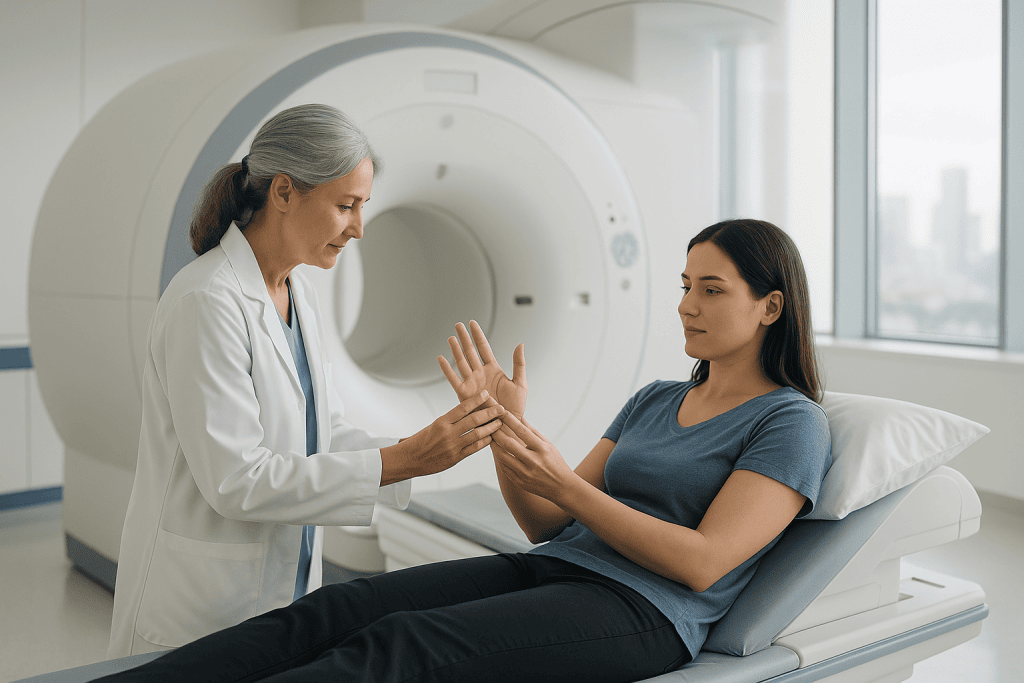
- Examine the tremor directly: the doctor may ask the person to hold the arms outstretched, pour water between cups, drink from a glass, write a sentence, or draw a spiral. These tasks help reveal the action and postural tremor typical of essential tremor.
- Perform a neurological examination: checking muscle tone, reflexes, walking pattern, and coordination to look for signs of other conditions such as Parkinson’s disease or cerebellar disease.
Doctors typically look for a tremor that affects both hands or arms during action, has been present for a sustained period, and is not explained by another neurological condition, medication, or medical illness. Depending on the situation, additional tests may be used to rule out other causes rather than to confirm essential tremor itself:
- Blood tests, particularly thyroid function tests, since an overactive thyroid can cause tremor. In younger patients, doctors may also check copper metabolism to exclude Wilson’s disease, a rare inherited condition.
- Medication review, because some drugs, including certain asthma medications, mood stabilizers, and stimulants, can cause or worsen tremor.
- Brain imaging such as MRI (magnetic resonance imaging, a detailed scan of the brain) is not routinely required but may be ordered if the examination suggests another condition.
- Specialized nuclear medicine scans of the brain’s dopamine system are occasionally used when it is difficult to distinguish essential tremor from Parkinson’s disease.
Because the diagnosis rests on careful observation over time, doctors may sometimes ask to reassess the tremor at follow-up visits before settling on a final diagnosis, particularly if the presentation is unusual.
Treatment options
There is currently no cure for essential tremor, but a range of treatments can reduce the shaking and improve daily function for many people. The choice of essential tremor treatment depends on how much the tremor interferes with the person’s life, their overall health, and their preferences. Options are generally considered in a stepwise way.
Watchful waiting and lifestyle measures
If the tremor is mild and does not interfere with daily activities, treatment may not be needed at all. Doctors often suggest practical measures first, such as reducing caffeine, managing stress, getting adequate sleep, and reviewing any medications that might be worsening the tremor. Occupational therapy can help with adaptive strategies and tools, for example, weighted utensils, wide-grip pens, and cups with lids, that make daily tasks easier.
Medications
When the tremor interferes with function or causes significant distress, medication is usually the first active treatment. Commonly used options include:
- Beta-blockers such as propranolol, a medication originally developed for heart conditions that can dampen tremor in many patients. It may not be suitable for people with asthma, certain heart rhythm problems, or very low blood pressure.
- Primidone, an anti-seizure medication that is also widely used for essential tremor. Side effects such as drowsiness or unsteadiness can occur, especially when starting treatment.
- Other medications, including certain anti-seizure drugs or, in selected cases, medications for anxiety, may be tried when first-line options are not effective or not tolerated.
Medications reduce tremor in many people, but the response varies, and some patients experience only partial improvement. Your doctor may adjust doses gradually or combine medications to find the best balance between benefit and side effects.
Botulinum toxin injections
For head or voice tremor in particular, doctors may consider botulinum toxin injectionssmall, targeted injections that temporarily weaken overactive muscles. Effects are temporary and injections need to be repeated periodically. Possible side effects include temporary muscle weakness near the injection site or, with voice treatment, a breathy voice.
Procedures and surgery
When tremor is severe and does not respond adequately to medication, procedural options may be discussed by a team that usually includes a neurologist and a neurosurgeon:
- Deep brain stimulation (DBS): a surgical treatment in which thin electrodes are placed in a specific area of the brain involved in tremor (most often part of the thalamus, a deep relay center in the brain) and connected to a small pulse generator implanted under the skin of the chest. The device delivers electrical stimulation that can substantially reduce tremor in many suitable patients. The settings can be adjusted after surgery. As with any brain surgery, there are risks, including bleeding, infection, and stimulation-related side effects, which the surgical team will explain in detail.
- Focused ultrasound thalamotomy: a newer, incision-free procedure that uses focused ultrasound waves, guided by MRI, to create a small, precise lesion (a tiny area of treated tissue) in the tremor circuit of the brain. It is typically performed on one side and can reduce tremor in the opposite hand. Possible side effects include temporary or, less often, persistent numbness, balance problems, or walking difficulties.
- Radiofrequency or radiosurgical thalamotomy: older or alternative lesioning approaches that are used less frequently but may be considered in specific circumstances.
Whether a procedure is appropriate depends on many individual factors, including the severity and location of the tremor, other health conditions, and imaging findings. At centers with movement disorder programs, including Acibadem, these decisions are generally made by a multidisciplinary team after a thorough evaluation.
Living with essential tremor and outlook
Essential tremor is a chronic condition, and for most people it tends to progress slowly over many years. The rate of progression varies considerably: some people experience only mild tremor for decades, while others find that the tremor gradually spreads to new body regions or becomes more disabling. Essential tremor does not shorten life expectancy, and it does not usually turn into Parkinson’s disease, although a small proportion of people with essential tremor may later develop other movement disorders, which is one reason ongoing follow-up can be helpful.
Living well with essential tremor often involves a combination of medical treatment and practical adaptation. Many people benefit from:
- Working with an occupational therapist to find tools and techniques for eating, writing, and dressing
- Planning demanding fine-motor tasks for times of day when the tremor is milder
- Limiting caffeine and managing stress, since both can amplify tremor
- Being open with family, friends, and colleagues, which can reduce the social anxiety that sometimes accompanies visible tremor
- Seeking support for mood symptoms, as anxiety and low mood are common in people with chronic tremor and can, in turn, worsen the shaking
It is honest to say that treatment outcomes vary. Many people achieve meaningful improvement with medication or procedures, but no treatment can be guaranteed to eliminate tremor entirely. Regular follow-up allows treatment to be adjusted as the condition or a person’s needs change over time.
Frequently asked questions
What is essential tremor in simple terms?
Essential tremor is a common brain-related condition that causes rhythmic shaking, most often of the hands, during movement or while holding a position, for example, when drinking from a cup or writing. It is not caused by another disease, it often runs in families, and while it can be bothersome or disabling, it is not life-threatening. It is a separate condition from Parkinson’s disease, even though the two are sometimes confused.
Can essential tremor be cured or go away on its own?
At present, there is no cure for essential tremor, and it does not usually go away on its own. In most cases it is slowly progressive, meaning the tremor tends to increase gradually over years. However, treatments, including medications, botulinum toxin injections, and procedures such as deep brain stimulation or focused ultrasound, can reduce the tremor and improve daily function for many people. Your doctor can help identify the approach that fits your situation.
How serious is essential tremor?
Essential tremor is not a fatal condition and does not damage other organs. Its seriousness lies mainly in how much it interferes with everyday life. For some people the tremor remains mild and manageable; for others it can make eating, writing, working, or speaking difficult and can affect confidence and mood. Because the impact varies so widely, doctors tailor treatment to how much the tremor affects each individual rather than to the tremor alone.
How is essential tremor different from Parkinson’s disease?
The tremor of essential tremor typically appears during action, such as reaching for an object or holding a cup, and often affects both hands, and sometimes the head and voice. Parkinson’s tremor, by contrast, is usually most visible when the hand is resting, often starts on one side, and is accompanied by other features such as slowness of movement and stiffness. A neurologist can usually distinguish the two through examination, and in uncertain cases specialized brain scans may help.
What triggers or worsens essential tremor symptoms?
Common factors that can temporarily worsen essential tremor symptoms include stress, anxiety, fatigue, caffeine, low blood sugar, and certain medications, such as some asthma drugs and stimulants. Cold environments and strong emotions can also make the tremor more noticeable. These triggers do not cause the underlying condition, but managing them, for example, by limiting caffeine and improving sleep, often helps reduce the day-to-day severity of the shaking.
Is essential tremor hereditary?
Essential tremor frequently runs in families, and having a parent or sibling with the condition increases the likelihood of developing it. When it is inherited, it is sometimes called familial tremor. However, the genetics are complex, no single responsible gene has been confirmed, and many people develop essential tremor with no affected relatives at all. Genetic testing is not currently part of routine essential tremor diagnosis.
What is the most effective essential tremor treatment?
There is no single treatment that works best for everyone. Medications such as propranolol or primidone are usually tried first and help many patients. If tremor remains severe despite medication, procedures such as deep brain stimulation or MRI-guided focused ultrasound may substantially reduce it in carefully selected patients. The most effective option depends on the tremor’s severity and location, your overall health, and your preferences, which is why decisions are made together with a neurologist.
When to see a doctor
Consider arranging a medical evaluation if you notice a new or worsening tremor, if shaking is interfering with eating, writing, working, or other daily activities, or if tremor is affecting your confidence or mood. A doctor can confirm whether the tremor is essential tremor or has another cause, and can discuss treatment if needed. Seek prompt medical attention if a tremor is accompanied by any of the following red-flag warning signs:
- Sudden onset of tremor or shaking that appears abruptly over hours or days
- Tremor on one side of the body at rest, especially with slowness of movement, stiffness, or a change in walking
- Weakness, numbness, or paralysis of the face, arm, or leg
- Sudden difficulty speaking, understanding speech, or swallowing
- Severe headache, confusion, or loss of consciousness accompanying the tremor
- Problems with balance, frequent falls, or marked unsteadiness
- Tremor that began after starting a new medication or after significant alcohol use or withdrawal
- Tremor with unexplained weight loss, rapid heartbeat, or heat intolerance, which may suggest a thyroid problem
Some of these signs, particularly sudden weakness, speech difficulty, or severe headache, can indicate a stroke or another neurological emergency and require immediate medical care. For gradually developing tremor without red flags, a routine appointment with a neurologist is usually the appropriate next step.
Medically reviewed by the Acıbadem International Medical Board September 2, 2026
See our medical review board →
Update history
- PublishedJune 8, 2026
- Medical review approvedSeptember 2, 2026
- Last content updateSeptember 2, 2026