

Dental Bone Grafts for International Patients: Planning the Healing Gap Between Two Trips
Key Takeaways
- A dental bone graft typically needs about three to nine months to mature before an implant can be placed, which is why grafted cases usually require at least two separate surgical visits.
- Cabin pressure does not act directly on a socket graft; the sinus is the exception, so sinus-lift patients receive specific and often longer restrictions on flying and nose-blowing.
- Bleeding risk is highest in the first 24 to 48 hours and swelling peaks around day two or three, so the first post-operative check is best done before any long flight.
- Dry socket pain usually begins one to three days after extraction, exactly the window when travelers want to board a plane, which is a strong argument for staying near the surgeon that long.
- The CDC links long journeys and recent surgery to higher blood clot risk, and suggests walking every two to three hours and flexing the calves in the seat.
- The go-ahead for the implant trip comes from a scan showing mature bone, so a second trip booked with a buffer, or confirmed after remote scan review, avoids wasted travel.
A dental bone graft usually needs roughly three to nine months to mature before an implant can be placed, so patients who travel for care commonly need two separate trips. Most people can fly once early bleeding has settled and the surgeon has checked the site, often within several days, but the safe gap, the flight timing and follow-up arrangements should be set by the treating team.
The spreadsheet had two columns: flights home and flights back. Between them sat a blank cell labeled “healing,” and nobody at the kitchen table knew what number to type in it. The extraction was straightforward. The graft was routine. The problem was the calendar.
That blank cell is the heart of dental bone graft travel planning. A graft is not the finish line; it is the foundation poured before the house goes up, and foundations need curing time that cannot be rushed with a return ticket. Patients who live hours from their surgeon face a version of this puzzle. Patients who live a continent away face it with time zones, visas and a dentist at home who did not do the surgery.
This explainer walks through what the graft does, how long bone realistically takes to knit, when flying is usually reasonable, what can go wrong in the gap, and who should be watching the site while you are away. The decisions belong to your treating team. The questions, at least, can be yours.
What a dental bone graft actually does, in plain language
A dental bone graft is a procedure that adds bone or bone-like material to the jaw so there is enough volume to hold a future implant. The jaw is not a static block. Once a tooth is lost, the bone that held its root no longer receives chewing forces, and the body gradually reabsorbs it. The ridge narrows and sinks, sometimes within the first year after extraction.
An implant is a titanium post that acts as an artificial root, and it needs a certain depth and width of healthy bone to hold firm. When the ridge has thinned too much, a surgeon rebuilds it first. According to the Cleveland Clinic, the graft material may come from the patient’s own body (autograft), a human donor (allograft), an animal source (xenograft) or a synthetic mineral (alloplast). Each works on the same principle: the material acts as a scaffold that the patient’s own bone cells climb into, remodel and eventually replace with living bone.
That replacement is the slow part. Blood vessels have to grow into the scaffold, bone-forming cells have to migrate along it and new mineral has to harden. A membrane, a thin barrier placed over the graft, is often used to stop fast-growing gum tissue from filling the space before the slower bone can. Dissolvable membranes break down on their own; some need a small procedure for removal.
The practical upshot for anyone planning around travel: the graft is biologically active for months. It is not healed when the gum closes over it. The gum may look settled in two weeks. The bone underneath is still being rebuilt long after the stitches are gone, which is exactly why the second trip cannot be booked by appearance alone.
Why dental bone graft travel planning usually means two trips, not one
Dental bone graft travel planning starts with one uncomfortable fact: the implant and the graft are often separated by a season or more. The Mayo Clinic describes dental implant surgery as a process that can take many months, because the bone must grow into and around the implant surface in a process called osseointegration, the biological bonding of bone to titanium. When bone is thin, a graft is done first, and the Cleveland Clinic notes that complete graft healing typically takes between three and nine months, and sometimes longer.
Some surgeons place a small graft and an implant in the same session when the defect is minor and the implant can still be held firmly by existing bone. Larger deficits, especially in the upper back jaw near the sinus, usually need a staged approach: graft, wait, implant, wait again, then the crown. Which path applies to you depends on what the surgeon sees on a three-dimensional scan, not on how many flights you are willing to take.
This is why a single “everything in one visit” itinerary is rarely realistic for grafted cases. The honest plan has at least two surgical visits and often a third for the final crown, with each gap defined by biology.
A useful mental model is to think of the trips as checkpoints rather than deadlines. Checkpoint one: the graft is placed and the first week of healing is observed. Checkpoint two: imaging confirms the bone has matured enough to hold an implant. Checkpoint three: the implant has integrated and the tooth can be built. Travel dates follow the checkpoints; the checkpoints should never be squeezed to fit the travel dates.
Who is usually a candidate for a graft, and who is asked to wait
Grafting is generally offered to adults whose jaw has lost enough bone that an implant could not be placed securely without it. Common reasons include a tooth missing for years, advanced gum disease that eroded the supporting bone, trauma, or a large tooth root whose extraction leaves a socket too wide for an implant to stabilize. The Cleveland Clinic lists all of these as typical indications.
The surgeon is equally interested in the factors that slow bone healing. Smoking reduces blood flow to the gums and is linked to higher rates of implant and graft failure. Uncontrolled diabetes impairs wound healing. Active gum disease anywhere in the mouth is a reservoir of bacteria that can seed a fresh graft. Patients taking medicines that affect bone turnover, such as certain drugs used for osteoporosis or cancer, need a conversation about jaw healing before any surgery. Radiation therapy to the head and neck is another reason for caution.
People in these groups are not automatically excluded. They are often asked to wait until the modifiable problems are addressed: gum disease treated, blood sugar stabilized, smoking paused around the surgical window. Younger patients whose jaws are still growing are usually asked to delay implants entirely until growth is complete, since an implant does not move with a growing jaw.
For international patients, the waiting list of prerequisites matters doubly. A gum-disease cleaning that would be a quick local appointment at home becomes a logistical event if it has to happen in another time zone. The sensible sequence is to have the general dentist at home deal with the preparatory work first, then travel for the surgical stage only once the mouth is ready. The treating surgeon should confirm that readiness, ideally from records sent in advance.
What happens on the day: extraction, graft and the membrane
The most common graft for a traveler is a socket preservation graft placed at the time of extraction. The idea is simple: fill the hole left by the root immediately so the ridge does not collapse during the months before the implant. Under local anesthetic, with or without sedation, the surgeon removes the tooth as gently as possible to keep the thin walls of bone around the socket intact.
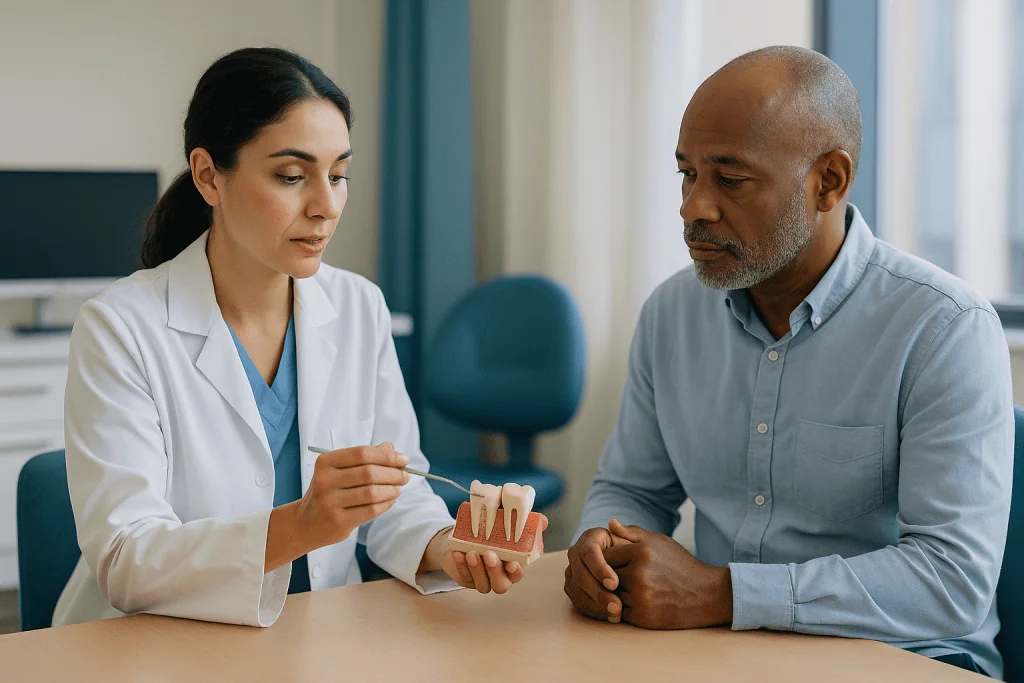
The socket is cleaned of any infected tissue. Graft material, which has the texture of coarse sand, is packed into the space. A membrane is laid over the top to keep gum cells out, and the gum is stitched closed or nearly closed. The whole addition typically adds minutes, not hours, to a routine extraction.
Ridge augmentation is a bigger operation for a jaw that has already shrunk. The gum is lifted, graft material is shaped against the existing bone, sometimes fixed with tiny screws or a rigid membrane, and the gum is stretched to cover it. A sinus lift, used in the upper back jaw, raises the floor of the sinus cavity and places graft beneath it; the Cleveland Clinic describes this as a way to create height where the sinus has expanded into the space the tooth roots once occupied.
Afterward you will likely be sent out with gauze, written instructions and an appointment for a check within the first week. Mild swelling, bruising and a dull ache are expected. Small granules of graft material sometimes work loose in the first days; a few grains in the saliva are common and not a sign of failure, though a steady loss should be reported. The surgeon’s written instructions, not a general article, govern what you may eat, how you rinse and when you brush near the site.
Is it safe to fly after a dental bone graft or implant surgery?
The question people type most often is whether flying after dental bone graft surgery is safe, and the honest answer is: usually yes once the early phase has passed, with the timing set by the surgeon. There is no authoritative rule that cabin pressure damages a graft. The mouth is not a closed air space in the way the middle ear or sinus is, so pressure changes on ascent and descent do not act directly on a socket graft.
The sinus is the exception worth naming. After a sinus lift, the membrane lining the sinus has been lifted and may be thin or repaired. Pressure changes, nose-blowing, sneezing with the mouth closed and the dry cabin air can all strain that membrane. Surgeons routinely ask patients to avoid flying for a longer period after sinus procedures than after a simple socket graft, and to follow specific instructions about not blowing the nose. That period should come from your own surgeon.
The more general concern is medical rather than dental. The CDC notes that both surgery and long-haul travel independently raise the risk of blood clots in the legs, and that flying too soon after any procedure can compound the two. A short oral procedure under local anesthetic carries a much lower clot risk than abdominal surgery, but a patient who sat through a long operation under sedation, then boards a nine-hour flight the next morning, has stacked two risk factors unnecessarily.
Practical reasons also favor waiting a few days: bleeding is most likely in the first 24 to 48 hours, swelling peaks around day two or three, and the first post-operative check catches early infection or a lost membrane while the surgeon who placed it can still act. Build those days into the itinerary rather than hoping to shave them off.
How long after a bone graft can you get implants? Typical healing ranges
Nobody can promise a date, but the ranges are reasonably consistent in mainstream sources. The table below gathers them. Every figure is a typical range, not a guarantee, and your surgeon may extend any of them based on imaging.
| Stage | What is healing | Typical range reported | Source |
|---|---|---|---|
| Soft-tissue recovery after grafting | Gum closure, swelling, soreness | Feeling back to normal within one to two weeks | Cleveland Clinic |
| Graft maturation before implant | Scaffold replaced by living bone | About three to nine months, sometimes longer | Cleveland Clinic |
| Implant osseointegration | Bone bonding to titanium | Several months, process often spans many months overall | Mayo Clinic |
| Sinus lift maturation | New bone forming beneath sinus floor | Several months, generally at the longer end before an implant | Cleveland Clinic |
Three things determine where in a range you land. The first is the size of the graft: a small socket preservation often matures faster than a large block or sinus augmentation. The second is the material; a patient’s own bone tends to integrate differently than a mineral scaffold, and surgeons choose with the timeline in mind. The third is the patient: smoking, blood sugar control and oral hygiene all shift the curve.
The decision to proceed to an implant is made on a scan, usually a cone-beam CT, which is a low-dose three-dimensional dental X-ray, taken after the expected waiting period. If the bone density looks immature, the surgeon waits longer. For a traveler, that means the second trip should be booked with a buffer or, where possible, after a scan taken near home has been reviewed remotely by the surgical team. A fixed return date set in advance is the single most common source of friction in staged treatment.
How likely is a dry socket with a bone graft?
Dry socket, known clinically as alveolar osteitis, is the painful condition that develops when the blood clot that should protect an extraction socket is lost or fails to form, exposing bone and nerve endings. The Mayo Clinic describes it as occurring in a small percentage of tooth extractions, more commonly after difficult removals such as impacted lower wisdom teeth, with pain typically beginning one to three days after surgery and often radiating toward the ear or temple.
Does a graft change the odds? The reasoning cuts both ways. A socket that is packed with graft material and covered by a membrane is physically protected, and the clot is held in place rather than sitting exposed. In that sense a grafted socket behaves differently from an empty one, and the classic picture of dry socket is less typical. On the other hand, a grafted socket can still become infected, and an infected graft produces pain and bad taste that patients often describe as dry socket even when the mechanism is different.
The known risk factors are the same with or without a graft: smoking or vaping, which both delay clot formation and introduce suction; oral contraceptives; poor oral hygiene; a history of dry socket; and vigorous rinsing, spitting or drinking through a straw in the first days. The Mayo Clinic lists these as modifiable contributors.
For the traveler the timing is the problem. Pain from dry socket or early graft infection appears in the exact window when many people want to be on a plane. Someone who flies on day one and develops throbbing pain over the Atlantic has no surgeon to call. This is one of the strongest arguments for keeping the first several days near the operating team, so that a simple medicated dressing or cleaning, if needed, can be done by the person who knows the site.
How to prepare for tooth extraction and bone graft before you leave home
Most of the preparation that protects a graft happens weeks before anyone picks up a scalpel, and most of it can be done at home. Start with a full dental examination and cleaning so that active gum disease is treated and the surgeon is not placing a graft into a mouth full of bacteria. Ask the home dentist for a copy of recent X-rays and a written summary of your dental history; the CDC’s guidance on receiving medical care abroad emphasizes carrying copies of medical records and a current medicine list.
Bring that medicine list to the surgical consultation. Blood thinners, drugs that affect bone turnover, immune-suppressing medicines and steroids all change how a surgeon plans. Never stop or alter a prescribed medicine on your own because you anticipate dental surgery; the prescribing clinician and the surgeon decide together.
If you smoke, the surgeon will probably ask you to stop for a period before and after the procedure, because nicotine constricts the small vessels that feed a graft. Chronic conditions such as diabetes should be as stable as possible, with recent blood test results available.
Logistics matter as much as biology. Arrange accommodation within reach of the surgery for the first follow-up check. Plan soft, cool, nutritious food for the first days; you will not want to shop for it with a numb lip. Pack any oral hygiene supplies the surgeon recommends and a small supply of clean gauze. If you had sedation, you will need someone to escort you back to your accommodation.
Finally, ask the surgeon to write down the plan: what was placed, which material and membrane were used, when the first check is, what the expected healing period is and who to contact outside office hours. That document becomes the bridge to whoever monitors you at home.
Dental bone graft travel planning: who watches the site while you are away
The weakest link in dental bone graft travel planning is not the flight. It is the months between trips when the surgeon is far away and the dentist nearby did not do the surgery. The CDC advises anyone receiving care abroad to arrange follow-up care before leaving, and to understand that complications may need treatment after returning home.
Set that arrangement up before the first trip, not after. Tell your home dentist that you are having a graft, and ask whether they are willing to do a visual check and, if needed, a radiograph during the waiting period. Some will; some prefer not to take responsibility for another clinician’s surgery. Knowing the answer in advance avoids a scramble when something feels off.
Ask the surgeon what they want monitored and when. A typical sequence is a check within the first week, a review once the gums have fully closed, and imaging toward the end of the expected maturation period to decide implant timing. The surgeon may be able to review a scan taken at home, which can turn the second trip from a hopeful booking into a confirmed one.
Secure the lines of communication. Written contact details for the surgical team, including an out-of-hours route, should be in your phone and on paper. Photographs of the site taken in good light can be surprisingly useful for a remote opinion, though they never replace an examination.
Insurance is the final piece people forget. Dental and medical coverage for grafting varies by plan and country, and travel insurance often excludes planned procedures and their complications. Ask both insurers for written confirmation of what is and is not covered, including follow-up and emergency treatment at home, before committing to a date. Neither this article nor your surgeon can answer that question for you.
Clot prevention, mobility and medicines during the journey home
The oral surgery itself is rarely the biggest medical risk of the trip. Sitting still for many hours is. The CDC reports that the risk of deep vein thrombosis, a blood clot in a deep leg vein, rises with journeys longer than about four hours, and that recent surgery is an added risk factor. Most people on a dental trip are at low baseline risk, but the basics are cheap and worth doing.
Move. The CDC suggests getting up and walking the aisle every two to three hours and exercising the calf muscles while seated by flexing the ankles and raising the heels. Choose an aisle seat if you can. Drink water; the dry cabin air dehydrates, and dehydration thickens the blood slightly and also dries the healing gum. Avoid alcohol on the flight, which worsens dehydration and can interact with any medicines you were prescribed.
Anyone with a personal or family history of clots, a clotting disorder, recent hormone therapy or significant obesity should raise this with the surgeon and, ideally, their own physician before booking a long flight soon after surgery. Compression stockings or other measures may be suggested by a clinician; they are not a decision to make from a magazine.
On medicines: if you were prescribed an antibiotic to protect the graft, the point is to keep a steady level in the blood for the full course, so time zones need thought. Ask the surgeon or pharmacist how to keep the schedule consistent across the journey rather than guessing. Pain relief is usually planned around the first few days, when discomfort peaks. Carry prescriptions in original packaging with a copy of the prescription, and check that any medicine you carry is permitted at your destination. All questions about which medicines, how much and for how long belong to the prescribing clinician.
Eating, hygiene and the long middle of the healing gap
Most of the healing gap is uneventful, and that is the goal. The first week is about protecting the clot and the membrane: soft foods, no straws, no vigorous rinsing, gentle brushing that avoids the surgical site, and whatever rinse the surgeon specifies. Chewing on the opposite side is standard advice. The Cleveland Clinic’s recovery guidance notes that most people feel back to normal within one to two weeks, though the bone underneath continues to mature for months.
From roughly the second week, the gum usually looks closed and attention shifts to keeping the area clean without disturbing it. Food trapping in the healing site is the most common nuisance; your surgeon may suggest a soft brush or a syringe for gentle cleaning once the tissue is strong enough. Dissolvable stitches typically fall out on their own; if non-dissolvable stitches were used, their removal should be scheduled before you leave or arranged with the home dentist.
Some patients wear a temporary tooth over the site, often a removable partial denture or a bonded false tooth, for appearance. Any temporary must not press on the graft, since pressure on immature bone can compromise it. If a temporary starts to rub or feel tight as swelling settles, that is a reason to contact a dentist, not to adjust it yourself.
The middle months are also the time to keep the rest of the mouth healthy. Gum disease elsewhere does not stay elsewhere. Regular cleanings at home, good brushing and interdental cleaning, and avoiding tobacco all tilt the odds toward a graft that is dense enough for an implant at the first planned attempt. Think of it as tending the whole garden rather than staring at one seedling.
What people often get wrong about grafts and travel
“Once the gum heals, the graft is done.” The gum closes in weeks; the bone matures over months. A socket that looks perfect at a mirror check may still be mostly scaffold on a scan. Only imaging tells the surgeon when it is ready.
“Cabin pressure will blow out the graft.” There is no evidence that air pressure damages a socket graft. The sinus is the one region where pressure matters, which is why sinus-lift patients get specific instructions about flying and nose-blowing. Everyone else is mainly waiting for bleeding and swelling to settle.
“A graft guarantees the implant will work.” It improves the odds of having enough bone to place an implant. It does not guarantee the implant will integrate. Smoking, hygiene and systemic health still matter at every stage, and some grafts do not mature as hoped and need to be repeated.
“Grafts always come from a cadaver.” Donor bone is one option among several. Autografts use your own bone, xenografts use processed animal mineral, and synthetic materials exist. Donor material is screened and processed to remove cells; what remains is a mineral scaffold your body replaces.
“If it hurts, it is a dry socket.” Pain after a graft can be normal early soreness, dry socket, infection, a lost membrane or a temporary tooth pressing on the site. The distinctions change the treatment, and a clinician, not a search engine, should make them.
“Two trips is excessive; a good surgeon does it in one.” Same-day graft-plus-implant exists for selected small defects. For most sinus lifts and large ridge rebuilds, staging is the evidence-based approach, not a sign of a cautious or slow surgeon. Bone grows at the speed of biology, wherever the clinic is.
Questions to ask your care team before booking anything
Good questions turn a vague itinerary into a plan the surgeon can endorse. Bring these to the consultation and write the answers down.
- What type of graft do I need, which material and membrane will be used, and why those?
- Is a same-day graft and implant an option for my case, or does staging make more sense? What would make you change your mind on the day?
- What is the expected maturation period before an implant, and what will you look for on the scan before giving the go-ahead?
- How many days after surgery do you want to see me before I travel, and what would delay that clearance?
- Is a sinus lift involved? If so, what are your specific instructions about flying, nose-blowing and sneezing, and for how long?
- Who do I contact if I develop pain, swelling or bleeding after I return home, including outside office hours?
- Can my home dentist take a scan that you will review remotely to confirm timing for the next trip?
- What should my home dentist know about this graft, and may I have a written summary to give them?
- Which of my current medicines affect the plan, and have you spoken with my prescribing physician about them?
- If the graft does not mature as hoped, what is the fallback, and how would that change the number of trips?
- What temporary tooth, if any, is safe to wear over the site, and how should it fit?
Notice that none of these ask for a promise. They ask for mechanisms, contingencies and communication routes. A team that answers them clearly is giving you the material to plan around biology rather than hope.
When to call your doctor: red-flag signs during the healing gap
Most grafts heal without drama, but a few signs should prompt a same-day call to the surgeon or, if you are far away, to a local dentist or urgent care. If you are unable to reach anyone, a hospital emergency department can assess a spreading facial infection or uncontrolled bleeding.
Contact a clinician promptly for any of these:
- Bleeding that does not slow with firm gauze pressure after a reasonable attempt, or that restarts heavily days after surgery.
- Pain that worsens after the third day instead of easing, especially a throbbing ache radiating to the ear or temple, which the Mayo Clinic describes as typical of dry socket.
- Swelling that keeps increasing after day three, spreads toward the eye, the floor of the mouth or the neck, or makes it hard to open the mouth fully.
- Fever, chills or feeling generally unwell.
- Pus, a persistent foul taste or bad smell from the site, or a steady stream of graft granules rather than a few stray grains.
- The membrane visibly coming out or the wound opening to expose grey or white material.
- After a sinus lift: a nosebleed, air or fluid passing between mouth and nose, or a sudden sense of pressure or fullness in the cheek.
- Numbness of the lip, chin or tongue that persists well beyond the expected wearing-off of the anesthetic.
Seek emergency care immediately for difficulty breathing or swallowing, swelling that threatens the airway, or chest pain, breathlessness or a swollen, painful calf after a long journey, which can indicate a blood clot. These are rare, but they are the reason to keep the first days close to care and to know your contact route before you leave.
Frequently asked questions
Is it safe to fly after getting dental implants or a bone graft?
Usually yes, once early bleeding has stopped and the surgeon has checked the site, which often means waiting a few days rather than flying the next morning. Cabin pressure does not act on a socket graft, but sinus-lift patients are typically asked to wait longer and avoid nose-blowing. Your own surgeon sets the timing based on what was done.
How long after a bone graft can you get implants?
Mainstream sources describe a maturation period of roughly three to nine months, sometimes longer, before an implant is placed into grafted bone. Small socket grafts tend toward the shorter end; large ridge rebuilds and sinus lifts toward the longer end. The actual decision is made on a three-dimensional scan showing that the bone is dense enough, not on the calendar.
How likely is a dry socket with a bone graft?
Dry socket affects a small percentage of extractions overall and is most common after difficult lower wisdom tooth removals. A grafted, membrane-covered socket is physically protected, so the classic exposed-bone picture is less typical, though graft infection can feel similar. Smoking, straws, vigorous rinsing and poor hygiene raise the risk regardless of whether a graft was placed.
Is bone grafting covered by medical insurance?
Coverage varies widely by plan, country and whether the graft is classed as dental or medical, and travel insurance often excludes planned procedures and their complications. The only reliable answer is written confirmation from your own insurers covering the graft, follow-up and any emergency treatment at home. Ask before committing to a date, not after.
How to prepare for tooth extraction and bone graft before traveling?
Have gum disease treated and teeth cleaned at home first, gather recent X-rays, a medical history and a full medicine list, and share them with the surgeon in advance. Never stop a prescribed medicine on your own. Arrange accommodation near the surgery for the first check, plan soft foods, and agree a written follow-up plan with your home dentist.
What does flying after dental bone graft surgery feel like?
Most people notice little beyond the ordinary soreness and swelling of the first week. Dry cabin air can make the mouth feel tight, so sipping water helps. Pressure changes may be felt in the cheeks after a sinus lift, which is one reason surgeons restrict flying longer after those procedures. Pain that escalates during a flight should be assessed on landing.
Can I get the graft and the implant in one trip?
Sometimes, when the defect is small enough that existing bone can hold the implant firmly while the graft fills the gap. Larger deficits, and most sinus lifts, are staged because the implant needs mature bone to integrate. The surgeon decides on the day based on how stable the implant feels, so even a planned single-stage case can become two trips.
Who checks my bone graft while I am home between trips?
Ideally your home dentist, by prior arrangement, with the operating surgeon available for remote advice and scan review. Set this up before the first trip, carry a written surgical summary, and keep the surgeon’s out-of-hours contact details. Some home dentists decline to monitor another clinician’s surgery, so confirm their willingness in advance rather than assuming.
What are the signs that a bone graft is failing?
Warning signs include pain that worsens after day three, increasing swelling, pus or a persistent foul taste, fever, the membrane coming loose, or a steady loss of graft granules rather than a few stray grains. Later, a scan may show the graft has not matured. Any of the early signs warrant a same-day call to a clinician.
Does smoking really matter for a few weeks around a graft?
Yes. Nicotine narrows the small blood vessels that must grow into the graft, delays clot formation and raises the risk of dry socket and graft failure. Surgeons typically ask patients to stop for a period before and after surgery. Vaping carries similar concerns because of nicotine and suction. How long to pause is a question for the treating team.
This article is for general information only and is not a substitute for professional medical advice. Please consult a qualified doctor about your individual situation.

More from the Blog
Getting Used to Removable Dentures: Speech, Sore Spots and Eating in the First Weeks
Most people need several weeks to get used to new removable dentures. During that time, speech usually sharpens with daily practice reading aloud, sore…
What a Well-Made Porcelain Crown Looks Like: Color Matching, Translucency and Gum Fit
A well-made porcelain crown blends with neighboring teeth in three ways at once: its color matches in brightness as well as shade, its edge…
When Does Socket Preservation Make Sense? A Small Dental Bone Graft Right After Extraction
A socket preservation graft is a small bone graft placed into the empty tooth socket immediately after an extraction to slow the natural shrinkage…
Dental Crowns for International Patients: Planning Two Visits, Temporaries and Follow-Up
Dental crowns for international patients are usually planned as two visits: the first shapes the tooth, records an impression and fits a temporary crown;…
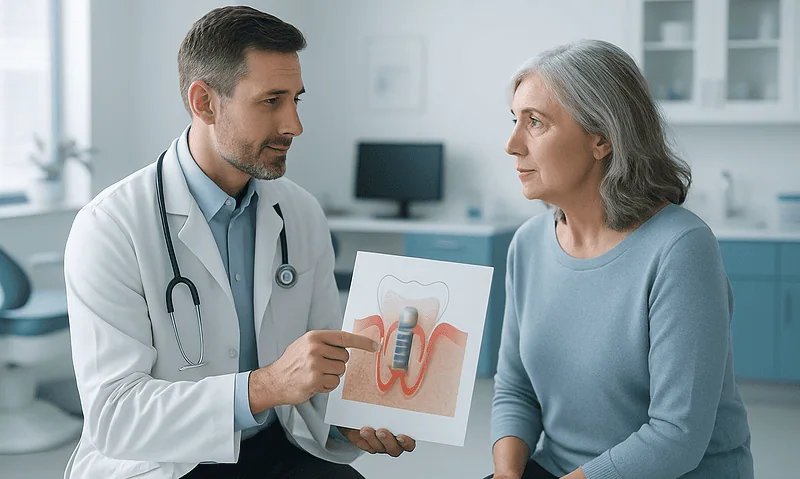
Peri-Implantitis Warning Signs: Bleeding, Pus and Implant Mobility That Mean a Prompt Visit
Peri-implantitis warning signs include gums around a dental implant that bleed when brushed or probed, redness or swelling, pus or a persistent bad taste,…
Getting Used to a New Dental Bridge: Sensitivity, Speech and Bite Adjustments in Early Weeks
The dental bridge adjustment period is the stretch of days to a few weeks in which a newly cemented bridge stops feeling foreign. Mild…