

What a Well-Made Porcelain Crown Looks Like: Color Matching, Translucency and Gum Fit

Key Takeaways
- Of the three dimensions of tooth color, brightness (value) is the one the eye forgives least, so a crown one step too light or dark stands out even when the hue is right.
- Natural front teeth grade from warm and opaque at the gum to lighter and slightly see-through at the edge, and a single flat shade of porcelain cannot copy that gradient.
- In dental ceramics, strength and translucency pull in opposite directions: zirconia is the strongest and least glassy, layered feldspathic porcelain the most lifelike and most fragile.
- A gray dark line at the gum usually comes from a metal crown core, a darkened root through thin gum, or a titanium implant abutment, each with a different remedy.
- Drying a tooth for even a few minutes makes it temporarily whiter and more opaque, which is why careful shade selection happens early in the visit and in indirect daylight.
- Cleveland Clinic cites a typical range of roughly five to fifteen years for how long crowns last, with material, tooth position and grinding habits shifting where in that range a crown falls.
A well-made porcelain crown blends with neighboring teeth in three ways at once: its color matches in brightness as well as shade, its edge lets light through like real enamel instead of looking flat or chalky, and it meets the gum in a smooth, sealed line with no gray shadow or gap. Dentists judge these features in natural light and adjust before final cementation.
The mirror comes up, the chair tilts back, and for a second nobody says anything. That pause, right after a new crown is tried in, is when most people decide whether the tooth looks like theirs or like something that was put there. Often the verdict arrives before they can explain why.
What the eye is reacting to is not a single quality. A porcelain crown natural look comes from color, the way light passes through the edge, and how the ceramic meets the gum. Miss one and the tooth reads as slightly wrong, even to a friend who could not name the problem.
This explainer walks through what a dentist and dental technician are actually trying to achieve, why a front tooth is harder than a molar, and what to look for in your own mirror. It applies whether the crown sits on a natural tooth or on a dental implant, the small titanium post that replaces a missing root.
Why a porcelain crown natural look starts with the tooth next to it
Nobody sees a crown in isolation. Your brain compares it, instantly and without permission, to the teeth on either side. So the first thing a careful dentist does is study those neighbors: how yellow the necks are near the gum, how gray or blue the biting edges look, whether there are faint white flecks or fine horizontal lines. A crown copies a family resemblance, not an ideal.
Natural teeth are not one color. Near the gum they are warmer and more saturated because the enamel is thin and the dentin underneath shows through. Dentin is the softer, more yellow inner layer of the tooth. Toward the edge, enamel thickens and the tooth becomes lighter and, on front teeth, slightly see-through. A crown made in a single flat shade ignores this gradient, which is one reason it can look pasted on.
Age matters too. Enamel wears and thins over decades, so older teeth tend to look darker and less translucent, with worn edges. A crown built with the bright, glassy edge of a twenty-year-old tooth will stand out in a fifty-year-old mouth. Matching means matching the person, not a catalog.
Position changes the stakes. A back molar can be somewhat off in shade and few people will notice. A front tooth sits in direct light every time you speak. This is why dentists often spend far longer on shade selection for a single upper incisor than for a molar, and why they may photograph the neighboring teeth with a shade tab in the frame for the technician who will build the crown.
If you are having several front teeth restored at once, the target shifts: now the crowns must match each other and the lower teeth, and a slightly brighter overall result may be reasonable. That is a conversation to have before any tooth is prepared, not after.
How a porcelain crown is made: what actually happens
A crown is a cap that covers the whole visible part of a tooth above the gum. Making one that looks right is a sequence of small decisions, and each affects the final appearance.
The dentist first shapes the tooth, removing a layer all the way around so the crown can sit over it without looking bulky. The amount removed depends on the material chosen; more translucent ceramics generally need more room to hide the darker tooth beneath. Where the shaped tooth meets the untouched tooth is called the margin, and its position, just at or slightly under the gum, decides how invisible the finish line will be.
Next comes the impression, either a putty mold or a digital scan of the prepared tooth and the neighbors. A temporary crown, usually acrylic, protects the tooth while the permanent one is made. Cleveland Clinic notes that traditional crowns typically take two visits, while some practices mill a ceramic crown in the office during a single, longer appointment.
In a laboratory or milling unit, the crown is built from ceramic. Layered crowns are made by hand in several colors of porcelain, warm near the gum and lighter toward the edge, then fired. Milled crowns are cut from a solid block and may be stained and glazed to add depth. Some are a blend: a strong ceramic core with hand-layered porcelain over it.
At the fitting visit the dentist checks the bite, the tightness of contact against neighboring teeth, and the appearance in daylight. Small adjustments to shape and surface stain can be made at the chair. Only when everything is acceptable is the crown cemented or bonded in place. A crown that looks wrong at try-in should be sent back, not glued in and hoped over.
Who a porcelain crown is usually for, and who is asked to wait
Crowns are used when a tooth has lost too much structure for a filling to hold: a large cavity, a crack, a root canal that has left the tooth brittle, or heavy wear that has flattened the biting surface. They also restore dental implants and, less often, reshape a tooth that is badly discolored or misshapen when more conservative options such as bonding or a veneer are not suitable. The choice of full-ceramic porcelain rather than metal-containing materials is usually driven by appearance, especially for teeth that show when you smile.
Several situations lead dentists to pause or choose differently. Active gum disease, the infection and inflammation of the tissue and bone around teeth, is the most common. A margin placed against swollen, bleeding gum will look different once the tissue heals and shrinks, often exposing a line. Treating the gums first, then crowning, protects the result.
Untreated decay in neighboring teeth, an unstable bite, or heavy nighttime grinding are also reasons to wait or to adjust the plan. Grinding can chip porcelain; a dentist may recommend a night guard or a tougher ceramic for back teeth. Whitening is another timing question: if you plan to bleach your other teeth, most dentists prefer to finish whitening and let the shade settle before matching a crown, because porcelain does not change color afterward.
For implant crowns, the timeline is set by bone healing. Mayo Clinic describes a process that commonly spans several months, because the titanium post must fuse with the jawbone before it can carry a permanent crown. Placing a final crown too early risks both the appearance and the implant itself. Children and teenagers whose jaws are still growing are usually not candidates for implants at all, and decisions about crowns on their teeth rest with a pediatric dentist.
Porcelain crown color matching: hue, chroma and value explained
Ask most people to describe a tooth color and they say a shade of white or yellow. Dental technicians think in three separate dimensions, and understanding them explains why a crown can be the right color and still look wrong.
Hue is the basic color family: yellowish, reddish, grayish. Chroma is how saturated that color is, from pale to strong. Value is brightness, how light or dark the tooth appears if you drained all the color out and saw it in black and white. Of the three, value is the one the human eye forgives least. A crown one step too bright looks like a spotlight; one step too dark looks like a shadow, even when hue and chroma are spot on.
Dentists match using standardized shade guides, sets of tooth-shaped ceramic tabs, and increasingly with digital shade scanners. Neither is foolproof. Overhead operatory lights are very bright and can wash out color, so many clinicians check shade in indirect daylight or under color-corrected lamps, and they do it early in the visit before the tooth dries out. A tooth that has been isolated and dried for even a few minutes turns temporarily whiter and more opaque, which can mislead the match.
Another trap is metamerism: two objects that match under one light source but not under another. This is why a crown chosen under fluorescent light can look different at a candlelit dinner. Checking under two or three lighting conditions reduces the risk.
Background color affects perception as well. Bright clothing, lipstick and colored bibs can shift how a shade appears, so some dentists drape a neutral gray cloth before selecting. It sounds fussy. It is also the difference between a crown you forget about and one you notice in every photograph.
Translucency: why the edge should let light through
Hold a front tooth up to a window in your imagination. Near the biting edge, where the tooth is almost pure enamel, light passes partly through, giving a faintly blue or gray glow. Toward the gum, where thick dentin blocks light, the tooth is opaque and warmer. This gradient from solid to see-through is what separates living teeth from a row of white tiles.
Enamel also has two subtler optical habits. It is opalescent, scattering blue light back at you while letting orange-red pass through, the same effect that makes an opal shimmer. And it fluoresces, glowing faintly under ultraviolet light, which is why natural teeth look bright under a nightclub blacklight. Good dental ceramics are formulated to imitate both, and layered crowns can place these effects exactly where a natural tooth would show them.
Translucency has a cost. The more light a ceramic lets through, the more the color of whatever is underneath shows. A darkened tooth after a root canal, a metal post inside the tooth, or the gray of an implant abutment can bleed through a thin, translucent crown and make it look dull. Technicians manage this with an opaque core layer that blocks the shadow, then build translucent porcelain over it. That takes space, which is one reason more tooth may be removed for a highly esthetic crown on a dark tooth.
The mistake at the other extreme is a crown that is uniformly opaque. It photographs as a flat, chalky white, especially with flash, because it reflects light from its surface instead of letting some sink in. If your provisional or final crown looks noticeably brighter in photos than in the mirror, low translucency is often the reason. Molars can tolerate this; front teeth rarely can.
Zirconia vs porcelain crown: which ceramic looks most natural?
Porcelain has become a catch-all word, but several ceramic families are used, and they trade appearance against strength in different ways. Which one suits you depends on where the tooth is, how hard you bite, and how dark the underlying tooth or implant part is.
| Material | Translucency | Strength | Where it tends to be used | Appearance notes |
|---|---|---|---|---|
| Feldspathic (layered) porcelain | Highest | Lowest of the group | Front teeth, veneers | Best imitation of enamel depth; needs sound tooth beneath |
| Lithium disilicate (glass ceramic) | High | Moderate to good | Front and premolar crowns | Good balance; can be bonded to tooth |
| Translucent zirconia | Moderate | High | Front or back single crowns | Newer formulations closer to natural, still less glassy at the edge |
| Conventional zirconia | Low | Very high | Molars, bridges, heavy grinders | Can look flat on front teeth unless layered with porcelain |
| Porcelain fused to metal | Low | High | Back teeth, some bridges | Metal core can show as a dark line at the gum |
The general pattern is simple: the strongest ceramics are the most opaque, and the most lifelike are the most fragile. A hybrid, a zirconia core with porcelain layered on the outside, tries to have both, though the porcelain layer can chip over time. Cleveland Clinic lists a range of roughly five to fifteen years for how long crowns typically last, with material, position and habits all influencing where in that range a particular crown falls.
Zirconia has improved considerably, and for many back teeth its slightly flatter look is a non-issue. For a single upper front tooth beside natural neighbors, most technicians still reach for a glass ceramic or a layered restoration, unless a dark underlying tooth demands the masking power of zirconia. This is a judgment call for your dentist and technician, and it is a fair thing to ask them to explain.
Gum fit and the dark line at gum crown: what a good margin looks like
The junction where crown meets gum is where most visible failures live. Three things can go wrong there: a gap, a shadow, or a shelf.
A gap is an open margin, a space between the edge of the crown and the tooth. It traps plaque, the sticky bacterial film that causes decay and gum inflammation, and often shows as a thin dark line or as gum that stays red and puffy around one tooth. Dentists check for it with a fine probe and X-rays before cementing.
A shadow is the classic dark line at gum crown. With porcelain-fused-to-metal crowns, the metal core sits at the margin, and if the gum recedes even slightly, a gray band appears. All-ceramic crowns avoid this. A different shadow comes from a darkened tooth root showing through thin gum above a translucent crown, or from a gray titanium implant abutment. Solutions include a tooth-colored ceramic abutment or an opaque core; the right choice belongs to the treating team.
A shelf, or overhang, is a crown edge that is too bulky where it meets the tooth. The gum around it looks swollen and rolled, and the tooth appears wider at the neck than its neighbors. A well-made crown follows the emergence profile of the natural tooth, the gentle taper from root to full width, so the gum drapes over it the way it drapes over enamel.
Healthy gum is the frame for all of this. It should be pink, firm and scalloped, with a small peak of tissue between teeth. When that peak is missing, a tiny dark triangle appears between the crown and its neighbor. Technicians can slightly widen the crown’s contact area to close the space, but there are limits, and gum health comes first. The NIH’s dental institute describes gum disease as treatable and often preventable with daily cleaning and professional care, which is exactly what protects a crown’s margin over the years.
Crowns on dental implants: what changes when there is no root
An implant crown has an extra problem a tooth crown does not: the thing underneath is gray metal, not yellow dentin, and the gum around it behaves differently.
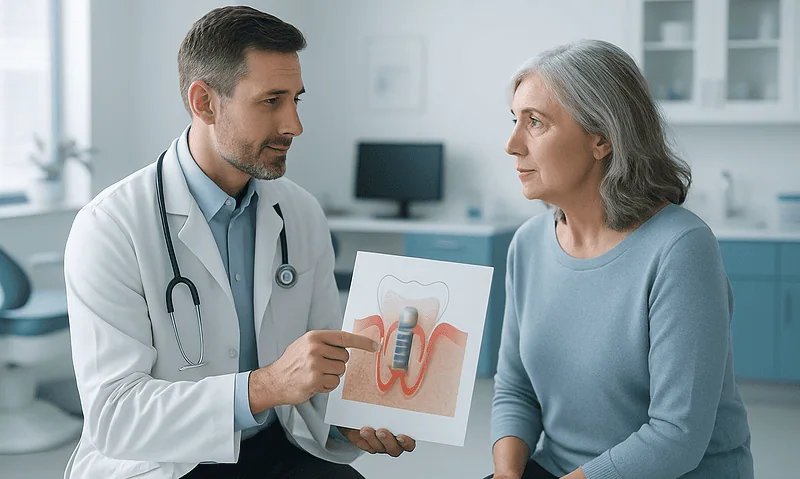
An implant is a titanium screw placed in the jawbone. Once bone has fused to it, a connector called an abutment is attached, and the crown sits on the abutment. In thin, translucent gum, especially on upper front teeth, the metal can cast a grayish tint through the tissue. Dentists address this with a ceramic or ceramic-coated abutment, or by shaping the crown so that the metal sits deeper. Which option is appropriate depends on bone, gum thickness and bite forces, and it is not always the most translucent choice.
Gum shape around implants is sculpted rather than inherited. A natural tooth arrives with its gum contour; an implant site has been healing after tooth loss, and the tissue can be flat or dipped. A well-shaped temporary crown worn during healing gently trains the gum into a natural scallop before the final crown is made. Mayo Clinic notes that the whole implant process often takes months because of these staged healing periods, and rushing the tissue stage tends to show later as an uneven gum line.
The crown itself is either screwed directly onto the abutment or cemented over it. Screw-retained crowns can be removed if needed, but the access hole must be hidden, usually on the tongue side or under a small ceramic plug on a molar. Cemented crowns avoid the hole but leave a risk of excess cement under the gum, which irritates tissue.
Bone loss around an implant, called peri-implantitis when infection is involved, can expose threads or darken the gum. Regular check-ups and careful cleaning around the implant are the practical defense, and any new gum change around an implant deserves a look by your dentist.
Shape, texture and shine: the details that fool the eye
Color gets the attention, but form is what your brain reads first, from across a room, before any shade is registered. A crown can be a perfect color and still look wrong if it is too round, too smooth or too shiny.
Natural teeth have character. Upper front teeth carry faint vertical ridges and shallow horizontal grooves, called perikymata, that scatter light softly. Edges are not razor straight; the two front teeth are usually slightly longer than their neighbors, and the corners have distinct angles. Worn teeth have flat, sometimes chipped edges that match the wear on the opposing lower teeth. A crown that copies a textbook tooth into a mouth full of worn ones looks new in the wrong way.
Surface finish is the quietest variable. Fresh porcelain fired to a high glaze reflects light like glass. Enamel, even young enamel, is more matte and reflects in a diffuse way. Technicians often break up the glaze with fine polishing or micro-texture so highlights sit where they would on the neighbors. Look at a photograph of your smile with flash: a crown that shows a single sharp white glare while the natural teeth show soft, broken highlights is telling you about its surface, not its color.
Symmetry matters more than perfection. Human eyes are exquisitely tuned to compare the left and right sides of a face. If one front tooth is being crowned, the technician’s real reference is its twin on the other side: its width, length, the tilt of its edge, the curve of the gum above it. Photographs of the opposite tooth, and sometimes a model of the whole mouth, are how that information travels to the laboratory.
None of this is vanity. Shape also decides how a crown feels on your tongue and lips, and how well it cleans, which brings us to the weeks after placement.
What the following days and weeks usually look like
The first few days after a permanent crown is placed are mostly about the gum and the bite adjusting. Cleveland Clinic describes mild sensitivity to hot and cold as common in the early period, especially when the tooth still has its nerve; it typically eases over a few weeks. Sharp pain on biting, though, usually means the crown is slightly high in the bite and needs a small adjustment, which is quick to do and should not be waited out.
Gum tissue around a new margin can look a little red or feel tender for a week or two, particularly if the crown edge sits just under the gum line. That inflammation should settle as you resume normal brushing and flossing. If the gum stays puffy or bleeds when you floss around that one tooth after several weeks, mention it; an overhang, leftover cement or an open margin are the usual suspects.
Appearance can shift subtly in the same window. A crown that looked a fraction bright at try-in often blends better once the surrounding teeth rehydrate and the gum returns to its normal pink. This is why dentists sometimes ask you to live with a color for a couple of weeks before judging it, though a clearly wrong shade at try-in should be corrected before cementation, not after.
Temporary crowns are a separate story. They are made of acrylic, chosen from a limited range of shades, and often look flatter and more opaque than the final ceramic. They can also stain from coffee, tea or curry within days. A temporary that looks fake tells you little about the final crown, but if you like or dislike its shape, say so; the temporary is often the template the technician copies.
For implant crowns, the schedule is longer and staged, with healing periods between surgery, abutment placement and final crown, as Mayo Clinic outlines. Your surgeon and restoring dentist will set the specific timeline.
Why does my crown look fake? Common causes and what can be done
People searching this question are usually describing one of a handful of problems, and each has a different fix.
Too bright, too white. The most frequent complaint. Either the shade was selected under harsh light, or a whiter-than-natural shade was chosen deliberately and the neighbors were never whitened to match. Surface staining at the chair can warm a crown slightly, but it cannot darken it much. Whitening the natural teeth may close the gap. Beyond that, a remake is the honest answer.
Flat and chalky. Low translucency, often from a thick opaque core or an unlayered high-strength ceramic on a front tooth. Stain and glaze help a little; a remake in a more translucent material, if the underlying tooth allows it, helps more.
Gray at the gum. Either a metal margin, a dark root through thin gum, or a metal implant abutment. Options range from gum treatment to a new crown with a ceramic abutment or an opaque shoulder. This one usually needs more than a polish.
Wrong shape. Too round, too long, edges too straight, or a bulge at the gum. Small reductions in length or width can be made in the mouth with fine diamond instruments and repolished. Adding material is not possible with fired porcelain, so a crown that is too short or too narrow is a remake.
Wrong shine. Often fixable in minutes by adjusting the surface texture and polish to match neighbors.
The larger point is that most of these are detectable at try-in, before cement. That is your moment to speak plainly, in good light, with a hand mirror and a photograph. A dentist who cares about the result would rather hear it then than a month later, and no ethical practitioner is offended by a patient asking to see the crown in daylight before it is fixed in place.
What people often get wrong about porcelain crowns
Whiter is better. The single most common misconception. Teeth that are brighter than the whites of your eyes tend to look artificial, and a crown chosen that way draws attention to itself. Matching the neighbors, or whitening everything first and then matching, gives a result that disappears into the smile.
Porcelain cannot stain, so it never needs attention. Ceramic itself resists stain well, but the glaze can wear, the margin can collect plaque, and the natural teeth around it continue to darken with age and diet. Over years the crown may end up lighter than its neighbors, not because it changed but because they did. MedlinePlus lists aging, tobacco and staining foods among common causes of tooth darkening.
Crowns protect a tooth from decay. The crown does not decay, but the tooth underneath it can, right at the margin, if plaque sits there. A crowned tooth needs the same brushing and flossing as any other, and the gum line around it deserves particular care.
A dark line means the crown is failing. Sometimes it is only the metal edge of an older crown showing after normal gum recession, which is a cosmetic matter, not an emergency. A dark line paired with soreness, bleeding or a bad taste is different and should be checked.
One material is best for everyone. Strength and beauty pull in opposite directions in dental ceramics. The right choice for a heavy grinder’s molar is not the right choice for a single upper incisor, and a good team chooses tooth by tooth.
The technician does not matter. The dentist prepares the tooth and takes the records, but the person who builds a layered crown is a skilled craftsperson working from photographs and notes. Detailed communication between the two is the unglamorous factor behind most natural-looking results.
Questions to ask your care team
The most useful conversations about a crown’s appearance happen before the tooth is prepared and again at try-in. These questions tend to surface the decisions that actually shape the result.
- Which ceramic are you planning for this tooth, and why that one for this position?
- Will the crown be layered by hand or milled from a single block, and how will depth and translucency be built in?
- How will you select the shade, and can we check it in natural light before you dry the tooth?
- Will you photograph the neighboring teeth with a shade tab for the technician?
- Where will the margin sit relative to my gum, and is my gum healthy enough to crown now?
- If I am considering whitening, should that happen before we match the shade?
- What will the temporary look like, and can I give feedback on its shape before the final is made?
- For an implant: will the abutment be metal or ceramic, and could gray show through my gum?
- Will I have a chance to see the final crown in a hand mirror and in daylight before it is cemented?
- If the color or shape is not right at try-in, what happens next?
- How should I clean around the margin, and how often do you want to check it?
- Do I grind my teeth, and does that change the material you would choose?
Bring a photograph of your smile from a few years ago if the tooth being crowned has already changed shape or color; it gives the team a target that no shade guide can. If you have strong feelings about not wanting a noticeably whiter tooth, or the opposite, say so early. The decisions remain with the treating team, who balance appearance against strength, gum health and your bite, but they can only weigh what you tell them.
When to call your doctor
Most crown problems are cosmetic or minor and can wait for a routine appointment. Some are not. Contact your dentist promptly, or seek urgent dental care, if you notice any of the following.
- Throbbing or spontaneous pain in the crowned tooth, or pain that wakes you at night, which can signal inflammation or infection of the tooth’s nerve.
- Swelling of the gum, cheek or jaw near the crown, a pimple-like bump on the gum, or a persistent bad taste; these can indicate an abscess, a pocket of infection, which the NHS advises should be seen without delay.
- Fever or feeling generally unwell together with dental pain.
- A crown that has come loose or fallen off. Keep it, avoid chewing on that side, and arrange to be seen; the exposed tooth is vulnerable to damage and sensitivity.
- A cracked or chipped crown with sharp edges cutting the tongue or cheek.
- Bleeding, redness or pus around an implant crown, or an implant that feels loose. Mayo Clinic notes that infection and implant failure are among the complications to watch for.
- Sharp pain every time you bite that does not ease within a few days of placement.
- Numbness or tingling of the lip, chin or tongue after implant surgery that does not resolve.
- Difficulty swallowing or breathing with facial swelling, which is a medical emergency; call emergency services.
Mild sensitivity to temperature in the first weeks, slight gum tenderness around a new margin, and a color you are still getting used to are not red flags, but they are worth mentioning at your follow-up. Your dentist decides whether a change is expected healing or something that needs treatment, and the earlier a genuine problem is seen, the simpler it usually is to manage.
Frequently asked questions
How does porcelain crown color matching actually work?
Dentists match a crown against standardized ceramic shade tabs or a digital shade scanner, checking hue, saturation and brightness separately. The best matches are taken early in the visit, before the tooth dries out, and under indirect daylight or color-corrected lamps, then photographed with a tab beside the tooth so the technician can build the same gradient of color from gum to edge.
Why does my new crown look fake even though the color is close?
Usually because of translucency, shape or shine rather than color. A crown that is uniformly opaque reflects light off its surface and looks flat, especially in photographs. One that is too round, too long or too glossy also reads as artificial. Many of these issues can be adjusted at the chair before cementation; a poor material choice for a front tooth may need a remake.
What causes a dark line at the gum on a crown?
The most common cause is the metal core of a porcelain-fused-to-metal crown becoming visible as the gum recedes. A dark tooth root showing through thin gum, a gray implant abutment, or a gap at the crown margin collecting plaque can also create a shadow. Each has a different fix, from gum treatment to an all-ceramic crown or a ceramic abutment, decided by your dentist.
Zirconia vs porcelain crown: which looks more natural?
Layered porcelain and glass ceramics such as lithium disilicate generally imitate enamel’s depth and translucency more closely, which is why they are often chosen for single front teeth. Zirconia is stronger and more opaque; newer translucent zirconia has narrowed the gap and can be layered with porcelain. Position, bite force and the color of the underlying tooth determine which is appropriate.
Should I whiten my teeth before getting a porcelain crown?
If you intend to whiten at all, most dentists prefer that you do it first and allow the shade to settle before the crown is matched, because porcelain does not change color afterward. A crown matched to unwhitened teeth will look darker once the neighbors are bleached. Discuss timing with your dentist; whitening decisions and products are for your dental team to advise on.
Can a porcelain crown be adjusted after it is cemented?
Small changes are possible: reducing length or width, reshaping edges, adjusting texture and polish, and sometimes adding surface stain to warm the color slightly. Material cannot be added back to fired porcelain, and a crown cannot be made noticeably lighter or more translucent in place. Larger problems with shade, shape or margin generally mean remaking the crown.
How long does it take to get used to the look of a new crown?
Many people find a crown blends better over the first couple of weeks as the neighboring teeth rehydrate and the gum returns to its normal pink after treatment. Cleveland Clinic notes mild sensitivity is also common in that period. A crown that looks clearly wrong at try-in, however, should be corrected before cementation rather than lived with.
Do implant crowns look different from crowns on natural teeth?
They can, because the structure underneath is gray titanium rather than yellow dentin, and the gum around an implant has been reshaped rather than inherited. Thin gum on upper front teeth may show a gray tint unless a ceramic abutment or opaque crown core is used. A carefully shaped temporary crown during healing helps the gum form a natural scallop.
Will my porcelain crown stain over time?
Ceramic itself resists stain well, but the glaze can wear, plaque can collect at the margin, and the natural teeth around the crown keep darkening with age, tobacco and staining foods, as MedlinePlus describes. Over years the crown may look lighter than its neighbors because they changed. Good cleaning and regular professional care keep the margin looking clean.
Does gum health affect how a crown looks?
Significantly. Inflamed gum is red and swollen, so a margin placed against it will be exposed when the tissue heals and shrinks. Healthy gum is pink, firm and scalloped, framing the crown and filling the space between teeth. Dentists usually treat gum disease before crowning, and the NIH dental institute emphasizes daily cleaning and professional care to keep gums healthy.
References
- Cleveland Clinic: Dental Crowns
- MedlinePlus: Tooth – abnormal colors
- NIH National Institute of Dental and Craniofacial Research: Periodontal (Gum) Disease
This article is for general information only and is not a substitute for professional medical advice. Please consult a qualified doctor about your individual situation.

More from the Blog
Dental Bone Grafts for International Patients: Planning the Healing Gap Between Two Trips
A dental bone graft usually needs roughly three to nine months to mature before an implant can be placed, so patients who travel for…
Getting Used to Removable Dentures: Speech, Sore Spots and Eating in the First Weeks
Most people need several weeks to get used to new removable dentures. During that time, speech usually sharpens with daily practice reading aloud, sore…
When Does Socket Preservation Make Sense? A Small Dental Bone Graft Right After Extraction
A socket preservation graft is a small bone graft placed into the empty tooth socket immediately after an extraction to slow the natural shrinkage…
Dental Crowns for International Patients: Planning Two Visits, Temporaries and Follow-Up
Dental crowns for international patients are usually planned as two visits: the first shapes the tooth, records an impression and fits a temporary crown;…
Peri-Implantitis Warning Signs: Bleeding, Pus and Implant Mobility That Mean a Prompt Visit
Peri-implantitis warning signs include gums around a dental implant that bleed when brushed or probed, redness or swelling, pus or a persistent bad taste,…
Getting Used to a New Dental Bridge: Sensitivity, Speech and Bite Adjustments in Early Weeks
The dental bridge adjustment period is the stretch of days to a few weeks in which a newly cemented bridge stops feeling foreign. Mild…