

Dental Robotics Myths: Does the Robot Operate Alone, and What Does the Surgeon Still Control?
Key Takeaways
- In robot-assisted implant surgery the surgeon holds and drives the drill; the robotic arm only constrains its angle and depth to a plan the surgeon created.
- The arm does not generate forward motion, so if the surgeon stops pushing, the drill stops advancing, and guidance can be disengaged at any moment.
- Guidance reduces positional error near nerves, sinuses and neighboring roots but does not lower the risk of infection, implant failure or later gum disease around the implant.
- Freehand, static-guide, dynamic-navigation and robotic approaches all place the same implant; they differ only in how the plan reaches the surgeon's hand.
- Recovery follows the ordinary implant timeline: a few days of swelling and soreness, then several months of osseointegration before the final tooth is fitted.
- The most consequential errors in guided surgery happen at the planning stage, which is why the surgeon's reading of the 3D scan remains the real safety step.
No, a dental robot does not operate alone. In robot-assisted implant surgery, the surgeon plans the implant position on a 3D scan, then holds the drill while a robotic arm physically guides its angle and depth and stops at the planned limits. The surgeon makes every clinical decision, applies the force, and can override or withdraw the instrument at any moment.
A woman in her sixties sits in a consultation room turning a printed 3D image of her own jaw in her hands. Her dentist has mentioned that the implant could be placed with robotic assistance. She nods politely, then asks the question she has been holding for ten minutes: “So who is actually holding the drill?”
That question sits at the center of most dental robotics myths. The word “robot” carries a lot of cultural weight: assembly lines, science fiction, machines that do things without us. When it lands in a dental office, people picture an arm working inside their mouth while the surgeon watches from a chair.
The reality is quieter and, frankly, more reassuring. The robot in this setting is closer to a very precise ruler that pushes back than to an independent operator. Understanding where the machine ends and the surgeon begins is the whole point of what follows.
Where dental robotics myths begin: the picture of a machine working alone
Most confusion traces back to a single mental image. People imagine a robotic arm, drill attached, moving through a programmed sequence inside the mouth while the clinician supervises. It is the industrial-robot picture, borrowed from car factories, and it is wrong for dentistry.
The systems in use for dental implant placement belong to a category regulators describe as computer-assisted surgical devices. That phrase matters. “Assisted” is doing the real work in it. The device supports a human surgeon; it does not replace one. The same principle applies across robotic surgery generally: MedlinePlus describes robotic surgery as a method in which a surgeon controls instruments through a computer, not a procedure the computer performs on its own.
Why does the myth persist? Partly because the marketing language around new technology tends to emphasize the machine. Partly because “robot” is a shorter word than “haptic guidance system with a surgeon-held handpiece.” And partly because very few patients have ever seen one working. A thing you have never watched is easy to imagine incorrectly.
There is also a second, opposite myth worth naming early. Some people assume the robot is a gimmick that adds nothing, that the surgeon is simply drilling as usual with an expensive prop nearby. That undersells what the guidance actually does, which is to hold the instrument to a plan with a consistency a human hand cannot match over a long procedure.
Both extremes miss the design. The machine is built to be strong on the things machines are good at, such as holding a position and enforcing a limit, and to leave everything else, judgment above all, in human hands. Keeping that division in mind makes the rest of the technology far easier to understand.
How robotic dental implant surgery actually works, step by step
The procedure begins long before anyone touches a drill. First comes imaging, usually a cone-beam CT, which is a low-radiation 3D X-ray of the jaw that shows bone thickness, nerve canals and sinus floors. The surgeon studies that scan and decides where an implant should sit: its angle, its depth, its distance from the nerve that runs through the lower jaw and from the neighboring roots.
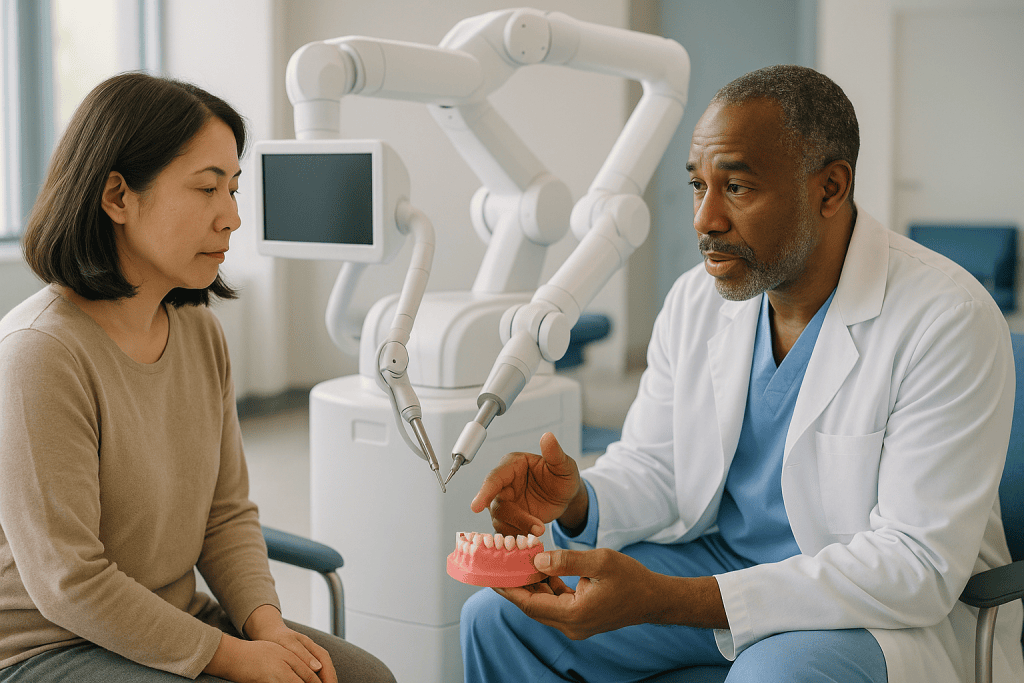
That decision becomes a digital plan. Nothing about the plan is automated in any meaningful sense. The software displays options; the surgeon chooses.
On the day of surgery, a small tracking device is attached to the teeth or to the jaw so the system knows exactly where the patient is in space. If the patient shifts slightly, the system registers the movement and updates. This is the same tracking logic used in other forms of computer-assisted surgery described by Johns Hopkins Medicine, where instruments are followed in real time relative to the anatomy.
Then the surgeon picks up the handpiece. It is mounted to a robotic arm, but the surgeon’s hand is on it. As the drill approaches the planned position, the arm provides what engineers call haptic guidance: gentle physical resistance that steers the tip toward the planned path and refuses to let it drift beyond the planned angle or depth. The surgeon supplies the forward pressure and the drilling motion. The arm supplies the boundaries.
Once the site is prepared, the implant itself, a small titanium post, is placed along the same guided path. After that, the robot’s contribution is over. Closing the gum, checking the fit, and everything that follows is conventional surgery.
Described plainly, the sequence is: human plans, human drills, machine keeps the drill inside the plan. That is the whole mechanism.
What does the surgeon still control? Nearly everything that requires judgment
The honest answer is that the surgeon controls every decision and most of the physical actions. The robot controls the geometry.
Start with the decisions. Whether an implant is appropriate at all, whether bone grafting is needed first, which site to use, how many implants, what size, what angle, how deep, whether to place a temporary tooth the same day or wait for healing: each of these is a clinical judgment the surgeon makes using training, the scan, and the patient’s history. The software cannot weigh a patient’s smoking history against their bone density. A person does that.
Now the physical actions. The surgeon makes the incision or chooses a flapless approach, holds and advances the drill, feels the resistance of the bone through the handpiece, decides when to slow down, irrigates the site, seats the implant, and closes. The arm never initiates movement. If the surgeon stops pushing, the drill stops advancing.
What the robot does is narrower and very specific. It steers the drill toward the planned entry point, holds the planned angle, and enforces a hard stop at the planned depth. Think of a cabinet maker’s drill press: the operator still runs the drill, but the press keeps the bit perpendicular and stops it at a set depth. The press is a tool for consistency, not a carpenter.
Then there is override. If something unexpected appears, such as bone quality that differs from the scan, the surgeon can pull back, pause, adjust the plan or abandon guidance entirely and finish freehand. Mayo Clinic makes the same point about robotic surgery in general: the surgeon remains in control throughout and can convert to a conventional approach if needed.
So when the woman in the consultation room asks who is holding the drill, the answer is simple. Her surgeon is.
Robotic vs guided implant surgery vs freehand: how the approaches compare
Robotic guidance is not the only way to place an implant accurately, and it is not the oldest. Understanding the alternatives puts it in proportion.
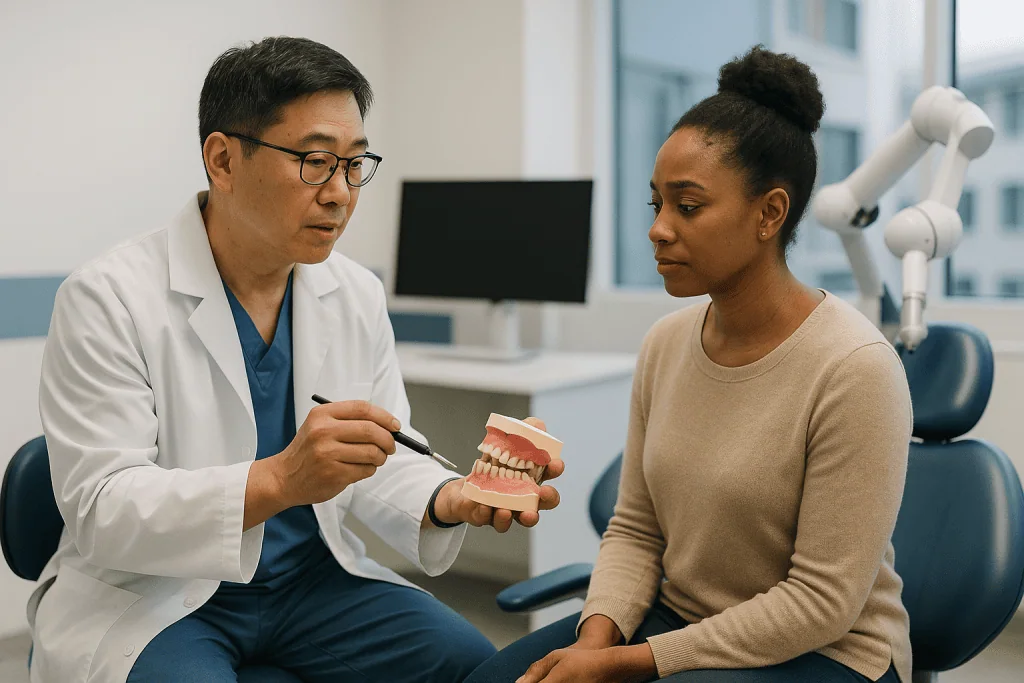
Freehand placement means the surgeon drills using anatomical landmarks, the scan viewed on a screen, and experience. It is still widely used and appropriate for many straightforward cases.
Static guided surgery uses a custom-printed plastic template that fits over the teeth or gums with metal sleeves that direct the drill. The plan is locked into the guide before surgery; changing it mid-procedure means removing the guide.
Dynamic navigation tracks the drill in real time and shows its position on a screen against the plan, like GPS. The surgeon watches the display and corrects by hand.
Robot-assisted guidance adds a physical arm that constrains the drill to the plan while still being driven by the surgeon.
| Approach | Who holds the drill | How the plan is enforced | Can the plan change mid-surgery? |
|---|---|---|---|
| Freehand | Surgeon | Surgeon’s eye and hand | Yes, freely |
| Static guide | Surgeon | Printed template with sleeves | Only by removing the guide |
| Dynamic navigation | Surgeon | Visual feedback on a screen | Yes, surgeon adjusts by hand |
| Robot-assisted | Surgeon | Physical haptic boundary from the arm | Yes, surgeon can edit the plan or override |
Notice the second column. In every row, the surgeon holds the drill. The methods differ in how the plan is communicated back to the human hand: through memory, through plastic, through a screen, or through resistance in the handpiece.
Which approach suits a given patient depends on the case, the surgeon’s training and the equipment available. None of the four is a standard of care that the others fall short of. The treating team weighs the trade-offs.
Is robotic dental surgery safe? What the evidence actually shows
The most useful thing to say about safety here is also the least dramatic: robot-assisted implant placement is dental implant surgery, with the same risks that implant surgery has always carried, plus a guidance layer designed to reduce one specific category of error.
That category is positional error. Placing an implant too close to the inferior alveolar nerve, the nerve running through the lower jaw that supplies feeling to the lip and chin, can cause numbness. Angling an implant into a neighboring root can damage that tooth. Drilling too deep in the upper jaw can breach the sinus. Mayo Clinic lists nerve damage, sinus problems and injury to surrounding structures among the recognized risks of implant surgery. Guidance systems, whether static, dynamic or robotic, exist to keep the drill away from those structures.
What does the research show? Published clinical studies of robot-assisted implant placement have generally reported accuracy, measured as the deviation between the planned and the actual implant position, that is comparable to or somewhat tighter than other guided methods. Those studies are, so far, mostly small, often from single centers, and short in follow-up. That is the normal shape of evidence for a newer technique. It supports the claim that the guidance is precise. It does not yet support strong claims about long-term implant outcomes relative to other methods, because that would require larger and longer trials.
The risks that guidance cannot touch remain: infection, bleeding, implant failure to fuse with bone, and gum disease around the implant later. Cleveland Clinic notes that implant failure, though uncommon, happens, and that factors such as smoking and uncontrolled diabetes raise the risk. No robot changes a patient’s healing biology.
A fair summary: the technology is a credible tool for positional accuracy, and it is neither a safety guarantee nor a source of new danger when used by a trained surgeon.
Who is robot-assisted implant placement usually for, and who is usually asked to wait
Robotic guidance does not change who is a candidate for implants. It changes how the drilling is guided once someone already is a candidate. So the first filter is the ordinary one.
According to Mayo Clinic, implants are generally considered for adults who have one or more missing teeth, whose jawbone has finished growing, who have enough bone to hold an implant or can have a graft, whose oral tissues are healthy, and who can commit to several months of the process. Cleveland Clinic adds that people who do not smoke, or who are willing to stop during healing, tend to do better.
Within that group, surgeons tend to find guidance most useful when precision has less room for error: implants near the lower jaw nerve, implants beside natural teeth in tight spaces, multiple implants that must be parallel to support a bridge, or patients with limited bone where a millimeter of angle matters. A single implant in a wide, easy site may not need it.
Who is usually asked to wait? The same people who would be asked to wait for any implant surgery. Adolescents whose jaws are still growing. People with active gum infection, which needs treatment first. People whose diabetes or other chronic conditions are poorly controlled at the time. People recovering from radiation to the jaw or taking certain medicines that affect bone healing, where the treating team will want a specialist review first. Heavy smokers may be asked to quit or delay. Pregnant patients are typically asked to postpone elective surgery.
There are also practical limits specific to robotic systems. The tracking device must attach securely, which can be difficult when very few teeth remain, and a patient must be able to keep reasonably still. Someone who cannot open wide, or who cannot tolerate the attachment, may be better served by another method.
These are judgments, not rules, and the treating team makes them.
Does the robot make surgery faster, painless or bloodless? Separating precision from comfort
Three promises tend to attach themselves to any new surgical technology: it will be quicker, it will hurt less, and it will be cleaner. For robot-assisted implants, each deserves a careful look.
Faster? Not necessarily. Setting up the tracking device and registering the patient to the scan takes time that a freehand procedure does not require. Some surgeons report that the drilling itself proceeds smoothly because they are not stopping to check position, but the total time in the chair depends on the case, the surgeon’s familiarity with the system and how many implants are placed. It is reasonable to expect a similar appointment length to other guided approaches, not a dramatically shorter one.
Painless? The robot does not affect anesthesia. Local anesthetic, with or without sedation, is what keeps the procedure comfortable, exactly as in conventional implant surgery. Afterward, Mayo Clinic describes the typical experience as some swelling, bruising, minor bleeding and pain at the site for a few days. Guidance may allow a smaller incision or a flapless approach in some cases, which can mean less soft-tissue disturbance, but that is a decision the surgeon makes based on the anatomy, and it is available with other guided methods too.
Bloodless? Implant surgery involves bone and gum; there is always some bleeding. Precision in placement does not change that.
What the technology genuinely offers is consistency of position. That is a real benefit, and it is worth being precise about because a patient who expects a painless, twenty-minute, bloodless experience will be disappointed by an entirely normal recovery. The accurate promise is narrower: the implant is more likely to end up where the plan said it would.
Comfort comes from good anesthesia, gentle tissue handling and clear aftercare. Those remain the surgeon’s job, robot or no robot.
What the following days and weeks usually look like after robot-assisted implant surgery
Because the robot only guides the drilling, recovery follows the ordinary implant timeline. Knowing that timeline in advance takes much of the anxiety out of it.
The first few days. Expect swelling of the gums and face, some bruising of the skin or gum, minor bleeding, and soreness at the site. Mayo Clinic lists these as typical after implant placement. Most people manage with the pain relief and cold-compress advice their team provides. Soft foods for a short period are usual; the team will say how long.
The first one to two weeks. The gum over the site heals. If stitches were placed, they dissolve or are removed at a follow-up visit. Swelling should be improving day by day after the second or third day rather than getting worse.
The following months. This is the quiet, invisible part. The implant undergoes osseointegration, the process by which the jawbone grows onto the titanium surface and locks it in place. Mayo Clinic describes this as taking several months, and Cleveland Clinic gives a typical window of roughly three to nine months depending on the site and bone quality. During this stage the implant is doing its most important work while the patient feels nothing in particular.
Restoration. Once the implant is stable, a connector called an abutment is attached, and the final crown, bridge or denture is fitted. If a bone graft was needed before the implant, the whole sequence takes longer; Mayo Clinic notes that the entire process can take many months from first visit to final tooth.
Where does the robot appear in this timeline? Only on the day of surgery. Every phase after that depends on biology and on the patient’s care of the site.
What people often get wrong about robot-assisted dental implants
Here are the dental robotics myths that surface most often in consultations, each set against what the technology actually does.
“The robot does the surgery.” The surgeon holds the drill, applies the force, and makes every decision. The arm constrains angle and depth. That is the entire division of labor.
“If the robot is involved, nothing can go wrong.” Guidance reduces positional error. It does not prevent infection, bleeding, failure of the implant to fuse, or later gum disease around it. Those depend on health, healing and hygiene.
“A robot means the surgeon is inexperienced.” The opposite is closer to the truth. Planning a case for robotic guidance and knowing when to override it demand a thorough understanding of the anatomy. Systems in this category are designed for trained surgeons and require specific training to operate.
“Robotic surgery is a completely new, untested idea.” Computer-assisted and robot-assisted surgery has decades of history in other fields. MedlinePlus and Johns Hopkins Medicine both describe its established use across urology, gynecology and general surgery. Dental applications are newer, and the evidence for them is still maturing, but the underlying principle of surgeon-controlled, computer-tracked instruments is well established.
“It hurts less because a robot is more gentle.” Post-operative discomfort relates to tissue handling and anesthesia, not to the presence of an arm. Recovery expectations are the same as for conventional implant surgery.
“The robot could keep drilling if something went wrong.” The arm does not generate forward motion. If the surgeon stops pushing, the drill stops advancing. It can also be disengaged at any moment.
“The plan is fixed once the robot starts.” Unlike a printed static guide, the digital plan can be edited during the procedure if the surgeon sees a reason to change it.
The pattern across all of these is the same: the robot is credited with autonomy it does not have, for better and for worse.
Can the robot make a mistake? Safety stops, override and what "haptic" really means
It is fair to ask what happens when a machine involved in surgery does something unexpected. The design of these systems is built around that question.
Start with the word haptic. It simply means relating to touch. A haptic guidance system communicates with the surgeon through resistance felt in the hand. As the drill approaches the boundary of the planned path, the arm pushes back gently. At the planned depth, it stops firmly. The surgeon feels the plan rather than reading it from a screen.
Now the failure modes. The most discussed is registration error: if the tracking device shifts or the system loses track of the patient’s position, the guidance would be pointing to the wrong place. Systems address this in two ways. They monitor tracking continuously and alert the surgeon if confidence drops, and, more importantly, the surgeon is watching the site directly the whole time. A drill that the arm is steering toward an obviously wrong location is noticed by the person holding it.
The second concern is the arm moving on its own. It is designed not to. The arm resists and constrains; it does not drive. Forward pressure comes from the surgeon. Remove that pressure and the drill does not advance.
The third is a software or power fault. The practical response is the same one Mayo Clinic describes for robotic surgery generally: the surgeon converts to a conventional technique and completes the procedure by hand. Every surgeon trained on these systems is already trained to place implants without them.
Finally, there is the plan itself. The most consequential errors in guided surgery of any kind happen before the drill turns, when a plan is drawn in the wrong place on the scan. No arm can correct a flawed plan; it will faithfully guide to whatever position was chosen. That is why the planning stage, done by a human reading the anatomy, remains the true safety step.
Is a robot better than an experienced surgeon? Why the question is framed wrong
People often ask whether they should choose “the robot” or “a good surgeon,” as if the two were competing. The framing does not survive contact with how the procedure works.
A robot-assisted implant is placed by a surgeon. The relevant comparison is not machine versus human but surgeon with guidance versus surgeon without it, or one type of guidance versus another. In that comparison, guidance of any kind tends to narrow the spread of outcomes: it makes the position of the implant more predictable and less dependent on the steadiness of a hand at the end of a long day. That is valuable. It is not the same as saying a guided placement by one surgeon will be better than an unguided placement by another.
Consider what the surgeon still contributes even in the most guided case. Reading the scan and identifying where a nerve runs closer to the surface than usual. Recognizing that bone which looked solid on the image feels soft under the drill and adjusting the plan. Deciding that a patient’s gum tissue will not tolerate a flapless approach. Choosing to stop and stage the treatment rather than press on. Judgment shows up at every step, and no current system performs any of it.
There is also the matter of training. Using a guidance system well requires learning its behavior: how it registers, how it signals a boundary, when its feedback is trustworthy and when it is not. A surgeon early in that learning process is not automatically producing better results than one who has placed implants freehand for years.
The evidence supports a modest, specific claim: guidance improves positional accuracy compared with freehand placement in the studies that have measured it. It does not support replacing the question “is this surgeon well trained for my case?” with “does this office have a robot?” Ask the first question first.
Risks and alternatives in plain language
Any surgical decision is a weighing of risks against alternatives, and robotic guidance changes that balance only slightly. Here is the neutral version.
Risks of implant surgery, guided or not. Mayo Clinic lists infection at the implant site, injury or damage to surrounding structures such as other teeth or blood vessels, nerve damage causing pain, numbness or tingling in the teeth, gums, lips or chin, and sinus problems when upper-jaw implants protrude into the sinus cavity. Cleveland Clinic adds implant failure, meaning the post does not fuse with the bone, and peri-implantitis, which is gum and bone infection around an established implant, often linked to poor hygiene or smoking.
Considerations specific to guided approaches. Additional imaging is required for planning; cone-beam CT uses a low radiation dose, but it is a dose. The tracking device is attached to teeth or bone. The procedure includes setup time. If tracking is lost, the surgeon falls back to conventional technique, which is a change of method rather than a harm in itself.
Alternatives to a robot-assisted implant. The same implant placed freehand, with a static printed guide, or with dynamic screen-based navigation. All are established methods, and a surgeon may recommend any of them depending on the case.
Alternatives to an implant at all. A fixed bridge supported by neighboring teeth, a removable partial denture, or, for a single missing tooth in some positions, no replacement. Each carries its own trade-offs in longevity, effect on neighboring teeth, comfort and maintenance. Mayo Clinic and Cleveland Clinic both describe these options as legitimate choices rather than lesser ones.
What a patient should take from this list is proportion. Robotic guidance addresses one risk on it, positional error, and leaves the rest unchanged. Deciding whether that trade is worthwhile for a particular mouth is exactly the conversation to have with the treating team.
Questions to ask your care team about robot-assisted implant placement
A good consultation leaves the patient understanding not only what will happen but why this approach was chosen over the others. These questions tend to open that conversation.
- Why do you recommend robotic guidance for my case rather than a static guide, dynamic navigation or freehand placement? What about my anatomy makes the difference?
- Who will be holding the drill, and what exactly will the system be doing while you work?
- What is your plan if the tracking is lost or the system needs to be set aside mid-procedure?
- Do I need a bone graft or sinus lift first, and how does that affect the timeline?
- What imaging will I need, and has anything on the scan given you concern about nerves, sinuses or neighboring roots?
- How many implants do you plan to place, and will a temporary tooth be fitted the same day or after healing?
- Will I have local anesthetic alone, or sedation as well, and who will monitor me?
- What should the first week feel like, and what would be a sign that healing is not going as expected?
- How will my medical conditions or medicines affect healing, and do you need to speak with my physician before surgery?
- Once the implant has fused, who fits the final crown or bridge, and how long is the whole process likely to take from today?
Two habits make these questions more useful. Write the answers down; the volume of information in an implant consultation is easy to lose. And notice how the team responds to the override question. A surgeon comfortable explaining when they would set the technology aside is one who understands it as a tool.
No question on this list has a single correct answer. Each is an invitation to hear the reasoning behind the plan.
When to call your doctor after robot-assisted dental implant surgery
Ordinary recovery includes swelling, bruising, mild bleeding and soreness that ease over several days. Certain signs fall outside that picture and warrant a prompt call to the dental surgeon or, for the most serious, emergency care.
Call the same day if you notice:
- Bleeding that does not slow with steady pressure on gauze, or that restarts after having stopped.
- Swelling that is still increasing after the second or third day, or that spreads toward the eye or down the neck.
- Pain that worsens after the first few days rather than easing, or that is not controlled by the plan your team gave you.
- Fever, chills, a foul taste or pus at the surgical site, which can indicate infection.
- Numbness or tingling in the lip, chin, tongue or gums that persists well after the anesthetic should have worn off. Mayo Clinic identifies nerve injury as a recognized complication, and early assessment matters.
- A feeling that the implant or a temporary tooth has loosened, or an odd sensation of air or fluid passing between the mouth and nose after upper-jaw surgery.
Seek emergency care immediately if you have:
- Difficulty breathing or swallowing, or swelling of the tongue or floor of the mouth.
- Heavy bleeding that soaks through gauze repeatedly.
- A rash, hives or throat tightness after taking a prescribed medicine, which may signal an allergic reaction.
Later in the process, months after surgery, redness, bleeding when brushing or a bad smell around the implant should also be reported; Cleveland Clinic describes these as signs of peri-implantitis, infection of the tissue around the implant, which is easier to manage when caught early.
When in doubt, call. Teams that place implants expect these calls and would rather hear about a symptom that turns out to be nothing than miss one that mattered.
Frequently asked questions
Does the robot operate alone during dental implant surgery?
No. The surgeon holds the handpiece, applies the drilling force and makes every clinical decision. The robotic arm provides physical resistance that keeps the drill on the planned angle and stops it at the planned depth. It does not move the drill forward on its own, and the surgeon can override it or switch to conventional technique at any point during the procedure.
Is robotic dental surgery safe?
It carries the same risks as conventional implant surgery, including infection, bleeding, nerve injury, sinus involvement and implant failure, while adding guidance intended to reduce positional error. Published studies of robotic implant placement report good accuracy, but most are small and short in follow-up, so long-term comparisons with other methods are still limited. A trained surgeon remains in control throughout.
What is the difference between robotic vs guided implant surgery?
Static guided surgery uses a custom-printed plastic template with sleeves that direct the drill, fixed before the procedure. Robot-assisted surgery uses a tracked robotic arm that physically steers the surgeon-held drill along a digital plan and allows the plan to be adjusted during surgery. Both aim to place the implant where the 3D plan specified; they differ in how that plan is enforced.
Can the robot make a mistake?
The main technical risk is tracking or registration error, where the system loses accurate knowledge of the patient’s position. Systems monitor tracking and alert the surgeon, who is also watching the site directly and can stop immediately. The arm does not drive the drill forward, so it cannot continue on its own. A plan drawn in the wrong place is the more important error, and that is a human planning step.
Who is robot-assisted dental implant surgery usually for?
Anyone who is already a candidate for implants: adults with finished jaw growth, adequate bone or a plan for grafting, healthy gums and controlled medical conditions. Surgeons often find guidance most useful when precision matters most, such as implants near the lower jaw nerve, in tight spaces beside natural teeth, or multiple implants that must be parallel. The treating team decides case by case.
Does robotic dental surgery hurt less than regular implant surgery?
Not inherently. Comfort during surgery comes from local anesthetic with or without sedation, which is the same regardless of guidance. Afterward, most people experience some swelling, bruising, minor bleeding and soreness for a few days, as Mayo Clinic describes for implant surgery generally. In some cases guidance allows a smaller incision, which can reduce tissue disturbance, but that depends on the anatomy and the surgeon’s judgment.
How long does recovery take after robot-assisted dental implants?
The soft tissue typically settles over the first one to two weeks, while the implant fuses with the jawbone over several months, a process called osseointegration that Cleveland Clinic describes as often taking roughly three to nine months. The final crown or bridge is fitted after that. If a bone graft is needed first, Mayo Clinic notes the entire process can take many months from start to finish.
Does using a robot mean my surgeon is less experienced?
No. Planning a case for robotic guidance and knowing when to override it require a thorough understanding of jaw anatomy, and these systems are designed for trained surgeons who can also complete the procedure by hand if needed. The more useful question is whether the surgeon is well trained for your particular case, with or without guidance.
What does the surgeon control that the robot does not?
Everything requiring judgment: whether implants are appropriate, whether grafting is needed, how many implants, their size, angle and depth, the surgical approach, when to slow down or stop, seating the implant and closing the site. The robot controls only the geometry of the drill path during preparation, holding the planned angle and enforcing the planned depth while the surgeon drives the instrument.
What are the alternatives to robot-assisted dental implants?
The same implant can be placed freehand, with a static printed guide or with dynamic screen-based navigation, all of which are established methods. Alternatives to an implant altogether include a fixed bridge supported by neighboring teeth or a removable partial denture. Each option has its own trade-offs in longevity, effect on neighboring teeth and maintenance, and the treating team can explain which fits your situation.
References
This article is for general information only and is not a substitute for professional medical advice. Please consult a qualified doctor about your individual situation.

More from the Blog

Zygomatic Implant Surgery Step by Step: Cheekbone Anchoring, Sinus Path and Same-Day Teeth
Zygomatic implant surgery replaces upper teeth when the jawbone is too thin for standard implants. A surgeon plans the route on 3D scans, then…
Does a Cracked Tooth Always Need a Dental Crown? Repair, Monitoring and How Dentists Decide
No. Whether a cracked tooth needs a crown depends on how deep the crack runs, where it sits, whether it causes pain on biting,…

All On 6 Recovery Timeline: Swelling, Soft Diet and When the Temporary Bridge Is Swapped
All on 6 recovery usually unfolds in stages: facial swelling and bruising peak within the first two to three days and settle over one…

Who Benefits Most From Dental Robotics? Tight Spaces, Full-Arch Cases and Limited Bone
Dental robotics most often helps when the margin for error is thin: a single narrow gap between healthy teeth, a full-arch case where several…

How Inlays and Onlays Are Placed: Shaping, Impressions, Lab Fabrication and Bonding Explained
An inlay onlay procedure usually takes two visits. First, the dentist numbs the tooth, removes decay or an old filling, and shapes the cavity…

Imaging in Implantology: How Panoramic X-Rays and 3D Scans Guide Implant Position and Depth
Implantology imaging combines two-dimensional dental X-rays, most often a panoramic film, with a three-dimensional cone beam CT (CBCT) scan when the clinician needs to…