

Digestive Enzymes: Who Actually Needs Them and Who Is Wasting Money

Key Takeaways
- Symptoms of true enzyme deficiency usually do not appear until the pancreas has lost roughly 90 percent of its function, which is why healthy adults have no shortfall to supplement.
- Prescription pancrelipase for exocrine pancreatic insufficiency is backed by multiple randomized placebo-controlled trials showing measurable improvement in fat absorption and weight.
- Around two-thirds of the world's adults have reduced lactase activity, and lactase taken with dairy, or lactose-free milk, has moderate trial evidence for easing symptoms.
- Alpha-galactosidase has a few small randomized trials showing less gas after legume-heavy meals, but no evidence for bloating from other causes.
- Over-the-counter enzyme blends are regulated as foods under a 1994 US law and are not required to prove they work before sale, unlike FDA-approved prescription enzymes.
- Greasy, pale or floating stools with unintended weight loss point to fat malabsorption and warrant a fecal elastase test, not a supplement trial.
Digestive enzyme supplements help a specific group of people: those with exocrine pancreatic insufficiency (from chronic pancreatitis, cystic fibrosis or pancreatic surgery), who need prescription pancrelipase, and people with lactose intolerance, who often benefit from lactase. For healthy adults, and for most people with bloating or irritable bowel syndrome, evidence of benefit is weak, and a clinician should evaluate persistent symptoms before anyone buys a supplement.
The video is forty seconds long. A creator holds a bottle up to the camera, describes a late dinner of pasta and ice cream, and promises that two capsules before the meal mean no bloating, no heaviness, no regret. As of spring 2025, clips like this have pushed digestive enzymes into the top tier of gut-health searches, right alongside probiotics and fiber. The bottle in the video is a dietary supplement. Nobody in the clip mentions that.
What makes this trend worth a careful look is that digestive enzymes are also serious medicine. For someone whose pancreas has stopped producing them, a prescription enzyme is the difference between absorbing a meal and passing most of its fat straight through. That is a real, measurable, well-documented benefit, and it belongs to a fairly small number of people.
So the honest question is not whether digestive enzymes work. It is: work for whom, for what, and how would you know if you are one of those people? That is what this piece sorts out.
What are digestive enzymes, and what does your body already make?
Enzymes are proteins that speed up chemical reactions, and digestive enzymes are the ones that break food into pieces small enough to cross the gut wall. Your body makes them in several places, in quantities that surprise most people. Salivary glands start on starch while you are still chewing. The stomach adds pepsin for protein. The pancreas, a gland tucked behind the stomach, produces roughly a liter or more of enzyme-rich fluid every day, and the lining of the small intestine finishes the job with enzymes such as lactase, which splits milk sugar.
The three headline enzyme families are simple to remember. Amylase handles carbohydrates. Protease handles protein. Lipase handles fat, and it is the one that matters most clinically, because fat digestion has the least backup. If starch escapes the pancreas, intestinal enzymes and gut bacteria partly rescue it. If fat escapes, it largely stays undigested, and that is what produces the greasy, floating stools and weight loss that mark true enzyme deficiency.
Here is the part the supplement aisle skips: in a person with a working pancreas, enzyme output is not the bottleneck. The gland releases enzymes in response to a meal and can scale up production considerably. Bloating after a large dinner, in a healthy adult, is far more often about the volume of food, the speed of eating, swallowed air and the fermentable fibers that gut bacteria turn into gas than about a shortage of enzymes. Adding more of something you already have in surplus does very little, which is why the evidence for enzymes in otherwise healthy people is so thin.
What changed recently: why digestive enzymes are trending
Nothing changed in the pancreas. What changed is the marketplace. Over 2024 and into 2025, short-form video turned enzyme blends into a lifestyle product, positioned as a fix for bloating, a companion to high-protein diets and, in some clips, a weight-loss aid. Search interest followed. The claims outran the science, and the two categories of product, prescription and supplement, got blurred together.

A few dated facts help untangle them. Prescription pancreatic enzymes, sold as pancrelipase, are made from pig pancreas and, since a US Food and Drug Administration requirement that took full effect in 2010, must go through formal approval showing they deliver a consistent, measured amount of active lipase. MedlinePlus lists pancrelipase as a prescription medicine specifically for people whose pancreas does not make enough enzymes. Over-the-counter enzyme blends, by contrast, are regulated under the 1994 Dietary Supplement Health and Education Act as foods, not drugs. The manufacturer does not have to prove they work before selling them, and the label may list enzyme activity in units that are not directly comparable across brands.
Mainstream medical publishers have responded to the trend with unusually direct language. Harvard Health describes a limited role for digestive enzyme supplements outside diagnosed deficiency. Johns Hopkins Medicine notes that enzyme supplements are appropriate for specific conditions and that people with general digestive complaints should talk with a clinician rather than self-prescribe. Cleveland Clinic makes the same point: a diagnosed shortfall is the reason to take them.
Read together, the recent shift is a growing gap between what people are buying enzymes for and what the medical literature says they are good at. Closing that gap is the point of everything that follows.
What are the signs you need digestive enzymes?
The signs that point toward a genuine enzyme shortage look different from the signs people are being sold enzymes for. True deficiency, called exocrine pancreatic insufficiency (EPI), meaning the pancreas is no longer producing enough digestive enzymes to absorb food, shows itself mainly through fat. Undigested fat produces stools that are pale, bulky, oily or foul-smelling, that float, or that leave a greasy film in the bowl. Doctors call this steatorrhea. It usually comes with loose, frequent bowel movements, cramping after meals, and, over time, unintended weight loss and signs of missing fat-soluble vitamins: easy bruising from low vitamin K, bone pain or fractures from low vitamin D, night-vision trouble from low vitamin A.
Two things about this cluster matter. First, it is persistent, present most days for weeks, not an occasional bad night after a heavy meal. Second, it almost always sits on top of a known reason: chronic pancreatitis, cystic fibrosis, pancreatic surgery, pancreatic cancer or, less often, long-standing diabetes or celiac disease.
Contrast that with the symptoms in the viral clips: a full feeling after a large meal, a visibly distended belly by evening, gas. These are real and unpleasant, but they are not fat malabsorption, and they are common in people with completely normal pancreatic function.
The test that separates the two is straightforward. Fecal elastase is a stool test measuring an enzyme the pancreas releases; a low result suggests the gland is underperforming. Blood tests for fat-soluble vitamins and, when needed, imaging of the pancreas complete the picture. If your symptoms are in the first group, that testing is worth requesting. If they are in the second, the answer is more likely to be found in how and what you eat than in a capsule.
Who actually needs digestive enzymes: exocrine pancreatic insufficiency
If there is one group for whom the phrase “digestive enzymes” describes essential medicine rather than a wellness product, it is people with exocrine pancreatic insufficiency. The pancreas has failed, partly or fully, at its digestive job, and the only way to replace what it no longer makes is to swallow enzymes with food.
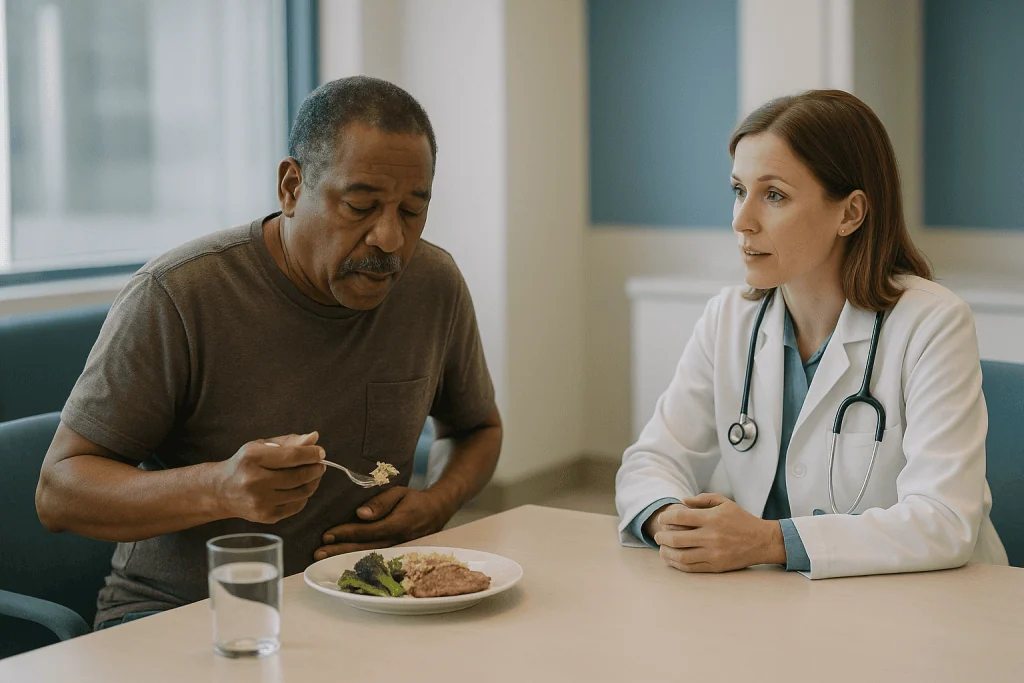
The causes are specific. In cystic fibrosis, thick secretions block the pancreatic ducts, and most people with the condition develop insufficiency in childhood. In chronic pancreatitis, repeated inflammation scars the gland until enzyme output falls below the threshold needed for absorption, typically when more than about 90 percent of function is lost. Surgery that removes part or all of the pancreas, tumors that block the duct, and, less commonly, advanced celiac disease or long-standing diabetes can do the same.
For these patients, prescription pancrelipase is the standard of care, and the evidence behind it is strong. Randomized, placebo-controlled trials in both cystic fibrosis and chronic pancreatitis have measured the coefficient of fat absorption, the percentage of dietary fat that actually gets absorbed, and shown consistent, substantial improvement with treatment. Patients gain weight, stool frequency falls, and vitamin levels recover. The Mayo Clinic lists enzyme replacement among the core treatments for chronic pancreatitis.
Everything about this therapy is individualized. The prescribing clinician sets the amount based on the person’s remaining pancreatic function, body size and fat intake, adjusts it against symptoms and weight, and monitors fat-soluble vitamins. None of that can be reproduced by picking a supplement off a shelf, and it is the reason MedlinePlus lists pancrelipase as prescription-only. If you have one of the diagnoses above and greasy stools or unexplained weight loss, this conversation with your doctor is overdue.
Lactose intolerance: the clearest over-the-counter win
Lactase is the enzyme in the small intestine that splits lactose, the sugar in milk, into two simpler sugars the body can absorb. Most mammals stop making much of it after weaning, and so do most human adults: NIH sources estimate that around two-thirds of the world’s adults have reduced lactase activity, with rates highest in people of East Asian, West African, Arab, Jewish, Greek and Italian descent and lowest in those of Northern European ancestry.
When lactose reaches the colon undigested, bacteria ferment it, producing gas, bloating, cramps and loose stools, usually within thirty minutes to two hours of a dairy-heavy meal. The NHS describes this as lactose intolerance, and it is common, uncomfortable and not dangerous.
Lactase supplements, taken with the first bite of a lactose-containing food, supply the missing enzyme so the sugar gets broken down before bacteria reach it. The evidence here is moderate: several small randomized crossover trials show that lactase reduces breath hydrogen (a marker of fermentation) and symptoms after a lactose load, though the effect varies with the product and the amount of dairy eaten. Lactose-free milk, which has had lactase added during processing, works on the same principle and is arguably the more reliable option.
Two caveats make this a qualified rather than unconditional endorsement. Lactose intolerance is a diagnosis of pattern and, ideally, of testing, not of assumption; a milk allergy, celiac disease or irritable bowel syndrome can produce similar symptoms and are handled very differently. Second, lactase only fixes lactose. A person who takes it and still bloats after a bowl of beans has answered a useful question: dairy was not the whole story.
Do digestive enzymes help with bloating and gas?
This is the promise driving the trend, so it deserves a precise answer. Bloating has many causes, and enzymes address exactly one of them: fermentable carbohydrate reaching the colon because the small intestine could not break it down. For lactose, that story is well established. For the oligosaccharides in beans, lentils, cabbage, broccoli and whole grains, there is a second candidate.
Alpha-galactosidase is an enzyme, usually derived from a food-grade fungus, that splits the complex sugars in legumes and cruciferous vegetables that humans cannot digest on their own. A handful of small randomized, placebo-controlled trials, mostly in healthy volunteers eating deliberately high-oligosaccharide meals, have found less breath hydrogen and less reported flatulence when the enzyme was taken with the meal. One small pediatric study in children with functional abdominal pain also reported fewer symptoms. That is genuinely encouraging, and it is also modest: short studies, small numbers, and effects that shrink when the meal is ordinary rather than engineered to produce gas.
For bloating from other causes, the evidence essentially disappears. Bloating from swallowed air, from constipation, from eating fast, from carbonated drinks, from stress-related changes in gut motility, from small intestinal bacterial overgrowth or from the visceral hypersensitivity of irritable bowel syndrome does not involve a missing enzyme, and adding one has not been shown to help in trials. Broad-spectrum blends that list a dozen enzymes on the label have not been tested as products; each ingredient is inferred to work from its role in a healthy gut, not shown to work in people who took the capsule.
The practical test is cheap: notice what you ate before the bloating. If the answer is dairy or a legume-heavy dish, an enzyme is worth considering. If the answer is “a lot of everything, quickly,” it is not.
What the evidence actually says, graded
Evidence comes in tiers, and it helps to name them. Randomized controlled trials, in which people are assigned by chance to a treatment or a placebo, are the strongest test of whether something works. Observational studies watch what happens to people who chose a treatment and can show associations but not cause. Expert opinion and mechanistic reasoning (“this enzyme digests fat, so it should help”) sit at the bottom.
By that ladder, digestive enzymes sort cleanly.
Strong evidence, multiple randomized trials: prescription pancrelipase for exocrine pancreatic insufficiency caused by cystic fibrosis, chronic pancreatitis and pancreatic surgery. Fat absorption improves measurably, weight and nutritional markers improve, and the benefit is consistent across studies and decades. Guideline bodies treat it as standard care.
Moderate evidence, several small randomized trials: lactase for lactose intolerance. Symptoms and fermentation markers improve, with variation between products and doses. Lactose-free dairy achieves the same goal with more predictability.
Weak to moderate evidence, a few small randomized trials: alpha-galactosidase for gas after legume-rich meals. Promising, short-term, mostly in healthy volunteers.
Weak or inconsistent evidence: pancreatic enzymes for irritable bowel syndrome in people with a normal pancreas. A small number of pilot trials exist; results are mixed, sample sizes are tiny, and no guideline recommends them. Plant proteases such as bromelain and papain for “protein digestion” rest almost entirely on laboratory plausibility.
No credible evidence: enzymes for weight loss, for “detoxification,” for general energy, for cancelling out a large meal, or as a daily tune-up for a healthy gut.
Harvard Health and Johns Hopkins reach the same conclusion in plainer words: enzymes are valuable when a deficiency has been identified and largely unproven when it has not. That is the standard any purchase should be held to.
Digestive enzymes at a glance: who benefits and how strong the proof is
The table below condenses the previous sections into one view. Regulatory status matters as much as the evidence column, because it tells you whether the amount of active enzyme in the product has been independently verified.
| Enzyme | What it breaks down | Who has evidence of benefit | Strength of evidence | Regulatory status in the US |
|---|---|---|---|---|
| Pancrelipase (lipase, protease, amylase from pig pancreas) | Fat, protein, starch | Exocrine pancreatic insufficiency: cystic fibrosis, chronic pancreatitis, pancreatic surgery or cancer | Strong; multiple randomized placebo-controlled trials | Prescription medicine, FDA-approved |
| Lactase | Lactose (milk sugar) | Lactose intolerance | Moderate; small randomized crossover trials | Dietary supplement; also added to lactose-free dairy |
| Alpha-galactosidase | Oligosaccharides in beans, lentils, cabbage, broccoli | Gas and bloating after legume-rich meals | Weak to moderate; a few small randomized trials, mostly healthy volunteers | Dietary supplement |
| Multi-enzyme blends (amylase, protease, lipase, cellulase, bromelain, papain and others) | Marketed for “everything” | No specific diagnosed group | Weak; individual ingredients inferred from mechanism, blends untested as products | Dietary supplement |
| Bromelain, papain (plant proteases) | Protein | None established for digestion | Very weak; mainly laboratory data | Dietary supplement |
Two patterns stand out. The stronger the evidence, the narrower the group it applies to. And the products most heavily promoted online, the broad blends, are the ones with the least data behind them. That inversion is not a coincidence; a product with a specific indication has a specific market, while a product that promises to fix everything can be sold to everyone.
One more reading of the table: every row with real evidence involves a single, named enzyme matched to a single, named problem. That is a useful filter when a label lists fourteen ingredients and no condition.
Who is wasting money on digestive enzymes?
The honest list is longer than the marketing would suggest.
Healthy adults taking a daily blend as insurance are the largest group. A functioning pancreas already produces enzymes in excess of need and ramps up in response to meals; there is no trial showing that adding more improves digestion, nutrient absorption, energy or anything else in this population. Most supplemental enzymes are proteins, and a good share are simply digested by stomach acid and the body’s own proteases before they reach the small intestine.
People buying enzymes to offset a large or indulgent meal are the second group. Post-meal fullness is a volume and speed problem. Enzymes do not shrink the meal, slow the eating or remove the calories, and the weight-loss framing that appears in some videos has no evidence at all.
People with irritable bowel syndrome (IBS), a common disorder of gut-brain interaction defined by recurrent abdominal pain with altered bowel habits, form a third and more sympathetic group. Their symptoms are real and enzymes are an understandable thing to try. Yet the pilot trials are small and inconsistent, no major gastroenterology guideline recommends enzymes for IBS, and better-supported approaches exist: structured dietary changes such as a supervised low-FODMAP trial, soluble fiber, gut-directed behavioral therapies and, when needed, prescribed medicines.
Fourth are people whose real diagnosis is something else. Celiac disease, small intestinal bacterial overgrowth, bile acid diarrhea, inflammatory bowel disease and gallbladder problems all produce symptoms that enzymes are marketed for and that enzymes do not treat. Money spent on a blend is not just wasted; it can delay the test that would have found the actual problem.
The uncomfortable summary: if you cannot name the enzyme you are missing and the reason you are missing it, the evidence says you are probably not the person these products help.
Prescription pancrelipase vs supplement blends: not the same product
Both are called digestive enzymes. That shared name hides differences that matter clinically.
Prescription pancrelipase is derived from pig pancreas and standardized to a stated amount of lipase activity, verified through the FDA approval process, with each batch tested for consistency. The capsules are enteric-coated, meaning the coating resists stomach acid and dissolves in the small intestine, so the enzymes arrive where fat is absorbed rather than being destroyed on the way. The prescribing clinician matches the amount to the person, adjusts it over time and checks nutritional markers. The medicine has a defined safety record, including known rare risks discussed later in this piece.
Over-the-counter blends are a different category of product in nearly every respect. Their enzymes may come from fungi, bacteria, plants or animals. Activity is often reported in a variety of units that make comparison across labels difficult, and because supplements are not required to demonstrate effectiveness before sale, the activity printed on the bottle has not been independently confirmed against a clinical outcome. Many are not enteric-coated, so a portion of the enzyme is inactivated by stomach acid. Independent testing of supplements in general has repeatedly found products whose contents differ from their labels, and enzyme products are not exempt from that problem.
The practical consequence is one that gastroenterologists see regularly: a person with undiagnosed pancreatic insufficiency who has been taking a supplement blend, getting partial relief that is hard to interpret, and losing months before the fecal elastase test that would have led to proper treatment. For someone with a diagnosed pancreatic condition, a supplement is not a substitute for prescription therapy, and switching between them, or changing a prescribed amount, is a decision that belongs to the treating clinician.
Is it okay to take digestive enzymes every day? Side effects to know
The answer splits along the same line as everything else in this article.
For people with exocrine pancreatic insufficiency, daily use with every meal and snack is exactly how prescription pancrelipase is meant to work, indefinitely, because the underlying deficiency does not go away. Long-term safety in this population is well documented. Common side effects are mild: abdominal discomfort, gas, constipation or, occasionally, nausea. Elevated uric acid has been reported. The one serious concern is a rare bowel-scarring condition called fibrosing colonopathy, seen mainly in children with cystic fibrosis taking very high amounts; this is why clinicians set and monitor the amount rather than leaving it to the patient. Because the product is derived from pigs, people with a pork allergy need to discuss that, and those who avoid pork for religious reasons may want the conversation as well.
For people with lactose intolerance, lactase taken with dairy as needed, whether that turns out to be daily or twice a month, has no meaningful safety signal. The same is broadly true of alpha-galactosidase, though it is worth knowing that it releases the simple sugar galactose, which matters for the rare people with galactosemia, an inherited condition in which galactose cannot be processed.
For healthy adults taking a broad blend every day, the question is less about danger and more about the absence of a reason. Reported side effects are usually gastrointestinal and mild; allergic reactions to fungal or plant enzymes occur but are uncommon. Papain and bromelain have been reported to interact with blood-thinning medicines in case reports and may increase bleeding risk, a point anyone on anticoagulants should raise with their pharmacist. A supplement that provides no measurable benefit does not need to be dangerous to be a poor daily habit.
Who should not take digestive enzymes?
Several groups should stop, or should not start, without a conversation with a clinician.
Anyone with a known allergy to the enzyme source tops the list. For pancrelipase that means pork protein; for many supplement blends it means fungal proteins from Aspergillus species, pineapple (bromelain) or papaya (papain). Allergic reactions can range from itching and hives to, rarely, breathing difficulty.
People taking anticoagulant or antiplatelet medicines should be cautious with plant proteases such as bromelain and papain, which have been linked in case reports to increased bleeding. People with gout or elevated uric acid may want to know that pancrelipase can raise uric acid levels. Those with galactosemia should avoid alpha-galactosidase.
People with acute pancreatitis, meaning sudden inflammation of the pancreas, are generally not started on enzyme replacement during the acute episode; the timing and need are decisions for the treating team. People with a suspected bowel obstruction or severe, worsening abdominal pain should not be experimenting with any supplement; they should be seeking care.
Pregnant and breastfeeding people have very limited safety data for most over-the-counter enzyme blends, and the standard advice, to take only what a clinician has agreed is necessary, applies. Children fall in the same category: enzyme replacement in pediatric cystic fibrosis is closely managed care, and a general blend has no established role in a healthy child.
Finally, and most broadly, anyone using a supplement to manage a symptom that has not been evaluated should not keep doing so indefinitely. Unexplained diarrhea, weight loss, greasy stools or persistent bloating deserve a diagnosis. Taking something that muffles a symptom without explaining it is the one use of digestive enzymes with a clear downside, because it can postpone the answer.
Common myths about digestive enzymes, corrected
Myth: enzyme production declines with age, so everyone over 40 needs a supplement. Pancreatic enzyme output does fall modestly with age, but the pancreas has a very large functional reserve, and symptoms of insufficiency do not appear until output drops by roughly 90 percent. Healthy older adults digest food normally. Age alone is not an indication.
Myth: cooked food is “enzyme-dead” and you must replace the enzymes lost in cooking. The enzymes in raw food serve the plant, not you, and are broken down by stomach acid like any other protein. Your own pancreas and intestine supply the enzymes for digestion; cooking food does not reduce your ability to digest it and often improves it.
Myth: enzymes let you eat gluten if you have celiac disease. No enzyme product has been shown in clinical trials to allow people with celiac disease to eat gluten safely. Investigational gluten-degrading enzymes exist in research settings, are not approved for this purpose, and are not for sale or self-use. A strict gluten-free diet remains the treatment.
Myth: enzymes help you lose weight or “burn” a heavy meal. Enzymes make nutrients more absorbable, not less. There is no trial showing weight loss, and the mechanism argues against it.
Myth: if a supplement helps a little, you must have had a deficiency. Placebo responses in digestive symptom trials are large, commonly 30 to 40 percent. Feeling somewhat better after starting a capsule is compatible with having a perfectly healthy pancreas.
Myth: more enzymes mean better digestion. Once enough enzyme is present to handle the meal, extra does nothing, and in the case of prescription pancrelipase, very high amounts carry known risk. The goal is the right amount for a diagnosed need, set by a clinician, not the largest number on a label.
When to see a doctor
Digestive enzymes sit at the intersection of a real medical treatment and a heavily marketed supplement, so knowing when to move from the shelf to the clinic matters more here than for most gut-health trends.
Make an appointment, without waiting to see whether a supplement helps, if you notice any of the following for more than a couple of weeks: stools that are pale, greasy, oily, floating or unusually foul-smelling; unintended weight loss; persistent diarrhea; abdominal pain that recurs after most meals; or bloating that has become a daily rather than occasional event. Ask specifically about a fecal elastase test and fat-soluble vitamin levels if pancreatic insufficiency seems possible.
Seek care promptly, the same day, for red-flag signs: blood in the stool or black, tarry stools; severe or worsening abdominal pain, especially with fever or vomiting; jaundice, meaning yellowing of the skin or eyes; difficulty swallowing; a new change in bowel habit in anyone over 50; or signs of an allergic reaction after taking an enzyme product, such as hives, facial swelling or trouble breathing.
Bring the bottle if you have been taking a supplement. Clinicians need to know what you have tried, partly because some ingredients interact with medicines and partly because partial relief from an enzyme blend is itself a clue worth interpreting.
If you have already been prescribed pancrelipase or another enzyme therapy, the amount, the timing and any change belong to your prescribing clinician. Persistent greasy stools, weight loss or new abdominal pain on treatment are reasons to call, not reasons to adjust on your own or to swap in an over-the-counter product. And if a supplement seemed to help and you are wondering whether that means something, that is a reasonable question to put to your doctor rather than to a video.
Frequently asked questions
Is taking digestive enzymes good for you?
Digestive enzymes are good for people who have a diagnosed shortage of a specific enzyme: prescription pancrelipase for exocrine pancreatic insufficiency, lactase for lactose intolerance, and possibly alpha-galactosidase for gas after legumes. For healthy adults with a normal pancreas, trials have not shown any benefit to digestion, nutrient absorption or energy, so daily use as general insurance is not supported by evidence.
What are the signs you need digestive enzymes?
The signs that point toward a real deficiency are pale, greasy, oily or floating stools, persistent diarrhea, cramping after meals, unintended weight loss and signs of low fat-soluble vitamins such as easy bruising, usually in someone with chronic pancreatitis, cystic fibrosis or pancreatic surgery. Occasional bloating after a large meal is not one of those signs. A stool test called fecal elastase can confirm or rule out pancreatic insufficiency.
Is it okay to take digestive enzymes every day?
For people prescribed pancrelipase, daily use with every meal is how the treatment works and is well studied over the long term under clinician monitoring. Lactase taken whenever you eat dairy is also considered safe. For healthy adults, daily use of a broad enzyme blend is generally not harmful but has no demonstrated benefit, and plant proteases such as bromelain may interact with blood thinners.
Who should not take digestive enzymes?
People with allergies to the enzyme source, including pork for pancrelipase and pineapple, papaya or fungal proteins for many blends, should avoid them. People on anticoagulants should be cautious with bromelain and papain, and those with galactosemia should avoid alpha-galactosidase. Anyone with unexplained weight loss, greasy stools or severe abdominal pain should see a clinician for a diagnosis rather than self-treat with a supplement.
Do digestive enzymes help with bloating?
Only when the bloating comes from a specific undigested carbohydrate. Lactase helps bloating caused by lactose, and alpha-galactosidase has some trial evidence for gas after beans and cruciferous vegetables. Bloating from eating fast, swallowed air, constipation, carbonated drinks, stress or irritable bowel syndrome does not involve a missing enzyme, and enzyme supplements have not been shown to help in those situations.
What are the side effects of digestive enzymes?
Most side effects are mild and gastrointestinal: abdominal discomfort, gas, constipation or nausea. Prescription pancrelipase can raise uric acid and, at very high amounts in children with cystic fibrosis, has been linked to a rare bowel-scarring condition, which is why clinicians set the amount. Allergic reactions to pork, fungal or plant-derived enzymes occur but are uncommon; hives, swelling or breathing trouble need urgent care.
When is the best time to take digestive enzymes?
Enzymes work on food that is present, so both prescription and over-the-counter products are designed to be taken with meals, typically at the start of eating, rather than on an empty stomach or hours later. For prescription pancrelipase, the exact timing, the split across a meal and any adjustments are set by the prescribing clinician; follow their instructions and the product label rather than online advice.
Can digestive enzymes help with irritable bowel syndrome?
The evidence is weak. A small number of pilot trials of pancreatic enzymes in people with irritable bowel syndrome and a normal pancreas have produced mixed results, and no major gastroenterology guideline recommends them. Better-supported options include a supervised low-FODMAP dietary trial, soluble fiber, gut-directed behavioral therapies and prescribed medicines. Any trial of enzymes for IBS should be discussed with the treating clinician.
Are over-the-counter digestive enzymes the same as prescription ones?
No. Prescription pancrelipase is FDA-approved, standardized to a verified amount of lipase, enteric-coated to survive stomach acid, and adjusted by a clinician for the individual. Over-the-counter blends are regulated as dietary supplements, do not have to prove effectiveness before sale, often lack enteric coating, and report activity in units that are hard to compare. They are not a substitute for prescribed enzyme therapy.
How do doctors test whether you are low on digestive enzymes?
The most common test is fecal elastase, a stool test that measures an enzyme released by the pancreas; a low value suggests exocrine pancreatic insufficiency. Doctors may also check blood levels of fat-soluble vitamins A, D, E and K, measure fat in the stool, and image the pancreas with CT or MRI when a structural cause is suspected. Lactose intolerance is usually assessed with a hydrogen breath test or a supervised elimination trial.
References
This article is for general information only and is not a substitute for professional medical advice. Please consult a qualified doctor about your individual situation.

More from the Blog

Which Tests Come Before a GERD Treatment Plan? Endoscopy, pH Monitoring and Manometry
GERD testing before treatment usually starts with a history and physical exam; many people begin acid-suppressing therapy without any test. Doctors typically order an…

Lactose Intolerance Over the Years: What Improves, What Persists and How Care Adjusts
Lactose intolerance is usually long term when it comes from the normal, genetically programmed decline in the lactase enzyme after early childhood; that form…

Silent Reflux: The Throat-Clearing, Hoarse-Voice Reflux Many People Never Suspect
Silent reflux, known clinically as laryngopharyngeal reflux (LPR), happens when stomach contents travel up past the esophagus and irritate the throat and voice box,…

When a PEG Tube Needs Replacing: Blockages, Wear and How the Exchange Is Done
A PEG tube usually needs replacing when it blocks and cannot be cleared by flushing, when the material cracks, kinks or discolors, when a…

What Hepatitis B Blood Tests Show: Markers, Viral Load and How They Shape Your Plan
A hepatitis B viral load test measures how much hepatitis B virus DNA is circulating in a set volume of blood, usually reported in…

Recovering After a Gastrointestinal Bleed: Anemia Checks, Diet Steps and Regaining Energy
Recovery after a GI bleed usually unfolds over weeks rather than days. The lining heals first, then the blood count and iron stores follow,…