

Do Children Outgrow Strabismus? Misconceptions That Delay Treatment

Key Takeaways
- Newborn eye wandering that settles by around three months is normal, but a turn that persists beyond early infancy does not typically correct itself, according to the NHS and MedlinePlus.
- The NHS estimates strabismus affects about 1 in 20 children, and the National Eye Institute puts amblyopia, the vision loss that can follow, at up to 3 in 100.
- Amblyopia develops from birth to about age 7, per Mayo Clinic, so the deadline for protecting vision is set by brain development, not by the eye muscle.
- In accommodative esotropia, glasses straighten the eye by removing focusing strain; the eyes crossing again without the glasses confirms the diagnosis rather than showing treatment failure.
- Patching and dilating drops treat the vision loss of amblyopia, not the alignment, so an eye can still turn after a successful course.
- A white or yellow pupil reflection in flash photographs, a sudden new turn, or a turn with headache or vomiting are red flags that need same-day medical attention.
Most children do not outgrow true strabismus, a condition in which the two eyes point in different directions. Brief eye wandering in newborns that settles by around three months is normal, and some children have pseudostrabismus, an appearance of crossing without real misalignment. An eye turn that persists in a toddler or older child usually needs assessment, because untreated misalignment can lead to permanent vision loss in the drifting eye.
The photograph is the tell. A fourth birthday, a cake with too many candles, and in one frame the left eye is looking at the camera while the right eye has quietly turned toward the nose. A parent scrolls back through the album and finds it again: the beach, the school concert, the sofa. Then the grandmother, kindly, says what grandmothers everywhere say. “His uncle had that. He grew out of it.” So the parent types the question into a phone at midnight: will my child outgrow strabismus?
The honest answer is more interesting than yes or no, and it hinges on two very different things that can look identical in a snapshot. One is a normal stage or a trick of facial shape that really does fade. The other is a wiring problem between eye and brain that does not fade, and that, left alone, teaches the brain to stop using one eye.
Telling them apart takes a few minutes with a penlight and a trained examiner. Guessing from the family album can take years, and those are the years the visual brain is still being built.
Will my child outgrow strabismus? Where the hope comes from
The belief is not silly. Two real observations sit behind it. Very young babies do cross or drift their eyes now and then; the NHS notes this is common in the first months and usually settles by around three months as the brain learns to steer both eyes together. Separately, some children have pseudostrabismus, an appearance of crossed eyes created by a wide, flat bridge of the nose or a fold of skin at the inner corner of each eye, while the eyes are in fact perfectly aligned. Pseudostrabismus really does disappear as the face grows, and almost every family knows someone whose baby pictures prove it.
The trouble starts when those two normal situations harden into a general rule, and the rule is then applied to a three-year-old whose eye turns in every time she looks at a picture book. That child does not have wandering newborn eyes, and she does not have a facial-shape illusion. She has esotropia, an eye that turns inward, and the guidance from MedlinePlus, Cleveland Clinic and the NHS is consistent: true strabismus that persists beyond infancy does not typically correct itself.
There is a quieter reason the myth survives. Strabismus rarely hurts, and small children almost never complain about it, because the brain has a remarkable trick for coping: it switches the second image off. A parent notices an eye that looks slightly off in photographs. The child sees one clear picture and gets on with the day. Nothing feels urgent, so nothing happens.
Waiting for a growth spurt to fix a coordination problem spends the one resource that cannot be recovered later. The visual brain finishes most of its construction in early childhood, and the next section explains why that deadline, not the eye muscle, is what should drive the decision to be seen.
What actually happens when the eyes stop working as a pair
Each eye is moved by six small muscles, and the brainstem coordinates all twelve so that both eyes land on the same target at the same instant. When they do, the two slightly different pictures are fused into one image with depth. That fused, three-dimensional sense is called stereopsis, and it is a skill the brain learns in the first years of life rather than something present at birth.

Strabismus breaks the partnership. One eye aims at the target; the other aims somewhere else, inward (esotropia), outward (exotropia), or occasionally up or down. The brain now receives two pictures that do not overlap. An adult who develops this suddenly, after a stroke or head injury for example, sees double and finds it miserable. A young child’s brain does something different and, in the short term, cleverer: it suppresses the image from the deviating eye. The double vision vanishes. So does the child’s reason to complain.
Suppression is the root of the harm. A brain that keeps ignoring one eye gradually stops building the connections that eye needs, and vision in that eye fails to develop even though the eye itself is healthy. That outcome is amblyopia, described in the next sections. The National Eye Institute lists strabismus as one of the most common causes.
Why does the alignment fail in the first place? Cleveland Clinic and MedlinePlus describe several routes. Uncorrected farsightedness makes a child overwork the focusing system, which is neurologically linked to turning the eyes inward. Some infants are born with poor coordination of the eye muscles. Less commonly, a nerve or brain problem, a cataract, a retinal condition, or a tumor inside the eye reduces the vision in one eye so much that it drifts. Family history raises the risk, as do prematurity and certain genetic conditions. The mechanism matters because it decides the treatment, which is why the first appointment is about finding the cause rather than simply confirming the turn.
Does strabismus go away on its own? It depends on the type
“Strabismus” is a family name, not a single diagnosis, and the members of the family behave very differently over time. The NHS estimates that a squint, its term for strabismus, affects about 1 in 20 children; Cleveland Clinic puts the figure at roughly 4 percent of the population. Within that group, the question of natural resolution has different answers depending on which type a child has.
| Type | Typical age it appears | Does it usually resolve alone? | Usual first-line approach |
|---|---|---|---|
| Newborn eye wandering | Birth to about 3 months | Yes, in most infants | Observation; review if it persists |
| Pseudostrabismus | Infancy | Yes, as facial features mature | Exam to confirm true alignment |
| Infantile esotropia | Before 6 months | No | Assessment for glasses and often surgery |
| Accommodative esotropia | About 2 to 3 years | No, but controlled by glasses | Full farsighted correction |
| Intermittent exotropia | Toddler to school age | Rarely; may stay stable or progress | Monitoring, glasses, sometimes surgery |
| Sudden-onset strabismus | Any age | Should not be assumed to | Prompt medical evaluation |
Two rows deserve a closer look because they feed the myth most. Accommodative esotropia in children is the type most likely to be “outgrown” in conversation, because glasses make the eyes look straight and, as some children grow, their farsightedness lessens and the prescription can be reduced under supervision. That is not the eye fixing itself; it is a treatment working and then being adjusted. Intermittent exotropia is the other confuser, because the eye is straight most of the day and only drifts when the child is tired or daydreaming. Parents reasonably conclude it is going away. The evidence summarized by MedlinePlus suggests the opposite pattern is more common: without monitoring, the drifting can become more frequent, not less.
Lazy eye vs strabismus: why the brain sets the deadline
People often use “lazy eye” and “crossed eyes” interchangeably, and the mix-up hides the most important fact in this article. Strabismus is a misalignment you can sometimes see. Amblyopia, the medical term for lazy eye, is a loss of vision in a structurally normal eye because the brain has stopped using it. You cannot see amblyopia in a photograph. A child can have straight-looking eyes and be functionally blind in one of them, and a child can have an obvious turn and still have good vision in both if the brain has been alternating between them.
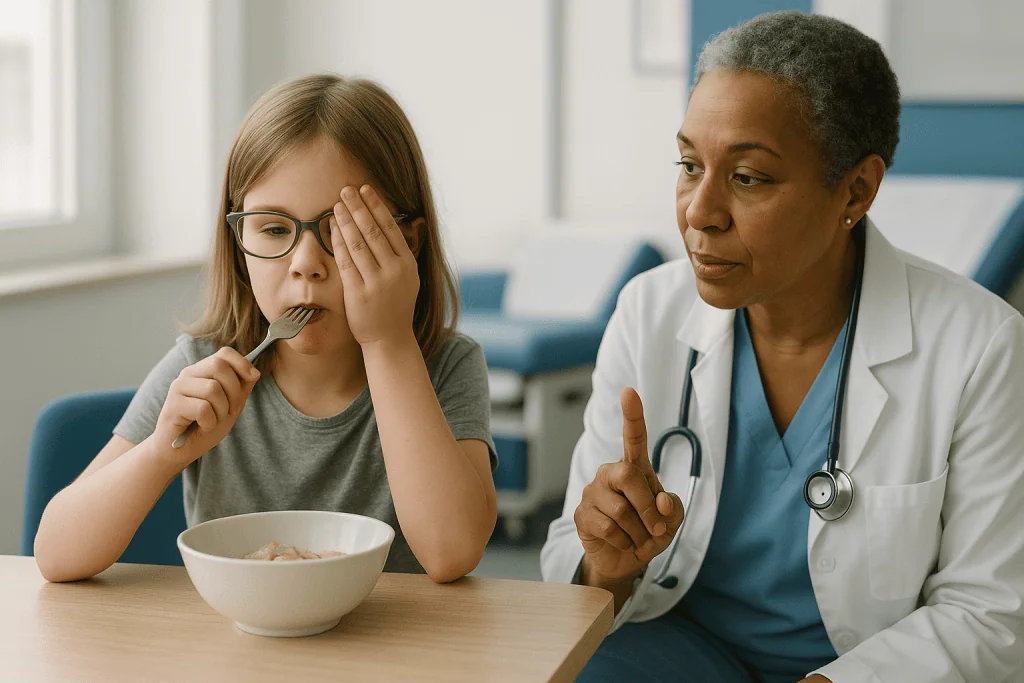
The National Eye Institute estimates that amblyopia affects up to 3 in 100 children and describes it as the most common cause of vision loss in children. Mayo Clinic notes that it develops from birth up to about age 7, the period in which the visual pathways are still plastic. Strabismus is one of three main triggers; the others are a large difference in prescription between the two eyes and anything that blocks a clear image, such as a congenital cataract or a droopy eyelid.
Here is why the calendar matters more than the muscle. Straightening an eye is possible at almost any age. Restoring vision in an eye the brain has learned to ignore becomes progressively harder as that plastic period closes. Mayo Clinic and the National Eye Institute both note that amblyopia treatment tends to work best when started early, and that responses in older children and adults are more limited and less predictable. The eye muscle can wait; the visual cortex is on a schedule of its own.
This is the argument against “let’s see how he does by kindergarten.” A child who is examined at three and found to have healthy vision in both eyes has lost nothing by being checked. A child who waits until seven and turns out to have deep amblyopia has lost something that treatment may not fully return.
Who is usually treated now, and who is asked to wait and watch
Not every eye turn leads to glasses or an operating room, and a good pediatric eye team spends as much effort deciding what not to do as what to do. The distinction is between active treatment and active observation. Observation still involves scheduled examinations; it is not the same as going home and hoping.
Children who are usually treated promptly include those with a constant turn at any age beyond the first few months, any turn combined with reduced vision in one eye, a turn that appeared suddenly in a child whose eyes were previously straight, and any strabismus accompanied by an abnormal head tilt, double vision, or a white rather than red reflection in the pupil on flash photographs. Infantile esotropia, the large inward turn present before six months, falls in this group; Cleveland Clinic and MedlinePlus both note it generally requires surgical realignment because glasses do not address its cause.
Children who are often asked to wait, with follow-up dates in the diary, include infants under about three months with occasional wandering and no other signs, children whose examination confirms pseudostrabismus, and children with a small intermittent exotropia who have equal vision in both eyes and good stereopsis when tested. For that last group, the aim of watching is to catch the moment, if it comes, when the control begins to slip and the turn becomes more frequent or the depth perception starts to decline.
Adults sit in a separate category. Someone who has had strabismus since childhood can still be treated for alignment, and someone who develops a new turn as an adult needs evaluation for the neurological or medical cause first. The decision about which pathway a particular child follows rests with the treating team, who can measure what a parent can only estimate: how large the turn is, how often it occurs, what each eye sees, and whether the brain is fusing the two images at all.
Strabismus in toddlers: what the first appointment actually involves
Parents often delay because they assume a two-year-old cannot be tested. The opposite is true; pediatric eye examinations are designed around children who cannot read, cannot sit still, and may not want to be there. Most of the work is done by watching how the eyes behave rather than by asking the child to perform.
The examiner, usually a pediatric ophthalmologist or an orthoptist, a specialist in eye movement and binocular vision, will start with a cover test: covering one eye while the child looks at a toy, then uncovering it and watching whether either eye jumps to pick up the target. That movement, or its absence, reveals a true turn and distinguishes it from pseudostrabismus. A penlight held at arm’s length shows whether the light reflects from the same spot on each cornea, a quick alignment check known as the corneal light reflex test.
Vision is measured with matching games or pictures long before letters are possible, and depth perception with special glasses and images that only pop out if both eyes are working together. Expect dilating drops. These relax the focusing muscle inside the eye so the true prescription can be measured, and they widen the pupil so the examiner can inspect the lens and retina for the rare but serious causes described earlier. The blur and light sensitivity typically last several hours, and small children are usually more bothered by the sting than by the blur.
Preparation helps more than promises do. Bring the photographs that worried you; a series showing the turn in different settings is genuinely useful clinical information. Feed and rest the child beforehand. Bring sunglasses or a hat for the trip home. Allow a couple of hours, since the drops need time to work. If glasses are prescribed, the team will explain that they are treating the mechanism, not the appearance, which is why the next section spends time on how spectacles straighten an eye.
Accommodative esotropia in children: when glasses do most of the work
Ask what type of eyeglasses are best for strabismus and the honest answer is: whichever pair corrects the specific optical error driving the turn, worn all day. For the most common childhood pattern, that means glasses for farsightedness, and the mechanism is worth understanding because it explains why parents are told never to stop them once the eyes look straight.
A farsighted child sees blur at every distance unless the focusing muscle inside the eye works overtime. That focusing effort is wired to the same reflex that turns the eyes inward for near work, so a child straining to focus at three feet may over-converge and cross. Put the full farsighted prescription in front of those eyes, and the strain disappears; the reflex quiets; the eye drifts back to center. Cleveland Clinic and MedlinePlus describe this as the standard first step for accommodative esotropia. The eyes look straight because the glasses are on, which is exactly why they look crossed again when the glasses come off. That is not failure. That is the diagnosis being confirmed.
Some children are straight for distance but still cross when looking at a book. For them, bifocal lenses with extra reading power in the lower segment are sometimes used, a decision made on measurements at both distances. Prism lenses, which bend light to bring the two images closer together, are used more often for double vision in older children and adults than for alignment in toddlers.
Frame choice matters in a practical rather than a fashionable sense: a pair that slides down a small nose is a pair that is not correcting anything, so cable temples, elastic straps and impact-resistant lenses are common recommendations for young children. Prescriptions are rechecked regularly because farsightedness changes with growth. Any reduction in lens power, sometimes called weaning, is a supervised, gradual process led by the eye team, and it is not appropriate for every child.
Patching, drops and eye exercises: what the evidence actually shows
A common confusion, and one that leads families to abandon treatment early, is thinking that patching straightens the eye. It does not. Patching, and the drop-based alternative, treat amblyopia, the vision loss, not the misalignment. A child can finish a course of patching with excellent vision in both eyes and an eye that still turns; that is a success on one problem and unfinished business on another.
Patching works by covering the stronger eye for part of the day so the brain is forced to use the weaker one. The schedule is set by the eye team based on the child’s age and the depth of the amblyopia, and it is adjusted at each visit. The main alternative is a dilating drop, atropine, placed in the stronger eye. It blurs near vision in that eye by relaxing its focusing muscle, which nudges the brain toward the weaker eye without anything over the face. The National Eye Institute and Mayo Clinic describe both approaches as established treatments, and which one suits a given child, and for how long, is a prescribing decision for the clinician, not a rule that fits everyone.
Eye exercises deserve a clear-eyed sentence. There is reasonable evidence, summarized by MedlinePlus, that supervised exercises help convergence insufficiency, a specific difficulty turning the eyes inward for reading that causes eyestrain and blurred near vision. For most other forms of strabismus, exercises have not been shown to straighten a misaligned eye, and promises otherwise should prompt a question about the evidence.
Timelines are measured in months, not days. The National Eye Institute notes that amblyopia treatment may continue for months to years, with regular checks to confirm the weaker eye is improving and the stronger eye is not slipping. Stopping abruptly because the eye “looks fine” risks the improvement fading, which is one more reason to leave the schedule with the team.
What strabismus surgery involves, and the weeks that follow
The word surgery, next to the word eye, next to the word child, is frightening, so it helps to know what the operation actually does. The surgeon does not operate inside the eye. The eye muscles attach to the outer white coat of the eyeball, and the surgeon adjusts where they attach or how much they pull: moving an attachment point back to loosen a muscle that is pulling too hard, or shortening a muscle to strengthen its pull. Children are asleep under general anesthesia throughout. The NHS notes the operation is usually done as a day case, with the child going home the same day, and that it may be performed on one or both eyes even when only one appears to turn, because balancing the pull on both sides often produces a steadier result.
Surgery is usually considered when glasses and, where needed, amblyopia treatment have done what they can and a significant turn remains, or for types such as infantile esotropia where glasses do not address the cause. It aligns the eyes; it does not by itself restore vision lost to amblyopia, and glasses are frequently still needed afterward.
The days that follow are uncomfortable rather than dangerous for most children. The eye is red, watery and gritty; Cleveland Clinic notes the redness generally fades over a few weeks. The NHS advises that children can usually return to school after about a week, with swimming avoided until the team clears it. Some children see double for a short period while the brain adjusts to the new position.
Risks, in neutral terms, include under- or overcorrection, which is why some children need a second operation; infection, which is uncommon; and the general risks of anesthesia. In older children and adults, adjustable sutures allow the surgeon to fine-tune the alignment shortly after the procedure while the patient is awake. Whether surgery is appropriate, and when, is a judgment the treating team makes on measurements rather than on how the eye looks in a photograph.
What is the new treatment for strabismus?
Parents searching at midnight often hope a newer option has quietly replaced patches and operations. The truthful summary is that the toolkit has been refined rather than reinvented, and nothing on the horizon removes the need for early detection.
Botulinum toxin injected into an overactive eye muscle is sometimes described as new, though it has been used in strabismus for decades. It temporarily weakens the muscle so the eye can drift toward center, and in selected cases, particularly some infants with esotropia and some adults, it is used as an alternative or adjunct to surgery. Its effect is temporary by design, repeat treatment may be needed, and the evidence does not show it outperforms surgery across the board. It is a tool for specific situations, chosen by the surgeon.
Binocular or “dichoptic” digital therapies are the genuinely newer idea. The child watches a film or plays a game on a tablet while special glasses show a stronger image to the weaker eye and a weaker image to the stronger one, training the brain to use both together. Randomized trials indexed on PubMed have reported modest improvements in vision for the amblyopic eye over weeks, with adherence a recurring problem, and the comparisons with standard patching have not consistently shown these approaches to be superior. They are being studied as amblyopia treatments; they are not established as a way to straighten a misaligned eye, and anyone told otherwise should ask for the trial data.
Adjustable sutures, mentioned earlier, and finer imaging of the eye muscles have improved surgical planning for complex cases. Vision screening with handheld photoscreeners, devices that estimate alignment and refractive error from a photograph of the pupils, has expanded early detection in some settings, though a positive screen still needs a full examination.
So the most honest answer to the question is unglamorous. The most powerful “new” step available to most families is an examination sooner rather than later.
Will my child outgrow strabismus? What people often get wrong
Myths about strabismus cluster around a single hope, that time will do the work, and they delay care in predictable ways. Correcting them one at a time is more useful than dismissing them, because each contains a grain of something true.
- “They’ll grow out of it.” True for newborn wandering before about three months and for pseudostrabismus. Not true for a persistent turn in a toddler, according to the NHS, MedlinePlus and Cleveland Clinic.
- “Glasses will make the eyes lazy or dependent.” The reverse. In accommodative esotropia the glasses remove the strain that causes the turn, and a child who sees clearly through both eyes is a child whose brain keeps using both.
- “Surgery is just cosmetic.” Alignment supports depth perception, reduces double vision in older patients and, in young children, gives the brain a chance to fuse the two images. Appearance is a consequence, not the purpose.
- “He’s too young to be tested.” Alignment and vision can be assessed in infants with games, toys and observation; letter charts are not required.
- “Patch the bad eye so it rests.” Patching covers the good eye to make the weaker one work. Covering the weaker eye deepens the problem.
- “It only happens when she’s tired, so it’s fine.” Intermittent exotropia often behaves this way early and needs monitoring precisely because it can become more frequent.
- “If we miss the window, it can always be fixed later.” Alignment can be treated later. Vision lost to amblyopia is harder to recover once the plastic period Mayo Clinic describes has closed.
One more misunderstanding hides in the language. A parent who hears “the turn is well controlled with glasses” may relay it as “the eye is better now” and, a year later, let the glasses lapse. Controlled is not the same as gone. The eye team will say when, and whether, the prescription can change; that is not a decision for a growth chart or a grandparent, however well meant.
Is it hard to live with strabismus?
For many children whose strabismus is found early and managed, daily life is ordinary: glasses, occasional patching, follow-up visits, and a childhood otherwise indistinguishable from anyone else’s. The difficulties tend to arise in two situations, when the condition was not treated in time and vision in one eye never developed, and when the alignment itself remains noticeable into the school years.
Functionally, the cost of reduced binocular vision is depth judgment. Catching a ball, pouring into a glass, judging a step or the distance to the car ahead all rely partly on stereopsis, and people who lack it compensate with other cues, motion, shadows and relative size, remarkably well, though some tasks and a small number of occupations that demand fine depth perception remain harder. Untreated amblyopia carries a second, quieter risk: if the good eye is later injured or diseased, there is no well-developed second eye to fall back on, which is one reason the National Eye Institute treats early detection as a public-health matter rather than a matter of looks.
Socially, a visible turn can attract comments from other children, and older children and adults sometimes describe avoiding eye contact or feeling that people are unsure which eye to look at. Those experiences are real and should be raised with the care team rather than absorbed in silence; alignment treatment remains possible in adolescence and adulthood, and clinicians take the social dimension seriously as part of a person’s function, not vanity.
At school, a child with glasses and a patch may need a teacher who understands why the patch is worn and can position the child so the weaker eye is doing the work. Reading may be slower during patching. Sports are generally not restricted, and a strap for the glasses solves most practical problems. Living with strabismus is, for most, a matter of routines rather than limits. Living with the untreated consequences of strabismus is what the early appointment is designed to prevent.
Questions to ask your care team
Appointments with a wriggling child are short on time and long on distraction, and the questions that matter most are easy to forget once the drops are in. It helps to arrive with a list and leave with written answers, because the details, which eye, how often, until when, are what make the difference between a treatment plan that is followed and one that drifts.
On the diagnosis itself, ask which type of strabismus your child has, whether it is constant or intermittent, and whether the examination found any difference in vision between the two eyes. Ask directly whether amblyopia is present, since that changes the urgency. If the team has chosen to observe rather than treat, ask what specifically they are watching for, and what change at home should prompt an earlier visit.
On glasses, ask whether the prescription is meant to straighten the eye, sharpen the vision, or both; whether they should be worn every waking hour; and how often the prescription will be rechecked as your child grows. Ask what it means if the eye still turns with the glasses on.
On patching or drops, ask which eye is being treated and why, how the team will know it is working, and what the plan is if the child refuses. On surgery, ask what the alternatives are, what a realistic range of outcomes looks like for a child of this age with this measurement, whether more than one operation is likely, and what the first two weeks at home usually involve.
Finally, ask what should happen if your child develops a new symptom between appointments, such as double vision, a head tilt, or a turn that suddenly looks different, and who you should contact. Writing those instructions down turns the “when to call” list in the next section from a general guide into one tailored to your child.
When to call your doctor
Most childhood strabismus is not an emergency, but a few patterns signal something that should be seen quickly rather than at the next routine visit. The distinction is between a turn that has been stable and slowly assessed and a turn that is new, changing or accompanied by other signs.
Contact your child’s doctor or eye team promptly, the same day where possible, if you notice:
- A new eye turn in a child whose eyes were previously straight, especially if it appeared over hours or days.
- An eye turn together with headache, vomiting, unusual drowsiness, unsteadiness when walking, or a new tilt of the head to one side.
- A white or yellowish reflection in one pupil in flash photographs where the other pupil looks red or dark. MedlinePlus notes this can indicate a cataract or, rarely, a tumor inside the eye.
- A drooping eyelid that has appeared alongside the turn, or a pupil that is a different size from the other.
- A child of any age who reports seeing double.
- After strabismus surgery: increasing rather than easing pain, thick discharge, a sudden drop in vision, fever, or redness that spreads and worsens beyond the first days.
Arrange a non-urgent appointment if a baby’s eyes are still crossing or drifting after about three months, if you see a turn that comes and goes in a toddler, if one eye seems to wander when your child is tired or unwell, or if a child squints, closes one eye in bright light, or turns the head to look at things. Cleveland Clinic and the NHS both advise that any suspected squint beyond early infancy is worth an examination, since the tests are painless and a normal result costs nothing.
Nothing in this article can tell you which category your child falls into. That judgment, and every decision about glasses, patching, drops or surgery that follows, belongs with the team examining your child. What a parent controls is the timing of the first look, and on that point the evidence is unusually clear: sooner is safer than later.
Frequently asked questions
Does strabismus go away on its own in toddlers?
Rarely. A true eye turn that persists past the first few months of life does not typically resolve without treatment, according to the NHS and MedlinePlus. The exceptions are normal newborn wandering before about three months and pseudostrabismus, where facial features create the appearance of crossing while the eyes are actually aligned. Because the two can look identical in photographs, a toddler with a visible turn should be examined rather than watched for a growth spurt.
What percentage of people have strabismus?
About 4 percent of people, according to Cleveland Clinic; the NHS estimates that squint affects roughly 1 in 20 children. Amblyopia, the vision loss that can develop when one eye is ignored by the brain, is somewhat less common, affecting up to 3 in 100 children according to the National Eye Institute. Strabismus can also appear for the first time in adulthood, usually as a result of a medical or neurological cause that needs evaluation.
What is the difference between lazy eye vs strabismus?
Strabismus is a misalignment of the eyes; amblyopia, commonly called lazy eye, is reduced vision in a healthy eye because the brain has stopped using it. Strabismus is one of the main causes of amblyopia, but a child can have either without the other. The misalignment is sometimes visible; the vision loss never is, which is why an examination rather than a photograph is needed to know whether a child’s vision is developing normally in both eyes.
What type of eyeglasses are best for strabismus?
The pair that corrects the specific optical error driving the turn, worn full time. For accommodative esotropia in children, that means the full farsighted prescription, which relaxes focusing effort and lets the eye straighten. Some children need bifocals if the eye turns more for near work, and prism lenses are sometimes used for double vision. Practical features such as a secure fit and impact-resistant lenses matter more than any brand. The prescription is set and rechecked by the eye team.
Is it hard to live with strabismus?
For most children whose strabismus is detected and managed early, daily life is ordinary apart from glasses, patching and follow-up visits. Difficulties are more likely when treatment is delayed and vision in one eye never develops, affecting depth judgment and leaving no strong second eye if the good one is ever injured. A visible turn can also affect confidence in older children, and alignment treatment remains possible in adolescence and adulthood.
What is the new treatment for strabismus?
There is no new therapy that replaces early detection, glasses, patching or surgery. Botulinum toxin injection into an eye muscle is an established option for selected cases rather than a novelty. Binocular tablet-based games that train both eyes together are being studied for amblyopia; trials indexed on PubMed show modest, short-term vision gains, not consistently better than patching, and they are not established as a way to straighten an eye.
Can a child be too young for a strabismus test?
No. Alignment and vision can be assessed in infants using a cover test, a penlight reflex check, matching pictures and observation of how each eye follows a toy. Dilating drops allow the true prescription to be measured and the inside of the eye to be examined. Letter charts are not required. The NHS advises that any squint persisting beyond about three months of age should be checked.
Why do my child's eyes still cross when the glasses come off?
Because the glasses are treating the mechanism of the turn, not permanently removing it. In accommodative esotropia the eye crosses when the child strains to focus; the lenses remove that strain, so the eye is straight while they are on and crosses again when they are off. This is expected and confirms the diagnosis. Any decision to reduce the prescription as a child grows is made gradually by the eye team.
Does patching straighten a turned eye?
No. Patching covers the stronger eye to force the weaker one to work, and it treats amblyopia, the vision loss, rather than the alignment. A child can complete patching with good vision in both eyes and still have an eye that turns, which may then be addressed with glasses or surgery. Covering the weaker eye instead would deepen the problem, so the team’s instructions about which eye to patch matter.
How long does recovery take after strabismus surgery in children?
Most children go home the same day, according to the NHS, and can usually return to school after about a week. The eye is typically red, watery and gritty, with redness fading over a few weeks per Cleveland Clinic. Swimming is avoided until the team clears it. Some children have brief double vision while the brain adjusts, and glasses are often still needed afterward. Whether a second operation is needed depends on the final alignment.
References
- MedlinePlus: Strabismus
- NHS: Squint
- Cleveland Clinic: Strabismus (Crossed Eyes)
- National Eye Institute (NIH): Amblyopia (Lazy Eye)
This article is for general information only and is not a substitute for professional medical advice. Please consult a qualified doctor about your individual situation.

More from the Blog

Glare, Dryness and Ghosting After Astigmatism Correction: Normal Healing or a Call to Make?
Glare, halos, dry eyes and faint ghost images are among the most common astigmatism surgery side effects, and in most people they fade as…
How Patching and Glasses Retrain a Lazy Eye: What Amblyopia Treatment Actually Does
Patching treats a lazy eye by covering the stronger eye for a set number of hours each day, which forces the brain to use…

Choosing an Intraocular Lens: Questions to Bring to Your Ophthalmologist
Choosing an intraocular lens means weighing how you use your eyes each day against the trade-offs of each lens design. Monofocal lenses give one…

Which Symptoms After Vitrectomy Need a Same-Day Call: Pain, Pressure and a Curtain Over Vision
After a vitrectomy, call your eye surgeon the same day for worsening eye pain, a hard or pressured feeling in the eye with headache…

Who Gets an Intraocular Lens Outside Cataract Surgery? Refractive Lens Exchange Explained
Outside cataract surgery, an intraocular lens is usually considered for adults, typically over about 50, whose natural lens still focuses poorly because of presbyopia…
Dry Eyes and Night Glare After Myopia Laser Surgery: What Usually Fades and What to Report
After myopia laser surgery, dry eyes and night glare are the most common side effects. Both usually ease as the cornea heals: dryness tends…