

Do Fibroids Cause Pain, Bleeding and Back Pain?
Key Takeaways
- The NHS defines heavy menstrual bleeding as losing 80 milliliters or more per period or bleeding for more than seven days, and passing clots larger than about 2.5 centimeters is a practical warning sign.
- Fibroids that bulge into the uterine cavity (submucosal) drive the heaviest bleeding, while fibroids on the outer surface (subserosal) more often cause pressure and back pain with periods left unchanged.
- Lower back pain from fibroids comes from growths on the back wall of the uterus pressing toward the sacrum and nearby nerves, and it typically travels with pelvic symptoms rather than appearing alone.
- Cleveland Clinic estimates 40 to 80 percent of people with a uterus develop fibroids, yet the NHS notes only about one in three of those experience symptoms.
- Fibroid tissue carries more estrogen and progesterone receptors than normal uterine muscle, which is why fibroids grow during reproductive years and usually shrink after menopause.
- Iron-deficiency anemia is the most common complication of fibroid bleeding, and unexplained fatigue, breathlessness or ice cravings alongside heavy periods should prompt a simple blood test.
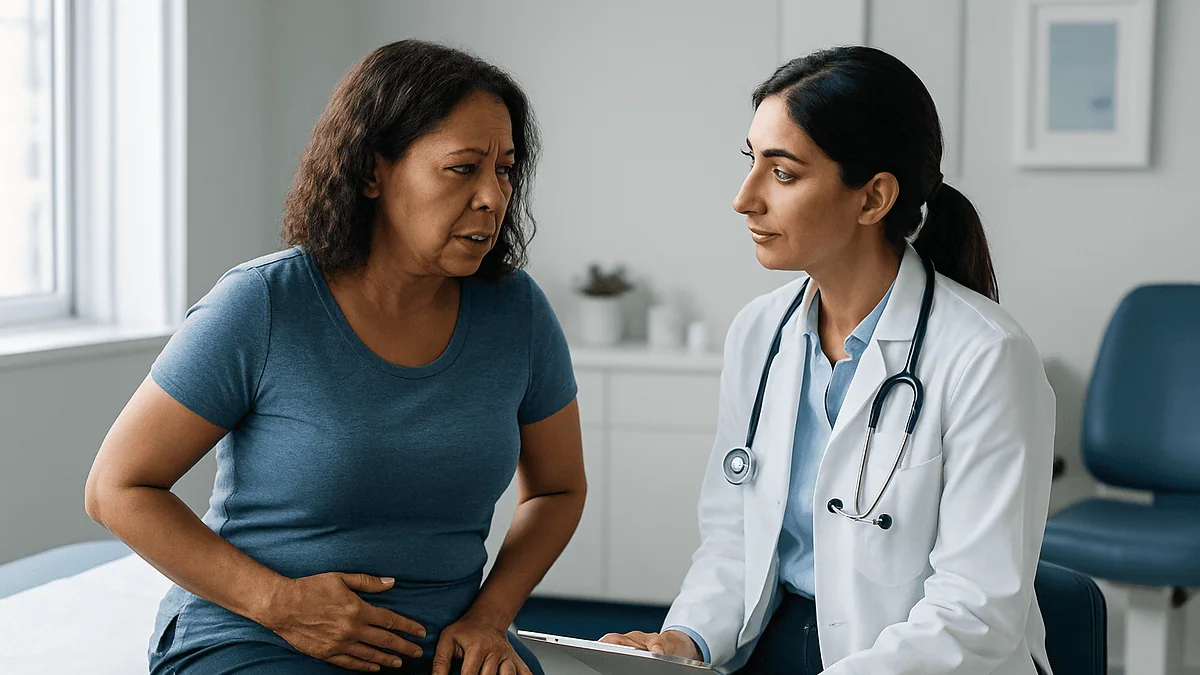
Yes. Uterine fibroids can cause heavy or prolonged menstrual bleeding, pelvic pain or pressure, and lower back pain, although many people who have fibroids never notice any symptoms. What a fibroid does depends largely on where it sits in the uterus and how large it grows. Heavy bleeding, pain during periods or sex, and persistent backache are reasons to talk with a clinician, who can confirm the cause with an examination and an ultrasound scan.
A friend once described her periods as “planning around a flood.” She kept a spare outfit in her desk drawer, mapped bathroom locations before every meeting, and had quietly stopped booking anything for the first two days of each cycle. She assumed this was simply what a heavy period looked like. Her ultrasound told a different story: three firm knots of muscle in the wall of her uterus, the largest about the size of a plum.
Fibroids are among the most common growths in the body, and among the most misunderstood. Some people carry them for decades and never know. Others live with bleeding that drains their iron, pressure that makes a full bladder feel urgent within the hour, and a low, nagging backache that no stretching routine seems to touch.
This article separates what the evidence actually shows about fibroids, bleeding and pain from the folklore that surrounds them, and explains which symptoms deserve a proper conversation with a clinician.
Can fibroids cause bleeding? Yes, and here is the mechanism
Heavy menstrual bleeding is the single most common complaint linked to fibroids, and the reason is more mechanical than mysterious. A fibroid is a benign knot of smooth muscle and fibrous tissue growing within the muscular wall of the uterus. When one bulges toward the inner cavity, it stretches the lining that sheds each month, so there is simply more surface area to bleed.
Distortion of the wall matters too. A healthy uterus stops menstrual bleeding partly by contracting, squeezing shut the small vessels that feed the lining. A wall studded with firm nodules cannot clamp down evenly. Vessels around the fibroid also tend to be wider and more fragile than normal, which adds to the volume lost. The result is a period that is heavier, longer, or both.
Not every fibroid behaves this way. Growths sitting on the outer surface of the uterus may cause pressure symptoms while leaving periods almost unchanged. According to the NHS, roughly one in three people with fibroids develop symptoms at all, which explains why so many are discovered incidentally during a scan for something else.
The practical point: if your periods have grown heavier over months or years and you are between your thirties and fifties, fibroids belong on the list of possibilities. Confirming or ruling them out usually takes a pelvic examination and an ultrasound, nothing more dramatic.
What counts as heavy bleeding with fibroids?
“Heavy” is a slippery word when the only reference point is your own body. Clinicians use more concrete markers. The NHS defines heavy menstrual bleeding as losing 80 milliliters or more per period, having periods that last longer than seven days, or both. Nobody measures this at home, of course, so the everyday signs matter more.
You may be bleeding heavily if you notice several of the following:
- Needing to change a pad or tampon every one to two hours, or emptying a menstrual cup more often than the manufacturer recommends
- Passing clots larger than about 2.5 centimeters, roughly the size of a US quarter
- Bleeding through to clothes or bedding despite using protection
- Using two forms of protection at once, such as a pad and a tampon
- Periods lasting more than seven days
- Feeling tired, breathless or lightheaded around your period
One useful comparison: a typical period involves losing about six to eight teaspoons of blood in total. Filling a regular pad hourly for several hours in a row is well beyond that range.
Tracking helps enormously. Two or three cycles noted in a phone app or diary, recording flow, clots and how many days you bled, gives a clinician far more to work with than a general sense that things feel worse. It also makes it easier to judge, later, whether any treatment is doing what it should.
Do fibroids cause bleeding between periods or after sex?
Fibroids are mainly a story about heavier periods rather than random bleeding. Still, a fibroid pushing into the uterine cavity can make the lining uneven and prone to shedding at odd times, so spotting between periods does happen, particularly with the submucosal type described later in this article.
Bleeding after sex is less typical. The friction of intercourse can irritate a fibroid that protrudes through the cervix, but this is uncommon. More often, post-sex bleeding points to something at the cervix or vaginal wall, which is why clinicians examine rather than assume.
Here is where evidence-based caution matters. Bleeding between periods, bleeding after sex, and any bleeding after menopause all have several possible explanations, including polyps, changes in the uterine lining, and infection. Fibroids are a common and benign cause, yet they are not the only one, and the pattern of bleeding alone cannot tell the difference. Mayo Clinic lists irregular bleeding among fibroid symptoms while advising that unexplained bleeding be evaluated.
The message is not alarm but attribution. If you already know you have fibroids and you develop a new kind of bleeding, it is reasonable to mention it rather than fold it into the existing diagnosis. Clinicians would rather confirm the obvious than miss the unusual, and an examination or scan is a small price for that clarity.
Why do fibroids cause pelvic pain and pressure?
Picture a small pouch of muscle designed to hold a pregnancy, now sharing its space with one or several firm nodules that range, in NHS terms, from the size of a pea to the size of a melon. Pain and pressure follow from that crowding.
Period pain tends to be the first complaint. A uterus trying to expel blood and clots past a fibroid contracts harder, and those contractions register as cramping. Large clots passing through the cervix can produce sharp, brief pain on their own.
Pressure is the second theme. A fibroid on the front wall leans on the bladder, so people describe needing to urinate frequently or feeling they cannot fully empty. A fibroid at the back presses on the rectum, contributing to constipation or a sense of fullness. Very large fibroids can make the lower abdomen feel firm or visibly swollen, sometimes mistaken for weight gain.
Pain during sex, particularly deep pain, is reported when fibroids sit near the cervix or make the uterus bulky and tender to movement.
Two less common situations cause sudden, severe pain. A fibroid can outgrow its blood supply and begin to break down, a process called degeneration that is more likely during pregnancy. A fibroid hanging from a stalk can twist, cutting off its own circulation. Both produce acute pain that usually sends people to urgent care, and both are treatable once recognized.
Can fibroids cause back pain and leg pain?
Lower back pain is one of the symptoms both the NHS and Mayo Clinic list for fibroids, and the geography explains why. The uterus sits just in front of the sacrum, the triangular bone at the base of the spine. A fibroid growing from the back wall of the uterus has nowhere to expand except toward that bone and the nerves that pass alongside it.
The pain that results is typically a dull, constant ache low in the back, often worse around a period when the uterus is engorged with blood. Some people notice it radiating into the buttocks or down the back of a thigh when a fibroid presses on nerves that feed the leg. Numbness or tingling is possible but uncommon.
Distinguishing fibroid-related back pain from the ordinary kind takes some detective work. Mechanical back pain tends to change with posture, lifting and movement, and often eases with rest. Back pain from fibroids usually travels with other pelvic symptoms: heavy periods, pressure, urinary frequency. It also does not care how you sit.
An honest caveat: isolated back pain with normal periods and no pelvic symptoms is rarely explained by fibroids, even in someone who has them. Fibroids are common enough that they are frequently present without being responsible. A clinician weighing the whole picture, rather than a scan report alone, is the best guide to what is causing what.
Where a fibroid grows changes the symptoms
Two people can have fibroids of identical size and completely different experiences, because location shapes symptoms more than volume does. Clinicians describe fibroids by their position relative to the uterine wall.
| Type | Where it sits | Symptoms it most often drives |
|---|---|---|
| Submucosal | Just beneath the lining, bulging into the cavity | Heavy, prolonged periods; spotting; may affect fertility even when small |
| Intramural | Within the thickness of the muscular wall | Heavier periods, cramping, a bulkier uterus; the most common type |
| Subserosal | On the outer surface, growing outward | Pressure on bladder, bowel or back; periods often unchanged |
| Pedunculated | Attached by a stalk, inside or outside the uterus | Pressure symptoms; sudden severe pain if the stalk twists |
A submucosal fibroid the size of a grape can flood a period, while a subserosal fibroid the size of an orange might cause nothing more than mild urinary frequency. Position also influences which treatments make sense, which is why an ultrasound report that names the type is more useful than one that only lists measurements.
Most people with fibroids have more than one, often of mixed types, and the mix can shift over the years as some grow and others stay quiet. The NHS notes they can occur singly or in clusters.
How common are fibroids, and who tends to get them?
Fibroids are so ordinary that finding one on a scan is closer to the rule than the exception. Cleveland Clinic estimates that between 40 and 80 percent of people with a uterus develop them at some point, with most appearing between the ages of 30 and 50. The NHS puts the figure at around two in three by the time menopause arrives, and notes that about one in three of those will have symptoms.
Several factors nudge the odds. Mayo Clinic lists these among the most consistent:
- Age: fibroids become more likely through the reproductive years and typically stop growing after menopause
- Family history: having a mother or sister with fibroids raises the chance
- Race: Black women are more likely to develop fibroids, tend to develop them at younger ages, and more often have larger or more numerous growths
- Starting periods at an early age
- Obesity and vitamin D deficiency
- A diet higher in red meat and lower in green vegetables, fruit and dairy
The racial disparity deserves plain acknowledgment. The reasons are not fully understood, and research points to a mix of genetic, hormonal and environmental factors rather than any single cause. What is clear from the evidence is that symptoms in Black women are often more severe and start earlier, which makes early, respectful evaluation especially worthwhile.
None of these factors guarantees fibroids, and their absence does not rule them out. They tilt probabilities; they do not write destinies.
Why do fibroids grow? The hormone connection
Nobody knows exactly what starts a fibroid, but the evidence about what feeds one is consistent. Mayo Clinic describes fibroids as containing more receptors for estrogen and progesterone than the surrounding uterine muscle. Those two hormones rise and fall with each menstrual cycle, and fibroid tissue responds to them more eagerly than normal tissue does.
This explains the timeline most people observe. Fibroids appear during the reproductive years, may enlarge during pregnancy when hormone levels soar, and usually shrink after menopause as hormone production falls. It also explains why fibroid symptoms often fade in the years after periods stop, without any treatment at all.
Genetics play a role too. Many fibroids carry changes in genes that differ from those in normal uterine muscle, and the tendency clusters in families. Other growth factors, chemical messengers that help tissue repair and build, appear to be more active within fibroids.
What the evidence does not support is the idea that any single food, stress pattern or lifestyle habit creates fibroids. Diet and body weight are associated with risk in population studies, but association is not cause, and no dietary change has been shown to shrink existing fibroids in high-quality trials. Anyone promising otherwise is ahead of the science.
The hormonal insight matters for treatment. Approaches that lower or steady hormone levels can reduce bleeding and sometimes shrink fibroids temporarily, which is why they sit in the clinician’s toolkit.
Can fibroid bleeding make you anemic?
Blood carries iron, and losing more of it each month than the body can replace leads, slowly and quietly, to iron-deficiency anemia. Mayo Clinic names anemia as the most common complication of fibroids, and it is often the symptom that finally brings someone to a clinic, long after the heavy periods themselves have become normalized.
The signs are easy to mistake for ordinary tiredness. Fatigue that sleep does not fix. Breathlessness on stairs that used to be easy. Pale skin or nail beds. A racing heart when you stand up. Headaches, difficulty concentrating, cold hands and feet. Some people develop a craving for ice or other non-food items, a curious but recognized sign of iron deficiency.
The body compensates for a while, which is why anemia can be surprisingly advanced by the time it is noticed. A simple blood test measuring hemoglobin and iron stores settles the question.
Treating anemia and treating its cause are two different tasks. A clinician may recommend restoring iron levels while separately addressing the bleeding, because topping up iron without slowing the loss is like bailing a boat with a hole in it. How iron is replaced, and over what period, is a decision for the prescribing clinician based on your blood results.
If heavy periods and unusual tiredness travel together, mention both. The combination is a strong clue, and the test is quick.
Do fibroids affect fertility and pregnancy?
Most people with fibroids conceive without difficulty and carry pregnancies to term. That reassurance comes first because fibroid diagnoses often arrive with a wave of worry about fertility that the evidence does not justify for the majority.
The exceptions relate to position. Mayo Clinic notes that submucosal fibroids, the ones bulging into the cavity, can interfere with implantation or pregnancy loss in some cases. Large fibroids that block the fallopian tubes or distort the cavity may also contribute to difficulty conceiving. Intramural and subserosal fibroids are less clearly linked to fertility problems.
During pregnancy, hormone surges can encourage fibroids to grow, and a growing fibroid competing for space and blood supply raises the chance of certain complications. Mayo Clinic lists placental abruption, fetal growth restriction and preterm delivery among the risks associated with fibroids. Fibroid degeneration, where a fibroid outgrows its blood supply, is more common in pregnancy and causes sharp localized pain that usually settles with rest and pain management guided by the care team.
A fibroid low in the uterus may also influence the baby’s position or the mode of delivery, which is one reason obstetric teams like to know about fibroids early.
If you are planning a pregnancy and know you have fibroids, a conversation before conception allows the team to map their size and position and discuss whether anything needs attention first. For many, the answer is simply to proceed and monitor.
Can fibroids turn into cancer? Separating myth from evidence
The word “tumor” appears in some descriptions of fibroids, and it frightens people unnecessarily. Fibroids are benign by definition. They do not spread to other parts of the body, and Mayo Clinic states that having fibroids does not increase the risk of developing a cancerous fibroid or of other uterine cancers.
There is a rare cancer of the uterine muscle called leiomyosarcoma. It can look like a fibroid on imaging, which is where confusion arises. Current evidence suggests it arises independently rather than by a fibroid transforming, and it is uncommon, particularly before menopause.
What clinicians watch for is behavior that does not fit the fibroid pattern. Fibroids typically grow slowly and shrink after menopause. A growth that enlarges rapidly, especially after periods have stopped, or one that causes new bleeding after menopause, prompts closer evaluation, sometimes with MRI. That vigilance is proportionate caution, not a signal that fibroids are dangerous.
Two more myths worth retiring. First, fibroids are not caused by, and do not cause, sexually transmitted infections. Second, they are not a consequence of anything the person did or failed to do; risk factors like family history and age are not choices.
The realistic frame is this: fibroids are a common, benign condition that can nonetheless make daily life miserable through bleeding and pain. Both halves of that sentence are true, and neither needs exaggeration.
How are fibroids diagnosed?
Many fibroids announce themselves during a routine pelvic examination, when a clinician notices that the uterus feels enlarged or irregular. The NHS describes this as the typical first step, followed by imaging to confirm what the hands suspect.
Ultrasound does most of the work. An abdominal scan gives an overview; a transvaginal scan, using a slim probe placed in the vagina, produces sharper images of the uterine wall and cavity. Together they can measure fibroids, count them and describe their position. The whole process usually takes well under half an hour and involves no radiation.
Further tests are chosen based on what the ultrasound shows and what is being planned:
- MRI provides detailed maps of size, number and blood supply, useful before certain procedures or when the picture is unclear
- Hysteroscopy passes a thin telescope through the cervix to view the cavity directly and confirm submucosal fibroids
- Saline infusion sonography fills the cavity with fluid during ultrasound to outline growths against the lining
- Blood tests check for anemia and, where relevant, thyroid or clotting problems that can also cause heavy bleeding
A diagnosis of fibroids does not automatically mean treatment. For symptom-free fibroids found by chance, Mayo Clinic notes that watchful waiting is a reasonable approach, since many stay stable and most shrink after menopause. The question that follows a scan is not “how do we remove this” but “is this causing the problem you came in with,” and sometimes the honest answer is no.
What are the treatment options for fibroid bleeding and pain?
Treatment is chosen around three questions: how troublesome the symptoms are, whether future pregnancy matters, and how close menopause may be. The NHS and Mayo Clinic describe a range that runs from doing nothing to major surgery, with several stops in between.
Medicines come first for many. Some non-hormonal options work by helping blood clot more effectively during a period, reducing the amount lost without affecting the fibroid itself. Hormonal contraception thins the uterine lining, which lightens bleeding and eases cramps. A further group temporarily lowers estrogen to menopausal levels, which can shrink fibroids and stop periods for a time; the effect reverses when the medicine stops, so these are generally used for limited periods, often before surgery. Which, if any, suits you is a decision for the prescribing clinician.
Procedures address the fibroid directly:
- Endometrial ablation destroys the uterine lining to reduce bleeding; it suits small fibroids and is not appropriate for those wanting pregnancy
- Uterine artery embolization blocks the blood vessels feeding fibroids so they shrink
- Myomectomy removes fibroids while preserving the uterus, through the cervix, keyhole incisions or an open operation depending on size and position
- MRI-guided focused ultrasound heats and destroys fibroid tissue without incisions
- Hysterectomy removes the uterus and is the only option that prevents fibroids returning
Every approach carries trade-offs: recovery time, effect on fertility, chance of fibroids regrowing, and procedural risks such as bleeding or infection. The treating team weighs these against your priorities, and the right choice for one person is often the wrong one for another.
When should you see a doctor about fibroid symptoms?
The most useful rule is simple: if bleeding or pain is changing how you live, it deserves attention, whatever the cause turns out to be. Waiting until symptoms are unbearable serves nobody, and the evaluation itself is straightforward.
Make a routine appointment if you notice:
- Periods that soak through a pad or tampon every one to two hours, or that last longer than seven days
- Clots the size of a quarter or larger
- Bleeding between periods, after sex, or any bleeding after menopause
- Pelvic pressure, a firm or swollen lower abdomen, or needing to urinate far more often than usual
- Low back pain that arrives with pelvic symptoms and does not respond to the usual measures
- Persistent tiredness, breathlessness or dizziness alongside heavy periods
- Difficulty conceiving after a year of trying, or sooner if you are over 35
Seek urgent care the same day for sudden, severe pelvic pain, particularly during pregnancy or with a known stalked fibroid; bleeding so heavy you feel faint, your heart races, or you cannot keep up with protection; or fever with pelvic pain. These are uncommon, but they need prompt assessment rather than a wait-and-see approach.
Bring your cycle notes. Mention every symptom, including the ones that seem unrelated, such as constipation or back pain. Fibroids are a diagnosis of pattern, and the pattern is easiest to see when the whole picture is on the table. The evidence is clear that fibroids are common and benign; it is equally clear that their symptoms are real, measurable and worth addressing.
Frequently asked questions
Can fibroids cause bleeding every day?
Continuous daily bleeding is not typical of fibroids, which more often cause heavier or longer periods on a roughly regular schedule. A submucosal fibroid can produce spotting between periods, and very heavy cycles can blur into one another so bleeding feels constant. Persistent daily bleeding has several possible causes beyond fibroids, including changes in the uterine lining and hormonal imbalance, so it warrants an examination and ultrasound rather than being attributed to fibroids by default.
Do fibroids cause pain all the time or only during periods?
For most people, fibroid pain clusters around menstruation, when the uterus is engorged and contracting harder to expel blood and clots. Larger fibroids can cause constant pressure, a sense of fullness or dull backache throughout the month. Sudden, severe pain at any time is uncommon and usually signals a fibroid degenerating or twisting on its stalk, which needs prompt medical assessment.
Can fibroids cause back pain and leg pain together?
Yes, when a fibroid on the back wall of the uterus presses toward the sacrum and the nerves that run alongside it, pain can spread from the low back into the buttock or down the thigh. This pattern is less common than back pain alone and usually accompanies other pelvic symptoms such as heavy periods or pressure. Leg pain without any pelvic symptoms is more likely to have a spinal or muscular cause.
What size fibroid causes heavy bleeding?
Position matters more than size. A small submucosal fibroid bulging into the uterine cavity can flood a period, while a much larger subserosal fibroid on the outer surface may leave bleeding unchanged. Fibroids range from pea-sized to melon-sized according to the NHS, and ultrasound reports that describe location as well as measurements are the most useful for predicting which growth is responsible for bleeding.
Do fibroids go away on their own?
Fibroids rarely disappear during the reproductive years, but they commonly shrink after menopause as estrogen and progesterone levels fall, and symptoms often ease at that stage. Some fibroids stay the same size for years; others grow slowly. For people without symptoms, watchful waiting with periodic review is a reasonable approach described by Mayo Clinic. Decisions about monitoring versus treatment rest with you and your clinician.
Can fibroids cause bleeding after menopause?
Fibroids usually shrink after menopause and are an unlikely cause of new bleeding at that stage. Any bleeding after periods have stopped for a year should be evaluated promptly, because other causes, including changes in the uterine lining, need to be excluded. This is not a reason for alarm but a situation where a clinician will want to examine and image the uterus rather than assume an existing fibroid is responsible.
How do I know if my heavy bleeding is from fibroids or something else?
The pattern alone cannot tell you, because thyroid problems, clotting disorders, polyps and hormonal imbalance can all produce heavy periods. A clinician typically combines a pelvic examination with an ultrasound to identify fibroids, and blood tests to check for anemia and other contributors. Bringing two or three cycles of notes on flow, clots and duration helps the evaluation considerably.
Can fibroids make you tired?
Indirectly, yes. Heavy or prolonged bleeding drains iron faster than the body can replace it, leading to iron-deficiency anemia, which Mayo Clinic identifies as the most common complication of fibroids. Tiredness, breathlessness on exertion, dizziness, pale skin and a racing heart are typical signs. A simple blood test confirms it, and addressing both the iron level and the bleeding itself is the usual approach.
Do fibroids cause bleeding during pregnancy?
Fibroids are not a common cause of bleeding in pregnancy, although they can grow under the influence of pregnancy hormones and occasionally cause pain when they outgrow their blood supply. Mayo Clinic lists placental abruption, growth restriction and preterm birth among complications associated with fibroids. Any bleeding during pregnancy should be reported to the maternity team, who will assess the cause directly rather than attributing it to fibroids.
Will fibroid pain and bleeding come back after treatment?
It depends on the approach. Medicines relieve symptoms while taken and effects generally fade once stopped. Procedures that remove or shrink fibroids while keeping the uterus, such as myomectomy or embolization, leave the possibility of new fibroids forming over time. Hysterectomy is the only option that prevents recurrence. The treating team can explain the likelihood of return for each option in the context of your age and fibroid type.
References
- NHS: Fibroids: overview and symptoms
- NHS: Heavy periods
- Cleveland Clinic: Uterine fibroids
- MedlinePlus: Uterine fibroids
This article is for general information only and is not a substitute for professional medical advice. Please consult a qualified doctor about your individual situation.

More from the Blog

Questions to Ask Your Gynecologist Before a Hysteroscopy: Purpose, Findings and Next Steps
Before a hysteroscopy, ask your gynecologist why it is being done, whether it is diagnostic or will also treat something, whether it will be…

Before Fibroid Surgery: Blood Tests, Bleeding Patterns and the Fertility Conversation
Fibroid surgery preparation usually rests on three things in the weeks beforehand: blood tests that check for anemia, clotting and overall fitness for anesthesia;…

How Often You Need a Smear Test (UK, EU and US Intervals)
In the UK, cervical screening (a smear test) is offered every five years between ages 25 and 64, with earlier recall if HPV is…
Myomectomy vs Hysterectomy for Fibroids: How Pregnancy Plans Shape the Choice
Myomectomy removes fibroids while keeping the uterus, so it is usually the surgical option for people who may want a future pregnancy, though fibroids…

Fibroid Surgery Recovery: Bleeding Checks, Early Walking and Lifting Limits Week by Week
Fibroid surgery recovery time depends mainly on the route the surgeon used. Hysteroscopic removal through the cervix usually needs a few days; laparoscopic or…
Smear Tests During Pregnancy: Are They Safe, and When Should You Have One?
Yes, a smear test (Pap smear) can be done safely at any stage of pregnancy. The sample is taken from the surface of the…