

Do Hats Cause a Receding Hairline? The Myth, the Real Causes and What Actually Helps

Key Takeaways
- A receding hairline that moves back evenly at both temples into an M shape is the signature of androgenetic alopecia, a genetic, DHT-driven process that no hat can start or speed up.
- Follicles get oxygen from blood vessels in the skin, not from the air, so covering the scalp with a hat, helmet, or scarf does not suffocate hair.
- Only very tight headgear worn for hours daily over years can contribute to traction-type thinning, and Cleveland Clinic notes that this is usually reversible if the pulling stops before follicles scar.
- The NHS puts normal daily shedding at 50 to 100 hairs, and a hat simply collects some of them in one visible place, which makes ordinary loss look alarming.
- MedlinePlus reports that pattern hair loss can begin in the teenage years and affects roughly 50 million men and 30 million women in the United States, so early recession is common rather than a generational trend.
- Mayo Clinic notes that medical treatments for pattern loss can take at least six months to show an effect, and the NHS adds they work only while they are used, so decisions belong with a prescribing clinician.
No. Wearing a hat does not cause a receding hairline. Mainstream medical evidence attributes a receding hairline mainly to androgenetic alopecia, a genetic, hormone-driven process in which follicles gradually shrink. Hats neither suffocate follicles nor trigger this pattern. Only extremely tight headgear worn for years might contribute to traction-type thinning, which is uncommon and usually reversible if caught early.
The cap comes off in the bathroom mirror after a long summer of yard work, and there it is: a little more forehead at each temple than there was in the spring. The brain does what brains do. It looks for the nearest suspect, and the nearest suspect is sitting on the sink, sweat-stained and faded, worn nearly every day since June.
The hat makes a convenient culprit. It touches the exact place where the hair went missing, it was there the whole time, and blaming it feels more manageable than blaming your grandfather’s genes. Search traffic proves how common this instinct is: cyclists worried about helmets, students worried about beanies, whole discussion threads asking whether a uniform cap is quietly costing people their hairlines.
The evidence tells a calmer, more interesting story, one about follicles, hormones, timing, and why the hat almost always arrives at the scene after the crime has already begun.
Does wearing a hat cause a receding hairline?
Ask a dermatologist this question and you will usually get a small, patient smile before the answer: no. A receding hairline, the classic pattern where the corners above the temples drift backward into an M shape, is overwhelmingly a sign of androgenetic alopecia, the medical name for pattern hair loss. MedlinePlus describes exactly this trajectory: hair is lost in a well-defined pattern beginning above both temples, and over time the hairline recedes into that characteristic shape.
Nothing about a baseball cap, a beanie, or a hard hat feeds that process. Pattern loss is driven from the inside, by a person’s genetic sensitivity to androgens, particularly dihydrotestosterone (DHT), which slowly shrinks susceptible follicles until they produce hairs too fine and short to see. A hat sits on the outside of the skin. It does not change hormone levels, and it does not reach the follicle root, which lives several millimeters down in the dermis.
What a hat can do is confuse the timeline. People often start wearing hats more when they first suspect thinning, then notice further recession months later and connect the two. The recession would have happened anyway; the hat simply had a front-row seat. Throughout this article, that distinction between cause and coincidence will keep coming up, because it is the whole story.
What actually causes a hairline to recede?
Two ingredients do most of the work: inheritance and hormones. You inherit follicles with a particular sensitivity to androgens, and over years those follicles respond to DHT by miniaturizing. Each new growth cycle produces a slightly thinner, shorter, paler hair than the last, until the follicle is essentially dormant. The temples and crown carry the most sensitive follicles in most men, which is why recession starts there rather than at the back of the head.
This is not rare, and it is not new. MedlinePlus estimates that androgenetic alopecia affects roughly 50 million men and 30 million women in the United States, that it can begin as early as the teenage years, and that more than half of men over age 50 show some degree of it. A receding hairline at 24 is not a sign that something went wrong with your habits. It is, most often, an early expression of a very common trait.
Other forms of hair loss exist, and they matter for the hat question because a few of them are influenced by what touches the scalp. Traction alopecia comes from sustained pulling. Telogen effluvium is a temporary shedding that Mayo Clinic notes often appears several months after a physical or emotional shock such as illness, surgery, rapid weight loss, or a stressful period. Scalp conditions like fungal infection or inflammation can cause patchy loss too. Each has a different look and a different fix, and none of them produces the neat, symmetrical temple recession that people photograph and post online asking, “Is it the hat?”
Why does hair loss seem to start right when you take the hat off?
Pattern hair loss is a slow leak, not a burst pipe. Follicles miniaturize over many growth cycles, and each cycle lasts years, so the change from one month to the next is nearly invisible. Then something interrupts the routine. You get a haircut with a different part, you see yourself in harsh overhead lighting at a hotel, or you pull off a hat you have worn daily and look properly for the first time in months. Suddenly a gradual change registers all at once.
The hat plays a second, subtler trick. Hair pressed flat under a cap all day loses its volume, so when the cap comes off, the hair at the front lies close to the scalp and the temples look barer than they will an hour later. That flattened look is styling, not loss, but it lands exactly where recession happens, and the eye connects the dots.
Daily shedding adds to the illusion. The NHS notes that losing between 50 and 100 hairs a day is normal, often without noticing. A hat collects a portion of those hairs and presents them to you in one place when you take it off. Fifty hairs scattered across a pillow, a shower drain, and a hairbrush go unremarked. Fifty hairs clinging to the inside of a dark cap look like evidence. Same hairs, different display.
Do hats suffocate hair follicles?
The suffocation theory has a certain intuitive appeal: cover something up all day and surely it struggles to breathe. It falls apart on basic anatomy. Hair follicles do not take oxygen from the air around your head. They are supplied by blood vessels in the skin, the same way every other structure in your body receives oxygen and nutrients. A follicle under a snug cap receives exactly the same blood supply as a follicle in open air.
Consider the counterexamples your own body provides. Scalp hair under a helmet for a full shift, hair on the back of the head that rests against a pillow for eight hours a night, and hair covered by a headscarf every day for decades all keep growing. If covering hair starved it, people who wear religious head coverings from childhood would show recession patterns that dermatology simply does not observe as a population trend.
The idea that hats trap heat and “cook” follicles fails the same test. Scalp temperature under a hat rises modestly, well within the range the body handles every day in warm weather, and there is no established mechanism by which that warmth would trigger androgen-driven miniaturization. Miniaturization is a hormonal conversation between DHT and a genetically primed follicle. Air, heat, and light are not participants.
None of this means a hat is entirely irrelevant to scalp health, and the next few sections take the realistic exceptions seriously. But suffocation is not among them.
Can a tight hat or helmet cause traction alopecia?
Here is where a small, honest yes enters an otherwise firm no. Traction alopecia is hair loss caused by repeated pulling on the same hairs. Cleveland Clinic and Mayo Clinic both list tight hairstyles such as braids, ponytails, and cornrows as classic triggers, and in principle anything that tugs persistently at the hairline can contribute. A hat or helmet that fits so tightly it drags at the front hairs every time it goes on and off, worn for hours daily over years, sits at the far edge of that principle.
Two features distinguish traction loss from pattern loss, and they are worth memorizing. First, location: traction loss appears exactly where the tension is, often with small broken hairs, redness, or tenderness along the band line. Second, symmetry: pattern loss recedes evenly at both temples and thins the crown, following the map of androgen-sensitive follicles, not the outline of a hatband.
| Type of hair loss | Main driver | Typical pattern | Can headgear contribute? |
|---|---|---|---|
| Androgenetic alopecia | Genes plus DHT sensitivity | Temples recede, crown thins | No |
| Traction alopecia | Sustained pulling | Along the line of tension | Only with very tight, prolonged wear |
| Telogen effluvium | Illness, stress, rapid weight loss | Diffuse shedding all over | No |
| Scalp irritation or infection | Inflammation, fungus, bacteria | Patchy, often itchy or scaly | Indirectly, if headgear stays damp and dirty |
Cleveland Clinic notes that traction alopecia is usually reversible when the pulling stops early, but can become permanent if follicles scar. The remedy is mechanical: loosen the fit. If a hat leaves a red groove on your forehead, it is too tight for your hairline as well.
Does wearing a helmet every day cause bald spots?
Cyclists, construction workers, motorcyclists, and military personnel ask this version of the question, and their concern is more reasonable than the beanie crowd’s. A helmet is heavier than a cap, fits more firmly, and often stays on for hours in heat. Chin straps and padding create localized pressure that a soft hat does not.
Even so, the medical literature does not identify helmets as a cause of the temple-and-crown recession people usually mean by “balding.” What clinicians occasionally see is friction or pressure-related thinning at specific contact points, and, more commonly, sweat-related scalp irritation under padding. Both are localized, both track the shape of the equipment rather than the shape of pattern loss, and both tend to settle when the contact point is cushioned or the helmet is cleaned and dried properly.
A few practical checks separate a helmet problem from a hormone problem:
- Look at the map. Thinning that matches a strap, a pad, or a rim is equipment. Thinning at both temples and the crown, with the strap line untouched, is pattern loss.
- Look for irritation. Redness, small bumps, itching, or flaking under the helmet points toward friction or folliculitis rather than androgens.
- Look at the back of your head. Pattern loss spares the lower back of the scalp because those follicles are DHT-resistant. A helmet that rubs there can thin it; genes rarely do.
If the pattern says genes, the helmet is a bystander. If it says equipment, a better fit and a drier liner are the fix, not a hair-loss regimen.
Is it bad to wear a hat every day?
For your hairline, no. For your scalp skin, it depends on the hat and how you treat it. A clean, well-fitting hat worn daily is, from a dermatology standpoint, a neutral object. Some people worry that habitual hat-wearing weakens hair, thins it, or makes it “lazy.” Hair has no such memory. Each follicle runs its own cycle of growth, rest, and shedding on a schedule set by genetics and hormones, not by how often it sees daylight.
There are genuine upsides to daily hats that rarely make it into these debates. The scalp is skin, and skin on the top of the head takes the most direct sun of any surface on the body. Anyone whose hairline is already receding is exposing newly bare skin to ultraviolet light, and the CDC and other public health bodies recommend wide-brimmed hats as part of sun protection. In that sense a hat protects the very area people accuse it of harming.
The realistic downsides are hygiene-related. A hat that stays damp with sweat, is never washed, and is pulled on tightly each morning can foster the irritated, bumpy scalp described in the next section. That is a skin issue, treatable and temporary, not a follicle death sentence. Rotate between two hats so each dries fully, wash them as the label allows, and choose a fit you forget you are wearing. Do that and you can wear a hat every day of your life with your hairline none the wiser.
Can a sweaty or dirty hat make hair fall out?
Indirectly, and temporarily, yes. The mechanism is not the hat but what a hat can create: a warm, moist, occluded environment where sweat, oil, and dead skin accumulate against the scalp for hours. That environment invites folliculitis, an inflammation of hair follicles that shows up as small red or white-headed bumps, itching, and sometimes tenderness. Inflamed follicles can shed their hairs, and a scalp that is repeatedly scratched loses a few more.
The shedding from irritation looks nothing like a receding hairline. It is patchy, it comes with visible skin changes, and it clears when the inflammation clears. Mayo Clinic groups scalp infections and inflammatory conditions among the causes of hair loss precisely because they are recognizable and, for the most part, reversible once the underlying skin problem is treated.
Preventing it takes little effort. Sweat-wicking liners or bands can be removed and washed. Hats made of breathable fabrics dry faster than heavy cotton twill. Taking a hat off during breaks lets the scalp dry. If you train hard in a cap, treat it like a gym shirt rather than a piece of furniture: it goes in the wash, not back on the hook.
One caution about self-diagnosis. A persistently itchy, scaly, or spreading patch of hair loss can also signal a fungal infection or an inflammatory scalp disorder that needs a clinician’s eye. Hygiene changes are a reasonable first step for mild irritation; a stubborn or worsening patch is a reason to book an appointment rather than buy a new hat.
Why is Gen Z balding so fast?
Scroll long enough and you will find the theory that an entire generation is losing its hair earlier than any before it, with hats, hormones in food, phone radiation, and stress all offered as explanations. The honest answer is that there is no population-level medical evidence showing that people born after the late 1990s are balding faster than their parents did. What the evidence does show is that pattern hair loss has always started early for some people. MedlinePlus states plainly that androgenetic alopecia can begin as early as a person’s teens.
So why the perception? Several plausible, non-mysterious factors converge:
- Cameras. A generation photographed constantly, often from above and in unflattering light, notices crown thinning and temple recession years before earlier generations would have seen it in a bathroom mirror.
- Comparison. Social feeds place a 22-year-old next to hundreds of other 22-year-olds every day, making normal variation feel like personal failure.
- Temporary shedding. Mayo Clinic notes that a physical or emotional shock, such as a significant illness or rapid weight loss, can produce diffuse shedding several months later. Young adults who lived through stressful years and crash diets may be seeing telogen effluvium, which regrows, and mistaking it for permanent loss.
- Earlier help-seeking. More young people ask about hair loss, so more cases are visible, which is not the same as more cases existing.
None of these points make an early receding hairline less frustrating. They do reframe it. Losing hair at 21 is not a generational curse or a hat’s fault; it is an old trait meeting a new level of scrutiny.
Will my hair grow back if I stop wearing a hat?
It depends entirely on why it left. If the thinning is androgenetic alopecia, taking off the hat changes nothing, because the hat was never part of the process. The follicles at your temples will continue the same slow miniaturization whether they spend their days under fabric or in open air. This is the answer most people asking the question do not want, and it is the one the evidence supports.
If the thinning is traction or friction related, the outlook is better. Cleveland Clinic explains that traction alopecia is usually reversible when the source of pulling is removed early, before follicles scar. A hairline that thinned along a too-tight band line often fills back in once the pressure stops, though it does so on the hair cycle’s own timetable, which is measured in months rather than weeks, and there is no way to hurry a follicle through its rest phase.
If the shedding is telogen effluvium after an illness, a stressful stretch, or dramatic weight loss, the hat is irrelevant and the hair typically returns on its own as the follicles re-enter their growth phase. Mayo Clinic describes this kind of loss as usually temporary.
The useful move, then, is not to ditch the hat but to identify the pattern. Even, symmetrical temple recession that keeps progressing while your hats sit unworn in a closet is your answer: the hat was innocent, and a conversation with a clinician about pattern loss is the productive next step.
Will a receding hairline grow back?
Left alone, a hairline receding from androgenetic alopecia does not reverse on its own. Follicles that have fully miniaturized stop producing visible hair, and there is no lifestyle change, hat-free stretch, or shampoo that restores them. That is the blunt part. The less blunt part is that recession is a spectrum, and follicles that have thinned but not disappeared can respond to medical treatment.
Two broad approaches appear in mainstream guidance, and both are prescription or pharmacy decisions to make with a clinician rather than a search bar. One is a topical agent applied to the scalp that appears to prolong the growth phase of the hair cycle and enlarge shrinking follicles. The other is an oral medicine that lowers DHT by blocking the enzyme that converts testosterone into it, removing the signal that drives miniaturization. Mayo Clinic notes that it can take at least six months of treatment to prevent further loss and begin regrowth, and the NHS adds that these treatments do not work for everyone and only work for as long as they are used. Stop, and the process resumes.
Expectation-setting matters more than most articles admit. The realistic goal for many people is stabilization, holding the line where it is, with partial thickening of thinned areas as a bonus rather than a promise. Anyone considering treatment should discuss suitability, side effects, and monitoring with a prescribing clinician, because these are medicines with trade-offs, not cosmetics.
Do hair supplements stop a receding hairline?
Walk down any pharmacy aisle and you will find gummies, capsules, and powders promising thicker hair, most of them anchored on biotin. The marketing outruns the science. The NIH Office of Dietary Supplements notes that biotin deficiency is rare in people eating a varied diet, and that the evidence for biotin supplements improving hair growth in people who are not deficient is limited. Pattern hair loss is not a nutrient shortage. Adding more of a vitamin your body already has does not change how a follicle responds to DHT.
There is a narrow, legitimate exception. Genuine nutritional deficiencies, particularly iron deficiency and, less commonly, protein or other micronutrient shortfalls, can cause diffuse shedding. Mayo Clinic lists poor nutrition among hair loss risk factors, and someone with restrictive eating, heavy menstrual periods, or an absorption disorder may indeed see hair improve once the deficiency is corrected. But that is a diagnosis made with blood tests, not a guess made in a supplement aisle, and the loss it causes is all-over thinning rather than temple recession.
A practical way to think about it: if a product claims to fix a receding hairline and it is not something a clinician would prescribe, the claim is running ahead of the evidence. Eat well, address any confirmed deficiency, and save the money you would have spent on gummies for a proper evaluation if the recession bothers you.
When does a hair transplant enter the conversation?
Because pattern loss spares the follicles at the back and sides of the scalp, the ones genetically resistant to DHT, surgeons can relocate small groups of those follicles to the front. The transplanted hairs keep their resistance in their new location, which is the entire principle behind hair transplantation. Mayo Clinic lists it among options for people with permanent hair loss affecting the top of the head.
It is worth being clear-eyed about what a transplant does and does not do. It moves hair; it does not stop the underlying process. Native hairs around the transplanted area can keep thinning, which is why specialists often discuss medical therapy alongside surgery and why many advise waiting until a person’s pattern of loss has become predictable rather than operating on a rapidly changing hairline in the early twenties. Donor supply is finite, so planning for the hairline you will have at 50, not only the one you want at 25, is part of a responsible consultation.
Suitability depends on the density of the donor area, the extent of loss, scalp characteristics, overall health, and realistic expectations, all of which require an in-person assessment by a qualified specialist. Results vary between individuals, and no article, including this one, can tell you what yours would look like. What can be said with confidence is that a receding hairline caused by a hat is not a thing that needs a transplant, because it is not a thing that exists.
When should you see a doctor about a receding hairline?
Gradual, symmetrical recession at the temples in someone with a family history of the same thing is, medically, a low-alarm situation. It still deserves a conversation if it bothers you, because earlier treatment tends to preserve more hair than later treatment, and because a clinician can confirm the diagnosis rather than leaving you to guess. Mayo Clinic advises seeing a doctor if you are distressed by persistent hair loss and want to explore options.
Some patterns move the appointment from optional to prompt. Seek care soon if you notice any of these red flags:
- Sudden shedding in handfuls, or loss that appeared over weeks rather than years.
- Patchy, coin-shaped bald spots, which can indicate an autoimmune or infectious cause rather than pattern loss.
- Hair loss accompanied by scalp pain, itching, burning, scaling, pus, or redness.
- Shedding alongside other symptoms such as unexplained fatigue, weight change, or, in women, new acne or irregular periods, which can point to thyroid, iron, or hormonal problems.
- Loss that began after starting a new medicine, since some treatments list hair changes among their effects and the prescriber may have alternatives.
- Any hair loss in a child.
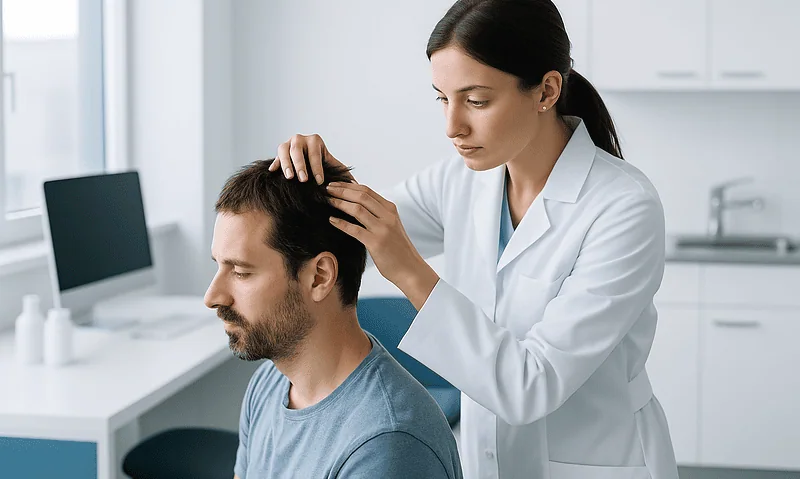
Expect the visit to be low-drama: a look at the scalp, questions about family history, health changes, diet, and stress, and sometimes blood tests. A dermatologist may also gently pull on a few hairs or examine the scalp with magnification to see whether follicles are miniaturizing or merely resting. None of it requires you to bring the hat.
Frequently asked questions
Does wearing a hat cause a receding hairline?
No. A receding hairline is almost always androgenetic alopecia, a hormone-driven, inherited process in which follicles at the temples and crown gradually shrink. Hats do not alter hormone levels or reach the follicle root, so they cannot start or accelerate that pattern. The only headgear-related hair loss recognized in medicine is traction or friction thinning from extremely tight, prolonged wear, and it follows the outline of the equipment rather than the classic M-shaped hairline.
Will my hair grow back if I stop wearing a hat?
Only if the hat was actually the problem, which is uncommon. Thinning from a too-tight band or helmet strap often recovers over months once the pressure stops, provided the follicles have not scarred. Temple recession from pattern hair loss continues whether or not you wear a hat, because the hat was never involved. If your hairline keeps moving back during a hat-free stretch, that is your answer, and a clinician can confirm the cause.
Will a receding hairline grow back on its own?
A hairline receding from androgenetic alopecia does not regrow spontaneously; fully miniaturized follicles stop producing visible hair. Follicles that have thinned but not vanished can respond to prescription treatments that either prolong the growth phase or lower DHT. Mayo Clinic notes these take at least six months to show results, and the NHS states they work only while used and not for everyone. Stabilizing the hairline is a more realistic goal than full restoration.
Is it bad to wear a hat every day?
Not for your hairline. Daily hat-wearing does not weaken follicles, and it protects scalp skin from sun, which matters more as a hairline recedes. The realistic downside is hygiene: a hat that stays damp and unwashed can irritate the scalp and trigger folliculitis, causing temporary patchy shedding with visible bumps or itching. Choose a comfortable fit, let hats dry fully between wears, and wash them as the label allows.
Why is Gen Z balding so fast?
There is no population-level evidence that this generation is balding earlier or faster than previous ones. MedlinePlus notes that pattern hair loss has always been able to begin in the teens. What has changed is visibility: constant photos from unflattering angles, side-by-side comparison on social media, and more open discussion make early thinning far more noticeable. Temporary shedding after illness, stress, or rapid weight loss can add to the impression.
Do helmets cause bald spots?
Helmets do not cause pattern baldness. They can occasionally cause localized thinning where a strap, pad, or rim rubs or presses for hours each day, and sweaty padding can inflame follicles. Both problems trace the shape of the equipment and usually improve with better fit, cushioning, and cleaning. Symmetrical loss at the temples and crown that spares the strap line points to genetics, not the helmet.
Can a tight hat cause traction alopecia?
In principle, yes, though it is unusual. Traction alopecia results from sustained pulling on the same hairs, and Cleveland Clinic and Mayo Clinic list tight hairstyles as the typical triggers. A hat that leaves a red groove and drags at the front hairs every time it goes on, worn daily for years, sits at the edge of that mechanism. Loosening the fit early usually allows recovery before follicles scar.
Why does my hat have so many hairs in it?
Because it is catching a normal day’s shedding. The NHS notes that losing 50 to 100 hairs a day is normal and often unnoticed, since those hairs scatter across pillows, drains, and brushes. A hat collects a share of them against a dark lining and presents them all at once when you take it off. Persistent shedding well beyond that, or hairs coming out in clumps, is a different matter worth raising with a doctor.
Do biotin or hair supplements stop a receding hairline?
The evidence does not support that. The NIH Office of Dietary Supplements notes that biotin deficiency is rare and that evidence for biotin improving hair growth in non-deficient people is limited. Pattern hair loss is hormonal, not nutritional. A confirmed deficiency, such as low iron, can cause diffuse shedding that improves when corrected, but that is diagnosed with blood tests and looks like all-over thinning rather than temple recession.
When should I see a doctor about hair loss?
See a clinician promptly for sudden shedding in handfuls, patchy coin-shaped bald spots, hair loss with scalp pain, scaling, redness or pus, loss accompanied by fatigue, weight change or new hormonal symptoms, loss after starting a new medicine, or any hair loss in a child. Gradual temple recession is lower urgency, but Mayo Clinic advises seeing a doctor if it distresses you, since earlier evaluation preserves more options.
References
This article is for general information only and is not a substitute for professional medical advice. Please consult a qualified doctor about your individual situation.

More from the Blog

Questions to Ask Before Robotic Hair Surgery: Who Places the Grafts and How Results Are Checked
Before robotic hair surgery, ask who performs each stage: the robot usually harvests follicular units, but a surgeon or trained technicians still make recipient…

Why the Cause of Hair Loss Sets the Plan: Tests Before Non-Surgical Hair Restoration
Before non-surgical hair restoration, clinicians usually confirm the cause first: a history and scalp examination, a gentle pull test, magnified scalp imaging (trichoscopy), and…

Who Is a Candidate for Laser Hair Therapy? Early Thinning vs Long-Standing Bald Areas
A laser hair therapy candidate is usually an adult with early to moderate hereditary (pattern) thinning, where follicles have shrunk but are still alive,…
How Scalp Micropigmentation Is Done: Pigment Dots, Session Spacing and Matching Your Hair Shade
Scalp micropigmentation is a cosmetic tattooing technique in which a trained practitioner deposits thousands of tiny pigment dots into the upper layer of the…

Hair Transplant Repair for International Patients: Photo Review, Staged Sessions and Follow-Up
Hair transplant repair for international patients usually begins with a remote photo review, followed by an in-person examination that checks the donor area, scar…

Hair Transplants for a Receding Hairline: Timing, Design and Realistic Density
A hair transplant can restore a receding hairline by moving follicles from the back of the scalp, where hair is genetically resistant to balding,…