

Does a Coronary Angiogram Hurt? Local Anesthesia, the Warm Contrast Feeling and Afterward

Key Takeaways
- Blood vessels carry few pain receptors, so once the skin is numbed the catheter itself is generally not felt as it travels to the heart.
- The warm flush after contrast injection is a predictable effect of the dye dilating small blood vessels and passes within seconds, sometimes with a false sense of having passed urine.
- Coronary angiography is performed awake under local anesthetic with light sedation, so you can report symptoms and hold your breath on request.
- The catheter portion of a diagnostic angiogram typically lasts about 30 to 60 minutes, though checking in and recovery make it a several-hour day.
- Wrist access usually allows sitting up within a couple of hours, whereas groin access generally means lying flat for several hours while the artery seals.
- A flat, colorful bruise that fades over one to two weeks is normal; a growing, pulsating or hard painful lump, bleeding that will not stop, or a cold pale hand or foot needs urgent attention.
A coronary angiogram is usually uncomfortable rather than painful. The skin at the wrist or groin is numbed with local anesthetic, which stings briefly; the catheter itself is generally not felt because blood vessels have few pain nerves. Most people notice a short warm flush when contrast dye is injected. Afterward, mild bruising and soreness at the puncture site are common and typically settle within days.
The night before her angiogram, a retired teacher told her daughter she was not worried about the result. She was worried about the needle. Where would it go? Would she be awake? Would she feel the tube moving toward her heart? She had googled “does coronary angiography hurt” at two in the morning and found a dozen contradictory forum posts.
Her questions are the ones cardiac nurses hear most often, and they deserve straighter answers than a forum can give. The procedure has an odd reputation: it sounds dramatic, a thin tube threaded into the arteries of the heart, yet most people who have had one describe the experience as strange rather than sore.
This explainer walks through what you feel at each stage, from the sting of the local anesthetic to the famous warm flush of the contrast dye, and what the puncture site does in the days that follow. It will not tell you what your result will be. That conversation belongs to your cardiology team.
Does coronary angiography hurt? The honest short answer
Most people are surprised by how little they feel. The two moments that register are the local anesthetic going in, which stings and burns for a few seconds, and the contrast injection, which produces a brief heat wave through the body. Between those moments, the sensations are mostly pressure, a little pushing at the wrist or groin, and the oddness of lying still while a team works around you.
The reason is anatomical. Skin is densely wired with pain receptors; the inside of an artery is not. Once the skin and the tissue just beneath it are numb, the catheter, a thin flexible tube about the width of a strand of cooked spaghetti, can be advanced through the vessel without the brain receiving a pain signal. The heart muscle itself does not sense the tip of the catheter touching the opening of a coronary artery.
That does not mean the experience is nothing. The NHS describes patients commonly reporting a warm, flushing sensation and sometimes a feeling of needing to pass urine when the dye is injected, both of which pass within seconds. Some people feel brief chest tightness or a skipped heartbeat as the catheter sits in the artery; the team watches the heart tracing continuously for exactly this reason.
Pain that is sharp, escalating or lasting is not expected, and the team wants to hear about it immediately. More local anesthetic can be added, sedation can be adjusted, and the catheter position can be changed. The honest summary: expect two or three brief, well-known sensations, a good deal of pressure and waiting, and a sore spot afterward. Expect anything beyond that to be taken seriously by the people in the room.
What actually happens during a coronary angiogram
A coronary angiogram is an X-ray study of the arteries that supply the heart muscle, made visible by injecting a contrast dye that shows up on the images. It is performed in a cardiac catheterization laboratory, usually called a cath lab, a room that looks like a cross between an operating theater and a radiology suite.
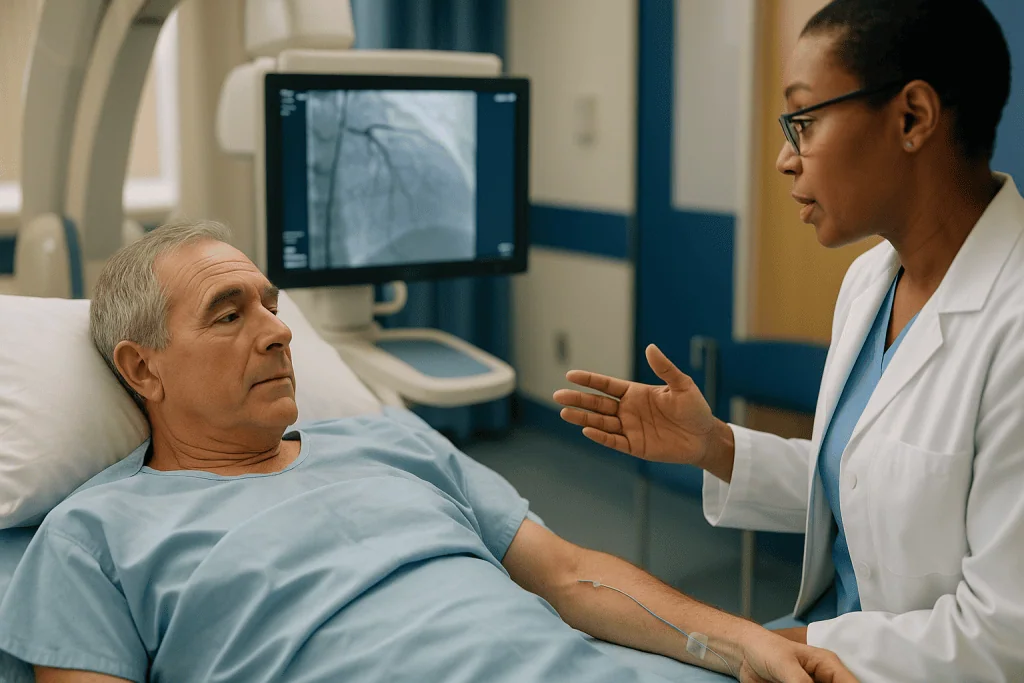
You lie on a narrow table with a large X-ray camera arm positioned over your chest. Electrodes on your skin feed a continuous heart tracing to a monitor, and a cuff checks your blood pressure at intervals. The access site, either the radial artery at the wrist or the femoral artery at the top of the thigh, is cleaned with cold antiseptic and surrounded by sterile drapes. Local anesthetic is injected into the skin.
Once the area is numb, the cardiologist places a small plastic sheath into the artery, a short tube that acts as a doorway so instruments can pass in and out without repeated punctures. Through it, a catheter is guided along the artery to the heart under X-ray guidance. Contrast is injected into each coronary artery while the camera records short clips from several angles. The camera arm moves around you, and you may be asked to hold your breath for a few seconds or turn your head.
The Mayo Clinic notes the diagnostic part typically takes under an hour, although preparation and recovery add time. If a narrowing is found, the team may discuss treating it during the same session with a balloon and stent, a procedure called percutaneous coronary intervention, or they may stop and plan separately. That choice depends on what the pictures show and on what you agreed beforehand.
Is an angiogram painful at the puncture site? Local anesthesia explained
The puncture site is where almost all of the actual pain lives, and it is brief. Local anesthetic, usually a lidocaine-class drug that temporarily blocks nerve signals in a small area, is injected with a fine needle just under the skin. People describe it as a bee sting followed by a spreading, stinging warmth that fades within a minute. The sensation is similar to the numbing injection at a dental appointment.
Once the drug takes effect, you should feel pressure but not sharpness. The cardiologist will often test the area by pressing with an instrument and asking whether it feels sharp or dull before placing the sheath. If you still feel sharpness, say so; more anesthetic can be added without any disadvantage.
The wrist deserves a specific mention. The radial artery is small and lies close to the skin, so the needle stick itself is usually quick, but the artery can spasm, tightening around the catheter in a reflex that feels like a deep, cramping ache in the forearm. Cath labs routinely give medicines through the sheath to relax the vessel and reduce this, and the ache usually eases once the catheter is withdrawn.
At the groin, the femoral artery sits deeper, so the numbing injection goes further in and may require a second pass. Pressure from the sheath can feel like firm thumb pressure on the crease of the hip. Neither route should produce ongoing sharp pain during the study.
Removing the sheath at the end is a separate moment. The team presses firmly on the artery for several minutes or uses a closure device, a small plug or band that seals the puncture. Firm pressure is uncomfortable, occasionally briefly painful, and it is the price of a vessel that stops bleeding properly.
The coronary angiogram warm feeling: why contrast dye makes you flush
Ask anyone who has had an angiogram what they remember, and the warm flush is the usual answer. It arrives a few seconds after the larger contrast injections and feels like a wave of heat rolling from the chest down through the pelvis to the legs, sometimes with a flush in the face. The NHS specifically warns patients to expect a warm feeling and, oddly, the sense that they have passed urine, even though they have not.

The mechanism is straightforward. Iodine-based contrast agents, the dyes that make blood vessels show up on X-ray, are slightly thicker and more concentrated than blood. As a bolus passes through the arteries it briefly dilates small blood vessels in the skin and the organs, and that sudden rush of blood flow is perceived as heat. The bladder and pelvic sensation comes from the same vessel dilation in the pelvis. It lasts roughly as long as it takes the dye to circulate once, typically well under a minute.
Some people also notice a metallic taste or a feeling of nausea. These are not allergic reactions; they are ordinary responses to contrast. A true allergic reaction, with itching, hives, swelling of the lips or throat, or wheezing, is uncommon and is treated in the lab with medicines kept at hand. If you have reacted to contrast before, tell the team well before the day, because preventive medicines can be arranged by your clinicians.
Knowing the flush is coming changes how it feels. Patients who were warned describe it as peculiar; those who were not sometimes describe it as frightening. Many cardiologists say “warm flush now” just before the injection, and if yours does not, you can ask them to.
Wrist or groin: how each access route feels before, during and after
The choice of entry point changes the experience more than almost anything else. Both routes lead to the same arteries and the same pictures; what differs is the puncture, the position you must hold afterward, and how quickly you can move. The table summarizes what patients commonly report, drawn from NHS and Johns Hopkins descriptions of cardiac catheterization.
| Aspect | Radial (wrist) | Femoral (groin) |
|---|---|---|
| Numbing injection | Shallow, quick sting | Deeper, may need two passes |
| During the study | Possible forearm cramping from artery spasm | Firm pressure at hip crease |
| Sheath removal | Compression band on the wrist | Manual pressure or a closure device |
| Position afterward | Can sit up soon after | Lie flat for several hours |
| Typical soreness | Tender wrist, bruise, numb fingertips briefly | Bruise at groin, aching with walking |
| Main caution | Avoid heavy lifting with that arm | Avoid bending, lifting, stairs early on |
Why does the team choose one over the other? Radial access is widely favored because the artery is easy to compress against the wrist bone, which lowers bleeding risk and lets you sit up and eat soon afterward. It is not suitable for everyone: a very small or spasm-prone artery, a poor backup blood supply to the hand, or previous wrist surgery can push the decision toward the groin. Femoral access also allows larger instruments if a complex treatment is anticipated.
From a comfort standpoint, most people find the wrist easier, mainly because lying flat for hours with a leg kept still is tedious and hard on the back. That said, a well-managed groin procedure is not a painful one, and the decision rests with the cardiologist examining your vessels.
Will I be awake? Sedation, awareness and what you hear in the room
Yes, you will almost certainly be awake. Coronary angiography is performed under local anesthetic, usually with light sedation rather than general anesthesia. The reason is practical: the team needs you to hold your breath on request, report chest discomfort, and keep still, none of which a fully anesthetized patient can do. The Cleveland Clinic describes cardiac catheterization patients as awake but relaxed, often drowsy enough to doze.
Sedation, when given, is typically a short-acting benzodiazepine-class medicine through a drip in the hand, sometimes with a small amount of an opioid-class painkiller. The aim is calm, not sleep. Some people remember the whole procedure clearly; others recall it in fragments. Whether you receive sedation at all, and how much, is a decision for the cardiologist and anesthesia staff based on your anxiety level, breathing, blood pressure and other medicines.
The room itself is part of the experience. It is cool, because the X-ray equipment needs it that way, and warm blankets are normally offered. You will hear the camera motors whir as the arm swings around you, the beeping of the heart monitor, and the team calling out positions and numbers. Screens are usually visible if you turn your head, and many cardiologists will show you your own arteries on the monitor and talk you through them, if you want to see.
If you are claustrophobic or extremely anxious, tell the pre-assessment nurse rather than the person placing the sheath. The team can plan a little more sedation, arrange for a nurse to stay at your head and talk you through, or in rare cases discuss other options. Anxiety is not a weakness here; it is information the team needs.
How long does an angiogram take, and what can make it longer
The diagnostic study is shorter than most people expect. MedlinePlus and the Mayo Clinic both describe the catheter portion as lasting roughly 30 to 60 minutes, with the time on the table dominated by positioning, numbing and image acquisition rather than by the catheter being inside the heart. Your day, however, is considerably longer.
A typical outline, which varies between hospitals and should be confirmed with your own unit, runs like this. Arrival and checking in, with blood tests, consent and a cannula placed, can take an hour or two. The procedure follows. Recovery then depends on the access site: with wrist access, a compression band is loosened in stages over a couple of hours; with groin access, the NHS advises lying flat for several hours before sitting up. Many people go home the same day, and some, particularly those having treatment in the same session or those with other medical issues, stay overnight.
Several things lengthen the procedure. Difficult anatomy, such as an artery that takes a sharp turn or a coronary opening in an unusual spot, may require several catheter shapes before a good picture is obtained. Artery spasm at the wrist can slow progress. Previous bypass surgery means each graft must be found and imaged separately, which adds time. If a narrowing is found and the team proceeds to a stent, the session can stretch to an hour or two longer.
None of these extensions usually involve more pain. They mostly mean more lying still, more breath holds and more contrast injections. If you are told the study is taking longer, it is reasonable to ask why and whether anything has changed.
Who is usually offered a coronary angiogram, and who is asked to wait
An angiogram is a test with a question attached. It is offered when the answer, an exact map of narrowings in the coronary arteries, will change what the treating team does next. The American Heart Association lists the usual triggers: chest pain that suggests reduced blood flow, an abnormal stress test or CT scan, a heart attack, unexplained heart failure, heart valve disease before surgery, or a congenital heart problem under evaluation.
In an emergency, particularly a heart attack where an artery is fully blocked, the angiogram happens urgently because it leads directly to treatment. In that setting it is not a choice to deliberate; it is the fastest route to restoring blood flow, and the comfort measures described here still apply.
Outside emergencies, several groups are commonly asked to wait or to have a different test first. People with low-risk symptoms and no abnormal findings may be steered toward a CT coronary angiogram, a scan through a vein rather than an artery, or a stress test. Those with significant kidney impairment may need adjustments, because contrast dye is cleared by the kidneys and can strain them; a cardiologist may defer the test, give fluids beforehand, or reduce the contrast volume. Pregnancy prompts a careful discussion about X-ray exposure. A recent allergic reaction to contrast, uncontrolled bleeding, severe anemia or an active infection can also push the date back until things are stabilized.
Being asked to wait is not the same as being told the problem is minor. It usually reflects the judgment that another test answers the question with less risk, or that a fixable issue should be sorted first. If the reasoning is not clear to you, ask the team to explain it in plain words.
Angiogram recovery time: the first hours after the catheter comes out
The first hours are mostly about the artery sealing itself. Sheath removal and compression are the moment most patients find the least pleasant, and they are also the moment that determines how the puncture behaves later.
With wrist access, a pneumatic band is inflated over the artery and gradually released over roughly an hour or two while a nurse checks the hand for color, warmth and pulse. Fingertips may tingle or feel slightly numb while the band is tight. Johns Hopkins notes that patients with radial access can usually sit up and walk sooner than those with groin access, and eating and drinking resume quickly.
With groin access, pressure is applied by hand or a closure device seals the hole. The NHS advises lying flat with the leg straight for several hours afterward, because bending the hip can reopen the puncture. Nurses check the site and the pulses in the foot at set intervals. Boredom and a stiff back are the usual complaints; actual pain should be mild.
Across both routes, you will be encouraged to drink fluids to help the kidneys clear the contrast, and your blood pressure and heart rhythm will be monitored. Before discharge, someone will inspect the site, explain how to look after it, and tell you who to call. Mayo Clinic guidance, like NHS guidance, is firm that you must not drive yourself home after sedation; arrange a lift and ideally have someone with you overnight.
A small, firm lump at the puncture site the size of a pea or a marble is common and usually represents a tiny collection of clotted blood that resolves on its own. A lump that is growing, pulsating or increasingly painful is a different matter and belongs in the red-flag list later in this article.
The days and weeks afterward: bruising, driving and getting back to normal
Most of the discomfort after an angiogram is a story about a bruise. Blood that seeped into the tissue around the puncture during and after the procedure turns the area purple, then green and yellow, over one to two weeks, and a groin bruise can track down the inner thigh under gravity. This looks alarming and is usually harmless. Tenderness peaks in the first couple of days and then fades.
Activity restrictions are short but specific. The NHS advises avoiding strenuous activity and heavy lifting for a few days, and keeping the puncture site clean and dry, with showering generally allowed from the next day and baths or swimming postponed until the skin has sealed. After wrist access, avoid lifting with that arm, pushing yourself up from a chair with it, or wearing a tight watch over the site until it has healed. After groin access, take stairs slowly and avoid squatting or straining for the first few days.
Driving is restricted mainly because of sedation and the risk of the groin puncture reopening when you brake hard; your unit will give you a specific instruction, and some national driving authorities have their own rules after cardiac procedures, so ask rather than assume. Return to desk work is often possible within a day or two; physical jobs may need a week. If a stent was placed, the recovery and the medicines that follow are different and are addressed by your cardiology team separately.
Low energy for a few days is common, partly from sedation and partly from the stress of a hospital day. Chest pain afterward is not an expected part of recovery and should be reported, as the next sections explain.
Risks and alternatives, described without drama
A fair explainer describes the downsides in the same even tone as the comforts. The Mayo Clinic and MedlinePlus list the recognized complications of coronary angiography, and both describe serious problems as rare, though not zero.
The common issues are local: bruising, a small lump of clotted blood at the site, and tenderness. Less common site problems include a larger collection of blood, a false aneurysm where blood pools in a pocket outside the artery wall, or, after wrist access, a radial artery that closes off, which usually causes no symptoms because the hand has a second artery. Contrast dye can temporarily reduce kidney function, more so in people with existing kidney disease or diabetes, which is why blood tests are checked before the day. Allergic reactions to contrast range from a rash to, rarely, a severe reaction treated immediately in the lab.
The rare but serious complications are the ones consent forms list: damage to the artery, a heart attack or stroke triggered by a dislodged clot or plaque, an abnormal heart rhythm, and death. The team quantifies these for you individually, because the numbers depend heavily on age, kidney function, the urgency of the procedure and how extensive the disease turns out to be. This article does not quote a single figure, because a single figure would be misleading.
Alternatives exist and are often used first. A CT coronary angiogram images the arteries without an arterial puncture, through a cannula in a vein. Stress testing, with exercise or medicine and imaging, assesses whether the heart muscle is short of blood without showing the arteries directly. Each answers a slightly different question, and the invasive angiogram remains the test used when the precise map is needed or treatment may follow.
What people often get wrong about angiogram pain
Forum posts and family stories carry a few persistent myths. Correcting them matters, because fear is a reliable amplifier of discomfort.
“You feel the tube going into your heart.” You do not. Arteries lack the pain receptors of skin, and the catheter tip sitting at a coronary opening produces, at most, a brief awareness of a skipped beat. What people interpret as feeling the catheter is usually the pressure of the sheath at the entry point.
“The warm flush means something has gone wrong.” It is the single most predictable sensation of the whole procedure, a direct effect of contrast dye widening small blood vessels. It passes in seconds.
“They put you to sleep for it.” General anesthesia is the exception, not the rule. Local anesthetic plus light sedation is the standard approach described by the NHS and Cleveland Clinic, and being awake is useful: you can report symptoms and follow breathing instructions.
“A big bruise means the artery is damaged.” Bruising reflects blood that leaked into the surrounding tissue during the procedure and compression. It fades over one to two weeks. A growing, pulsating or hard, painful swelling is the sign to report, not a flat, colorful bruise.
“If it does not hurt, they did not do it properly.” The opposite is closer to the truth. Good numbing, a cooperative artery and a calm patient make for a procedure that feels like a long, slightly strange dental appointment.
“Recovery takes weeks.” For a diagnostic angiogram without a stent, restrictions are measured in days. Fatigue and site tenderness are usually gone within a week, though anyone whose study led to treatment follows a different plan set by their team.
Questions to ask your care team before the day
The pre-assessment visit or phone call is the right place to settle the practical worries that make the day feel bigger than it is. These questions are drawn from what patients commonly wish they had asked.
- Which access site are you planning, wrist or groin, and what would make you change your mind on the day?
- Will I have sedation, and what are the options if I am very anxious or claustrophobic?
- Which of my regular medicines should I take that morning, and which should I pause? Please confirm this with the prescribing clinician rather than assuming.
- How should I manage diabetes medicines and fasting, given the timing of my slot?
- I have reacted to contrast or iodine before; what is the plan for that?
- Do my kidney results need anything done before or after the dye?
- If you find a narrowing, will you treat it in the same session, or stop and discuss first? What did I consent to?
- How long should I expect to be in the unit, and should my companion wait or come back?
- How will I be told the results, and by whom?
- When can I drive, shower, lift my grandchildren, and return to work?
- What exactly should I watch for at the puncture site, and which number do I call at night or on a weekend?
Bring a written list of your medicines, including over-the-counter supplements and blood thinners, and tell the team about any allergy, bleeding tendency, pregnancy or possibility of pregnancy. Ask for the plan in writing. Decisions about sedation, medicines around the procedure and whether to proceed to treatment rest with your cardiology team, informed by what you tell them; the more complete your answers, the better that plan fits you.
When to call your doctor: red-flag signs after a coronary angiogram
Soreness and a bruise are expected. The signs below are not, and the Mayo Clinic, NHS and Johns Hopkins each advise acting on them promptly rather than waiting for a routine appointment.
Call emergency services, or have someone take you to an emergency department, if any of these occur:
- Bleeding from the puncture site that does not stop after you press firmly on it for several minutes, or bleeding that soaks through the dressing.
- A lump at the site that is rapidly growing, pulsating, or becoming hard and very painful.
- The hand or foot on the procedure side turning pale, blue, cold or numb, or losing its pulse.
- Chest pain, pressure or tightness, especially with sweating, breathlessness or pain spreading to the arm, jaw or back.
- Sudden weakness of the face, arm or leg, slurred speech, confusion, or loss of vision, which can signal a stroke.
- Fainting, a racing or very irregular heartbeat, or severe breathlessness.
- Hives, swelling of the lips, tongue or throat, or wheezing, which can be a delayed contrast reaction.
Contact your cardiology unit or GP the same day if you notice increasing redness, warmth or discharge at the site, a fever, a bruise that keeps spreading after the first couple of days, worsening rather than easing pain, or very little urine output, which can hint at a kidney reaction to contrast.
If you are simply unsure, ring the number on your discharge sheet. Cardiac units expect these calls and would rather check a harmless bruise than miss a bleeding artery. Any change to your medicines, including pausing or restarting a blood thinner, should come from the treating team and not from a search result.
Frequently asked questions
Is an angiogram painful while it is being done?
Usually not. The sharpest moment is the local anesthetic injection, which stings for a few seconds like a dental numbing shot. After that, most people feel pressure at the wrist or groin, a brief warm flush when dye is injected, and occasionally a cramping ache in the forearm from artery spasm. Sharp or escalating pain is unexpected and should be reported to the team straight away.
What does the coronary angiogram warm feeling actually mean?
It means the contrast dye is circulating, nothing more. Iodine-based contrast briefly widens small blood vessels in the skin and pelvis, which the brain perceives as a wave of heat and sometimes as a false sensation of passing urine. It lasts well under a minute. It is not an allergic reaction; true allergy shows as itching, hives, swelling or wheezing and is treated in the lab.
Does coronary angiography hurt more at the wrist or the groin?
Neither should be painful once numbed, but the experiences differ. The wrist involves a shallow, quick sting and sometimes a cramping forearm ache from artery spasm, with a compression band afterward. The groin needs a deeper numbing injection, firmer pressure at sheath removal, and several hours lying flat. Many people find the wrist easier simply because they can sit up sooner.
Will I be awake, and can I ask for more sedation?
You will almost always be awake under local anesthetic with light sedation, because the team needs you to hold your breath and report symptoms. You can tell the nurse or cardiologist if you feel anxious or uncomfortable, and more local anesthetic or sedation is often possible. Whether and how much sedation is given is decided by the treating team based on your breathing, blood pressure and medicines.
How long does an angiogram take from start to finish?
The catheter part typically takes around 30 to 60 minutes according to MedlinePlus and the Mayo Clinic. Checking in, consent, blood tests and recovery add several hours, and groin access requires lying flat for a few hours afterward. Difficult anatomy, previous bypass grafts or proceeding to a stent can lengthen the session. Many people go home the same day; some stay overnight.
What is a normal angiogram recovery time for soreness and bruising?
Tenderness at the puncture site usually peaks within the first couple of days and eases over about a week. A bruise can spread and change color over one to two weeks before fading, and a groin bruise may track down the thigh. The NHS advises avoiding strenuous activity and heavy lifting for a few days. Growing swelling, bleeding or worsening pain is not normal and needs a call to the unit.
Why can I not drive myself home after an angiogram?
Two reasons. Sedation impairs reaction time and judgment for the rest of the day even if you feel alert, and a groin puncture can reopen with the sudden hip flexion of hard braking. The NHS and Mayo Clinic both advise arranging someone to drive you home. Your unit will give a specific timeframe for returning to driving, and some national licensing rules apply after cardiac procedures.
Can the contrast dye affect my kidneys?
It can temporarily reduce kidney function, especially in people with existing kidney disease or diabetes, which is why kidney blood tests are checked beforehand. Teams reduce the risk by giving fluids, limiting contrast volume and sometimes adjusting the timing of certain medicines, decisions made by the cardiologist and your prescribing clinician. Drinking fluids afterward helps clear the dye. Very low urine output after the procedure should be reported.
Is it normal to feel a small lump at the puncture site?
A small, firm, pea-to-marble-sized lump is common and usually represents a tiny pocket of clotted blood that the body reabsorbs over a few weeks. What is not normal is a lump that enlarges, pulsates, feels hot or becomes increasingly painful, which can signal continued bleeding or a false aneurysm. Those changes need same-day assessment, and the unit’s discharge number is the first call.
What if a narrowing is found during the angiogram?
It depends on what you agreed to beforehand and what the pictures show. Some teams treat a suitable narrowing in the same session with a balloon and stent; others stop, discuss the images with you and a wider heart team, and plan treatment separately. Neither path is right for everyone. Ask before the day which approach your cardiologist intends so the decision does not surprise you.
References
This article is for general information only and is not a substitute for professional medical advice. Please consult a qualified doctor about your individual situation.

More from the Blog

How Do Pacemakers, CRT and Defibrillators Support a Failing Heart? Device Therapy Explained
Heart failure device therapy uses small implanted electrical devices to support a weakened heart. Pacemakers keep the heart from beating too slowly, cardiac resynchronization…

Which Questions to Ask When Cardiac Sarcoidosis Treatment Is First Proposed
When cardiac sarcoidosis treatment is first proposed, the most useful questions cover five areas: how certain the diagnosis is and which scans support it,…

What Happens During a Cardiac Ablation Procedure, From Mapping to the Final Rhythm Check
During cardiac ablation, a heart rhythm specialist threads thin, flexible catheters through a vein, usually in the groin, up into the heart, records its…

After Aortic Aneurysm Repair: The Wound, Leg and Kidney Changes to Report Promptly
After aortic aneurysm repair, report promptly any wound that becomes increasingly red, hot, swollen, leaking or opens; a leg that turns pale, cold, numb,…

Pericarditis, Effusion and Constriction: How Pericardial Diseases Are Treated Differently
Pericarditis is usually treated with anti-inflammatory medicines, a temporary break from strenuous exercise and scheduled follow-up, and most viral or idiopathic cases settle within…

During Deep Vein Thrombosis Treatment: What Is Expected and When to Call Your Doctor
During deep vein thrombosis treatment, leg aching, swelling and warmth usually ease gradually over days to weeks while anticoagulant medicines stop the clot from…