

Does a Robot Operate on Your Eye Alone? Robotic Ophthalmology Myths, Put Right
Key Takeaways
- No approved eye procedure anywhere is performed by a robot without a surgeon making the decisions and controlling the instruments throughout.
- "Robotic cataract surgery" almost always means a femtosecond laser performing surgeon-programmed cutting steps, after which the surgeon completes the operation by hand.
- Reviews comparing laser-assisted with conventional cataract surgery have generally found similar visual outcomes and complication rates, which is why manual surgery remains the standard.
- Robotic arms that filter hand tremor inside the eye have been used in small, supervised human studies, mainly on the retina, and remain investigational rather than available.
- The NHS puts conventional cataract surgery at roughly 30 to 45 minutes under local anesthetic, with full recovery typically taking four to six weeks whichever technique is used.
- The main downsides of robotic surgery in the eye are added set-up time, loss of tactile feedback, surgeon learning curves and, above all, unproven benefit for patients' sight.
No. Today, no robot performs eye surgery on its own. In every approved procedure, a trained ophthalmologist makes the decisions and controls the instruments. Some cataract steps can be automated with a surgeon-programmed laser, and robotic arms that steady a surgeon's hand inside the eye are being tested in small studies. Fully autonomous eye surgery remains experimental and is not offered to patients as routine care.
The consent form was on the kitchen table, and the question that kept surfacing had nothing to do with the paperwork. A woman in her seventies, booked for cataract surgery on her left eye, had watched a news clip about a machine “operating” on a retina without a human hand nearby. She wanted to know one thing before anyone touched her eye: would a person be doing this, or a computer?
It is a fair question, and the headlines have not made it easier. So, does a robot do eye surgery? The plain answer is that a surgeon does, sometimes with a very sophisticated tool in hand. But the gap between what the technology can do in a research lab and what happens in an ordinary operating room is wide, and it is worth walking through it slowly.
What follows is a myth-by-myth account of where robots really sit in eye care: what exists, what is being tested, and what remains a promise rather than a procedure.
Does a robot do eye surgery today? The short, honest answer
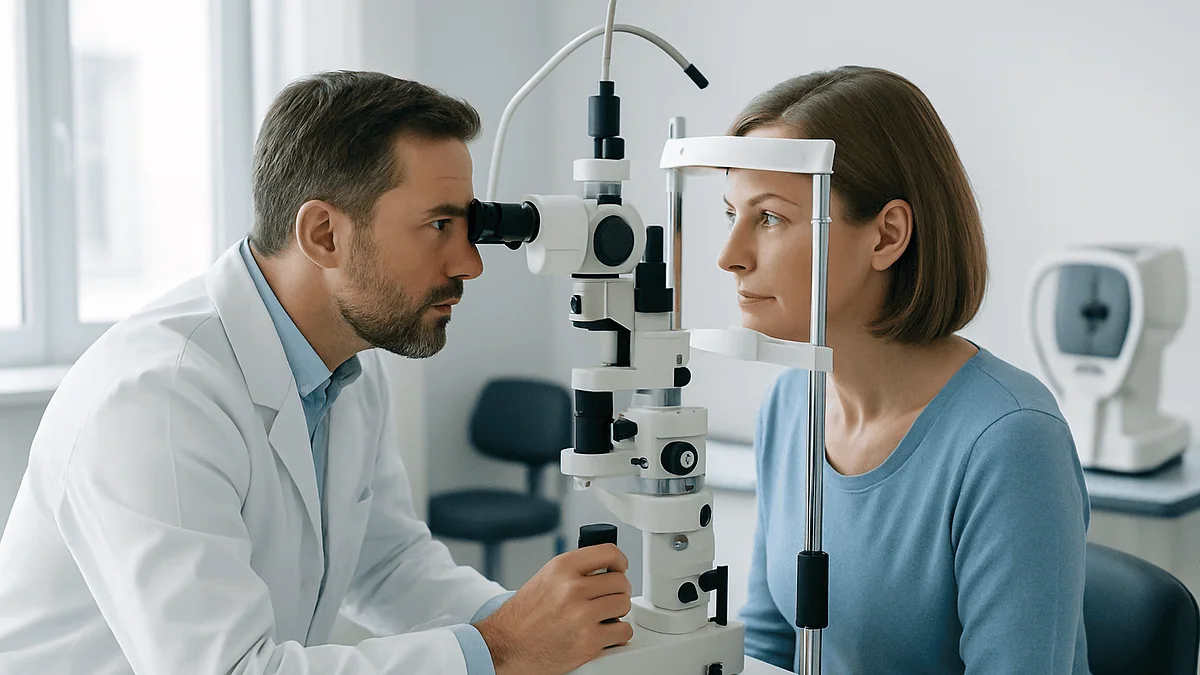
If you are scheduled for cataract surgery, a glaucoma procedure, a retinal repair or laser vision correction, a human ophthalmologist will perform it. That is true whether the operating room contains a microscope, a laser, or a robotic arm. In every eye procedure that is offered as standard care, the surgeon chooses the plan, makes the incisions or programs the laser, watches every step through the microscope, and can stop or change course at any moment.
Where does the confusion come from? Partly from language. “Robotic” gets attached to anything with a computer inside it, from a laser that cuts a precise circle in the lens capsule to a joystick-controlled arm that holds a needle steadier than a wrist can. None of those devices decides anything. They execute what a surgeon has set up and continue only while the surgeon allows them to.
Partly the confusion comes from genuine research. Engineers have built systems that can, in laboratory settings and in a small number of supervised studies, guide an instrument toward a target inside the eye with very little human steering. Those studies are real and interesting. They are also small, closely monitored, and not something a patient can request at a routine appointment.
The Mayo Clinic’s description of robotic surgery in general applies neatly to the eye: the surgeon sits at a console and controls the instruments; the system translates those movements into smaller, steadier ones. The robot is a set of hands, not a brain.
So when the woman at the kitchen table asked whether a person would be operating on her eye, the accurate answer was yes, without qualification. Whether that person would be using a laser or a mechanical aid for part of the work is a separate, and far less alarming, question.
What "robotic" actually means in an operating room
The word covers three quite different things, and separating them clears up most of the myths.
The first is surgeon-controlled assistance. A robotic system is a mechanical arm or platform that moves an instrument in response to the surgeon’s hand movements, usually scaling them down and filtering out tremor. Tremor is the tiny, involuntary shake present in every healthy human hand. In abdominal and pelvic surgery this model has been used for years; Johns Hopkins describes it as the surgeon operating from a console while the arms mirror the movements at the patient. In eye surgery, versions of this idea are in clinical evaluation rather than everyday use.
The second is image-guided automation of a single step. The clearest example is the femtosecond laser. A femtosecond laser is a laser that fires pulses lasting a millionth of a billionth of a second, short enough to cut tissue without heating it. In cataract surgery it can make the corneal incisions, open the front of the lens capsule and soften the cloudy lens, all along a path the surgeon has mapped on a scan. Once the surgeon presses the pedal, the laser does that pre-planned part on its own. This is automation, but it is automation of a step the surgeon has designed and is watching.
The third is autonomy: a machine that senses the anatomy, plans its own path and moves without a human guiding each motion. This exists in engineering papers and animal or model-eye experiments, and in a very small number of supervised human studies. It is not available as a treatment.
When a news story says “robot performs eye surgery,” it is almost always describing the first or second category. The third is the one people picture, and it is the one furthest from the clinic.
How robot-assisted eye surgery works, step by step
Picture the setting first, because the eye imposes constraints that no other organ does. The surgeon looks down through a microscope, or increasingly at a high-resolution screen fed by a 3D camera, at a target the size of a grape. Inside it, at the back, lies the retina, a layer of light-sensing tissue thinner than a sheet of paper. Blood vessels running across it are finer than a human hair.
In a robot-assisted procedure as it is being studied, the sequence usually runs like this. The patient receives anesthetic, most often local drops or an injection around the eye rather than a general anesthetic, as is standard for cataract surgery according to the NHS. The surgeon makes tiny entry ports through the white of the eye by hand. A slender instrument, such as a forceps or a needle, is mounted on the robotic arm and placed through one port.
From there the surgeon steers. Depending on the design, they either hold a handle attached to the arm, which lets the arm dampen tremor while following their hand, or they operate a controller a few feet away. The system scales the movement down, so a small hand motion becomes a much smaller instrument motion. Some designs add a “virtual wall” that prevents the tip from pushing deeper than a set limit.
The critical detail is that the surgeon is never a spectator. They watch the tip, judge the tissue response and adjust continuously. If the view is obscured, if the eye moves unexpectedly, or if anything looks wrong, they lift their foot from the pedal or release the handle and the instrument stops.
After the assisted step, the surgeon removes the instrument, closes the ports, often without stitches, and the rest of the procedure and recovery follows the same path as a conventional operation.
Laser cataract surgery vs traditional: is a laser a robot?
Most people who ask whether a robot does eye surgery are actually thinking about cataract surgery, because that is the operation they or a relative are facing. So it helps to be specific about what “robotic cataract surgery” usually means when a clinic uses the phrase.
In conventional cataract surgery, described by MedlinePlus and the NHS, the surgeon makes a small incision by hand, opens the front of the lens capsule with a fine instrument, uses ultrasound to break up and suction out the cloudy lens, and places a folded artificial lens through the same incision. The NHS notes the procedure usually takes around 30 to 45 minutes and is done under local anesthetic as a day case.
In laser-assisted cataract surgery, a femtosecond laser performs the first three of those tasks along a surgeon-designed plan built from a scan taken moments earlier. The surgeon then completes the removal and lens placement by hand. That is the whole difference: a laser does some of the cutting instead of a blade.
Is that a robot? By a loose definition, yes; by the definition most patients have in mind, no. There is no arm, no autonomous decision, and the surgeon is present and in control for every second.
Does it produce better vision? This is where honest language matters. Large reviews comparing laser-assisted with conventional cataract surgery have generally found similar visual results and similar complication rates, which is why the NHS still describes the manual technique as the standard. Some surgeons value the laser for particular anatomies or lens types; others do not find it changes outcomes. That is a professional judgement for your surgeon, not a reason to seek out or avoid a particular clinic.
Where robots are genuinely being tested: the retina
If any part of the eye pushes human hands to their limit, it is the retina. A surgeon repairing a membrane on its surface, or injecting a drug into a retinal vein, is working at a scale where the natural tremor of a healthy hand is a meaningful fraction of the target. This is why nearly all serious robotic eye research has focused here rather than on the front of the eye.
Several groups have built systems that stabilize an instrument inside the vitreous cavity, the jelly-filled space between the lens and retina. Early supervised human studies, in which a surgeon used a robotic arm to peel a membrane from the retinal surface or to place a needle into a tiny vessel, have been published and reported as feasible. The point of those studies was to show that the approach was safe enough to study further, not to prove it was better than skilled hands.
Two things about this research deserve emphasis. First, the numbers are small. These are pilot studies involving handfuls of patients, each under a surgeon’s direct control, in settings with ethics approval and intensive monitoring. Second, they address procedures that many retinal surgeons already perform manually with good results, so the bar for a robot to clear is high.
Where robotic stabilization might eventually matter most is in tasks that humans currently cannot do reliably at all, such as delivering a treatment into a retinal vessel narrower than a strand of hair, or holding an instrument motionless for minutes while a drug infuses. Those applications are being explored, but the phrase to keep in mind is “being explored.” A patient with a retinal detachment today will be treated by a surgeon’s hands, and that remains the evidence-based standard.
Who robot-assisted eye surgery is usually for, and who is asked to wait
Because robot-assisted eye surgery is largely a research activity, the honest description of “who it is for” is narrow: adults who meet the entry criteria of a specific clinical study, at a center running that study, who have understood that the technique is investigational and have given informed consent.
Study criteria vary, but they tend to share features. Participants usually have a condition for which a conventional operation is already indicated, so the robot is assisting a procedure that would have happened anyway. They are usually otherwise well enough to tolerate a slightly longer operation, since set-up adds time. They are generally able to lie still under local anesthetic, because eye movement and head movement matter more when a fixed instrument is inside the globe.
Who is typically asked to wait, or is not considered at all? People whose eye condition is urgent, such as an acute retinal detachment threatening the central vision, because established surgery should not be delayed for an experimental variant. People who cannot lie flat or still for the required time. People with conditions that make the eye unusually fragile or difficult to image. Children, in nearly all current studies. And, importantly, anyone who has been told a robotic approach is available but has not been given a clear explanation of what is standard and what is investigational.
For laser-assisted cataract surgery, which is an established option rather than a research one, eligibility is broader but still individual. Surgeons consider the shape and clarity of the cornea, whether the pupil dilates well, any existing eye disease and the lens implant planned. A very dense cataract or a small pupil can make the laser step less useful.
None of this is a checklist you can apply to yourself. It is context for the conversation your ophthalmologist will lead.
Traditional, laser-assisted and robot-assisted eye surgery compared
The three approaches are easy to blur together in a headline. Laid side by side, the differences in who controls what, and in how established each one is, become clearer.
| Feature | Conventional (manual) | Laser-assisted (femtosecond) | Robot-assisted (research) |
|---|---|---|---|
| Who makes decisions | Surgeon | Surgeon | Surgeon |
| Who moves the instrument | Surgeon’s hand | Laser follows surgeon’s plan for specific steps; surgeon completes by hand | Robotic arm follows surgeon’s hand or controller, filtering tremor |
| Typical use today | Standard for cataract, retina, glaucoma | Established option for some cataract steps | Supervised clinical studies, mainly retinal procedures |
| Anesthetic | Usually local, day case | Usually local, day case | Usually local in studies; may take longer |
| Evidence base | Large, long-term | Reviews show broadly similar outcomes to manual | Small pilot studies showing feasibility |
| Autonomous? | No | No (pre-programmed step only) | No |
Two rows deserve a second look. The first row is identical across all three columns, and that is the single most important fact in this article. The last row is also identical: none of these is autonomous.
The “evidence base” row explains why your surgeon may sound unenthusiastic about something a news story called revolutionary. Conventional cataract surgery is one of the most performed operations in the world, with decades of outcome data behind the guidance published by bodies such as the NHS. Robot-assisted eye surgery has, so far, shown that it can be done. Showing that it should be done, for which patients and at what risk, is a longer road.
What the days and weeks after eye surgery usually look like
Whether a laser, a robotic aid or only a surgeon’s hands were involved, recovery from eye surgery follows the biology of the eye rather than the technology used. That is reassuring: the aftercare plan you are given will be a familiar one.
For cataract surgery, the NHS describes a typical pattern. Most people go home the same day, often within a few hours, with a protective shield over the eye. Vision is usually blurry at first and may be noticeably better within a few days, though the NHS notes it can take four to six weeks to recover fully. Mild grittiness, watering, some redness and a sensation of a foreign body are common in the first days. Prescribed drops, usually an anti-inflammatory and sometimes an antibiotic, are used for a period set by the surgeon; how long, and how often, is for the prescribing team to decide, not for an article to suggest.
Everyday advice from the NHS and Mayo Clinic tends to overlap: avoid rubbing the eye, keep soap and shampoo out of it, skip swimming for a period your team specifies, avoid strenuous exercise and heavy lifting initially, and do not drive until your team confirms your vision meets the legal standard. Reading, watching television and using screens are generally fine as soon as they are comfortable.
Retinal surgery has a different rhythm. Some procedures involve a gas bubble placed inside the eye, which requires keeping the head in a particular position for days and avoiding air travel until the bubble has absorbed, because altitude changes make gas expand. Vision through a gas bubble is very poor and improves gradually as it clears over weeks.
If a robotic device was used within a study, follow-up is usually more frequent, not because the eye heals differently but because researchers need to document what happens. Your team will tell you what to expect.
What is the downside of robotic surgery in the eye?
Any honest explainer has to spend as long on the drawbacks as on the promise. The downside of robotic surgery, in ophthalmology specifically, falls into several categories.
Time. Setting up, calibrating and docking a robotic system adds minutes to a procedure that, in the case of cataract surgery, the NHS puts at roughly 30 to 45 minutes when done conventionally. Longer time under local anesthetic with an open eye is not risk-free.
Loss of tactile feedback. A surgeon holding an instrument feels the faint resistance of tissue. A surgeon holding a controller does not, or feels only what the system simulates. In the eye, where the retina tears under forces too small to perceive, that missing sense matters. Engineers are working on force sensors, but the problem is not solved.
Unproven benefit. The central question for any new surgical technology is whether patients see better, or suffer fewer complications, than with the established method. For robot-assisted eye surgery that evidence does not yet exist beyond feasibility. For laser-assisted cataract surgery, reviews have broadly found comparable outcomes to manual surgery. “New” and “better” are different words.
Learning curves. Every surgeon using a new platform is early on a curve. Outcomes during that phase may differ from their established results with manual technique.
Failure modes. Software freezes, instrument-tracking errors and unexpected eye movement while a rigid arm holds an instrument inside the globe are all scenarios that study protocols must plan for. They are rare in reports so far, but the reports are small.
Complexity and access. Systems require maintenance, training and infrastructure. None of that changes the biology of the eye, but it does shape which patients encounter the technology and under what supervision.
Weighed against these, the potential upside, steadier instruments and access to tasks hands cannot do, is real but not yet demonstrated in the form patients care about: better sight.
How close are we to robotic eyes and fully autonomous surgery?
Two very different ideas hide inside this popular search. One is a machine that operates on an eye without a surgeon. The other is a replacement eye, a bionic or robotic organ restoring sight. They tend to get asked together, so they deserve separate answers.
Autonomous surgery. Research groups have published work in which a robotic system, using imaging and machine learning, guides a needle toward a target in an animal or model eye with minimal human steering. Machine learning is a method by which software improves at a task by analyzing many examples. These experiments are real advances in engineering. What they are not is a treatment. Between a laboratory demonstration and a procedure offered to patients lie years of safety testing, regulatory review, comparison against skilled surgeons and the building of a professional consensus that a machine can be trusted with tissue that does not regenerate. No mainstream guideline body describes autonomous eye surgery as a current or near-term standard.
Robotic or bionic eyes. Devices that stimulate the retina or the visual pathway electrically, sometimes called retinal implants or visual prostheses, have been implanted in small numbers of people with specific inherited retinal diseases. Those who receive them typically perceive patterns of light rather than detailed images. Research continues, and some programs have paused or changed direction. A device that restores natural sight to someone with advanced eye disease is a research goal, not an available option.
Why is the eye harder than, say, the abdomen? It is small, it moves involuntarily, its tissues are transparent and therefore hard for cameras and sensors to track, and its most valuable structure, the retina, cannot be repaired if a machine misjudges depth by a fraction of a millimeter. Caution here is not conservatism for its own sake. It is the appropriate response to an organ that offers no second chances.
Remote robotic eye surgery headlines: what they show and don't
Stories about a surgeon in one city operating on a patient hundreds of miles away have a particular pull, and a couple have involved the eye. It is worth reading them with a slower eye than the headline invites.
What such a demonstration proves is that a robotic system can transmit a surgeon’s hand movements over a network with a delay small enough to be workable, and that the surgeon can complete a defined task on the far end. That is a genuine engineering achievement.
What it does not prove is that this is safe or sensible as routine care. Consider what has to be true on the patient’s side. An eye surgeon, anesthesia support and a full operating team must be present, ready to take over instantly if the connection drops or the machine misbehaves. The patient’s eye must be prepared, the ports made and the instrument mounted by hands in the room. In practice, therefore, remote surgery adds a distant surgeon to a team that already contains a local one. The scenario in which it might help, expertise reaching a place that has none, is precisely the scenario in which the on-site safety net is missing.
Network latency, the delay between a hand moving and the instrument responding, is the other issue. In most surgery a tenth of a second of lag is a nuisance. Inside the eye, where the target is a vessel narrower than a hair, it can be the difference between a clean puncture and a torn retina.
None of this means remote assistance has no future. Mentoring a less experienced surgeon through a screen, or a distant specialist reviewing images in real time, are plausible and already partly practiced. But a patient wondering whether their surgeon will be in the room can be told, with confidence, that for any standard eye operation the answer is yes.
What people often get wrong about robots in eye surgery
Some misunderstandings surface again and again in clinic conversations. Correcting them is most of the work of answering the title question.
“The robot decides where to cut.” It does not. In every approved procedure the surgeon plans, positions, watches and can stop. In laser-assisted cataract surgery the laser follows a map the surgeon drew minutes earlier from a scan of that specific eye.
“Robotic means more precise, so it must be safer.” Steadier is not the same as safer. Safety depends on the whole procedure, including set-up time, the surgeon’s experience with the platform and how the system behaves when the unexpected happens. Reviews of laser-assisted cataract surgery have generally found complication rates similar to manual surgery, not lower.
“If a hospital offers it, it must be better than the old way.” Availability of a technology says nothing about evidence for it. Ask what the outcome data show for your particular situation.
“I saw a robot do retinal surgery on the news, so I can ask for it.” Those cases were within research studies with strict entry criteria and ethics oversight. They are not a menu option.
“Laser eye surgery and laser cataract surgery are the same thing.” They are not. Laser vision correction reshapes the cornea to reduce the need for glasses; laser-assisted cataract surgery uses a different laser to help remove a cloudy lens. The NHS describes them as separate procedures with separate indications.
“Robots mean no surgeon is needed.” The opposite is true today: robotic systems require a fully trained surgeon plus additional training on the device.
“Autonomous eye surgery is a few years away.” No guideline body says so, and the technical and regulatory barriers are substantial. Anyone stating a timeline is guessing.
The pattern in all of these is the same: a real technology, described in a way that skips the human in the middle.
How much does robotic cataract surgery cost? Why the honest answer is a conversation
People search this question constantly, and a responsible article cannot answer it with a number. Costs for any eye procedure depend on where you live, what your insurance or health system covers, which lens implant is chosen, whether a laser or other device is used, and what the surgeon and facility charge. Any figure quoted in a general article would be wrong for most readers and would risk steering a medical decision by price.
What can be said neutrally is this. In many health systems, conventional cataract surgery is a standard covered procedure when it is clinically indicated. Laser-assisted steps and premium lens implants are, in a number of systems, treated as additional options rather than the standard, and may involve charges that the standard procedure does not. Robot-assisted eye surgery, being investigational, is generally provided within research studies, where the study rather than the patient usually carries the cost of the device. Those are patterns, not rules, and they vary widely.
The more useful question to bring to your appointment is not “how much” but “what am I paying for, and what does the evidence say it buys.” If a laser-assisted approach is proposed, ask whether it is expected to change your visual result or your risk, and what the published comparisons show. If the answer is that outcomes are broadly similar, as most reviews suggest, you can make an informed choice about whether the difference matters to you.
A related search, how much a surgical robot itself costs, belongs to hospital procurement rather than patient care and has no bearing on what you should decide. Whatever a machine cost the institution, the question for you remains whether its use has been shown to help people with your eyes.
Your ophthalmologist’s team and, where relevant, your insurer are the right people to give you real figures for your situation.
Questions to ask your care team about robotic or laser-assisted eye surgery
A good consultation leaves you knowing exactly who will do what. These questions are designed to get there without needing any technical background.
- Who will be performing my operation, and will they be in the room for all of it?
- Will any laser, robotic arm or automated device be used? If so, for which steps, and who controls it?
- Is this device part of standard care for my condition, or part of a research study? If a study, may I see the participant information sheet?
- What does the published evidence show about outcomes with this approach compared with the conventional method, for eyes like mine?
- How many procedures have you done with this device, and how does that compare with your experience of the manual technique?
- What happens if the device malfunctions or the plan needs to change partway through?
- Does using the device change the length of the operation, the type of anesthetic, or my recovery?
- Are there features of my eye, such as a dense cataract, a small pupil or corneal scarring, that make the device more or less suitable?
- What are the alternatives, including doing nothing for now, and what would you recommend if I were a relative?
- Which symptoms after surgery should prompt me to call, and whom do I call, including out of hours?
Write down the answers. It is easy to leave an eye appointment with dilated pupils and a hazy memory of what was said. If anything in the answers conflicts with what you have read here, trust your surgeon’s account of your own eye over a general article; they can see it and we cannot.
One question to notice if you find yourself asking it: “Should I choose the robotic option because it sounds more advanced?” The evidence-based reply is that advancement is measured in outcomes, and your team should be able to show you those.
When to call your doctor after eye surgery
Some discomfort after eye surgery is expected: grittiness, mild aching, watering, light sensitivity and blurred vision that improves over days. Certain changes are not expected, and they need same-day contact with your surgical team or, if you cannot reach them, urgent care. This is true regardless of whether a laser, a robotic aid or only a surgeon’s hands were used.
Call promptly if you notice any of the following, which mainstream sources such as the NHS and Mayo Clinic list as warning signs:
- Vision that was improving and then becomes suddenly worse, or vision that is getting steadily worse rather than better
- Increasing pain, or pain that is not eased by the pain relief your team recommended
- A red eye that is becoming redder, especially with pain or discharge
- A sudden shower of new floaters, flashes of light, or a shadow or curtain moving across part of your vision, which can signal a retinal tear or detachment
- Sticky or yellow discharge, or the eyelids swelling and becoming hard to open
- Nausea and vomiting with eye pain, which can accompany a sharp rise in eye pressure
- Any injury to the eye, or a feeling that something has struck or entered it
Infection inside the eye after surgery, called endophthalmitis, is uncommon but serious, and the hours matter. Do not wait to see whether it settles, and do not stop any prescribed drops on your own; tell the team what you are seeing and let them decide.
If you have a gas bubble in the eye after retinal surgery, seek advice before any air travel or travel to high altitude, and report any sudden pain, as pressure changes can be dangerous.
Keep the after-hours number your team gave you somewhere you can find it without needing to read small print. Blurry vision is exactly when you will need it.
Frequently asked questions
Does a robot do eye surgery without a surgeon present?
No. In every eye operation offered as standard care, a trained ophthalmologist is in the room, plans the procedure, controls the instruments or programs the laser, and can stop at any moment. Robotic and laser systems in ophthalmology execute steps the surgeon has set up; none of them makes clinical decisions. Fully autonomous eye surgery exists only in engineering research and small supervised studies, not as a treatment patients can receive.
What is robotic cataract surgery, really?
In nearly all cases it refers to laser-assisted cataract surgery. A femtosecond laser, a laser firing extremely short pulses that cut without heat, makes the corneal incisions, opens the lens capsule and softens the cataract along a path the surgeon has mapped on a scan. The surgeon then removes the lens material and places the implant by hand. It is automation of a few steps under direct surgeon control, not a robot performing the operation.
How does laser cataract surgery compare with traditional surgery?
Published reviews have generally found that laser-assisted and conventional cataract surgery produce broadly similar visual results and similar complication rates. The manual technique remains the standard described by the NHS and other mainstream sources. Some surgeons prefer the laser for particular eyes, such as certain corneal shapes or lens implants; others find it changes little. Whether it suits your eye is a judgement for your surgeon based on your examination.
What is the downside of robotic surgery for the eye?
The main drawbacks are longer set-up and operating time, loss of the tactile feedback a surgeon’s hand provides, a learning curve for each surgeon on a new platform, the possibility of device or software faults while an instrument is inside the eye, and, most importantly, a lack of evidence that patients see better or have fewer complications than with established methods. Steadier instruments are a promising idea, but a demonstrated benefit to sight is what matters, and that has not yet been shown.
How close are we to robotic eyes that restore sight?
Devices that electrically stimulate the retina or visual pathway have been implanted in small numbers of people with specific inherited retinal diseases, and recipients typically perceive patterns of light rather than detailed images. Research continues, and some programs have paused or changed course. A robotic or bionic eye restoring natural vision to people with advanced eye disease is a long-term research goal, not an available treatment, and no mainstream guideline body gives a timeline.
Can I ask for robot-assisted retinal surgery?
Not as a routine option. Robot-assisted retinal procedures reported so far have taken place within clinical studies with strict entry criteria, ethics approval and close monitoring, and a surgeon controlled the device throughout. If a study is recruiting where you are treated and you meet its criteria, your team may raise it. Otherwise, retinal surgery is performed by a surgeon’s hands, which remains the evidence-based standard for conditions such as retinal detachment and macular holes.
Is remote robotic eye surgery something patients receive?
No. Demonstrations in which a surgeon operated on an eye from a distance have shown that hand movements can be transmitted over a network with a workable delay, but they required a full surgical team, including an eye surgeon, present with the patient to take over if needed. Network lag is especially hazardous at the scale of retinal vessels. For any standard eye operation, your surgeon will be in the room.
How long does recovery take after robotic or laser cataract surgery?
Recovery follows the eye’s biology rather than the technology used. According to the NHS, most people go home the same day, vision often improves within a few days, and full recovery typically takes four to six weeks. Expect mild grittiness, watering and light sensitivity early on. Your surgeon sets how long to use prescribed drops, when to resume driving, swimming and heavy exertion, and when to return for review.
How much does robotic cataract surgery cost?
No general article can answer that honestly, because cost depends on your country, your insurance or health system, the lens implant chosen, whether a laser or other device is used, and the facility and surgeon involved. In many systems conventional surgery is covered when clinically indicated while laser steps and premium lenses may be treated as extras, but this varies. Ask your care team and insurer for figures for your situation, and ask what the evidence shows any extra buys.
Will a robot make my eye surgery safer?
There is no evidence yet that it does. Safety depends on the whole procedure: surgeon experience with the platform, operating time, how the system behaves when the eye moves or something unexpected happens, and the underlying health of your eye. Reviews of laser-assisted cataract surgery have found complication rates comparable to manual surgery. Robot-assisted retinal surgery has so far shown feasibility in small studies rather than improved safety. Your surgeon’s judgement about your eye remains the best guide.
References
This article is for general information only and is not a substitute for professional medical advice. Please consult a qualified doctor about your individual situation.

More from the Blog

When Do Glaucoma Drops Give Way to Laser or Surgery? How Treatment Usually Escalates
Glaucoma drops usually give way to laser or surgery when eye pressure stays above the target the eye specialist has set, when visual-field or…

Reading Your Glaucoma Treatment Plan: Target Pressure, Follow-Up Intervals and What to Ask
A glaucoma treatment plan usually sets a target eye pressure, chosen individually to slow damage to the optic nerve, and a follow-up interval for…

Questions to Ask Your Retina Specialist About Macular Degeneration Injections and Follow-Up
Before macular degeneration injections begin, ask your retina specialist what type and stage of AMD you have, which scans confirmed it, how the anti-VEGF…

Steroid Injection vs Surgical Removal for a Chalazion: How Doctors Weigh the Two
For a chalazion that has not settled with warm compresses, doctors usually choose between a corticosteroid injection into the lump and surgical drainage under…

Before Your Conjunctivitis Appointment: Lenses Out, Makeup Off and Which Details to Bring
Before a conjunctivitis appointment, take out contact lenses and switch to glasses, skip eye makeup so the examiner can judge redness, lid margins and…
Will You Be Awake During Eye Surgery? Drops, Blocks, Sedation and General Anesthesia
Most adults are awake for eye surgery. Cataract, glaucoma and many laser procedures are usually done with numbing drops or a local anesthetic injection…