

Does a Torn ACL Always Need Surgery? Who Copes Without Reconstruction and Who Does Not
Key Takeaways
- The ACL does not heal on its own because it sits inside the joint with a poor blood supply, so the real question is whether the knee can function well without it, not whether the tear will mend.
- In the KANON randomized trial of young active adults, rehabilitation-first and early-surgery groups reported similar knee function at two years, and about six in ten rehab-first participants never had surgery.
- Knee instability during daily life, a repairable meniscal tear or multiple torn ligaments, and a planned return to pivoting sport are the three factors that most strongly tilt the decision toward reconstruction.
- Reconstruction is usually delayed for a few weeks until swelling settles and motion returns, because operating on a stiff, inflamed knee raises the risk of long-term stiffness.
- Return to competitive pivoting sport after reconstruction typically takes around six months to a year according to NHS guidance, largely because the graft needs months to mature biologically.
- Osteoarthritis risk rises after any ACL injury whether or not surgery is performed, so completing rehabilitation and continuing landing and strength training matter on both paths.
Not always. Many people with a torn ACL, particularly those who do not play pivoting sports, regain a stable, working knee through structured rehabilitation alone. Surgery is usually considered when the knee keeps giving way, when the meniscus or other ligaments are also damaged, or when a return to cutting and jumping sports is the goal. Trials show comparable two-year outcomes for many active adults on either path.
The sound is what people remember. A pop, sometimes loud enough for a teammate to hear, then a knee that feels like it belongs to someone else. By the evening it is swollen to the size of a grapefruit, and by the next morning the search history reads like a courtroom transcript: does a torn acl need surgery, how long is recovery, can I still run.
Sit in any sports-medicine waiting room and you will meet two people with the same scan and opposite plans. One is a 19-year-old point guard whose whole season depends on cutting hard off her left leg. The other is a 46-year-old who tore his ligament stepping off a curb and mostly wants to cycle and garden without pain. Same ligament, same diagnosis, very different conversations.
That split is not indecision on the part of clinicians. It reflects some of the most honest evidence in orthopedics, which says the knee, not the calendar or the MRI report, should drive the choice.
What the ACL does, and why a torn one behaves so differently from a broken bone
The anterior cruciate ligament, or ACL, is a short cord of connective tissue about the width of a little finger that runs diagonally through the center of the knee. A ligament is a band of tough fibers that ties one bone to another; the ACL ties the shinbone to the thighbone and stops the shin from sliding forward or rotating too far when you plant, twist or land.
Bones heal by knitting themselves back together with new bone. The ACL mostly does not. It sits inside the joint, bathed in joint fluid, with a thin blood supply, so the torn ends tend to retract and scar rather than reconnect. This single fact explains the whole surgery debate. Nobody argues about whether a fractured wrist needs to heal; the ACL question is really whether a knee can function well with the ligament permanently gone.
Often it can. The knee has other restraints: the muscles of the thigh, the joint capsule, the remaining ligaments and the two crescent-shaped cartilage cushions called menisci. Strong, well-trained quadriceps and hamstrings can compensate for a missing ACL during straight-line activities such as walking, cycling and jogging. What they compensate for less reliably is the sudden change of direction, when the shin wants to shift forward and the muscles have only a fraction of a second to react.
Most tears happen without contact. The Mayo Clinic describes the classic mechanisms as landing awkwardly from a jump, stopping suddenly, or pivoting with the foot planted, and notes that women and girls in sports such as soccer and basketball are injured at higher rates than their male counterparts, for reasons that appear to involve anatomy, muscle strength patterns and hormones. A direct blow, the kind seen in football tackles, accounts for a minority of cases.
Does a torn ACL need surgery? What the evidence actually shows
The clearest answer comes from a Swedish trial known as KANON, published in the New England Journal of Medicine. Researchers took 121 young, active adults with a fresh ACL tear and randomly assigned them either to early reconstruction followed by rehabilitation, or to rehabilitation first with the option of surgery later if the knee stayed unstable. At two years, patient-reported knee function, pain and quality of life were statistically similar between the groups. In the rehabilitation-first arm, roughly four in ten participants eventually chose surgery, which means about six in ten did not.
Read carefully, that result says two things at once. It says a structured non-surgical program is a legitimate first choice for many active adults, not a compromise. It also says a meaningful minority who start without surgery will change their minds because the knee keeps buckling, and that starting with rehab did not appear to cost them a worse result when they did operate.
Guideline bodies have landed in the same place. The NHS describes surgery as an option rather than a default, typically offered when the knee is unstable, when the person wants to return to pivoting sports, or when other structures are damaged. The Mayo Clinic frames it as a shared decision based on age, activity level and stability.
What the evidence does not show is a percentage of tears that “require” surgery in a medical sense. Very few do. A tear that leaves a knee stable enough for a person’s chosen life can be managed without an operation; a tear that leaves the knee giving way during that same life usually cannot. The percentage depends on who is asked and what they want to do with the knee afterward, which is why the honest figure is a range, not a number.
Can you walk with a torn ACL? What the first week usually looks like
Yes, most people can walk with a completely torn ACL, and many walk into the clinic on it. Walking is a straight-line, low-rotation activity, and once the initial swelling eases the knee is often stable enough for it. The Cleveland Clinic notes that people frequently describe a feeling of looseness or a sense that the knee might give out rather than an inability to bear weight.
The first few days are a different story. A torn ACL bleeds into the joint, producing rapid swelling within hours. A knee that is tight with fluid does not bend or straighten fully, so limping is normal early on and does not by itself predict anything about the long-term outcome. Crutches for a short period, elevation, ice wrapped in cloth for short intervals and gentle range-of-motion exercises are the standard early steps recommended by the NHS and Mayo Clinic, and they apply whether or not surgery is eventually chosen.
What deserves attention is the pattern once the swelling has settled. A knee that walks comfortably on flat ground but lurches on stairs, gives way when you turn to answer a question, or buckles stepping off a curb is telling you something about its stability. Clinicians record these “giving-way” episodes carefully because they are among the strongest signals in the surgery decision. Each episode also carries a small risk of pinching or tearing the meniscus, so a knee that keeps buckling is not a knee to keep testing.
Being able to walk, in other words, answers the question “am I safe to get around this week.” It does not answer the title question. A stable-feeling knee at rest can still be an unstable knee at speed, and only a physical examination and a period of watching how it behaves under load can tell the difference.
How do you know if your ACL needs surgery? The three things clinicians weigh
No single test decides it. When an orthopedic surgeon or sports physician sits down with a torn ACL, the conversation tends to circle around three questions, and the answers carry different weight for different people.
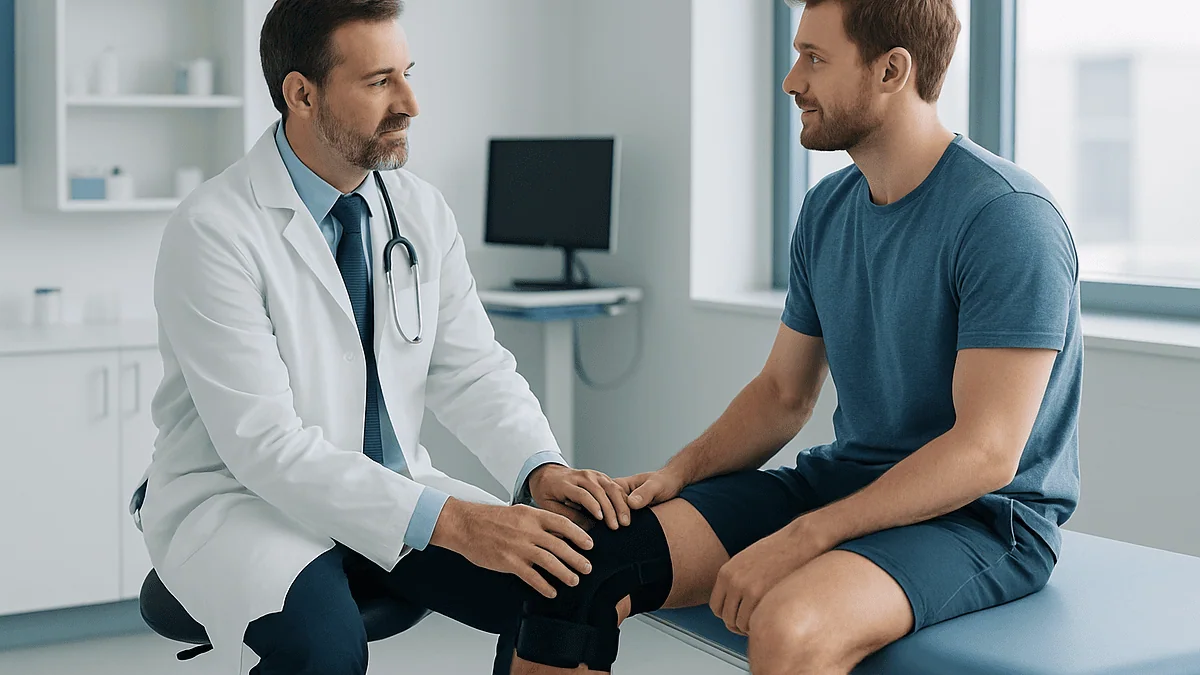
Is the knee mechanically unstable? On examination, the clinician gently pulls the shin forward against the thigh and feels for excess movement and a soft end point; a positive result on tests such as the Lachman or pivot-shift indicates the ligament is not doing its job. Just as important is your own account: how often the knee has given way, and during what activities. A knee that buckles during daily life is a much stronger candidate for reconstruction than one that only feels uncertain during a sprint.
What else is torn? The MRI, a scan that uses magnetic fields to picture soft tissue, is less about confirming the ACL tear, which the exam usually reveals, and more about checking the passengers. The Mayo Clinic notes that ACL tears are commonly accompanied by damage to the meniscus, the cartilage lining of the joint, or other ligaments. A repairable meniscal tear, a locked knee that will not straighten, or a tear of several ligaments together shifts the discussion toward surgery, because those structures often need fixing regardless and the ACL is addressed in the same operation.
What do you want the knee to do? This is the part patients sometimes underrate. Returning to soccer, basketball, skiing, netball or a physically demanding job that involves pivoting on uneven ground raises the odds that a knee without an ACL will eventually fail. Wanting to run, swim, cycle, hike and lift weights does not. Being honest about your real, likely future rather than an aspirational one is the most useful thing you can bring to the appointment.
Who copes without reconstruction: the profile of a "coper"
Sports-medicine researchers have a plain word for people whose knees function well without an ACL: copers. A coper is not someone with a milder tear; the ligament is usually completely ruptured. A coper is someone whose knee, muscles and nervous system adapt so that the missing ligament stops mattering for the things they do.
Several features tend to travel together in this group. Age is one, not because older tissue heals better, but because activity patterns change; the Mayo Clinic notes that non-surgical management is more commonly chosen by people who are less active or who do not play sports that involve cutting and pivoting. Straight-line athletes, runners and cyclists often do well. So do people whose knees stop giving way once the swelling settles and the quadriceps regain strength.
Clinicians sometimes use a screening approach after the acute phase: a person completes a short course of rehabilitation to restore motion and basic strength, then is assessed on how many giving-way episodes they have had, how confident they feel on the leg, and how they perform on single-leg hop tests compared with the uninjured side. Someone who reports no instability, hops nearly as far on the injured leg, and rates their knee as trustworthy is behaving like a coper and can reasonably continue without surgery under supervision.
Coping is not the same as ignoring. In the KANON trial, the rehabilitation-first participants followed a structured, supervised program lasting months, not a few stretches at home. The knee is protected by muscle, and muscle has to be built and maintained. A coper who stops training and returns to pivoting sports on an unprotected knee has changed categories, and the knee may remind them abruptly.
Who is usually offered surgery, and who is usually asked to wait
Some situations tilt the scales firmly toward reconstruction, and guidelines are consistent about them. A knee that continues to give way during ordinary daily activity after a proper course of rehabilitation is the classic indication; each episode risks fresh cartilage damage. Combined injuries, in which the ACL tears together with a repairable meniscus, the medial collateral ligament or the posterolateral corner, are commonly treated surgically because the other structures are more likely to heal well when the knee is stabilized. Young people who intend to return to high-level pivoting sport are also frequently offered reconstruction, given how often unprotected knees fail under those loads.
Equally important is who is asked to wait, because waiting is not the same as being denied. The NHS explains that reconstruction is usually delayed until swelling has gone down and the knee can move through a good range, typically a matter of weeks. Operating on a hot, stiff knee raises the risk of long-term stiffness, so a period of “prehabilitation” is standard even for people who will certainly have surgery. Children whose growth plates, the areas of soft bone at the ends of long bones where growth happens, are still open are managed with specialized techniques and often careful timing, a decision that sits squarely with a pediatric orthopedic team.
A third group is asked to wait for a different reason: to find out which group they belong to. For a recreational athlete in their thirties whose knee feels reasonably stable, three to six months of supervised rehabilitation is both a treatment and a diagnostic test. If the knee holds, surgery may never be needed. If it buckles, the case for reconstruction has made itself, and the muscle built along the way will speed the recovery afterward.
What ACL reconstruction actually involves, in plain language
Surgeons rarely stitch a torn ACL back together, because the frayed ends do not reliably heal. Instead, they rebuild it. Reconstruction means replacing the ligament with a graft, a strip of tendon taken from elsewhere in your own body or from a donor, and anchoring it in the position the original ligament occupied.
The operation is almost always arthroscopic, meaning it is performed through a few small incisions using a pencil-thin camera and slender instruments rather than a large open cut. MedlinePlus describes the common graft choices: a piece of the patellar tendon below the kneecap, hamstring tendons from the back of the thigh, or part of the quadriceps tendon above the kneecap. Each has trade-offs in donor-site soreness and strength characteristics, and the choice is a conversation to have with the surgeon rather than a matter of one being universally best. Tissue from a deceased donor, called an allograft, avoids harvesting your own tendon but may be selected differently for younger, higher-demand athletes.
Inside the joint, the surgeon removes the ruptured remnants, drills a narrow tunnel in the shinbone and another in the thighbone, threads the graft through and fixes it with screws or buttons. The graft then spends months slowly transforming, as your own cells populate it and it gradually takes on ligament-like properties. This biological timeline, not the wound healing, is why rehabilitation is measured in months.
Risks are real and worth stating neutrally. MedlinePlus and the NHS list infection, blood clots, persistent stiffness or loss of full motion, pain at the front of the knee, numbness near the incisions, graft stretching or re-rupture, and the general risks of anesthesia. Most people go home the same day or after one night. The surgery restores the ligament; it does not, on its own, restore the strength and confidence that let a person trust the knee again.
ACL rehab without surgery: what a real program looks like
Non-surgical treatment is easy to picture as “doing nothing.” It is closer to a part-time job. The programs studied in trials such as KANON and recommended by the NHS and Mayo Clinic are supervised by a physical therapist and progress through phases that map onto the healing knee.
The early phase, in the first weeks, is about calming the joint: reducing swelling, restoring full straightening and bending, and waking up the quadriceps, which often “switch off” reflexively after an injury. Quiet exercises such as tightening the thigh muscle with the leg straight, heel slides and gentle stationary cycling dominate.
The middle phase builds the muscles that will stand in for the ligament. Hamstring strength matters especially, because the hamstrings pull the shin backward and directly oppose the forward slide the ACL used to prevent. Squats, lunges, step-ups, leg presses and single-leg balance work appear here, progressed gradually in load and difficulty.
The later phase is where non-surgical rehab earns its reputation. Neuromuscular training teaches the nervous system to react faster: hopping and landing with control, changing direction on cue, catching a ball while balancing on one leg. The goal is that the muscles brace the knee before the shin has a chance to shift. Many people also learn to modify how they move, for example landing with more knee bend, which reduces stress on the joint.
Bracing sits in a gray area. A functional knee brace may provide reassurance and modest support during higher-risk activity, but the evidence that it prevents giving-way episodes on its own is limited, and guidelines do not present it as a substitute for strength. Timeframes vary, though supervised programs typically run for several months, and a person who is progressing but still experiencing instability at that point is usually re-evaluated for surgery.
Surgery versus structured rehabilitation: a side-by-side view
Laid next to each other, the two paths look less like winner and loser and more like two routes with different tolls. The table summarizes what mainstream guidance from the NHS, Mayo Clinic and MedlinePlus, together with the KANON trial, actually supports.
| Question | Reconstruction plus rehab | Rehab first, surgery only if needed |
|---|---|---|
| Who tends to be offered it | Knees that keep giving way; combined ligament or repairable meniscus injuries; return to pivoting sport | Stable-feeling knees; straight-line or lower-demand activity; people who prefer to avoid an operation |
| Knee function at two years in young active adults | Similar to the rehab-first group in KANON | Similar to the surgical group in KANON |
| Chance of a later change of plan | Low; surgery is already done | Roughly four in ten crossed over to surgery within two years in KANON |
| Typical time before pivoting sport | Around six months to a year (NHS) | Variable; many are advised to avoid pivoting sport unless the knee proves stable |
| Main risks | Infection, clots, stiffness, graft failure, anesthesia | Further giving-way episodes with possible meniscus or cartilage damage |
| Long-term arthritis risk | Increased after any ACL injury; not clearly prevented by surgery (Mayo Clinic) | Increased after any ACL injury |
Two rows deserve emphasis. The similar two-year outcomes are what allow a rehabilitation-first approach to be offered without guilt. The crossover rate is what keeps that approach honest: choosing rehab is not a one-time verdict but a plan with a built-in review, and a knee that fails the review has not wasted the time. The strength gained often shortens the recovery when surgery follows.
Neither column contains the phrase “back to normal.” Both paths aim to return people to a well-functioning knee, and both leave the joint with a history that deserves lifelong attention to strength and movement quality.
How long can a torn ACL go without surgery?
Indefinitely, for some people. Because the ligament does not heal, there is no window that closes on a stable knee, and no rule that says an untreated tear becomes surgical at a certain age or date. Plenty of people live full, active lives with an ACL torn decades earlier, either never diagnosed or deliberately managed without an operation.
The more useful question is how long a knee can go on giving way without consequences, and here the answer is shorter. Each instability episode is a moment in which the shin lurches forward and the joint surfaces grind or pinch. The meniscus is particularly vulnerable, and meniscal tears that accumulate over months of buckling are a common reason a person who initially chose rehabilitation is eventually advised to have surgery. Cartilage damage of this kind is a recognized contributor to the raised osteoarthritis risk seen after ACL injury.
Timing also matters from the other direction. The NHS describes a typical delay of a few weeks after injury before reconstruction so that swelling settles and motion returns, and trials such as KANON found that people who chose surgery later, after a period of rehabilitation, did not appear to fare worse than those who operated early. Delaying, in other words, is not the same as missing the boat. It becomes a problem only when delay is accompanied by repeated instability.
A practical way to think about it: the knee sets its own deadline. A knee that stays steady through daily life, work and chosen sport can continue without surgery for as long as it stays steady. A knee that buckles, especially more than once, is announcing that the muscles cannot fully cover for the ligament, and a discussion about reconstruction should not wait for the next episode. That judgment is one for the treating team, made with the person in front of them.
What the days and weeks after your decision usually look like
Whichever path is chosen, the early calendar looks remarkably similar, because both begin with the same swollen, protective knee. Timelines below are typical ranges drawn from NHS and MedlinePlus guidance, not promises, and individual recoveries vary widely.
After reconstruction, most people leave the hospital within a day, on crutches, with a knee that is sore and wrapped. The first two weeks focus on keeping swelling down, protecting the incisions, and, above all, regaining full straightening; a knee that cannot fully extend early tends to struggle later. Gentle bending, quadriceps activation and short walks are usually encouraged from the first days. Many people return to desk work within a couple of weeks and are walking without crutches somewhere in the first month, though the exact pace depends on the graft, any meniscal repair performed at the same time, and the surgeon’s protocol.
Between roughly six weeks and four months, strength work intensifies and the patterns of everyday life return: driving once the leg can react quickly, cycling, then straight-line jogging when the therapist judges the knee ready. The graft is still maturing during this period, which is why running is often introduced later than people expect and pivoting is off the table. The NHS gives around six months to a year as the usual range before a return to competitive pivoting sport, with formal testing of strength and hop performance often used to guide the decision.
Without surgery, the sequence is compressed at the front and open-ended at the back. Crutches are often needed only briefly, motion returns over a few weeks, and the strength and neuromuscular phases proceed as the knee allows. The review points, where clinicians ask about giving way and test function, are the milestones that matter most. Pain relief in either path is a conversation with the prescribing clinician, who will weigh it against your other health conditions.
Does surgery protect the knee long term? Arthritis, re-injury and honest uncertainty
Many people choose reconstruction believing it will prevent arthritis. The evidence does not support that belief in the clear way people hope. The Mayo Clinic states that people who have had an ACL injury are at higher risk of developing osteoarthritis in the knee regardless of whether they have surgery. The reasons are not fully understood but likely include the cartilage damage that happens in the original injury itself, changes in how the joint is loaded afterward, and any further damage from instability episodes.
What surgery can plausibly do is reduce the number of those instability episodes in a knee that would otherwise keep buckling, and therefore reduce the secondary damage they cause. That is a real benefit for the right person. It is a different claim from “surgery prevents arthritis,” and a careful surgeon will make the distinction.
Re-injury is the other long-term worry, and it cuts both ways. A reconstructed ligament can tear again, and the opposite knee is also at raised risk, particularly in young athletes who return to the sport that injured them. Non-surgically managed knees can suffer new meniscal or cartilage injuries during giving-way episodes. In both groups, the factors most consistently associated with staying healthy are the unglamorous ones: completing rehabilitation fully, meeting strength and hop criteria before returning to sport, and continuing prevention-style training that targets landing mechanics and hip and thigh strength. The Cleveland Clinic and Johns Hopkins both emphasize such programs as the best available protection.
Where the evidence is thin, it is fair to say so. Long-term randomized comparisons beyond five years are few, outcome measures differ between studies, and much of what is known comes from young athletes rather than the broader population of people who tear their ACL in everyday life. Anyone who promises a specific long-term outcome from either choice is speaking ahead of the data.
What people often get wrong about a torn ACL
“A complete tear means I have to have surgery.” The completeness of the tear on MRI does not decide treatment. Most tears that come to clinical attention are complete, and a large share of them are managed without an operation. Stability under load, associated injuries and your goals decide it, not the radiology report.
“A partial tear will heal if I rest it.” Partial ACL tear treatment is genuinely a gray area. Some partial tears leave enough intact fibers for a stable knee, and these are often managed with rehabilitation. Others behave like complete tears under examination. The label “partial” on a scan does not guarantee stability, and rest without strengthening does nothing to protect the joint.
“If I can walk on it, it can’t be torn.” Walking is one of the least demanding tasks for the ACL. Plenty of people walk into clinic with a fully ruptured ligament and a swollen knee, exactly as the Cleveland Clinic describes.
“Waiting to decide will ruin my chances.” Trial evidence suggests that people who start with rehabilitation and choose surgery later do not appear to end up worse off, provided the knee is not repeatedly giving way in the meantime. A few weeks of prehabilitation is standard even before planned surgery.
“Surgery gets me back to sport faster.” Reconstruction is the longer road in the short term, with return to pivoting sport typically taking six months to a year according to the NHS. What it offers the pivoting athlete is not speed but a knee more likely to tolerate cutting once that road is traveled.
“A brace fixes the problem.” A brace can offer support and confidence, but no brace reproduces the ligament, and none substitutes for the strength and reaction training that actually stabilize an ACL-deficient knee.
Questions to ask your care team before you decide
The most productive appointments are the ones where the patient arrives with their real life described honestly and a short list of questions that pin down the reasoning behind the recommendation. These are the ones that tend to move the conversation forward.
- On examination, how unstable is my knee, and how much of that is expected to improve once the swelling settles and my thigh strength returns?
- What else did the MRI show? Is there a meniscal tear, and if so, is it the kind that could be repaired or one that would be trimmed?
- Given the activities I actually plan to return to, how would you expect my knee to behave without a ligament?
- If I start with rehabilitation, what are the specific signs that would make you recommend surgery, and when would we formally review?
- If I have surgery, which graft would you suggest for me and why, and what are the trade-offs of the alternatives?
- What does your rehabilitation program look like in the first six weeks, and who supervises it?
- What criteria, such as strength testing or hop tests, do you use before clearing someone for running and for pivoting sport?
- Which complications do you see most often after this operation, and what would I watch for at home?
- What is my personal risk of re-injury, and what ongoing training would you recommend afterward?
- If I do nothing beyond rehabilitation, what is the realistic range of outcomes you have seen for people like me?
Notice that none of these questions asks the clinician to guarantee a result. Good answers will include ranges, conditions and uncertainty, because that is what the evidence contains. A clinician who invites this conversation, and who is willing to say “either path is reasonable for you,” is giving you the most accurate picture medicine currently has.
When to call your doctor: red flags after an ACL injury or surgery
Most knee injuries and most recoveries proceed without drama, but a short list of signs should prompt a same-day call to your treating team, or urgent care if they cannot be reached. This applies whether the knee has been operated on or not.
Seek urgent care if the knee is locked and cannot be fully straightened or bent, a pattern that can signal a displaced meniscal fragment caught in the joint. Call promptly if you cannot bear any weight on the leg, if the knee looks visibly deformed, or if the leg below the knee is numb, cold, pale or tingling, which can indicate a nerve or blood-vessel problem and is a medical emergency.
After surgery, the NHS and MedlinePlus advise contacting your team for a fever, spreading redness, warmth or foul-smelling discharge around the incisions, or pain that is escalating rather than easing. Calf pain, swelling or tenderness in one leg, especially with warmth, can indicate a blood clot; sudden shortness of breath, chest pain or coughing up blood may mean a clot has traveled to the lungs and requires emergency services immediately.
Less dramatic but still important: a knee that swells rapidly again after a new twist, a new giving-way episode during ordinary activity, or a sensation of the joint catching or clicking painfully should be reported at your next contact rather than waited out, because these can signal new cartilage damage that changes the plan.
Your care team has seen your knee and knows your history. When in doubt, calling is the right call; they would rather hear about a false alarm than learn about a missed complication later.
Frequently asked questions
How do you know if your ACL needs surgery?
Surgery is usually recommended when the knee keeps giving way after a proper course of rehabilitation, when other structures such as a repairable meniscus or additional ligaments are also torn, or when returning to cutting and pivoting sports is the goal. A physical examination of knee laxity, an MRI to check for associated injuries, and an honest discussion of your planned activities together guide the decision, which rests with your treating team.
How long can a torn ACL go without surgery?
There is no fixed deadline. A knee that stays stable through daily life and chosen activity can be managed without surgery indefinitely, since the ligament does not heal but the muscles can compensate. The concern is repeated giving-way episodes, each of which can damage the meniscus or cartilage. Trial evidence suggests people who start with rehabilitation and have surgery later do not appear to fare worse, provided instability has not been ignored.
What percent of ACL tears require surgery?
No reliable single figure exists, because “require” depends on the person’s goals and how the knee behaves. In the KANON trial of young active adults, roughly four in ten people who began with rehabilitation chose surgery within two years, meaning about six in ten did not. Among older or less active people, the proportion managed without surgery is generally higher, while among elite pivoting athletes reconstruction is far more common.
Can you walk with a torn ACL?
Yes, most people can walk with a completely torn ACL once the initial swelling eases, because walking places little rotational demand on the ligament. Limping in the first days is common and does not predict the long-term outcome. What matters is whether the knee gives way on stairs, curbs or turns; those episodes, rather than the ability to walk on flat ground, are what clinicians weigh when discussing surgery.
What does ACL rehab without surgery involve?
It is a structured, supervised program lasting several months, not rest. Early weeks focus on reducing swelling and restoring full motion; the middle phase builds quadriceps and especially hamstring strength, which directly opposes the forward slide the ACL prevented; the later phase trains balance, landing and rapid changes of direction so the muscles protect the knee reflexively. Regular reviews check for giving-way episodes and function, and persistent instability prompts reconsideration of surgery.
Is partial ACL tear treatment different from a complete tear?
Partly. Some partial tears leave enough intact fibers for a stable knee, and these are often managed with rehabilitation alone. Others behave like complete ruptures on examination, and the label on the MRI does not guarantee stability. Clinicians assess laxity and how the knee performs under load rather than relying on the scan description. Rest without strengthening protects neither type of tear, so supervised rehabilitation is the usual first step.
Does ACL surgery prevent arthritis later in life?
The evidence does not clearly show that it does. The Mayo Clinic notes that people who have had an ACL injury face a higher risk of knee osteoarthritis whether or not they have surgery, likely because of cartilage damage at the time of injury and altered joint loading afterward. Surgery may reduce further damage in a knee that would otherwise keep giving way, which is a narrower benefit than preventing arthritis outright.
How long after an ACL tear should surgery be done?
Reconstruction is usually delayed for a few weeks until swelling has settled and the knee moves through a good range, according to NHS guidance, because operating on a stiff, inflamed joint raises the risk of long-term stiffness. Many people complete a period of prehabilitation first. Beyond that, trials suggest delayed surgery after a trial of rehabilitation does not appear to worsen outcomes, as long as the knee has not been repeatedly buckling.
What graft is used in ACL reconstruction?
Surgeons rebuild the ligament using a tendon graft rather than stitching the torn ends. MedlinePlus lists common sources as a strip of the patellar tendon below the kneecap, hamstring tendons from the back of the thigh, the quadriceps tendon above the kneecap, or donor tissue known as an allograft. Each has trade-offs in donor-site soreness, strength and healing, and the choice is individualized between the surgeon and patient rather than one being universally best.
Can a torn ACL heal on its own without surgery?
A completely torn ACL generally does not heal back together, because it lies inside the joint with a limited blood supply and the torn ends retract and scar. What can happen is functional recovery: the surrounding muscles, other ligaments and the nervous system adapt so the knee becomes stable for a person’s activities. That is why non-surgical treatment is about building strength and control rather than waiting for the ligament to regrow.
References
This article is for general information only and is not a substitute for professional medical advice. Please consult a qualified doctor about your individual situation.

More from the Blog

Soft Tissue Injury Healing Stages: Why Sprains, Strains and Bruises Heal at Different Rates
Soft tissue injury healing time depends on what was damaged and how well it is supplied with blood. Bruises usually fade within about two…
What Happens Years After Meniscus Surgery? Cartilage Wear and Realistic Expectations
Years after meniscus surgery, the knee's future depends mainly on how much meniscus tissue was removed and how healthy the cartilage was beforehand. Partial…

Does a Sprain or Strain Need an MRI? When Imaging Adds to a Soft Tissue Injury Exam
Most sprains and strains do not need an MRI. Clinicians usually diagnose them by asking how the injury happened and examining the joint or…

Does Bursitis Come Back? Why Flares Recur and What Long-Term Results Usually Look Like
Yes, bursitis can come back. Most flares settle within a few weeks with rest, ice and reduced pressure on the area, but recurrence is…
Is Swelling After Ankle Arthroscopy Normal? What Helps and When to Call Your Team
Some swelling after ankle arthroscopy is expected and usually peaks in the first few days before easing over several weeks, because the joint is…
Preparing for Meniscus Surgery: The MRI Review, Fasting Rules and Medicine Checklist
Preparing for meniscus surgery usually involves three strands: an MRI review with your surgeon that clarifies whether the tear is likely to be trimmed…