

Does Ankle Impingement Need Surgery? Rehab and Injections First, Then Keyhole Surgery

Key Takeaways
- Ankle impingement is a pinching of soft tissue or bone between the shin bone and the ankle bone at the end of a movement, and most cases are managed without surgery.
- A bone spur on an X-ray or MRI is a finding, not a verdict; many active people have spurs that never cause symptoms.
- A structured rehab program usually runs several weeks to a few months before conservative care is judged to have failed, in line with soft-tissue healing timescales described by the NHS.
- A corticosteroid joint injection serves two purposes: it can ease inflammation for a period of months and it helps confirm that the pinched tissue is the true pain source.
- Keyhole surgery is typically a same-day procedure, but swelling, restricted activity and supervised physiotherapy usually continue for weeks afterward.
- The superficial peroneal nerve runs across the front of the ankle near the keyhole portals, which is why numbness on the top of the foot is a recognized risk of anterior arthroscopy.
Most people with ankle impingement do not need surgery. Clinicians usually begin with several weeks to months of activity changes and physiotherapy, sometimes adding an image-guided steroid injection. Keyhole (arthroscopic) surgery is generally considered only when pain and pinching persist despite proper rehab and imaging shows a clear mechanical cause. The decision rests with the treating orthopedic team.
A recreational midfielder in his thirties sits on the edge of a clinic couch, sock off, pointing to a spot just below the shin. Every time he plants and pushes off, something at the front of the ankle catches. The scan report mentions a bone spur. He has one question, and he asks it before the examination starts: does ankle impingement need surgery, or is this something he can work through?
It is a fair question, and the honest answer has a shape to it. Impingement is a pinching problem, not a broken-part problem, and pinching often settles when the joint is given time, better movement and, in some cases, a targeted injection. Surgery exists for the ankles that refuse to settle.
This explainer walks through that ladder in order: what impingement actually is, what rehab and injections do, who is offered keyhole surgery, and what recovery and risks look like when they are.
Does ankle impingement need surgery? The short answer
Not usually, and rarely as a first step. Orthopedic and sports medicine teams treat ankle impingement as a stepwise problem. The first rung is conservative care: reducing the movements that pinch, calming the irritated joint lining, and rebuilding the strength and control that let the ankle move without catching. Many people never climb higher than that.
The second rung is an injection into the joint, often used both to ease pain and to confirm that the pinching site really is the pain source. The third rung is arthroscopy, a keyhole operation in which a surgeon looks inside the joint with a small camera and removes the tissue or bone that is being trapped.
Why the order? Two reasons. Soft-tissue impingement, the kind that follows repeated sprains, often involves inflamed or scarred tissue that can quieten with time and rehab. The NHS notes that most sprains heal within about two weeks to a few months depending on severity, and the lingering thickened tissue that causes pinching frequently follows a similar, if slower, trajectory when it is no longer being irritated. Surgery also carries its own small but real risks, including infection, nerve irritation and blood clots, which are only worth accepting once simpler measures have had a fair trial.
What “a fair trial” means varies. A clinician will typically want to see a structured rehab program run for several weeks to a few months, not a fortnight of resting on the sofa, before calling conservative care a failure. The rest of this article explains each rung in enough detail that the conversation with your own team makes sense.
What is ankle impingement, and why does the ankle pinch?
Impingement means something is being squeezed where it should not be. In the ankle, that squeeze happens between the tibia (the shin bone) and the talus (the dome-shaped bone that sits beneath it) at the extreme of a movement.

Anterior impingement occurs at the front of the joint. When you pull the toes up toward the shin, a movement called dorsiflexion, the front edge of the tibia and the top of the talus come close together. If inflamed joint lining, scar tissue or a bony outgrowth is sitting in that gap, it gets pinched. Deep squats, lunging, going downstairs and the plant-and-push of sports all reproduce it.
Posterior impingement is the mirror image, at the back of the ankle when the foot points hard downward. Ballet dancers working on pointe and footballers striking the ball are the classic examples. Sometimes a small accessory bone called the os trigonum, present in a minority of people from birth, sits in exactly the wrong place.
Two mechanisms feed the problem. Repeated ankle sprains leave the joint capsule and ligaments thickened and scarred, and that bulk gets caught with every deep bend. Repetitive forced dorsiflexion, common in kicking sports, encourages the bone to lay down small spurs (osteophytes) along the front rim of the joint over years.
The distinction matters for treatment. Inflamed soft tissue can shrink. Bone cannot, but a bone spur is only a problem if it is actually being trapped and the surrounding tissue is irritated, which is why two people with similar X-rays can have very different symptoms, and why imaging alone never decides whether surgery is needed.
Anterior ankle impingement treatment: what rehab actually involves
Rehab for impingement is not the same as resting a sprain. Rest reduces irritation; it does not fix the movement pattern that produced the pinching. A good program does both, usually under a physiotherapist.
The first phase is relative rest. That means avoiding the end-range positions that reproduce the catch, not stopping all activity. A runner might keep cycling; a dancer might keep barre work while pausing pointe. Ice and elevation help the swollen lining calm down, the same principles MedlinePlus describes for sprain aftercare. Some clinicians suggest a small heel lift in the shoe for a few weeks in anterior cases, because raising the heel keeps the front of the joint slightly open during walking.
Once the joint is quieter, the emphasis shifts to restoring motion. Stiff calf muscles are a common contributor; when the calf will not lengthen, the body borrows extra dorsiflexion from the joint itself, jamming the front edge. Calf stretching and gentle joint mobilization aim to spread the movement demand more evenly.
The third phase is strength and control. Ankles that have been sprained repeatedly often lose proprioception, the sense of joint position that lets muscles react before the joint rolls. Balance drills on one leg, progressing to unstable surfaces, and strengthening of the peroneal muscles along the outside of the shin rebuild that protective reflex.
Finally comes a graded return to sport, adding the specific movements that were painful in small doses and monitoring the response. Clinicians commonly allow several weeks to a few months for this whole sequence before judging whether it has worked, consistent with the soft-tissue healing timescales the NHS describes. Skipping phases tends to bring the pinch straight back.
Do ankle impingement exercises actually work if there is a spur?
This is where people understandably get skeptical. If a bone spur is sitting on the front of the joint, how can stretching a calf muscle change anything? The spur, after all, is still there afterward.
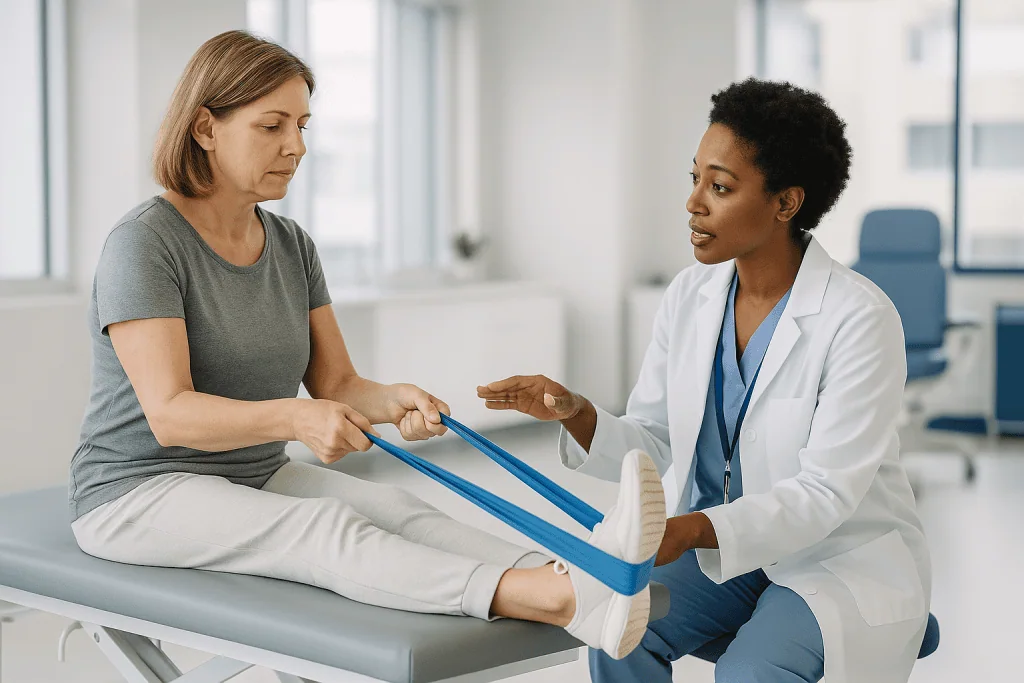
The answer lies in what causes pain. A spur itself has no nerve supply worth mentioning. The pain comes from the soft tissue trapped against it: inflamed synovium (the joint’s lining), thickened capsule, or a fold of scar. Exercises work on that tissue and on the way the joint is loaded, not on the bone.
Three things change with a well-run program. Swelling in the joint lining decreases, so there is less bulk to trap. Movement is redistributed, so the ankle stops being pushed into the exact end-range position where the pinch happens; better calf length and hip and knee control both contribute here. Muscle reaction time improves, so the joint is less likely to be driven suddenly into that position during sport.
Does this mean exercises “work” for everyone? No, and it would be misleading to say so. People whose pinching is dominated by a large, firmly placed spur, or by a loose fragment of bone, are less likely to get lasting relief from rehab alone, and their clinicians may move to imaging-guided injection or surgical discussion sooner. The evidence base for impingement rehab is largely observational rather than from large randomized trials, which is why guidance describes a trial of conservative care rather than promising a result.
What the evidence does support is the order. A joint that has been properly rehabilitated and still catches gives a surgeon a much clearer picture than one that was never given the chance, and the same strength and control work will be needed after any operation anyway.
What is an ankle impingement injection, and how does it help?
An injection is the middle rung of the ladder, and it does two jobs at once.
The procedure itself is brief. A clinician, often using ultrasound or X-ray guidance to be sure the needle is in the joint, injects a mixture of a corticosteroid and a local anesthetic into the space where the pinching happens. Corticosteroids are a class of anti-inflammatory medicine that reduce the swelling and irritability of the synovium. The local anesthetic numbs the area for a few hours.
Job one is diagnostic. If the ankle feels dramatically better while the anesthetic is working, that is strong evidence that the pinched tissue is indeed the pain source rather than, say, a nearby tendon or the joint cartilage. Surgeons find this reassuring before operating, because it predicts that removing the trapped tissue is likely to address the right problem.
Job two is therapeutic. The Mayo Clinic notes that relief from a corticosteroid joint injection, when it comes, tends to last for a period of months rather than permanently. For some people that window is enough: the lining calms, rehab progresses without pain, and the problem does not return. For others the pinch comes back as the effect fades.
Injections have limits. Repeated steroid injections into the same joint raise concerns about cartilage and nearby tendon health, so clinicians restrict how often they are offered. A brief flare of pain in the first day or two, temporary skin changes at the site and a small infection risk are the recognized downsides, again per the Mayo Clinic. People with diabetes may notice a temporary rise in blood glucose. Whether an injection is appropriate, and how many times, is a judgment for the treating clinician.
Who is usually offered keyhole surgery, and who is asked to wait?
Surgeons are looking for a particular combination before they recommend arthroscopy for impingement, and its absence is the commonest reason someone is asked to keep going with conservative care.
People commonly offered surgery share several features. Their symptoms have persisted despite a properly completed rehab program, usually over several months. Examination reproduces the pain at the front or back of the joint exactly where imaging shows a spur, thickened capsule or accessory bone. A diagnostic injection into the joint temporarily relieved the pain, pointing to the pinched tissue as the culprit. The rest of the joint cartilage looks reasonably healthy on imaging, so removing the obstruction is likely to leave a joint that functions well. Their goals, whether returning to sport or simply walking downstairs without catching, are realistic for what the operation can do.
People commonly asked to wait fall into a few groups. Anyone whose sprain or flare is recent, because the tissue may still settle on its own. Anyone who has had rehab that was brief, unsupervised or focused only on rest. Anyone whose ankle shows widespread arthritis, because a spur removal does not address worn cartilage and may disappoint. Adolescents whose bones are still growing, where the picture is often different and surgeons are more cautious. People with medical factors that raise surgical risk, such as poorly controlled diabetes, active smoking or circulation problems, who may be asked to address those first.
None of these are absolute rules. A professional athlete mid-season and a retired walker with the same scan may reasonably be given different advice, because the balance of risk and benefit differs. That balance is the treating team’s to weigh with the person in front of them.
How keyhole ankle surgery works: what actually happens
Arthroscopy means looking inside a joint through a narrow tube fitted with a camera. For ankle impingement, it is the standard surgical approach because it lets the surgeon see and remove trapped tissue through cuts a few millimeters long rather than opening the joint.
On the day, the operation is usually done under a general anesthetic, sometimes combined with a regional nerve block that numbs the leg for several hours afterward. The Mayo Clinic describes arthroscopy as typically an outpatient procedure, meaning most people go home the same day. A soft strap or traction may be used to open the joint space slightly so the instruments fit.
Two small incisions are made at the front of the ankle for anterior impingement, placed to avoid the superficial peroneal nerve that runs across the top of the foot. Sterile fluid is pumped in to expand the joint and give a clear view. Through one portal the surgeon inserts the camera; through the other, fine instruments.
What gets removed depends on what is found. Inflamed or scarred synovium is trimmed with a small shaver. A bone spur on the tibia or talus is shaved back with a burr until the joint can reach full dorsiflexion without contact. Loose fragments are retrieved. For posterior impingement the portals sit either side of the Achilles tendon, and an os trigonum, if present and symptomatic, may be removed.
The surgeon then moves the ankle through its range under direct vision to confirm nothing still catches, drains the fluid, closes the portals with a stitch or two and applies a padded dressing. The whole procedure commonly takes under an hour, though times vary with what is found inside.
Rehab, injection or surgery: how the options compare
Seeing the three rungs side by side makes the logic of the ladder clearer. The table below summarizes what each option is trying to do, who it tends to suit and what it asks of the person having it. Timeframes are typical ranges reported in patient guidance, not promises.
| Option | What it targets | Usually offered to | Typical time commitment | Main trade-offs |
|---|---|---|---|---|
| Structured rehab | Swollen joint lining, stiff calf, poor joint control | Almost everyone as a first step | Several weeks to a few months of supervised exercise (NHS soft-tissue healing guidance) | Requires consistency; does not remove bone; may not suffice if a large spur dominates |
| Image-guided steroid injection | Inflammation of the joint lining; confirms pain source | Those still pinching after initial rehab, or before surgical decision | Minutes to perform; relief measured in months when it occurs (Mayo Clinic) | Temporary; limits on repetition; small infection risk; brief flare possible |
| Arthroscopic (keyhole) surgery | Physically removes spur, scar or accessory bone | Persistent symptoms after fair conservative trial, with matching imaging and exam | Same-day procedure; weeks to months of recovery and rehab (Mayo Clinic) | Surgical risks including infection, nerve irritation, clots, stiffness; not all pain guaranteed to resolve |
A few things stand out. Rehab is not a rival to surgery; it is a prerequisite and then a follow-up to it. Injection sits in the middle partly because it informs the surgical decision, not just because it eases pain. Surgery is the only option that changes the bone, which is why it is reserved for ankles where bone is clearly the problem.
The other consistent theme is that none of the three is a shortcut. Each demands weeks of work from the person, and the total time from first pinch to confident return is often measured in months whichever route is taken.
Ankle impingement surgery recovery time: the first days and weeks
People are often surprised by how ordinary the first week after keyhole ankle surgery is, and by how long the later stages take.
The first two or three days are about swelling control. The ankle is bulky in its dressing, the regional block wears off within hours, and the Mayo Clinic’s general arthroscopy guidance applies: keep the leg elevated above heart level as much as possible, use ice as instructed, keep the dressing clean and dry, and take pain relief as prescribed by the surgical team. Most people can put weight through the foot with crutches or a supportive boot early, but the exact instruction depends on what was done inside and comes from the surgeon.
By the end of the first week, the portals are usually checked and the bulky dressing exchanged for something lighter. Gentle range-of-motion exercises typically start early, because the point of the operation was to allow full movement and a joint left still will stiffen. Desk-based work is often possible within days once the leg can be kept raised; standing jobs take longer.
Driving depends on which ankle was operated on, whether a boot is still needed and whether the person can perform an emergency stop comfortably, a point the Mayo Clinic makes for arthroscopy generally. Insurers have their own rules too.
From about week two onward, formal physiotherapy resumes, and it looks a lot like the pre-operative program: calf flexibility, strength, balance and then sport-specific drills. Return to running and cutting sports is usually measured in weeks to a few months rather than days, and varies with the amount of bone removed and the sport. Swelling that lingers for several weeks is common and not by itself a sign of trouble, though the red flags in the final section always apply.
What are the risks of ankle arthroscopy?
Keyhole is not the same as risk-free, and a good consent conversation covers the downsides in the same neutral tone as the upsides. The Mayo Clinic lists the general complications of arthroscopy, and several have particular relevance at the ankle.
Nerve irritation is the one ankle surgeons think about most. The superficial peroneal nerve crosses the front of the ankle close to where the anterior portals are placed. Bruising or stretching of it can leave a patch of numbness or tingling on the top of the foot. This often settles over weeks to months, but in a small number of people it persists.
Infection at the portals or, less commonly, inside the joint can occur with any operation. Signs to watch for are covered in the final section.
Blood clots in the calf (deep vein thrombosis) are a recognized risk after any lower-limb surgery, made more likely by immobility. Surgeons weigh each person’s risk factors and may advise early movement, compression or a preventive medicine; those decisions are individualized.
Stiffness can develop if the joint is not moved early enough, which is one reason rehab starts quickly.
Incomplete relief is a possibility that deserves plain acknowledgment. If some of the pain was coming from worn cartilage rather than the pinched tissue, removing the spur will not address it. Spurs can also slowly re-form over years in people who continue the same repetitive loading.
Rarer problems include bleeding into the joint, damage to cartilage from the instruments and reactions to anesthesia. None of this is a reason to avoid an operation that is clearly indicated; it is the reason surgeons wait until it clearly is.
What people often get wrong about ankle impingement
Because impingement is common in sporty populations, a lot of confident advice circulates in changing rooms. Some of it is wrong in ways that cost people months.
“If there is a spur, it has to come out.” Bone spurs on the front of the ankle are frequent in people who have played kicking sports for years, and many of them cause no symptoms at all. A spur is an indication for surgery only when it is demonstrably the thing being pinched and the pinch has not responded to conservative care.
“Rest will sort it.” Complete rest calms the lining, but the moment the person returns to the same movements with the same stiff calf and weak stabilizers, the pinch returns. Rest is a phase of rehab, not a substitute for it.
“The injection fixed it.” An injection can create a pain-free window, and that window is valuable for doing the rehab. Treated as a stand-alone solution, its effect tends to fade over months, as the Mayo Clinic’s guidance on corticosteroid injections describes.
“Keyhole means minor.” The incisions are small; the recovery is not trivial. Swelling, restricted activity and structured physiotherapy for weeks are the norm, and the nerve and clot risks are genuine.
“Surgery means back to sport.” It often allows it, but it does not guarantee it, particularly when cartilage wear coexists with the spur. Surgeons are careful not to promise outcomes, and patients are wise to be equally careful about expecting them.
“The MRI decides.” Imaging shows structure, not pain. Examination, response to rehab and, often, a diagnostic injection carry as much weight in the decision as any scan.
Does ankle impingement need surgery if the scan shows a bone spur?
This is probably the single most common version of the question, because scan reports are blunt documents and the word “osteophyte” sounds like a verdict.
It is not. A bone spur appearing on an X-ray or MRI is a finding, not a diagnosis of a problem requiring treatment. In people who have spent years running, kicking or dancing, small anterior spurs are frequently discovered incidentally when the ankle is imaged for something else. The joint has simply adapted its rim to repeated loading.
What turns a spur into an impingement problem is the soft tissue around it becoming inflamed and repeatedly caught. That inflammation is exactly what rehab and injection target, and if it settles, the spur can sit there indefinitely without complaint. Clinicians will therefore usually run the conservative pathway even when the report reads alarmingly.
There are circumstances in which the spur changes the calculation. A very large spur that physically blocks dorsiflexion so the joint cannot reach the range the person needs. A spur that has broken off and is floating as a loose fragment, which tends to catch unpredictably. A posterior accessory bone in a dancer who cannot achieve the pointe position required for their work. In these situations, a surgeon may reasonably move toward arthroscopy after a shorter conservative trial, because the obstruction is mechanical rather than inflammatory.
Even then, the decision is rarely made on imaging alone. Surgeons look for concordance: the place the person points to, the position that reproduces the pain on examination, the spot the scan highlights and the site the diagnostic injection numbed should all agree. When they do, surgery has a clear target. When they do not, a spur on a report is not enough.
Questions to ask your care team
Consultations are short and the terms are unfamiliar, so it helps to walk in with questions written down. These are the ones that tend to move the conversation forward.
- Is this anterior or posterior impingement, and is it mostly soft tissue, bone or both?
- What in my examination and imaging points to the pinched area as the source of my pain?
- What would a proper conservative trial look like for me, how long should it run, and how will we judge whether it has worked?
- Would an image-guided injection help clarify the diagnosis in my case, and what are its downsides for me specifically?
- If surgery is discussed, what exactly would you remove, and what would you leave alone?
- Does my joint show any cartilage wear that might limit what surgery can achieve?
- What are the risks that apply particularly to me, given my health, medicines and activity?
- What would the first two weeks after surgery involve day to day, and when could I bear weight, drive and work?
- What does the rehab program after surgery involve, and who supervises it?
- What is a realistic timeframe for returning to my sport or activity, and what might delay it?
- What would make you want to see me urgently after the operation?
Write the answers down or bring someone to listen. Ask, too, what the team would advise if you chose to wait. A good surgeon will describe both paths without pressure, because the choice between continuing rehab and proceeding to keyhole surgery is a shared one, made with the treating team and revisited as the ankle responds.
If anything remains unclear after the appointment, most services have a nurse or physiotherapist you can contact before the next step is booked.
When to call your doctor
Ankle impingement is a nuisance condition, not usually a dangerous one, but there are situations in which waiting for the next routine appointment is the wrong move.
Before any surgery, seek medical assessment promptly if the ankle becomes suddenly hot, red and markedly swollen without a clear injury, if you cannot put any weight through it after a twist, if the joint locks so it will not move at all, or if there is numbness or a change in color in the foot. These can signal a fracture, a joint infection or a circulation problem rather than simple impingement, and the NHS advises urgent assessment for a joint that cannot bear weight or looks deformed.
After an injection, contact the clinic if pain escalates rather than briefly flares and settles, if the joint becomes hot and red, or if you develop a fever. Infection after a joint injection is uncommon but needs quick treatment.
After keyhole surgery, the Mayo Clinic’s arthroscopy guidance lists the warning signs that warrant a same-day call: a fever, pain that is worsening rather than easing despite prescribed relief, increasing redness, warmth or discharge from the portals, the dressing becoming soaked, and new or worsening numbness or tingling in the foot. Swelling, pain or tenderness deep in the calf, or the calf becoming warm and red, could indicate a blood clot and should be assessed the same day. Sudden breathlessness or chest pain is an emergency; call emergency services.
In every case, the treating team decides what to do next. If you are unsure whether a symptom counts, the safest course is to call and describe it; clinics would far rather hear from you about something minor than miss something serious.
Frequently asked questions
Does ankle impingement need surgery if physiotherapy has not worked yet?
Not necessarily; the first question is whether the rehab was long enough and complete. Clinicians usually want to see a supervised program covering swelling control, calf flexibility, strength and balance over several weeks to months before concluding it has failed. If that has genuinely happened and the pain still matches imaging findings, an injection or surgical discussion becomes reasonable. Your treating team makes that call.
What is the typical ankle impingement surgery recovery time?
Recovery is usually described in weeks to a few months rather than days, per general arthroscopy guidance from the Mayo Clinic. The operation itself is typically same-day, swelling settles over the first weeks, desk work is often possible within days, and return to running or cutting sports takes longer. Your surgeon sets the individual timeline based on what was removed.
Are ankle impingement exercises safe to do at home?
Gentle exercises prescribed by a physiotherapist are usually safe and form the core of treatment. Exercises should avoid forcing the ankle into the exact end-range position that reproduces the pinch, at least early on. Because the right program depends on whether the impingement is anterior or posterior and on what else the ankle has been through, it is best to have it set up and reviewed by a clinician rather than copied from a video.
How long does an ankle impingement injection last?
When a corticosteroid injection helps, the Mayo Clinic describes relief lasting a period of months rather than permanently. The local anesthetic in the mixture numbs the joint for a few hours, which is what gives the injection its diagnostic value. Clinicians limit how often the same joint is injected because of concerns about cartilage and nearby tendons; the frequency is a decision for the treating clinician.
What is the best anterior ankle impingement treatment?
There is no single best option; treatment follows a ladder. Structured rehab comes first for almost everyone, an image-guided injection may be added if pinching persists or to confirm the diagnosis, and keyhole surgery is considered when symptoms continue despite these and imaging shows a clear mechanical cause. Which rung is right depends on your examination, imaging and goals, assessed by your care team.
Can ankle impingement go away on its own?
Soft-tissue impingement following a sprain can settle as the inflamed lining calms, particularly if the aggravating movements are reduced. The NHS notes that sprain-related tissue healing takes roughly two weeks to a few months depending on severity. Bone spurs do not disappear, but they only cause trouble when surrounding tissue is irritated, so symptoms can resolve even though the spur remains.
Is keyhole ankle surgery done under general anesthetic?
Usually, yes, often combined with a regional nerve block that numbs the leg for several hours afterward and eases early pain. Some centers use regional anesthesia alone. The Mayo Clinic describes arthroscopy as typically an outpatient procedure, so most people go home the same day. The anesthetic plan is agreed with the anesthesia team beforehand and takes your health history into account.
What are the main risks of arthroscopy for ankle impingement?
The recognized risks include infection, bleeding, blood clots in the leg, stiffness and reactions to anesthesia, as listed in the Mayo Clinic’s arthroscopy guidance. Specific to the ankle, irritation of the superficial peroneal nerve can cause numbness or tingling on top of the foot, which often improves but can persist. Incomplete pain relief is also possible if cartilage wear was contributing to symptoms.
Will a bone spur grow back after ankle impingement surgery?
It can, slowly, over years, particularly in people who return to the repetitive forced-dorsiflexion loading that produced it in the first place. Spur regrowth does not automatically mean symptoms return, because pain depends on whether surrounding tissue is being pinched. Maintaining calf flexibility, strength and good movement control after surgery is thought to reduce the chance of the problem recurring, though evidence here is observational.
When should I see a doctor about a catching feeling at the front of my ankle?
See a clinician if the catching or pain has persisted beyond a few weeks, is limiting sport or daily activity, or follows repeated sprains. Seek urgent assessment if the ankle is hot, red and swollen without injury, cannot bear weight, locks completely or shows numbness or color change, since these may indicate fracture, infection or a circulation problem rather than impingement.
References
This article is for general information only and is not a substitute for professional medical advice. Please consult a qualified doctor about your individual situation.

More from the Blog

When Can You Return to Sport After ACL Reconstruction? Why Tests Decide, Not the Calendar
Return to sport after ACL reconstruction is usually decided by passing objective tests rather than by reaching a date. Most rehabilitation guidance points to…

Why Surgeons Ask You to Stop Smoking Before Rotator Cuff Repair: Tendon Healing Explained
Surgeons ask patients to stop smoking before rotator cuff surgery because nicotine narrows small blood vessels and carbon monoxide displaces oxygen, starving the repaired…

Flying Home After Cruciate Ligament Surgery: Clot Precautions, Bracing and Timing
Most people can fly after ACL surgery once the surgical team has confirmed that swelling is settling, the wound is healing and clot risk…
How Arthroscopy Works: The Camera, the Portals and What Surgeons Can Fix Through Keyholes
Arthroscopy works by passing a pencil-width tube with a light and a video camera into a joint through an incision a few millimetres long,…

Soft Tissue Injury Healing Stages: Why Sprains, Strains and Bruises Heal at Different Rates
Soft tissue injury healing time depends on what was damaged and how well it is supplied with blood. Bruises usually fade within about two…

What Happens Years After Meniscus Surgery? Cartilage Wear and Realistic Expectations
Years after meniscus surgery, the knee's future depends mainly on how much meniscus tissue was removed and how healthy the cartilage was beforehand. Partial…