

Does Laser Liposuction Hurt? Anesthesia Options and Managing Soreness in the First Days

Key Takeaways
- Laser liposuction is still surgery with incisions, a heated fiber and suction; the laser loosens fat but does not make the procedure or the recovery painless.
- Under tumescent local anesthesia, the expected sensations are pressure, warmth and tugging; a sharp spot means more anesthetic is needed and should be reported immediately.
- Soreness typically peaks within the first 2 to 3 days and eases over 1 to 2 weeks, while swelling settles over several weeks and the final contour emerges over months.
- The heat from laser-assisted liposuction adds a burn risk that suction-only techniques do not carry, according to the Mayo Clinic.
- Surgeons generally cap removal at about 5 liters, roughly 11 pounds, per session for safety, and awake laser sessions usually remove far less.
- Liposuction removes only pinchable subcutaneous fat, so deep visceral belly fat, loose skin and cellulite do not change with the procedure.
Laser liposuction is usually done under local anesthesia, so most people feel pressure, warmth and tugging rather than sharp pain during the procedure. Soreness afterward is common and is often compared to a deep bruise or a hard workout, typically peaking in the first 2 to 3 days and easing over 1 to 2 weeks. Pain that worsens, spreads or comes with fever needs prompt medical review.
The consult is over, the paperwork is signed, and now the question that nobody quite asked out loud is sitting on the kitchen table at ten at night: does laser liposuction hurt? Not the brochure version. The real one. Will you feel the cannula? Will you be able to sleep on your side? Will the compression garment feel like a hug or a vice?
Those are fair questions, and the honest answers are more specific than “a little discomfort.” Laser liposuction is a surgical procedure, even when it happens in an office rather than an operating theater. Small incisions, a thin laser fiber, suction. Nerves are involved. Fluid is involved. So is a stretch of days when getting out of a chair takes some planning.
What follows is a plain account of what people commonly feel at each stage, what the anesthesia choices actually change, and what the early days of soreness usually look like, drawn from mainstream medical sources rather than testimonials.
Does laser liposuction hurt? The short, honest answer
For most people the answer splits into two parts: during, and after. During the procedure, laser liposuction is typically performed with the treatment area numbed by local anesthesia, sometimes with a sedative to keep you relaxed. The Mayo Clinic describes laser-assisted liposuction as a technique that uses high-intensity laser light to break down fat before it is removed through a small tube, and notes that liposuction of this kind can be done under local or general anesthesia depending on the area and the amount of fat involved. With the area numb, people commonly report pressure, a pushing or scraping sensation, warmth from the fiber, and occasional sharp twinges where the numbing is thinner. Sharp, sustained pain is not the expected experience, and it is a signal to tell the team so more anesthetic can be placed.
After the procedure, soreness is the rule rather than the exception. The NHS lists pain, bruising, swelling and numbness as expected after liposuction, and the Mayo Clinic describes swelling that typically settles over a few weeks. The sensation most people describe is a deep muscular ache, tender skin and a feeling that the treated area has been worked hard. It is usually at its worst in the first 2 to 3 days and then steps down.
Where does the laser fit into this? It is a tool for loosening fat and, in theory, encouraging some skin tightening through heat. It does not make the procedure painless, and it introduces a risk that suction-only techniques do not have: the Mayo Clinic specifically notes that heat from laser-assisted liposuction can cause burns. Whether this technique ends up feeling gentler than traditional liposuction depends far more on the anesthesia plan, the surgeon’s technique and the size of the area than on the word “laser” in the name.
What actually happens during laser liposuction
Picture the treatment area as a sponge that needs to be softened before it can be squeezed. The procedure starts with the surgeon marking the zones to be treated while you stand, because fat sits differently when you lie down. Once you are on the table, the skin is cleaned and numbed.
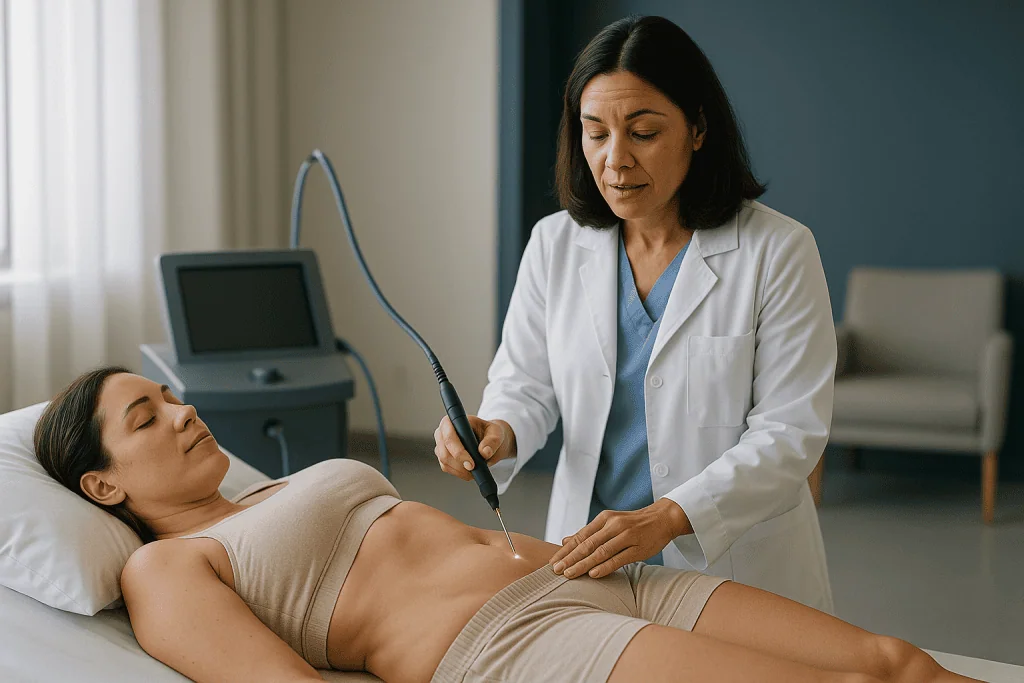
Next comes the fluid. Most laser liposuction uses the tumescent technique. Tumescent simply means “swollen”: a large volume of dilute solution containing a local anesthetic and a medicine that narrows blood vessels is infused into the fat until the area feels firm. MedlinePlus explains that this fluid numbs the tissue, reduces bleeding and makes the fat easier to remove. The infusion itself is often the most noticeable moment, felt as pressure, stinging or a spreading cold sensation before the numbing takes hold.
Then the laser. A fiber about the width of a piece of spaghetti is threaded through an incision a few millimeters long. Energy from the fiber heats and ruptures fat cells and coagulates small vessels. You may feel warmth and a rhythmic back-and-forth motion. The surgeon watches skin temperature closely, because too much heat on the underside of the skin is what causes burns.
Finally, suction. A thin cannula, which is a hollow tube attached to a vacuum, removes the liquefied fat and some of the fluid. This is the tugging stage. The NHS notes that the procedure can take 1 to 3 hours depending on how many areas are treated. Incisions are sometimes left partly open to let fluid drain, then dressings and a compression garment go on before you leave.
Is laser lipo painful during the procedure? What each stage feels like
People remember procedures as scenes, not as a single rating out of ten, so it helps to walk through the scenes.
The numbing injections at the incision sites feel like any dental or dermatology injection: a sting for a few seconds. The tumescent infusion is different in character. Because a lot of fluid goes in, the area can feel tight, heavy or achy, and some people describe a burning or cramping wave that passes as the anesthetic spreads. This phase is often the most uncomfortable part of an awake procedure, and it is also brief relative to the whole session.
Once the tissue is numb, the laser phase is mostly sensation without pain: warmth, sometimes a distinct hot spot that you should mention immediately, and a sense of movement under the skin. The suction phase brings tugging, vibration and pressure. Certain places are more sensitive than others. Areas close to bone, such as the flanks over the hip or the inner knee, and areas with dense fibrous fat, such as the upper back, tend to produce more twinges. The under-chin area is often quoted as one of the more tolerable zones because the volume is small and the session is short.
Two things matter more than the technique. The first is communication: an awake patient who says “that spot is sharp” gets more anesthetic placed there. The second is the anesthesia plan agreed beforehand. The Cleveland Clinic notes that liposuction may be performed with local anesthesia, sedation or general anesthesia, and that the choice depends on how much fat is being removed and the areas involved. If you know you are anxious or have a low tolerance for sustained pressure, that is a conversation to have before the day, not during it.
Anesthesia options for laser liposuction: local, sedation and general
Anesthesia is the single biggest lever on how the procedure feels, and it is decided with the team rather than picked from a menu. The main approaches, as described by the Cleveland Clinic and MedlinePlus, differ in what you feel, how alert you are and how you recover in the hours afterward.

| Approach | What it involves | What you typically feel | Usually considered when |
|---|---|---|---|
| Local (tumescent) only | Dilute local anesthetic infused into the fat; you are awake | Pressure, warmth, tugging; occasional sharp spots that can be re-numbed | Small to moderate areas; patient comfortable being awake |
| Local with sedation | Tumescent fluid plus an oral or intravenous medicine to relax you | Drowsy, less aware of time; sensations dulled | Larger areas, anxiety, or longer sessions |
| General anesthesia | You are fully asleep; airway managed by an anesthesia professional | Nothing during the procedure; grogginess, sore throat or nausea afterward are possible | Multiple or extensive areas; combined procedures |
Each carries trade-offs. Local anesthesia avoids the systemic effects of general anesthesia and lets you walk out the same day, but the tumescent solution has its own limit: the Mayo Clinic lists lidocaine toxicity among liposuction risks, which is why the volume of fluid caps the size of a purely awake session. Sedation smooths anxiety but requires someone to drive you home and monitor you. General anesthesia removes all awareness but brings the standard anesthetic risks that the Cleveland Clinic outlines, including nausea and, rarely, breathing or heart complications.
Which is “least painful”? During the procedure, general anesthesia, by definition. In the days afterward, the anesthetic type matters far less than the amount of tissue treated; a large area done asleep will ache more the next day than a small area done awake.
Laser lipo vs traditional liposuction: is it really less painful?
The marketing framing puts laser on one side and “traditional” on the other, as if one were a scalpel and the other a spa treatment. The medical framing is more modest. The Mayo Clinic lists several liposuction techniques, tumescent, ultrasound-assisted, laser-assisted and power-assisted, and describes them as variations on the same core operation: fluid, a cannula and suction. Laser and ultrasound both pre-treat the fat with energy; power-assisted uses a vibrating cannula to reduce the force the surgeon has to apply.
Does the laser make the procedure hurt less? The honest answer is that comparative evidence is limited, and the major patient-information sources do not claim a pain advantage for one technique over another. The plausible mechanism for less soreness is that liquefied fat needs less mechanical force to remove, which could mean less trauma to surrounding tissue and smaller bruises. Against that sits the heat, which can inflame tissue and, as the Mayo Clinic notes, cause burns if the fiber lingers.
A more useful comparison is between anesthesia plans and treatment sizes, because those drive the experience. A small awake session, whatever the tool, tends to produce mild soreness that peaks within a few days. A large session under general anesthesia produces more swelling and a longer recovery regardless of whether a laser was used. The NHS advice on recovery, including time off work and weeks of compression, is written for liposuction generally and does not carve out a shorter path for laser techniques.
What laser liposuction is not: it is not the same as non-invasive fat reduction, the devices that cool or heat fat from outside the skin without incisions. Those are genuinely different procedures with different sensations and different, more modest, expectations. Confusing the two is a common source of surprise on the day.
Who laser liposuction is usually for, and who is usually asked to wait
Liposuction of any kind is a contouring procedure, not a weight-loss method. The Mayo Clinic and the NHS both make this point plainly, and it shapes who is offered it. The people surgeons generally consider good candidates are close to a stable weight, have specific pockets of fat that resist diet and exercise, have skin with enough elasticity to shrink back over the smaller volume, and do not smoke. The Mayo Clinic also notes that liposuction does not treat cellulite or loose skin, which are two of the most common mismatches between hopes and outcomes.
Who is typically asked to wait, or steered elsewhere? Someone whose weight is still changing, whether losing or gaining, because fat removed today does not stop new fat from settling nearby. Someone with a bleeding disorder, poorly controlled diabetes, heart or lung disease, or a compromised immune system, since the Cleveland Clinic lists these among factors that increase risk. Someone who smokes, because smoking impairs healing and raises complication rates. Anyone who is pregnant or breastfeeding. People taking medicines that affect clotting need a plan from the prescribing clinician before any elective surgery, and that decision belongs to the prescriber, never to the patient alone.
There is also a psychological screen that good teams take seriously. Elective surgery undertaken during a period of acute distress, or with the expectation that it will fix something beyond the contour of one area, is more likely to disappoint. Surgeons are encouraged by professional bodies to explore motivation and expectations at consultation. If a team pauses to ask why you want this and what you expect afterward, that is a sign of careful practice, not obstruction.
The first 72 hours: what the soreness usually feels like
The first evening is often quieter than people fear. Local anesthetic from the tumescent fluid continues to work for hours, and many people describe feeling little beyond tightness and the odd sensation of fluid moving. Expect leaking. The pale pink fluid that soaks the dressings is the tumescent solution mixed with a little blood, and drainage over the first day or two is normal and even encouraged, because fluid that drains out cannot sit inside as swelling.
The ache typically arrives as the anesthetic fades, often overnight or the next morning. This is the day most people rate as hardest. The treated area feels bruised deep in the tissue, the skin is tender to the touch, and movements that stretch the area, such as twisting to reach a seatbelt or standing from a low sofa, produce a sharp reminder. The NHS lists pain, swelling and bruising as expected in this period, and MedlinePlus notes that numbness in the treated area is common and can persist for weeks.
By day 2 to 3, swelling usually peaks. The area may look larger than it did before surgery, which alarms people who expected an immediate change. Firmness, lumpiness and a feeling of heaviness are typical while the tissue is waterlogged. Bruises spread and change color. Getting up, moving around the house and doing light activity generally helps rather than harms, and most teams ask for short, frequent walks starting the same day to reduce the risk of blood clots.
Discomfort during this window is expected. What is not expected is one-sided calf pain, chest pain, shortness of breath, fever, or pain that climbs rather than falls, and those signals are covered in the section on when to call your doctor.
Laser lipo recovery time: the following weeks
Recovery unfolds in layers rather than as a single date when you are “better.” The soreness layer lifts first. For most people the deep ache eases noticeably by the end of the first week and becomes intermittent tenderness by the second. The NHS suggests planning around 2 weeks away from work after liposuption, adjusting for how physical the job is and how much was treated, and advises avoiding strenuous exercise for several weeks.
The swelling layer takes longer. The Mayo Clinic describes swelling that usually subsides within a few weeks, with the treated area appearing leaner after several weeks and the final contour emerging over several months as the tissue settles. The NHS puts the full effect at up to 6 months. During this stretch the area can feel firm, uneven or numb in patches. MedlinePlus lists numbness as a common after-effect that can last for weeks; occasionally it persists longer, and rarely it is permanent.
The compression layer sits across all of this. A snug garment worn for several weeks, as both the NHS and Cleveland Clinic describe, limits swelling, supports the skin as it retracts and, according to many patients, simply makes moving more comfortable. Most people find the garment annoying rather than painful, though the first days of taking it off to shower can bring a surprising rush of throbbing as blood flow returns to the area.
Small incisions typically close within a week or two and fade over months. Sensations that many people are not warned about include itching as nerves recover, brief electric zings, and hardness under the skin that softens with time and gentle activity. None of these on their own indicate a problem; the pattern that matters is steady improvement week over week.
Managing soreness at home: compression, movement and sleep
Most of what makes the first days bearable is not medicine at all. It is logistics.
Start with the garment. Wear it as the team instructs, which in most protocols means nearly continuously for the first weeks, with brief breaks for hygiene. Compression keeps fluid from pooling, reduces the swing between swollen and less swollen that aggravates tenderness, and gives the treated area a sense of support. If the garment is cutting in, rolling at the edges or leaving deep indentations, tell the team; fit matters more than tightness.
Then movement. Lying still feels intuitive but tends to make the area stiffer and raises the risk of clots in the legs, which is a recognized complication of any surgery. Short walks around the home every hour or two while awake, gradually lengthening, are the usual advice. Avoid lifting, twisting and workouts until cleared.
Set up sleep before surgery day. People treated on the abdomen or flanks often find a reclined position with pillows under the knees most comfortable; those treated under the chin are commonly asked to keep the head elevated. Place absorbent pads under you for the first nights, because drainage does not respect bedtime.
Skip hot baths, saunas and direct heat on the area while the incisions heal and while sensation is reduced, because numb skin cannot warn you of a burn. Keep hydrated and eat normally; healing tissue needs protein and fluid. Do not massage the area unless your team specifically instructs it, as timing and technique vary.
Small comforts count. Loose clothing that opens at the front, a step stool by a high bed, and a friend for the first night are the details that separate a hard recovery from a manageable one.
Pain medicine after laser liposuction: what your team may discuss
Pain relief after liposuction is a plan, not a single pill, and it is written by the surgical team who know what was done and what you already take. What a general article can do is explain the categories so the conversation makes sense.
Simple analgesics, such as acetaminophen (paracetamol), work centrally to reduce pain perception and are frequently the backbone of post-procedure comfort because they do not affect bleeding. Anti-inflammatory medicines, the class known as NSAIDs, reduce pain and swelling by blocking inflammatory chemicals, but some surgeons ask patients to avoid them around surgery because they can increase bleeding and bruising; policies differ, and yours will tell you theirs. Opioid medicines act on receptors in the nervous system to blunt pain and are generally reserved for short use when simpler options are not enough, because of side effects that include nausea, constipation, drowsiness and dependence with prolonged use.
Two practical points. First, the local anesthetic in the tumescent fluid keeps working for hours after you leave, so the first dose of anything is often timed to bridge the gap before it fades; your team will explain their timing. Second, some medicines and supplements affect clotting and healing, including certain herbal products, and anything you take regularly needs to be reviewed by the prescribing clinician before surgery rather than stopped on your own initiative.
If the pain plan you were given is not controlling the ache enough to walk, sleep and shower, that is worth a call. Under-treated pain slows mobility, and pain that is escalating rather than settling is itself a symptom the team needs to hear about. Never adjust prescribed medicines without asking.
Laser lipo side effects and downsides people should know about
Every honest explainer owes readers the risk list, and for liposuction it is longer than the glossy version suggests. The Mayo Clinic groups the complications into several families.
Contour problems are the most common disappointment: bumps, waves or asymmetry where fat was removed unevenly or skin did not retract smoothly. These are more likely with poor skin elasticity and can be permanent. Fluid problems come next: a seroma, which is a pocket of fluid that collects under the skin, may need to be drained with a needle. Numbness, either temporary or lasting, and irritated nerves are also listed.
Infection is uncommon but serious when it happens. Internal puncture, where the cannula penetrates an organ, is rare and can require emergency surgery. Fat embolism, where loosened fat enters the bloodstream and lodges in the lungs or brain, is a medical emergency. Kidney and heart problems can follow large shifts in fluid, which is one reason volume limits exist. Lidocaine toxicity from the tumescent solution is rare but recognized.
Laser-specific downsides deserve their own line. Heat from the fiber can burn the skin from underneath, and the Mayo Clinic flags this risk explicitly. Some surgeons also note that heated tissue can feel firmer for longer during recovery.
The NHS adds the risks shared by any surgery: bleeding, blood clots in the legs or lungs, and reactions to anesthesia. It also emphasizes that results can be undone by weight gain and that cosmetic surgery carries no guarantee of the appearance you hoped for.
None of this is an argument against the procedure. It is an argument for choosing a properly credentialed surgeon operating in an accredited setting, and for going in with a realistic picture of what “minimally invasive” does and does not mean.
Does laser lipo work for belly fat, and how many pounds can it remove?
Two of the most searched questions, and both need untangling.
Belly fat comes in two kinds. Subcutaneous fat sits between the skin and the abdominal muscles; you can pinch it. Visceral fat sits deep in the abdomen around the organs; you cannot. Liposuction of any kind, laser included, only reaches subcutaneous fat. The Mayo Clinic is clear that liposuction removes fat from specific areas and is not a treatment for obesity or for the health risks associated with excess weight. A firm, rounded abdomen driven by visceral fat will not change with liposuction, and a good consultation will say so. Loose skin after pregnancy or major weight loss will also not tighten enough with fat removal alone, though laser heat is marketed as encouraging some retraction; the evidence for meaningful tightening is limited and should be described as a possible modest effect, not a promise.
On quantity, surgeons think in liters, not pounds, and the number is bounded by safety rather than by appetite. The Cleveland Clinic notes that surgeons generally limit removal in one session to about 5 liters, roughly 11 pounds of fat and fluid, because larger volumes raise the risk of fluid imbalance, clots and other complications, and often require hospital observation. In practice, laser sessions done awake remove far less than that, because the volume of tumescent fluid, and therefore of local anesthetic, has its own ceiling. A single area such as the lower abdomen or the under-chin typically involves a fraction of a liter to a couple of liters.
The reframing that helps most people is this: the scale is not the outcome measure. Waist circumference, how clothes fit and the smoothness of the contour are. If losing weight is the goal, liposuction is the wrong instrument, and any team worth trusting will say that at the first appointment.
What people often get wrong about laser lipo and pain
“Laser means no cutting.” There are incisions. They are small, but a fiber and a cannula still have to get under the skin. Non-invasive fat reduction devices are a different category entirely.
“Being awake means it will hurt.” Awake surgery under tumescent local anesthesia is standard for liposuction, and the tissue is genuinely numb. The awake part is mostly sensation and sound, not pain, and it comes with the advantage that you can report a sharp spot in real time.
“If I can feel pressure, the anesthetic is not working.” Local anesthetics block pain signals far more effectively than they block pressure and movement sensation. Pressure with no sharpness is what “working” feels like.
“The laser makes recovery painless.” Soreness, swelling and bruising are expected after every liposuction technique, and the NHS and Mayo Clinic recovery guidance does not distinguish laser from other methods. Heat can add firmness and, rarely, burns.
“Swelling on day three means something went wrong.” Swelling typically peaks around then and can make the area look bigger than before surgery. Steady improvement afterward is the pattern that matters.
“Numbness is a bad sign.” Reduced sensation in the treated area is common and usually resolves over weeks to months, according to MedlinePlus. It is persistent numbness beyond that, or numbness in a limb, that warrants review.
“More pain relief means faster healing.” Comfort matters because it lets you move, and moving reduces clot risk. But the medicine plan should come from your team, and some common painkillers are avoided around surgery because they affect bleeding.
“It will fix my belly.” Only pinchable subcutaneous fat is removed. Visceral fat, loose skin and separated abdominal muscles are separate problems with separate solutions.
Questions to ask your care team before laser liposuction
A good consultation is a two-way interview. These are the questions that most directly affect how much the experience hurts and how smoothly the first days go.
- Which anesthesia approach do you recommend for my areas, and why? What would make you switch to sedation or general anesthesia?
- How long will the local anesthetic keep working after I leave, and what is your plan for the hours when it fades?
- Which pain-relief medicines do you want me to use and which do you want me to avoid around surgery, given everything I currently take?
- What is your policy on anti-inflammatory medicines before and after the procedure?
- How will you protect the skin from heat during the laser phase, and how do you monitor temperature?
- How much do you expect to remove, in volume, and does that fall within what you consider safe for an office-based procedure?
- What kind of compression garment will I need, how long should I wear it, and what do I do if it does not fit well?
- What drainage should I expect, and for how many days?
- When can I shower, drive, return to desk work, return to exercise?
- What signs should make me call you the same day, and what number do I use after hours?
- Are you board-certified in a relevant surgical specialty, and is the facility accredited for the anesthesia being used?
- What happens if the contour is uneven or a fluid pocket forms; is revision part of the care plan?
Write the answers down. The team’s willingness to answer plainly, including about risks and about what the procedure will not change, tells you as much as the answers themselves.
When to call your doctor after laser liposuction
Ordinary recovery is uncomfortable, and the discomfort improves. The signs below describe pain or symptoms that do not fit that pattern and need same-day contact with your surgical team, or emergency care where indicated.
- Pain that is increasing after the second or third day, or pain concentrated in one spot that is becoming hot, red or hard.
- Fever, chills, or spreading redness around an incision, all of which can signal infection.
- Foul-smelling discharge, pus, or an incision that reopens or bleeds steadily through dressings.
- Swelling in one leg, calf pain or tenderness, or warmth in the calf, which can indicate a blood clot.
- Sudden shortness of breath, chest pain, coughing up blood, or a racing heartbeat: call emergency services. These can indicate a clot or fat embolism that has traveled to the lungs.
- Confusion, severe drowsiness, ringing in the ears, a metallic taste, tingling around the mouth, or seizure-like symptoms in the hours after an awake procedure, which can be signs of local anesthetic toxicity and require emergency care.
- Fainting, dizziness on standing that does not settle, very little urine, or extreme thirst, which can reflect fluid imbalance.
- A large, tense, rapidly growing swelling, which may be bleeding or fluid collecting under the skin.
- Skin that turns dark, blistered or dusky over the treated area, which can indicate a burn or compromised blood supply.
- Severe abdominal pain, a rigid abdomen, or vomiting after abdominal treatment.
The threshold for calling is low, and teams would rather hear about a false alarm than miss a real one. Keep the after-hours number somewhere visible, and if you are ever unsure whether a symptom is serious, treat it as serious until someone qualified tells you otherwise. Every decision about examination, imaging or treatment belongs to the team caring for you.
Frequently asked questions
Is laser lipo painful while you are awake?
Most awake patients describe pressure, warmth and tugging rather than pain, because the tumescent local anesthetic numbs the treated fat. The infusion of numbing fluid at the start is often the least comfortable moment, felt as stinging or tightness that passes as the anesthetic spreads. Sharp, sustained pain is not expected and should be reported so the surgeon can add anesthetic to that spot.
What type of liposuction is the least painful?
No technique has been shown in mainstream guidance to be reliably less painful than another. During the procedure, general anesthesia removes all sensation by definition. Afterward, soreness depends mainly on how much tissue was treated and how large the area was, not on whether a laser, ultrasound or power-assisted cannula was used. Smaller areas done under local anesthesia tend to produce the mildest recovery.
How long is laser lipo recovery time?
Soreness usually eases substantially within 1 to 2 weeks, and the NHS suggests planning about 2 weeks away from work, adjusted for how physical the job is. Swelling typically subsides over a few weeks, compression is worn for several weeks, and the final shape settles over several months, with the NHS quoting up to 6 months for the full effect.
What are the downsides of laser liposuction?
Expected downsides are swelling, bruising, soreness and temporary numbness. Recognized complications include uneven contours, fluid pockets under the skin, infection, blood clots, internal puncture, fat embolism, kidney or heart strain from fluid shifts, and local anesthetic toxicity. Laser-assisted techniques add a risk of skin burns from heat. Results can also be undone by later weight gain, and loose skin is not corrected.
Does laser lipo really work for belly fat?
It can remove subcutaneous fat, the pinchable layer under the skin, from the abdomen. It cannot reach visceral fat, which sits deep around the organs and drives a firm, rounded belly, and it does not tighten significantly loose skin or repair separated abdominal muscles. The Mayo Clinic describes liposuction as a contouring procedure rather than a weight-loss or obesity treatment.
How many pounds of fat can laser lipo remove?
Surgeons measure in liters and generally limit a single session to about 5 liters, roughly 11 pounds, because larger volumes raise the risk of fluid imbalance and other complications, according to the Cleveland Clinic. Awake laser sessions usually remove considerably less because the amount of local anesthetic fluid is itself limited. The change people notice is in shape and clothing fit rather than on the scale.
What does soreness feel like the day after laser lipo?
Most people describe a deep bruised ache, tender skin and stiffness when twisting or standing from a low seat, similar to a very hard workout. The area may look more swollen than before surgery, and pinkish fluid often drains from the incisions for a day or two. This is typically the hardest day, with gradual improvement afterward.
What are common laser lipo side effects in the first week?
Swelling that peaks around day 2 to 3, bruising that spreads and changes color, numbness or tingling in the treated area, firmness or lumpiness under the skin, and drainage of anesthetic fluid from the incisions are all common. Itching and brief electric sensations as nerves recover are also frequently reported. Fever, spreading redness, calf pain or breathlessness are not normal and need urgent review.
Can I take painkillers after laser liposuction?
Pain relief should follow the plan written by your surgical team, who know what was treated and what you already take. Some commonly used anti-inflammatory medicines are avoided around surgery by many surgeons because they can increase bleeding and bruising, while other simple analgesics are often used. Never start, stop or change a prescribed medicine without checking with the prescribing clinician.
How does laser lipo compare with traditional liposuction for pain?
Both use tumescent fluid, a cannula and suction; the laser adds heat to liquefy fat first. There is no strong evidence that this reduces pain, and the Mayo Clinic notes the heat can cause burns. Recovery guidance from the NHS and Mayo Clinic is the same for all liposuction techniques, so expectations for soreness, swelling and time off should not differ meaningfully.
References
This article is for general information only and is not a substitute for professional medical advice. Please consult a qualified doctor about your individual situation.

More from the Blog
Is Body Aesthetics Surgery Right for You? Weight Stability, Skin Quality and Overall Health
A body aesthetics surgery candidate is usually an adult whose weight has held steady for months, who does not smoke, whose long-term conditions are…

Does Hi Def Liposuction Build Muscle? Separating Fact From Marketing on Sculpted Abs
No. Hi def liposuction does not build muscle. It removes fat from the thin layer under the skin and sculpts what remains so that…

CoolSculpting vs Liposuction: What Each Can Remove, Downtime and Who Suits Which Approach
Cryolipolysis (the technique widely known by the trade name CoolSculpting) and liposuction both target pockets of fat under the skin, but they differ in…
Which Patients Suit Fat Grafting? Donor Areas, Skin Quality and Volume Goals Explained
A good fat grafting candidate is generally a healthy, non-smoking adult at a stable weight who has enough surplus fat in a donor area…
How Vaginoplasty Is Performed: Anesthesia, Tissue Repair and Time in the Operating Room
Vaginoplasty is performed under general anesthesia and takes several hours. In the most common technique, penile inversion, surgeons remove the testes, preserve the nerves…

How Lymphedema Microsurgery Is Performed: Tiny Vessels, the Microscope and Operating Time
Lymphedema microsurgery reroutes or rebuilds lymphatic drainage rather than cutting swelling away. Under a high-power microscope, a surgeon either joins lymphatic vessels under a…