

Does Microneedling Hurt? Numbing Options and What the Sensation Is Really Like
Key Takeaways
- Needle depth is the single biggest driver of how much microneedling hurts, and it is a clinical decision tied to what is being treated rather than a comfort setting.
- Topical anesthetic creams block sharp pain but not pressure or vibration, so feeling the device move across your face is normal even when fully numbed.
- The forehead, hairline, nose and jawline feel sharpest because skin sits close to bone there; the cheeks are consistently the most comfortable zone.
- Cleveland Clinic describes post-procedure redness and swelling lasting around one to two days, with sessions commonly spaced about four to six weeks apart.
- MedlinePlus warns that topical anesthetics applied over large areas or under wraps have caused serious reactions, which is why numbing should be handled by the clinician rather than at home.
- Published dermatology reviews report real but incremental improvement in acne scars and texture over several months, not dramatic change after a single session.
Microneedling is usually described as mildly to moderately uncomfortable rather than truly painful: a scratchy, vibrating pressure that feels sharper over bony areas such as the forehead and jawline. Most professional treatments begin with a topical numbing cream, which dulls the sting considerably. How much it hurts depends on needle depth, the device, the area treated and your own sensitivity, so ask your clinician what to expect.
The consultation went well. The clinician talked through acne scars, fine lines, the plan for a small series of sessions. Then, in the car park, the question that never quite got asked surfaces: does microneedling hurt? Not “is it safe” or “will it work,” but the plainer, more human worry about lying still while a device full of tiny needles moves across your face.
It is a fair question, and the honest answer sits between the two camps that dominate online. One insists it is nothing. The other describes something close to torture. Both are describing real experiences, because the sensation depends on choices made in the treatment room: how deep the needles go, whether the skin is numbed, and which part of the face is being worked on.
This explainer sets out what the sensation is actually like, how numbing works, why the forehead stings more than the cheek, and what the days afterward usually look like, so the conversation with your care team starts from facts rather than forum folklore.
What actually happens during microneedling
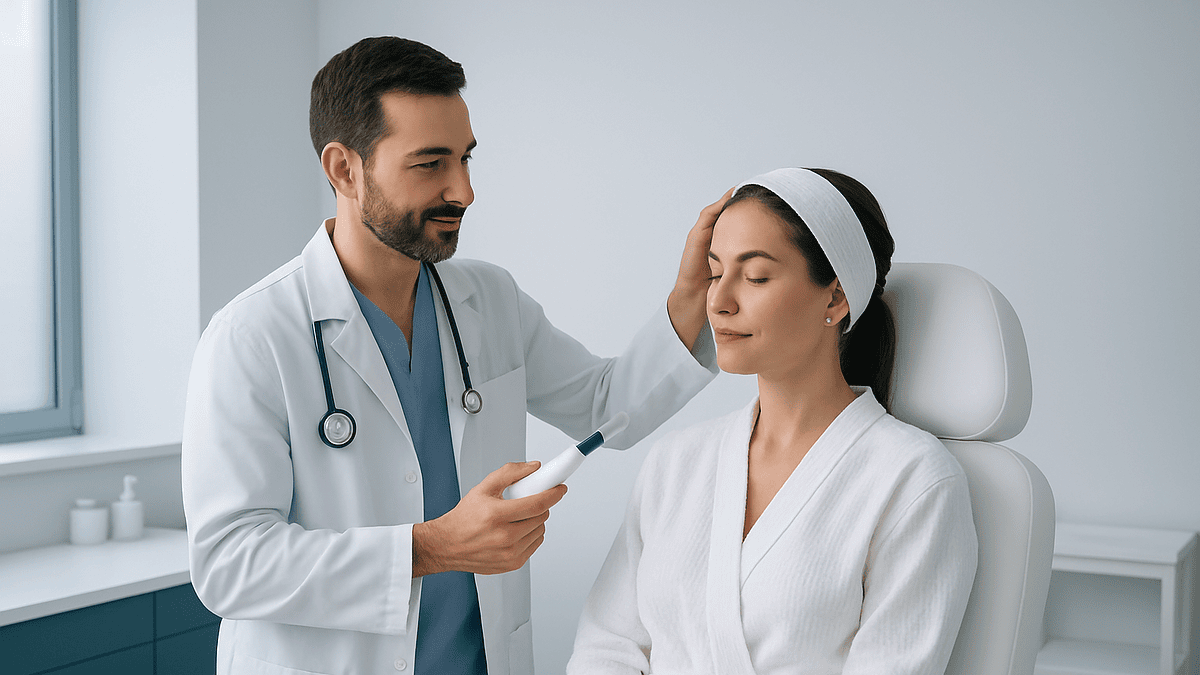
Microneedling is a cosmetic skin procedure in which a handheld device with very fine, short needles makes thousands of tiny, controlled punctures in the outer layers of skin. Older versions look like a small paint roller studded with needles. Most clinics now use a motorized pen whose needle tip moves up and down at speed while the clinician glides it across the skin in overlapping passes.
The point is not the puncture itself but what follows. Each micro-injury is small enough to close within hours yet large enough to signal the skin’s repair system. The body responds by producing new collagen, the structural protein that gives skin its firmness, along with elastin, which lets it spring back. Dermatology reviews describe this as “collagen induction”: the injury is the trigger, and remodeling happens over the following weeks and months rather than on the day.
Needle depth is the variable that matters most for both results and comfort. Published reviews describe professional devices adjustable across roughly half a millimeter to a few millimeters, with shallower settings used for texture and product absorption and deeper settings reserved for scars and thicker skin. At-home rollers sold to consumers use much shorter needles and work in a different, more superficial way.
A typical appointment runs like this: the skin is cleansed, a numbing cream is usually applied and left to work, the cream is removed, the device is passed over each area in several directions, and a soothing serum or plain hyaluronic acid is applied afterward. The needling itself for a full face is often measured in minutes rather than hours. Pinpoint bleeding, a fine speckling of red dots, is expected and is one way the clinician judges that the needles are reaching the intended depth.
Does microneedling hurt? What the sensation is really like, step by step
People who have had it done tend to reach for the same handful of comparisons. A cat’s tongue. Fine sandpaper. An electric toothbrush pressed against the skin. Something scratchy and buzzing, with occasional sharper flickers where the skin is thinner. Very few describe a stabbing or burning pain, and most reserve their strongest words for specific zones rather than the whole face.
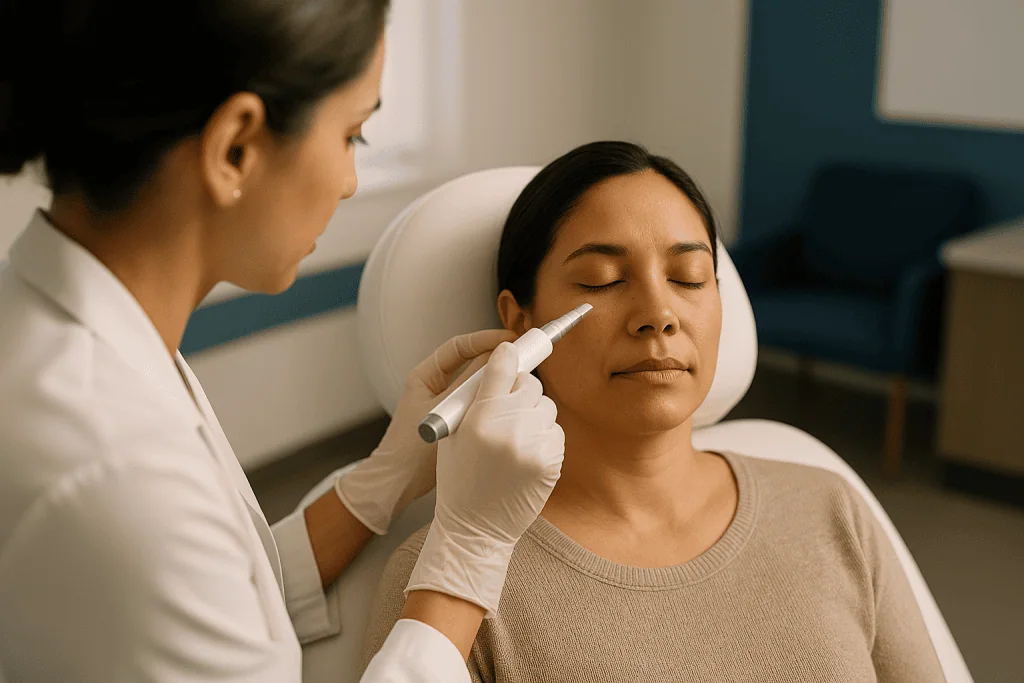
The first pass, over a numbed cheek, often surprises people by how little they feel: pressure, vibration and a faint prickle, more odd than painful. The sensation builds as the clinician moves to the forehead, around the hairline, along the jaw and over the nose. These areas have less soft tissue between skin and bone, so the vibration travels differently and the nerve endings register more. Around the mouth and under the eyes, sensitivity is higher again, and many clinicians work more lightly or shorten the time there.
Toward the end of a session, some people notice a warm, tight feeling spreading across the treated skin, similar to the early stage of a sunburn. That is the inflammatory response beginning, and it is expected. Cleveland Clinic describes the immediate aftermath as redness and mild swelling that most people find tolerable rather than distressing.
Individual variation is real. Anxiety amplifies pain perception, as does a poor night’s sleep or the days just before a menstrual period, when many people report heightened skin sensitivity. Someone who found tattooing easy may still dislike the vibration of a needling pen, and vice versa. The most useful thing a clinician can do is tell you before each area what to expect, then check in as they go. You are allowed to ask for a pause at any point.
Microneedling pain level: what changes how much it hurts
Because the same procedure can feel very different from one room to the next, it helps to see the levers laid side by side. None of these is a promise; they describe tendencies reported in dermatology reviews and by clinicians.
| Factor | How it changes the feel | What you can ask about |
|---|---|---|
| Needle depth | Shallow settings feel like scratching; deeper settings used for scars produce sharper, more distinct pricks | What depth is planned for each area and why |
| Numbing cream | Topical anesthetic dulls most surface sensation; vibration and pressure remain | What is used, how long it sits, whether occlusion is planned |
| Device type | Motorized pens deliver fast, even punctures; rollers can drag; radiofrequency devices add heat | Which device, and whether energy is delivered |
| Area treated | Forehead, hairline, nose and jawline feel more; cheeks feel least | Whether sensitive zones will be treated more lightly |
| Skin condition | Sunburned, dehydrated or inflamed skin is more reactive | How to prepare in the week before |
| Your day | Fatigue, anxiety and hormonal timing raise perceived pain | Whether rescheduling is sensible if you feel unwell |
Two of these deserve emphasis. Depth is the biggest driver, and it is a clinical decision made for you rather than a comfort setting; asking a clinician to go shallower for the sake of comfort may mean treating a scar less effectively, so the trade-off should be discussed openly. Numbing is the second, and it is where most of the difference between “barely noticed it” and “gritted my teeth” comes from. If a provider suggests skipping numbing to save time, it is reasonable to ask why.
Numbing cream for microneedling and other comfort options
A topical anesthetic is a cream or gel applied to the skin that temporarily blocks the nerve signals responsible for pain. The most widely used ingredients belong to the local anesthetic class, with lidocaine the common generic example. Applied to intact skin and given time to absorb, these agents dampen the sharp, pricking component of needling. What they do not remove is the sense of pressure and vibration, which is why people still describe feeling the device even when fully numbed.
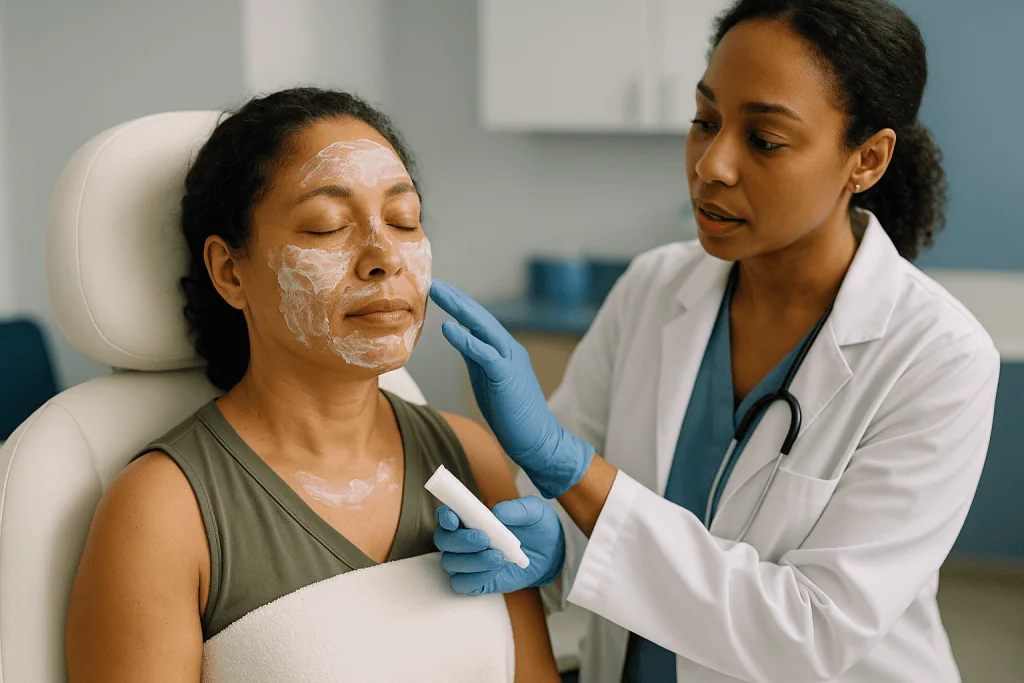
Timing matters. Cleveland Clinic notes that numbing cream is typically applied around an hour before the needling begins, and clinicians often cover the area with plastic film to help absorption. Once the cream is removed, the effect fades over time, so long sessions sometimes involve re-application to areas treated last.
Safety is not trivial with these products. MedlinePlus warns that serious side effects have occurred when topical anesthetics are applied over large areas of skin, left on longer than directed or covered with wraps that increase absorption. This is precisely why numbing for a face-and-neck session should be handled by the clinician rather than bought and applied at home beforehand. If you have a history of reactions to local anesthetics, heart rhythm problems or liver disease, mention it; the choice and use of any anesthetic belongs to the treating clinician.
Beyond cream, comfort often comes from smaller measures. Cooling the skin with a chilled roller or a fan reduces the burning sensation, particularly at the end. Some pens offer adjustable speed, and slowing the pass over the forehead can help. Vibration from the device itself has a mild distracting effect. A short break between zones, steady breathing and a clinician who narrates what is coming next all measurably lower how much people report feeling. For radiofrequency microneedling, which adds heat energy through the needles, deeper numbing approaches may be discussed; again, that conversation sits with the care team.
Does microneedling feel like a tattoo? Microneedling vs tattoo pain
The comparison comes up constantly, and it is half right. Both involve needles moving rapidly in and out of skin, and both produce a buzzing, scratching sensation. The similarities end there.
A tattoo needle deposits ink into the dermis, the deeper living layer of skin, and the artist works the same spot repeatedly to saturate color. Sessions can last hours, usually without any anesthetic, and the sensation accumulates into a raw, burning ache. Microneedling passes over each area a handful of times, uses needles that are generally shorter and finer, and is nearly always performed on skin that has been numbed. Many people who have both describe microneedling as a lighter, briefer, more diffuse version of the tattoo feeling, sharper for a moment on bony spots but never settling into the sustained soreness of a long tattoo session.
Where microneedling can feel more intense is over a wide area at once. A tattoo is usually a contained patch; a full-face needling treatment covers cheeks, forehead, nose, chin and sometimes neck in one sitting, so the whole face feels warm and tight afterward rather than one small region. The other difference is what follows. Tattooed skin weeps and scabs for days. Microneedled skin, according to Cleveland Clinic, is typically red and slightly swollen for a day or two and then settles, with no scabbing when performed correctly.
If you found tattooing easy, you will almost certainly find microneedling manageable. If you found tattooing unbearable, that is not a reliable predictor, because the numbing changes the equation entirely. The people who struggle most tend to be those who dislike vibration near the face or who feel claustrophobic lying still with a device moving around their eyes, and both of those can be discussed and planned for in advance.
Which parts of the face hurt most during microneedling?
Ask any clinician and the map is remarkably consistent. The cheeks are the comfortable zone: plenty of soft tissue, relatively thick skin, and nerve endings that are less densely packed. Most people feel a light scratching there and little else once numbed.
The forehead is the first place sensation climbs. Skin sits directly over bone with little padding, so the pen’s vibration transmits straight through and the pricks register more distinctly. The temples and the hairline are similar, and hair follicles at the edge add a tugging feeling some people find more unpleasant than the needling itself.
The nose is often the most surprising. Its skin is thick and oily but the bridge and tip are bony and cartilaginous, and the area is small, so the device tends to concentrate there. People frequently describe a sharp, watering-eyes sensation on the nose that passes as soon as the clinician moves on. The jawline and chin behave like the forehead: bone close to the surface, sensation up a notch.
Around the mouth and under the eyes, skin is thin and richly supplied with nerves. Clinicians usually treat these zones with lighter pressure, a shallower setting or fewer passes, and some avoid the immediate eyelid area entirely. Upper lip needling in particular can produce a stinging that people compare to threading or waxing.
Beyond the face, the neck is generally comfortable, the décolletage more sensitive because of thinner skin over the sternum, and the scalp, sometimes treated for hair thinning, can feel intense because of dense follicles over bone. A good practitioner sequences the session so the most sensitive zones are treated while numbing is at its peak, and tells you in advance which areas will feel different. If a spot is genuinely painful rather than uncomfortable, say so; that is information the clinician needs.
Who microneedling is usually for, and who is usually asked to wait
Dermatology reviews describe microneedling as most commonly used for atrophic acne scars, the pitted or depressed marks acne leaves behind; for fine lines and mild skin laxity; for enlarged pores and uneven texture; for some surgical and traumatic scars; and for stretch marks. It is also used to help topical products penetrate the skin, an approach sometimes called drug delivery needling. Its appeal across skin tones is that, unlike many lasers, it does not rely on heat or on targeting pigment, which lowers though does not remove the risk of darkening in deeper skin tones.
Certain situations lead clinicians to postpone or decline. Active acne with inflamed, pus-filled spots is one, because needling can spread bacteria across the face and worsen breakouts. Active infections, including cold sores, warts or impetigo, are another; needling over a cold sore can seed the virus across the treated area. Skin conditions in flare, such as eczema, psoriasis or rosacea, are usually treated first and needling revisited later.
A history of keloids, which are raised, thick scars that grow beyond the original wound, is a significant caution, because any injury can trigger them. People taking blood-thinning medication may bleed more than expected and should tell the clinician so the decision can be made together, never by stopping the medicine on their own. Recent oral isotretinoin, a retinoid used for severe acne, thins and sensitizes skin, and clinicians typically ask for a waiting period after the course ends, the length of which they will set.
Pregnancy is generally treated as a reason to wait, largely because the safety of topical anesthetics and post-care products has not been studied in pregnancy. Recent sunburn, a fresh tan or chemotherapy and radiation in the treated area are also common reasons to defer. None of these is a permanent no; they are timing questions for the treating team.
What the days and weeks after microneedling usually look like
Walking out of the room, the face is typically flushed and warm, somewhere between a brisk winter walk and a moderate sunburn. Some people see pinpoint dots of dried blood; others have none. Mild swelling, especially under the eyes and along the cheekbones, can appear over the next few hours. Cleveland Clinic describes this redness and swelling as usually lasting around one to two days, with tenderness that is more like sensitivity to touch than ongoing pain.
Day one is often the itchiest. As the tiny punctures close, the skin feels tight and dry, and moisturizing gently with a bland product recommended by the clinic is the main task. Makeup, active skincare ingredients such as retinoids and acids, sweaty exercise, saunas and swimming pools are typically avoided for a short window the clinic will specify, both to reduce irritation and to keep bacteria out of freshly opened skin. Sun protection is non-negotiable during healing because inflamed skin darkens more readily.
By day two or three, the redness usually fades to a faint pink that is easy to cover. Fine flaking is common toward the end of the first week as the treated surface sheds. Some people notice their skin looks temporarily brighter or plumper at this point; that is mostly swelling and hydration rather than new collagen.
The real remodeling is slow. Published reviews of collagen induction describe new collagen deposition continuing for weeks and maturing over several months, which is why photographs are usually compared at intervals rather than session to session. Clinicians commonly space treatments several weeks apart, Cleveland Clinic citing a range of about four to six weeks, so each round of healing can finish before the next begins. Three to six sessions is a typical plan for scarring, but the number and spacing are set for you by the treating team based on how your skin responds.
Is there a downside to microneedling? Risks in plain language
Yes, and an honest answer serves you better than reassurance. The common downsides are short-lived: redness, swelling, pinpoint bleeding, bruising, dryness, flaking and a temporary breakout as the skin purges. These are expected and usually settle within days.
The less common ones matter more. Infection is the most serious realistic risk. Microneedling creates thousands of open channels, and if the device is not sterile, the skin is not cleaned or products applied afterward are contaminated, bacteria or viruses have a direct route in. Dermatology reviews report cases of herpes reactivation, meaning cold sores flaring across the treated area, in people with a history of the virus. Tell your clinician if you get cold sores; they may discuss preventive measures.
Post-inflammatory hyperpigmentation, dark patches that appear as inflamed skin heals, is the main concern for people with medium to deep skin tones. It is less frequent with microneedling than with heat-based treatments, but aggressive depths, poor sun protection or treating over an active tan all raise the chance. Reviews also describe “tram-track” scarring, fine linear marks left when a device is dragged rather than stamped or when excessive pressure is used, most often with rollers.
A particular hazard involves what goes on the skin afterward. The literature includes reports of allergic and granulomatous reactions, meaning lumpy inflammatory nodules, after products not intended for use on broken skin, including certain vitamin C serums, were applied immediately following needling. Reputable practitioners restrict post-procedure products to sterile, purpose-made preparations for this reason.
Home devices carry their own downside. Rollers reused without proper sterilization, shared between people or pressed too hard have caused infections and scarring. The alternative treatments a clinician may discuss include chemical peels, fractional lasers, fillers for depressed scars and prescription topicals; each has its own risk profile, and the choice depends on your skin, your goals and your history rather than on any single procedure being universally better.
Is 40 too old for microneedling?
No. There is no upper age cutoff in dermatology guidance for microneedling, and many people first consider it in their forties, fifties and beyond, often for a combination of lingering acne scars, fine lines and the loss of firmness that accumulates over decades of sun exposure. The more useful question is not “am I too old” but “what is realistic for my skin at this stage, and what else might be needed.”
Skin changes with age in predictable ways. The dermis thins, collagen production slows and existing collagen becomes more fragmented. Microneedling works by asking the skin to make new collagen, and older skin still does this, just more slowly and less abundantly than at twenty-five. Published reviews describe improvements in texture and fine lines across a wide age range, while noting that the studies are generally small and short. What that means in practice: results tend to be gradual, and expectations of erasing deep folds or lifting sagging tissue are not supported by the evidence for this procedure alone.
Does it hurt more at forty or sixty? Not in any consistent way. Thinner skin can feel the pricks more distinctly, but numbing works the same, and many older adults report better tolerance because they arrive calmer and with fewer preconceptions. Healing may be marginally slower, so redness sometimes lingers a little longer than the one-to-two-day range described for younger skin.
Medical history becomes more relevant with age. Blood-thinning medicines, diabetes that affects wound healing, previous radiotherapy to the head and neck, and a history of skin cancers in the area all warrant discussion. None automatically rules the procedure out, but each shapes how the treating team plans depth, spacing and aftercare. A consultation that takes your full history is worth more than any age rule of thumb.
Is microneedling facial worth it? What the evidence actually shows
The evidence is encouraging but modest, and it is worth being precise about both halves of that sentence.
For atrophic acne scars, the indication with the most research, published reviews in the dermatology literature summarize multiple small trials showing measurable improvement in scar depth and texture after a series of sessions, with a favorable safety profile across skin types. The comprehensive review by Alster and Graham in Dermatologic Surgery and the open-access overview by Singh and Yadav both reach similar conclusions: microneedling is a reasonable, well-tolerated option for scarring and texture, with results that are real but incremental.
For fine lines and mild laxity, the studies are smaller still and often rely on before-and-after photographs graded by clinicians rather than objective measurement. Improvement is reported, but the size of the effect is harder to pin down and direct comparisons with lasers or peels are limited. For stretch marks and surgical scars, the evidence base is thinner again.
Where the evidence is weakest is around bold claims: dramatic tightening, pore “shrinking,” and results from a single session. Collagen remodeling is a months-long process, and any change visible within days is swelling and hydration rather than structural improvement. Combination approaches, such as needling with platelet-rich plasma or with radiofrequency energy, are increasingly studied, but head-to-head trials remain few, and the added benefit over needling alone has not been consistently demonstrated.
So is it worth it? That depends on what you are treating, how much gradual improvement means to you, and how you weigh a few days of redness and the small but real risks against alternatives. Mayo Clinic lists skin needling among the procedures a dermatologist may discuss for acne scars alongside peels, lasers, fillers and surgical techniques, and that framing is the right one: a legitimate option among several, chosen with a clinician, never a guaranteed outcome.
What people often get wrong about microneedling and pain
“More pain means better results.” This idea comes from the reasonable observation that deeper needling produces more collagen remodeling. It does not follow that pain is a useful gauge. Pain reflects where on the face the device is, how well the numbing has taken and how anxious you are, none of which measure effectiveness. Pinpoint bleeding and clinical judgment guide depth, not your discomfort.
“If I can feel it, the numbing failed.” Topical anesthetics block sharp pain signals but leave pressure and vibration largely intact. Feeling the device move is normal. Feeling distinct, sharp pricks throughout is worth mentioning so the clinician can adjust.
“At-home rollers are the same thing, just cheaper.” Consumer rollers use far shorter needles and cannot reach the depths used for scarring. Used carelessly or shared, they have caused infections and linear scars. They are a different tool with a different, more limited purpose.
“Applying my own numbing cream beforehand is fine.” MedlinePlus is explicit that topical anesthetics over large areas or under occlusion have caused serious reactions. Numbing for a face-and-neck session should be managed by the clinician.
“Redness for a week means something went wrong.” Most people are pink for a day or two, but sensitive skin, deeper settings and older skin can take longer. Prolonged redness with heat, swelling or pus is a different matter and is covered below.
“Bleeding means the practitioner was too rough.” Pinpoint bleeding is expected at scar-treatment depths and is one of the ways depth is confirmed. Heavy bleeding or bruising is not, and is worth raising.
“I should see results at my follow-up in a week.” The glow at one week is hydration and swelling. Structural change is measured in months, which is why clinicians photograph at longer intervals and why judging the treatment after one session is premature.
Questions to ask your care team about microneedling
A good consultation leaves you knowing what will happen to your face and why. These questions help get there; write down the answers so you can compare them with what actually happens on the day.
- What am I being treated for, and what does the evidence suggest is realistic for that concern with microneedling alone?
- Which device will you use, is it a pen or roller, and are the needle cartridges single-use and sterile?
- What depth do you plan for each area of my face, and how will you adjust for the forehead, nose and under-eyes?
- Will I be numbed, with what class of anesthetic, how long will it sit, and who applies it?
- What does your training and experience with this procedure look like, and who do I contact if there is a problem afterward?
- Given my skin tone, what is my risk of darkening afterward, and what will you do to reduce it?
- I get cold sores / take a blood thinner / recently finished acne medication / am planning a pregnancy: how does that change the plan?
- What exactly will be applied to my skin during and after the session, and is it intended for use on broken skin?
- How many sessions and how far apart are you proposing, and at what point will we review whether it is working?
- What should the first three days look like, what counts as normal, and what should make me call you?
- What are the alternatives for my concern, and why are you suggesting this one?
- Are there any activities, products or medicines I should discuss with my prescribing doctor before the appointment?
Notice that several of these questions are about the practitioner and the setting rather than the procedure. The NHS guidance on cosmetic procedures stresses checking who will perform the treatment, their qualifications and what happens if something goes wrong, and that advice applies fully here. A confident, specific set of answers is a good sign. Vagueness about sterility, depth or aftercare is a reason to pause.
When to call your doctor after microneedling
Most recoveries are uneventful: pink, tight, itchy skin that settles within a couple of days and flakes lightly by the end of the week. A small number are not, and because the procedure opens the skin, problems can escalate quickly if ignored. The following signs warrant a same-day call to the clinic that treated you or to your doctor.
- Redness that is spreading or deepening after the first two days rather than fading, especially if the skin feels hot to the touch.
- Swelling that is worsening rather than settling, or that affects one side of the face markedly more than the other.
- Pus, yellow crusting, weeping or a foul smell from any treated area, which suggest bacterial infection.
- Clusters of small blisters or painful sores, particularly around the mouth or nose, which can indicate a cold sore outbreak spreading across needled skin.
- Fever, chills or feeling generally unwell in the days after treatment.
- Hives, widespread itching, swelling of the lips or eyelids, wheezing or difficulty breathing, which may signal an allergic reaction to a product applied to the skin.
- New dark patches developing over the treated area in the weeks afterward, so that pigmentation can be assessed and managed early.
- Raised, thickened or linear scars forming where needling was performed.
- Pain that is severe, increasing or out of proportion to the redness you can see.
Any difficulty breathing, swelling of the tongue or throat, or a rapidly spreading rash is an emergency; use local emergency services rather than waiting for a callback. For everything else, do not try to treat a suspected infection or reaction with over-the-counter products on your own; open skin behaves differently, and the clinic or your physician needs to see it. Photographs taken in good light each day for the first week are genuinely useful if you do need to call, because they show the trajectory rather than a single moment. The decision about what to do next, whether that is watchful waiting, a prescription or postponing further sessions, rests with the treating team.
Frequently asked questions
Does microneedling hurt without numbing cream?
Without numbing, microneedling is noticeably sharper, particularly over the forehead, nose and jawline, and most people describe it as uncomfortable rather than unbearable at shallow depths. At the deeper settings used for scars, discomfort rises considerably, which is why professional treatments almost always include a topical anesthetic. If numbing is not being offered, ask your clinician why and what depth is planned.
What is the microneedling pain level on a scale of one to ten?
Most people who have been numbed place it somewhere in the low to middle of the scale, with brief spikes on bony areas. Numbers vary widely because depth, device, area and individual sensitivity all differ, so no single figure is reliable. A more useful gauge is the everyday comparison people reach for: fine sandpaper or an electric toothbrush against the skin, rather than a needle stick.
Does microneedling feel like a tattoo?
It shares the buzzing, scratching quality but is briefer, more superficial and nearly always performed on numbed skin, so most people find it lighter than tattooing. Tattoo needles work the same spot repeatedly for hours to deposit ink; microneedling passes over each area a few times. The whole face can feel warm and tight afterward, but there is no scabbing or prolonged soreness when it is done correctly.
Is microneedling painful on the forehead?
The forehead is one of the more sensitive areas because the skin lies directly over bone with little soft tissue beneath, so vibration and pricks register more distinctly. Clinicians often treat it while numbing is at its peak, slow the device or use lighter pressure there. If it feels genuinely painful rather than uncomfortable, tell the practitioner so they can adjust.
How long does numbing cream for microneedling take to work?
Cleveland Clinic describes numbing cream being applied around an hour before needling begins, often under plastic film to help absorption. The exact product, timing and whether occlusion is used are decided by the clinician, and MedlinePlus cautions against applying these products over large areas or under wraps without supervision. Arriving early is usually built into the appointment for this reason.
Is 40 too old for microneedling?
No. There is no upper age limit in dermatology guidance, and many people begin in their forties or later for scars, fine lines and texture. Older skin still produces new collagen in response to needling, though more slowly, so results tend to be gradual and expectations should be realistic. Medical history, including blood thinners and previous skin cancers, matters more than age itself.
Is microneedling facial worth it?
For atrophic acne scars and uneven texture, published dermatology reviews report measurable, incremental improvement after a series of sessions with a good safety record across skin tones. Evidence for fine lines and laxity is smaller and less precise, and claims of dramatic tightening are not supported. Whether it is worth it depends on your concern, tolerance for a few days of redness and the alternatives your clinician outlines.
Is there a downside to micro needling?
Yes. Short-term downsides include redness, swelling, pinpoint bleeding, dryness and temporary breakouts. Less common but more serious risks are infection, cold sore reactivation, dark patches in deeper skin tones, linear tram-track scars from poor technique and reactions to products applied on open skin. Sterile single-use cartridges, careful aftercare and an experienced practitioner reduce these risks but do not eliminate them.
How long does the skin stay red after microneedling?
Cleveland Clinic describes redness and mild swelling typically lasting around one to two days, fading to a pink that is easy to cover and then to light flaking by the end of the first week. Deeper settings, sensitive skin and older skin can extend this somewhat. Redness that spreads, feels hot or comes with pus or blisters after the second day should be reported promptly.
Can I do microneedling at home to avoid the pain of a clinic session?
Home rollers use much shorter needles, so they cause less sensation but also cannot reach the depths used for scarring, and they carry their own risks. Reviews report infections and fine linear scars from devices that were reused without sterilization, shared or pressed too hard. They are a different tool with a limited purpose, not a painless substitute for a professional treatment.
References
- Cleveland Clinic: Microneedling: What It Is, Uses, Benefits & Results
- Singh A, Yadav S. Microneedling: Advances and widening horizons. Indian Dermatology Online Journal (NIH PMC)
- MedlinePlus: Lidocaine Topical
- NHS: Cosmetic procedures
This article is for general information only and is not a substitute for professional medical advice. Please consult a qualified doctor about your individual situation.

More from the Blog
How to Prepare for Microneedling: Sun, Retinoids and the Two Weeks Before Your Session
Preparing for microneedling usually means keeping the skin out of strong sun and free of sunburn or tan for the two weeks beforehand, pausing…
IPL Photorejuvenation Results: Why Spots Darken Before They Fade and How Sessions Build
IPL photorejuvenation results usually appear gradually. Treated brown spots often turn darker and coffee-ground-like for several days before flaking away over one to two…

Surface Reconstruction Recovery: Early Supervised Walking, Physical Therapy and Milestones
Surface reconstruction recovery after ocular surface surgery usually unfolds in stages: the corneal surface layer re-covers over days, comfort and light sensitivity settle over…

Before Aesthetic Filling: Blood Thinners, Alcohol and Supplements Your Doctor Will Review
Before dermal fillers, clinicians typically review anything that increases bruising or bleeding: prescribed anticoagulants and antiplatelet drugs, over-the-counter anti-inflammatory painkillers, supplements such as fish…
Reconstruction After Cancer or Infection: How Grafts, Flaps and Staged Surgery Are Planned
Reconstructive surgery after cancer or infection rebuilds tissue removed by a tumor operation or destroyed by infection, using skin grafts, flaps of tissue moved…

Why Hands Show Age Early: Volume Loss, Visible Veins and Sun Spots and How Each Is Treated
Hands show age early because their skin is thin, has very little fat beneath it, and spends decades in sunlight without protection. Over time…