

Does Radiation Therapy Hurt? What the Beam Feels Like and Where Discomfort Comes From
Key Takeaways
- External beam radiation cannot be felt while it is delivered; the sensation is identical to a diagnostic X-ray, though the dose is much higher.
- Side effects stay within the treated area because they come from healthy cells in the beam's path, so your treatment field predicts where discomfort may appear.
- Skin and mucous membrane reactions typically begin a week or two into a course, because those tissues take that long to shed the cells damaged on day one.
- The most uncomfortable stretch of a multi-week course is usually the final week and the one to two weeks after the last session, not the first days.
- After external beam treatment you are not radioactive and pose no risk to children or partners; only some internal or systemic treatments carry temporary precautions.
- Moderate regular movement has the most consistent evidence for easing radiation-related fatigue, which is the one side effect that ignores the beam's borders.
External beam radiation therapy is not felt while it is being delivered; the beam itself causes no pain, heat or pressure. Discomfort, when it happens, comes later and from the healthy tissue in the beam's path: skin soreness, a raw throat, bowel or bladder irritation, or fatigue, usually building over the course and easing in the weeks after treatment ends. Internal radiation can involve procedural discomfort.
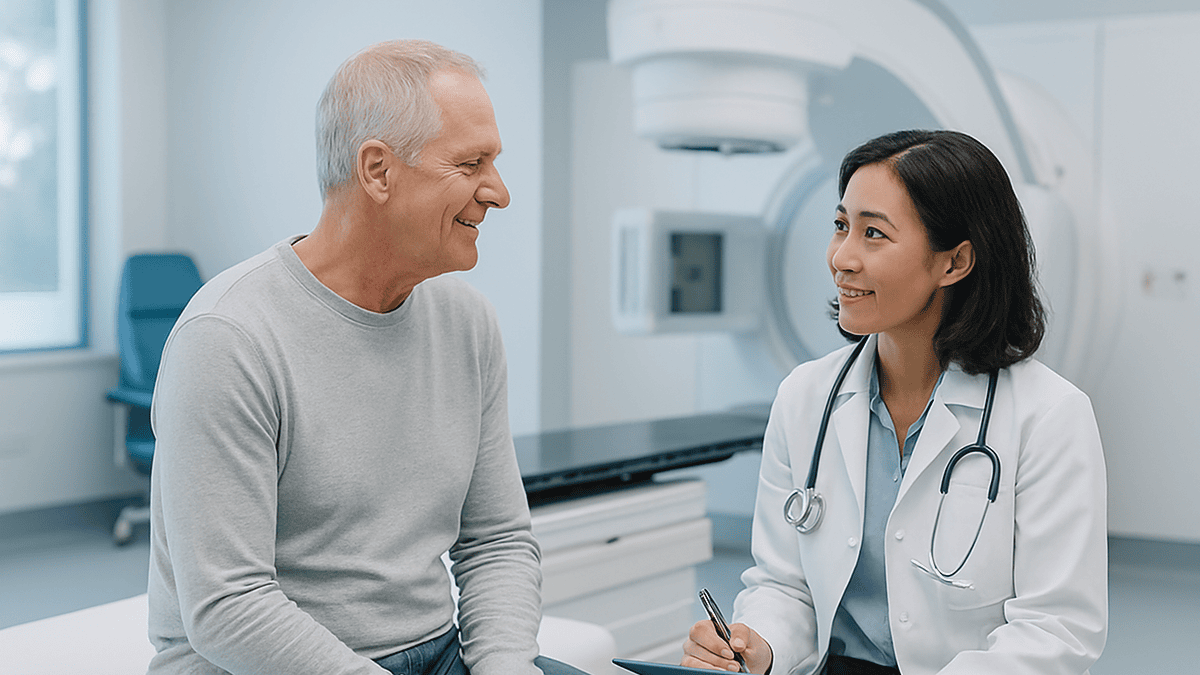
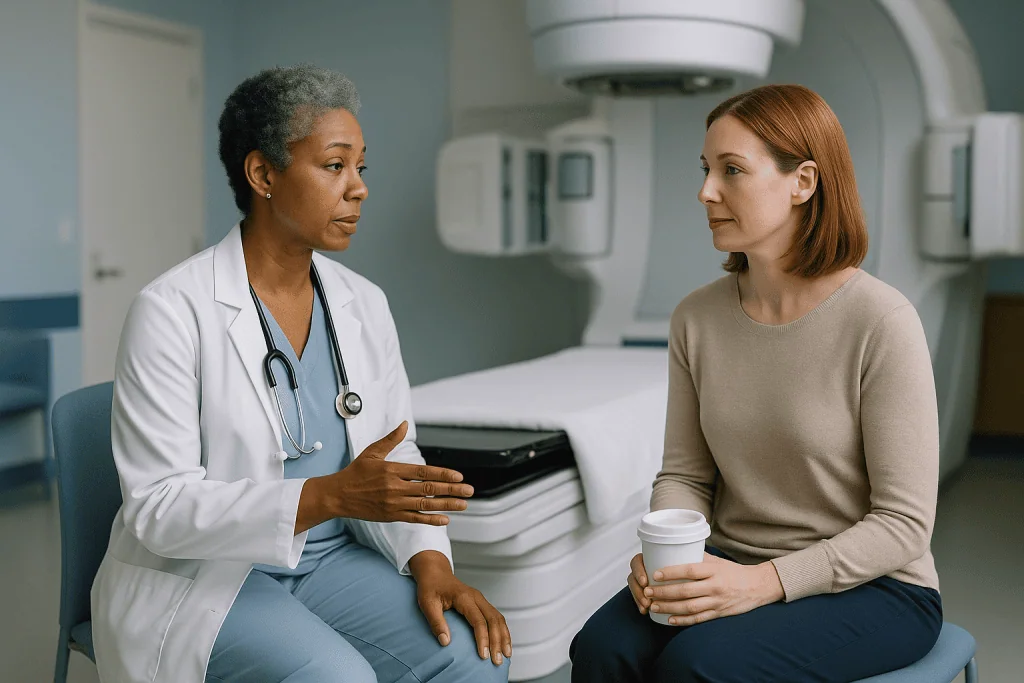
The first thing many people notice in the treatment room is how ordinary it looks. A wide table, a machine shaped like a giant camera arm, a radio playing quietly. Someone lies down, the therapists line up faint marks on the skin with a laser, and then they leave. The machine hums and rotates. Nothing burns, nothing stings. A few minutes later the door opens and it is over.
That mismatch, between the word “radiation” and the quiet reality of the room, is why so many people type does radiation therapy hurt into a search bar the night before their first session. The honest answer has two parts. The beam is painless. What can hurt is what the beam does, over days and weeks, to the normal tissue it must pass through to reach a tumor.
This explainer walks through both halves: what the session itself feels like, and exactly where discomfort comes from, site by site, so that the things worth watching for are separated from the things worth ignoring.
Does radiation therapy hurt while the beam is actually on?
No. External beam radiation, the most common form, uses high-energy X-rays or particles that pass through the body without triggering the nerves that sense heat, pressure or injury. MedlinePlus compares the experience to having a diagnostic X-ray taken: you do not see or feel the radiation itself. The dose is far higher than a chest X-ray, but the sensation is identical, which is to say there is none.
What people do feel is everything around the beam. The treatment couch is firm and often cool. You are asked to hold one position, sometimes with arms raised above the head or a molded cushion under the knees, for the whole session. The NHS notes that each session usually lasts between 10 and 30 minutes, though the beam is only on for a fraction of that; most of the time is spent on positioning and imaging checks. Lying perfectly still on a hard surface for that long can leave shoulders, hips or a stiff neck complaining afterward, especially early in the course when the body has not adjusted.
Some treatments require an immobilization device. For head and neck or brain treatment, a custom thermoplastic mask is molded to the face and clipped to the table. It does not hurt, but the snugness and the inability to move the head can feel claustrophobic. Therapists can usually adjust how tightly it sits, cut out the eyes or mouth, or talk you through the session over the intercom. Telling them in advance that enclosed spaces bother you is worth doing before the mask is made, not after.
The machine itself is loud in a mechanical, whirring way, and it rotates around you. Nothing touches your skin except the table and any positioning aids.
What does radiation feel like? Warmth, flashes, smells and the power of expectation
Most people feel nothing during delivery, and that remains the typical report across treatment sites. A minority describe sensations that are real but easily misread as harm.
People receiving radiation to the brain occasionally report seeing brief blue or white flashes, even with eyes closed. These are thought to be produced when the beam stimulates the retina or the visual pathway directly; they stop the moment the beam stops and do not indicate injury. Cleveland Clinic lists unusual smells during brain treatment among the odd but harmless effects some patients report, likely from the beam interacting with the olfactory system or with ozone in the room.
A feeling of warmth on the skin during a session is less common than people expect. When it does occur it is usually a few weeks into a course, once the skin has already started to react, rather than a sensation caused by the beam in that moment. Early on, the skin is unchanged and there is no warmth at all.
Expectation does a lot of work here. Lying alone in a room with a machine you have been told delivers something powerful, the mind searches for evidence that it is happening. A tingle, an itch under the mask, an ache in a shoulder pinned overhead: all get attributed to the radiation. Therapists hear this on almost every first day. It helps to know in advance that the treatment is designed to be invisible to the senses, and that the body’s later reaction is a separate, slower process.
Once a session ends, you can get up and leave immediately. Nothing about external beam radiation lingers in the body, and no one around you is exposed.
Where discomfort really comes from: tissue in the beam's path, not the beam
Radiation works by damaging DNA inside cells. Cancer cells, which divide rapidly and repair poorly, are the target, but healthy cells in the beam’s path absorb some dose too. Modern planning shapes the beam to spare as much normal tissue as possible, yet some exposure is unavoidable. The healthy cells that suffer most are the ones that also divide quickly: the lining of the skin, mouth, throat, gut and bladder, plus the hair follicles in the treated area.
This is the mechanism behind almost every uncomfortable side effect. The National Cancer Institute explains that side effects occur because radiation damages normal cells near the tumor, and that they are limited to the part of the body being treated. A person treated for a tumor in the pelvis will not develop a sore mouth. Someone treated for a tongue cancer will not develop diarrhea. Knowing your treatment field tells you, quite precisely, where discomfort might arise.
Timing follows the biology. Cells in the skin and mucous membranes turn over in roughly a couple of weeks. The lining you have on day one is still intact for the first several sessions; irritation appears when the damaged cells beneath it fail to replace what is being shed. That is why the NHS describes side effects tending to build up gradually over a course rather than appearing after the first visit.
Fatigue is the one effect that is not confined to the field. Its cause is partly the energy the body spends repairing tissue, partly the disruption of daily travel and appointments, partly anemia or poor sleep in some people. It is real, it is common, and it is not a sign the treatment is failing or that something has gone wrong.
Is radiotherapy painful for the skin? Radiation dermatitis explained
Skin reaction, known clinically as radiation dermatitis, is the discomfort people most often mean when they ask whether radiotherapy is painful. It affects the skin the beam enters and, for some fields, where it exits. Breast, head and neck, and some skin or limb treatments carry the highest likelihood because the target sits close to the surface.

The pattern is predictable. According to the NHS, skin changes typically begin a week or two into treatment. The area first looks slightly pink or darker, depending on skin tone, and may feel dry or tight, like mild sunburn. Over the following weeks it can become itchy, then tender. In folds, under the breast, in the armpit, groin or neck crease, the skin may peel or become moist and raw, which is where genuine pain can arise. In darker skin tones, the change often appears as deepening pigmentation rather than redness, so tenderness and texture are better guides than color.
The intensity keeps climbing for a short while after the final session because the damaged cells are still working their way to the surface. The NCI notes that skin reactions usually begin to heal a few weeks after treatment finishes, though the area may stay darker or more sensitive for longer.
Care teams generally advise gentle washing with lukewarm water and mild soap, patting dry, avoiding friction from tight straps or collars, protecting the area from sun, and using only the creams the team has approved. Some products contain metals or fragrances that irritate treated skin, and timing matters, since lotion applied just before a session can alter the surface dose. Ask before using anything, including familiar brands from your bathroom shelf.
Who radiation therapy is usually for, and who is usually asked to wait
People searching “at what stage of cancer is radiotherapy used” often assume it belongs to one end of the spectrum. It does not. Mayo Clinic describes radiation being used as the only treatment for some early cancers, before surgery to shrink a tumor, after surgery to treat any cells left behind, alongside chemotherapy, and in advanced disease to relieve symptoms such as pain or bleeding. Roughly half of people with cancer receive radiation at some point, according to the NCI.
Symptom-relieving, or palliative, radiation deserves a specific mention because it flips the pain question around. Here the aim is to reduce discomfort, most commonly from cancer that has spread to bone. Courses are short, sometimes a single session, and the tissue effects are correspondingly milder. A temporary worsening of pain at the treated site during the first days, before relief begins, is a recognized effect that teams anticipate and plan for.
Who is asked to wait? Radiation is generally postponed or avoided during pregnancy unless the situation is urgent, because of the risk to the developing baby. A surgical wound in the treatment field usually needs to heal first, since radiation slows tissue repair. Active infection or a severe existing skin condition in the field may delay a start. People with certain inherited conditions that impair DNA repair, or who have already had radiation to the same area, may not be candidates because normal tissue has a lifetime tolerance.
None of these are decisions a patient makes alone from a list. The radiation oncologist weighs tumor type, location, prior treatment, overall health and the person’s own priorities. Alternatives, whether surgery, systemic therapy, active monitoring or a different radiation technique, are part of that same conversation.
A body map of discomfort: what tends to show up by treatment site
Because side effects stay within the treated field, the most useful way to anticipate discomfort is by location. The table below summarizes the patterns described by the NHS and the NCI. It is a map of what is possible, not a forecast of what will happen to any one person; many people experience only a fraction of what is listed.
| Treatment area | Discomfort that may develop | Typical onset during a multi-week course |
|---|---|---|
| Brain | Headache, scalp tenderness, patchy hair loss, fatigue, nausea in some | Hair loss around week 2 to 3 |
| Head and neck | Sore mouth and throat (mucositis), dry mouth, taste change, thick saliva, painful swallowing, skin reaction | Mouth soreness from week 2 onward, often the hardest site |
| Chest / breast | Skin soreness, breast swelling or tenderness, sore throat if the esophagus is in the field, cough | Skin changes week 2 to 3 |
| Abdomen | Nausea, loss of appetite, cramping, loose stools | Nausea can begin within the first week |
| Pelvis (prostate, cervix, rectum, bladder) | Urinary urgency and burning, diarrhea, rectal soreness, vaginal dryness or discomfort | Bladder and bowel symptoms week 2 to 4 |
| Bone (palliative) | Brief pain flare, then easing; local skin reaction if superficial | Flare in the first days after treatment |
Two threads run through the table. The first is that the mucous membranes, mouth, gut and bladder lining, are the source of the most genuinely painful reactions, because they are exposed to food, acid, urine and friction every day while trying to heal. The second is that fatigue sits behind every row. It is the one effect that does not respect the beam’s borders, and people consistently underestimate how much it shapes the experience.
Internal radiation and brachytherapy: a different kind of discomfort
Not all radiation arrives from a machine across the room. Brachytherapy places a sealed radioactive source directly inside or beside the tumor, using thin tubes, seeds or an applicator. It is common in cervical, uterine and prostate cancer, and used in some breast, skin and eye cancers. Systemic radiation, such as radioactive iodine for thyroid disease, is swallowed or injected and travels through the bloodstream.
With brachytherapy, the radiation itself is still painless. The discomfort comes from the procedure. Placing an applicator into the vagina or uterus, or inserting needles through the skin into the prostate, requires anesthesia or sedation, and afterward there may be soreness, cramping, spotting or a bruised feeling for several days, as Cleveland Clinic describes. For treatments where the source stays in place for hours or days, lying still with the applicator in position is uncomfortable in the way any prolonged bed rest is: stiffness, restlessness, a sore back. Pain relief is planned in advance, and the nursing team checks frequently.
Permanent seed implants for prostate cancer typically cause a few days of perineal soreness and urinary irritation as swelling settles, then a gradual course of bladder symptoms over the following weeks as the seeds deliver their dose slowly.
Radiation safety is where internal treatment differs most from external beam. Temporary high-dose sources are removed before you go home, leaving no radioactivity behind. Permanent seeds and systemic radiation do emit low levels for a period, so teams give specific instructions about close contact with children and pregnant people for a defined time. Those instructions vary by treatment and are not something to generalize from a magazine; follow the written guidance you are given.
How will I feel after 5 sessions of radiotherapy, and how is that different from a long course?
The answer depends on whether five sessions is the whole treatment or the first week of a longer one. Both are common.
Short courses of five sessions, sometimes fewer, are used in two main settings: symptom relief for bone or other metastases, and stereotactic treatment, which delivers a high dose to a small, precisely targeted area over a few visits. When five sessions is the complete course, the tissue effects are often milder than people brace for, because the total volume of healthy tissue involved is small. Fatigue for a week or two, mild skin change at the entry site, and a temporary pain flare at a treated bone are the usual reports. For stereotactic treatment of a lung or liver lesion, cough or nausea may appear briefly and settle.
When five sessions is simply week one of a six- or seven-week course, most people feel almost exactly as they did before starting. The skin looks normal. The mouth or gut has not yet reacted, because the cells lining them were healthy on day one and take time to shed. The NHS is explicit that side effects tend to build gradually, and the NCI places the onset of most early effects a couple of weeks in. The exception is nausea from abdominal or brain treatment, which can begin within the first few days.
What people do notice in that first week is the logistics. Daily travel, waiting rooms, parking, the odd rhythm of a life organized around an appointment every weekday. That, plus the emotional weight of having started, produces a tiredness that is easy to mistake for a physical effect of the beam. Both are real; only one is caused by radiation.
What are the hardest days after radiation treatment?
Ask people who have completed a multi-week course, and a pattern emerges that surprises almost everyone: the worst stretch is usually the final week of treatment and the one or two weeks immediately after the last session. Finishing does not bring instant relief.
The reason is the lag built into tissue biology. Skin and mucous membranes damaged on the final day still have to complete their cycle of dying and shedding, which takes days. Inflammation set in motion by the last sessions keeps rising for a short time after the beam stops. The NHS and the NCI both describe side effects continuing, and sometimes worsening, for a week or two after treatment before they begin to improve. A raw throat from head and neck treatment, a peeling skin fold under the breast, a burning bladder in pelvic treatment: each tends to peak during this window.
Fatigue often peaks here too, then lifts slowly. The NHS notes that most side effects begin to ease within a few weeks of finishing, but that tiredness can persist for several months for some people. Recovery is rarely a straight line; a good day is followed by a flat one, and that is normal.
Emotionally, this period carries its own difficulty. Daily contact with the treatment team ends abruptly. The structure that carried you through disappears, and you are left at home with side effects at their height and no one checking on you each morning. Many people describe this as harder than the treatment itself. Knowing it is coming, and arranging a follow-up contact point before your last session, takes some of the sting out of it.
Late effects, changes that appear months or years afterward, are a separate topic, specific to the site treated, and part of the long-term follow-up plan your team will explain.
Is radiation worse than chemo? An honest comparison
The question is asked constantly and has no single answer, because the two treatments act in completely different ways and are often given together. What can be said honestly is where the discomfort of each tends to live.
Chemotherapy is systemic. The drugs travel through the whole body, so effects can appear anywhere: nausea, hair loss from the entire scalp, mouth sores, nerve tingling in hands and feet, increased infection risk from lowered white blood cells, and fatigue. Radiation is local. Its effects are confined to the treated area, and blood counts are usually less affected unless large volumes of bone marrow are in the field.
Radiation is delivered daily for weeks, which is a logistical burden chemotherapy, given in cycles, does not usually impose. Chemotherapy effects often come in waves tied to each cycle; radiation effects build gradually and then recede.
For some sites, radiation is the more uncomfortable treatment. Head and neck radiation is widely regarded as among the most demanding courses in oncology because of mouth pain and swallowing difficulty. For other sites, a short course of pelvic radiation may be considerably easier to tolerate than a full chemotherapy regimen.
When both are given together, a practice called chemoradiation, each can intensify the other’s local effects, and teams plan supportive care with that in mind. The comparison that matters is not radiation versus chemotherapy in the abstract but what is being proposed for you, at your treatment site, with your health and priorities. That is a conversation for your oncology team, and asking them directly, “which part of this plan is likely to be hardest for me, and why?”, tends to get a more useful answer than any general ranking.
What people often get wrong about radiation therapy and pain
Several beliefs travel from person to person and add fear that the evidence does not support.
“You feel it burning.” External beam radiation is imperceptible during delivery. Skin reaction appears days to weeks later and is inflammatory, not a burn in the kitchen sense. The word “radiation burn” persists but describes a dermatitis that develops slowly and heals with the skin’s own turnover.
“You’ll be radioactive and dangerous to be around.” Not after external beam treatment. The NCI is explicit that external radiation does not make a person radioactive; it is safe to hold a child or share a bed the same day. Only certain internal or systemic treatments carry temporary precautions, and those are spelled out in writing.
“All your hair falls out.” Hair is lost only where the beam passes. Pelvic treatment does not affect the scalp; brain treatment does not affect the legs.
“If it doesn’t hurt, it isn’t working.” There is no relationship between the discomfort a person feels and the effect on the tumor. Some people complete a full course with barely a mark. That is good planning, not weak treatment.
“Side effects mean the cancer is spreading.” A sore throat in week three of chest radiation is the esophagus reacting to the beam. It is expected, temporary and unrelated to how the tumor is responding.
“The pain will stop the day treatment ends.” As described above, the peak usually comes after the final session, then recedes over weeks.
“Creams and supplements can prevent all of it.” Some measures help, many are unproven, and a few interfere. Bring anything you are considering to the team before using it, because the evidence for over-the-counter products in this setting is mixed at best.
Radiation therapy side effects: how discomfort is managed and what the evidence supports
Supportive care during radiation is a specialty in its own right, and it starts before the first session. The radiation oncology team, including nurses, dietitians and often a dentist for head and neck cases, plans for the effects your specific field is likely to produce.
For skin, the approach is protective: gentle cleansing, loose clothing, sun avoidance and approved moisturizers, with topical steroid preparations sometimes prescribed to reduce inflammation when reaction is significant. Moist, broken skin may be dressed with specialized products. Cleveland Clinic and the NHS both emphasize avoiding heat, ice, adhesive tape and unapproved creams on treated skin.
For the mouth and throat, salt-and-baking-soda rinses, soft or liquid diets, avoiding spicy, acidic or very hot foods, and prescribed numbing or coating mouthwashes are standard. Pain during swallowing is treated in steps, from simple analgesics to stronger prescribed options, and some people need a temporary feeding tube to maintain nutrition while the throat heals. That is a supportive measure, not a failure.
For the gut and bladder, dietary adjustment, anti-diarrheal or anti-nausea medicines, and drinking enough fluid to keep urine dilute are the usual tools. Anti-nausea medicines work by blocking signals in the brain and gut that trigger vomiting and are commonly given before sessions for abdominal or brain treatment.
Fatigue responds best to a counterintuitive prescription: light regular movement. The NCI and Harvard Health both point to moderate exercise during treatment as the intervention with the most consistent evidence for reducing cancer-related fatigue, alongside protecting sleep and asking for help with daily tasks.
Every medicine mentioned here is a class, not a suggestion. Which one, whether, and for how long are decisions for the prescribing clinician who knows your history, your other medicines and your treatment plan.
Questions to ask your care team before and during treatment
A good conversation before the first session can reshape the whole experience. Radiation oncology teams expect these questions and would rather answer them early than manage anxiety later.
- Exactly which part of my body will be in the treatment field, and which side effects does that make likely for me?
- How many sessions, over how many weeks, and how long will each visit take from arrival to leaving?
- Will I need a mask, mold or other positioning device? Can I see or try one beforehand?
- When in the course should I expect skin or mouth changes to start, and what should the area look like when it is healing normally versus when I should report it?
- Which creams, soaps and deodorants are safe on the treated area, and when should I apply them relative to my session?
- Is there anything I should stop, such as shaving the area, swimming or using heat pads?
- What pain relief is planned if I need it, and who do I contact if the plan is not enough?
- Should I see a dentist, dietitian or physical therapist before starting?
- Can I keep working, driving and exercising, and how might that change as the weeks go on?
- What will the two weeks after my last session look like, and who is my point of contact then?
- Which late effects, months or years from now, are relevant to my treatment site, and how will they be monitored?
- If this treatment were not chosen, what are the alternatives, and what are their trade-offs?
Write the answers down or bring someone who will. Most people absorb a fraction of what is said in a consultation, and the practical details, especially about skin care timing and who to call, are the ones that matter at nine on a Saturday night.
When to call your doctor: red-flag signs during and after radiation
Most discomfort during radiation is expected and can wait for your next scheduled review. Some signs should prompt a same-day call to the treatment team or, out of hours, the number they gave you. The NHS and the NCI list the following as reasons not to wait.
- A temperature of 100.4°F (38°C) or higher, or feeling shivery and unwell, particularly if you are also having chemotherapy, because infection risk can be raised.
- Skin in the treatment area that is blistered, weeping, bleeding or has an unpleasant smell, or spreading redness and heat beyond the treated field, which may signal infection.
- Inability to swallow fluids, or not keeping anything down for more than a day, which risks dehydration and interrupts treatment.
- Severe or worsening pain that your current plan is not controlling.
- Difficulty breathing, new chest pain, or a cough producing blood.
- Blood in urine or stool, or being unable to pass urine.
- New confusion, drowsiness, a severe headache, seizure, or sudden weakness or numbness, especially during brain treatment.
- Sudden swelling, pain or redness in a leg, which can indicate a blood clot.
- Any symptom that frightens you and that you cannot explain from the list of expected effects you were given.
Calling is never an imposition. Teams would far rather hear about a skin fold that is breaking down at day ten than discover it, infected, at the next review. Treatment may occasionally be paused for a few days to let tissue recover; that decision is the radiation oncologist’s and is made to protect the overall plan, not abandon it. If you are unsure whether something counts, that uncertainty is itself a reason to pick up the phone.
Frequently asked questions
Is radiotherapy painful during the actual treatment?
No. The beam produces no sensation of heat, pressure or pain while it is on; you cannot see or feel it. Any discomfort during a session comes from lying still on a firm table, holding an awkward arm position, or wearing a molded mask, not from the radiation itself. Skin or mouth soreness, when it occurs, develops gradually over the following weeks as damaged tissue lining is shed.
What does radiation feel like if you feel anything at all?
Most people feel nothing. A minority receiving brain treatment report brief flashes of light or odd smells that stop instantly when the beam does; these are harmless effects of the beam stimulating sensory pathways. A sense of warmth on the skin sometimes appears later in a course, once dermatitis has begun, rather than being caused by the beam in that moment.
How will I feel after 5 sessions of radiotherapy?
If five sessions is your entire course, expect mild, short-lived effects: a week or two of fatigue, slight skin change at the entry point, and possibly a brief pain flare at a treated bone before relief. If five sessions is week one of a longer course, most people feel much as they did before starting, because tissue reactions typically take a couple of weeks to appear.
What are the hardest days after radiation treatment?
For most multi-week courses, the final week and the one to two weeks after the last session are the hardest. Skin and lining reactions continue to peak briefly once the beam stops, fatigue is usually at its height, and the daily contact with the treatment team ends abruptly. Improvement typically begins within a few weeks, though tiredness can linger for months in some people.
Is radiation worse than chemo?
Neither is universally worse. Chemotherapy affects the whole body, so effects can appear anywhere; radiation effects are confined to the treated area. Head and neck radiation is among the most demanding treatments in oncology, while a short pelvic course may be easier than a full chemotherapy regimen. When both are given together, each can intensify the other’s local effects, so the comparison depends entirely on your specific plan.
At what stage of cancer is radiotherapy used?
At every stage. Radiation can be the sole treatment for some early cancers, given before surgery to shrink a tumor, after surgery to treat remaining cells, combined with chemotherapy, or used in advanced disease to relieve pain, bleeding or pressure. Roughly half of people with cancer receive it at some point, according to the National Cancer Institute, and the intent shapes how many sessions are given.
Do radiation therapy side effects mean the treatment is working?
No. There is no relationship between how much discomfort you feel and how the tumor is responding. Side effects reflect how much healthy tissue lies in the beam’s path and how your body reacts, not treatment effectiveness. Some people finish a full course with almost no visible change; that reflects careful planning and individual variation, not a weaker treatment.
Why does skin in the treatment area get sore and how long does it last?
Radiation damages the rapidly dividing cells in the skin’s lower layers, so when the surface layer sheds on its normal schedule, roughly every couple of weeks, it is not fully replaced. The area becomes pink or darker, dry, itchy and sometimes raw, especially in skin folds. Reactions usually begin to heal a few weeks after treatment ends, though pigmentation and sensitivity can persist longer.
Am I radioactive after radiation therapy, and can I be around children?
After external beam radiation you are not radioactive at all and can hug children, share a bed and travel normally the same day. Temporary brachytherapy sources are removed before you leave. Permanent seed implants and systemic treatments such as radioactive iodine do emit low levels for a period, so your team will give specific written instructions about close contact for a defined time.
Can I use my usual creams and deodorant on the treated skin?
Ask your team before using anything, including products you have used for years. Some contain metals, alcohol or fragrance that irritate treated skin, and timing matters because a cream applied just before a session can affect the surface dose. Teams typically approve gentle unscented moisturizers and advise on when to apply them; they may prescribe a topical steroid if inflammation becomes significant.
References
- MedlinePlus – Radiation Therapy
- NHS – Radiotherapy: Side effects
- NHS – Radiotherapy: What happens
- Cleveland Clinic – Radiation Therapy
This article is for general information only and is not a substitute for professional medical advice. Please consult a qualified doctor about your individual situation.

More from the Blog

How Do Doctors Judge Whether SBRT Worked? Why the First Follow-Up Scan Waits a Few Months
After stereotactic body radiation therapy (SBRT), the first imaging check usually happens a few months after the final session, because irradiated tumors shrink slowly…
Which Blood and Genetic Tests Guide Lymphocytic Leukemia Treatment Choices?
Treatment choices in chronic lymphocytic leukemia rest on a small set of tests: a complete blood count with flow cytometry to confirm the diagnosis,…
When Is Graft-Versus-Host Disease Suspected? Fever, Rash and Diarrhea After Transplant
Graft-versus-host disease is suspected when someone who has received donor stem cells develops a new rash, persistent watery diarrhea, nausea, or rising liver tests,…
Mohs Surgery Recovery: Pressure Dressing, Stitches and the First Two Weeks of Wound Care
Mohs surgery recovery usually begins with a firm pressure dressing worn for about one to two days, followed by daily gentle cleaning, ointment and…
Why Genetic and Molecular Testing Comes First in Acute Myelogenous Leukemia Treatment
Genetic and molecular testing comes first in acute myelogenous leukemia because the chromosome changes and gene mutations found in the leukemia cells decide which…
Why a Dental Check Comes Before IMRT for Head and Neck Cancer
A dental check comes before IMRT for head and neck cancer because radiation permanently reduces the jawbone's blood supply and its ability to heal.…