

What Is Normal After Testicular Cancer Surgery and When to Call Your Care Team
Key Takeaways
- Radical inguinal orchiectomy removes the testicle through a groin incision, not the scrotum, so most post-operative pain sits in the groin and most bruising drains downward into the scrotum.
- A temperature of 38°C (100.4°F) or higher, spreading redness, pus or a foul smell at the wound are the infection signs MedlinePlus lists, and all warrant a same-day call.
- Swelling and bruising that peak, then fade over about two weeks are typical; swelling that keeps growing, hardens or darkens has changed category.
- Cleveland Clinic guidance describes light activity within a couple of weeks and several weeks before heavy lifting, but your surgeon's instructions override any general timeline.
- One remaining healthy testicle usually maintains normal testosterone, erections and fertility, according to the NHS, and sperm banking is best arranged before any further treatment.
- After surgery, repeated tumor marker blood tests (AFP, hCG, LDH) and a CT scan set the stage and decide between surveillance, chemotherapy, radiation or further surgery.
After orchiectomy, mild groin soreness, bruising, a little swelling and tiredness for a few weeks are common. Call your care team the same day for fever, spreading redness, pus or a bad smell at the incision, swelling that is rapidly growing or very hard, severe pain not eased by prescribed medicine, chest pain, breathlessness, or a swollen, painful calf.
The first shower after surgery is when most people finally look. Not at the scan, not at the pathology report, but at the strip of tape low in the groin and the scrotum that now sits differently. It is bruised, a little puffy, and, for a moment, hard to read. Is this what healing looks like, or is something wrong?
That question, after orchiectomy when to call doctor and when to simply wait, is the one that fills the days between the operation and the first follow-up visit. Surgeons answer it in the recovery room, but nobody remembers much from the recovery room.
This explainer walks through what the operation actually does, what the incision, the swelling and the fatigue typically look like week by week, which signs genuinely need a phone call, and what usually happens next. The decisions belong to your treating team. The reassurance, and the red flags, can sit here.
What actually happens during testicular cancer surgery
The standard operation for a suspected testicular cancer is a radical inguinal orchiectomy. Orchiectomy simply means removal of a testicle; inguinal means the surgeon reaches it through a cut in the groin rather than the scrotum. That detail matters. Testicular cancers can spread along the lymph channels running up the spermatic cord, the bundle of blood vessels, nerves and the sperm duct that suspends the testicle. Going in through the groin lets the surgeon clamp and remove the cord high up, close to where it enters the abdomen, and avoids opening a second drainage route through scrotal skin. Mayo Clinic and the NHS both describe this approach as the first treatment for nearly all testicular cancers.
The incision is usually a few centimeters long and sits in the crease above the pubic bone, roughly where a hernia repair scar would be. The testicle is lifted up and out through that opening, the cord is tied off, and the whole specimen goes to the pathology laboratory. Because a biopsy through the scrotum could seed cancer cells, the diagnosis is almost always confirmed only after the testicle is removed, not before.
Most people have the operation under general anesthesia or a spinal block and go home the same day or after one night, according to the NHS. Dissolvable stitches under the skin are common, often covered with skin glue or a small dressing. Some surgeons place a silicone testicular prosthesis at the same time if the patient asks; others prefer to discuss it later. There is usually no drain and no catheter.
What you feel afterwards is mostly the groin wound and the tissue tunnel the testicle traveled through, not the scrotum itself.
Who has an orchiectomy first, and who is usually asked to wait
Orchiectomy is unusual among cancer operations because it is often done quickly, sometimes within days of an ultrasound. The NHS notes that surgery is the first treatment for almost everyone with a testicular lump that imaging shows is solid and inside the testicle, whatever the eventual cell type turns out to be. Waiting for more tests rarely adds information that changes the decision, and removing the testicle is both treatment and diagnosis.
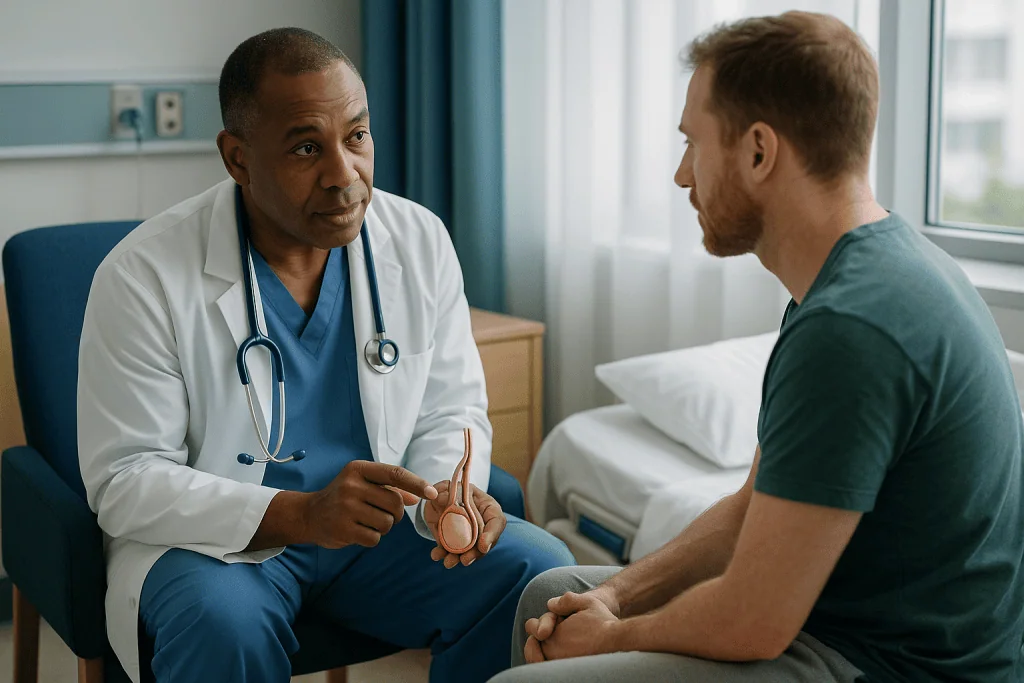
There are a few situations where the team may pause or sequence things differently. If tumor markers, the blood proteins some testicular cancers release, are very high and scans show bulky disease elsewhere, some centers begin chemotherapy first and remove the testicle afterwards; Mayo Clinic lists this as an option for advanced disease. If the lump is more likely a cyst, an infection or a swelling of the epididymis (the coiled tube behind the testicle), the urologist may recommend a repeat ultrasound rather than an operation.
Fertility planning can also shift timing by a day or two. Because the remaining testicle may already have reduced sperm production, and because chemotherapy or radiation may follow, the NHS advises that sperm banking be offered before treatment starts. Many teams arrange it before surgery so nothing is lost.
Removing part of a testicle, called partial orchiectomy, is occasionally considered when someone has only one testicle or tumors in both, but it is a specialist decision and not the norm. Who waits and who proceeds is a judgment your urologist makes from the ultrasound, the markers and your own priorities.
After orchiectomy, when to call the doctor and when to wait: the first 72 hours
The first three days set the pattern for everything that follows, so it helps to know what an ordinary Tuesday looks like versus a Tuesday that needs a phone call.
Ordinary includes a groin that aches when you sit up, cough or climb stairs, a dull heaviness low in the abdomen, bruising that spreads down into the scrotum and sometimes across to the other side, and a scrotum that feels swollen and tender to the touch. A few spots of blood or clear yellow fluid on the dressing are common. Appetite may be poor, bowels sluggish from anesthesia and pain medicine, and energy low. Cleveland Clinic describes this as the expected course for the first several days.
What is not ordinary, and what your surgeon will want to hear about the same day, includes a temperature of 38°C (100.4°F) or higher, which MedlinePlus lists as a warning sign of surgical wound infection; pain that climbs rather than settles despite the medicines you were given; swelling that balloons over a few hours or a scrotum that becomes hard, shiny and dark; bleeding that soaks a dressing; or any difficulty passing urine.
Anything involving the chest is an emergency, not a phone call. Sudden breathlessness, chest pain or coughing up blood after any operation can signal a blood clot that has traveled to the lung. So can a calf that is swollen, warm and painful on one side. These are rare after a groin operation, but they do not wait for office hours.
If in doubt, call. Surgical teams would far rather answer a question about a bruise than hear about a problem three days late.
How long does orchiectomy recovery take? The incision week by week
People searching for orchiectomy recovery time usually want a single number. The honest answer is a range, and it depends on what is being recovered.
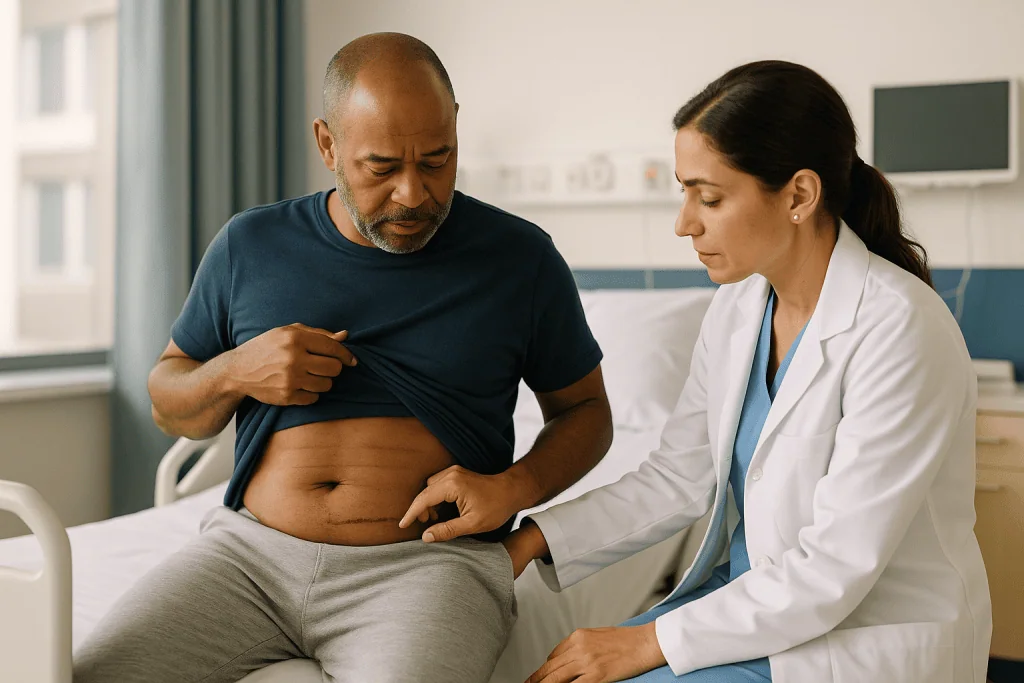
The skin itself heals fastest. In the first week the incision is pink or purple, slightly raised and firm underneath; that firmness is a healing ridge, not a lump of disease. Skin glue peels off on its own within roughly a week to ten days, and dissolvable stitches soften and disappear over several weeks. By the second week most people can shower normally, if they were not already, and the wound edges look sealed. By six to eight weeks the scar is flatter and paler, though it may stay a little numb or itchy for months because small skin nerves were cut.
The tissue deeper down takes longer. Cleveland Clinic describes a typical return to light daily activity within a couple of weeks and advises avoiding heavy lifting and strenuous exercise for several weeks afterwards, because the groin muscles and the tunnel where the cord was removed need time to knit. The NHS similarly describes recovery from orchiectomy in terms of a few weeks rather than days.
Fatigue is the slowest of all. Anesthesia, disrupted sleep, a new diagnosis and the wait for pathology combine into a tiredness that is not really about the incision. It usually lifts gradually over a month or so, but it is worth mentioning to your team if it does not.
Timelines here are typical patterns from published patient guidance, not promises. Your surgeon’s own instructions take priority.
Swelling after orchiectomy, bruising and pain: what is usually normal
Swelling after orchiectomy worries people more than almost anything else, partly because a scrotum that has just lost a testicle is expected to look smaller, and instead it often looks bigger. Two ordinary things explain that.
The first is a hematoma, a collection of blood under the skin from the small vessels cut during surgery. Gravity pulls it downward, so the scrotum and inner thigh can turn purple, then green and yellow, over about two weeks. The second is a seroma, a pocket of clear fluid the body produces in the space the testicle used to occupy. Both are soft, both are tender, and both shrink on their own in most cases. Cleveland Clinic lists bruising and swelling among the expected effects of the operation.
Supportive underwear, rather than loose boxers, keeps the scrotum from hanging and pulling on the wound, and many surgeons suggest it for the first week or two. Cool packs wrapped in a cloth, used for short spells, can ease the first days. Lying down with the hips slightly raised helps fluid drain.
Pain typically peaks in the first 48 hours and then declines steadily. It is usually described as an ache or pulling in the groin, worse with movement, coughing or a full bladder. Your team will have prescribed or recommended pain relief; the mechanism and choice of medicine, and any changes to it, belong to them.
The pattern to watch is direction of travel. Swelling and pain that plateau and then improve are normal. Swelling that keeps growing day on day, becomes hard and tense, or arrives with fever or spreading redness has changed category and deserves a call.
Normal healing versus a reason to call: a side-by-side guide
The table below gathers the distinctions from the sections above in one place. It is a guide to the conversation, not a substitute for it: your surgical team’s discharge sheet overrides anything here, and any sign that frightens you is reason enough to pick up the phone.
| What you notice | Usually part of healing | Call your care team |
|---|---|---|
| Incision | Pink, firm ridge, small amount of clear or blood-tinged fluid in first days | Redness spreading outward, pus, foul smell, edges opening, soaking through dressings |
| Scrotum | Soft swelling and bruising that peaks then slowly fades over about two weeks | Rapidly enlarging, hard, tense, shiny or very dark swelling |
| Pain | Aching that is worst in first 48 hours and eases with rest and prescribed medicine | Pain increasing after day three, or not controlled by what you were prescribed |
| Temperature | Feeling warm the first evening after anesthesia | 38°C (100.4°F) or higher, chills, sweats |
| Urination | Slight hesitancy the first day | Unable to pass urine, burning, blood in urine |
| Legs and chest | General tiredness, mild ankle puffiness from inactivity | One swollen, painful, warm calf; chest pain; sudden breathlessness (emergency) |
| Mood and energy | Low energy and worry while awaiting results | Persistent low mood, inability to sleep or function, thoughts of self-harm |
The fever threshold comes from MedlinePlus guidance on surgical wound infection; the healing patterns reflect Cleveland Clinic and NHS descriptions of orchiectomy recovery. Everything in the right-hand column is worth reporting even if it turns out to be nothing.
Signs of infection after orchiectomy and other wound problems
Wound infection after a groin operation is uncommon, but the groin is a warm, folded area, so it is worth knowing the signs of infection after orchiectomy rather than guessing.
MedlinePlus describes the classic picture: redness that spreads beyond the immediate edge of the incision, increasing warmth and swelling around the wound, thick yellow or green discharge, a bad smell, pain that gets worse instead of better, and fever. Any one of these on its own may be innocent; a faint pink line along a fresh scar is normal. The combination, or the trend, is what matters. Infections usually announce themselves between roughly day three and day ten, after the immediate post-operative soreness has begun to settle.
Two other wound problems deserve a mention. A small opening at one end of the incision, called wound dehiscence, sometimes happens where skin glue lifts early or where a stitch dissolves before the tissue has fully sealed. It looks alarming but is usually shallow and heals from the base with simple dressings; your team should see it, but it is rarely an emergency. A seroma can also occasionally leak clear fluid through the wound for a few days, which is messy but not infected as long as there is no redness, smell or fever.
Keeping the area clean and dry helps. Most surgeons allow showering after 24 to 48 hours with water running over the wound, then patting dry; baths, pools and hot tubs usually wait until the skin has fully closed. Do not apply creams, powders or antiseptics unless your team suggested them.
If antibiotics are needed, the choice and course length sit with the clinician who examines the wound.
Testosterone, fertility and sex after losing one testicle
The question people rarely ask out loud is whether one testicle is enough. For most, it is. The remaining testicle typically produces enough testosterone, the main male sex hormone, to keep energy, mood, muscle and sexual function within the normal range, and the NHS notes that having one testicle removed does not usually affect the ability to have erections or father children.
There are exceptions. Some people already had a smaller or less active remaining testicle before diagnosis. Others go on to chemotherapy or radiation, which can further reduce hormone and sperm production. For this reason many teams check a testosterone level at follow-up and ask about symptoms of low testosterone, called hypogonadism: persistent fatigue, low libido, difficulty with erections, low mood or loss of muscle. If levels are genuinely low and symptoms match, testosterone replacement is a treatment that exists; whether it is appropriate, and in what form, is a decision for your endocrinologist or urologist based on repeated blood tests, not a single reading.
Fertility follows a similar logic. Mayo Clinic and the NHS both advise discussing sperm banking before treatment begins, because it is easy to do beforehand and impossible to do retrospectively. Sperm counts may be lower than average at diagnosis for reasons related to the cancer itself, and they may take many months to recover after chemotherapy. A semen analysis some months down the line can clarify where things stand.
Sexual activity can usually resume once the wound is comfortable, often within a few weeks according to Cleveland Clinic. Ejaculation is unaffected by removing one testicle. Pain, bleeding or a sense of the scrotum being pulled during sex is reason to slow down and mention it at follow-up.
Lifting, driving, work and exercise: what the following weeks usually look like
Testicular cancer surgery recovery has a rhythm that most patient guidance describes in similar terms. The first week is for walking, not working out. Short, frequent walks around the house and garden reduce the risk of blood clots and help the bowels wake up, while lifting anything heavier than a kettle pulls on the groin repair.
Driving usually waits until you can brake hard without flinching and are no longer taking medicines that cause drowsiness; for many people that is around a week, though insurers and surgeons vary, so check both. Desk-based work is often possible within one to two weeks. Physically demanding jobs and contact sports typically wait for several weeks, in line with Cleveland Clinic’s advice to avoid heavy lifting and strenuous activity until the deeper tissue has healed. Cycling deserves a special mention: the saddle sits exactly where the swelling is, so many people find it uncomfortable for longer than running or swimming.
A sensible test before returning to any activity is whether it causes pain in the groin during or afterwards. Soreness the next morning suggests you pushed too soon; no reaction suggests the tissue is ready.
Travel is possible once you are comfortable and your team is happy for you to be away from follow-up. Long car or plane journeys in the first weeks call for regular leg stretches, good hydration and, if your team recommends it, compression stockings, because immobility after surgery raises clot risk. Keep your surgeon’s contact details and a copy of your discharge summary with you.
None of these timelines are targets. They are the shape of a typical recovery, and yours may be faster or slower without anything being wrong.
Tumor markers, staging and what usually comes after orchiectomy
Surgery ends one chapter and opens another, and understanding the second one makes the waiting easier.
The pathology report, usually available within a week or two, describes the cell type. The two main groups are seminoma and non-seminoma, terms for how the cancer cells look under the microscope; they behave differently and are treated differently. The report also notes the size of the tumor and whether cells were found in blood vessels or the spermatic cord.
Blood tests for tumor markers are repeated in the weeks after surgery. The three commonly measured, according to Mayo Clinic, are alpha-fetoprotein (AFP), beta human chorionic gonadotropin (hCG) and lactate dehydrogenase (LDH). If these were raised before surgery, the team watches whether they fall to normal, which suggests the cancer was confined to the testicle, or stay elevated, which suggests disease elsewhere. A CT scan of the chest, abdomen and pelvis completes the picture, and together these give the stage.
For early-stage disease, the most common next step described by the NHS and Mayo Clinic is surveillance: regular examinations, marker tests and scans over several years, with no further treatment unless something changes. Others are offered a short course of chemotherapy or, for some seminomas, radiation to the lymph nodes in the abdomen. A minority need a second operation, a retroperitoneal lymph node dissection (RPLND), which removes lymph nodes at the back of the abdomen.
Which path applies to you is a multidisciplinary decision made from your specific pathology and imaging. Ask your team to explain the reasoning, and ask what the surveillance schedule would involve in practice, because it is a multi-year commitment either way.
Should I have a testicular prosthesis, and what is normal if I did?
A testicular prosthesis is a soft silicone implant shaped and weighted to resemble a testicle. It has no medical function; it exists so the scrotum looks and feels balanced. Cleveland Clinic and the NHS both describe it as an option offered either during the orchiectomy or as a separate later procedure.
There is no right answer. Some people feel strongly that they want to look unchanged in a changing room or a relationship. Others find the idea of a foreign object unappealing, or decide later, once the shock has passed, that the difference does not bother them. Surgeons generally advise against rushing the choice if you are undecided, because a later insertion is a small operation and the reverse, removing an implant you regret, is also a small operation, but neither is trivial.
If you did have one placed, the early weeks look much like a standard recovery, with a little extra swelling and firmness around the implant. The prosthesis may sit higher than expected at first and settle over a few months as the internal stitch that anchors it relaxes. It will feel firmer and less mobile than a natural testicle. Signs to report are the same as for any wound: spreading redness, discharge, fever, or an implant that becomes very painful or seems to be pushing toward the skin, which can indicate infection or extrusion and needs prompt assessment.
Cold weather can make the implant feel oddly cool, since it does not have its own blood supply. That is normal and passes as your body warms it.
Discuss size, timing and expectations with your urologist rather than deciding from photographs online.
What people often get wrong about recovery after testicular cancer surgery
Myths cluster around this operation, partly because so few people talk about it. A few of the most common deserve a direct correction.
The first is that a swollen scrotum means the surgeon left something behind or the cancer has spread. It almost always means blood or fluid has drained downward from the groin wound, as described above, and it fades over a couple of weeks. Cancer does not spread visibly in a fortnight.
The second is that losing a testicle halves testosterone and ends sex life or fertility. The NHS is clear that one healthy testicle generally maintains normal hormone levels, erections and sperm production. Where problems arise, they are more often linked to further treatment or a pre-existing issue, and they can be measured and addressed.
The third is that a firm lump under the scar is a recurrence. A ridge of scar tissue under a healing incision is normal and can persist for months. New lumps in the remaining testicle are a different matter and should be examined, but scar tissue in the groin is expected.
The fourth is that supplements, special diets or unproven therapies sold online can replace surveillance or reduce recurrence. No mainstream guideline supports that, and skipping follow-up scans to pursue them removes the safety net that makes early-stage testicular cancer so manageable.
The fifth is that feeling low after surgery is weakness. Anxiety, grief for a changed body and fear of the pathology result are ordinary reactions. Mayo Clinic notes that support groups and counseling are part of standard care, not an add-on.
Finally, the belief that you should not bother the team with small questions. Surgical teams plan for those calls.
Questions to ask your care team before you leave and at follow-up
Discharge conversations are rushed and post-anesthesia memory is poor, so write questions down and bring someone to listen. These are the ones patients most often wish they had asked.
- Which number do I call in office hours, and which out of hours, if something worries me about the wound?
- What specifically would you want me to call about the same day, and what can wait for the follow-up visit?
- How was the wound closed, and when can the glue or dressing come off? When can I shower, and when can I bathe or swim?
- How much swelling and bruising is typical with your technique, and over how many days should I expect it to improve?
- What pain relief have you recommended, and what should I do if it is not enough? (The answer, and any changes, sit with them.)
- When can I drive, return to my particular job, lift my children, cycle or run?
- When will the pathology result be available, and who will contact me? Will we meet in person to discuss it?
- When are the tumor marker blood tests and CT scan scheduled, and what will each result change?
- Was a prosthesis placed, or is it something we should discuss later?
- Should I bank sperm before any further treatment, and how is that arranged?
- Will you check my testosterone at follow-up, and what symptoms should prompt an earlier check?
- Who can I speak to about the emotional side, for me and for my partner or family?
- How do I examine my remaining testicle, and how often?
Ask for the answers in writing where possible. A one-page summary of who to call, what to expect and when the next appointment falls is worth more than any general article, including this one.
When to call your doctor after orchiectomy: red-flag signs
Most recoveries pass without a single urgent call. Knowing which signs justify one lets you stop scanning every twinge and focus on getting well.
Call your surgical team the same day, including out of hours, for any of the following: a temperature of 38°C (100.4°F) or higher, or chills and shivering; redness spreading outward from the incision, pus or cloudy discharge, a foul smell, or wound edges that have opened; bleeding that soaks through a dressing or does not stop with ten minutes of firm pressure; scrotal swelling that is enlarging rapidly, feels hard and tense, or turns dark and shiny; pain that is increasing after the third day or is not controlled by the medicines you were given; inability to pass urine, or burning and blood when you do; persistent vomiting or a swollen, tender abdomen; a prosthesis that becomes painful or appears to be pushing toward the skin.
Treat as an emergency, and call emergency services or go to the nearest emergency department: chest pain, sudden shortness of breath or coughing up blood; a calf that is swollen, warm and painful on one side; fainting, confusion or a racing heart with fever; a wound bleeding heavily that will not stop.
Contact your team or a mental health professional promptly if low mood, anxiety or sleeplessness is stopping you functioning, or if you have any thoughts of harming yourself.
Between visits, also report a new lump, hardness or heaviness in the remaining testicle, new back pain, a persistent cough, or breast tenderness, since these are the symptoms surveillance is designed to catch early. None of them means recurrence, but each deserves examination rather than waiting for the next scheduled scan.
Frequently asked questions
After orchiectomy when should I call the doctor about swelling?
Call if the scrotal swelling is growing quickly over hours, feels hard and tense, turns dark or shiny, or comes with fever or spreading redness. Soft swelling and bruising that peak in the first days and slowly fade over roughly two weeks are an expected part of healing described in Cleveland Clinic and NHS guidance.
What is a normal orchiectomy recovery time?
Most people manage light daily activity within a couple of weeks and are advised to avoid heavy lifting and strenuous exercise for several weeks, according to Cleveland Clinic. The skin incision seals within about two weeks; fatigue and deeper tissue healing take longer. These are typical ranges, and your surgeon’s own advice applies to your recovery.
What are the signs of infection after orchiectomy?
MedlinePlus lists redness spreading beyond the wound edge, increasing warmth and swelling, thick yellow or green discharge, a bad smell, worsening pain and a temperature of 38°C (100.4°F) or higher. Infections most often appear between about day three and day ten. Report any of these the same day so the wound can be examined.
Is it normal to have a hard lump under the scar after testicular cancer surgery?
Yes, a firm ridge along and beneath a healing groin incision is scar tissue and can persist for months. It is not a sign of recurrence. A new lump, hardness or heaviness in the remaining testicle is different and should be examined, but firmness under the surgical scar is expected.
How long does swelling after orchiectomy last?
Swelling and bruising typically peak within the first few days and fade over about two weeks as the collected blood and fluid are reabsorbed. Supportive underwear and short spells with a wrapped cool pack can ease it. Swelling that continues to enlarge, hardens or arrives with fever needs a call to your care team.
Will one testicle produce enough testosterone?
For most people, yes. The NHS notes that a single healthy testicle usually maintains normal hormone levels, erections and fertility. Some people already have a less active remaining testicle, and chemotherapy or radiation can lower production further, so many teams check testosterone at follow-up and act only on repeated low readings with matching symptoms.
When can I have sex after testicular cancer surgery?
Usually once the groin wound is comfortable, often within a few weeks according to Cleveland Clinic. Ejaculation and erections are not affected by removing one testicle. Pain, bleeding or a pulling sensation in the scrotum is a reason to stop and mention it at follow-up rather than push through.
Can I fly or travel soon after orchiectomy?
Once you are comfortable, off sedating medicines and your team is happy for you to be away from follow-up, travel is generally possible. Post-operative immobility raises blood clot risk, so walk and stretch regularly, stay hydrated and follow any advice on compression stockings. Carry your discharge summary and your surgeon’s contact details.
What happens after orchiectomy for testicular cancer surgery recovery and follow-up?
The pathology report identifies the cell type, tumor markers are rechecked in the following weeks, and a CT scan completes staging. Early-stage disease is most often managed with surveillance, meaning regular examinations, blood tests and scans over several years; others are offered chemotherapy, radiation or lymph node surgery. Your multidisciplinary team explains which applies to you.
Is feeling anxious or low after orchiectomy normal?
It is very common. A new cancer diagnosis, a changed body and the wait for results are heavy in themselves. Mayo Clinic notes that counseling and support groups are part of standard care. If low mood or anxiety stops you functioning, or you have thoughts of self-harm, contact your team or a mental health professional promptly.
References
- NHS: Testicular cancer, treatment
- MedlinePlus: Surgical wound infection, treatment
- MedlinePlus: Testicular cancer
This article is for general information only and is not a substitute for professional medical advice. Please consult a qualified doctor about your individual situation.

More from the Blog

Life After Wilms Tumor Treatment: Living With One Kidney, Sports and Long-Term Follow-Up
Life after Wilms tumor usually means living well with one kidney, returning to school and most sports, and attending long-term follow-up for years. The…
Voice and Swallowing After Neck Cancer Treatment: What Rehabilitation Can Restore
Voice changes after neck cancer treatment, such as hoarseness, breathiness, a lower or weaker pitch and difficulty swallowing, are common after surgery, radiation or…
How Ovarian Cancer Treatment Is Planned: Surgery, Chemotherapy and the Order They Come In
Ovarian cancer treatment by stage usually combines surgery to remove as much visible cancer as possible with platinum-based chemotherapy. Early-stage disease confined to the…

Simple, Skin-Sparing or Nipple-Sparing Mastectomy: How the Types Differ and Who Gets Which
The main types of mastectomy differ in how much skin and nipple are kept, not in how much breast tissue is removed. A total…

Sarcoma in Teenagers and Young Adults: How Treatment Planning Considers Growth and School
Sarcoma treatment in teenagers usually combines chemotherapy with surgery, and sometimes radiation, sequenced over many months by a specialist sarcoma team. Because young bodies…

How Do Doctors Judge Whether SBRT Worked? Why the First Follow-Up Scan Waits a Few Months
After stereotactic body radiation therapy (SBRT), the first imaging check usually happens a few months after the final session, because irradiated tumors shrink slowly…