

Life After Skin Cancer Treatment: Sun Habits, Skin Self-Checks and Regular Reviews
Key Takeaways
- The WHO advises full sun protection whenever the UV index reaches 3 or higher, regardless of how warm or cloudy the day feels.
- Glass blocks most UVB but lets a large share of UVA through, which is why long drives on high-UV days count as sun exposure.
- Laboratory SPF assumes about a shot glass of sunscreen for an adult body; applying half that roughly halves the protection you think you have.
- A first skin cancer is the strongest single predictor of a second, which is why follow-up reviews focus on the whole skin surface, not just the scar.
- Fresh snow can reflect up to 80 percent of UV, so ski days deliver far more exposure than the forecast index alone suggests.
- No food has been shown to cause skin cancer to return, and vitamin D can be maintained through diet or supplements discussed with your doctor rather than through sunbathing.
Sun protection after skin cancer means daily habits rather than a single product: seeking shade when the UV index is 3 or higher, wearing tightly woven clothing, a wide-brimmed hat and UV-blocking sunglasses, and applying a broad-spectrum sunscreen of at least SPF 30 to exposed skin, reapplied every two hours outdoors. Monthly skin self-checks and the follow-up schedule set by your treating team complete the plan.
The stitches came out on a Tuesday. By Saturday the sky over the backyard was the cloudless kind that used to mean a long afternoon with the hedge trimmer, and Maria found herself standing at the sliding door with her sneakers on and her hand not quite on the handle. The dermatologist had said the basal cell carcinoma was removed with a clear margin. She had also said, almost in passing, that Maria’s skin had now shown what it does with ultraviolet light.
That pause at the door is where most people land after treatment. Sun protection after skin cancer is not complicated, but it does ask you to rethink habits that felt harmless for decades. The good news is that the evidence is unusually clear about what helps.
This article walks through the sun habits that matter, how to look at your own skin without turning every freckle into a crisis, and what the regular reviews with your care team are actually for.
How sun protection after skin cancer actually works
Ultraviolet radiation is the part of sunlight you cannot see or feel as heat, and it comes in two bands that matter for skin. UVB is shorter and is the main cause of sunburn. UVA is longer, reaches deeper, passes through window glass and drives much of the wrinkling and pigment change we call aging. The CDC notes that both bands damage the DNA inside skin cells, and both contribute to skin cancer.
A skin cell that has been treated to years of UV picks up small copying errors in its genetic code. Most are repaired or the cell dies. Occasionally one survives with an error in a gene that controls growth, and that cell becomes the seed of a tumor. Having had one skin cancer tells your doctors two things: your skin has absorbed enough UV to produce at least one such cell, and the surrounding skin, sometimes called the field, has probably collected similar damage that has not yet declared itself.
Protection works at the front end of that chain. Shade and clothing stop photons before they reach the skin. Sunscreen absorbs or scatters them within a thin film on the surface. None of this reverses damage already done, which is why self-checks and reviews remain part of the plan. It does reduce the rate at which new damage accumulates, and for someone whose skin has already proved vulnerable, slowing that clock is the single most useful thing within their own control.
One more mechanism is worth knowing. Immune cells in the skin help clear abnormal cells early, and UV suppresses that local immunity for hours after exposure. Protecting skin therefore does two jobs at once: fewer new mutations and a better-functioning cleanup crew.
Who needs the strictest sun protection, and who is asked to wait
Everyone who has had a skin cancer is advised to protect their skin, but some groups are asked to be especially careful. People who take medicines that dampen the immune system, for example after an organ transplant or for certain autoimmune conditions, develop squamous cell carcinomas at markedly higher rates because UV-damaged cells are cleared less efficiently. People with very fair skin, many moles, a history of blistering sunburns in childhood or a family history of melanoma also sit at the higher-risk end, according to Mayo Clinic’s summary of risk factors.
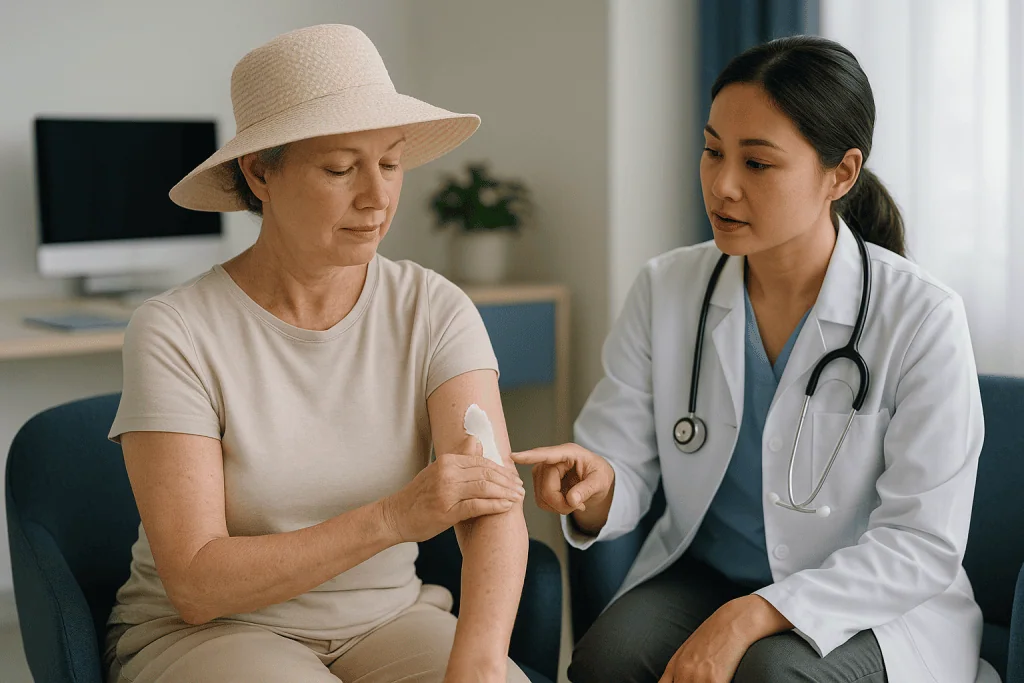
Who is asked to wait? Usually this concerns the treated area rather than sun protection in general. A wound that is still open, weeping or held together with sutures or adhesive strips should not have sunscreen rubbed into it. Surgeons and dermatology nurses generally ask patients to keep a healing wound covered with a dressing or clothing until the skin has closed, then to start protecting the new scar. The exact moment depends on how the area was treated, whether it was excised, frozen, scraped, treated with a topical cream or with radiation, and only the team that did the procedure can say when it is ready.
Skin treated with radiation, or with certain topical treatments, can stay unusually sensitive for weeks. During that period sun exposure may cause more irritation than usual, and teams often recommend physical cover over sunscreen until the reaction settles.
Children and teenagers deserve a mention, because a parent’s diagnosis often prompts the whole household to change habits. A large share of lifetime UV exposure happens before adulthood, and the same shade, hat and clothing rules apply from infancy onward. Sunscreen use in babies under six months is something to discuss with a pediatrician rather than assume.
Is sunscreen enough? The layers that do the real work
The honest answer is no, and the ranking surprises people. Guidance from the CDC and WHO puts shade and clothing ahead of sunscreen, not because sunscreen fails, but because fabric and roof tiles do not wear off, are not applied too thinly and do not get forgotten after a swim.
Start with timing. The CDC identifies the hours between 10 a.m. and 4 p.m. as the strongest UV window in most of the United States. Moving a walk, a gardening session or a child’s practice to early morning or late afternoon removes a large slice of exposure with no effort at all. The shadow rule is a useful shortcut: when your shadow is shorter than you are, the sun is high and UV is strong.
Next, fabric. Tightly woven, darker or brighter cloth blocks more UV than loose, pale, thin weaves. Hold a shirt up to a window; if you can see light through it, UV is getting through too. Clothing sold with a UPF label has been tested for how much UV it blocks, and a UPF of 50 stops roughly 98 percent of UV reaching the fabric, a figure the CDC cites in its clothing guidance. A hat with a brim of about three inches all the way around shades the face, ears and neck, which are the sites where skin cancers cluster.
Sunglasses that block UVA and UVB protect the eyelids, which are thin-skinned and commonly affected, and reduce the eye conditions linked to UV.
Sunscreen fills the gaps: face, hands, forearms, feet in sandals, the part in your hair. Think of it as the last layer rather than the first.
What is the best sunscreen to use after skin cancer?
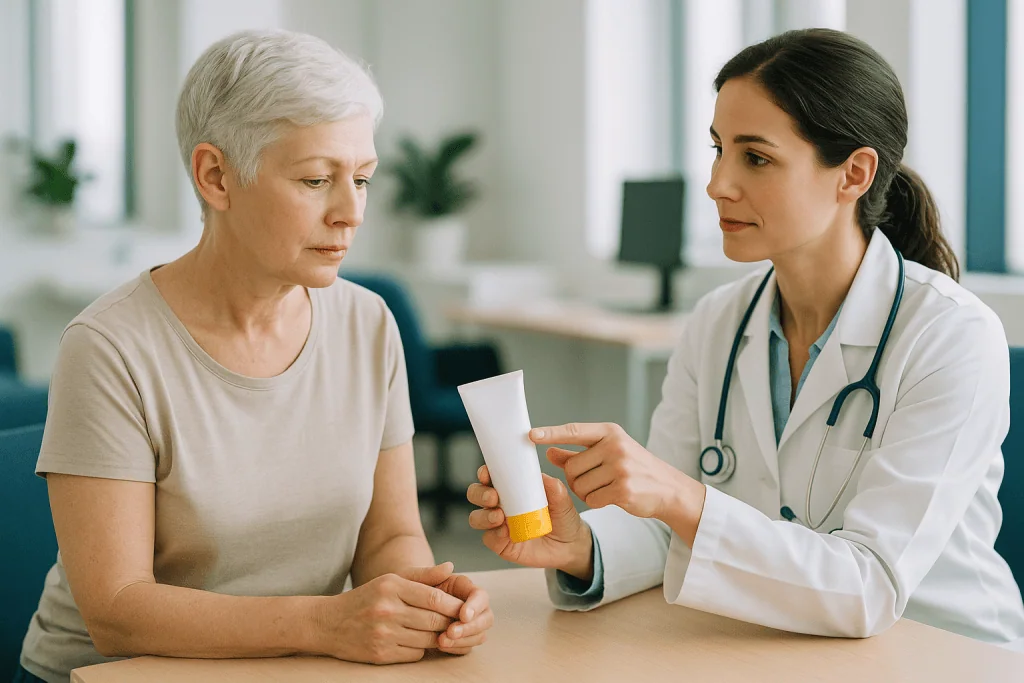
There is no single best product, and no mainstream guideline names one. What the evidence supports is a set of label features, and once a sunscreen meets them, the best one is the one you will actually wear every day.
| Label term | What it means in plain language | Why it matters after skin cancer |
|---|---|---|
| Broad spectrum | Filters both UVA and UVB | Both bands damage skin DNA; SPF alone measures only UVB |
| SPF 30 or higher | Filters roughly 97 percent of UVB when applied at the tested thickness | Recommended by the NHS and widely used in US guidance for high-risk skin |
| Water resistant (40 or 80 minutes) | Keeps its SPF for that long in water or heavy sweat | Sets a realistic reapplication interval when swimming or exercising |
| Mineral filters (zinc oxide, titanium dioxide) | Sit on the surface and scatter UV | Often gentler on freshly treated or sensitive skin |
| Chemical filters | Absorb UV and release it as heat | Lighter textures that some people find easier to wear daily |
Two practical points matter more than the filter debate. First, quantity. Laboratory SPF is measured at a thickness most people never achieve; Mayo Clinic describes about a shot glass worth, roughly one ounce, to cover the exposed skin of an adult in a swimsuit, and a nickel-sized amount for the face. Most people apply a quarter to half that. Second, reapplication. The CDC advises reapplying every two hours outdoors and sooner after swimming, sweating or toweling off.
Mineral and chemical filters are both considered safe by regulators when used as directed. If a product stings a scar or triggers a rash, switch rather than stop; your dermatology team can suggest what tends to suit treated skin.
Should I use sunscreen after having melanoma skin cancer?
Yes. This question appears in search results so often that it deserves a direct answer, and the concern behind it is usually one of two things: a worry that sunscreen itself is risky, or a hope that the melanoma has already happened and further protection is pointless. Neither holds up.
On the first point, regulatory reviews in the United States and Europe have found no evidence that approved sunscreen filters cause cancer, and the NHS sunscreen guidance recommends daily use for anyone at increased risk. Questions about how much of certain chemical filters are absorbed through skin prompted ongoing research, but no health harm has been demonstrated, and mineral filters exist for anyone who prefers to avoid the uncertainty entirely.
On the second point, the logic runs the other way. A melanoma diagnosis raises the chance of a second primary melanoma and of other skin cancers, because the same skin, the same genetics and the same accumulated UV remain. Cleveland Clinic’s patient material on melanoma lists sun protection and regular skin checks as standard parts of life after treatment. Reducing future UV exposure is one of the few risk factors a person can change after diagnosis.
People treated for melanoma sometimes ask whether they must avoid the outdoors altogether. Guidance does not say that. It says to make outdoor time deliberate: check the UV index, choose shade, cover skin, apply and reapply sunscreen, and keep the appointments your team has set. Ordinary life, including sport, gardening and travel, continues.
If you are receiving immunotherapy or targeted therapy for melanoma, some of these treatments make skin more reactive to sunlight. Your oncology team will say whether that applies to you.
UV index and skin cancer risk: planning your day by the number
The UV index is a scale developed by the WHO and partner agencies that describes the strength of ultraviolet radiation expected at midday, from 1 to 11 and above. It appears in most weather apps and on many forecast pages. For someone managing sun protection after skin cancer, it turns a vague sense of “it looks sunny” into a specific plan.
The WHO’s guidance is straightforward: at a UV index of 3 or higher, protection is needed, meaning shade during peak hours, clothing, a hat, sunglasses and sunscreen. At 1 or 2, most people can be outdoors safely without special measures, though anyone with very fair or recently treated skin may still choose to cover up. From 8 upward the WHO advises minimizing time outside around midday.
Three facts about the index catch people out. Cloud is unreliable cover; thin or scattered cloud can let most UV through, and the index accounts for expected cloud only in general terms. Temperature is irrelevant; a cool spring day at altitude can carry a higher UV index than a humid summer evening. Reflection adds to the total: the WHO notes that fresh snow can reflect up to 80 percent of UV, dry sand around 15 percent and sea foam around 25 percent, so beach and ski days deliver more than the forecast number suggests.
Windows change the mix. Glass blocks most UVB but allows a large share of UVA through, which is why the left side of the face and the left forearm often show more sun damage in people who drive a lot in the United States. Long drives on high-index days are a reasonable moment for sunscreen even indoors.
Skin self-exam after skin cancer: how to check without spiraling
A skin self-exam is a systematic look at your own skin, usually once a month, to notice anything new or changing so your care team can assess it. Mayo Clinic and Cleveland Clinic both recommend this rhythm for people with a history of skin cancer. Monthly is frequent enough to catch change early and infrequent enough that you learn what normal looks like instead of reacting to daily fluctuations.
Set the scene properly. Use a full-length mirror and a hand mirror in a well-lit room, or ask a partner to help with your back and scalp. Work in the same order every time: face and ears, scalp with a comb, neck, chest, arms including palms and between fingers, torso, back, buttocks, legs, soles of the feet and between the toes. Many skin cancers appear in places that never see the sun, so the whole surface counts.
What you are looking for is change rather than a diagnosis. The features clinicians use for pigmented spots are often summarized as ABCDE: asymmetry, irregular border, more than one color, diameter growing, and evolution over time. Non-pigmented skin cancers more often look like a sore that does not heal, a pearly or waxy bump, or a scaly patch that keeps returning. The “ugly duckling” idea is useful too: a spot that simply does not resemble its neighbors deserves a second look.
Photographs help enormously. A dated picture of your back or a cluster of moles, taken in the same light, lets you and your doctor compare rather than rely on memory. The point of a self-check is not to decide what a spot is. It is to know what to bring to the appointment.
Skin cancer follow-up appointments: what regular reviews involve
Follow-up after skin cancer has two aims: to detect any return of the treated cancer, and to find new skin cancers early, when treatment is simplest. How often you are seen depends on the type of cancer, its stage and your personal risk, and the schedule is set by your treating team rather than by a fixed rule.
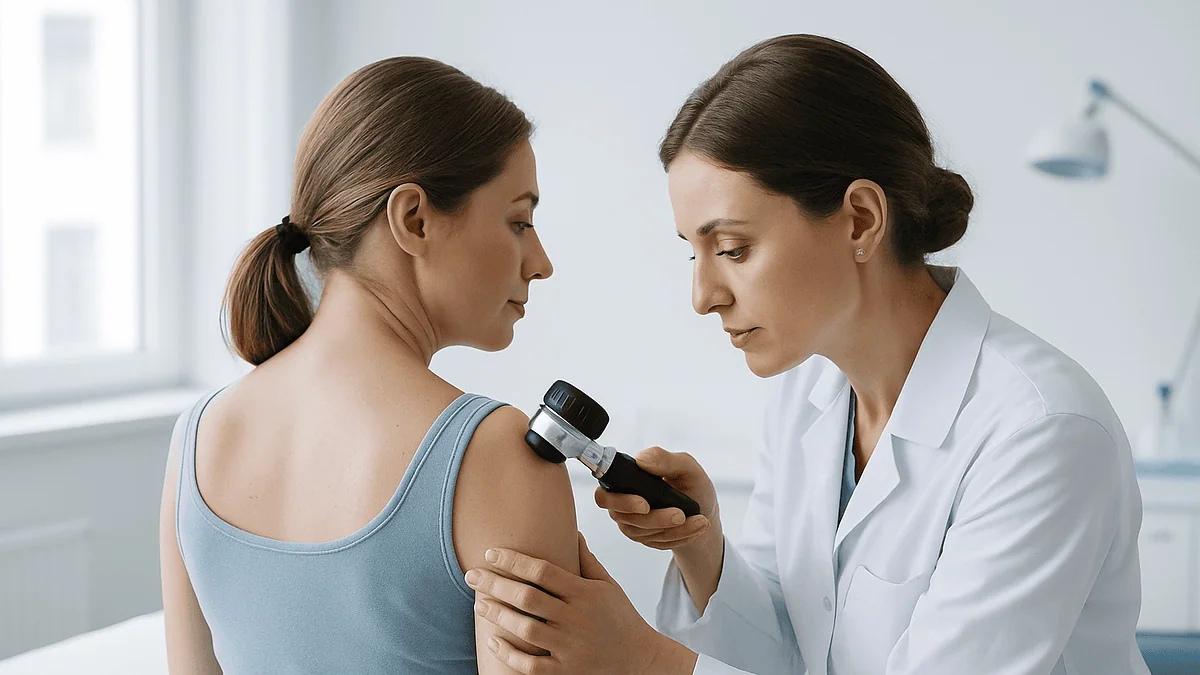
A typical review is unglamorous. A dermatologist or specialist nurse examines the treated site and scar, then the whole skin surface, often using a dermatoscope, a handheld magnifier with polarized light that shows structures beneath the surface. For melanoma, the lymph nodes near the original site are usually felt. Some services photograph the whole body or map moles digitally so that change can be measured between visits. Imaging or blood tests are not routine for low-risk skin cancers and are reserved for situations where the team judges them useful.
The NHS describes check-ups after melanoma continuing for several years, more frequent in the first period after treatment and spaced out over time, with the exact pattern depending on stage. Basal cell carcinoma follow-up is often lighter, sometimes a single check or an annual review, because spread beyond the skin is rare. People at high risk of further squamous cell carcinomas, particularly those on immune-suppressing medicines, are often reviewed more closely.
Bring your own notes. A short list of spots you have wondered about, your photographs and any questions makes the appointment more useful. If you notice something worrying between reviews, guidance is consistent: do not wait for the next scheduled date. Call and ask to be seen.
What the first weeks after skin cancer treatment usually look like
Recovery depends on how the cancer was treated, so the following is a general picture rather than a prediction for your case. Your team’s written aftercare instructions take priority over anything here.
After surgical excision, the most common treatment for basal and squamous cell carcinoma, the wound is closed with sutures or left to heal with dressings. Sutures on the face are usually removed within about a week, and elsewhere within two weeks, per typical dermatology practice described by Mayo Clinic. The area may be swollen and bruised for several days. Once the skin has closed, the new scar is pink and fragile and burns far more easily than the surrounding skin, so covering it or applying sunscreen once your team gives the go-ahead protects both the scar’s appearance and the skin beneath.
Cryotherapy, meaning freezing, and curettage, meaning scraping, leave a blister or shallow wound that crusts over and heals across two to four weeks in most cases. Topical treatments for very early or precancerous lesions cause deliberate redness and peeling that can last through the treatment course and a week or two beyond. Radiation to the skin produces a reaction that peaks after the course ends and settles over the following weeks.
Fatigue and low mood are common in the weeks after any cancer diagnosis, even a small one, and are worth mentioning to your team rather than pushing through alone.
Sun habits can begin immediately for the rest of your skin. The treated area joins in when it has healed, and a gentle question at your first review, “can I put sunscreen on this now?”, is exactly the kind of question follow-up exists to answer.
Vitamin D, diet and supplements: what foods should I avoid?
People searching this question usually hope for a list. The honest answer is that no food has been shown to cause skin cancer to return, and no diet has been shown to prevent it. Mainstream guidance from the CDC and Mayo Clinic focuses on UV protection and skin checks because that is where the evidence is.
A few nutrition points are worth knowing. Observational studies have linked higher alcohol intake with higher melanoma risk, and alcohol also makes people less likely to reapply sunscreen or seek shade; keeping intake modest is reasonable on general health grounds. A diet rich in vegetables, fruit and whole grains supports overall health during recovery, though it should be seen as good sense rather than skin cancer treatment.
Vitamin D is the real worry behind the question. Skin makes vitamin D when UVB reaches it, so covering up raises a fair concern. The NIH Office of Dietary Supplements notes that vitamin D can be obtained from oily fish, fortified milk and cereals, egg yolks and supplements, and that the amount needed varies by age. Anyone consistently practicing sun protection after skin cancer can ask their doctor whether a blood test or a supplement is sensible. Deliberate sunbathing to make vitamin D is not recommended by any of these bodies.
A form of vitamin B3 called nicotinamide has been studied for reducing new skin cancers in people who have had several. Results differ between trials, one showing a reduction in a high-risk group and a later trial in transplant recipients finding no benefit, so it is not established standard practice. If you have read about it, raise it with your dermatology team rather than starting it on your own.
Scared of the sun after skin cancer: finding the line between caution and fear
The pause at the sliding door is common enough that dermatology nurses have a name for the feeling behind it. After a diagnosis, sunlight can shift in the mind from a pleasure to a threat, and some people begin avoiding daylight altogether, canceling outdoor plans, or checking their skin several times a day. This is an understandable reaction, and it is also more restrictive than the evidence requires.
The guidance from the WHO, CDC and NHS does not ask anyone to live indoors. It asks for a set of habits during the hours and seasons when UV is strong, and for a monthly rather than daily look at the skin. Outdoor exercise, gardening, travel and time with family all remain available, and all of them support the physical and mental recovery that matters after any cancer diagnosis.
A few practical anchors help. Let the UV index make the decision for you; a number below 3 means an ordinary day out. Keep a hat and a sunscreen stick by the front door and in the car so protection stops requiring willpower. Choose one date each month for your skin check and put it in your calendar, then deliberately leave your skin alone the rest of the time. If a spot worries you, photograph it and call your team instead of watching it hourly.
Persistent anxiety, poor sleep or a sense that the diagnosis has taken over daily life are worth raising with your doctor. Many cancer services have psychologists or counselors who work with exactly this, and asking for that support is part of good follow-up, not a sign of overreacting.
What people often get wrong about sun protection after skin cancer
Some of the most common beliefs about sun and skin cancer sound plausible and are simply wrong. Correcting them matters because each one leads to a specific gap in protection.
“A base tan protects me.” A tan is the skin’s response to DNA damage, and Harvard Health notes it offers only a small amount of protection, roughly equivalent to a very low SPF, while the exposure needed to get it adds to lifetime damage. Tanning beds emit UVA at high intensity and are classified by the WHO as carcinogenic to humans.
“I only need sunscreen on hot, sunny days.” UV depends on the sun’s angle, not temperature, and passes through cloud and glass. A cool, bright day in April can carry a higher UV index than a humid August evening.
“Higher SPF means I can stay out longer.” SPF describes how much UVB is filtered at the tested thickness. SPF 30 filters roughly 97 percent and SPF 50 about 98 percent, per the NHS. Neither extends the two-hour reapplication interval, and neither compensates for a thin layer.
“Dark skin does not get skin cancer.” It gets it less often but not never, and the CDC notes that skin cancers in people with darker skin are more often found late, partly because of this belief. Palms, soles and nail beds deserve attention in every skin tone.
“Once treated, the risk is gone.” The opposite is true. A first skin cancer is the strongest predictor of a second, which is the whole reason follow-up exists.
“Sunscreen causes vitamin D deficiency.” Real-world studies have not found that typical sunscreen use produces deficiency, largely because most people apply less than the tested amount and vitamin D is also available from food and supplements.
Questions to ask your care team
Follow-up appointments are short, and the questions that matter most tend to surface in the parking lot afterward. Writing them down beforehand changes the visit. The list below is a starting point; pick the ones that fit your situation.
- What type and stage of skin cancer did I have, and what does that mean for my risk of another one?
- How often will I be reviewed, for how long, and who should I contact between appointments if I notice something?
- When can I start applying sunscreen to the treated area, and is there anything I should avoid on the scar while it heals?
- Are any of my medicines making my skin more sensitive to sunlight, and does that change what you recommend?
- Do I need any imaging, blood tests or lymph node checks, or is a skin examination enough in my case?
- Should I have my vitamin D level tested, given that I will be covering up more?
- Would whole-body photography or mole mapping be useful for me?
- Should my children, siblings or parents be examined, and what should they know about their own risk?
- Is there anything about my work, sport or travel plans that you would ask me to change?
- Who can I talk to if I find that worry about the sun or my skin is affecting daily life?
You are also entitled to ask for your pathology report and to have any unfamiliar term in it explained. Clear margins, depth, and the presence or absence of features like ulceration are details your team uses to set your follow-up, and understanding them makes the rest of the plan feel less arbitrary. Every decision about treatment, testing and timing sits with the team that knows your case, and good questions help them tailor it.
When to call your doctor
Most changes people notice after skin cancer treatment are harmless: a scar that stays pink for months, a mole that has always been there but is newly noticed, a patch of dry skin. Even so, guidance from Mayo Clinic, Cleveland Clinic and the NHS is consistent that certain signs should prompt a call to your care team rather than waiting for the next scheduled review.
Contact your doctor promptly if you notice any of the following:
- A new lump, thickening or nodule in or next to the treated scar, or a scar that begins to break down, bleed or ulcerate after it had healed.
- A spot anywhere on your skin that is new, growing, changing shape or color, bleeding, itching persistently, or crusting and never fully healing.
- A mole that looks clearly different from all your others, or that has developed a dark, irregular or multicolored area.
- A lump under the skin in the neck, armpit or groin, particularly on the same side of the body as a treated melanoma.
- A dark streak under a nail, or a dark patch on a palm or sole, that you cannot explain by injury.
Seek urgent care the same day for signs of wound infection after surgery, including spreading redness, warmth, increasing pain, pus or a fever, or for a wound that bleeds heavily and does not stop with firm pressure.
If you have been treated for melanoma and develop unexplained persistent headaches, breathlessness, bone pain, or significant unintended weight loss, tell your oncology team; these are non-specific and have many ordinary causes, but they are exactly what follow-up is designed to assess.
None of these signs means the cancer has returned. Each one means a clinician should look, and the only wrong response is to wait.
Frequently asked questions
What is the best sunscreen to use after skin cancer?
The best sunscreen is one labeled broad spectrum, SPF 30 or higher and water resistant, that you will actually apply generously every day. No guideline names a specific product. Mineral filters such as zinc oxide often suit freshly treated or sensitive skin; chemical filters offer lighter textures. Apply about a shot glass for the body and reapply every two hours outdoors, per CDC guidance.
What is the 2 week rule for skin cancer?
The two-week rule is a UK referral standard: when a family doctor suspects skin cancer, the patient should be seen by a specialist within two weeks. It is a health-system target, not a medical rule about how fast cancers grow. In the United States there is no equivalent fixed pathway, but the principle applies: a suspicious spot should be examined promptly rather than watched for months.
Should I use sunscreen after having melanoma skin cancer?
Yes. A melanoma diagnosis raises the risk of further melanomas and other skin cancers, and reducing future UV exposure is one of the few risk factors you can change. Regulatory reviews have found no evidence that approved sunscreen filters cause cancer. Use sunscreen as the final layer after shade, clothing, a hat and sunglasses, and follow your oncology team’s advice if your treatment makes skin more light-sensitive.
What foods should I avoid if I have skin cancer?
No food has been shown to cause skin cancer to return, so there is no evidence-based avoidance list. Observational studies link heavier alcohol intake with higher melanoma risk, and alcohol also undermines sun-safe behavior, so moderation is reasonable. A varied diet supports recovery generally. If you are covering up more, ask your doctor about vitamin D from food, fortified products or a supplement.
How often should I do a skin self-exam after skin cancer?
Once a month is the rhythm recommended by Mayo Clinic and Cleveland Clinic for people with a history of skin cancer. Monthly is frequent enough to catch change early and infrequent enough to learn what your normal skin looks like. Use good light, two mirrors or a helper, check the whole surface including scalp, soles and between toes, and photograph anything you want to compare later.
How long do skin cancer follow-up appointments continue?
It depends on the type and stage. The NHS describes melanoma check-ups continuing for several years, more frequent early on and spaced out later. Basal cell carcinoma follow-up is often lighter, sometimes a single review or annual checks, because spread is rare. People at high risk of repeated squamous cell carcinomas may be seen more closely. Your treating team sets the schedule for your case.
Does the UV index matter for skin cancer if it is cloudy or cool?
Yes. UV strength depends on the sun’s angle and season, not on temperature, and thin or scattered cloud lets most UV through. The WHO advises protection at a UV index of 3 or above whatever the weather feels like. A bright, cool spring day can carry a higher index than a humid summer evening, so check the number in your weather app rather than judging by warmth.
Can I still go on beach or ski vacations after skin cancer?
Generally yes, with planning. Sand reflects around 15 percent of UV and fresh snow up to 80 percent, per the WHO, so these settings deliver more exposure than the forecast index suggests. Plan outdoor time outside the midday peak, use shade structures, wear UPF clothing and a brimmed hat, and reapply sunscreen every two hours or after swimming. Ask your team about any recently treated skin before you travel.
When can I put sunscreen on my scar after skin cancer surgery?
Only once the wound has fully closed and your team has said it is ready, which for many excisions is after sutures come out, typically within one to two weeks. Until then, keep the area covered with a dressing or clothing. A new scar is pink, fragile and burns easily, so protecting it once healed helps both its appearance and the skin beneath. Your surgeon’s written aftercare instructions take priority.
Does wearing sunscreen every day cause vitamin D deficiency?
Real-world studies have not found that typical sunscreen use leads to deficiency, largely because most people apply less than the tested amount and vitamin D also comes from oily fish, fortified foods and supplements. The NIH Office of Dietary Supplements notes that intake needs vary by age. If you practice strict sun protection, ask your doctor whether a blood test or supplement is sensible rather than sunbathing to compensate.
References
This article is for general information only and is not a substitute for professional medical advice. Please consult a qualified doctor about your individual situation.

More from the Blog
How Esophageal Cancer Treatment Is Planned: From Endoscopic Removal to Combined Care
Esophageal cancer treatment is planned by stage after tests map how deep the tumor has grown and whether it has reached lymph nodes or…
Radiation for Cervical Cancer: Expected Side Effects and the Signs That Need a Call
Radiation for cervical cancer commonly causes tiredness, loose stools or diarrhea, bladder irritation, skin soreness in the groin and buttocks, and vaginal discharge or…

Does Radiation Therapy Hurt? What the Beam Feels Like and Where Discomfort Comes From
External beam radiation therapy is not felt while it is being delivered; the beam itself causes no pain, heat or pressure. Discomfort, when it…
What Is Normal After Testicular Cancer Surgery and When to Call Your Care Team
After orchiectomy, mild groin soreness, bruising, a little swelling and tiredness for a few weeks are common. Call your care team the same day…
Is a Second Opinion Useful for a Leukemia Treatment Plan? What Hematologists Say
A leukemia second opinion is generally considered useful, and many hematologists treat it as routine rather than a sign of distrust. Because leukemia is…

Living With Permanent Brachytherapy Seeds: Contact With Children, Pets and Partners
Permanent brachytherapy seeds give off low-energy radiation that is mostly absorbed within a few millimeters of surrounding tissue, so everyday contact such as sharing…