

Does the Robot Operate on Its Own? Robotic Knee Replacement Myths, Corrected

Key Takeaways
- In robotic-assisted knee replacement the surgeon performs every step; the arm guides or limits the cutting tool to a plan the surgeon created and can override at any time.
- The incision, anesthesia, implant families and rehabilitation program are the same as in conventional knee replacement; only the planning and execution of bone cuts differ.
- Studies consistently show robotic assistance places implants closer to the planned position, but a durable advantage in long-term function or implant survival has not yet been demonstrated.
- Downsides include longer operating time during the learning curve, extra tracker pin sites in the bone, and a CT scan on some systems.
- The NHS describes a typical hospital stay of one to three days and notes that full recovery from knee replacement can take up to a year, regardless of technique.
- Unrealistic expectations are among the strongest predictors of dissatisfaction after knee replacement, and no evidence yet shows robotic assistance lowers dissatisfaction rates.
No. In robotic knee replacement, the surgeon performs the operation and the robotic arm acts as a precision tool. The surgeon plans the implant position on a 3D map of the knee, and the system then guides or limits the saw or burr to that plan. It cannot start, move or make decisions on its own, and the surgeon can pause or override it at any point.
A retired schoolteacher sat across from her surgeon with a printout folded into quarters. The headline promised a knee replaced by a robot. Her first question was not about pain or recovery. It was simpler: who, exactly, will be holding the saw?
That question sits at the heart of most robotic knee replacement myths. Marketing images show a gleaming arm hovering over a draped leg, and the imagination fills in the rest: a machine working alone while people watch from behind glass. The reality in the operating room is quieter and more human than that.
This explainer walks through what the robotic arm actually does, what it cannot do, what the research shows so far, and the questions worth asking before anyone agrees to a date. Where the evidence is still thin, it says so plainly.
Does the robot operate on its own? What actually happens in the room
Picture the operating room about twenty minutes into the case. The surgeon has already made the incision, moved the soft tissue aside and exposed the worn joint surfaces. Only now does the robotic arm come into play, and it does nothing until a human tells it to.
A knee replacement, in plain terms, is an operation that removes the damaged ends of the thigh bone and shin bone and covers them with metal and plastic components that glide against each other. The hardest technical part is cutting the bone at exactly the right angles and depths so the new parts sit level and the ligaments stay balanced. That is the step where the robotic system earns its place.
Small reflective markers are pinned to the bones. Cameras track them continuously, so the system always knows where the knee is in space, even as the leg is bent and straightened. The surgeon then brings the cutting instrument, which is attached to the arm, toward the bone. The arm either guides the saw along the planned cut or, on some systems, physically resists movement outside the planned zone. Cleveland Clinic describes robotic surgery generally as surgeon-controlled, with the machine translating the surgeon’s hand movements and providing precision rather than autonomy.
At every moment the surgeon’s hands are on the instrument. If the plan looks wrong once the joint is opened, the surgeon changes the plan on the screen, or sets the arm aside and finishes with conventional tools. Nothing about the operation requires the machine to make a judgment. The judgment, and the responsibility, remain with the person in the gown.
Why the word robot misleads, and what the arm really is
Language does a lot of the damage here. When most people hear robot, they picture something that thinks. Engineers who build surgical systems use a narrower definition: a machine that carries out precise, repeatable motion under external control. A dishwasher meets that definition. So does a car with cruise control, which does not decide where you are going.
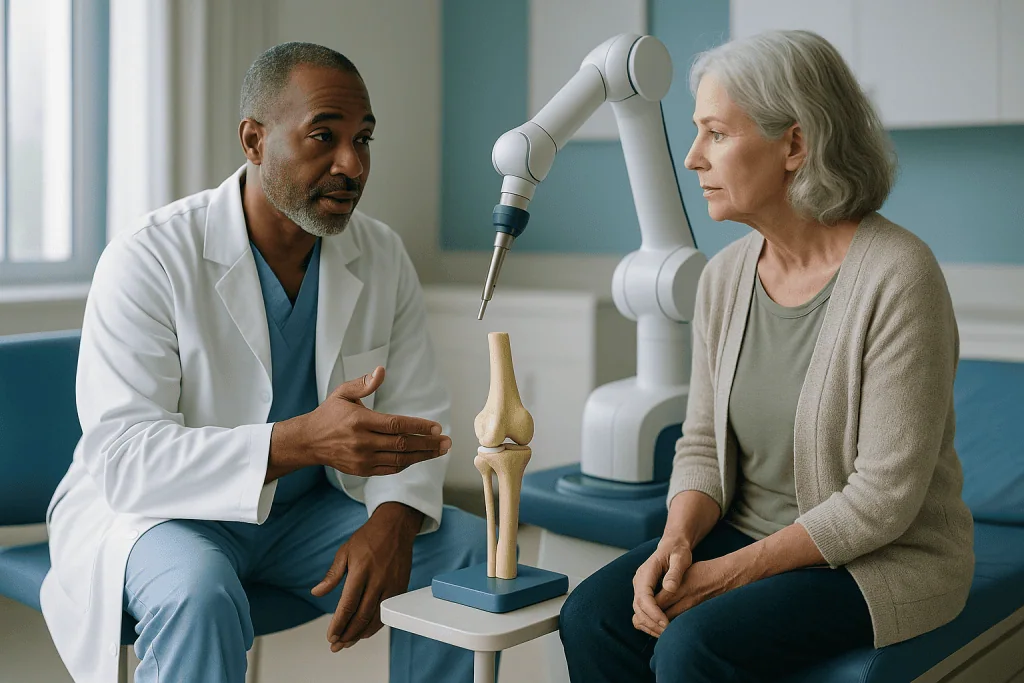
A more accurate phrase is robotic-assisted, or robotic-arm assisted, knee replacement. The arm is closer to a very sophisticated jig: a device that holds a cutting tool steady and keeps it within boundaries the surgeon has defined. What separates it from the metal guides surgeons have used for decades is that the boundaries are set digitally from a three-dimensional model rather than eyeballed from bony landmarks.
Three features tend to be present across systems, whatever the brand. First, tracking: cameras or sensors follow the position of the bones in real time. Second, planning: software shows the surgeon where the implant will sit and how the ligaments are likely to behave at different knee angles. Third, execution: the arm guides or constrains the instrument so the cut matches the plan.
What is absent is any capacity to decide. The system does not know whether a person is a good candidate, whether the ligaments feel too tight, or whether a bone cyst discovered mid-operation changes the approach. Those calls are made the same way they have always been made, by a trained surgeon looking at the joint.
Understanding this distinction matters because it reframes the question a patient should ask. Not: how good is the robot? Rather: how experienced is the team using it, and what does the evidence say the tool adds?
How the 3D plan is built before the first cut
The planning stage is where robotic-assisted surgery differs most visibly from the traditional approach, and it usually happens days before the operation or in the first minutes of it.
Some systems rely on a CT scan, which is a series of X-ray slices assembled into a three-dimensional image of the bone. Others build the map during surgery by touching a tracked probe to dozens of points on the exposed joint surface, a process sometimes called registration. Either way, the result is a digital model of that person’s knee rather than an average knee from a textbook.
On that model, the surgeon chooses the implant size and positions it virtually. The software then predicts how the knee will move through a full arc of bending and straightening, and how much tension the ligaments on the inner and outer sides will carry. If the model suggests one side will be too tight, the surgeon can adjust the planned cuts by fractions of a millimeter and a degree or two of rotation before any bone is removed.
This is the honest technical case for the technology. Conventional instruments achieve good alignment in most hands, but they depend on visual and tactile estimates. The digital plan aims to reduce the spread of those estimates. Whether smaller variation in alignment translates into knees that feel better years later is a separate question, and the next sections take it seriously rather than assuming the answer.
Worth noting for the anxious reader: the plan is a proposal, not a script. Surgeons routinely revise it once they see the joint. The scan cannot feel scar tissue, and it cannot know how a particular knee has adapted to years of limping.
Robotic vs traditional knee replacement: what actually differs
Strip away the branding and the two approaches share far more than they differ. The incision, the anesthesia, the implants themselves, the hospital pathway and the rehabilitation are essentially the same. The difference lives in one phase of the operation: how the bone cuts are planned and executed.
| Step | Conventional instruments | Robotic-assisted |
|---|---|---|
| Who operates | Surgeon | Surgeon, with the arm as a guided tool |
| Planning | X-rays plus landmarks seen during surgery | 3D model from CT or intraoperative mapping |
| Bone cuts | Metal guides pinned to bone | Arm guides or limits the saw to the digital plan |
| Ligament balance | Assessed by feel and spacer blocks | Software prediction plus surgeon’s feel |
| Implants used | Standard designs | Standard designs, matched to the system |
| Anesthesia and incision | Same | Same |
| Rehabilitation | Same program | Same program |
| Extra steps | None | Possible CT scan; tracker pins in bone |
Two lines in that table deserve a second look. The implants are the same families of metal and plastic components used for years, so the technology does not change what is left inside the knee. And the rehabilitation is identical, which is why claims of dramatically shorter recovery should be met with a raised eyebrow; a knee that has had its surfaces replaced needs the same weeks of work regardless of how the cuts were made.
The tracker pins are a genuine difference. Small pins are placed into the thigh and shin bones to hold the markers, which adds tiny extra wounds and a small additional risk that surgeons weigh when advising each patient.
What the evidence shows so far, graded honestly
Here is where a careful reader should slow down, because this is where robotic knee replacement myths do the most harm in both directions: overselling and reflexive dismissal.
What is reasonably well established: studies comparing robotic-assisted and conventional knee replacement consistently show the robotic approach achieves implant positions closer to the surgeon’s intended plan, with fewer cases falling outside the target range. That is a measurement on an X-ray or CT scan, not a feeling in the knee.
What is suggestive but not settled: some studies report slightly less pain and lower pain-medicine use in the first days after robotic-assisted surgery, plausibly because the arm limits the saw and may cause less soft-tissue disturbance. Early functional scores are sometimes a little better in the first weeks. Many of these studies are small, come from single centers with heavy experience in the technology, or were sponsored by manufacturers, all of which lower the confidence one can place in them.
What is not yet shown: a clear, durable advantage in how the knee functions at one year and beyond, or in how long the implant lasts. Knee replacements are expected to serve for a long time, so the trials able to answer the longevity question simply have not run long enough. Mayo Clinic notes that most replaced knees still function well many years after surgery, and that figure comes from decades of conventional technique.
The fair summary: robotic assistance is a precision tool with a strong technical rationale and modest, still-maturing evidence for patient-felt benefit. That is not a criticism. It is simply where the science stands, and a good surgeon will say so.
What is the downside to robotic knee replacement?
People searching for the downside to robotic knee replacement usually suspect there is a catch behind the glossy leaflet. There are several, and none of them is a secret.
Time in the operating room tends to be longer, especially while a surgical team is early in its learning curve. Setting up the arm, placing tracker pins and registering the bone all take minutes that conventional surgery does not require. Longer operations mean longer anesthesia and, in theory, slightly more exposure to infection, though large differences have not been demonstrated.
The tracker pins themselves are a small but real addition. They leave extra puncture wounds above and below the incision and carry a very small risk of a stress fracture through the pin site or a local infection. Surgeons who use these systems know this and place the pins accordingly, but the risk is not zero.
If the surgery is planned from a CT scan, that scan adds a dose of radiation the patient would not otherwise receive. For most adults this is a minor consideration, but it is a real one, and it is a reasonable thing to ask about.
Technology can fail. Tracking can be lost, software can freeze, a marker can be knocked. In every such case the surgeon completes the operation with conventional instruments, which is why experience in both techniques matters.
Finally, there is the risk of inflated expectations. A person who believes the machine guarantees a perfect knee may feel let down by an ordinary, good recovery. Knee replacement, however performed, leaves a joint that is better than the arthritic one but different from the knee of youth. The technology does not change that.
Who is not a candidate for knee replacement, robotic or otherwise
The question who is not a candidate for knee replacement has almost the same answer whether or not a robotic arm is involved, because the technology changes how the bone is cut, not whether cutting bone is the right idea.
Knee replacement is usually considered when arthritis or another joint condition causes pain that limits daily life and has not responded to non-surgical measures. The NHS lists severe pain, stiffness, reduced mobility and pain that disturbs sleep despite other treatments as typical reasons surgeons discuss the operation. Age alone does not decide it; the state of the joint and its effect on life do.
People who are usually asked to wait, or to consider other options first, include those whose arthritis is mild on imaging and manageable with exercise, weight management and pain relief; those with an active infection anywhere in the body, because bacteria can settle on a new implant; those with poorly controlled diabetes or other conditions that raise surgical risk until better stabilized; and those who smoke, since quitting improves wound healing and lowers complication rates. Very poor skin over the knee or weak bone from certain conditions can also prompt a pause.
Robotic-specific considerations are few. Prior hardware in the thigh or shin can sometimes interfere with tracker pin placement or scan quality. Very severe deformity may exceed what a given system was designed to plan for. In such cases a surgeon may recommend conventional instruments, and that is a technical decision, not a downgrade.
Every one of these judgments belongs with the treating team, who can weigh imaging, examination and overall health together. An article cannot tell any individual whether surgery is right for them; it can only describe the considerations that usually shape the conversation.
What people often get wrong: robotic knee replacement myths, corrected
Myths cluster around new technology the way iron filings gather at a magnet. These are the ones surgeons hear most, with the corrections the evidence supports.
- Myth: the robot performs the surgery. The surgeon performs it. The arm guides or limits a cutting tool according to the surgeon’s plan and can be overridden or set aside at any moment.
- Myth: robotic means minimally invasive. The incision is generally the same length. The arm works inside a standard exposure; it does not operate through keyholes.
- Myth: the implant is different or better. The same families of metal and plastic components are used. The technology affects placement, not the parts.
- Myth: recovery is dramatically faster. Rehabilitation follows the same program. Some studies suggest slightly less early pain, but the weeks of exercise required are unchanged.
- Myth: the new knee will last much longer. Long-term survival data for robotic-assisted knees do not yet exist in sufficient volume to make that claim. The plausible mechanism, better alignment, has not yet been shown to translate into longer implant life.
- Myth: it removes the risk of complications. Infection, blood clots, stiffness and persistent pain remain possible with any knee replacement. Mayo Clinic and MedlinePlus list these risks for the operation as a whole.
- Myth: conventional surgery is outdated. Decades of good outcomes come from conventional technique. Many high-volume surgeons use both, choosing by patient and by case.
The thread running through every correction is the same: the technology is a tool in a skilled hand. Evaluate the hand and the evidence, not the marketing.
What doctors don't tell you about knee replacement, or what gets lost in a short visit
Search engines fill with the phrase what doctors don’t tell you about knee replacement. The honest answer is that most surgeons do tell patients these things, but a fifteen-minute consultation and a nervous listener make for imperfect transmission. Here is what tends to fall through the gaps.
The knee will feel different, probably forever. Kneeling on a hard floor is uncomfortable for many people after replacement, and some never enjoy it again. A quiet clicking as the plastic and metal surfaces meet is common and usually harmless. A patch of numb skin on the outer side of the incision is expected, because small skin nerves are cut on the way in.
Rehabilitation is the operation’s second half. The NHS advises that most people walk with support within a day of surgery and that regaining bend and strength depends heavily on doing prescribed exercises daily, through discomfort, for weeks. The best-placed implant in the world stiffens if it is not moved.
Swelling lingers. It is common for the knee and lower leg to remain puffy for months, and warmth around the joint can persist well past the point when the wound looks healed. Neither means something is wrong, though sudden new swelling is a different matter, covered later.
Sleep can be the hardest part. Night pain in the first weeks surprises many people who expected the daytime to be worse.
Not everyone is delighted. A meaningful minority remain dissatisfied, most often because of ongoing pain or expectations that were not met. That reality is the subject of the next section, and it applies to robotic-assisted surgery as much as to any other.
What is the regret rate for total knee replacement? What the evidence actually says
The phrase regret rate does not appear in clinical guidelines, but the question behind it is entirely fair: how many people wish they had not gone ahead?
Researchers usually measure something adjacent, satisfaction, through questionnaires sent one or two years after surgery. Across many studies over several decades, most people report being satisfied and would choose the operation again, while a sizable minority report ongoing pain, stiffness or disappointment. Estimates of that minority vary considerably depending on the population studied, how the question is worded and when it is asked, which is why no single agreed percentage exists and why this article does not quote one as fact.
What the research does agree on is what predicts dissatisfaction. Unrealistic expectations rank near the top: people who anticipated a knee indistinguishable from their twenties tend to be less happy than those who expected relief from arthritic pain and the return of walking, stairs and sleep. Persistent pain without an identifiable cause, pre-existing depression or anxiety, and chronic pain elsewhere in the body also predict lower satisfaction. Surgical factors such as infection, loosening or instability matter but account for a smaller share.
Has robotic assistance changed any of this? There is no convincing evidence yet that it lowers dissatisfaction rates. Some early studies suggest slightly better scores in the first year; others show no difference. Anyone who promises that a robotic-assisted knee removes the risk of regret is ahead of the data.
The practical implication is encouraging rather than grim. Expectations can be shaped. A frank conversation about what the knee will and will not do is one of the strongest levers a patient and surgeon have, and it costs nothing but time.
Robotic knee replacement recovery time: the first days and weeks
Robotic knee replacement recovery time follows the same arc as recovery from any knee replacement, so the timelines below come from general guidance rather than from technology-specific promises.
Day of surgery and day one: the NHS notes that most people are helped to stand and take a few steps with a frame or crutches within twenty-four hours, sometimes the same day. Early movement lowers the risk of blood clots and starts the fight against stiffness. Pain is managed with a combination of medicine classes chosen by the anesthesia and surgical teams; timing and choices belong to them.
Hospital stay: the NHS describes a typical stay of one to three days, with some people going home the same day when a pathway supports it and others staying longer for medical reasons.
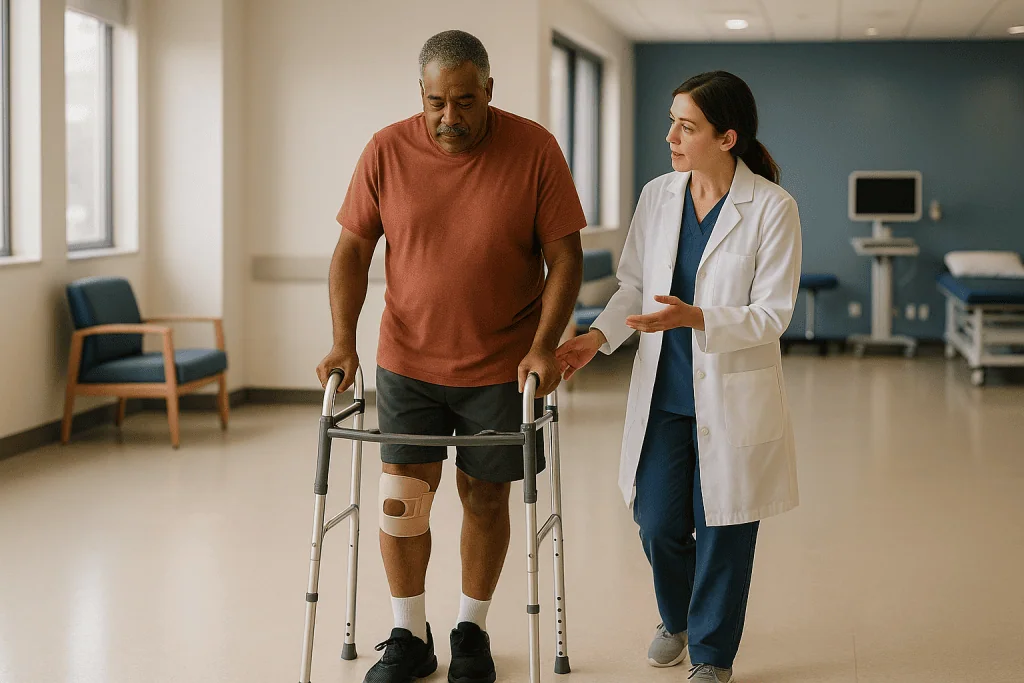
The first two weeks: walking indoors with support, ice and elevation for swelling, wound checks, and a daily exercise program focused on straightening the knee fully and bending it progressively. A physical therapist, a clinician who guides movement and strength recovery, usually sets and adjusts this program.
Weeks two to six: many people move from two crutches to one, then to none indoors. Mayo Clinic notes that most people can resume ordinary daily activities within about three to six weeks, though stairs, longer walks and driving return at different rates for different people. Driving generally waits until the leg can control the pedals reliably and pain medicine no longer impairs reactions; the treating team advises on timing.
Through all of this the pattern is two steps forward, one step back. A bad day is not a failed operation. A trend over weeks is what matters.
Weeks six to twelve and beyond: strength, stairs and how long implants last
The second phase of recovery is quieter and longer than the first. By six weeks most wounds are healed and the emphasis shifts from protecting the knee to strengthening the thigh muscles that stabilize it.
Between six and twelve weeks, people typically return to office work, light gardening, swimming once the wound is fully closed, and cycling on a stationary bike. Walking distance increases steadily. Kneeling is often still uncomfortable and may remain so.
Around three months, many people feel the knee has become theirs rather than a construction site. Yet the NHS advises that full recovery, meaning the point at which the knee feels as good as it is going to feel, can take up to a year. Swelling after long days, mild warmth and occasional aching are common well into that window.
Activity for the long term follows a simple principle: low-impact and regular. Walking, cycling, swimming, golf and doubles tennis are widely considered appropriate. Running and jumping sports place repetitive high loads on the plastic bearing and are generally discouraged, though the treating surgeon’s advice for the individual knee should override any general rule.
How long will it last? Mayo Clinic notes that most replaced knees are still functioning well fifteen years after surgery, and many go considerably longer. These figures come from conventional technique followed over decades. Robotic-assisted knees have not been in place long enough to produce equivalent long-term data. Anyone told that robotic placement guarantees a longer-lasting knee is hearing a hypothesis presented as a result.
Risks and alternatives, in plain clinical language
Every knee replacement carries risks that the method of cutting bone does not remove. Naming them is not fear-mongering; it is the basis of informed consent.
Infection can occur in the wound or, more seriously, deep around the implant. Deep infection may require further surgery. Blood clots in the leg veins, called deep vein thrombosis, can form after any lower-limb operation and can travel to the lungs. Clot-prevention measures, including early walking and medicine chosen by the team, are standard. Stiffness, where the knee will not bend or straighten as hoped, sometimes needs manipulation under anesthesia. Nerve or blood vessel injury is rare. Over years, implants can loosen or the plastic can wear, and a small proportion of knees need revision surgery. MedlinePlus and Mayo Clinic describe these risks for the operation in general.
Robotic-specific additions are the tracker pin sites and, where used, the CT scan, discussed earlier.
Alternatives deserve equal airtime. Non-surgical management includes supervised exercise to strengthen the thigh, weight management where relevant, walking aids, bracing and pain-relief medicines of various classes, with choices and timelines set by the prescribing clinician. Injections into the joint can provide temporary relief for some people; the evidence for different injection types varies, and a clinician can explain what is known. Partial knee replacement, which resurfaces only the worn compartment, suits some people whose damage is confined to one part of the joint. Osteotomy, a bone-realignment procedure, is occasionally used in younger people.
None of these is universally better. Each carries trade-offs that depend on the joint, the person and their goals, which is exactly why the decision rests with the treating team.
Questions to ask your care team before agreeing to a date
A good consultation is a conversation, not a briefing. These questions tend to surface the information that matters most, and a confident team will welcome them.
- Why is knee replacement being recommended for me now, and what would happen if I waited six months?
- Are there non-surgical options I have not fully tried, and what does the evidence say about each?
- Will you use robotic assistance for my operation, and what do you see as its specific advantage in my case?
- How many knee replacements do you perform each year, and how many with this system? How do you handle a technical failure mid-operation?
- Will I need a CT scan beforehand, and are there extra pin sites? What are the risks of those?
- Which implant design will you use, and does it differ from what you would use with conventional instruments?
- What is the realistic expectation for my knee at three months, one year and beyond? What will it likely not be able to do?
- How is pain managed in the hospital and at home, and who do I contact if it is not controlled?
- What is the plan for preventing blood clots, and for how long?
- What does the rehabilitation program look like, who delivers it, and how much of it depends on me at home?
- What signs after surgery should make me call you the same day?
- If I am unhappy with the result at one year, what are the possible reasons and next steps?
Write the answers down or bring someone who will. The details that seem obvious in the room have a way of evaporating in the parking lot.
When to call your doctor: red-flag signs after knee replacement
Most recovery worries turn out to be ordinary: an aching knee at night, a swollen ankle after a long day, a clicking sensation with stairs. A short list of signs, however, should prompt a same-day call to the surgical team or, when severe, emergency care. This applies equally after robotic-assisted and conventional surgery.
- Fever, chills or feeling generally unwell, particularly with a wound that is increasingly red, warm, or leaking fluid or pus.
- A wound that opens, or drainage that continues beyond the first several days rather than tapering off.
- Sudden new swelling, pain or tenderness in the calf, or a calf that feels warm and tight, which can signal a blood clot.
- Sudden shortness of breath, chest pain, coughing up blood or a racing heartbeat, which may indicate a clot that has traveled to the lungs. These warrant emergency services immediately.
- Pain that is escalating rather than easing over days, or that is not controlled by the plan the team provided.
- Loss of ability to bear weight on the leg after having been able to, or a sensation that the knee gives way or has shifted.
- Numbness, tingling or weakness in the foot that is new or worsening, or a foot that becomes cold or pale.
- Any fall onto the operated knee.
MedlinePlus and the NHS both list infection and blood clots among the main complications to watch for, and both emphasize that early reporting leads to simpler treatment. A team would far rather hear about a worry that turns out to be nothing than learn about a problem a week late. When in doubt, call.
Frequently asked questions
Does the robot ever move or cut without the surgeon?
No. The robotic arm has no independent function. It moves only when the surgeon guides the attached instrument, and it either follows the surgeon’s plan or physically limits the tool to the planned zone. If the surgeon lets go, stops, or decides the plan needs changing, the arm does nothing further. The surgeon can also abandon the system entirely and finish with conventional instruments.
What is the downside to robotic knee replacement?
The main downsides are longer operating time, especially early in a team’s experience, small extra pin sites in the thigh and shin bones for the tracking markers, and on some systems a preoperative CT scan with its radiation dose. Technology can also fail mid-operation, requiring a switch to conventional tools. None of these is large, but each is a real trade-off worth discussing with the surgeon.
Is robotic vs traditional knee replacement a meaningful difference for the patient?
For most patients the felt difference is modest. Robotic assistance achieves implant positions closer to the plan on imaging, and some studies report slightly less pain in the first days. The incision, implant, hospital stay and rehabilitation are the same. Long-term function and implant longevity have not been shown to differ, largely because the technology is too new for such data to exist.
Who is not a candidate for knee replacement?
People with mild arthritis manageable without surgery, active infection anywhere in the body, poorly controlled medical conditions that raise surgical risk, or who continue to smoke are usually asked to wait or optimize first. Robotic-specific barriers are rare but include prior hardware that interferes with tracking or scanning. The final judgment always rests with the treating team after examination and imaging.
What is robotic knee replacement recovery time?
Recovery mirrors conventional knee replacement. The NHS describes standing and walking with support within about a day, a typical hospital stay of one to three days, and up to a year for full recovery. Mayo Clinic notes most people resume daily activities within roughly three to six weeks. Robotic assistance has not been shown to shorten these ranges meaningfully; the rehabilitation program is the same.
What doctors don't tell you about knee replacement?
Most do tell patients, but details get lost. Commonly underappreciated points: kneeling may stay uncomfortable long-term, a numb patch beside the scar is expected, painless clicking is common, swelling can persist for months, night pain is often worse than daytime pain early on, and rehabilitation effort strongly shapes the result. A minority of people remain dissatisfied, most often because of ongoing pain or expectations that were not met.
What is the regret rate for total knee replacement?
There is no single agreed figure. Studies measure satisfaction rather than regret, and results vary with how and when the question is asked. Most people report being satisfied, while a sizable minority report ongoing pain or disappointment. Unrealistic expectations, unexplained persistent pain and pre-existing mood conditions predict dissatisfaction more strongly than surgical technique. No evidence yet shows robotic assistance changes these rates.
Is the implant different in a robotic knee replacement?
No. The same families of metal and plastic components used in conventional surgery are used with robotic assistance, matched to the particular system’s software. The technology changes how precisely the bone is prepared to receive the implant, not the implant itself. Anyone told the robotic knee is made of something better is hearing marketing rather than a clinical fact.
Does robotic knee replacement mean a smaller incision?
Generally not. The robotic arm works within a standard surgical exposure so the surgeon and the tracking cameras can see the joint. Incision length is set by anatomy and surgical technique, not by the presence of the arm. The small extra wounds from tracker pins mean the total number of skin punctures is, if anything, slightly greater.
Will a robotic-assisted knee last longer than a conventional one?
It is not known. Better alignment is a plausible reason it might, but implants must be followed for many years to measure longevity, and robotic-assisted knees have not been in place long enough. Mayo Clinic’s figure that most replaced knees still function well after fifteen years comes from conventional technique. Any promise of longer survival with robotics is currently a hypothesis, not a demonstrated result.
References
- Knee replacement (NHS)
- Knee replacement: Recovery (NHS)
- Knee joint replacement (MedlinePlus Medical Encyclopedia)
- Robotic Surgery (Cleveland Clinic)
This article is for general information only and is not a substitute for professional medical advice. Please consult a qualified doctor about your individual situation.

More from the Blog

Hip Flexor Pain: Tight, Strained or Something Else, and the Exercises That Help
Hip flexor pain is soreness at the front of the hip or groin where the iliopsoas and rectus femoris muscles lift the thigh. Most…

How a Pavlik Harness Keeps Your Baby’s Hips in Place So the Socket Can Deepen
A Pavlik harness works by holding a baby's hips bent up and gently spread apart, so the ball at the top of each thigh…

Shoulder Replacement Recovery: Timeline, Sling Life and Real Milestones
Most people wear a sling for about two to six weeks after shoulder replacement, regain everyday reach by three months, and see strength keep…

What to Ask Your Surgeon Before Hip Replacement: Approach, Implant Type and Rehab Plan
Before hip replacement, ask your surgeon which surgical approach they use and why, what implant type and bearing surface they plan (cemented or uncemented,…

First Signs of Arthritis in the Fingers, and How Arthritis Is Tested
The first signs of arthritis in the fingers are usually subtle: stiffness on waking or after gripping something, aching or tenderness in a knuckle,…

Blood Thinners and Compression Stockings After Robotic Hip Replacement: Why Both Matter
Blood thinners after hip replacement are standard because surgery on the hip, combined with days of reduced movement, sharply raises the chance of a…