

Does Transcranial Magnetic Stimulation Hurt? Scalp Tenderness, Headache and How Long They Last
Key Takeaways
- Mainstream clinical sources describe TMS discomfort as a tapping or knocking on the scalp with possible facial twitching, felt only while pulse trains run, not between them.
- Post-session scalp tenderness and headache typically last hours rather than days and, per Mayo Clinic and Cleveland Clinic, decrease over the first one to two weeks of a course as the scalp habituates.
- The soreness comes from induced current in scalp nerves and forehead muscles, not from anything happening in brain tissue, which has no pain receptors; a milder session after habituation is not a weaker one.
- Seizure is the most serious risk and is described in international safety guidelines as rare within recommended parameters, with most reported cases linked to sleep deprivation, alcohol, threshold-lowering medicines or over-limit stimulation.
- Hearing protection is required at every session because the coil's click is loud at close range; transient hearing changes have been reported only when earplugs were skipped.
- A standard depression course runs about five sessions a week for four to six weeks with no anesthesia, and people drive themselves home; intensity is set relative to each person's own motor threshold.
Transcranial magnetic stimulation is usually described as uncomfortable rather than painful. Most people feel a firm tapping or pecking on the scalp during the pulses, and some develop a mild headache or scalp tenderness afterward. In clinical reports these effects are typically mild, ease within hours, and lessen over the first one to two weeks of a course. Seizure and other serious effects are rare.
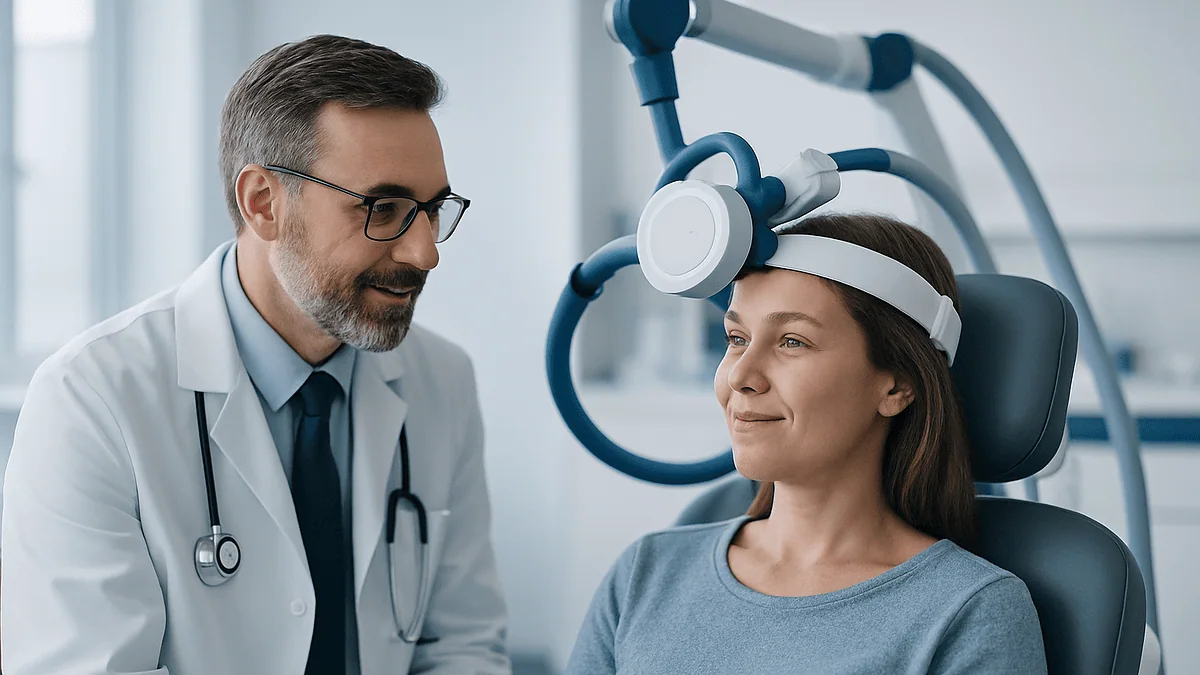
The chair looks like something from a dentist’s office, and that is roughly the emotion in the room. A woman in her forties, two antidepressant trials behind her, settles back while a technician adjusts a padded coil against the left side of her head. She has read the forum thread titled “No one warned me how painful rTMS can be,” and she has read the clinic brochures saying the opposite. The question she came in with is the same one thousands of people type into a search bar before a first appointment: does TMS hurt?
The honest answer sits between the forum and the brochure. The sensation is real, it is stronger for some people than others, and it has a recognizable arc across a course of treatment. Knowing that arc in advance changes the experience more than any reassurance can.
This explainer walks through what the pulses actually do to scalp nerves and muscle, why headaches happen, how long the tenderness typically lasts, and which sensations should prompt a call to the treating team rather than a shrug.
Does TMS hurt? What people actually feel in the chair
Ask ten people who have completed a course and you will hear ten versions of the same description: a woodpecker, a rubber band snapping, a knuckle rapping on the skull. The Mayo Clinic describes the sensation plainly as tapping or knocking on the head, and that is what most patients report during the active pulse trains.
The intensity is not constant. A standard repetitive TMS session delivers pulses in short bursts, each lasting a few seconds, followed by a pause. During the burst the tapping is at its sharpest and the muscles of the forehead, eyelid or jaw on the treated side may twitch. In the pause, nothing. That rhythm of pulse and rest is why people say the discomfort is manageable even when a single burst is unpleasant: it never runs uninterrupted.
Pain thresholds vary enormously. The Cleveland Clinic notes that some people feel only mild pressure, while others describe the early sessions as genuinely sore. Anatomy accounts for much of the difference. Thin scalp tissue over a bony area, a coil placed near a branch of the trigeminal nerve, or simple sensitivity to touch all raise the felt intensity.
Where the coil sits matters as well. Depression protocols usually target the dorsolateral prefrontal cortex, a region of the frontal lobe just behind the forehead above the temple. The muscles and nerves there are more responsive than those over the crown, which is one reason people treated for depression describe more forehead and eye sensation than people who have TMS for other indications.
None of this is a mark against the treatment. Discomfort is a side effect, not a sign of harm, and most published safety reviews describe it as the most common but least serious thing patients experience.
How transcranial magnetic stimulation works, in plain language
The physics are older than the medicine. When an electric current runs through a wire coil, it produces a magnetic field; when that field changes rapidly, it induces a small electric current in any conductor nearby. In TMS the conductor is brain tissue a few centimeters under the coil.
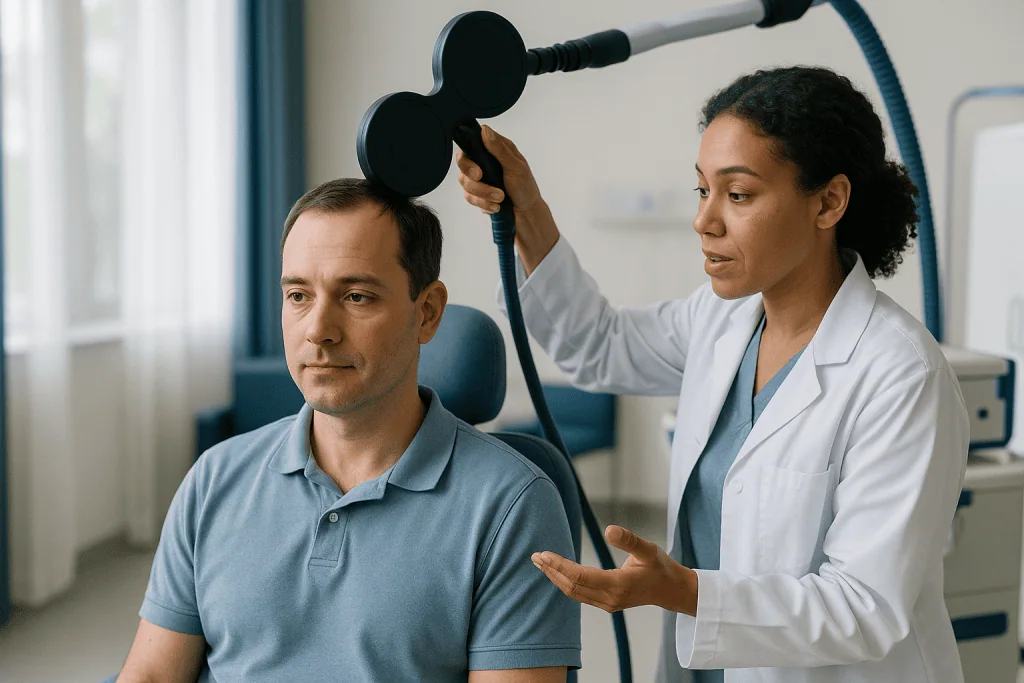
An electromagnetic coil, usually shaped like a figure eight or a rounded cap, rests against the scalp. A machine sends brief, powerful pulses of current through it. Each pulse creates a magnetic field that passes painlessly through skin and bone (bone does not block magnetism the way it blocks electricity) and nudges neurons in the cortex, the brain’s outer layer, into firing. Repeated over many sessions, this repeated nudging is thought to shift the activity of circuits that are underactive or overactive in depression and some other conditions, according to the National Institute of Mental Health.
Repetitive TMS, or rTMS, simply means the pulses are delivered in trains rather than one at a time. Theta burst stimulation is a newer pattern that packs pulses into very short, rhythmic clusters and finishes in a few minutes rather than twenty or more.
Before the first treatment, the clinician finds the motor threshold: the lowest pulse strength that makes a thumb or finger twitch when the coil is over the hand area of the motor cortex. Treatment intensity is set relative to that personal threshold, which is why two people on the same protocol may receive different pulse strengths.
A course, per Mayo Clinic, typically runs five days a week for four to six weeks, with sessions lasting roughly 20 to 40 minutes depending on protocol. There is no anesthesia, no sedation, and people drive themselves home.
Why the scalp and face feel it: the mechanism behind tenderness
The magnetic field is aimed at the brain, but it does not skip the layers in between. That is the whole story of TMS discomfort.
Every pulse induces current in the scalp before it reaches the cortex. Scalp tissue is dense with sensory nerve endings, and the frontal region is supplied by branches of the trigeminal nerve, the large nerve that carries sensation from the face. Each pulse gives those fibers a brisk electrical tap. The brain, which has no pain receptors of its own, registers the pulse as coming from the skin.
Muscle is the second layer. The frontalis muscle across the forehead and the temporalis muscle at the temple both lie under common coil positions. Induced current makes them contract with each pulse, which is why an eyebrow may jump or the jaw may clench for a fraction of a second. Hundreds of tiny contractions across a session leave those muscles feeling worked, the way a long day of squinting leaves the brow sore.
Then there is pressure. The coil must sit firmly against the head to keep the target consistent, and thirty minutes of steady contact on one spot compresses the skin. Some tenderness the next morning is simply that.
The Mayo Clinic groups these effects together as scalp discomfort at the stimulation site and tingling or spasms of facial muscles. Published safety guidelines from the International Federation of Clinical Neurophysiology (Rossi and colleagues, 2009) describe the same picture: local pain and muscle twitching are the most frequent complaints, are dose and site dependent, and do not indicate tissue injury.
Understanding the layers helps because each has a fix. Nerve sensitivity responds to gradual intensity ramping; muscle fatigue responds to time; pressure responds to small coil repositioning.
TMS headache: what it feels like and how long it lasts
A headache after a session is the second most common complaint, and it tends to arrive on a schedule. People typically notice it toward the end of treatment or within the first hour afterward, feel it as a dull, diffuse ache rather than a stabbing pain, and find it has gone by evening.

Why it happens is not fully settled. The best-supported explanation is that repeated stimulation of scalp nerves and sustained contraction of forehead and temple muscles trigger a tension-type headache, the same variety most people get from stress or a long screen day. Mayo Clinic lists headache as a common side effect that is generally mild to moderate and improves shortly after an individual session. The Cleveland Clinic gives the same characterization and adds that headaches tend to lessen as the course continues.
Duration matters more than intensity to most people. Across clinical sources, the typical pattern is a headache measured in hours, not days, and a frequency that falls sharply after the first week. A headache that lasts into the next day, or that grows worse with each session rather than better, is unusual and worth reporting.
Simple measures are usually enough. Clinics commonly suggest hydration, a light meal before the appointment, and, if the treating clinician agrees, an ordinary over-the-counter pain reliever taken before or after the session. That decision belongs to the prescribing team, particularly for anyone already taking medicines that interact with pain relievers or that affect seizure threshold.
People who live with migraine sometimes worry TMS will provoke an attack. The evidence here is mixed and individual. Some report no change; a few report a migraine in the early sessions. It is worth mentioning a migraine history at the assessment so the team can adjust intensity ramping and monitor accordingly.
How long does TMS scalp tenderness last? The typical timeline
Two clocks run at once: how long soreness lasts after any single session, and how many sessions pass before the soreness fades from the course altogether.
On the first clock, scalp tenderness usually settles within a few hours. Touching the treated area that evening may feel like pressing a light bruise; by the next morning most people notice nothing until the coil goes back on. Mayo Clinic describes side effects as improving shortly after an individual session.
The second clock is the one worth knowing about before you start. Both Mayo Clinic and Cleveland Clinic report that discomfort decreases over time with additional sessions. In practice, many people describe the first three to five sessions as the hardest and the second week as noticeably easier. By the third week, a large share report the pulses as a familiar tapping they barely register.
Habituation explains much of this. Sensory nerves fire less vigorously in response to a stimulus they encounter every day, and the brain’s own pain-modulating pathways dampen a predictable, non-threatening sensation. Muscles condition too, much as a new exercise stops producing next-day soreness after a couple of weeks.
Clinicians also help the process along. Intensity is often started below the full target and raised over the first several sessions, a practice sometimes called ramping. Small adjustments to coil angle can move the field off a sensitive nerve branch without moving it off the brain target.
None of these timelines is a guarantee. A minority of people remain sensitive throughout, and a smaller group find the discomfort reason enough to stop. Safety guidelines record that dropout for pain is uncommon but real. If tenderness is not easing by the end of the second week, that is a conversation to have, not a sign of failure.
Which sensations are normal, and which are not? A summary table
The table below gathers what mainstream clinical sources describe as expected sensations during and after transcranial magnetic stimulation, alongside the small set of experiences that should be reported the same day. It reflects typical patterns from Mayo Clinic, Cleveland Clinic and the 2009 safety guidelines; individual experience will vary.
| Sensation | When it usually appears | Typical duration | What it usually means |
|---|---|---|---|
| Tapping or knocking on the scalp | During pulse trains | Only while pulses run | Expected; the induced current reaching scalp nerves |
| Eyebrow, eyelid or jaw twitching | During pulse trains | Stops with each pause | Expected; nearby muscles contracting |
| Scalp tenderness at the coil site | Immediately after | Hours; fades over 1 to 2 weeks of the course | Expected; nerve and pressure effect |
| Mild to moderate headache | End of session or within an hour | Hours, rarely into next day | Expected; tension-type pattern |
| Lightheadedness | Standing up after session | Minutes | Expected occasionally; sit before standing |
| Ringing in ears or muffled hearing | After session | Should not persist | Report; check ear protection was in place |
| Severe or worsening headache, or one lasting past a day | Any time | Any | Report the same day |
| Loss of awareness, jerking of limbs, confusion | During or shortly after | Any | Emergency; possible seizure |
| New or sharply worse low mood, agitation or thoughts of self-harm | Any time in the course | Any | Contact the treating team promptly |
A pattern rather than a single event is the useful signal. Discomfort that trends downward across sessions is the ordinary course. Discomfort that trends upward, or any symptom in the bottom three rows, breaks the pattern and deserves a phone call.
Session by session: what the first days and weeks usually look like
The first appointment is the longest and, for many people, the strangest. It begins with the motor threshold test described earlier: the coil moves over the top of the head until a finger twitches, and the machine records that strength. Expect this part to involve a few minutes of odd, tapping pulses over the crown while you watch your own hand move. The treatment position is then mapped, often with a cap marked in a grid so the same spot can be found tomorrow.
The first treatment itself is where people discover how their own scalp responds. Clinics often begin below the target intensity, so the first day may be more surprising than painful. Facial twitching is at its most noticeable because it is unfamiliar. Earplugs are standard: the coil produces a loud click with each pulse, and Mayo Clinic advises hearing protection at every session.
Days two through five are typically the sorest stretch. Intensity may rise toward target, the scalp has not yet habituated, and some people go home with a headache each afternoon. This is the week most forum complaints describe. It is also the week when small adjustments help most, so telling the technician exactly where it hurts is worth the awkwardness.
Week two usually brings the turn. Tenderness shortens from hours to minutes, headaches thin out, and the tapping becomes background noise. Many people read, listen to music or chat with the technician through sessions from this point.
Weeks three through six settle into routine. The remaining discomfort is mostly the physical fact of a coil pressed to one spot daily; some people notice a small tender patch or a little hair flattening there. Mood changes, if they come, tend to be gradual rather than sudden, and the team will track them with standard questionnaires.
After the course ends, residual scalp sensitivity, where it exists, typically clears within days.
Who TMS is usually for, and who is usually asked to wait
Transcranial magnetic stimulation is most established as a treatment for major depressive disorder in adults who have not improved with at least one adequate trial of antidepressant medication. The NHS lists rTMS among the brain stimulation options for depression that has not responded to other treatments, and Mayo Clinic frames it the same way. Regulators in several countries have also cleared protocols for obsessive-compulsive disorder, smoking cessation and migraine with aura, and research continues in chronic pain, post-traumatic stress and stroke recovery. Evidence strength differs sharply across these uses, and a clinician will explain which apply.
The screening conversation before treatment is largely about metal and seizures. Because the coil generates a strong magnetic field, anything ferromagnetic within about a foot of it is a concern. People with cochlear implants, deep brain stimulators, aneurysm clips or coils, metal plates near the treatment site, or embedded shrapnel are usually excluded or referred for individual assessment. Dental fillings and braces are generally acceptable, and a medical device team can advise on pacemakers and other implanted electronics sited farther from the head.
A personal history of epilepsy, a prior seizure, or a brain injury raises the small seizure risk and often means either exclusion or a modified approach. Heavy alcohol use, sleep deprivation and certain medicines that lower the seizure threshold are reviewed for the same reason.
Pregnancy is not an absolute barrier in the safety guidelines, but data are limited, and most teams take a cautious, case-by-case approach.
People are also sometimes asked to wait for practical reasons. A course requires daily attendance for weeks, and a period of unstable housing, travel or acute illness may make starting later the wiser choice. Whether TMS is offered, deferred or replaced by another option remains a judgment for the treating team, made with the person’s full history in view.
What not to do during TMS treatment
The rules are few and mostly common sense, but each has a mechanism behind it.
Do not remove the earplugs. The coil’s click is loud enough that safety guidelines recommend hearing protection for every session, and transient hearing changes have been reported when it was skipped. If the plugs feel loose, say so.
Do not move your head during pulse trains. Even a small shift takes the coil off target, which wastes the session and can slide the field onto a more sensitive nerve branch, making the next burst hurt more. Most chairs have a headrest and a chin or forehead support for this reason; use them.
Do not arrive sleep-deprived or hungover. Both lower the seizure threshold, and the 2009 safety guidelines specifically flag them as modifiable risk factors. A poor night is worth mentioning at check-in so the team can decide whether to proceed.
Do not change your medicines without telling the team. Starting or stopping certain antidepressants, stimulants or other prescriptions can alter seizure risk and change how the brain responds to stimulation. The decision about any medicine belongs to the prescribing clinician, but the TMS team needs to know.
Do not wear metal near the head. Hair clips, earrings, glasses and hearing aids come off. Some clinics ask about magnetic-strip cards and phones, which can be damaged if left within the field.
Do not push through severe pain in silence. Intensity, coil angle and ramping can all be adjusted, but only if the technician knows. A short pause mid-session is routine.
Finally, do not skip sessions casually. Protocols are built on cumulative daily stimulation, and long gaps may reduce the intended effect. If an absence is unavoidable, the team can advise on how to handle it.
Does TMS rewire the brain? What neuroplasticity actually means here
“Rewire” is a word that makes neuroscientists wince and marketers smile. The accurate concept is neuroplasticity: the brain’s ordinary capacity to strengthen or weaken connections between neurons in response to repeated activity. Learning a language does it. So does recovering from a stroke. TMS is thought to harness the same process in a targeted way.
The leading model runs like this. In depression, imaging studies have repeatedly found reduced activity in the left dorsolateral prefrontal cortex and altered communication between that region and deeper structures involved in mood. High-frequency stimulation over that area appears to increase its excitability during and for a period after the session. Repeat that daily for weeks and the change may persist, a phenomenon related to long-term potentiation, the cellular mechanism that underlies memory formation. The National Institute of Mental Health summarizes the evidence as showing that rTMS can alter activity in brain networks implicated in depression, while noting the exact mechanism is still under study.
What this does not mean is that TMS rebuilds the brain or permanently rearranges it. The changes measured so far are functional shifts in how strongly regions communicate, not structural surgery. That is also why effects can fade for some people over months, and why maintenance sessions are sometimes discussed.
The distinction matters for expectations. A treatment that gently biases a network toward healthier activity is plausible and supported by trials. A treatment that rewires personality or intelligence is not what the evidence describes, and no one should be promised it.
It also matters for the pain question. Because the therapeutic effect depends on pulses reaching the cortex, not on how much the scalp hurts, a session that feels milder after habituation is not a weaker session. Discomfort is a side product of the physics, not a measure of the dose.
Rare but serious TMS side effects: seizures, hearing and mood
Scalp discomfort is common and trivial. The serious risks are the opposite: rare, and worth understanding precisely because they are the reason for the screening questions.
Seizure is the one everyone asks about. The 2009 international safety guidelines describe induced seizure as the most serious adverse effect of rTMS and, when stimulation stays within recommended parameters, an uncommon one. Cleveland Clinic puts the risk at well under one percent of people treated. Seizures that have occurred were typically brief, self-limiting and left no lasting harm, and most involved a known risk factor such as sleep deprivation, alcohol, a lowered seizure threshold from medicines, or stimulation above guideline limits. This is why the pre-treatment questionnaire asks about all of those things, and why answering honestly is protective.
Hearing deserves its own mention. The coil’s click can exceed safe noise levels at close range, and transient hearing changes have been reported in people who did not wear protection. With earplugs in place, the guidelines report no lasting hearing effects in adults.
Mood switching is a concern specific to people with bipolar disorder or a family history of it. Stimulation that lifts depression can, in a small number of cases, tip into mania or hypomania, a state of abnormally elevated energy, reduced need for sleep and racing thoughts. Teams screen for bipolar history and monitor for the signs; if they appear, the course is reviewed.
Fainting has been reported, usually related to anxiety or standing up quickly rather than to the stimulation itself. Sitting for a minute before leaving the chair is enough for most people.
Long-term risks are the least studied, simply because the treatment is younger than many alternatives. Follow-up data so far have not identified cognitive decline or structural brain changes, but clinicians are appropriately cautious in how they word that.
What do neurologists think of TMS, and what is the controversy?
Within neurology and psychiatry the technology itself is not controversial; the physics are well understood and the safety record is long. The debates are about evidence, expectations and expansion.
On depression, the mainstream view is measured acceptance. Major clinical bodies list rTMS as an option for treatment-resistant depression, and randomized trials have shown a benefit over sham stimulation. Harvard Health has described it as a reasonable option for people who have not responded to medication while stressing that response varies and that the treatment is not a first step. Neurologists tend to add a caveat psychiatrists share: effect sizes in trials are modest, sham responses are substantial, and the people most likely to benefit are still hard to predict in advance.
The first real controversy is scope creep. Clinics in some countries advertise TMS for conditions ranging from autism to long COVID to cognitive enhancement, where trial evidence is thin, inconsistent or absent. Specialists are broadly critical of this, because marketing an unproven use as effective is both misleading and a drain on patients’ resources and hope.
The second is protocol variation. Coil types, pulse frequencies, session numbers and targeting methods differ across trials and clinics, which makes results hard to compare and leaves open questions about which parameters matter most. Accelerated protocols that compress weeks of stimulation into days have generated excitement and equally strong calls for larger, independent replication.
The third is durability. How long benefit lasts after a course, and whether maintenance sessions are needed, remain active research questions with no consensus answer.
What neurologists do not dispute is the tolerability picture. Compared with electroconvulsive therapy, which requires anesthesia and can affect memory, or with medication changes that bring systemic side effects, TMS is regarded as a low-burden option whose main day-to-day cost is the scalp discomfort this article describes.
What people often get wrong about whether TMS is painful
Myths about TMS pain run in both directions, and each does its own damage.
“It is completely painless.” This is brochure language, and it sets people up to feel misled on day two. Mainstream clinical sources are consistent that scalp discomfort and headache are common. Calling the treatment noninvasive is accurate; calling it sensation-free is not.
“It feels like electroconvulsive therapy.” ECT induces a controlled seizure under general anesthesia and is a fundamentally different procedure. TMS involves no anesthesia, no seizure by design, and no memory effects in the evidence to date. People sometimes conflate the two because both are described as brain stimulation.
“If it hurts, it must be working.” The therapeutic effect depends on the field reaching the target cortex. Scalp pain is a by-product of nerves in the way, and it fades with habituation while the stimulation stays the same. A comfortable session is not a weaker one.
“The pain gets worse over the course.” The opposite is the typical pattern. Both Mayo Clinic and Cleveland Clinic describe discomfort decreasing with additional sessions. Worsening pain is the exception and a reason to speak up.
“You need to be sedated or take strong painkillers.” Sedation is not part of TMS. Where a pain reliever is used at all, it is the ordinary kind, and only if the treating clinician agrees it is appropriate for that person.
“Everyone can just tough it out.” A small minority find the sensation intolerable even after adjustments. That is a legitimate reason to stop, and it does not mean the person failed or that other options are closed.
“The headache means something is wrong in the brain.” The headache pattern after TMS resembles tension-type headache arising from scalp muscles and nerves. A severe, sudden or persistent headache is different and should be reported, but the ordinary post-session ache is not a warning sign.
Questions to ask your care team before the first session
A good assessment appointment leaves room for questions. These are the ones that tend to change how the first weeks feel.
- Which protocol and coil will be used, and roughly how long will each session last? Knowing whether to expect four minutes or forty helps you plan and helps you interpret sensation.
- Will the intensity be ramped up over the first sessions, or set to target from day one? If ramping is not standard practice at this clinic, ask whether it can be considered.
- What should I do if a burst is more painful than I can tolerate? Confirm that you can signal a pause and that the technician can adjust coil angle or intensity mid-session.
- How do you handle post-session headache, and is an over-the-counter pain reliever appropriate for me given my other medicines? The prescribing clinician should answer this, not a leaflet.
- Which of my current medicines or health conditions affect seizure risk, and what should I tell you about on any given day? Sleep, alcohol and illness all belong in this conversation.
- What hearing protection is provided, and what should I do if my ears ring afterward?
- Do I have a history of migraine, bipolar disorder or a head injury that changes how you will monitor me?
- How will you measure whether the treatment is helping, and when would we review whether to continue?
- What are the alternatives if TMS is not right for me, or if I cannot tolerate it? Medication adjustment, psychotherapy and other brain stimulation options all sit within the same decision.
- Who do I call, and at what hours, if something feels wrong between sessions?
Write the answers down. The first session involves enough novelty that details heard in the assessment room are easily lost, and having the plan for pain in writing makes it far easier to ask for it when the coil is already on.
When to call your doctor: red-flag signs during a TMS course
Most of what a TMS course produces, physically, is a tapping sensation, a sore patch of scalp and the occasional afternoon headache, all of which ease within hours and fade over the first weeks. The signs below fall outside that pattern.
Call emergency services, or have someone with you do so, if during or shortly after a session there is a loss of awareness, rhythmic jerking of the limbs, a fall, or a period of confusion afterward. These can indicate a seizure. It is rare, it is usually brief, and it still requires medical assessment before any further treatment.
Contact the treating team the same day for a headache that is sudden and severe, that is the worst you have had, that comes with vomiting, stiff neck, visual change or weakness on one side, or that persists into the following day and is not easing. Report ringing in the ears or muffled hearing that has not cleared within a few hours of the session, particularly if ear protection was loose or absent.
Reach out promptly, without waiting for the next appointment, if mood shifts sharply in either direction: a marked drop with new or intensifying thoughts of self-harm, or an unexpected surge of energy, very little need for sleep, racing thoughts or unusually impulsive behavior, which can signal a switch into mania in people with bipolar vulnerability. Anyone with thoughts of harming themselves should use their local crisis line or emergency services immediately.
Also mention, at the next session rather than as an emergency, scalp pain that is increasing rather than decreasing across the first two weeks, skin changes or a sore at the coil site, or any new symptom that began after treatment started.
Every one of these is a reason to talk, not a verdict on the treatment. Whether to pause, adjust or continue is a decision for the treating team, made with you and with the full picture in front of them.
Frequently asked questions
Does TMS hurt the first time more than later sessions?
Usually, yes. The first several sessions are the ones most people describe as sore, because the scalp has not yet habituated and intensity is often being raised toward target. Both Mayo Clinic and Cleveland Clinic report that discomfort decreases with additional sessions, and many people find the second week noticeably easier. If pain is rising rather than easing by week two, tell the team.
Is TMS painful enough that people stop treatment?
A small minority do stop because of discomfort, and published safety guidelines record this as uncommon. Most people find the sensation manageable once intensity ramping, coil angle adjustments and simple measures like hydration are in place. Stopping for pain is a legitimate choice, and it does not close off other options such as medication review, psychotherapy or different stimulation approaches, which the treating team can discuss.
What are the most common TMS side effects?
Scalp discomfort at the coil site, mild to moderate headache, and twitching or tingling of facial muscles during pulses are the most commonly reported, according to Mayo Clinic. Lightheadedness on standing occurs occasionally. All are typically short-lived and mild. Serious effects, chiefly seizure, are rare when stimulation stays within recommended parameters and screening for risk factors has been done.
How long does a TMS headache last?
Typically hours, not days. Most people notice it toward the end of a session or within the first hour afterward and find it gone by evening. Clinical sources describe it as mild to moderate and improving shortly after each session, with frequency falling over the first week or two. A headache that is severe, sudden, or persists into the next day should be reported to the treating team.
What should I not do during TMS?
Keep earplugs in, keep your head still during pulse trains, and avoid arriving sleep-deprived or after heavy alcohol, since both lower the seizure threshold. Remove metal from around the head. Do not start, stop or change any medicine without telling the team, because some prescriptions affect seizure risk. And do not suffer severe pain silently; pauses and coil adjustments are routine.
Does TMS rewire the brain?
Not in the literal sense. The better term is neuroplasticity: repeated stimulation appears to shift how strongly certain brain regions communicate, particularly circuits involving the prefrontal cortex that are altered in depression. These are functional changes measured in trials, not structural rebuilding, and the National Institute of Mental Health notes the exact mechanism is still being studied. Effects can fade over time, which is why maintenance is sometimes discussed.
What do neurologists think of TMS?
The broad view is measured acceptance for treatment-resistant depression, where randomized trials show benefit over sham and the safety record is strong. Specialists commonly add that effect sizes are modest, response is hard to predict, and durability is uncertain. They are more skeptical of clinics advertising TMS for conditions where evidence is thin, and they regard its low physical burden as a genuine advantage over some alternatives.
What is the controversy with TMS?
Mainly three things: marketing for conditions with weak or absent trial evidence, wide variation in protocols that makes results hard to compare, and unanswered questions about how long benefit lasts after a course. Accelerated protocols have drawn both enthusiasm and calls for larger independent replication. The technology and its safety in depression are not themselves disputed among clinicians.
Can TMS cause a seizure, and how likely is that?
It can, and it is the most serious recognized risk, but international safety guidelines describe it as rare within recommended stimulation limits, and Cleveland Clinic puts the risk at well under one percent of people treated. Most reported cases involved a known risk factor such as sleep deprivation, alcohol, medicines that lower the seizure threshold, or stimulation above guideline parameters. Screening before treatment is designed to identify these.
Can I take a painkiller before a TMS session?
Many clinics say an ordinary over-the-counter pain reliever is acceptable, but that decision belongs to the prescribing clinician, who knows your other medicines and health conditions. Some medicines interact with pain relievers or affect seizure threshold. Ask at the assessment appointment, get the answer in writing, and mention any migraine history so the team can plan intensity ramping accordingly.
References
- Cleveland Clinic: Transcranial Magnetic Stimulation (TMS)
- National Institute of Mental Health: Brain Stimulation Therapies
- NHS: Treatment: Depression in adults (brain stimulation options)
This article is for general information only and is not a substitute for professional medical advice. Please consult a qualified doctor about your individual situation.

More from the Blog

Second Opinions in Neurodegenerative Diseases: When a Diagnosis Deserves Another Look
A neurodegenerative disease second opinion is a fresh review of your history, examination and test results by another neurologist, often one who focuses on…

Neuroinfectious Diseases Treatment: How Meningitis and Encephalitis Care Is Planned
A meningitis encephalitis treatment plan starts within minutes of suspicion, usually before tests confirm the cause. Doctors give intravenous antibiotics, and often an antiviral,…

Who May Be a Candidate for Peripheral Nerve Surgery? Injury, Compression and Tumor Cases
Peripheral nerve surgery is considered for three groups: people with a nerve that has been cut, torn or crushed and shows no sign of…

Can You Keep Working With Multiple Sclerosis? Fatigue, Heat and Pacing Strategies Explained
Many people with multiple sclerosis continue working, often for years, though the path varies with symptoms, job demands and disease course. Fatigue and heat…

Can Home and Work Routines Be Adapted in Motor Neuron Disease? Mobility Aids, Meals and Rest
Yes. Most people with motor neuron disease can adapt home and work routines for a considerable time by pacing activity, changing how meals are…

Questions to Ask Before Agreeing to a Cerebrovascular Disease Treatment Plan
Before agreeing to a cerebrovascular disease treatment plan, ask what the imaging showed (clot, bleed, narrowing or small vessel damage), why this option was…