

E-Max Crown Treatment Step by Step: Minimal Tooth Preparation, Scanning and Bonding Explained

Key Takeaways
- Lithium disilicate is a glass-ceramic whose embedded crystals stop cracks spreading, which is why it combines near-enamel translucency with enough strength for most single crowns.
- The conservative tooth preparation associated with e-max type crowns is possible only because the crown is adhesively bonded to enamel, so bonding quality directly affects how much tooth is kept.
- Intraoral scanning replaces impression trays with a handheld camera and lets errors be corrected on screen before a crown is made, but it does not improve a poorly prepared tooth.
- Same-day milled crowns and laboratory-pressed crowns are made from the same class of material; the laboratory route allows hand-layered color for highly visible front teeth at the cost of a temporary crown for a few weeks.
- Mainstream patient guidance puts typical crown lifespan in a broad range of roughly five to fifteen years, driven mainly by grinding, bite balance, margin hygiene and moisture control during bonding rather than by brand.
- The tooth under a crown can still decay at the margin, so daily flossing and routine check-ups remain essential after the ceramic is in place.
The e max crown procedure typically involves an examination and X-rays, conservative reshaping of the tooth, a digital scan or impression, fabrication of a lithium disilicate glass-ceramic crown, and adhesive bonding of that crown to the tooth. It is usually completed in one or two visits, mild sensitivity is common for a short period afterward, and suitability, timing and material choice rest with the treating dentist.
The crack showed up on a Tuesday, in the mirror, while flossing. A hairline across an old filling on a front molar, the kind you keep touching with your tongue once you know it is there. The dentist said the tooth would need a crown, and then said a phrase that sent most people straight to their phones: a lithium disilicate crown, or what patients usually call an e-max.
If that is where you are, this article walks through the e max crown procedure the way a careful clinician would explain it across the chair: what is actually removed from the tooth, what the scanner is doing, why the bonding step matters as much as the ceramic itself, and what the first week afterward tends to feel like. “E-max” is a manufacturer’s product name that has become everyday shorthand for a whole class of glass-ceramic crowns. This piece uses the word the way people search for it and discusses the material, not any product or provider.
Along the way it corrects a few persistent myths, sets out honest evidence on longevity, and gives you a list of questions worth asking before anyone picks up a handpiece.
What is an e-max crown, and why does the material matter?
A crown is a custom cap that covers the whole visible part of a tooth above the gumline, restoring its shape, strength and appearance when a filling would no longer hold. Dentists reach for crowns after large decay, a fracture, root canal treatment, heavy wear, or to top an implant, as the Cleveland Clinic describes on its dental crowns page.
What makes the so-called e-max crown different is the ceramic inside it. Lithium disilicate is a glass-ceramic: glass that has been heat-treated so that fine, needle-like crystals grow throughout it. Those crystals interrupt cracks the way rebar interrupts cracks in concrete, which is why the material is far tougher than the traditional feldspathic porcelain that once chipped so readily on molars. At the same time it keeps much of the translucency of glass, so light passes into it and back out roughly the way it does through natural enamel.
That combination, strength plus optical depth in a single block of material, is the reason the term has spread. Older strong crowns hid a metal core under porcelain and could show a grey line at the gum. Zirconia, another modern ceramic, is stronger still but historically more opaque. Lithium disilicate sits in the middle: strong enough for most single teeth, translucent enough to disappear beside a neighboring incisor.
The material also bonds chemically to tooth structure after a specific surface treatment, which matters more than most patients realize. It means the crown and the tooth act as one unit rather than a cap sitting on a peg. That single property shapes almost every step described below, from how little enamel needs to be removed to how the crown is fixed in place at the end.
How the e max crown procedure works, from first visit to final bite
Strip away the technology and the e max crown procedure follows a simple logic: assess, prepare, capture, make, attach, check.
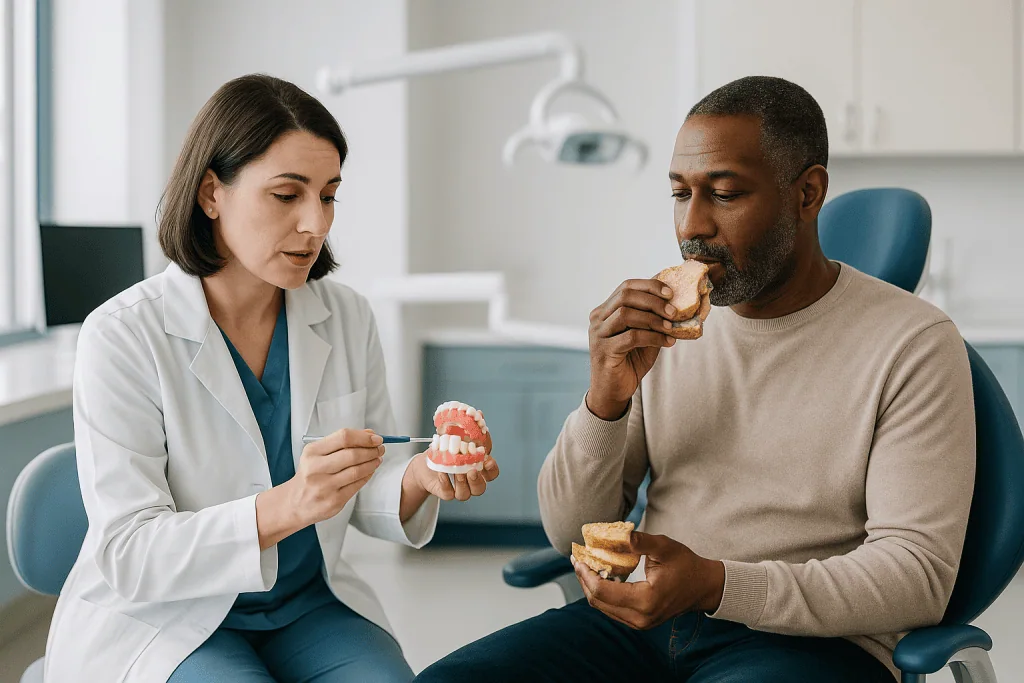
Assessment comes first. The dentist examines the tooth, takes X-rays to look at the root and surrounding bone, and tests whether the nerve inside is healthy. A tooth with a dying nerve will usually need root canal treatment before a crown; putting a permanent cover on an infected tooth only hides the problem, a point the Cleveland Clinic makes in its patient guidance.
Preparation follows. Under local anesthetic, the tooth is reshaped so the crown has room to sit without making the tooth bulkier than its neighbors. For a bonded glass-ceramic crown, that reduction is deliberately modest, which the next sections explain in detail.
Capture is the scanning step. A small wand photographs the prepared tooth thousands of times a second and stitches the images into a three-dimensional model, or a conventional impression tray records the same shape in a putty-like material.
Making the crown happens either in the practice, where a milling machine carves it from a solid ceramic block during the same appointment, or in a dental laboratory over a period of days to weeks. In the two-visit route you leave with a temporary crown, which the Cleveland Clinic notes is usually worn for a few weeks while the permanent one is fabricated.
Attachment is the bonding stage: the inside of the crown and the surface of the tooth are each chemically treated, then joined with a resin adhesive that is hardened with a curing light. Finally the dentist checks how the new crown meets the opposing teeth and polishes any high spots. A short follow-up visit is common to review the bite once the numbness has fully worn off.
Who is usually a good candidate, and who is usually asked to wait
Glass-ceramic crowns suit a wide range of everyday situations, but they are not the default for every tooth and every patient, and a good treatment plan says so out loud.
Candidates commonly include people with a single damaged front tooth or premolar where appearance matters, a molar with a large failing filling but enough remaining structure to bond to, or a tooth that has had root canal treatment and now needs full coverage. They are also used as the visible part of an implant restoration: the implant replaces the root, an abutment connects to it, and a ceramic crown forms the tooth you see. The NHS overview of dental treatments describes crowns and implants as options after decay, fracture or tooth loss, and leaves the choice of material to clinical judgment.
Some people are asked to wait or to consider a different material. Active gum disease is usually treated first, because a crown margin placed against inflamed, bleeding tissue will not seal well and the gum level may change as it heals. Untreated decay elsewhere in the mouth is often stabilized first for the same reason. A tooth with too little sound structure left may need a post or a build-up before it can hold any crown, and occasionally the honest answer is that it cannot be saved.
Heavy grinders, people with a very deep bite, or those who have already fractured ceramic restorations may be steered toward a stronger, more opaque ceramic or toward a night guard as part of the plan. The Mayo Clinic notes that bruxism, the medical term for grinding or clenching teeth, can wear or fracture teeth and dental work. Pregnancy, uncontrolled diabetes or recent head and neck radiotherapy can all change timing. None of these are refusals; they are sequencing decisions that belong to the treating team.
Minimal tooth preparation: what "minimal" really means in e-max crown preparation
“Minimal preparation” is one of the most quoted and least explained phrases in cosmetic dentistry, so it is worth being concrete.

Every crown needs space. If a cap is going to sit over a tooth and finish flush with the neighbors, some of the original tooth has to be reduced to make room for the ceramic. The thicker the material has to be to survive chewing, the more tooth must go. Traditional porcelain-fused-to-metal crowns needed a metal core plus a porcelain layer, so a fairly aggressive reduction was standard, and the margin was often tucked beneath the gum to hide the metal edge.
Lithium disilicate changes two variables. First, because the material is strong in relatively thin sections when properly bonded to enamel, the dentist can often remove less from the chewing surface and sides than with older designs. Second, because the ceramic has no metal to hide, the finish line can frequently be kept at or just above the gumline, where it is easier to clean and gentler on the gum.
“Minimal” is therefore relative, not zero. The dentist is still shaping the tooth with a handpiece, still creating a smooth, rounded margin all the way around, and still making sure there are no sharp internal angles that would concentrate stress in the ceramic. Enamel is prized during this step, because the strongest bond is to enamel rather than to the softer dentin underneath.
Patients sometimes confuse this with a veneer, which covers only the front face of a tooth and removes even less. A crown wraps all surfaces. When a dentist says the preparation will be conservative, ask them to show you on the model how much is being kept; the answer tells you a great deal about how the tooth will behave in the long run.
Digital scanning versus impression trays: what changes for you
For decades the shape of a prepared tooth was captured with a tray of soft material that set in the mouth over several minutes. Anyone who has gagged through one remembers it. Intraoral scanning replaces that with a handheld camera roughly the size of a large electric toothbrush.
An intraoral scanner is a device that projects light onto the teeth and records their surface as a dense cloud of points, building a three-dimensional model on a screen in real time. The dentist moves the wand slowly around the prepared tooth, its neighbors and the opposing arch, then asks you to bite so the software can record how the jaws meet. The whole capture usually takes a few minutes. If a region is blurred or hidden by saliva, only that spot needs rescanning rather than repeating the entire impression.
From the patient’s chair, the differences are practical. There is no tray, no setting time, and less gag reflex. Errors are visible immediately instead of being discovered when a poorly fitting crown comes back from the laboratory. The digital file can be sent to a laboratory instantly or fed into an in-office milling machine, which is what makes same-day crowns possible; the Cleveland Clinic describes this CAD/CAM approach, computer-aided design and computer-aided manufacturing, as an alternative to the traditional two-visit route.
Scanning does have limits. Deep margins below the gumline, bleeding, or a very wet field can still defeat the camera, and in those cases a conventional impression remains a perfectly sound choice. Neither method makes a crown better on its own. The scan records exactly what the dentist prepared, so the quality of the preparation and the care taken to keep the gum healthy and dry matter far more than the brand or age of the equipment.
Milling and pressing: how a lithium disilicate crown is made
Two manufacturing routes produce the same material, and knowing which one your dentist uses explains why some people leave with a permanent crown in a single afternoon and others wait a couple of weeks.
Milling starts with a factory-made block of partially crystallized ceramic. In this state it is relatively soft and has a bluish tint. A computer-controlled cutter, guided by the digital design, carves the crown from the block in a matter of minutes. The milled crown is then placed in a small furnace, where a heat cycle completes the crystallization, turning it hard and shifting its color to the shade chosen for your tooth. This is the pathway behind same-day crowns done in the practice.
Pressing is the laboratory route and works more like casting jewelry. A technician builds the crown in wax, invests it in a mold, burns the wax out, and presses molten ceramic into the space under heat and pressure. Pressed crowns can then be layered with thin coats of colored porcelain by hand to mimic the subtle variations of a front tooth, which is one reason laboratory fabrication is still common for highly visible incisors. This route is why a temporary crown is worn in the interim; the Cleveland Clinic notes that laboratory turnaround typically runs a few weeks.
Either way, the crown is tried on the tooth before bonding. The dentist checks the fit at the margin, the tightness of contact with neighboring teeth, and the shade under natural light. Small adjustments are made with fine polishing instruments. A crown that rocks, gaps at the edge or catches floss is adjusted or remade rather than forced on, because the bonding step that follows is not easily reversed.
Bonding versus cementing: why the glue is half the story
Ask most people how a crown stays on and they will say it is glued. That is true in the loosest sense, but the difference between traditional cementing and adhesive bonding is the single biggest technical idea in the e max crown procedure.
Conventional cementation relies mainly on mechanical grip. A luting cement fills the microscopic space between tooth and crown, and the crown’s tight fit around a tall, tapered preparation does most of the holding work. Metal-based crowns have been cemented this way for a century and it works well when there is plenty of tooth height to grip.
Adhesive bonding creates a chemical and micromechanical join. The inside of a glass-ceramic crown is etched with a mild acid, which roughens the surface at a microscopic level, then painted with a coupling agent that forms a chemical bridge between glass and resin. The tooth surface is likewise etched and coated with a bonding agent. A resin cement is placed between the two, the crown is seated, and a blue curing light hardens the resin within seconds. The result is a restoration that shares chewing stress with the tooth beneath it rather than merely sitting on top.
Why does this matter to you? Because a bonded glass-ceramic crown draws much of its strength from the tooth it is attached to. That is what allows the conservative preparation described earlier, and it is why keeping the tooth completely dry during bonding is treated with almost surgical seriousness: a rubber dam, a stretched sheet that isolates the tooth from saliva, or careful cotton isolation is routine. A moment of contamination can weaken the bond in a way no one will see until the crown loosens or chips months later. The chemistry is unforgiving, which is exactly why a methodical clinician matters more than a fast one.
E-max crown vs zirconia vs porcelain-fused-to-metal: how they compare
Patients often arrive having read that one ceramic is “the best.” The honest picture is that each material trades something for something else, and the right choice depends on the tooth’s location, how much structure remains, and how hard you bite. The Cleveland Clinic lists ceramic, zirconia, porcelain-fused-to-metal and metal alloys as the common crown families; the table below summarizes how they tend to differ in everyday clinical practice.
| Feature | Lithium disilicate (e-max type) | Zirconia | Porcelain-fused-to-metal |
|---|---|---|---|
| Appearance | High translucency, close to enamel | Historically opaque; newer types more translucent | Good, but metal core can show grey at the gum |
| Strength | High for single teeth; relies on bonding | Highest; suits heavy bites and bridges | Strong core; porcelain layer can chip |
| Tooth reduction | Conservative when bonded to enamel | Can be conservative in monolithic form | Typically the most reduction |
| Attachment | Adhesive bonding preferred | Usually cemented, bonding possible | Conventional cement |
| Typical use | Front teeth, premolars, many molars, implant crowns | Molars, bridges, grinders | Long track record, now less common |
Notice that none of the columns wins every row. A translucent ceramic is a poor choice for hiding a dark, root-treated tooth beneath it, where a more opaque core does a better job. A very strong ceramic in a thin section is wasted on a front tooth that mainly needs to look natural. Metal-based crowns remain a reasonable option in some mouths, particularly where allergy, bite or budget constraints apply, and a dentist who still offers them is not behind the times.
The comparison worth having is not material versus material in the abstract but material versus your particular tooth. Ask why this ceramic for this tooth, and expect an answer about enamel, bite and location rather than about fashion.
What the following days and weeks usually look like
The appointment ends, the numbness fades over a couple of hours, and the tongue begins its inspection. Here is what most people describe, and what the evidence-based patient guidance from the Cleveland Clinic and NHS suggests is ordinary.
The first evening the tooth may feel slightly “tall” or strange, partly because you are paying attention to it and partly because local anesthetic can blunt your sense of how the teeth meet. Mild soreness of the gum around the margin is common where it was gently pushed aside during preparation and bonding. Sensitivity to cold, and sometimes to sweet foods, is the most frequent complaint and typically settles over days to a few weeks as the tooth calms down; the Cleveland Clinic lists temporary sensitivity as an expected after-effect rather than a complication.
If a temporary crown is in place between visits, it is designed to be removable, which means it is held with weak cement. Sticky or very chewy foods can pull it off, and flossing is best done by sliding the floss out sideways rather than lifting it up. If a temporary comes loose, the tooth beneath is exposed and may be sensitive; the practice will usually want to re-seat it promptly.
With the permanent crown, most people return to normal eating within a day or two. Brushing twice daily and cleaning between the teeth resume immediately, because the tooth under the crown can still decay at the margin. A crown does not make a tooth immune to plaque.
A short review visit within the first weeks is routine to check the bite with fresh eyes. A spot that feels high after the numbness wears off is easy to adjust and worth reporting, since uneven pressure is a common cause of lingering ache and, over time, of ceramic chipping.
How long do e-max crowns last? What the evidence actually shows
This is the question everyone asks and the one where honesty matters most. The short answer is that well-made, well-bonded glass-ceramic crowns are a durable restoration, but no one can promise a lifespan for the crown in your mouth, and any clinic quoting a precise personal figure is guessing.
What mainstream patient guidance does say is broad. The Cleveland Clinic states that dental crowns in general typically last somewhere between five and fifteen years, with the range driven by material, wear, and how well the tooth is cared for. The NHS makes the same point in its overview of dental treatments: how long a crown lasts depends on how well you look after it. Neither source singles out one ceramic as superior, and this article will not either.
The research literature on lithium disilicate single crowns is generally encouraging, but figures vary between studies depending on how failure is defined, whether the crowns were bonded or cemented, and how long patients were followed. Rather than quote a percentage that would be misleading out of context, it is more useful to understand what shortens a crown’s life. Grinding and clenching, a bite that was never quite balanced, decay creeping under the margin because of missed flossing, and bonding done in a wet field all appear repeatedly as culprits. Smoking and gum disease affect the tooth holding the crown rather than the ceramic itself.
Two practical implications follow. First, longevity is shared work: the dentist controls preparation, fit and bonding; you control plaque, diet and whether you wear the night guard you were given. Second, a crown that fails rarely fails silently. Chips, a rough edge, floss that tears, or new sensitivity at the gumline are signals to have it looked at, not signs that the whole approach was wrong.
Risks, side effects and alternatives in plain language
Every procedure that changes a tooth carries risk, and a good consent conversation names them without drama.
The most common short-term issue is sensitivity, already described, which usually fades. Less often, the nerve inside a prepared tooth becomes inflamed and does not recover, particularly in a tooth that already had deep decay or a large filling. When that happens, root canal treatment can often be done through a small opening in the crown, but the possibility should be discussed beforehand rather than discovered afterward. The Cleveland Clinic lists nerve irritation, chipping, loosening and decay at the margin among the recognized risks of crowns.
Ceramic can chip or fracture, most often on molars in people who grind, or where the crown was thinner than ideal. Small chips can sometimes be smoothed or repaired; larger fractures mean a new crown. A bonded crown that debonds, in other words comes loose, is uncommon when the isolation was good but not impossible, and usually points to moisture contamination or an unusually heavy bite.
Gum tissue can recede over years, exposing a margin that was once hidden. With a translucent glass-ceramic this is less visible than with a metal edge, but it can create a ledge that traps plaque.
Allergy to the materials is rare. Local anesthetic carries its own small risks, which are the same as for any filling.
Alternatives depend on the tooth. A large filling or an onlay, a partial ceramic cover for the chewing surface, may be enough if sufficient tooth remains. A different crown material may be wiser for a heavy bite or a dark tooth. In some cases extraction and an implant, or leaving the tooth alone and monitoring it, are legitimate options to have on the table. Which of these is right is a decision for you and the treating team, not for an article.
What people often get wrong about the e max crown procedure
Misconceptions cluster around this topic, partly because the name sounds like a guarantee. Here are the ones clinicians correct most often.
“An e-max crown is a brand of treatment.” It is a product name that has become shorthand for lithium disilicate glass-ceramic. Many manufacturers make the material, and the outcome depends far more on preparation, bonding and bite than on whose block was milled.
“Minimal prep means almost no drilling.” Preparation is conservative compared with metal-based crowns, but the tooth is still reshaped on every surface. Anyone told nothing will be removed is being described a veneer, not a crown.
“A crown protects the tooth from decay.” The ceramic itself cannot decay, but the tooth beneath it can, especially at the margin where crown meets root. The Cleveland Clinic explicitly warns that decay under a crown remains a risk and that normal brushing and flossing must continue.
“Same-day crowns are lower quality.” In-office milling uses the same class of material as laboratory work. The trade-off is that hand-layered laboratory crowns can achieve finer color effects for a highly visible front tooth. Neither route is inherently better; they suit different situations.
“Stronger is always better.” A more opaque, harder ceramic may be the right call for a grinder’s molar, but it can look flat on an incisor and, if it is much harder than the opposing tooth, wear that tooth over time. Matching the material to the location matters.
“Once bonded, nothing can be done.” Bonded crowns are harder to remove than cemented ones, but they can be sectioned and replaced when needed, and root canal access through the crown is routine.
“It will feel normal immediately.” Most do within days, yet a brief period of cold sensitivity and bite awareness is ordinary and does not mean something has gone wrong.
Questions to ask your care team before the first appointment
A good consultation leaves you knowing not just what will happen but why this plan and not another. These questions tend to surface the answers that matter.
- Why a crown rather than a large filling or an onlay for this tooth, and how much sound enamel will remain after preparation?
- Is the nerve in this tooth healthy, and what is the plan if it becomes inflamed after the crown is placed?
- Why this ceramic for this particular tooth, given its position, my bite and the color of the tooth underneath?
- Will the crown be made in the practice the same day or in a laboratory, and what does that mean for temporaries and appointment count?
- How will you keep the tooth dry during bonding, and will a rubber dam or similar isolation be used?
- Where will the margin sit in relation to my gum, and how should I clean around it?
- Do I show signs of grinding or clenching, and would a night guard be part of the plan?
- What sensations are normal in the first weeks, and which ones should prompt a call?
- If the crown chips or comes loose, what happens next?
- How often will you want to check the crown at routine visits, and what will you look for on X-rays?
Notice that none of these asks for a percentage or a promise. Questions about “success rates” invite numbers that sound reassuring but rarely apply to an individual tooth. Questions about process, isolation and follow-up tell you how carefully the work will be done, which is what actually drives longevity.
It is also entirely reasonable to ask for a second opinion, to see photographs of the preparation on a model, or to take the plan home and read it before agreeing. The NHS guidance on dental treatments encourages patients to discuss options and understand what is proposed before treatment begins. A team that welcomes those questions is telling you something valuable about how it works.
When to call your doctor or dentist: red-flag signs after a crown
Most of the odd sensations after a new crown fade on their own. A few do not, and some need attention quickly. Use this as a guide to picking up the phone rather than as a way to diagnose yourself.
Contact your dental team promptly if you notice a temporary or permanent crown that has come loose or fallen out, a crown that feels distinctly high when you bite and has not settled after a day or two, a sharp edge or chip you can feel with your tongue, floss that repeatedly shreds or catches at the margin, or sensitivity to cold or biting that is worsening rather than easing after the first couple of weeks. None of these is an emergency, but all of them are easier to fix early.
Seek same-day advice from your dentist or, if the practice is closed, an urgent dental or medical service if you develop throbbing pain that wakes you or is not controlled by the measures your dentist advised, swelling of the gum, face or jaw, a bad taste or pus near the tooth, fever alongside dental pain, or pain that spreads toward the ear or under the jaw. These can signal infection of the nerve or surrounding tissue, which the NHS describes as needing prompt professional assessment rather than waiting for a routine appointment.
Go to an emergency department or call emergency services if facial swelling makes it difficult to swallow, breathe or open your mouth, if swelling is spreading rapidly toward the eye or neck, or if you feel generally unwell with a high temperature. These are rare after a crown, but dental infections can occasionally spread and need urgent care.
Whatever the symptom, describe it plainly and let the team decide the timing. They know the tooth, the X-rays and the work that was done; you know how it feels. Together that is usually enough to sort a settling crown from one that needs a second look.
Frequently asked questions
What is the e max crown procedure, in simple terms?
It is a sequence of assessing the tooth with an exam and X-rays, reshaping it conservatively under local anesthetic, scanning or taking an impression, fabricating a lithium disilicate ceramic crown, and bonding it to the tooth with resin adhesive. The crown may be milled in the practice the same day or made in a laboratory over a few weeks while you wear a temporary. Your dentist checks the bite before you leave and usually at a follow-up.
How long does an e-max crown appointment take?
It varies with the route chosen. A same-day CAD/CAM crown typically occupies a single longer visit covering preparation, scanning, milling, glazing and bonding. The traditional route splits this into two shorter visits separated by laboratory time, which the Cleveland Clinic describes as usually a few weeks. Complex cases, teeth needing a build-up first, or highly visible front teeth requiring shade trials can add appointments. Ask your dentist which pathway applies to your tooth.
Is e-max crown preparation painful?
Preparation is done under local anesthetic, so the tooth itself should not hurt during the appointment, though you will feel vibration and pressure. Afterward, mild gum soreness and sensitivity to cold are common for days to a few weeks and usually settle on their own. Pain that is severe, throbbing, wakes you at night or comes with swelling is not typical and should be reported to your dental team promptly for assessment.
How long do e-max crowns last?
No individual lifespan can be promised. General patient guidance from the Cleveland Clinic places typical crown longevity between roughly five and fifteen years depending on material, wear and care, and the NHS emphasizes that duration depends heavily on how well you look after the tooth. Grinding, an unbalanced bite, decay at the margin and moisture contamination during bonding are the factors most often linked to earlier failure in glass-ceramic crowns.
What is the difference between an emax crown vs zirconia?
Both are metal-free ceramics. Lithium disilicate, the e-max type, is more translucent and closer to natural enamel in the way it handles light, and it relies on adhesive bonding for much of its strength. Zirconia is stronger and traditionally more opaque, so it is often chosen for heavy bites, bridges and back teeth. Newer zirconia is more translucent than older forms. The right choice depends on the tooth’s position, remaining structure and your bite, decided with your dentist.
Can a lithium disilicate crown be used on a dental implant?
Yes. In an implant restoration the implant replaces the root, an abutment connects to it, and a crown forms the visible tooth. Lithium disilicate is commonly used for that crown on single implants, particularly where appearance matters. Because there is no natural tooth to bond to, the crown is attached to the abutment differently, either cemented or screw-retained. The implant team will explain which design suits your case and why.
Will the crown look fake or too white?
A well-made glass-ceramic crown is designed to blend with neighboring teeth rather than stand out, because the material transmits light in a way similar to enamel. Shade is selected against your own teeth, ideally in natural light, and laboratory crowns can be hand-layered to copy subtle variations. If you want whiter teeth overall, dentists usually recommend discussing whitening before the crown is made, since ceramic does not change color afterward.
Can a tooth still decay under a crown?
It can. The ceramic itself cannot decay, but the natural tooth beneath remains vulnerable, especially at the margin where crown meets tooth near the gum. The Cleveland Clinic lists decay under a crown among the recognized risks. Daily brushing, cleaning between teeth and routine check-ups with periodic X-rays allow early detection. A margin that traps floss or feels rough is worth having examined rather than ignored.
What should I do if my temporary crown falls off?
Keep the temporary if you can, avoid chewing on that side, and contact your dental practice so it can be re-seated or replaced promptly. The prepared tooth underneath may be sensitive to temperature and can shift slightly if left uncovered for long, which may affect the fit of the permanent crown. Do not attempt to glue it back with household adhesives; follow the guidance your dental team gives you over the phone.
Do I need a night guard after getting a ceramic crown?
Not everyone does, but people who grind or clench, a condition called bruxism, are often advised to wear one because those forces can chip or wear ceramic and natural teeth alike. The Mayo Clinic notes that bruxism can damage teeth and dental work. Your dentist may look for wear facets, jaw muscle tenderness or a history of cracked fillings when deciding. Follow their advice rather than a general rule.
References
This article is for general information only and is not a substitute for professional medical advice. Please consult a qualified doctor about your individual situation.

More from the Blog
Are Zirconium Teeth Right for You? Bite Force, Smile Goals and When Another Ceramic Fits Better
A good zirconium teeth candidate usually needs a strong restoration for a back tooth, an implant crown, or a bridge, especially with a heavy…
All-on-4 vs All-on-6: When Two More Implants Make Sense
All-on-4 and All-on-6 both anchor a full arch of fixed replacement teeth; the difference is how many implants carry the load. Four implants suit…
What to Ask Before a Dental Crown: Material, Margin Placement and What Happens to the Nerve
Before agreeing to a dental crown, ask what the crown is for, which material is proposed and why, where the edge of the crown…
Dental Implants After Gum Disease: When They Are Possible, and What Comes First
Yes, people with periodontal disease can often get dental implants, but not while the disease is active. Infection and inflammation must be treated first,…

How Long Do All-on-4 Implants Last? Longevity, Care and What Can Go Wrong
With diligent daily cleaning and regular professional maintenance, the four titanium implants supporting an All-on-4 restoration commonly last 20 years or longer, and long-term…

When Removable Dentures Stop Fitting: Relining, Rebasing and When a Remake Is Needed
Removable dentures usually stop fitting because the jawbone and gum underneath slowly shrink, not because the denture itself changes much. Dentists first assess the…