E-Max Crowns
E-max crowns are all-ceramic dental restorations used to improve tooth appearance, strength, and function. They are valued for their natural translucency, durability, and minimally invasive cosmetic results.
Quick answer
An E-max crown is a full-coverage cap made from lithium disilicate, a strong, translucent all-ceramic material. It restores the shape, strength and function of a tooth weakened by fracture, decay, deep discolouration or a failing filling, and is often chosen for visible teeth because it closely mimics natural enamel. Treatment typically takes two visits: preparation and scanning first, then bonding of the laboratory-made crown.
E Max Crown Dental Restoration: What It Is and Who It Helps
An e max crown dental restoration is a full-coverage cap made from lithium disilicate, a strong, translucent all-ceramic material. It is fitted over a prepared tooth to restore its shape, strength and everyday function while protecting the natural structure that remains underneath. Because the ceramic handles light in much the same way as natural enamel, it is frequently chosen for front teeth and other visible parts of the smile, though it can be appropriate elsewhere depending on the bite and the condition of the tooth.
A damaged or weakened tooth affects more than appearance. You may find yourself chewing on one side, avoiding cold drinks, covering your mouth when you speak, or worrying that a cracked tooth will break further at the wrong moment. For many people the question is not simply whether to restore a tooth, but how to do so in a way that looks natural, feels comfortable and preserves as much healthy tooth structure as possible.
Patients usually arrive at e-max crowns after a specific trigger: a visible fracture, an old filling that keeps failing, discolouration that does not respond to whitening, or a tooth that has become misshapen or shortened over time. Some are focused on aesthetics. Others are trying to solve pain, bite instability or loss of function. In many cases both concerns matter equally, and a well-planned crown is expected to address them together rather than trading one against the other.
It helps to see this option in context. An E-max crown is one material choice within the wider family of dental crowns. Whether it is the right choice depends on the position of the tooth, the forces it carries during chewing, any grinding or clenching habits, gum health and how much sound structure remains above the gumline. In some mouths a different ceramic, or a different restorative approach altogether, will serve better. The value of a careful evaluation is that the material is chosen for your mouth, not for its popularity.
What is emax made of?
E-max is a lithium disilicate glass-ceramic. The crown is either pressed or milled from a single block of this material and then characterised and glazed to match the neighbouring teeth. There is no metal substructure at any point: the restoration is ceramic all the way through, which is what allows light to pass into and through it rather than reflecting flatly off an opaque core. The name comes from a branded ceramic system, which is why you will see it written in several ways, emax crown, e.max crown and E-max crown all refer to the same lithium disilicate material. The spelling varies; the material does not.
How is an e max dental crown different from a veneer or a filling?
An e max dental crown covers the entire visible portion of the tooth, all the way around, whereas a veneer covers mainly the front surface and a dental filling repairs a defect within the tooth while leaving the rest of the natural crown exposed. That distinction matters when a tooth is structurally weak. A filling relies on the surrounding tooth to hold it; if that surrounding tooth is cracked, thin or heavily restored, the filling has little to grip and the tooth remains vulnerable. A full-coverage crown works the other way round: it wraps and braces the remaining structure so that biting forces are distributed across the whole restoration rather than concentrated on a weak point.
In practical terms, an E-max crown aims to do three things at once: protect the tooth, restore reliable chewing and speech, and create an appearance that blends in rather than drawing attention to itself. For many patients, that combination is what makes it appealing.
Who May Need E-max Crowns
People who end up needing e-max crowns usually notice a combination of functional and cosmetic concerns. Sometimes there is a clear event, such as biting on something hard and chipping a tooth. In other cases the change is gradual. A large filling begins to leak or fracture at its edges. A root canal-treated tooth becomes more brittle over the years. Acid wear, tooth grinding or age-related breakdown leaves the tooth shorter, weaker or more sensitive than it once was.
Common signs that lead a dentist to consider crown treatment include:
- Visible cracks, chips or fractures in a tooth
- Pain when biting or chewing
- Tooth sensitivity to hot, cold or sweet foods
- A tooth with a large filling and little remaining healthy structure
- Discolouration too deep to improve with whitening
- An irregular tooth shape or size affecting the balance of the smile
- Repeated failure of older restorations
- A root canal-treated tooth that needs long-term protection
Diagnosis begins with a detailed dental examination. The dentist assesses the tooth itself, the surrounding gums, the neighbouring teeth and the way the upper and lower teeth meet. Imaging is usually part of the process. Depending on the case, this may include digital X-rays to evaluate the roots, the bone support, previous dental work and any decay hidden beneath existing restorations. In some situations, digital intraoral scans and photographic analysis are added to study shape, shade, alignment and bite relationships in greater detail.
Patients are often surprised to learn that deciding on a crown is not only about the single tooth in question. A tooth may look like a good candidate for an aesthetic ceramic crown, but if the bite places heavy pressure on that exact area, the plan may need to change. Likewise, if gum inflammation or untreated decay is present, those problems should be managed first, because the stability and longevity of any crown depend on the health of what sits beneath and around it.
People come to this treatment for a range of reasons. Some want to replace older crowns that look opaque, bulky or dark near the gumline. Others are planning a broader smile improvement and need one or several crowns integrated into that plan. Some are preparing for an important life event and want treatment organised within a clearly defined timeframe. Others have simply postponed care for years, because of work, family demands or uncertainty about the right approach, and now want the tooth dealt with properly.
The best candidates share a few characteristics: gums and supporting bone healthy enough to sustain the result, realistic expectations, and teeth that can be predictably restored. An in-person assessment remains essential, because not every damaged tooth is best treated with a crown, and not every crown case is ideal for E-max material specifically.
Conditions and Situations E-max Crowns Can Address
E-max crowns are used in both restorative and cosmetic dentistry. Their role is not limited to making teeth look better; in many cases they are recommended because they can strengthen and protect a tooth that would otherwise continue to deteriorate.
- Cracked or fractured teeth: when enough structure remains to support a crown, full coverage helps protect the tooth from further breakdown while restoring appearance and function.
- Teeth with large fillings: a tooth that has lost substantial structure to previous decay or repeated repairs may no longer be reliably restored with another filling.
- Root canal-treated teeth: after endodontic treatment, many teeth need a crown to reduce the risk of fracture and return them to normal use.
- Severely discoloured teeth: when internal staining does not respond to whitening, a ceramic crown offers a more predictable aesthetic route.
- Misshapen or undersized teeth: some patients have developmental differences in tooth size or contour that affect the harmony of the smile.
- Worn teeth: attrition from grinding or erosion from acid exposure can shorten and weaken teeth, sometimes making full-coverage restoration necessary.
- Replacement of older crowns: ageing restorations may show wear, poor fit, gumline discolouration or an obvious mismatch with the natural teeth beside them.
E-max is especially valued when the final appearance matters. Its optical qualities allow it to mimic the way natural teeth reflect and transmit light, which is difficult to achieve with some other materials. That said, aesthetics alone should not drive the decision. The crown must also survive in your specific bite, year after year. The dentist’s job is to balance beauty, biomechanics and long-term oral health, and to say plainly when those three point towards a different solution.
Emax vs Zirconia and Other Crown Materials
The emax vs zirconia question is one of the most common in modern crown dentistry, and the honest answer is that neither material is simply better: they are suited to different jobs. Zirconia is generally the tougher of the two and resists fracture under heavy load, which is why dentists often favour it for molars, for patients with strong grinding habits, and for multi-unit work such as a dental bridge. Lithium disilicate is the more translucent material and typically produces the more lifelike result, which is why it is so often chosen for single crowns in the visible zone of the smile.
The lines have blurred somewhat in recent years. Newer, more translucent zirconia formulations look better than the dense, opaque zirconia of the past, and skilled laboratory layering can improve either material. But the underlying trade-off remains: emax crowns and zirconia crowns are both metal-free, both durable in appropriate cases, and each gives up a little of what the other does best. Your dentist’s recommendation should follow from the position of the tooth, the space available, the forces in your bite and how visible the restoration will be, not from a blanket preference for one material.
Is an Emax crown better than a porcelain crown?
For many single visible teeth, yes, lithium disilicate is stronger than traditional feldspathic porcelain and avoids the metal substructure used in porcelain-fused-to-metal crowns, which can create a grey shadow near the gumline over time. Conventional porcelain crowns still have their place, and porcelain layered over a strong core can be extremely lifelike in expert hands. But when patients ask this question, they are usually comparing an all-ceramic E-max crown against an older metal-based crown they want to replace, and in that comparison the all-ceramic option usually wins on appearance while remaining strong enough for the intended position. Whether it wins in your mouth depends on your bite, which is exactly what the assessment is for.
When might a dentist recommend a different material?
A different material may be recommended when the tooth carries very heavy load, when a long-span bridge is planned, when there is limited vertical space for the restoration, or when severe night-time grinding puts any glass-ceramic at a disadvantage. None of these situations makes E-max impossible in every case, but each shifts the balance. A dentist who explains why they are steering you away from the most aesthetic option is usually protecting the longevity of your result, not complicating your decision.
How E-max Crown Treatment Is Performed
Planning e max crown dental treatment begins with a consultation. The dentist reviews your concerns, examines the tooth, evaluates the bite and confirms whether an E-max crown is appropriate at all. If there is active gum disease, untreated decay or infection, those issues are usually managed first. If you are considering cosmetic changes across several teeth, planning may include photographs, digital scans and a frank discussion of shape and shade goals, so the final result feels harmonious rather than overdone. Once the tooth is ready to be restored, the procedure follows a defined sequence.
Preparation Before the Procedure
The area is numbed with local anaesthetic so the tooth can be prepared comfortably. If the tooth carries significant old filling material, decay or unsupported enamel, these weakened portions are removed first. In some cases the tooth is rebuilt with a core material to give the crown a stable foundation. If too little structure remains above the gumline, additional planning is needed before crown placement can be considered reliable: this is a limit worth knowing about in advance rather than discovering mid-treatment.
A measured amount of tooth structure is then shaped to create room for the crown and to define the path along which it will seat securely. One advantage often associated with E-max is that, in selected cases, it supports relatively conservative preparation while still delivering a strong, aesthetic restoration. The exact reduction depends on the tooth’s position, the desired final shape and the bite; it is a clinical judgement, not a fixed formula.
Digital Scanning and Impression Taking
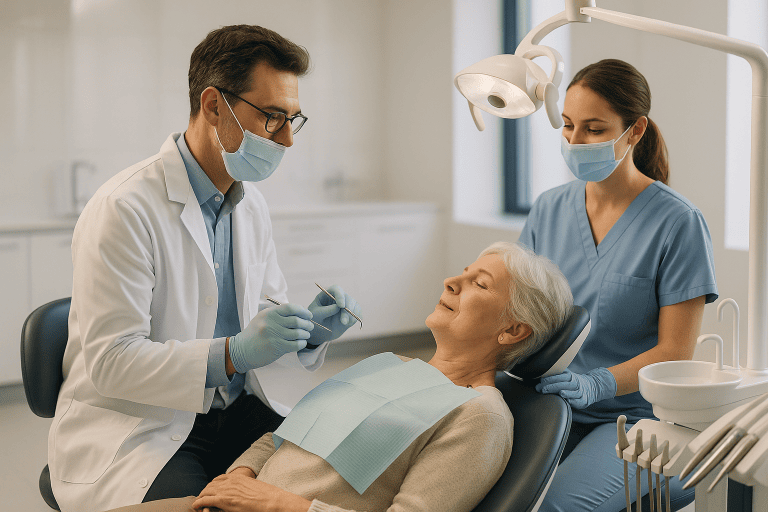
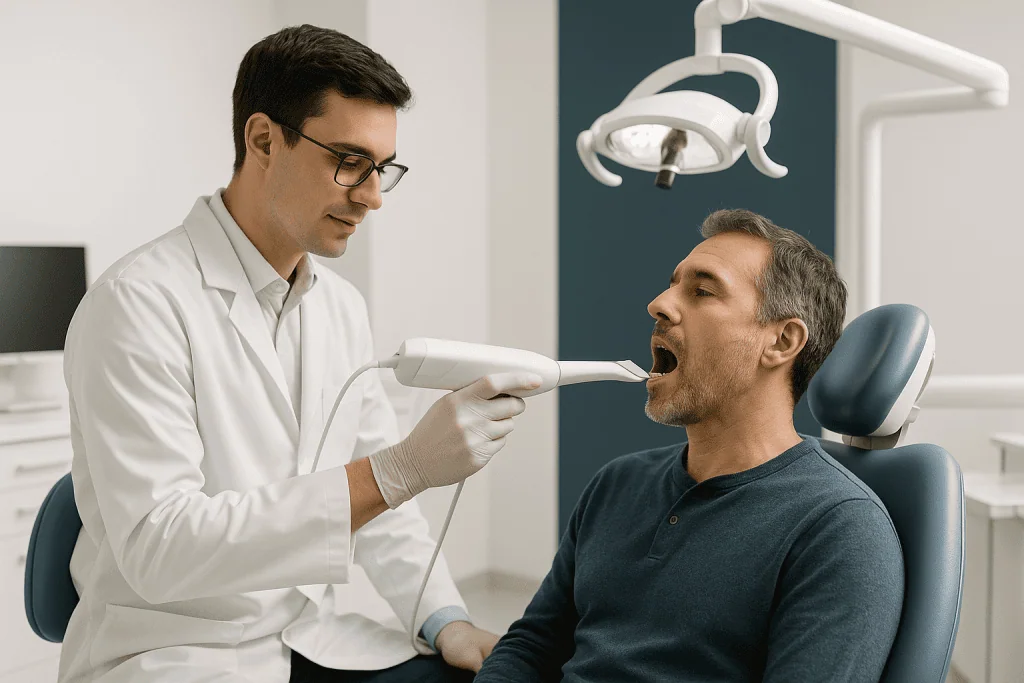
After preparation, the dentist records the shape of the tooth and the surrounding structures. Increasingly this is done with digital intraoral scanning rather than traditional impression trays, although either method may be used. Digital scanning improves precision in many cases, lets the dentist inspect the preparation on screen in real time, and streamlines communication with the dental laboratory.
Shade selection is a critical step, particularly for visible teeth. It may involve direct visual matching, calibrated photography or digital shade analysis. The goal is not simply to pick a colour but to account for translucency, brightness and how the crown will sit next to its neighbours under different lighting, daylight, indoor light and the light of a camera flash all reveal a restoration differently.
Temporary Crown Placement
In most cases a temporary crown is placed while the final restoration is being made. The temporary protects the prepared tooth, reduces sensitivity, maintains the gum contour and gives you acceptable appearance and function in the interim. It is not built for long-term use, so the dentist will advise avoiding very hard or sticky foods until the final crown is fitted.
Laboratory Fabrication
The final crown is made from the scan or impression, the bite record and the aesthetic information gathered during planning. Laboratory skill matters more than patients often realise. The crown must fit accurately at its margins, contact the neighbouring teeth correctly, and align with the bite so that forces are distributed as intended. For front teeth, small differences in contour or translucency visibly separate a crown that looks like a tooth from one that looks like dental work.
Modern workflows combine digital design with hand craftsmanship: software controls fit and anatomy, while a technician refines the subtle surface texture and internal colour effects that make ceramic read as enamel.
Can you cement e-max crowns?
Yes. E-max crowns can be fixed in place either by adhesive bonding or, where the prepared tooth offers enough natural retention, by conventional cementation. Adhesive bonding is generally preferred for lithium disilicate because the bonded interface adds to the overall strength of the restoration, but it is technique-sensitive: the ceramic surface and the tooth must each be treated in a specific sequence, and moisture control during the procedure matters. Which approach is used in your case is a clinical decision based on the shape of the preparation, the position of the margins and the condition of the tooth.
Try-In, Adjustment and Final Placement
At the fitting appointment, the temporary is removed and the tooth is cleaned. The dentist checks the final crown for fit, marginal adaptation, shade, contour and bite contact. You may be asked to close on thin marking paper so any high spots can be identified and adjusted. For visible teeth, the appearance is reviewed from several angles and in natural facial expression, not just close up. Once fit and appearance are approved, the crown is bonded or cemented according to the requirements of the case, the bite is rechecked, and the dentist confirms that floss passes correctly between the teeth.
How long does treatment take?
Most e max crown dental treatment for a single tooth takes two visits, although the exact timing depends on the complexity of the case and the production pathway. If other procedures are needed first, gum treatment, root canal therapy or a core build-up, the overall timeline lengthens accordingly. It helps when the full sequence, consultation, diagnostics, preparation, temporary placement, final fitting and review, is agreed at the outset, so each stage is scheduled deliberately rather than improvised as treatment goes along.
Technology Used and How It Helps
Several categories of technology support modern crown work. Digital imaging helps detect underlying decay, assess root and bone health, and flag structural risks that could change the plan. Intraoral scanners improve the accuracy and comfort of impressions. Digital smile-planning tools help align the restoration with facial features and adjacent teeth in cosmetic cases. Laboratory design software controls contours and contact points, and contemporary ceramic processing and adhesive protocols contribute to fit and material performance. Technology is most useful when it serves sound clinical judgement; the question is never whether a tool is used, but whether it genuinely improves diagnosis, planning, accuracy and communication in your treatment.
Recovery After the Procedure
Recovery is usually straightforward. Mild gum tenderness or temperature sensitivity can occur for a short time, particularly if the tooth needed extensive preparation, and most patients return to normal daily activities immediately. If the bite feels slightly off after placement, even a minor adjustment makes a real difference, so persistent pressure or discomfort when chewing should be mentioned at review rather than tolerated.
Home care remains essential. The crown itself cannot decay, but the tooth underneath and the margin where crown meets tooth still need careful cleaning. Brushing, flossing and regular professional reviews: the everyday routines covered under dental hygieneare part of maintaining the result. If you clench or grind your teeth, the dentist may recommend a night guard to reduce excessive force on the crown and the teeth around it.
Why Acting Early Matters
People often delay crown treatment because the tooth is not hurting constantly, or because the cosmetic issue feels manageable for now. The difficulty is that structural dental problems tend to progress quietly. A crack can deepen. A large old filling can leak and allow recurrent decay to spread beneath the surface, invisible from the outside. A weakened tooth can fracture suddenly during ordinary chewing, turning a treatable situation into one that requires far more extensive intervention.
Earlier treatment may preserve more of the natural tooth, and this is a core principle of restorative dentistry: the longer damage continues, the greater the chance that remaining healthy structure becomes compromised. In practical terms, delay can mean a more complex rebuild, root canal treatment, gum management, or extraction if the tooth eventually becomes non-restorable.
Delay also affects the rest of the mouth. When one tooth is painful or unstable, patients shift chewing to the other side. Over time this can create muscle tension, uneven wear and additional stress on neighbouring restorations. Cosmetic goals become harder to achieve, too, if surrounding teeth drift or the gums become inflamed around a failing restoration.
An evaluation does not commit you to immediate treatment. It tells you what is happening now, what the options are, and what is likely to change if you wait. For many patients, having that information clearly laid out reduces anxiety and makes the eventual decision, whichever way it goes, a calmer one.
Benefits of E-max Crowns
The potential advantages are easiest to understand in practical terms:
| Benefit | What It Means for You |
|---|---|
| Natural appearance | The ceramic reflects and transmits light in a way that can resemble natural enamel, helping the crown blend with nearby teeth. |
| Metal-free restoration | There is no metal substructure, which suits patients seeking a highly aesthetic result or wishing to avoid a grey gumline effect. |
| Strength with aesthetics | The crown restores function while keeping a refined, lifelike appearance, especially in the visible parts of the smile. |
| Protection for weakened teeth | A tooth with cracks, large fillings or structural loss is reinforced and covered, reducing the risk of further breakdown. |
| Customised fit and contour | The crown is made specifically for your tooth, your bite and your smile, supporting both comfort and appearance. |
| Conservative treatment in suitable cases | With careful planning it may be possible to preserve a meaningful amount of healthy tooth while still achieving a durable restoration. |
Recovery Timeline After E-max Crown Treatment
Although recovery is usually quick, it helps to know what the first days and weeks commonly involve:
| Time Period | What Patients Can Expect |
|---|---|
| Day 1 | Numbness wears off within hours. Some sensitivity or slight gum tenderness may be present. Most patients return to usual activities the same day. |
| First week | The tooth and surrounding gums settle. Chewing feels increasingly natural. If the bite feels high or uneven, a simple adjustment may be needed. |
| First month | The crown typically feels integrated into normal eating and speaking. Cleaning around it becomes routine, and any early fit concerns should be addressed at review. |
| Longer term | With regular dental reviews, good home care and management of grinding where present, the crown can remain functional and aesthetic for many years. |
How Long E-Max Crowns Last and How to Look After Them
How long do e max crowns last?
There is no fixed lifespan, and any clinic quoting one as a certainty is simplifying. Lithium disilicate is a durable material, and a well-made, well-bonded E-max crown on a suitable tooth can remain in service for many years. What actually determines longevity is a set of individual factors: how accurately the crown fits at its margins, how heavy the forces in your bite are, whether you grind or clench, how well the tooth and gumline are cleaned day to day, and whether you attend regular reviews so small problems are caught early. The material sets the ceiling; your bite and your habits decide how close you get to it.
Do e-max crowns stain?
The glazed ceramic surface resists staining from tea, coffee, red wine and tobacco better than natural enamel does, so the crown itself holds its shade well. Two caveats are worth knowing. First, the crown will not respond to whitening products, so if you plan to whiten your natural teeth, that shade change should be settled before the crown’s colour is chosen, otherwise the crown may later look darker than its neighbours. Second, superficial deposits and stain can accumulate at the margin where crown meets tooth if plaque is allowed to sit there, which is a hygiene issue rather than a material one and is managed with good home care and professional cleaning.
What are the downsides of E-max crowns?
Every restoration has limits, and stating them plainly is part of honest planning. E-max crowns require the removal of some natural tooth structure, and that step is irreversible: once a tooth is prepared for a crown, it will always need one. As a glass-ceramic, the material can chip or fracture under extreme force, which is why it is chosen more cautiously for heavy grinders and back teeth under maximum load, and why zirconia or another approach is sometimes recommended instead. The bonding procedure is technique-sensitive, so the outcome depends on disciplined clinical work, not just the material’s data sheet. E-max also sits towards the higher end of restorative options in laboratory effort and clinical time, which is reflected in what clinics charge. Finally, some short-term sensitivity after preparation is common, and occasionally a prepared tooth later needs root canal treatment if its nerve does not settle. None of these downsides argues against the crown in a suitable case; they argue for choosing the case carefully.
What Influences a Good Outcome
Successful e max crown dental work depends on more than the material itself. The single most important factor is case selection. E-max performs best when the tooth, the bite and the aesthetic goals are evaluated together. A crown that looks beautiful but is overloaded in function may not hold up over time; a strong restoration poorly matched in colour or contour may function adequately yet leave the patient dissatisfied every time they see a photograph.
The condition of the tooth matters greatly. Teeth with adequate remaining structure, healthy roots and stable gum support offer a strong foundation. If a tooth has extensive decay below the gumline, severe cracking or mobility from periodontal disease, the long-term outlook changes and the plan may need to be reconsidered, sometimes towards a different restoration, sometimes towards treating the underlying problem first.
Bite forces are the other major consideration. Grinding and clenching place high stress on any restoration. This does not automatically rule out E-max, but it shapes the design, the material thickness and the aftercare, and it is often the reason a protective night guard becomes part of the long-term plan.
Precision at every stage also counts: tooth preparation, impressions or scans, laboratory fabrication, shade matching, fit assessment and bonding technique. Small errors in margin fit or bite contact can cause sensitivity, food trapping, gum irritation or premature wear. This is why crown treatment should not be approached as a simple cosmetic purchase. It is a clinical procedure that rewards careful diagnosis and disciplined execution, and shows the cost of shortcuts within a few years.
Your own habits complete the picture. Daily brushing and flossing, regular professional examinations, restraint about biting very hard objects, and attendance at follow-up visits all support longevity. If you have a history of dry mouth, high cavity risk or irregular dental attendance, these should be discussed openly so the care plan reflects reality rather than an ideal patient. Expectations should be realistic too: a well-made crown can look very natural, but it remains a restoration. The goal is a result that is healthy, functional and aesthetically balanced within your own mouth and smile.
What Affects the Cost of an Emax Crown
There is no single answer to what an E-max crown costs, because the price of a crown reflects far more than the block of ceramic it starts from. The main drivers are consistent across clinics and countries. How many teeth are being treated, and whether the crown stands alone or forms part of a wider smile plan. What preparatory work the tooth needs first: a core build-up, root canal treatment or gum therapy each add clinical time before the crown itself begins. The diagnostic pathway, from imaging to digital scanning and shade analysis. And the laboratory work, where the difference between an adequate crown and an excellent one lies largely in technician skill and time. When you compare quotations, the useful question is not which number is lowest but what each number includes: diagnostics, temporaries, the laboratory standard, adjustments and follow-up review. A quotation that itemises these tells you more about the clinic than the total does.
Dental Restoration at Acibadem
Dental treatment at Acibadem sits within its Dental & Oral Health units, inside a broader hospital environment. For most single-crown cases that context is simply reassuring background; for patients with complex needs or concurrent health conditions that may influence dental treatment, access to a wider multidisciplinary setting has practical value.
Crown cases that involve cosmetic goals, structural damage, bite issues, gum concerns or prior dental work needing revision benefit from coordinated evaluation, restorative and prosthodontic perspectives, endodontic assessment where root canal-treated teeth are involved, and periodontal input where gum health affects the final result. Digital imaging, intraoral scanning and detailed smile and bite analysis support that planning, so the recommendation rests on a complete assessment rather than a quick visual estimate: whether the tooth should be crowned at all, whether E-max is the right material for it, and how the restoration should be shaped and shaded.
The treatment sequence, consultation, diagnostics, preparation, temporary placement, final fitting and review, is planned as a coherent whole, with each stage given the time it needs. The aim is a schedule that is organised without being rushed, because a crown fitted under time pressure is a crown fitted badly.
Questions Worth Settling Before You Decide
Wherever you choose to be treated, a few questions separate a considered plan from a templated one. Is a crown genuinely the most conservative option that will work for this tooth, or would a smaller restoration serve? Why is E-max the recommended material for this position and this bite, rather than zirconia or another ceramic? What preparatory work does the tooth need first, and how does that change the timeline? How will the shade be matched, and should any whitening happen beforehand? What does the aftercare plan look like, including whether a night guard is advisable?
A dentist who answers these questions specifically, about your tooth, not teeth in general, is giving you the raw material for a good decision. When crown treatment is planned that way, an E-max crown can restore strength, appearance and everyday confidence in a manner that feels refined rather than artificial, and that holds up to the ordinary demands of eating, speaking and smiling for years to come.
Preparation
- Your dentist examines the teeth, discusses your smile goals, and may take digital scans or impressions. Any decay, gum issues, or bite problems are treated first to help ensure a stable, long-lasting result. You may be advised to avoid very hard foods if temporary crowns are placed between visits.
Aftercare
- Mild sensitivity can occur for a short time after placement, especially with hot or cold foods. Good oral hygiene, regular dental checkups, and avoiding habits like teeth grinding or biting hard objects help protect the crowns. Your dentist may recommend a night guard if bruxism is present.
Frequently Asked Questions
What are E-max crowns and why are they popular for front teeth?
E-max crowns are all-ceramic dental crowns made from strong lithium disilicate material. They are popular because they combine durability with a very natural look, allowing light to pass through in a way similar to real enamel. This makes them especially suitable for front teeth and visible areas of the smile. At Acibadem, dental specialists evaluate your bite, tooth condition and cosmetic goals to decide whether E-max crowns are the most suitable option for you.
Am I a good candidate for E-max crowns?
You may be a good candidate if you have a damaged, weakened, discolored or misshapen tooth and want a highly aesthetic restoration. E-max crowns are often recommended for patients with healthy gums and enough natural tooth structure to support a crown. They may not be the best choice in every case, especially if heavy grinding or certain bite issues are present. Acibadem specialists provide a personalized assessment to recommend the safest and most effective crown material for your needs.
How long do E-max crowns last?
With good oral hygiene and regular dental checkups, E-max crowns can last many years. Their lifespan depends on factors such as daily brushing and flossing, bite pressure, diet, and whether you clench or grind your teeth. Avoiding habits like chewing ice or opening packages with your teeth also helps protect them. During your consultation at Acibadem, the dentist can explain how to care for your crown and whether a night guard may be helpful if grinding is a concern.
Are E-max crowns better than zirconia crowns?
E-max and zirconia crowns are both high-quality options, but they serve slightly different purposes. E-max is often chosen for superior translucency and a very lifelike appearance, especially for front teeth. Zirconia may be preferred in some back teeth or cases needing extra strength. The better choice depends on the tooth position, bite forces, cosmetic expectations and your overall dental health. At Acibadem, your dentist compares these factors and suggests the most appropriate material for long-term function and appearance.
Is the E-max crown procedure painful?
The procedure is usually well tolerated and is performed with local anesthesia to keep you comfortable during tooth preparation. Some patients notice mild sensitivity or tenderness for a short time after the appointment, especially if the tooth was already sensitive before treatment. This generally improves quickly. If needed, your dentist can advise on simple ways to manage temporary discomfort. At Acibadem, patient comfort is a priority throughout the planning, treatment and follow-up stages.
How many days do I need in Turkey for E-max crowns?
The length of stay depends on how many crowns you need, whether any preliminary treatment is required, and whether digital scans or lab work can be completed quickly. Many international patients can complete treatment in a few days, while more complex smile cases may need longer or a second visit. Planning, tooth preparation, temporary crowns and final fitting all affect the timeline. Acibadem teams help organize your treatment schedule after a personalized assessment and travel planning review.
Do E-max crowns look natural?
Yes, one of the main reasons patients choose E-max crowns is their natural appearance. The ceramic material has excellent translucency, allowing the crown to reflect light similarly to real teeth. This helps create a realistic result that blends well with nearby teeth, especially in the smile zone. Shade, shape and contour can also be customized to suit your facial features and preferences. At Acibadem, careful planning is used to achieve a balanced, natural-looking smile rather than an artificial result.
Can E-max crowns stain or change color over time?
E-max crowns are resistant to staining compared with natural enamel, and their color is stable because the shade is built into the ceramic material. However, the surrounding natural teeth can still change color over time from coffee, tea, smoking or aging, which may affect how well everything matches. Good oral hygiene and routine polishing help maintain appearance. If you are considering whitening, it is often discussed before crown treatment so Acibadem specialists can plan the best shade match.
What is the recovery like after getting E-max crowns?
Recovery is usually straightforward. You may have mild gum tenderness or temporary sensitivity to hot and cold for a few days, especially after tooth preparation. Most patients return to normal daily activities immediately, though it is wise to avoid very hard or sticky foods until the final crown is placed and fully adjusted. Once fitted properly, the crown should feel comfortable and function like a natural tooth. Acibadem dentists provide aftercare guidance and check your bite to help ensure a smooth recovery.
How much do E-max crowns cost in Turkey?
The cost of E-max crowns in Turkey can vary depending on the number of teeth treated, whether additional procedures are needed, the complexity of the case and the treatment plan chosen. It is best to be cautious with fixed online price claims because they may not reflect your actual needs. After reviewing your dental condition, Acibadem specialists can prepare a personalized treatment plan and clear cost estimate, helping international patients understand both the clinical steps and overall budget.
Medically reviewed by the Acıbadem International Medical Board September 1, 2026
See our medical review board →
Update history
- PublishedJuly 19, 2026
- Medical review approvedSeptember 1, 2026
- Last content updateSeptember 1, 2026
From the Acibadem Blog

E-Max Crown Treatment Step by Step: Minimal Tooth Preparation, Scanning and Bonding Explained
The e max crown procedure typically involves an examination and X-rays, conservative reshaping of the tooth, a digital scan or impression, fabrication of a…