

E-Max Crown Problems: Chipping, Debonding and Sensitivity and How Each Is Handled
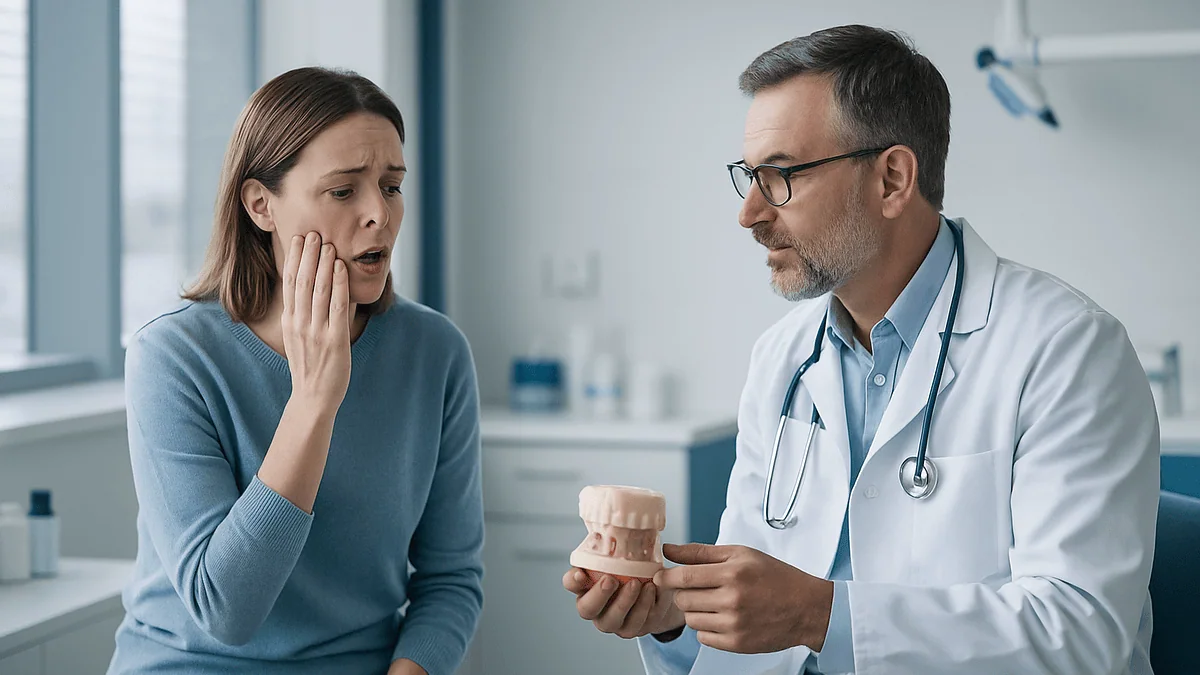
Key Takeaways
- Lithium disilicate resists straight-down chewing forces well but is brittle under sideways loads on thin edges, which is why chips cluster at margins and cusp tips.
- A small chip on a crown whose gum-line seal is intact is usually polished in the chair rather than replaced.
- A crown that has come off should be kept dry, never glued back at home, and brought to the dentist the same day so the tooth underneath stays protected.
- Cold sensitivity that shortens week by week after crown work is generally settling; pain that lingers a minute or more or wakes you points to nerve inflammation that needs assessment.
- Biting soreness on a new or recemented crown is most often a high spot that a brief bite adjustment resolves.
- Untreated grinding is one of the most common reasons a glass ceramic crown chips or loosens, and a night guard is the one preventive step largely in the patient's hands.
E-Max crowns are made of lithium disilicate glass ceramic, and their most common problems are small edge chips, loss of the bond to the tooth, and temperature or biting sensitivity. Minor chips are often smoothed or polished, larger fractures usually mean a new crown, a loose crown is cleaned and recemented if the tooth is sound, and sensitivity is investigated for bite height, nerve inflammation or gum recession. The treating dentist decides each step.
The crunch comes from an almond, or a piece of ice, or the seed at the bottom of a bowl of olives. Your tongue goes straight to the tooth that had the crown fitted last spring, and there it is: a tiny rough edge that was not there this morning. Nothing hurts. It still looks white in the mirror. But the smooth glassy surface you paid attention to for months now has a corner missing, and the question arrives before breakfast is finished. Is this serious?
Lithium disilicate, sold widely under the E-Max name, has become one of the most common ceramics for single crowns because it looks like enamel and bonds well to teeth. Yet e max crown chipping, a crown that has come loose, and a crown that zings with cold are the three complaints dentists hear most about it.
Each has a different cause, a different fix, and a different level of urgency. This explainer walks through all three, including what the appointment usually involves and which signs should not wait.
What is an E-Max crown, and why does e max crown chipping happen at all?
A crown is a cap that covers the whole visible part of a tooth after decay, a fracture or a root canal has left it too weak to stand alone. E-Max is a brand name for a particular lithium disilicate glass ceramic; the generic material name is what dentists use in the clinical literature, and the same broad behavior applies to lithium disilicate crowns made under other names.
Glass ceramic sits in an interesting middle ground. Compared with older porcelain layered over metal, it transmits light the way enamel does, so a front tooth crowned in this material rarely shows the gray line at the gum that people remember from their parents’ dentistry. Compared with zirconia, a denser tooth-colored ceramic, it is less strong in bending but easier to bond chemically to the tooth, which is part of why it earned a reputation for conservative, natural-looking work.
That middle ground explains the chipping. Glass ceramics are hard but brittle. They resist the steady, vertical pressure of ordinary chewing very well. What they tolerate less well is a sharp, off-axis load on a thin edge: a molar clenched against a molar overnight, a fingernail, a pen cap, a hard seed at the wrong angle. The thinner the ceramic at that spot, the smaller the force needed to lift a flake away.
Chipping is therefore usually a story about thickness, bite forces and habits, not about a defective crown. Understanding which of those three applied to your tooth is the first thing a dentist will try to work out, because it decides whether a polish, a repair or a fresh crown makes the most sense, and whether anything else in the mouth needs attention first.
How lithium disilicate crowns actually work: strength, bonding and where they fail
A lithium disilicate crown begins as a block or ingot of glass containing tiny needle-shaped crystals. Once it is milled or pressed to the shape of your tooth, it is heated in a furnace so the crystals grow and interlock, which is where the material gains most of its toughness. The crown is then glazed or polished so the surface is smooth enough to slide against opposing teeth without wearing them.
The second half of the story is the bond. The inside of the crown is etched with a mild acid to roughen it microscopically, then coated with a silane, a coupling agent that lets resin cement grip glass. The tooth is prepared with its own etch and bonding agent. When the resin cement sets between the two, crown and tooth behave almost like a single structure. Well-bonded glass ceramic is considerably more resistant to cracking than the same ceramic sitting loosely on a tooth, because the tooth underneath supports it and the cement layer spreads the load.
Three weak points follow from this design:
- Thin margins and cusp tips, where the glass is a fraction of a millimeter thick and a sideways knock can lift a flake.
- The cement layer, which can fail if the tooth was contaminated with saliva or blood during bonding, if the tooth is very short, or if the bite loads the crown from an awkward direction.
- The tooth itself, which is living tissue with a nerve that may react to the drilling, the temporary crown and the cement chemistry.
Those three weak points map neatly onto the three problems people search for: chipping, debonding and sensitivity. Each is handled by working backward to the point that failed.
Can e max crowns chip? What a chip looks like and what usually caused it
Yes, although in the published literature outright fracture is uncommon. A systematic review in the Journal of Prosthetic Dentistry that pooled clinical studies of lithium disilicate single crowns found survival above 95% over follow-up periods of roughly two to five years, with fracture and chipping among the small number of failures recorded (Pieger and colleagues, PubMed reference below). That is reassuring context, not a guarantee, and individual mouths vary enormously.
Chips come in recognizably different sizes:
- A surface flake: a rough patch you feel with the tongue before you see it, often along the biting edge of a front tooth or the outer edge of a molar. The crown is otherwise intact.
- A corner or cusp loss: a visible missing piece, sometimes with a sharp edge that catches the cheek or tongue. The core of the crown still covers the tooth.
- A through-and-through crack: a line running from the biting surface toward the gum, sometimes with a piece that rocks when pressed. Underlying tooth may be exposed.
Cause matters as much as size. Dentists look at the opposing tooth for a matching hard spot, at wear facets on other teeth that suggest overnight grinding, and at the thickness of the ceramic where it failed. Bruxism, the medical name for clenching or grinding, is common and often unrecognized; Mayo Clinic lists worn or chipped teeth and fractured restorations among its signs. A crown placed on a heavy grinder without a protective night guard is under a load the material was never designed to take alone.
Habits count too. Chewing ice, biting fingernails or opening packaging with the teeth are the everyday equivalents of tapping a wine glass with a knife: harmless most of the time, until the angle is wrong.
E max crown chipping: how each type of damage is usually handled
The response scales with the damage and with how much sound ceramic remains. The table summarizes the common pathways; the treating dentist chooses among them after examining the tooth, the bite and often a radiograph, and none of these outcomes can be promised in advance.
| What has happened | What the dentist usually checks | Common approach |
|---|---|---|
| Small edge flake, no exposed tooth | Sharpness, bite contact, grinding signs | Smooth and repolish the edge in the chair; adjust a high spot; consider a night guard |
| Corner or cusp missing, crown still sealed | Whether the crown still seals the margin, esthetics, remaining thickness | Direct composite repair after roughening and silane, or a new crown if the area is load bearing |
| Crack through the crown or loose fragment | Exposed dentin, decay under the margin, tooth fracture | Remove the crown, assess the tooth, place a new crown; core build-up or root treatment if needed |
| Repeated chipping of the same crown | Bite forces, material choice, habits | Discuss a stronger ceramic or different design, plus habit and guard management |
Polishing is genuinely a fix, not a cover-up. A smoothed glass ceramic edge is stable and no longer traps plaque or scrapes the tongue. Composite repair, in which tooth-colored resin is bonded onto the chipped area, works best on front teeth where the missing piece is cosmetic rather than structural; on a molar cusp that takes the full chewing load, repairs tend to have a shorter life, which is why many dentists lean toward replacement there.
Whatever the route, a chipped crown that is still sealed to the tooth is rarely an emergency. The urgency rises only when tooth structure is exposed, when the fragment is loose enough to swallow or inhale, or when pain appears.
E max crown repair or replacement: how the decision is usually made
Patients often assume a chipped ceramic crown must be replaced. Dentists think in terms of risk and remaining value instead, and their reasoning is worth knowing so you can follow the conversation.
The first question is whether the seal at the gum line is intact. A crown’s real job is to keep bacteria and saliva off the tooth underneath. If the chip is well above the margin and the crown still fits snugly, the tooth is protected even if the crown looks imperfect. If the chip runs to the margin or a probe catches at the edge, decay can start beneath the crown, and replacement moves up the list.
The second question is load. The front teeth cut; the back teeth crush. A composite patch on an incisor edge sees mostly shear forces during speech and gentle biting. The same patch on a molar cusp is compressed thousands of times a day. Repairs in high-load areas can last, but they are more likely to need redoing, and each repair cycle involves bonding new material to an increasingly complex surface.
The third question is what the chip revealed. A crown that chipped because the ceramic was thin over a tall cusp may chip again in the same place if simply repaired, because the underlying geometry has not changed. A crown that chipped because of a single olive stone is a different case.
Finally, there is the tooth’s history. A root-treated tooth with a large post and core carries more risk with each removal and replacement than a lightly prepared vital tooth. Some dentists will nurse a repaired crown along on such a tooth precisely to avoid disturbing it. The decision is individual, and it belongs to you and the dentist together.
E max crown fell off: what debonding means and what to do in the first hours
Debonding is the technical word for a crown separating from the tooth. Sometimes the crown comes away whole, cement still lining its inside; sometimes it comes away with the core build-up, a filling material used to rebuild a badly broken tooth before crowning, attached to it. Occasionally the tooth itself has fractured and part of it is inside the crown.
The first hours are mainly about protecting what is left:
- Find and keep the crown. Rinse it, look inside it, and store it dry in a small container. Do not scrub it or try to clean out old cement.
- Look at the tooth. If it is a smooth stump, the crown has simply debonded. If there is a jagged piece, a metal post or a soft area, tell the dentist when you call.
- Avoid chewing on that side and keep very hot, cold and sweet things away from it, since exposed dentin is often sensitive.
- Do not glue it back yourself. Household adhesives and even over-the-counter dental cements can trap bacteria, seat the crown at the wrong height and make the professional recementation harder.
Call the dental office the same day. Most practices treat a lost crown as a priority appointment rather than an emergency, but a prepared tooth left uncovered for long can drift slightly, become sensitive, decay, or chip itself, all of which may turn a straightforward recementation into a new crown.
Seek urgent care rather than routine care if the crown was swallowed with any difficulty breathing, if a piece may have been inhaled, if there is bleeding that does not stop, or if the tooth is loose in its socket after a blow. Those signs point to something beyond a dental cement failure.
Why do E-Max crowns come loose? Cement, moisture, tooth shape and habits
A glass ceramic crown relies on chemistry far more than an old metal crown did. Metal crowns were held largely by friction on a tall, near-parallel tooth stump; the cement filled gaps. Lithium disilicate crowns are often placed on shorter or more tapered preparations because the bond is expected to do the work. When the bond is compromised, there is less mechanical backup.
Common reasons a bond fails:
- Contamination during placement. Saliva, blood or even oil from an air line on the etched surfaces can block the resin from wetting the tooth or the ceramic. This is why isolation with a rubber dam or careful suction matters, and why a crown that comes off within weeks often shows clean, cement-free tooth underneath.
- Short or over-tapered teeth. A tooth worn down by years of grinding, or a lower molar that never had much height, offers little surface area and little resistance to being twisted off.
- Bite forces. Grinding and clenching load the crown sideways over and over. NHS guidance on teeth grinding notes that it can break or loosen dental work as well as wear down natural teeth.
- Decay at the margin. If bacteria get under an edge, the tooth softens and the cement loses its anchor.
- Sticky foods and habits. Caramel, chewing gum and taffy exert a pulling force exactly opposite to the crown’s seating direction.
Implant-supported crowns deserve a separate note. A lithium disilicate crown on an implant may be cemented to a metal or zirconia abutment, a connector piece screwed into the implant, or the crown may itself be screw-retained. Loosening there can mean the cement has failed or that the abutment screw has loosened. The two feel similar from the inside of the mouth but are managed differently, so tell the dentist if the tooth in question sits on an implant.
E max crown sensitivity: why a new crown can feel cold-sensitive or sore to bite
Some sensitivity after crown work is ordinary. The tooth has been drilled, dried, coated with acidic conditioners and bonding agents, capped with a temporary and then with the final crown, all within a few weeks. The pulp, the soft tissue containing the nerve and blood supply, has every reason to be irritable for a while. Cleveland Clinic notes that sensitivity to heat and cold can persist for a few weeks after a crown is placed and usually settles, with desensitizing toothpaste sometimes used in the interim.
The mechanism is straightforward. Dentin, the layer beneath enamel, is riddled with microscopic tubules filled with fluid that runs to the nerve. Cold, sweet or air contracts that fluid and the nerve fires. A fresh preparation exposes many tubules; the cement and crown seal most of them, but any tiny gap at the margin, or any residual inflammation in the pulp, keeps the sensation alive. Fluoride or potassium nitrate toothpastes work by plugging tubules or calming the nerve endings, which is why dentists often suggest them; the choice is the dentist’s.
Soreness on biting is different from cold sensitivity and is often about height. A crown that sits even slightly high meets the opposing tooth first with every bite. The ligament that suspends the tooth in its socket becomes bruised, and the tooth aches or feels tender to tap. This is usually solved by a short adjustment appointment where the dentist marks the contacts with articulating paper and grinds the high spot away, then repolishes the ceramic.
Neither pattern, on its own, suggests a problem with the material. What matters is the direction of travel: sensitivity that is fading week by week is settling; sensitivity that is holding steady or worsening deserves a closer look.
When sensitivity is more than settling: nerve inflammation, high bite and gum issues
Dentists sort persistent sensitivity into a handful of causes, and the questions they ask are designed to separate them.
Reversible pulpitis is inflammation of the nerve that calms once the irritant is removed. Its signature is a sharp, brief response to cold that stops within seconds of the stimulus going away. It often improves as the pulp recovers from treatment, and a slightly high bite or a marginal gap may be adjusted or sealed to help it along.
Irreversible pulpitis is inflammation that has gone too far for the nerve to recover. The pain lingers for a minute or more after cold, may wake you at night, may throb without any trigger, or may respond to heat rather than cold. A tooth in this state usually needs root canal treatment, in which the inflamed pulp is removed and the canal sealed. The crown can sometimes be kept and accessed through a small opening that is later filled; sometimes it must be replaced. MedlinePlus describes toothache that is severe, lasts more than a day or two, or comes with fever or swelling as reasons to see a dentist promptly.
Gum recession exposes root surface next to the crown margin. Root dentin has no enamel and is sensitive to cold and to brushing. Treatment ranges from desensitizing agents and brushing technique to a bonding layer over the exposed root, and occasionally to gum grafting.
Cracked tooth under the crown produces a sharp pain on releasing a bite rather than on biting down, often on a specific spot. It is the hardest to diagnose and may need the crown removed to see the tooth clearly.
Each of these has a different plan, which is why simply waiting for sensitivity to fade is reasonable only while it is genuinely fading.
Who is a good candidate for an E-Max crown, and who is usually asked to wait or choose another material
Lithium disilicate tends to be chosen when appearance matters and forces are moderate. Front teeth and premolars are its natural territory, as are single molars in people without signs of heavy grinding. It suits teeth where enough enamel remains for a strong bond, because the resin cement grips enamel more reliably than dentin. It also suits situations where the dentist wants to remove as little tooth as possible, since glass ceramic can be made thinner than porcelain-fused-to-metal while keeping the tooth looking natural.
Several groups are commonly steered toward a different material or asked to sort something out first:
- People with pronounced bruxism, especially with flattened teeth and a history of broken restorations. Zirconia, a denser ceramic with higher fracture resistance, or a metal-based crown on a back tooth, may be discussed, alongside a night guard whichever material is chosen.
- Teeth with very little height left. A short stump gives the bond little help, and the dentist may recommend a procedure to lengthen the crown, a post and core, or a design with more mechanical retention.
- Active gum disease or untreated decay elsewhere. Crowning a tooth in an unstable mouth risks early failure, so stabilizing the gums usually comes first.
- Teeth with uncertain pulp health. A tooth that is already tender or has a deep filling may be observed, or root treated, before a final crown is committed, to avoid drilling through a new crown later.
- Long spans. Lithium disilicate is generally used for single crowns and short bridges; longer bridges usually need a stronger framework.
None of this makes glass ceramic wrong for anyone in particular. It means the material choice is a judgment about forces, tooth condition and priorities, made by the dentist with the patient, and sometimes the wisest step is to wait until the mouth is ready.
What the first days and weeks after a crown repair or recementation usually look like
Timelines here are typical ranges drawn from general dental guidance, not promises, and your dentist’s instructions override them.
After a chip is polished, most people notice little beyond a smoother tongue. The ceramic does not need time to set. If a high spot was adjusted at the same time, any biting tenderness in the ligament generally eases over a few days as the bruising settles.
After a composite repair, the resin is fully hardened by the curing light before you leave, so you can eat normally. The repaired area may look very slightly different in gloss or shade under strong light; the dentist usually polishes it at the appointment and may refine it at a follow-up. Avoid biting directly into hard foods with that edge while everyone gets a sense of how the repair is holding.
After recementation, the cement reaches most of its strength within minutes and full strength within about a day depending on type, which is why dentists often ask you to avoid chewing on that side and to skip sticky or very hard foods for the rest of the day. Mild gum soreness where excess cement was cleaned away is common and short-lived. Cold sensitivity in the first days is expected if the tooth was exposed for a while before the appointment; Cleveland Clinic describes post-crown sensitivity as commonly lasting a few weeks.
After a new crown, the pattern mirrors the original placement: a temporary for a couple of weeks unless the crown is made in a single visit, then a fitting appointment. Flossing around the margin from the first evening keeps the gum healthy while the tissue adapts.
Across all of these, one follow-up habit stands out: if a night guard was recommended, wearing it from the first night is the single most effective thing you control.
What people often get wrong about E-Max crown problems
Myth: a chipped crown means the dentist used a bad batch. Occasionally a laboratory flaw is to blame, but far more often the ceramic was asked to do something at its thinnest point that no ceramic tolerates well, or the bite forces were higher than anyone realized. The evidence base for lithium disilicate single crowns, including the systematic review cited below, shows low failure rates overall; individual chips are usually about local circumstances.
Myth: a loose crown can be pressed back and forgotten. A crown that has debonded leaves a gap that saliva and bacteria fill within hours. Pressing it back may make the tooth comfortable, and it will also hide developing decay. Recementation needs the old cement removed and the surfaces reconditioned, which only the dentist can do.
Myth: sensitivity means the nerve is dying. Some post-crown sensitivity is ordinary and fades. It becomes a concern when it lingers after the trigger is gone, wakes you, or worsens over weeks. The pattern, not the presence, of sensitivity is what the dentist reads.
Myth: zirconia never chips, so everyone should have zirconia. Zirconia is stronger in bending and chips less often, but it bonds less readily, is harder on opposing teeth when it is not well polished, and looks less like enamel in thin sections. Material choice is a trade-off, not a ranking.
Myth: once crowned, a tooth cannot decay. The crowned surface cannot, but the margin at the gum line is a seam of tooth and cement, and it decays like any other tooth surface if brushing and flossing lapse. MedlinePlus dental care guidance on daily brushing, flossing and regular checkups applies to crowned teeth exactly as it does to natural ones.
Myth: crowns last forever. Cleveland Clinic gives a typical range of roughly five to fifteen years, with habits and care making the difference between the ends of that range.
Questions to ask your care team
A chipped, loose or sensitive crown is a good moment to understand the tooth better than you did when it was first crowned. These questions tend to produce useful answers rather than reassurance alone.
- Where exactly did the crown chip, and how thick was the ceramic there? The answer tells you whether a repair is likely to hold or whether the same spot will fail again.
- Is the seal at the gum line still intact? If yes, there is time to consider options; if not, the priority is protecting the tooth.
- Do you see signs that I grind or clench? Wear facets, scalloped tongue edges and jaw muscle tenderness are things the dentist can spot that you cannot.
- Would a night guard change the odds for this tooth and for my other restorations?
- If we repair rather than replace, what should I expect the repair to look like and how will we know if it is failing?
- If we replace, is lithium disilicate still the right material for this tooth, or would you now choose something different, and why?
- What is the state of the nerve? Has the tooth been tested for vitality, and is there anything on the radiograph suggesting root treatment may be needed?
- For a loose crown: did the cement fail, did the core fail, or did the tooth fracture? Each carries a different outlook.
- For an implant crown: is the cement loose or is the screw loose?
- How long should I give sensitivity to settle before we investigate further, and what signs should bring me back sooner?
Write the answers down. Crown problems have a way of recurring years later, and knowing the tooth’s history saves time at the next appointment.
When to call your doctor: red flags after an E-Max crown problem
Most crown complaints belong in the next available routine slot. A handful do not. Contact your dentist promptly, or seek urgent or emergency care where indicated, if any of the following apply.
- Pain that throbs on its own, wakes you at night, or lingers for a minute or more after hot or cold, since this pattern suggests the nerve is significantly inflamed.
- Swelling of the gum, cheek or face near the tooth, a bad taste, or a pimple-like bump on the gum, all of which can signal an abscess, a pocket of infection at the root.
- Fever alongside tooth pain, or swelling that makes it hard to open the mouth, swallow or breathe. Difficulty breathing or swallowing is a medical emergency and should be treated as one.
- A crown or fragment swallowed with choking or coughing that does not settle, or any possibility that a piece was inhaled.
- A tooth that is loose in its socket, or a crown that came off after a blow to the face, especially with bleeding that does not stop or other injuries.
- An exposed, sharp or fractured tooth stump that is cutting the tongue or cheek.
- Numbness or tingling in the lip or chin that appears after dental work and does not fade.
MedlinePlus advises seeing a dentist for toothache that lasts more than a day or two, is severe, or comes with fever, earache, or pain on opening the mouth. Everything short of those signs is still worth a call, particularly a lost crown, because early attention keeps a simple recementation from turning into something larger. Whatever the symptom, the assessment and the plan rest with your treating dental team, who can see the tooth, test the nerve and read the radiograph in a way no article can.
Frequently asked questions
Can e max crowns chip easily?
Not easily under normal chewing, but they can chip under sharp or sideways forces on thin edges. Pooled clinical studies of lithium disilicate single crowns report survival above 95% over follow-up of roughly two to five years, so chipping is the exception rather than the rule. The people most likely to see it are heavy grinders and those who bite hard objects such as ice, nails or pen caps.
What should I do if my e max crown fell off?
Keep the crown, rinse it, store it dry, and call your dentist the same day. Avoid chewing on that side and steer clear of very hot, cold or sweet foods, since the exposed tooth is often sensitive. Do not use household glue or store-bought cement. If the crown was swallowed with choking, or the tooth is loose after an injury, seek urgent care instead of waiting for a routine slot.
Is e max crown sensitivity normal after placement?
Some sensitivity is expected. The tooth has been drilled, conditioned and cemented, and the nerve is often irritable for a while; Cleveland Clinic describes sensitivity that can last a few weeks and usually settles. It should shorten and fade over time. Sensitivity that stays the same or worsens, lingers after the trigger, or appears without a trigger deserves a dental check rather than more waiting.
Can an e max crown repair be done without replacing the crown?
Often, yes, when the chip is small and the crown still seals the tooth. Minor edge flakes are smoothed and repolished. Larger cosmetic chips on front teeth can be repaired with bonded composite resin after the ceramic is roughened and treated with a coupling agent. Chips on load-bearing molar cusps, cracks through the crown, or damage reaching the gum line usually lead the dentist toward replacement.
Why does my crowned tooth hurt when I bite down?
The most common reason is a crown that sits slightly high, so it meets the opposing tooth first and bruises the ligament that holds the tooth in its socket. A short adjustment appointment usually resolves it. Pain specifically on releasing the bite, or pain that has appeared months later, can suggest a crack in the underlying tooth or a problem with the nerve, and needs examination.
Does a chipped E-Max crown need to be fixed right away?
Usually not urgently, if the crown is still firmly attached and no tooth is exposed. A rough edge can be uncomfortable for the tongue, and it should be smoothed soon, but it is not an emergency. Book promptly if tooth structure is visible, if a fragment rocks or feels loose, if there is pain, or if the chipped edge is cutting your cheek or tongue.
Will a night guard stop my E-Max crown from chipping again?
It reduces the risk rather than eliminating it. A night guard spreads and absorbs the forces of clenching and grinding, which NHS and Mayo Clinic guidance identify as causes of worn teeth and damaged dental work. It does nothing about daytime habits like chewing ice or biting nails, and it cannot thicken a crown that is thin at the failure point. Your dentist can advise whether one suits you.
Is zirconia better than E-Max if my crown keeps chipping?
Zirconia is more resistant to fracture and is often considered for teeth that have chipped repeatedly or for heavy grinders. It is not universally better: it bonds less readily to the tooth, is less translucent, and needs careful polishing to avoid wearing opposing teeth. Material choice is a trade-off that your dentist weighs against the tooth’s position, remaining structure and your bite.
Can a crown be recemented if it came off with the filling inside?
Sometimes, but the dentist first has to judge how much sound tooth remains. If the core build-up came away inside the crown, the tooth may need a new core, a post, or a fresh crown rather than a simple recementation. If part of the tooth itself broke, the plan depends on where the fracture runs. This is why bringing the crown with you matters.
How long do E-Max crowns usually last?
General guidance from Cleveland Clinic gives a typical crown lifespan of roughly five to fifteen years, with oral hygiene, grinding habits and chewing behavior shaping where an individual falls in that range. Clinical reviews of lithium disilicate single crowns report high survival over the first several years. No dentist can promise a specific lifespan for a specific tooth; regular checkups catch small problems while they are still small.
References
This article is for general information only and is not a substitute for professional medical advice. Please consult a qualified doctor about your individual situation.

More from the Blog
The Dental Implant Process: Every Stage From First Scan to Final Crown
The dental implant process typically unfolds over three to nine months. It begins with a 3D scan and treatment planning, followed by any needed…

Why an ENT Check May Come Before a Sinus Lift When You Have Chronic Sinusitis or Allergies
An ENT (ear, nose and throat) check often comes before a sinus lift because the graft is placed directly beneath the maxillary sinus lining,…

Sinus Lift Healing Timeline: From Graft Placement to the Day Your Implants Can Be Planned
A sinus lift usually needs several months to heal before implants can be planned. Cleveland Clinic and Mayo Clinic describe bone graft maturation as…
Who Needs Full Mouth Reconstruction? Worn, Eroded and Missing Teeth That Add Up to a Rebuild
Full mouth reconstruction is usually considered when several problems overlap in one mouth: teeth worn flat by grinding, enamel dissolved by acid, multiple missing…

Full Mouth Reconstruction Stages: Bite Stabilization, Tooth Rebuilding and the Final Fit
Full mouth reconstruction usually moves through three stages. First, the bite is stabilized and gum disease, decay, grinding and jaw-joint problems are treated. Second,…

How to Clean Around Zygomatic Implants and a Fixed Bridge: Water Flossers and Recall Visits
Cleaning zygomatic implants and the fixed bridge they support means brushing twice daily with a soft brush, cleaning under the bridge with interdental brushes,…