

Eating, Talking and Stretching the Lip After a Lip Lift: Habits to Change While You Heal

Key Takeaways
- The lip lift incision sits directly over the orbicularis oris, the ring muscle that moves the mouth, so ordinary eating, laughing and yawning create more strain than for most facial incisions.
- Sutures are typically removed at about one week, but the wound gains most of its strength from new collagen over the following weeks, which is why movement restrictions outlast suture removal.
- Nicotine from any source, including vapes and patches, narrows the small blood vessels feeding the wound and is linked to higher infection and poor-scar rates after surgery.
- A fresh scar exposed to sun can darken permanently, and the crease beneath the nose offers less shade than people assume, especially when the head tilts upward.
- Scars continue to mature for up to two years, so the pink, slightly firm line seen in the first months is not the final appearance.
- Normal conversation is fine from day one; the movements surgeons ask you to limit are wide mouth opening, broad smiling and deliberate lip stretching, none of which speed healing.
After a lip lift, the main things to avoid in the first one to two weeks are wide mouth opening, hard or messy foods, exaggerated smiling or lip stretching, sleeping face-down, smoking, alcohol, strenuous exercise and sun on the fresh incision. These habits pull on sutures or slow healing. Follow your surgeon's written instructions, and ask the team before resuming any activity.
The first surprise usually arrives at breakfast. A spoon of yogurt, a reflexive wipe of the mouth, and the sudden awareness that a row of tiny stitches now sits exactly where the upper lip meets the nose. The second surprise comes on the phone, when a friend says something funny and the laugh has to be caught halfway.
People searching for what not to do after lip lift surgery are rarely asking about the operation itself. They are asking about the thousand small movements a mouth makes every day, and which of them can be trusted. Eating, talking, yawning, smiling, brushing teeth: each one tugs, however slightly, on an incision that is only a few centimeters long and sitting on one of the most mobile pieces of skin on the body.
This explainer walks through those habits one by one, separates the restrictions that have a clear mechanism behind them from the ones that are mostly folklore, and sets out the signs that mean you should stop reading and call your surgical team.
What not to do after a lip lift: the short list that matters most
Most aftercare sheets run to two pages. Strip them back and nearly every instruction serves one of two goals: keep tension off the incision while it knits, and protect the scar while it matures. The first goal dominates the opening week or two; the second stretches across months.
With that in mind, the habits most surgical teams ask patients to change are these:
- Opening the mouth wide, for big bites, loud laughing, or yawning without a hand cupped under the nose.
- Eating foods that need tearing, biting or heavy chewing, or that leave residue around the incision.
- Exaggerated smiling, pouting, pursing the lips or deliberately stretching the upper lip to “see the result”.
- Sleeping face-down or on the side, where a pillow can press on or drag the upper lip.
- Smoking or vaping nicotine, which narrows blood vessels feeding the wound.
- Heavy exercise or bending with the head low, which raises blood pressure in the face.
- Direct sun on the incision line, which can darken an immature scar.
- Picking, scrubbing or applying unprescribed creams to the suture line.
None of these is unusual advice for facial surgery. What makes a lip lift different is geography. The incision sits where skin, cartilage and the ring-shaped muscle around the mouth all meet, so ordinary life, not accidents, is the main source of strain. Cleveland Clinic’s overview of the procedure notes that most people are back to routine activity within about a week, but that swelling and scar changes continue well beyond that (Cleveland Clinic).
The sections that follow take each habit in turn. Where the evidence is solid, we say so. Where an instruction is simply cautious common practice, we say that too.
How a lip lift works, and why the incision sits where it does
The most common version is often called a subnasal or “bullhorn” lip lift, named for the curved shape of the skin removed. The surgeon marks a narrow strip of skin directly beneath the nose, takes it out, and closes the gap with fine sutures tucked into the crease where the nose meets the lip. Removing that strip shortens the philtrum, the vertical groove between the nose and the upper lip, and gently rotates the upper lip upward and outward so that more of the vermilion, the pink part of the lip, is visible at rest.
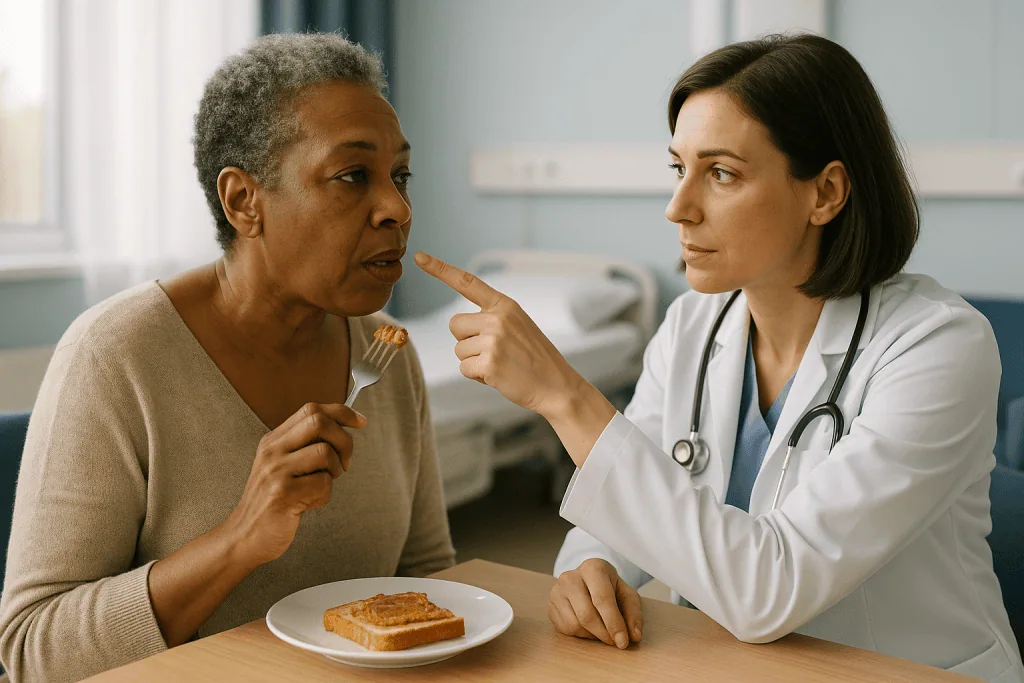
Variations exist. A direct lip lift places the incision along the vermilion border itself; a corner lift addresses only the outer edges of the mouth; an Italian lift uses two smaller incisions beneath each nostril. Cleveland Clinic describes these as choices a surgeon makes based on anatomy and the change a person wants, not as grades of quality (Cleveland Clinic).
The procedure is usually done under local anesthesia, sometimes with light sedation, and typically takes around an hour. Sutures are generally removed in roughly a week.
Why does all of this matter for eating and talking? Because beneath the incision lies the orbicularis oris, the circular muscle that purses, closes and shapes the mouth. Every word, sip and smile recruits it. In a stable region such as the scalp, a closed incision is left largely alone. Under the nose, it is pulled hundreds of times a day. The aftercare rules are really a strategy for lowering that count while the wound edges gain strength.
Who a lip lift is usually for, and who is usually asked to wait
The philtrum lengthens with age, and a longer philtrum tends to make the upper lip look thinner and hide the upper teeth at rest. People who seek a lip lift are commonly adults who notice that change, or younger adults who have always had a long upper lip and have found that fillers add volume without altering its length. A lip lift changes proportion rather than fullness, which is why surgeons often describe it as a different tool rather than a bigger one.
Candidacy is a conversation, not a checklist, and it belongs with the treating team. Several situations commonly lead a surgeon to ask someone to wait or to reconsider:
- Current smoking or nicotine use, because nicotine reduces blood flow to healing skin and raises wound complication rates (MedlinePlus).
- A personal or family history of keloids, which are raised scars that grow beyond the original wound and are more common in people with darker skin tones (MedlinePlus).
- An active cold sore or a recent outbreak, since surgery near the mouth can trigger a flare.
- Medical conditions that impair healing, including poorly controlled diabetes, or medicines that affect clotting; any change to those medicines is a decision for the prescribing clinician.
- Pregnancy or breastfeeding, when elective surgery is generally deferred.
- Expectations that the procedure cannot meet, such as a dramatic increase in lip volume.
Mayo Clinic’s guidance on cosmetic surgery stresses that the best predictor of a good experience is a clear understanding of what the operation can and cannot do, plus a realistic commitment to recovery time (Mayo Clinic). For a lip lift, that commitment means accepting one or two weeks of eating, speaking and sleeping differently.
Eating after a lip lift: how to take a bite without pulling the stitches
Think of the upper lip as a hinge that has been temporarily pinned. The hinge still works; the point is not to swing it to its limits. Eating is where most people feel this first, and where a few practical changes make the biggest difference.
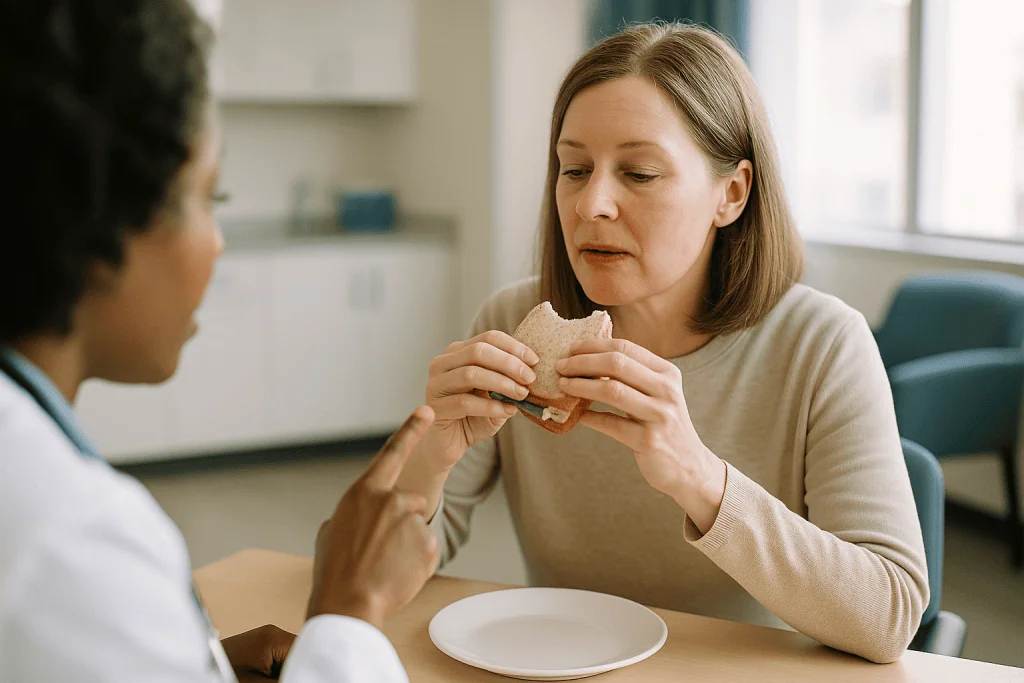
For the first several days, soft foods that need little chewing are easier: soups eaten from a spoon, smoothies, scrambled eggs, mashed vegetables, yogurt, well-cooked grains. Small bites placed toward the back of the mouth avoid the lip stretching forward to meet the food. A small spoon or fork does the same job a large one does, with less mouth opening.
Foods worth postponing tend to fall into four groups:
- Anything that requires a wide bite, such as burgers, sandwiches, whole apples or corn on the cob.
- Foods that need tearing with the front teeth, including crusty bread and tough meat.
- Very hot, spicy or acidic items, which sting an incision that sits a few millimeters from the lip.
- Messy or crumbly foods that force repeated wiping of the area.
Straws are a genuine gray area. Some surgeons prohibit them because sucking purses the lips and loads the orbicularis muscle; others allow a straw positioned at the side of the mouth. Ask your own team rather than assuming.
After eating, the incision is cleaned gently according to the written instructions you were given, typically by dabbing rather than rubbing. MedlinePlus’s guidance on surgical wound care emphasizes keeping the area clean, avoiding soaking, and never scrubbing a closed incision (MedlinePlus). Food residue sitting on sutures is both an infection risk and an invitation to pick, which is the one habit every surgeon agrees on avoiding.
Talking, laughing and yawning: how much mouth movement is too much?
Nobody is asked to stop speaking after a lip lift, and ordinary conversation at normal volume is generally fine from the first day. The concern is amplitude, not frequency. Shouting across a room, singing, or animated storytelling with a wide-open mouth all stretch the upper lip far more than quiet speech.
Laughing is harder to control, which is why many people find it helpful to warn friends in advance and to steer the first week toward calmer company. When a laugh does arrive, cupping a hand lightly under the nose and keeping the mouth relatively closed reduces the pull. The same trick works for sneezing and coughing: aim for an open-throat cough with minimal lip movement rather than suppressing it entirely, since a forced, stifled sneeze is its own strain.
Yawning deserves special mention because it is the widest involuntary movement a mouth makes. People often report feeling a sharp tug at the incision during a yawn in the first days. Supporting the upper lip with a fingertip just below the nose, and letting the lower jaw do most of the opening, keeps the tension where it belongs.
Professions matter here. Teachers, lawyers, call-center staff, singers and anyone who speaks for a living should raise this during consultation, because the usual “back to work in about a week” estimate reported by Cleveland Clinic assumes work that is not vocally demanding (Cleveland Clinic). A surgeon may suggest a longer buffer, lighter duties or a schedule built around rest for the mouth.
What the evidence does not support is total silence. There is no clinical rationale for avoiding speech, and the stiffness people feel from under-using the mouth can make the first full conversation feel oddly stilted.
Stretching, smiling and massage: when can I smile after lip lift surgery?
Smiling is the question that catches people off guard, because it is the one movement they most want to test. A gentle, closed-lip smile is usually acceptable within days. A broad, toothy grin stretches the upper lip sideways and upward against the fresh incision, and most surgeons ask patients to hold that back during the first week or two while sutures are in and the wound edges are still weak.
The reason is mechanical rather than cosmetic. A closed incision gains tensile strength gradually; in the first days it is held mainly by the sutures, and only over the following weeks does the body lay down enough new collagen, the protein scaffold of healing skin, to take over. Repeated wide stretching during that window can widen the eventual scar even without reopening it (NHS).
Deliberate lip stretching is a related habit worth naming. Some people pull the upper lip down in front of a mirror to check symmetry, or press the lip outward to “encourage” the new shape. There is no evidence that this helps, and it adds tension exactly where tension is unwelcome.
Massage is different again. Scar massage is a recognized technique for softening mature scars, and some teams introduce it once the incision has fully closed and sutures are out, often several weeks in. It should begin only when your surgeon says so, using the technique they demonstrate, not a version found online.
A practical rule of thumb many teams give: if a movement makes you feel the incision, it is probably more than the incision needs right now. Stiffness that eases over the first few weeks is expected; a sharp pull or sudden pain is a reason to stop and check in with the team.
Sleeping, washing and brushing your teeth: the quieter habits that still tug
Daily hygiene creates friction on the incision in ways that are easy to overlook until the first night.
Sleeping on the back with the head raised on two pillows is the standard advice for most facial surgery, and a lip lift is no exception. Elevation helps swelling drain and keeps the face off the pillow. People who habitually sleep on their side or stomach sometimes find a travel pillow or rolled towels on either side of the head helpful for keeping position during the first week. Rolling over in sleep is not a disaster, but a face pressed into fabric can drag the lip and disturb sutures.
Washing the face around the incision usually means gentle cleansing of everything except the suture line, then caring for the line itself as instructed, often with a dab of a prescribed ointment. Soaking the area, swimming, and steamy saunas are typically off the list until the wound is closed and the team gives the go-ahead, consistent with general surgical wound care advice (MedlinePlus).
Toothbrushing is where most people find a workaround quickly: a small-headed or child-sized brush, the mouth opened only as wide as needed, and the upper lip left relaxed rather than pulled up to reach the gum line. Mouthwash is fine if it does not splash the incision; spitting gently rather than forcefully avoids a hard purse of the lips.
Shaving the upper lip, for those who do, waits until the incision has closed and your surgeon has cleared it. Makeup, likewise, stays off the suture line until the team says the skin has sealed, because cosmetics can carry bacteria into an immature wound and are difficult to remove without rubbing.
Smoking, alcohol, exercise and sun: four habits with a mechanism behind them
Some restrictions in a lip lift aftercare sheet are matters of caution. These four have a clear physiological basis.
Nicotine, from cigarettes, vapes, patches or gum alike, constricts small blood vessels and lowers the oxygen reaching a healing wound. MedlinePlus notes that smokers have higher rates of wound infection, slower healing and poorer scars after surgery, and that the benefits of stopping begin well before the operation and continue through recovery (MedlinePlus). An incision beneath the nose is small, but its blood supply runs through exactly the kind of fine vessels nicotine affects most.
Alcohol dilates blood vessels, which can increase swelling and the risk of bleeding in the first days, and it can interact with prescribed pain relievers. Most teams ask for abstinence until any such medicines are finished; the prescribing clinician sets that timeline.
Strenuous exercise raises heart rate and blood pressure, including in the face, which increases swelling and the chance of bleeding at the incision. Bending forward with the head below the heart does the same. Walking is usually encouraged from day one. Gym sessions, running and yoga inversions are typically paused for a period the surgeon specifies, often a couple of weeks, with the exact figure set by the team.
Sun exposure acts on the scar rather than the wound. Ultraviolet light can cause a fresh scar to darken, a change that may be permanent (NHS). Because the subnasal incision sits in a slight shadow under the nose, people sometimes assume it is protected. It is not, especially when the head tilts upward. Once the incision has closed, a broad-spectrum sunscreen and a hat become part of the routine for months.
Lip lift recovery timeline: what the first days and weeks usually look like
Timelines vary with technique, individual healing and how closely the aftercare plan is followed. The ranges below are typical patterns described in mainstream patient guidance, not promises, and your own surgeon’s instructions take precedence.
| Stage | What is commonly happening | Habits usually adjusted |
|---|---|---|
| Days 1–3 | Swelling and tightness peak; upper lip may feel stiff and numb; bruising possible | Soft foods, small bites, quiet speech, sleep on back with head raised, no exercise beyond walking |
| Days 4–7 | Swelling begins to ease; incision still held mainly by sutures | Continue soft diet; avoid wide smiling and yawning; gentle cleansing only |
| Around week 1 | Sutures typically removed; many people return to non-strenuous work | Gradual return to normal eating as cleared; still no heavy exercise or sun on the line |
| Weeks 2–4 | Incision closed; residual swelling settling; scar pink and sometimes firm | Exercise resumed as cleared; sunscreen on the scar; scar massage only if advised |
| Months 1–3 | Swelling largely resolved; scar begins to flatten and fade | Normal routine; continued sun protection |
| Up to 1–2 years | Scar continues to mature and pale | No restrictions; the scar’s final appearance emerges gradually |
Two sources anchor those ranges. Cleveland Clinic reports suture removal at about a week and a return to most activities over the following week or two, with swelling improving over several weeks (Cleveland Clinic). The NHS notes that scars in general keep changing for up to two years before reaching their final look (NHS).
The practical lesson is that “healed” has more than one meaning. The incision is usually sealed within a couple of weeks. The lip looks settled to most observers within a few months. The scar, however, is still a work in progress long after everyone has stopped noticing it.
Lip lift scar care: what the evidence supports and what it does not
The incision for a subnasal lip lift is placed in the natural crease beneath the nose precisely so that the eventual scar hides in a shadow. Even so, the scar is the part of recovery people worry about longest, and it is the part most exposed to online advice of uncertain quality.
Measures with reasonable support behind them:
- Keeping the wound clean and closed during the first weeks, since infection and reopening are the strongest predictors of a worse scar (MedlinePlus).
- Protecting the scar from sun for several months, because ultraviolet exposure can leave it permanently darker (NHS).
- Silicone sheets or gel once the incision has closed, which the NHS lists among the options used to soften and flatten scars; the effect is modest and variable.
- Gentle scar massage, once advised by the team, which may help a firm scar soften over time.
- Not smoking, for the blood-supply reasons already described.
Measures without good evidence include vitamin E oil applied to the skin, which has not been shown to improve surgical scars and can irritate some people, and most “scar-erasing” creams marketed online. Claims that a product can make a scar vanish should be treated with skepticism; the NHS is clear that scars never disappear completely, though many fade to a fine, pale line.
Raised or thickened scars occasionally develop. A hypertrophic scar stays within the wound’s borders and often improves with time; a keloid grows beyond them and is more common in people with darker skin and in those with a family history (MedlinePlus). Treatments such as steroid injections exist for both, and the decision to use them sits with the treating clinician after examining the scar.
What are the downsides of a lip lift? Risks in plain language
Honest aftercare starts with honest expectations, and the downsides of a lip lift are worth stating neutrally rather than minimizing.
The permanent scar is the most obvious. Most people find it hides well in the crease beneath the nose, but it is a surgical scar on the face, and in a minority it is more visible, pink for longer, or thickened. It cannot be undone.
Asymmetry is possible, either because the two sides heal slightly differently or because pre-existing facial asymmetry becomes more noticeable once the lip is lifted. Minor differences are common early and often settle with swelling; persistent asymmetry sometimes needs revision.
Over-correction, where the lip is lifted too far and the upper teeth show excessively at rest, is difficult to reverse. This is why surgeons tend toward conservative skin removal.
Numbness or altered sensation in the upper lip is expected in the first weeks and usually improves; in some people it lingers longer. Temporary stiffness when smiling or speaking is also common.
Widened nostril bases, a subtle change in the shape of the nose, and changes to a mustache line in people who grow one are specific to the incision’s location.
General surgical risks apply as with any procedure: bleeding, infection, poor wound healing, reaction to anesthesia, and dissatisfaction with the result (Cleveland Clinic).
Alternatives exist and are worth discussing with the team: injectable fillers add volume but do not shorten the philtrum and are temporary; a “lip flip” using a muscle-relaxing injection briefly rolls the lip outward without surgery; and doing nothing remains a legitimate option. Mayo Clinic’s guidance encourages people to weigh these choices with a clinician rather than with marketing material (Mayo Clinic).
What people often get wrong about what not to do after lip lift surgery
Recovery advice travels fast on social media and loses accuracy along the way. A few corrections, each grounded in how wounds actually heal.
“You cannot talk for a week.” Not true. Normal conversation is fine. What surgeons ask you to limit is wide, forceful mouth movement, not speech itself.
“Stretching the lip early helps it settle into the new shape.” There is no evidence for this, and the mechanism argues against it. Tension across a fresh incision tends to widen the scar rather than refine the result (NHS).
“If the stitches look fine, the wound is strong.” Sutures hold the skin edges together; they do not make the wound strong. Strength comes from new collagen laid down over weeks, which is why restrictions outlast suture removal.
“Vaping is safer than smoking for healing.” The relevant molecule is nicotine, which constricts blood vessels regardless of how it is delivered (MedlinePlus).
“The scar is under the nose, so sun doesn’t reach it.” It does, especially when the head tilts up, and an immature scar can darken permanently with ultraviolet exposure.
“Swelling means something went wrong.” Swelling and stiffness in the first days are expected. What matters is the pattern: swelling that improves steadily is normal; swelling that suddenly worsens, becomes one-sided, or arrives with heat and redness is not.
“The result you see at two weeks is the final result.” At two weeks, the lip is still swollen and the scar is at its most visible. Cleveland Clinic notes that swelling continues to settle over weeks and the scar over months, so judging the outcome early tends to produce unnecessary worry (Cleveland Clinic).
Lip lift aftercare instructions: questions to ask your care team before you go home
Written instructions vary between surgeons because techniques vary, and a generic list online cannot replace the one you are given. These questions help make sure the sheet you take home actually answers the things you will wonder about at 2 a.m.
- Which foods are off the list, and for how long? Can I use a straw?
- Is there a limit on talking at work, and would you advise a longer break if my job involves a lot of speaking?
- When can I smile widely, laugh freely and yawn without supporting the lip?
- How should I clean the incision, how often, and with what? Is any ointment prescribed, and when do I stop it?
- What sleeping position do you recommend, and for how many nights?
- When are sutures removed, and what should the line look like on that day?
- When can I resume exercise, swimming and saunas?
- When can I apply makeup or sunscreen over the scar, and which kind?
- Do you recommend scar massage or silicone products, and when should they start?
- I have a history of cold sores or raised scars; does that change anything?
- Are there medicines or supplements I should pause or continue, and who makes that call?
- What signs mean I should contact you the same day, and how do I reach the team after hours?
- When is my follow-up, and at what point will you assess the final result?
Mayo Clinic suggests bringing a written list to any surgical consultation and asking for answers in writing, because details are easily forgotten once local anesthesia and nerves are involved (Mayo Clinic). The same applies to the discharge conversation. A good sign is a team that welcomes these questions; a reason for pause is one that cannot answer them.
When to call your doctor
Most lip lift recoveries are uneventful, and the day-to-day discomfort described in this article is expected. A small group of signs, however, point to complications that need prompt assessment rather than patience. Contact your surgical team the same day if you notice any of the following:
- Bleeding from the incision that does not stop with ten minutes of gentle, steady pressure.
- Increasing pain after the first two or three days, rather than gradual improvement.
- Spreading redness, warmth, or swelling around the incision, or swelling that suddenly becomes much worse on one side.
- Pus, cloudy discharge, or a foul smell from the wound.
- Fever or chills.
- A suture that has pulled through, or wound edges that have opened and separated.
- A cluster of small blisters near the lip, which may signal a cold-sore outbreak.
- Skin along the incision turning dusky, gray or black, which can indicate poor blood supply.
MedlinePlus lists these as the recognized warning signs of a surgical wound infection or healing problem, and advises not waiting for a scheduled follow-up when they appear (MedlinePlus).
Seek emergency care immediately for difficulty breathing, swelling of the tongue or throat, a widespread rash, or faintness, which can indicate a severe allergic reaction to a medicine or dressing.
Less urgent concerns, such as persistent numbness, a scar that looks thicker than expected, or a worry about symmetry, are appropriate for your next follow-up appointment, and worth writing down so they are not forgotten. Every decision about additional treatment, revision, or scar management rests with the surgeon who examines you, who can see what no article can.
Frequently asked questions
How long does it take to look normal after a lip lift?
Most visible swelling and bruising settle over the first two to three weeks, and many people feel comfortable in public once sutures are out at about a week. The lip itself continues to refine over a few months as deeper swelling resolves, and the scar keeps fading for up to two years. Individual timelines vary, and your surgeon can give a range based on your technique and healing.
How long does it take to heal after a lip lift?
The incision is usually sealed within one to two weeks, with sutures removed at roughly a week. Returning to non-strenuous work often happens around that point, while exercise and other activities are reintroduced over the following weeks as the team clears them. Full scar maturation takes months to a couple of years. “Healed” therefore means different things at different stages.
When can I smile after lip lift surgery?
A gentle, closed-lip smile is usually acceptable within the first few days. A wide, toothy smile stretches the upper lip against the incision and is generally held back for the first week or two while sutures are in and the wound is still weak. Your surgeon will tell you when full facial expression is fine; following their timeline rather than a general one protects the scar.
What are the downsides of a lip lift?
The main downsides are a permanent scar beneath the nose, the possibility of asymmetry or over-correction, temporary or occasionally longer-lasting numbness, subtle changes to the nostril bases, and the usual surgical risks of bleeding, infection and poor healing. Results cannot easily be reversed. These risks are why conservative technique and careful aftercare matter, and why the decision belongs in a thorough consultation.
What can I eat after a lip lift?
Soft foods that need little chewing and no wide bite are easiest in the first several days: soups, smoothies, eggs, yogurt, mashed vegetables and well-cooked grains, taken in small bites toward the back of the mouth. Foods requiring tearing, a wide bite, or that are very hot, spicy or messy are usually postponed. Ask your team specifically about straws, since advice varies.
Can I talk normally after a lip lift?
Yes, ordinary conversation at normal volume is generally fine from the first day. What surgeons ask you to limit is wide, forceful mouth movement: shouting, singing, animated laughing and unsupported yawning. People whose jobs involve a lot of speaking may be advised to take a slightly longer break or lighter duties, so raise this during consultation.
What is the best way to sleep after a lip lift?
On your back with the head raised on two pillows is the standard advice. Elevation reduces swelling and keeps the face off the pillow, which could drag the upper lip or disturb sutures. Side and stomach sleepers often use a travel pillow or rolled towels to stay in position. Most teams ask for this for about the first week, then relax the rule as the incision closes.
When can I exercise after a lip lift?
Walking is usually encouraged from day one. Strenuous exercise, heavy lifting and positions with the head below the heart raise blood pressure in the face, increasing swelling and bleeding risk, so they are typically paused for a period your surgeon specifies, often around two weeks. Swimming and saunas wait until the wound has fully closed. The team’s clearance, not a general figure, sets the date.
Does lip lift scar care actually make a difference?
Some measures have reasonable support: keeping the wound clean and closed, protecting the scar from sun for several months, silicone products once the incision has sealed, and gentle massage when advised. Vitamin E oil and most “scar-erasing” creams lack good evidence. Scars never vanish entirely, but most fade to a fine, pale line within the natural crease beneath the nose over time.
Can I get lip filler after a lip lift?
Many people combine the two over time, since a lip lift changes proportion while filler adds volume. Timing matters: injecting into a lip that is still swollen and healing is generally avoided, and most surgeons prefer to assess the settled result first, often several weeks to months in. Whether and when filler is appropriate is a decision for the treating clinician after examining the healed lip.
References
This article is for general information only and is not a substitute for professional medical advice. Please consult a qualified doctor about your individual situation.
Add us as a Preferred Source to see more of our trusted health content across Google Search, AI Overviews and Discover.

More from the Blog
Is Rhinoplasty Right for Your Nose? Skin Thickness, Breathing and Health Factors Explained
A good rhinoplasty candidate is usually an adult whose facial growth is complete, who is in stable general health, does not smoke, has a…

Dimple Creation Surgery Recovery: Swelling, Mouthwash Routine and When the Dimple Softens
Dimpleplasty recovery is usually short and mostly about the inside of the cheek: mild swelling and soreness for the first several days, a saltwater…

Are Buccal Fat Removal Results Permanent? How Cheeks Age After the Fat Pad Is Reduced
Buccal fat removal is generally considered permanent because the portion of the buccal fat pad that is taken out does not grow back, according…
Who Is a Candidate for Cheek Augmentation? Flat Midface, Volume Loss and Skin Thickness
A typical cheek augmentation candidate is a healthy nonsmoking adult whose facial growth is complete and who has a flat or under-projected midface, age-related…
Which Facial Rejuvenation Treatment Fits Which Concern? Lines, Volume Loss and Skin Texture
Facial rejuvenation treatment options are usually matched to the underlying change rather than to age. Lines caused by muscle movement are commonly treated with…

What to Disclose Before a Liquid Facelift: Blood Thinners, Supplements and Cold Sore History
Before a liquid facelift, tell the injector about every blood-thinning medicine (anticoagulants and antiplatelets, including low-dose aspirin), all supplements and herbal products, any history…