

Echocardiogram Preparation: Why Most Heart Ultrasounds Need Nothing Special Beforehand

Key Takeaways
- A standard transthoracic echocardiogram needs no fasting, no medicine changes, and no special steps; MedlinePlus, Mayo Clinic, and the NHS all advise eating, drinking, and taking medicines as usual.
- Only stress echocardiograms and transesophageal echocardiograms carry preparation instructions, typically avoiding food for a few hours and, for TEE, arranging a driver because of sedation.
- The bra usually comes off because the clearest ultrasound windows sit beside the breastbone and under the left breast, and an underwire blocks sound waves.
- The electrodes placed during an echo record rhythm only to time the images; the test itself is ultrasound, with no radiation and no iodine dye.
- A standard echo takes roughly 15 to 60 minutes, and a longer scan usually reflects harder-to-image anatomy or extra measurements rather than bad news.
- Any pause of a heart-rate-slowing medicine before a stress echo comes from the prescriber, never the patient, because the test is meant to show the heart on its usual treatment.
For a standard transthoracic echocardiogram, you generally need no special preparation: eat and drink normally, take your usual medicines unless told otherwise, and wear a top that is easy to remove. Preparation changes only for stress echocardiograms and transesophageal echocardiograms, which often require fasting for several hours and, for TEE, arranging a ride home after sedation. Always follow the specific instructions from your care team.
The appointment letter is two sentences long. “You are booked for an echocardiogram. No special preparation is required.” Marisol read it three times at the kitchen table, then opened a search bar and typed how to prepare for an echocardiogram anyway, because nothing involving her heart had ever felt like something you could simply show up to.
She isn’t unusual. Heart tests carry a weight that a blood draw or a dental X-ray never does, and people arrive having skipped breakfast, held off their morning medicines, or worn a dress that has to come off entirely, none of which the test asked of them. The letter, in most cases, was telling the truth.
This guide explains why a standard heart ultrasound needs so little of you, where the real exceptions sit, and what genuinely helps the person holding the probe get clear pictures.
How to prepare for an echocardiogram: the honest answer is usually "don't"
Ask three reputable sources the same question and you get the same plain answer. MedlinePlus lists no special steps before a standard echocardiogram. Mayo Clinic says you can eat, drink, and take medicines as you normally would. The NHS notes that for a routine scan you usually won’t need to do anything in particular. That agreement is worth trusting.
The reason is the physics. An echocardiogram is an ultrasound of the heart: a probe sends high-frequency sound waves through the chest wall, the waves bounce back off muscle, valves, and moving blood, and a computer turns the returning echoes into a live picture. Nothing you ate, drank, or swallowed that morning changes how sound travels through your ribs. There’s no radiation to shield against, no dye entering a vein in the usual version, and no needle. Your stomach can be full or empty; the pictures look the same.
So when people search how to prepare for an echocardiogram, the most useful preparation is administrative rather than physical. Confirm which kind of echo you’re booked for, because two less common versions genuinely do carry instructions. Read your letter to the end. Bring a list of your medicines. Choose clothing that comes off from the waist up without a struggle. Arrive with enough time to check in and change.
My opinion, after years of watching readers over-prepare for this test: the single thing that matters most is knowing whether the word “stress” or the letters “TEE” appear anywhere on your booking. If they don’t, relax. If they do, the rest of this article covers exactly what changes and why.
What actually happens during a heart ultrasound
The room is usually dim, which is about screen contrast, not drama. A sonographer, the technologist trained to perform ultrasound scans, asks you to undress from the waist up and put on a gown that opens at the front. Three or so small sticky pads called electrodes go on your chest; they record your heart’s electrical rhythm so each image can be matched to the moment in the heartbeat it was taken.
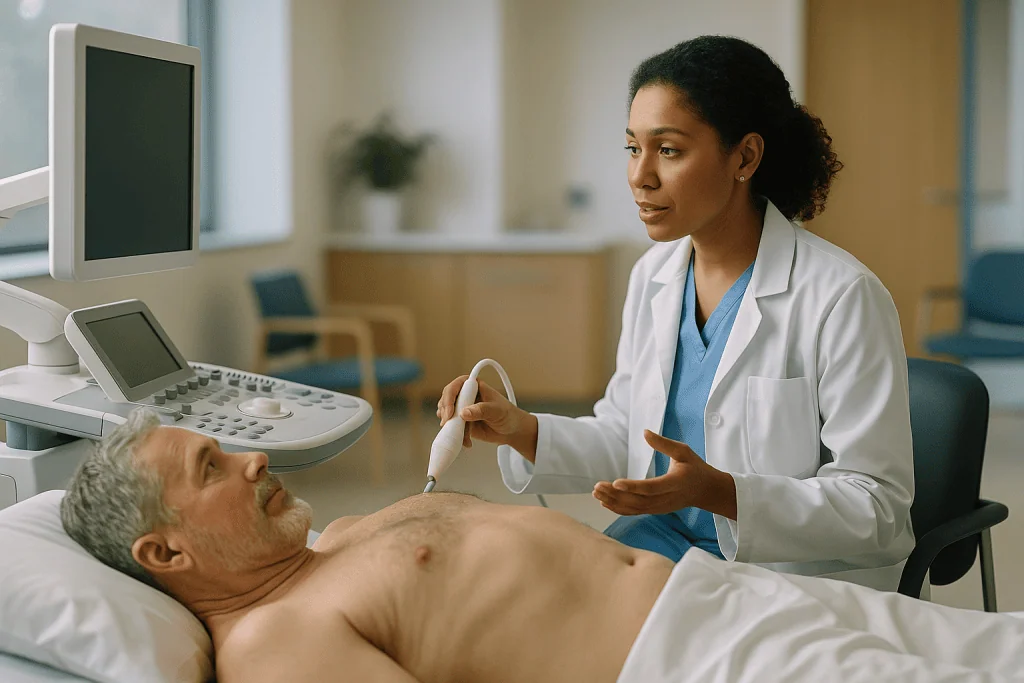
You’ll lie on your left side, often with your left arm tucked under your head. That position lets the heart drop closer to the chest wall and spreads the ribs slightly, giving the probe a better window. The probe itself, called a transducer, is a smooth handheld device about the size of a large marker. Gel goes on first to eliminate the air gap between transducer and skin, because sound waves cross gel far better than air.
Expect firm pressure, sometimes uncomfortable when the sonographer presses between ribs or under the left breast, but not sharp pain. You may hear whooshing from the speakers. That’s Doppler, a technique that measures the speed and direction of blood flow, working like a speed camera for the jets moving through your valves. You’ll be asked to breathe out and hold, or to shift position, several times.
Behind the screen the sonographer measures chamber sizes, wall thickness, how the valves open and close, and the ejection fraction: the percentage of blood the main pumping chamber pushes out with each beat (Cleveland Clinic). Occasionally a contrast agent made of microscopic gas bubbles is given through a vein to sharpen the picture; if that’s planned, you’ll be told in advance. When it’s done, you wipe off the gel, dress, and go.
Which echocardiogram are you having? Preparation at a glance
“Echocardiogram” covers a family of tests, and the preparation depends entirely on which one your clinician ordered. The transthoracic echo, done through the chest wall, is by far the most common and is what most people mean by “an echo.” A stress echocardiogram adds exercise or a heart-rate-raising medicine so the heart can be imaged working hard. A transesophageal echocardiogram (TEE) passes a thin probe down the throat into the food pipe, which lies directly behind the heart, giving sharper views of certain structures. Here is how they compare.
| Test | What it involves | Food and drink | Medicines | Afterward |
|---|---|---|---|---|
| Transthoracic echo | Probe on the chest while you lie on your left side | Eat and drink normally | Take as usual unless told otherwise | Wipe off gel and resume your day |
| Stress echo | Resting images, then treadmill, bike, or a heart-rate medicine, then repeat images | Usually asked to avoid food and often caffeine for a few hours beforehand | Some heart-rate-slowing medicines may be paused, only on the prescriber’s instruction | Brief monitoring, then normal activity |
| Transesophageal echo (TEE) | Throat numbing spray, sedation, thin probe swallowed | No food or drink for several hours beforehand | Discuss everything, especially blood thinners, in advance | No eating until numbness passes; no driving that day; someone takes you home |
The table shows the pattern that matters most: the two tests with instructions are the two that either push your heart or put a probe down your throat. Everything else is the standard scan, and for that, the instruction really is “come as you are” (MedlinePlus, Mayo Clinic, NHS).
If your letter doesn’t specify, phone the department and ask. Booking systems sometimes print only “echo,” and a five-minute call is far easier than arriving fasted for a test that didn’t need it, or, worse, arriving with a full stomach for one that did.
What should you not do before an echocardiogram?
For the standard test, the list of things to avoid is short and mostly about not overthinking it.

Don’t fast unless you were explicitly told to. Skipping meals for a routine echo brings no benefit and can leave you light-headed lying still in a dark room, particularly if you live with diabetes. Don’t stop or skip prescribed medicines on your own initiative; the test is designed to see your heart as it functions day to day, and that includes the effect of the medicines you normally take. Any change to a prescription before a stress test is a decision for the clinician who prescribes it, not something to improvise the morning of.
Don’t wear anything that makes undressing from the waist up awkward: a one-piece dress, a jumpsuit, or layers of necklaces you’ll have to unpick. Some departments ask you to skip body lotion or oil on the chest because it can make the sticky electrodes lose their grip; if your letter mentions this, follow it, and if it doesn’t, it’s rarely a problem.
Don’t rush in flustered from a sprint across the parking lot. A racing heart doesn’t invalidate a resting echo, but sitting for a few minutes first lets your rhythm settle and makes the measurements more representative of your ordinary self.
The picture changes for the two exceptions. Before a stress echo, don’t eat a heavy meal, and check whether caffeine should be avoided. Before a TEE, don’t eat or drink after the cutoff you were given, and don’t plan to drive yourself home. Those “don’ts” exist for safety, not convenience, and each is covered in detail further down.
Can you eat before an echocardiogram?
Yes, for a standard transthoracic echo. Eat breakfast, drink your coffee, bring your water bottle. Mayo Clinic and MedlinePlus both state that no dietary restrictions apply, and there’s no mechanism by which food would interfere: the stomach sits below the diaphragm, and the probe images the heart above it through the chest wall.
Stress echocardiograms are different, for two reasons. The first is comfort and safety. Exercising hard on a treadmill soon after a large meal is unpleasant and can bring on nausea, so MedlinePlus advises not eating or drinking for a few hours beforehand; your department sets the exact window. The second is caffeine. Coffee, tea, energy drinks, cola, and chocolate all nudge heart rate and blood pressure, and when a stress test uses a medicine rather than exercise to work the heart, caffeine can interfere with how some of those agents behave. Many labs therefore ask you to skip caffeine on the day, and some ask for longer. Follow whatever your letter says rather than a general rule read online.
A TEE requires an empty stomach for a more serious reason. You’ll receive sedation and a numbing throat spray, both of which blunt the gag reflex that normally keeps stomach contents out of the airway. MedlinePlus describes not eating or drinking for around six hours beforehand; some services set a slightly different cutoff, and theirs is the one that counts.
If you take medicines for diabetes and have been asked to fast, contact your team beforehand about how to manage that morning. Don’t guess, and don’t skip the test out of worry: there is a plan for this, and it starts with a phone call.
Echocardiogram: what to wear (and do you keep your bra on?)
Two pieces, not one. Trousers or a skirt with a separate top means you can undress from the waist up and stay comfortable below. You’ll be handed a gown that fastens at the back and opens at the front, or a drape, so that only the area being scanned is exposed at any moment.
Now the question people are often too shy to ask out loud: do you keep your bra on? Usually not. The transducer needs to reach several spots, beside the breastbone, under the left breast, near the bottom of the ribs, and at the notch above the collarbone, and the heart’s clearest window in most adults lies exactly where a bra band and cup sit. An underwire also blocks sound. So the bra comes off, the gown goes on, and the sonographer works around the drape, uncovering only what’s needed. If that feels uncomfortable, say so; you can ask for a chaperone or, where staffing allows, for a sonographer of a particular gender. Departments are used to both requests.
Jewelry around the neck is best left at home; a long pendant ends up in the gel. Body lotion, as mentioned, can stop the electrodes sticking, so a plain-skin day is easiest.
For a stress echo, add flat, supportive shoes and clothing you can walk briskly or pedal in. For a TEE, wear something loose and simple, because you’ll be drowsy afterward and won’t want to negotiate buttons.
Children and infants having an echo often lie on a parent’s lap or on a bed with a favorite toy or a screen playing. Some centers use mild sedation for very young children who cannot stay still, a decision made by the pediatric team beforehand and explained to parents in advance.
Should I take my usual medicines before an echo?
Take them. For a standard echo, Mayo Clinic’s guidance is that you continue your usual medicines unless you’ve been told otherwise, and there’s a sound clinical reason: your clinician wants to see how your heart performs under the treatment you actually live with. A scan done after stopping a blood-pressure medicine or a heart-failure medicine for a day shows a heart that doesn’t exist in your real week.
Stress echocardiograms are the exception where a conversation may happen. Some medicines used for blood pressure, angina, or rhythm problems, beta-blockers are the class most often discussed, work by slowing the heart rate. A stress test needs your heart to reach a target rate to be interpretable, and a slowed heart may not get there. For that reason a cardiologist sometimes asks a patient to hold a specific medicine before the test. The key word is “asks.” That instruction comes from the prescribing or ordering clinician, in writing or by phone, with a clear plan for when to resume. It is never a step to take on your own after reading about it here or anywhere else.
Before a TEE, mention every medicine and supplement, and in particular anything that thins the blood, because the team plans sedation and the small risk of throat bleeding around that information. In most cases blood thinners continue; the decision is theirs.
Whatever the test, bring a current list, names, not just the colors of the pills, or the boxes themselves. If you use an inhaler, bring it. If you’re unsure whether a medicine is relevant, assume it is; write it down and let the team decide what matters.
How long does an echocardiogram take?
Block out about an hour, and expect the scanning itself to take less. The NHS describes a standard echocardiogram as taking somewhere between 15 minutes and an hour, and Mayo Clinic puts it at under an hour for most people. Checking in, changing, and having electrodes placed account for some of that; the time with the probe on your chest is often 30 to 45 minutes.
Several things stretch a scan. Sound waves travel poorly through air and fat, so lung disease, a barrel-shaped chest, or a larger body can make the heart harder to see and require more angles and more patience. Certain findings prompt extra measurements: a leaky valve, for instance, is assessed from several views and with Doppler at each. Some labs routinely add three-dimensional imaging or contrast, which adds minutes. None of this means something is wrong; a long scan is far more often a thorough scan than a worrying one.
A stress echocardiogram runs longer because it has three parts: resting images, the exercise or medicine phase while your heart rate climbs, and a rapid second set of images captured at peak, followed by monitoring as you recover. Plan on the appointment taking roughly an hour or more, with the exercise portion itself often only several minutes (MedlinePlus).
A TEE has the shortest imaging time but the longest visit. The probe is in place for a fraction of an hour, but sedation beforehand and observation afterward mean you’ll be in the department for a good part of a morning or afternoon, and you won’t be able to drive yourself home (MedlinePlus). Whichever test you have, the sonographer’s timeline is about pictures, not prognosis.
Who is an echocardiogram usually for, and who is asked to wait
Echocardiography is ordered for an enormous range of reasons, which is one cause of the worry it provokes: the same test that investigates a serious symptom is also used to reassure. Common triggers include a murmur heard at a routine visit, breathlessness or swollen ankles that could point to heart failure, palpitations, an abnormal ECG, a family history of inherited heart muscle disease, a stroke or clot where a heart source is being considered, and follow-up after a heart attack or heart surgery. People on certain chemotherapy drugs have periodic echoes to monitor heart muscle. Athletes, pregnant patients with symptoms, and newborns with a suspected structural difference all have echoes too. Because ultrasound involves no radiation, it is used freely in pregnancy and childhood (NHS).
Who is usually asked to wait? For a standard echo, almost nobody; it’s safe for essentially everyone, and scheduling is about clinical priority, so an urgent inpatient scan happens the same day while a routine outpatient one may be booked weeks out.
A stress echo is deferred when the heart is not in a state to be pushed, for example, during unstable chest pain, a recent heart attack still under assessment, uncontrolled severe high blood pressure, or an acute illness such as a chest infection. If you can’t walk or pedal because of joints, lungs, or balance, the exercise version is swapped for the medicine version rather than abandoned.
A TEE is postponed or reconsidered in people with significant disease of the esophagus, strictures, varices, recent surgery, or swallowing difficulties, and in anyone who has eaten too recently for sedation to be safe. In those cases the team weighs alternatives such as a contrast-enhanced chest echo or cardiac MRI. Every one of these calls belongs to the clinicians who know your history.
How to prepare for an echocardiogram with stress or a scope (TEE)
Two versions of the test genuinely ask something of you. Here is what each involves and how the preparation differs.
Stress echocardiogram. You arrive lightly fed or fasted for a few hours, per your letter, and probably without caffeine. After a resting scan, you walk on a treadmill or pedal a bike while the incline or resistance rises in stages; the goal is to reach a heart rate calculated from your age. If you can’t exercise, a medicine such as dobutamine, a drug that makes the heart beat faster and harder, imitating exertion, is given through a small cannula instead. At peak, you lie down quickly and the sonographer captures a second set of images within seconds, because the comparison between rest and stress is the whole point: a segment of heart wall that moves well at rest but sluggishly under load suggests an artery that can’t keep up (MedlinePlus). Wear shoes you can move in, report any chest discomfort as it happens, and expect to be monitored while your heart rate comes down.
Transesophageal echocardiogram. Fasting is non-negotiable for the reasons covered above. A cannula goes in a vein, your throat is sprayed with local anesthetic, and a sedative makes you drowsy and relaxed; most people remember little. A thin probe on a flexible tube is passed down the food pipe: you’ll be asked to swallow as it goes, and images are taken from behind the heart, unobstructed by ribs and lungs. Afterward you rest until awake, must not eat or drink until the numbness has fully worn off so you don’t choke, and need someone to take you home and stay nearby. A sore throat for a day or so is common; serious injury to the esophagus is rare (MedlinePlus).
What the following days usually look like
After a standard echo, there is nothing to recover from. People wipe off the remaining gel, dress, and drive to work. If a contrast agent was used, the bubbles are breathed out through the lungs within minutes and need no special care; allergic-type reactions are uncommon and would show within the department, which is why you’re observed briefly.
After a stress echo, muscle tiredness or a light head for an hour is normal; drink water and eat when you’re ready. After a TEE, the sedation lingers. For the rest of that day you shouldn’t drive, operate machinery, sign important documents, or be alone, and you should start with liquids and soft foods once swallowing feels normal. A scratchy throat commonly settles within a day or two (MedlinePlus).
The part people find hardest is waiting for results. The sonographer measures; a cardiologist interprets and writes the report; the report goes to the clinician who ordered the test. Sonographers usually can’t discuss findings, not from secrecy but because interpretation is a separate step. The NHS notes that you might hear results straight away in some settings or that they may be sent on to your doctor, which can take days to a few weeks depending on the service. Ask at checkout how and when you’ll hear.
What comes next depends entirely on the findings and your symptoms. Many scans are normal and close a question. Some lead to a repeat echo in months or years to watch a valve or a chamber over time. Others prompt further tests, an MRI, a rhythm monitor worn for days, a catheter study, or a treatment conversation. Each of those is a decision for you and your treating team together, made with the full report in front of you.
What people often get wrong about echocardiogram preparation
An echocardiogram is the same as an ECG. It isn’t. An electrocardiogram records the heart’s electrical signals with stickers and takes minutes; an echocardiogram is a moving ultrasound picture of the heart’s structure and blood flow. The electrodes used during an echo are only there to time the images.
You have to fast. Only for stress or transesophageal echoes. For the standard test, eating normally is the recommendation from MedlinePlus, Mayo Clinic, and the NHS alike.
It involves radiation or dye. Ultrasound is sound, not X-rays, and no iodine dye is used. The microbubble contrast sometimes given is a different substance, used in a minority of scans, and it contains no iodine.
You should stop your heart medicines so the “real” heart shows. The opposite is true. The test is meant to show your heart as it is on treatment. Any pause before a stress test is arranged by the prescriber, not the patient.
The sonographer’s face tells you the result. Sonographers concentrate hard, measure precisely, and sometimes frown at a difficult window between ribs. That’s technique, not diagnosis. The report comes later from a cardiologist.
An echo shows blocked arteries. Not directly. A resting echo shows the pump, the valves, and the chambers; the coronary arteries themselves are too small to assess this way. A stress echo can suggest that an artery isn’t keeping up by showing a wall segment that weakens under load, but confirming a blockage needs a different test.
A quick scan means they missed something, or a long one means bad news. Duration tracks image quality and thoroughness far more than findings. The person with the clearest ultrasound windows often has the shortest appointment, and nothing more should be read into it.
Questions to ask your care team
Bring these on paper or on your phone, and write the answers down before you leave, because a good question asked and then forgotten is no help at all.
- Which type of echocardiogram am I having, transthoracic, stress, or transesophageal, and does that change anything I should do beforehand?
- Do I need to avoid food, drink, or caffeine, and for how long before the appointment?
- Should I take all my usual medicines that morning? If any need to be paused, who is giving that instruction, and when do I restart?
- Will a contrast agent be used, and is there anything in my allergy history you should know about first?
- If this is a stress test and I can’t exercise well, what’s the alternative?
- If this is a TEE, what should my companion expect, and how long will I be in the department?
- Who will interpret the scan, how will I receive the results, and roughly when?
- What question is this test meant to answer for me?
- If the result is normal, what happens next? If it isn’t, what are the likely next steps?
- Can I ask for a chaperone, or for a specific sonographer, if that would make me more comfortable?
The last two on that list matter more than they seem. Knowing why the test was ordered turns a frightening appointment into a specific inquiry with a beginning and an end. Comfort in the room isn’t a luxury either; a tense, shallow-breathing patient is harder to image than a relaxed one, so anything that helps you settle helps the pictures too. Ask early, before you’re lying on your side with gel on your chest, when questions are harder to voice.
When to call your doctor
Most people leave an echocardiogram and simply get on with their day. A small number of situations call for prompt contact, and a smaller number call for emergency help.
Before the test, while you wait for the appointment: if you develop chest pain or pressure at rest, breathlessness that stops you speaking in full sentences, fainting or near-fainting, a very fast or irregular heartbeat that doesn’t settle, or new painful swelling in one leg, don’t wait for the scan, call emergency services or go to an emergency department. An echo is a scheduled investigation, not a substitute for urgent assessment.
After a stress echocardiogram: contact your team the same day for chest discomfort that persists after you’ve rested, palpitations that don’t settle, or unusual breathlessness. Seek emergency care for chest pain that returns or worsens, fainting, or symptoms that feel like the ones that prompted the test but stronger.
After a transesophageal echocardiogram: a mild sore throat is expected, but call promptly for difficulty swallowing that lasts, pain in the chest, neck, or upper abdomen, fever, vomiting blood, or black or bloody stools; these are uncommon but can signal injury to the esophagus and need same-day assessment (MedlinePlus). Also call if numbness hasn’t faded several hours later or drowsiness seems out of proportion.
After contrast: hives, swelling of the lips or face, wheeze, or dizziness in the hours afterward warrant an urgent call; sudden breathing difficulty is an emergency.
And at any point, if worry itself is the problem, if you can’t sleep waiting for the report, call the clinic. Asking when results will arrive is a legitimate reason to pick up the phone, and every decision about what those results mean rests with the team looking after you.
Frequently asked questions
Is there any prep necessary for an echocardiogram?
For a standard transthoracic echocardiogram, no. MedlinePlus lists no special steps, and Mayo Clinic says you can eat, drink, and take medicines as normal. The practical preparation is choosing a two-piece outfit, bringing a medicine list, and confirming which type of echo you’re having, since stress and transesophageal versions do require fasting and other instructions from your team.
What should you not do before an echocardiogram?
Don’t fast, stop medicines, or skip caffeine unless your letter tells you to, because a standard echo needs none of that. Don’t wear a one-piece outfit that makes undressing from the waist up awkward, and avoid heavy lotion on the chest if asked. Before a stress echo, avoid a large meal; before a TEE, don’t eat or drink after your cutoff and don’t plan to drive home.
How long does an echogram take?
A standard echocardiogram usually takes between 15 minutes and an hour according to the NHS, with Mayo Clinic describing most as under an hour. Stress echoes run longer because they include resting images, an exercise or medicine phase, and repeat images at peak. A TEE has brief imaging but a longer visit because of sedation and recovery, so allow several hours in the department.
Do you keep your bra on for an echocardiogram?
Usually the bra is removed. The sonographer needs to place the probe beside the breastbone and under the left breast, exactly where a bra band and cup sit, and an underwire blocks the sound waves. You’ll wear a gown or drape so only the scanned area is uncovered, and you can request a chaperone or, where possible, a sonographer of a particular gender.
Can you eat before an echocardiogram?
Yes, before a standard echo you can eat and drink normally; food in the stomach has no effect on ultrasound images of the heart. Stress echocardiograms usually require avoiding food for a few hours so exercise is safe and comfortable. Transesophageal echocardiograms require an empty stomach for several hours because sedation and throat numbing blunt the gag reflex that protects your airway.
Can I drink coffee before an echocardiogram?
Before a standard echo, yes. Before a stress echocardiogram, many departments ask you to avoid caffeine on the day, because coffee, tea, energy drinks, and chocolate raise heart rate and can interfere with the medicines sometimes used to stress the heart. Your appointment letter is the authority; if it says nothing about caffeine and you’re unsure, phone the department before the morning of the test.
Should I stop my medications before an echocardiogram?
No, not on your own. For a standard echo, Mayo Clinic advises taking medicines as usual so the scan reflects your heart on its normal treatment. Before a stress echo, a cardiologist may specifically ask you to hold a heart-rate-slowing medicine so your heart can reach its target rate, but that instruction comes from the prescriber with a plan to restart. Bring a full medicine list to every echo.
What is the difference between an echocardiogram and a stress echocardiogram?
A standard echocardiogram images your heart at rest. A stress echocardiogram takes images at rest and again immediately after your heart has been made to work hard, either by treadmill or bike exercise or by a medicine that mimics exertion. Comparing the two sets can reveal a region of heart muscle that weakens under load, which suggests an artery struggling to supply it (MedlinePlus).
Is an echocardiogram safe during pregnancy?
Yes. An echocardiogram uses sound waves, not radiation, and the NHS notes ultrasound scans are considered safe in pregnancy. Standard echoes are performed in pregnant patients when symptoms or a known heart condition require it, and a specialized fetal echocardiogram can image the baby’s heart before birth. Tell the department you’re pregnant so they can adjust positioning for comfort and avoid unnecessary contrast.
When will I get my echocardiogram results?
Not usually from the sonographer, who records images while a cardiologist interprets them and writes the report for the clinician who ordered the test. The NHS notes you may hear results straight away in some settings, or they may be sent to your doctor, which can take days to a few weeks depending on the service. Ask at checkout exactly how and when you’ll be contacted.
References
- MedlinePlus – Echocardiogram
- MedlinePlus – Stress echocardiography
- MedlinePlus – Transesophageal echocardiogram
- NHS – Echocardiogram
This article is for general information only and is not a substitute for professional medical advice. Please consult a qualified doctor about your individual situation.

More from the Blog

Percutaneous Closure Step by Step: How a Catheter Seals an Atrial Septal Defect or PFO
Percutaneous ASD closure is a catheter procedure: a cardiologist threads a thin tube from a groin vein to the heart, measures the hole between…

Echocardiography in Pregnancy and Childhood: Why Heart Ultrasound Is Used Across Ages
An echocardiogram in pregnancy and children is a painless heart ultrasound that uses sound waves, not radiation, to show how the heart is built…

Robotic Cardiac Surgery Recovery: Intensive Care, Early Walking and the Weeks Back Home
Robotic cardiac surgery recovery time is usually shorter than after open-chest surgery because the breastbone is left intact. Many people spend the first night…

Small Dense LDL: The Particle Size Debate Explained
Small dense LDL refers to the smaller, heavier low-density lipoprotein particles that appear to enter artery walls more easily and oxidize faster than larger…

How Echocardiography Grades Heart Valve Disease and Times the Decision to Operate
Echocardiography grades heart valve disease as mild, moderate or severe by measuring how fast blood moves through a narrowed valve, how much leaks back…

Morning High Blood Pressure: Why Readings Peak After Waking and When It Matters
Morning high blood pressure means readings taken soon after waking are consistently above target, often 135/85 mmHg or higher on a home monitor. Blood…