

Morning High Blood Pressure: Why Readings Peak After Waking and When It Matters

Key Takeaways
- Blood pressure naturally rises 10 to 20 mmHg systolic in the first hours after waking, which is why heart attacks and strokes cluster between 6 a.m. and noon.
- A home morning average of 135/85 mmHg or higher, with normal evening readings, is the pattern researchers label morning hypertension, and it is often invisible at clinic visits.
- In a 2003 Circulation study of 519 older adults, a morning surge of 55 mmHg or more carried roughly 2.7 times the stroke risk, but no trial has yet shown that shrinking the surge itself prevents events.
- A 2022 randomised trial of more than 21,000 adults found no difference in heart attacks or strokes between morning and evening medicine dosing, so timing changes belong to the prescriber, not to the patient.
- Measuring before using the bathroom, with a too-small cuff, or within 30 minutes of caffeine can each add 5 to 10 mmHg to a morning reading.
- A reading of 180/120 mmHg or higher that persists after five minutes of rest needs same-day medical contact, and immediate emergency care if chest pain, weakness, speech or vision changes accompany it.
Morning high blood pressure means readings taken soon after waking are consistently above target, often 135/85 mmHg or higher on a home monitor. Blood pressure naturally climbs 10 to 20 mmHg in the first hours after waking as stress hormones and nerve signals rise. Poor sleep, alcohol, salt, caffeine, sleep apnea or a missed medicine can push it higher. Repeated elevated morning readings deserve a clinician's review, not panic.
The cuff sighs, the numbers flash, and a retired teacher in a quiet kitchen stares at 152/94 before her first cup of coffee. By lunchtime the same arm reads 128/80. Which one is real? That question has been racing through search engines since late summer, driven by a wave of short videos claiming you should “never check blood pressure in the morning” because the body is “still flooded with cortisol” and the reading “doesn’t count.”
The timing is not accidental. The 2025 American Heart Association and American College of Cardiology blood pressure guideline, published in August 2025, leaned harder than ever on home monitoring, and more people now own a validated arm cuff than at any point in history. As of September 2026, more of them are discovering a pattern their doctor’s office never saw: morning high blood pressure.
The viral advice gets one thing right and one thing badly wrong. Morning readings do run higher. That is exactly why they matter.
What is morning high blood pressure, and is it the same as a morning surge?
Two phrases get tangled together online, and separating them helps. Morning hypertension describes blood pressure that is above target when measured at home within about an hour of waking, on most days, regardless of what the rest of the day looks like. Many research groups set that bar at a morning average of 135/85 mmHg or higher on a home monitor, which roughly corresponds to 140/90 mmHg in a clinic. United States guidelines now classify any sustained reading of 130/80 mmHg or higher as stage 1 hypertension, so a morning average in that range already counts.
The morning surge is a different idea. It is the size of the jump between the lowest pressure during sleep and the pressure in the first two hours after waking, and it can only be measured with a 24-hour ambulatory monitor, a cuff worn on the arm that inflates automatically through the day and night. A rise of 10 to 20 mmHg in systolic pressure, the top number, is normal physiology. A rise of 50 mmHg or more is the threshold most studies used to define an exaggerated surge.
Why does the distinction matter? Because someone can have a perfectly ordinary surge yet still wake up at 150/95 mmHg simply because their pressure is high around the clock. Another person can read 125/78 mmHg in the morning but have jumped nearly 50 mmHg from a very low overnight level. The first person needs their overall blood pressure managed. The second may need a closer look at sleep and nighttime pressure.
Home readings tell you the first thing reliably. Only ambulatory monitoring tells you the second. Keep both ideas in mind as you read on, because the viral claims blur them constantly.
Why does blood pressure peak after waking?
Blood pressure follows a daily rhythm as predictable as the tide. It falls 10 to 20 percent during deep sleep, begins climbing in the hours before dawn, and typically peaks somewhere between mid-morning and midday before easing through the afternoon and evening. Mayo Clinic describes this as a normal circadian pattern, the body’s built-in 24-hour clock influencing heart rate, hormone release and vessel tone.

Several systems fire at once when you wake. The sympathetic nervous system, the “fight or flight” branch of the nerve network that controls heart rate and blood vessel width, switches from its overnight idle into daytime gear. Cortisol, the body’s main stress hormone, reaches its daily high within 30 to 45 minutes of waking. The renin-angiotensin system, a hormone cascade from the kidneys that tightens blood vessels and holds onto salt, is also most active in the early morning.
Then there is simple mechanics. Sitting up and standing after hours lying flat forces the circulation to work against gravity, and blood vessels constrict to keep blood flowing to the brain. Platelets, the clotting fragments in blood, are stickier in the morning, and blood is slightly thicker after a night without fluid.
Put together, these changes explain why heart attacks and strokes cluster between about 6 a.m. and noon in large population studies. They also explain why a reading at 7 a.m. is not “wrong” compared with one at 3 p.m. It is capturing the body at its most demanding hour. For most people the morning rise is modest and harmless. The question is whether yours stays within the normal range or overshoots it.
High blood pressure in the morning causes: the everyday triggers
When a reader asks what causes very high blood pressure in the morning, the honest answer usually sits in the previous 12 hours, not in the cuff. The common culprits are ordinary and, happily, often changeable.
- Short or broken sleep. Fewer than six hours, or sleep fragmented by pain, a crying baby or a bathroom trip, keeps the sympathetic nervous system revved and blunts the overnight dip.
- Obstructive sleep apnea. In this condition the airway repeatedly collapses during sleep, oxygen falls, and the body responds with surges of adrenaline. Morning hypertension that resists treatment is one of its classic signatures, especially alongside loud snoring and daytime sleepiness.
- Alcohol the night before. Even two drinks can raise the next morning’s systolic pressure by several mmHg as the sedative effect wears off.
- Salt-heavy dinners. The kidneys take hours to clear a sodium load, and fluid retained overnight shows up on the morning cuff.
- Caffeine and nicotine. Either one taken before measuring can add 5 to 15 mmHg for 30 to 60 minutes.
- A full bladder. Measuring before you visit the bathroom can add roughly 10 mmHg.
- Cold rooms and rushing. Cold constricts skin vessels; hurrying to the monitor after the alarm does the rest.
- Missed or short-acting medicine. A dose taken the previous morning may be fading by dawn, which is the single most common cause of morning hypertension in people already treated.
Pain, a stressful day ahead, decongestant cold remedies and anti-inflammatory painkillers can also push readings up. Rarer causes, such as an overactive adrenal gland or narrowed kidney arteries, exist but are uncommon and usually suspected only when pressure is severe, started young, or resists several medicines. A clinician decides whether those tests are warranted.
What should my blood pressure be in the morning?
The target does not change with the clock. What changes is where you measure. On a home monitor, the American Heart Association considers readings below 120/80 mmHg normal and readings of 130/80 mmHg or higher consistent with hypertension. Because home readings run a few mmHg lower than clinic readings for the same person, many international bodies, including the United Kingdom’s National Health Service, use 135/85 mmHg as the home equivalent of the clinic threshold of 140/90 mmHg.
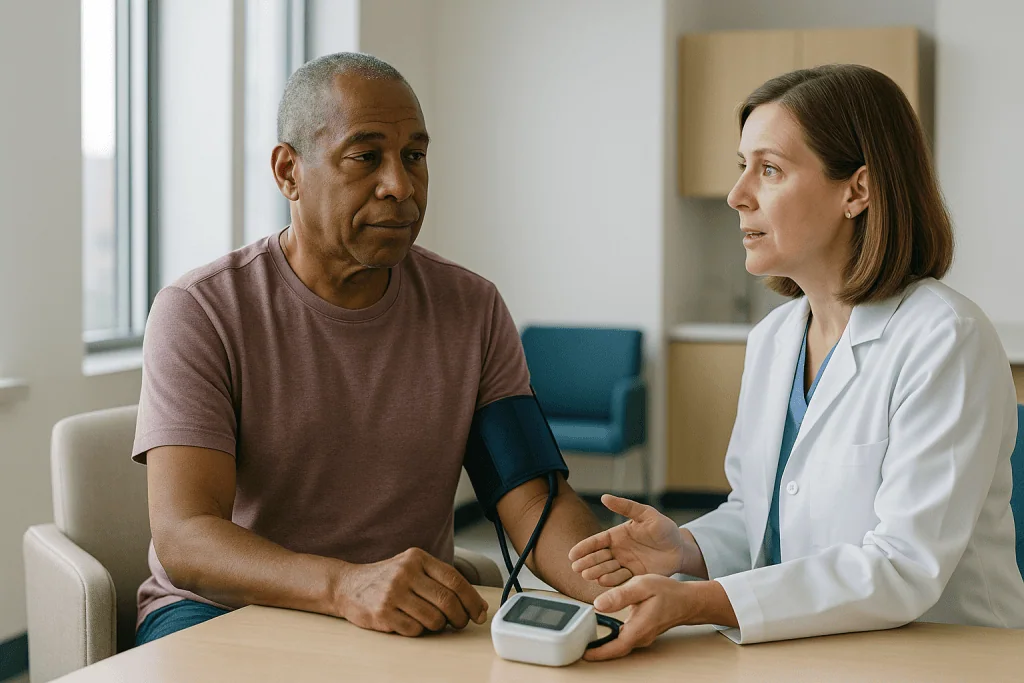
So what should normal blood pressure in the morning look like in practice? A morning average under 130/80 mmHg is reassuring for most adults. A morning average between 130/80 and 139/89 mmHg suggests stage 1 hypertension and is worth a conversation. An average of 140/90 mmHg or higher in the morning, when evening readings are fine, is the pattern doctors specifically label morning hypertension.
Notice the word average. A single reading is weather; the average is climate. Guidance from the American Heart Association asks for two readings a minute apart, morning and evening, for at least seven days, then discarding the first day and averaging the rest. That sample of around 24 readings irons out the bad night and the forgotten bathroom trip.
Your personal target may be lower or higher than the general numbers. People with diabetes, chronic kidney disease or previous heart disease are often asked to aim lower. Some older adults, or those who feel dizzy on standing, may be given a slightly higher goal to avoid falls. Only the clinician who knows your history can set that number, and it applies to your morning readings as much as any other time of day.
What changed recently
Three dated developments explain why morning readings are suddenly on everyone’s mind.
August 2025: the guideline update. The American Heart Association and American College of Cardiology released their first full high blood pressure guideline since 2017. It kept the 130/80 mmHg definition of hypertension, introduced a new risk calculator to guide treatment decisions, and placed stronger emphasis than before on home and out-of-office monitoring to confirm a diagnosis and track control. The practical effect: clinicians are now more likely to ask patients to bring a week of morning and evening readings before adjusting anything.
Validated home monitors became routine. The American Heart Association’s home monitoring guidance, updated in step with the guideline, spells out the protocol most of this article relies on: an upper-arm cuff, five minutes of seated rest, feet flat, arm at heart level, no caffeine or exercise in the prior 30 minutes, and readings taken before morning medicines. Millions of people following that advice are, for the first time, seeing a consistent morning pattern.
Late summer 2026: the viral “skip the morning” claim. A cluster of short videos argued that morning readings are artificially inflated by cortisol and should be ignored. The clips borrowed a kernel of truth from decades-old research, including a widely cited 2003 study in Circulation that linked an exaggerated morning surge to stroke, then drew the opposite conclusion from it. That study, and the body of work it inspired, is the reason researchers want morning readings, not the reason to avoid them.
None of these events created a new disease. They changed how many people are looking, and when.
What the evidence actually says about the morning blood pressure surge
Grading the evidence honestly means separating three claims that often travel together.
Claim 1: Morning blood pressure predicts cardiovascular events. Evidence strength: strong, from large prospective observational cohorts. Home morning readings have repeatedly outperformed clinic readings at predicting stroke and heart disease, including in studies of tens of thousands of participants followed for years. Ambulatory data tell the same story: morning and nighttime pressures are more closely tied to outcomes than afternoon clinic visits. This is the best-supported point in the field.
Claim 2: An exaggerated morning surge is harmful on its own. Evidence strength: moderate, observational, and not entirely consistent. The 2003 Circulation study of 519 older adults found that those with a surge of 55 mmHg or more had roughly 2.7 times the stroke risk of those with smaller surges, even after accounting for average pressure. Later cohorts in Europe and Asia confirmed an association with stroke and silent brain changes in some populations but not all, and definitions of “surge” varied. Expert consensus now treats a very large surge as a marker of risk, while acknowledging that no randomised trial has tested whether shrinking the surge itself prevents events.
Claim 3: Treating morning hypertension specifically improves outcomes. Evidence strength: limited to indirect. Randomised trials show convincingly that lowering average blood pressure reduces strokes and heart attacks. Whether targeting the morning window adds benefit beyond good overall control has not been proven. A large 2022 randomised trial of more than 21,000 people in the United Kingdom found that taking antihypertensive medicine in the evening rather than the morning made no difference to heart attacks, strokes or cardiovascular deaths.
The takeaway from the data is unglamorous: morning readings are a reliable window on risk, the overall average is what treatment should bring down, and the surge is a clue rather than a target.
Dippers, non-dippers and risers: daily blood pressure patterns compared
Ambulatory monitoring sorts people into patterns based on how far pressure falls overnight. Knowing the vocabulary helps when a report lands in your hands, and it clarifies where morning high blood pressure fits.
| Pattern | Overnight change | Typical morning picture | What the evidence suggests |
|---|---|---|---|
| Normal dipper | Falls 10–20% | Modest rise after waking | Lowest cardiovascular risk for a given daytime average |
| Extreme dipper | Falls more than 20% | Large surge from a very low base | Linked in some cohorts to stroke and reduced brain blood flow, mainly in older adults |
| Non-dipper | Falls less than 10% | Already high on waking | Higher risk of heart and kidney damage; common in sleep apnea, kidney disease, diabetes |
| Reverse dipper (riser) | Higher at night than by day | Highest readings before and around waking | Highest risk group; prompts a search for secondary causes |
| Masked morning hypertension | Variable | High at home in the morning, normal in clinic | Easily missed; home readings are the only way to find it |
| White-coat effect | Normal | Normal at home, high in clinic | Lower risk than sustained hypertension but still worth monitoring |
A few points stand out. The non-dipper and riser patterns, where pressure never properly rests, carry more risk than a dramatic surge from a healthy low. Masked morning hypertension is the one most relevant to the kitchen scene in the opening: the office never sees it, and the person is often told their pressure is fine.
You cannot diagnose your own pattern from a wrist cuff at breakfast. If your morning readings are consistently high while clinic readings are normal, or if you snore heavily and feel unrefreshed, a clinician may order 24-hour monitoring to see which row you belong in. That single test often changes the plan more than any number of daytime visits.
Why should you not take your blood pressure in the morning? The viral claim, examined
The claim deserves a fair hearing, because it is not built on nothing. Cortisol does peak shortly after waking. Sympathetic activity does climb. A reading taken 30 seconds after the alarm, standing in a cold hallway with a full bladder, will indeed be higher than the body’s true resting pressure. If someone measured that way, concluded they had severe hypertension, and started worrying, the video’s warning would be fair.
Where it goes wrong is the leap from “morning readings are higher” to “morning readings are misleading.” Every major body that issues home monitoring guidance, including the American Heart Association, the National Health Service and the World Health Organization, asks for morning readings on purpose. The morning is when pressure is highest and when cardiovascular events cluster. Measuring only in the relaxed evening would be like checking a bridge’s load only when traffic is light.
The protocol already corrects for the artifacts the videos worry about. Use the bathroom first. Sit quietly for five minutes. No coffee, cigarette or exercise beforehand. Back supported, feet flat, arm resting at heart level, cuff on bare skin. Take two readings a minute apart and record both. Do this before taking morning medicines, so the reading reflects the trough of the previous dose. Follow those steps and the cortisol peak is simply part of the honest picture, not a contaminant.
Is there anyone who genuinely should not measure in the morning? People who become anxious about the number and inflate it by dread, a phenomenon doctors sometimes see, may be advised to measure less often or at a different hour. That is an individual decision with a clinician, not a rule for everyone. For most adults, skipping the morning reading hides the very data that matters most.
When to take blood pressure, morning or night, and how to do it well
The answer from every mainstream guideline is both, and the reasoning is simple: the two readings answer different questions. Morning tells you how high pressure climbs at the body’s peak and whether yesterday’s medicine lasted the night. Evening tells you how well the day’s dose is working and whether the pressure comes down when life quiets. The gap between them is often the most useful number of all; a large morning-to-evening difference is a flag for sleep problems or a medicine that fades too soon.
A practical rhythm looks like this:
- Morning: within an hour of waking, after the bathroom, before breakfast, caffeine and medicines.
- Evening: before bed, at least 30 minutes after eating, exercise or alcohol.
- Each session: two readings one minute apart, same arm, same chair.
- Duration: seven consecutive days before a clinic visit or medicine change, then a few days a month for monitoring once stable.
Choose an automatic upper-arm cuff that has been independently validated, in a size that fits your arm; a cuff that is too small overreads by 5 to 10 mmHg. Wrist and finger devices are less reliable, partly because the wrist must be held exactly at heart level. Bring the monitor to a clinic visit once a year so it can be checked against the office device.
Write down or let the device store every reading, including the ones that embarrass you. A log that mysteriously lacks high numbers is not useful to anyone. Note the context too: “poor sleep,” “headache,” “forgot evening dose.” Those annotations are what turn a column of numbers into a story a clinician can act on.
Is 140/90 BP life threatening?
Not in the moment. A reading of 140/90 mmHg will not cause a stroke or heart attack this morning, and nobody needs an emergency department for that number alone. It is, however, the long-standing clinical threshold for stage 2 hypertension in the United States and for a diagnosis of hypertension in most of the world. Sustained over years, pressure at that level roughly doubles the risk of heart disease and stroke compared with 120/80 mmHg, which is why it earns treatment rather than alarm.
The scale of risk helps put the number in context. Observational data pooled from about a million adults show that each 20 mmHg rise in systolic pressure, or 10 mmHg in diastolic, approximately doubles the risk of death from stroke or heart disease across the usual range. That relationship is continuous, with no cliff edge at 140. A person at 138/88 mmHg is not safe and a person at 142/92 mmHg is not doomed; both sit on the same slope and both benefit from moving down it.
Genuinely dangerous readings live far higher. Mayo Clinic describes a hypertensive crisis as a sudden pressure of 180/120 mmHg or above. If that reading recurs after five minutes of rest and comes with chest pain, shortness of breath, numbness, weakness, trouble speaking, vision changes, severe headache or confusion, it is an emergency. If it recurs without symptoms, it still needs same-day medical contact.
So a morning reading of 140/90 mmHg is a reason to repeat the measurement properly, build a seven-day log, and book an appointment. It is not a reason to lie awake. The damage from hypertension is slow, cumulative and, with sustained control, largely preventable.
Does medicine timing fix morning high blood pressure?
Because morning hypertension in treated patients so often reflects a dose wearing thin by dawn, the obvious question is whether moving the dose to bedtime solves it. The science here has swung, and it is worth knowing where it landed.
Several smaller studies from the 2000s and 2010s suggested evening dosing improved nighttime control and reduced events, and the idea spread widely. Then the question was put to a proper test. A 2022 randomised trial enrolled more than 21,000 adults in the United Kingdom, assigned them to take their usual antihypertensive medicines either in the morning or in the evening, and followed them for a median of about five years. Rates of heart attack, stroke and cardiovascular death were essentially identical in the two groups. For most people, the time of day appears not to matter for hard outcomes.
What does matter, according to expert consensus, is coverage across the full 24 hours. Medicines with a long duration of action, or a regimen that spreads coverage, are more likely to keep morning readings in range than a short-acting medicine taken once at breakfast. Where morning readings stay high despite good evening readings, clinicians may adjust the type, combination or timing of medicine, or look for an underlying cause such as sleep apnea.
What this means for a reader: never shift, split or skip a dose based on your morning log. Bring the log to the person who prescribes for you. Timing, class and combination are their decisions, made with knowledge of your kidneys, your other medicines and your risk of dizziness. The trial evidence says the clock is less important than consistency, and consistency means taking what was prescribed, when it was prescribed, every day.
Lifestyle changes that lower morning readings, graded by evidence
The levers below are ranked by how convincingly they lower blood pressure in randomised trials, with a note on why each one has particular relevance to the morning.
Reduce sodium (strong, randomised). Trials of the DASH eating pattern, rich in vegetables, fruit, whole grains and low-fat dairy, combined with sodium reduction, lowered systolic pressure by around 8 to 11 mmHg in people with hypertension. Since the kidneys clear sodium overnight, a lower-salt dinner directly trims the next morning’s number.
Move regularly (strong, randomised). About 150 minutes a week of moderate aerobic activity lowers systolic pressure by roughly 5 to 8 mmHg. Exercise also improves sleep quality, which deepens the overnight dip.
Lose excess weight if applicable (strong, randomised). Each kilogram lost is associated with about 1 mmHg off systolic pressure. Weight loss also reduces the severity of sleep apnea, a major driver of morning hypertension.
Limit alcohol (strong, randomised). Cutting intake in heavier drinkers lowers systolic pressure by around 4 mmHg, and the morning rebound after evening drinking disappears.
Treat sleep apnea (moderate, randomised). Nighttime breathing support reduces morning and nighttime pressure modestly, with larger gains in those who use it consistently. A sleep study, arranged by a clinician, is how this is diagnosed.
Protect sleep (moderate, observational and small trials). Regular bedtimes and seven or more hours of sleep are linked to a healthier dipping pattern.
Potassium-rich foods (moderate, randomised). Higher dietary potassium from foods helps the body excrete sodium. Supplements are a different matter and can be dangerous with kidney disease or certain medicines, so discuss any supplement with a clinician.
Stress techniques (weak to moderate). Slow breathing and meditation show small reductions in some trials, inconsistent in others. Harmless, pleasant, and not a substitute for the items above.
Common myths about morning high blood pressure
Myth: Morning readings are “fake” because of cortisol. Cortisol is part of normal waking physiology, not an artifact. Guidelines specifically request morning readings, and morning values predict stroke at least as well as any other time of day. Measure after resting, not at the alarm, and the number is genuine.
Myth: If my evening reading is normal, I am fine. Masked morning hypertension exists precisely because evening and clinic readings can look normal while the morning runs high. Observational cohorts tie that pattern to a higher rate of cardiovascular events than sustained normal pressure.
Myth: A morning headache means my pressure is dangerous. Most morning headaches come from poor sleep, dehydration, caffeine withdrawal or sleep apnea. Hypertension rarely causes symptoms until readings are extreme. Check the number rather than inferring it from a headache, and take a severe, sudden headache seriously regardless of the reading.
Myth: Everyone should switch their medicine to bedtime. The largest randomised trial on this question found no difference in heart attacks or strokes between morning and evening dosing. Timing is a clinical judgment for the prescriber, not a universal fix.
Myth: Morning blood pressure rises because you are “dehydrated” and water will fix it. Overnight fluid loss is small. Drinking a glass of water is sensible but does not meaningfully lower a hypertensive reading; in the short term, swallowing a large volume can briefly raise pressure.
Myth: A wrist cuff is good enough. Wrist devices are sensitive to arm position and generally less accurate. An upper-arm cuff, correctly sized, is the standard every guideline recommends.
Myth: One high morning reading equals a diagnosis. Diagnosis rests on an average across days. One number proves little, in either direction.
When to see a doctor
Morning high blood pressure is rarely an emergency, but a few situations are. Call emergency services, or have someone take you to an emergency department, if a reading of 180/120 mmHg or higher is accompanied by any of the following: chest pain or pressure, shortness of breath, sudden weakness or numbness on one side, difficulty speaking or understanding speech, loss of vision or double vision, a severe headache unlike any before, confusion, a seizure, or nosebleeds that will not stop. These are warning signs of stroke, heart attack, aortic damage or organ injury, and minutes matter.
Contact a clinician the same day if a reading of 180/120 mmHg or higher repeats after five minutes of quiet rest, even without symptoms.
Book a routine appointment, bringing your seven-day log, if:
- your morning average is 130/80 mmHg or higher and you are not on treatment;
- your morning readings stay above your personal target despite taking prescribed medicine faithfully;
- there is a gap of 20 mmHg or more between your morning and evening systolic readings;
- you snore loudly, wake gasping, or feel exhausted despite a full night in bed;
- you feel dizzy or faint on standing, especially if readings are sometimes low;
- you are pregnant and any reading is 140/90 mmHg or higher, which needs prompt review;
- you have diabetes, kidney disease or a prior heart event, where thresholds for action are lower.
Never adjust, split, delay or stop a prescribed medicine on your own because of a reading. Share the log, describe how you measured, and let the clinician decide whether the plan needs changing or whether a 24-hour monitor or sleep study would answer the question properly. A good morning log is one of the most useful things a patient can carry into that room.
Frequently asked questions
What causes very high blood pressure in the morning?
The most common causes are a medicine wearing off overnight, obstructive sleep apnea, alcohol or a salty meal the evening before, short or broken sleep, and measuring too soon after waking with caffeine, nicotine or a full bladder. The body’s normal morning rise in stress hormones and nerve activity then sits on top of these. Readings consistently above 180/120 mmHg, or high readings with symptoms, need urgent medical review.
What should my blood pressure be in the morning?
For most adults, a morning home average under 130/80 mmHg is reassuring. An average of 135/85 mmHg or higher in the morning is widely used to define morning hypertension. The target does not change with the time of day; what matters is the average of two readings a minute apart over at least seven days. People with diabetes, kidney disease or heart disease may be given a lower personal goal by their clinician.
Why should you not take your blood pressure in the morning?
You should. The viral advice to skip morning readings confuses a normal physiological peak with a measurement error. Every major guideline asks for morning readings because that is when pressure is highest and when cardiovascular events cluster. The readings are only misleading if taken immediately after the alarm, standing, cold, caffeinated or with a full bladder. Rest five minutes seated and the morning number is a genuine, valuable data point.
Is 140/90 BP life threatening?
No, not in the moment. A reading of 140/90 mmHg will not cause a stroke today, but sustained over years it roughly doubles cardiovascular risk compared with 120/80 mmHg, which is why it is treated. A hypertensive emergency involves readings of 180/120 mmHg or higher with symptoms such as chest pain, weakness, vision or speech changes. At 140/90 mmHg, repeat the reading properly, keep a seven-day log and book a routine appointment.
Is it better to take blood pressure morning or night?
Both, because they answer different questions. Morning readings, taken before medicine, show the body’s peak and whether yesterday’s dose lasted the night. Evening readings show how well the day’s treatment worked and whether pressure settles. A gap of 20 mmHg or more between the two systolic values is a useful flag for sleep problems or a medicine that fades early, and it is worth showing to a clinician.
What is a morning blood pressure surge?
The morning surge is the rise from the lowest pressure during sleep to the pressure in the first two hours after waking, measured by a 24-hour ambulatory monitor. A rise of 10 to 20 mmHg is normal; studies have used 50 to 55 mmHg or more to define an exaggerated surge. Observational data link a large surge to stroke and silent brain changes, though the evidence is inconsistent across populations and no trial has targeted the surge directly.
Is normal blood pressure in the morning lower than in the evening?
Usually not. For most people the daily pattern peaks between mid-morning and midday and eases through the evening, so morning readings tend to be a little higher than bedtime readings. A morning number markedly lower than the evening one is uncommon and can reflect medicine that peaks late in the day or dehydration, which a clinician would want to know about. The overall average, not the direction of the difference, decides treatment.
Does sleep apnea explain high blood pressure in the morning?
Often, yes. Obstructive sleep apnea causes repeated drops in oxygen during sleep, each triggering a surge of adrenaline that keeps nighttime and morning pressure high and blunts the normal overnight dip. Loud snoring, witnessed pauses in breathing, waking unrefreshed and daytime sleepiness alongside stubborn morning readings are classic clues. A sleep study, arranged through a clinician, confirms it, and treating apnea modestly lowers morning and nighttime pressure in randomised trials.
Should I measure blood pressure before or after my morning medicine?
Before. Guideline protocols ask for the morning reading before medicines, food and caffeine, so the number reflects the lowest point of the previous dose and reveals whether coverage lasts the full 24 hours. If readings are consistently high at that point, it tells the prescriber something useful. Do not change when you take the medicine based on your log; share the readings and let the prescribing clinician decide.
Can worrying about the reading raise my morning blood pressure?
Yes. Anticipatory anxiety activates the same sympathetic nervous system that drives the morning rise, and some people see readings climb the longer they stare at the cuff. Sitting quietly for five minutes, breathing slowly, taking two readings a minute apart and recording the average usually settles it. If dread of the number is making measurement unreliable, tell your clinician; a different schedule or a 24-hour monitor may give a cleaner picture.
This article is for general information only and is not a substitute for professional medical advice. Please consult a qualified doctor about your individual situation.

More from the Blog

What Results From Ablation Therapy Look Like, and How Rhythm Checks Confirm Them Over Time
Results from cardiac ablation are judged over months, not days. Because scar tissue takes roughly three months to settle (the blanking period), early palpitations…

Anticoagulants After Cardiac Thrombosis: What the Regular Blood Tests Are Checking
After a clot forms inside the heart, anticoagulants are prescribed to slow the blood's clotting so the clot can stabilize and the body can…

Isometric Exercise for Blood Pressure: Why Wall Sits Beat Cardio in a 2023 Meta-Analysis
Isometric exercise, such as wall sits and handgrip holds, lowered resting systolic blood pressure by about 8 mmHg and diastolic by about 4 mmHg…

How Peripheral Angiography Maps Leg and Arm Arteries to Find Narrowing or Blockage
Peripheral angiography is an X-ray study in which a clinician threads a thin tube into an artery, usually at the groin or wrist, injects…

How Coronary CT Angiography Results Guide the Next Step, From Reassurance to Catheter Tests
After a coronary CT angiogram, the next step depends on what the scan shows. Clear or minimally affected arteries usually mean reassurance and a…

After the Fontan Procedure: Sternum Healing, Hydration and How to Lift Your Child Safely
After the Fontan procedure, most children spend roughly one to two weeks in hospital, then heal the breastbone over about six to eight weeks…