

Isometric Exercise for Blood Pressure: Why Wall Sits Beat Cardio in a 2023 Meta-Analysis

Key Takeaways
- The 2023 British Journal of Sports Medicine meta-analysis pooled 270 randomized trials and 15,827 participants, and found isometric training lowered systolic pressure by 8.24 mmHg versus 4.49 mmHg for aerobic exercise.
- The protocol behind those numbers was four two-minute holds with rest between, three times a week, for at least eight weeks, at an intensity that allowed steady breathing.
- Wall squats ranked first for systolic reduction largely because they load the big leg muscles; handgrip training works too but with a somewhat smaller expected effect.
- Pressure rises during a hold and the benefit appears only at rest weeks later, which is why no single 60-second exercise produces a lasting change.
- Aerobic exercise still has the strongest evidence for fewer heart attacks and strokes; isometric trials have measured only blood pressure, not long-term events.
- Breath-holding during a hold triggers the Valsalva manoeuvre and can spike pressure sharply, so audible, steady breathing is the single most important safety rule.
Isometric exercise, such as wall sits and handgrip holds, lowered resting systolic blood pressure by about 8 mmHg and diastolic by about 4 mmHg in a 2023 meta-analysis of 270 randomized trials, roughly double the average effect of aerobic exercise. The evidence is real but based on short, small trials, so isometric training is best treated as a supplement to cardio and prescribed care, never a replacement.
Scroll through almost any fitness feed as of early 2025 and you will find someone pressed against a kitchen wall, thighs parallel to the floor, timer running, with a caption promising that two minutes of holding still does more for blood pressure than a jog. The clip usually ends with a screenshot of a journal page. That page is real. It comes from a meta-analysis published in the British Journal of Sports Medicine in July 2023, and it has been re-circulating ever since.
The headline finding was striking: isometric exercise, blood pressure data pooled from 270 trials, came out ahead of running, cycling, weight training and interval sessions for lowering resting pressure. Wall squats topped the systolic ranking.
What the clips leave out matters just as much. How big is 8 mmHg, really? Who were the people in those trials? And what should someone with a prescription in the bathroom cabinet actually do on Monday morning? This piece works through the study, the mechanism and the limits, so you can hold a wall sit with your eyes open.
What is isometric exercise, and why does blood pressure respond to it?
An isometric contraction is a muscle working hard without changing length: the thigh muscles in a wall sit, the forearm in a squeezed grip, the trunk in a plank. Nothing moves, yet the muscle is firing continuously. That continuous squeeze is the point. It clamps down on the small blood vessels inside the working muscle, so blood flow drops while the muscle is still demanding oxygen.
Compare that with cardio. In a brisk walk or a bike ride the muscles contract and relax rhythmically, acting like a pump that keeps blood moving. Pressure rises modestly and the vessels stay open. In an isometric hold the pressure inside the vessel climbs more steeply during the effort, then falls when you release. It is this repeated cycle of restriction followed by a rush of flow that researchers believe retrains the lining of the arteries over weeks.
Blood pressure itself is written as two numbers measured in millimetres of mercury, abbreviated mmHg. The top number, systolic, is the pressure when the heart contracts. The bottom number, diastolic, is the pressure between beats. The American Heart Association defines normal as below 120/80 mmHg and stage 1 hypertension as 130 to 139 systolic or 80 to 89 diastolic.
Those definitions matter because a few mmHg either way can move a person across a diagnostic line. Exercise of any kind has been part of blood pressure guidance for decades, and it is usually aerobic exercise that gets named first. The 2023 analysis did not overturn that advice. It added a second tool to the box, one that happens to need no shoes, no equipment and no more floor space than a doormat.
What changed recently: the 2023 meta-analysis and the months that followed
A meta-analysis is a study that pools the results of many earlier trials to produce a single, more precise estimate. Published online on 25 July 2023 in the British Journal of Sports Medicine, this one gathered 270 randomized controlled trials involving 15,827 participants and asked a plain question: which type of exercise training lowers resting blood pressure the most?

Every mode worked. Aerobic training reduced systolic pressure by an average of 4.49 mmHg, dynamic resistance training by 4.55, combined aerobic and resistance training by 6.04 and high-intensity interval training by 4.08. Isometric exercise training produced the largest change at 8.24 mmHg systolic and 4.00 mmHg diastolic. A statistical ranking method then placed the wall squat first for systolic reduction and running first for diastolic.
The paper landed in a crowded news week and spread quickly, partly because the exercise it recommended looked so unlike exercise. Within months the wall sit had become a staple of short-form video, and searches for isometric exercise and blood pressure climbed and have stayed elevated through 2024 and into 2025.
Two things have not changed. Major guidance from the American Heart Association, the NHS and Mayo Clinic still names moderate aerobic activity, around 150 minutes a week, as the foundation of lifestyle management for high blood pressure. None of those bodies has withdrawn that advice. What has shifted is the conversation around it: isometric training has moved from a niche research interest to a reasonable add-on that clinicians are increasingly asked about, and the 2023 data are the reason.
What the evidence actually says about isometric exercise and blood pressure
Strength of evidence deserves its own grading here, because the headline and the fine print point in slightly different directions.
On the plus side, the effect comes from randomized controlled trials, the study design in which participants are assigned by chance to exercise or to a control group. That is the strongest design for showing cause and effect, and the pooled result was consistent across the isometric studies rather than driven by one outlier. An 8 mmHg systolic reduction is also clinically meaningful: large pooled analyses of blood pressure trials suggest that each 5 mmHg drop in systolic pressure is associated with roughly a 10% lower risk of major cardiovascular events.
Now the caveats. Most isometric trials were small, often a few dozen people, and short, typically 8 to 12 weeks. Participants could not be blinded to whether they were exercising, and the people measuring pressure sometimes knew too. The outcome was resting blood pressure, a surrogate marker, not heart attacks or strokes. No trial has yet followed isometric exercisers long enough to show fewer cardiac events, whereas aerobic activity has decades of observational and trial data linking it to lower mortality.
The isometric trials also leaned on protocols developed in research laboratories, with heart rate monitors and calibrated knee angles. Home practice is rarely so precise.
So the honest summary reads like this: high-quality short-term trial evidence that isometric training lowers resting blood pressure; moderate confidence that the effect exceeds other modes; low to no evidence yet on long-term outcomes. That is a strong reason to try it and a weak reason to drop anything else.
How does isometric exercise compare with cardio and weights?
Numbers from the pooled analysis are easiest to read side by side. The table shows the average reduction in resting blood pressure after a training program, compared with no exercise, for each mode included in the 2023 paper.

| Exercise type | Systolic reduction (mmHg) | Diastolic reduction (mmHg) | Typical weekly commitment in trials | Long-term outcome data |
|---|---|---|---|---|
| Isometric training (wall squat, handgrip) | 8.24 | 4.00 | About 3 sessions of 4 x 2-minute holds | Blood pressure only; no event data yet |
| Combined aerobic and resistance | 6.04 | 2.54 | 3–5 sessions mixing both | Strong |
| Dynamic resistance (weights) | 4.55 | 3.04 | 2–3 sessions | Moderate to strong |
| Aerobic (walking, running, cycling) | 4.49 | 2.53 | 150 minutes moderate intensity | Strongest, decades of data |
| High-intensity interval training | 4.08 | 2.50 | 2–3 sessions | Moderate |
Read the table from right to left as well as left to right. Isometric training wins the first two columns and loses the last one. Aerobic exercise has the smallest systolic number and the deepest evidence base for what actually matters, which is living longer with a healthier heart.
There is a time argument too. Three isometric sessions a week add up to roughly 36 minutes including rest periods. A standard aerobic prescription is 150 minutes. For someone who struggles to find time, the isometric column is attractive, and the trials suggest the two approaches are complementary rather than competing. Walking improves fitness, weight, mood and blood sugar in ways a wall sit cannot. The wall sit appears to deliver a specific vascular effect in a very small footprint. Most people with raised blood pressure would benefit from both.
How can holding still lower blood pressure?
The mechanism is not fully settled, but several threads of research point the same way.
Start with the endothelium, the single layer of cells lining every blood vessel. Healthy endothelium releases nitric oxide, a gas that tells the surrounding muscle in the vessel wall to relax, widening the artery and lowering pressure. During an isometric hold, the contracting muscle squeezes its own blood supply almost shut. The moment you release, blood surges through at high speed. That surge drags along the vessel lining, a force called shear stress, and shear stress is one of the strongest known triggers for nitric oxide release. Repeat the cycle three times a week for two months and small trials have measured improved artery dilation in the trained limb and elsewhere.
A second thread involves the baroreflex, the body’s pressure thermostat. Sensors in the neck and chest arteries detect pressure and signal the brain to speed up or slow down the heart and tighten or loosen vessels. Isometric training appears to make this reflex more sensitive, so the body corrects upward drifts in pressure more promptly.
Third, the nervous system. People with high blood pressure often run a higher resting level of sympathetic activity, the fight-or-flight signal that constricts arteries. Some handgrip studies have recorded reduced sympathetic nerve traffic after training.
None of these changes shows up on a home monitor during the exercise itself. Pressure rises while you hold, sometimes sharply. The benefit is in the adaptation afterwards, measured at rest, days later. That distinction explains why a single wall sit does nothing lasting, and why the trials ran for weeks.
Do wall sits lower blood pressure more than other isometric moves?
The wall squat, which most people call a wall sit, ranked first for systolic reduction in the 2023 analysis. It is worth understanding why before assuming the wall has special powers.
Muscle mass is the likeliest explanation. A wall sit loads the quadriceps, gluteals and calves, several of the largest muscle groups in the body. A handgrip, the move used in many earlier isometric trials, loads the forearm. The more muscle that is squeezing its own blood supply, the larger the pressure swing during the hold and, on the evidence so far, the larger the training response.
Wall squats also demand no equipment. Handgrip protocols typically use a device that measures force, so the participant can hold a set percentage of their maximum. That precision is useful in a laboratory and awkward at home. Researchers who developed the wall squat protocol solved the dosing problem differently: they adjusted the knee angle until the participant’s heart rate reached a target during a trial hold, then kept that angle for the program. A deeper sit is harder; a shallower one is easier.
Planks appear in the same family but were less represented in the pooled data, so their ranking is less certain. They load the trunk and shoulders rather than the legs and may be harder for people with low back or wrist problems.
The practical reading: wall sits have the best current evidence among isometric moves and the lowest barrier to starting. If knees or balance make them unsuitable, a seated leg extension hold or handgrip squeeze keeps you in the same evidence base, with a somewhat smaller expected effect.
Does isometric handgrip exercise lower blood pressure too?
Yes, and for years handgrip was the main evidence. Many of the earlier isometric trials in the 2023 pool used a small device squeezed at roughly 30% of maximum effort, held for two minutes, four times, with rest between, three days a week. Pooled handgrip results have typically shown systolic reductions in the 5 to 8 mmHg range, slightly below the wall squat but comfortably above most aerobic estimates.
Handgrip has advantages that the wall sit lacks. It can be done sitting down, which matters for people with arthritic knees, balance concerns or limited mobility. It does not raise heart rate much, so it is less demanding for someone deconditioned. The intensity is measurable, which makes it a favourite of researchers who want a clean dose.
The disadvantage is that most people do not own a calibrated grip device, and squeezing a tennis ball at an unknown intensity is a guess. Some participants also find the sustained forearm burn surprisingly unpleasant, more so than a leg hold, and adherence in longer studies has been mixed.
Quality of evidence sits in the same bracket as the wall squat: consistent short-term randomized trials, small samples, no hard-outcome data. A few studies measured 24-hour ambulatory pressure, the gold standard that records readings throughout the day and night, and found reductions there too, which strengthens confidence that the effect is not an artefact of a single clinic reading.
If grip training appeals, the sensible route is to tell your clinician, start gently and watch your resting numbers over eight weeks rather than chasing a particular squeeze strength.
How often should I do isometric exercises to lower blood pressure?
The protocol that produced the headline numbers is specific enough to copy and simple enough to remember.
Most trials used four holds of two minutes each, separated by rest periods of one to four minutes, performed three times a week on non-consecutive days. A session therefore takes about 12 to 20 minutes including rest. Programs ran for at least eight weeks before pressure was remeasured, and the improvement generally appeared gradually across that period rather than in the first few days.
Frequency seems to matter more than heroics. The trials did not show that longer holds or daily sessions produced bigger drops; they showed that regular, moderate-intensity holds done consistently did. Intensity was set so that the hold felt hard but sustainable, with normal breathing possible throughout. If you cannot speak a short sentence during the second minute, the angle is too deep.
A reasonable home version runs like this:
- Choose a wall sit depth you can hold for two minutes with steady breathing and a strong but not maximal burn.
- Hold for two minutes, stand and walk gently for two minutes, repeat for four holds in total.
- Do this on three separate days each week.
- Measure resting blood pressure at the same time of day, seated and rested, once a week and keep a log for your clinician.
Expect nothing dramatic for the first fortnight. The trial averages describe what happened after two months, and individual responses varied widely around that average. Some participants dropped 15 mmHg; some barely moved. A log shared with the person managing your care is the only way to know which group you belong to.
How to do a wall sit safely when you have high blood pressure
Technique is mostly about one thing: breathing. Hold your breath and bear down during a strain, a reflex called the Valsalva manoeuvre, and pressure inside the chest spikes. Blood pressure can climb far higher than the exercise itself warrants, and people with uncontrolled hypertension are advised to avoid it. Steady, audible breathing through the whole hold is non-negotiable.
Set up with your back flat against a wall, feet about shoulder-width apart and far enough forward that when you slide down, your knees stay above your ankles rather than drifting past your toes. Lower until your thighs are somewhere between a shallow chair sit and parallel to the floor. Deeper is harder; start shallow. Rest your hands on your thighs or let them hang. Do not press them into your legs to cheat the load.
Count out loud or breathe in a rhythm for the two minutes. If your legs shake, that is normal muscle fatigue. If you feel dizzy, see spots, develop a headache or chest discomfort, stand up slowly and stop for the day.
A few practical points from the trials and from general exercise guidance:
- Warm up with two or three minutes of easy walking so the first hold is not a cold start.
- Rise slowly between holds; blood pressure can dip briefly when the legs relax, which is a common moment for light-headedness.
- Avoid exercising within an hour of a large meal or when your resting reading is well above your usual.
- Keep a chair beside you for the first few sessions.
None of this requires a gym. It does require a clinician’s blessing if your pressure is not yet controlled, which is covered below.
What are good static exercises for blood pressure, and can stretching help?
People often search for static aerobic exercises, which is a contradiction in terms. Aerobic means rhythmic movement that raises breathing and heart rate for a sustained period; static means holding still. The exercises people usually mean are isometric holds, and several beyond the wall sit have at least some trial support.
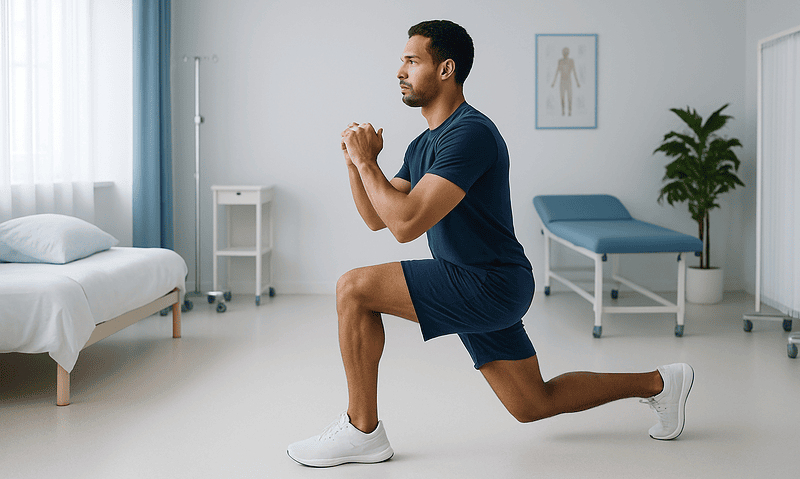
Seated leg extension holds, in which you straighten one knee and hold the leg out against gravity or a light ankle weight, load the quadriceps without stressing the knee joint under body weight. Handgrip squeezes, discussed above, suit anyone who needs to stay seated. Planks and side planks engage the trunk and appear in some trials, though with fewer participants. A static lunge hold, one foot forward and both knees bent, trains one leg at a time and challenges balance.
Stretching is a different story. Static stretching, holding a lengthened muscle for 20 to 60 seconds, has been tested in a handful of small trials. A Canadian study in 2021 compared eight weeks of a daily stretching routine against brisk walking in people with high-normal or stage 1 pressure and found the stretching group had slightly larger reductions in several measures. It was a trial of 40 people, so the finding is interesting rather than conclusive. The proposed mechanism is that stretching muscles also stretches the arteries running through them, reducing stiffness.
Yoga and tai chi, which blend gentle holds, slow movement and breath control, have moderate evidence of modest pressure reductions in pooled analyses, typically a few mmHg.
The pattern across all of these is the same: small effects, small studies, low risk. They belong alongside aerobic activity and isometric holds, not instead of them.
Common myths about wall sits and blood pressure, corrected
Myth: there is a 60-second trick to lower blood pressure. A single wall sit, breathing exercise or grip squeeze does not produce a lasting drop. Pressure rises during the hold and returns to baseline afterwards. Slow breathing for a minute can shave a few points off a reading taken immediately after, which is why relaxing before a measurement is standard advice, but that is a measurement effect, not a treatment. The trial benefits took eight weeks of regular sessions.
Myth: wall sits beat cardio, so you can skip the walk. The 2023 analysis compared resting blood pressure, one outcome among many. Aerobic exercise improves cardiorespiratory fitness, body weight, insulin sensitivity and mood, and it has long-term data linking it to fewer heart attacks and strokes. Isometric training has none of that yet. The better reading is that both help, through partly different routes.
Myth: isometrics are dangerous for anyone with high blood pressure. This was once common advice, because pressure climbs during a hold. The trials included hypertensive participants and reported very few adverse events. The real risk sits with breath-holding, maximal effort and uncontrolled pressure, each of which can be avoided.
Myth: a wall sit can replace medication. No trial has tested stopping treatment in favour of exercise. Reductions of 8 mmHg are meaningful but smaller than most single medicines achieve, and individual responses varied widely. Any change to a prescription belongs to the clinician who wrote it.
Myth: deeper and longer is better. The protocols used moderate intensity and two-minute holds. Pushing to failure raises the Valsalva risk and was not what the trials studied.
Who should be cautious with isometric training?
Most adults with mild to moderate hypertension can try isometric holds, and the trials recruited exactly that population. A smaller group should talk to their clinician first or choose another approach.
Uncontrolled or severe hypertension sits at the top of the list. General exercise guidance from Mayo Clinic and the American Heart Association suggests that if resting pressure is very high, for example above 180/110 mmHg, exercise should wait until it is brought down, because the acute spike during a hold starts from an already dangerous level.
People with a known aortic aneurysm, a bulge in the body’s main artery, are usually told to avoid heavy straining of any kind, and isometric effort counts. The same caution applies after a recent heart attack or heart surgery until a rehabilitation team clears it, and to anyone with unstable angina.
Glaucoma deserves a mention. Isometric effort and especially breath-holding raise pressure inside the eye, and some eye specialists advise patients with advanced glaucoma to avoid inverted positions and heavy straining.
Pregnancy is not a reason to avoid gentle isometrics in itself, but pressure changes in pregnancy need medical oversight, and anyone with pre-eclampsia or gestational hypertension should follow their obstetric team’s advice rather than a video.
Finally, several common medicines interact with exercise in ways worth knowing. Beta blockers blunt the heart rate response, so the heart-rate-based method of setting wall sit depth will not work. Diuretics can increase the chance of light-headedness when standing after a hold. Neither is a reason to stop; both are reasons to tell the prescriber what you are planning.
Where isometric exercise fits alongside medicine and other lifestyle changes
Picture blood pressure management as a stack of small, additive gains rather than a search for one big lever. The 2023 data place isometric training near the top of the lifestyle stack by size of effect, but the other layers are already well established and compound with it.
Reducing sodium to the levels recommended by the American Heart Association, below 2,300 mg a day and ideally nearer 1,500 mg for people with hypertension, typically lowers systolic pressure by several mmHg. The DASH eating pattern, rich in vegetables, fruit, whole grains and low-fat dairy, has trial evidence of reductions comparable to a single medicine in some groups. Losing excess weight tends to lower systolic pressure by around 1 mmHg per kilogram. Limiting alcohol, improving sleep and treating sleep apnea each contribute.
Medication remains the most powerful single tool for people who need it, and the decision about whether and what to prescribe rests with the treating clinician. Exercise of any type should be reported, because a successful program can lower readings enough that the prescriber wants to review the regimen. That review is theirs to make, based on repeated measurements over weeks, never a decision to take alone after a good fortnight.
Isometric holds slot in neatly because they ask so little. Three short sessions a week fit around a walking program rather than displacing it. For someone who finds 150 minutes of cardio out of reach, starting with wall sits may be the thing that gets them moving at all, and the trial evidence suggests the reward for that small step is real. For someone already active, it is a low-cost way to add a specific vascular stimulus the treadmill does not provide.
When to see a doctor about blood pressure and exercise
Check in with your clinician before starting isometric training if your blood pressure is not yet controlled, if you take medicines for the heart or blood pressure, or if you have any of the conditions listed in the caution section above. That conversation is brief and it changes nothing about the exercise; it simply makes sure the starting point is safe.
Seek urgent medical help, calling emergency services if necessary, for any of the following during or after exercise:
- Chest pain, pressure or tightness, or pain spreading to the arm, jaw or back.
- Sudden severe headache unlike your usual headaches.
- Shortness of breath that does not settle quickly with rest.
- Fainting or near-fainting, confusion, slurred speech, weakness or numbness on one side of the body, or a sudden change in vision.
- A home reading above 180/120 mmHg, repeated after a few minutes of rest, especially with any symptom above.
Book a routine appointment if home readings are consistently above 130/80 mmHg and you have not discussed them, if your readings fall noticeably after starting a program, or if you feel persistently dizzy on standing. A fall in pressure is good news, but it may mean a prescribed medicine needs review, and only the prescriber can make that call.
Bring your log. A simple record of dates, times, readings and sessions completed is far more useful to a clinician than a memory of feeling better. Measure seated, after five minutes of rest, with the cuff at heart level, and take two readings a minute apart. Home monitors validated for accuracy are listed by national hypertension societies; your pharmacist can usually point you to one.
Frequently asked questions
How often should I do isometric exercises to lower blood pressure?
Three times a week on non-consecutive days is the frequency used in most trials. Each session consisted of four two-minute holds separated by one to four minutes of rest, for a total of around 12 to 20 minutes. Programs ran at least eight weeks before pressure was remeasured. Daily sessions or longer holds were not shown to produce bigger reductions, so consistency matters more than intensity.
Do wall sits lower blood pressure more than running?
For resting systolic pressure, the 2023 pooled analysis ranked wall squats first and running lower, with isometric training averaging 8.24 mmHg versus 4.49 mmHg for aerobic exercise. For diastolic pressure, running ranked first. Running also carries decades of evidence for improved fitness and reduced cardiovascular events, which wall sits do not yet have. Most guidance treats the two as complementary rather than competing.
Does isometric handgrip exercise lower blood pressure?
Yes. Handgrip training, typically squeezing a device at around 30% of maximum effort for four two-minute holds, three times a week, has produced systolic reductions of roughly 5 to 8 mmHg in randomized trials. It suits people who need to stay seated or have knee problems. The main practical limit is that most home squeezing tools cannot measure intensity, so the dose is a guess.
What is a 60-second trick to lower blood pressure?
There is no 60-second exercise that produces a lasting reduction. Slow breathing for a minute can lower a reading taken immediately afterwards by a few points, which is why resting before measurement is standard, but that is a measurement effect. The isometric training benefits appeared after about eight weeks of regular sessions. Claims of instant results should be treated as marketing rather than evidence.
What are some good static exercises for blood pressure?
Wall sits have the best current evidence, followed by handgrip holds. Seated leg extension holds, planks, side planks and static lunge holds are all isometric moves with some trial support, though fewer participants. The phrase static aerobic exercise is a contradiction; aerobic exercise involves rhythmic movement. What people usually mean is isometric training, which can be combined with walking or cycling for a fuller program.
What stretches can help lower blood pressure?
Small trials suggest a daily 30-minute routine of whole-body static stretches, each held for 20 to 60 seconds, can lower blood pressure by a few mmHg, possibly by reducing stiffness in arteries that run through the stretched muscles. One 2021 trial of 40 people found stretching slightly outperformed brisk walking on several measures. The evidence is preliminary, and stretching is best viewed as an addition to, not a substitute for, aerobic and isometric exercise.
Is it safe to do isometric exercise with high blood pressure?
For most people with mild to moderate hypertension, yes, provided you breathe steadily and avoid maximal effort. Trials in hypertensive adults reported very few adverse events. People with very high uncontrolled pressure, an aortic aneurysm, recent heart attack or surgery, unstable angina or advanced glaucoma should get medical clearance first. Anyone on blood pressure medicines should tell their prescriber they are starting.
How long before isometric training lowers blood pressure?
Expect to wait at least four to eight weeks. The trial reductions were measured after programs of eight weeks or more, and improvements built gradually. Individual responses varied widely around the average of about 8 mmHg systolic, with some participants dropping much more and some barely changing. Weekly home readings at the same time of day, logged for your clinician, are the only reliable way to track your own response.
Can I stop my blood pressure medication if wall sits work?
No change to a prescribed medicine should be made without the clinician who prescribed it. No trial has tested replacing medication with isometric exercise, and the average reduction of 8 mmHg is smaller than most single medicines achieve. If your readings fall after starting a program, that is useful information for your prescriber, who may review your treatment based on repeated measurements over several weeks.
Why does blood pressure go up during a wall sit if the exercise lowers it?
The hold squeezes blood vessels inside the working muscle, so pressure climbs during the two minutes, sometimes sharply. The lasting benefit comes afterwards: the rush of blood on release stimulates the artery lining to release nitric oxide, which relaxes vessels, and repeated cycles over weeks appear to improve this response and reset the body’s pressure reflexes. The training effect shows up at rest, not during the exercise.
References
This article is for general information only and is not a substitute for professional medical advice. Please consult a qualified doctor about your individual situation.

More from the Blog

Anticoagulants After Cardiac Thrombosis: What the Regular Blood Tests Are Checking
After a clot forms inside the heart, anticoagulants are prescribed to slow the blood's clotting so the clot can stabilize and the body can…

How Peripheral Angiography Maps Leg and Arm Arteries to Find Narrowing or Blockage
Peripheral angiography is an X-ray study in which a clinician threads a thin tube into an artery, usually at the groin or wrist, injects…

How Coronary CT Angiography Results Guide the Next Step, From Reassurance to Catheter Tests
After a coronary CT angiogram, the next step depends on what the scan shows. Clear or minimally affected arteries usually mean reassurance and a…

After the Fontan Procedure: Sternum Healing, Hydration and How to Lift Your Child Safely
After the Fontan procedure, most children spend roughly one to two weeks in hospital, then heal the breastbone over about six to eight weeks…
Cardiac Rehabilitation Week by Week: How Exercise Intensity Is Increased Safely
A cardiac rehab 12 week program usually raises exercise intensity in stages: early sessions establish a safe baseline using heart rate, perceived effort and…

Heart Age Calculators: What They Estimate and How Accurate They Are
A heart age calculator converts your estimated 10-year risk of heart attack or stroke into the age of a person with ideal risk factors…