

Electric Toothbrushes, Water Flossers and Floss: What Dental Trials Show
Key Takeaways
- A Cochrane review of 56 randomized trials found electric toothbrushes remove about 11 percent more plaque than manual brushes at one to three months and about 21 percent more after three months.
- Gum inflammation fell by roughly 6 to 11 percent more with powered brushes, but no trial has run long enough to show fewer cavities or less tooth loss over a lifetime.
- Trials comparing oscillating-rotating and sonic electric toothbrushes against each other found insufficient evidence to declare either design clinically superior.
- Flossing added to brushing reduces gingivitis with low-certainty evidence; the trials were small and short, which is different from proving flossing does not work.
- Water flossers reduce gum inflammation compared with brushing alone, but head-to-head trials against string floss are too few and mixed to say one replaces the other.
- Interdental brushes showed a small edge over floss for gingivitis in pooled trials, provided the gaps between teeth are wide enough to fit them.
Randomized trials pooled in a Cochrane review found that electric toothbrushes remove modestly more plaque and reduce gum inflammation slightly more than manual brushes, roughly 11 to 21 percent more plaque removal over three months. Flossing and water flossers both help gums when added to brushing, but the evidence is low certainty. Technique, two minutes twice daily, fluoride toothpaste and daily cleaning between teeth matter more than the specific device.
The video is thirty seconds long and has several million views: a creator holds a water flosser up to the camera, announces that string floss is “a scam,” and adds that anyone still using a manual brush is “cleaning their teeth like it’s 1950.” Scroll a little further and a dentist in scrubs is politely disagreeing. Scroll again and a product-testing site has crowned its favorite electric toothbrush of the year, with a countdown timer on the discount.
That collision, viral confidence on one side and product roundups on the other, is why searches for the electric toothbrush, the water flosser and plain old flossing are all climbing together as of March 2026. Most of the noise skips the part that actually matters: dozens of randomized trials have compared these tools, and their results are specific, measurable and a good deal more modest than either camp suggests.
What follows is a tour of those trials. Where the evidence is strong, this article says so. Where it is thin, it says that too.
What changed recently in the electric toothbrush debate
Nothing dramatic has happened to the science itself, which is part of the story. The most-cited evidence on powered brushes remains a Cochrane systematic review published in 2014. A Cochrane review is an independent, standardized summary of all the randomized trials on a question, considered one of the more reliable forms of medical evidence. That review pooled 56 trials with 5,068 participants and found that powered brushes outperformed manual ones on both plaque and gum inflammation.
The interdental side of the picture was updated in 2019, when a second Cochrane team examined 35 trials involving 3,929 adults comparing brushing alone with brushing plus floss, interdental brushes, wooden or rubber sticks, or oral irrigators. “Oral irrigator” is the technical name for a water flosser, a handheld device that pulses a thin stream of water between the teeth. That review is the basis for nearly every honest claim made about flossing and water flossers today.
What has changed is the volume around those findings. Two things collided in late 2025 and early 2026. First, short-form video platforms surfaced a wave of clips claiming water flossers make floss obsolete, or that manual brushing is inherently inferior. Second, the annual round of “best electric toothbrush of 2026” buying guides arrived, most of them ranking devices on battery life and app features rather than on any clinical outcome.
Meanwhile, the mainstream guidance has stayed remarkably steady. The NHS, Mayo Clinic and MedlinePlus all continue to say the same thing: brush twice a day for two minutes with a fluoride toothpaste, clean between your teeth daily, and choose whatever tools help you actually do that. The trend, in other words, is a trend in attention, not in evidence, and that gap is exactly where myths grow.
Are electric toothbrushes really better than manual ones?
Yes, by a measurable but modest margin, and only if you use them properly. That is the shortest honest answer the trials support.
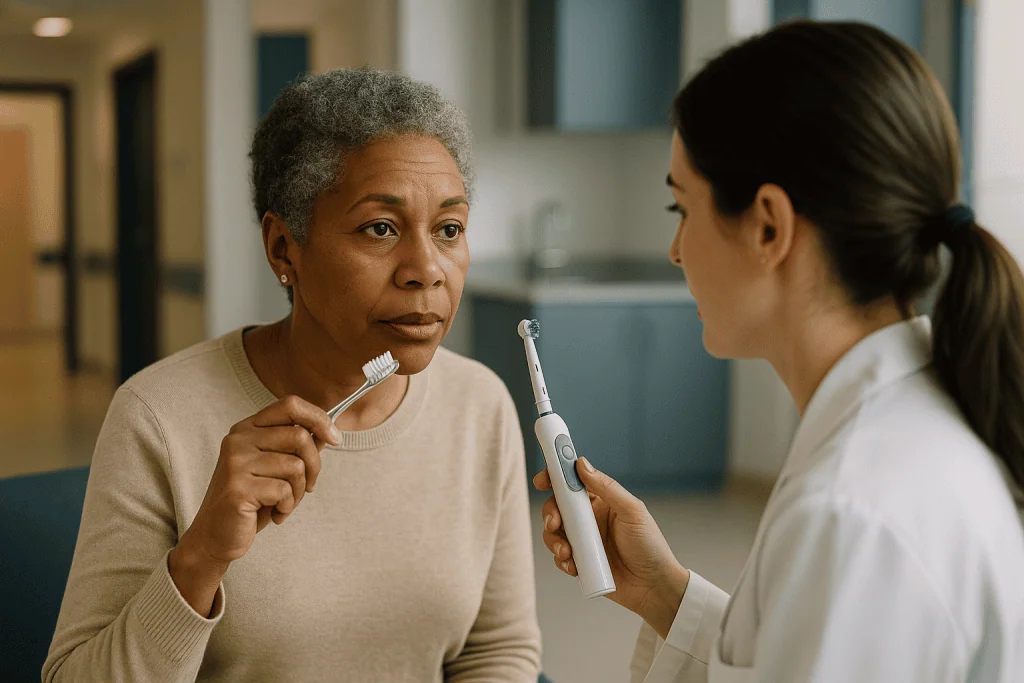
In the 2014 Cochrane review, people using powered brushes had about 11 percent less plaque than manual brushers after one to three months, rising to about 21 percent less after three months or longer. Plaque is the sticky film of bacteria that builds up on teeth within hours of cleaning; it is the raw material for both cavities and gum disease. Gingivitis, meaning inflammation of the gums that shows up as redness, puffiness and bleeding on brushing, fell by roughly 6 percent in the shorter studies and 11 percent in the longer ones.
Those percentages sound tidy, but they deserve context. A 21 percent reduction in plaque means the powered-brush group still had plenty of plaque; they simply had less of it than the manual group. Most trials also ran for a few months, not the years over which a cavity or a receding gumline actually develops. The review authors were explicit that they could not say whether the extra plaque removal translates into fewer fillings or fewer lost teeth over a lifetime, because no trial has run long enough to measure that.
There is a second caveat that the roundups rarely mention. Trial participants are taught how to use the device and are often reminded to brush. A powered brush left in a drawer, or dragged across the teeth for forty seconds, will not deliver the trial numbers. The tool creates an advantage; the habit collects it.
So the answer to “are electric toothbrushes really better” is a qualified yes: better at removing plaque, probably better for gum health, unproven for long-term tooth loss, and only as good as the two minutes you give them.
What the evidence actually says, graded by strength
Medical evidence comes in tiers, and it helps to know which tier each claim sits on before deciding what to buy.
The strongest tier is the randomized controlled trial, in which people are assigned by chance to one tool or another so that the groups are comparable. The powered-versus-manual question has more than fifty of these, pooled by Cochrane. The reviewers rated the certainty of the plaque and gingivitis findings as moderate, meaning further research could shift the size of the benefit but is unlikely to erase it. That is about as solid as home dental care evidence gets.
Flossing sits a tier lower. The 2019 Cochrane review found low-certainty evidence that adding floss to brushing reduces gingivitis at one, three and six months, and very low-certainty evidence on plaque. Low certainty does not mean flossing fails; it means the trials were small, short and often at risk of bias, so the true effect could be larger or smaller than measured.
Water flossers share that lower tier. The same review reported low-certainty evidence that oral irrigators reduce gingivitis compared with brushing alone at one month, with very low-certainty and inconsistent evidence for plaque. Head-to-head comparisons between water flossers and string floss were too few and too small to declare a winner with any confidence.
Interdental brushes, the tiny bottle-brush cleaners that slide between teeth, had a small surprise in their favor: low-certainty evidence that they reduce gingivitis more than floss does, at least where the gaps are wide enough to fit them.
Below all of this sits expert opinion and observational data, which is where most claims about specific brands, bristle patterns and app features live. Those claims are not necessarily wrong. They are simply untested, and should be described as such.
How an electric toothbrush removes plaque differently
A manual brush cleans by friction: bristle tips sweep across enamel and disrupt the bacterial film. Speed and consistency depend entirely on your wrist, which is why most people brush harder on the side opposite their dominant hand and skip the inner surfaces of the lower molars.
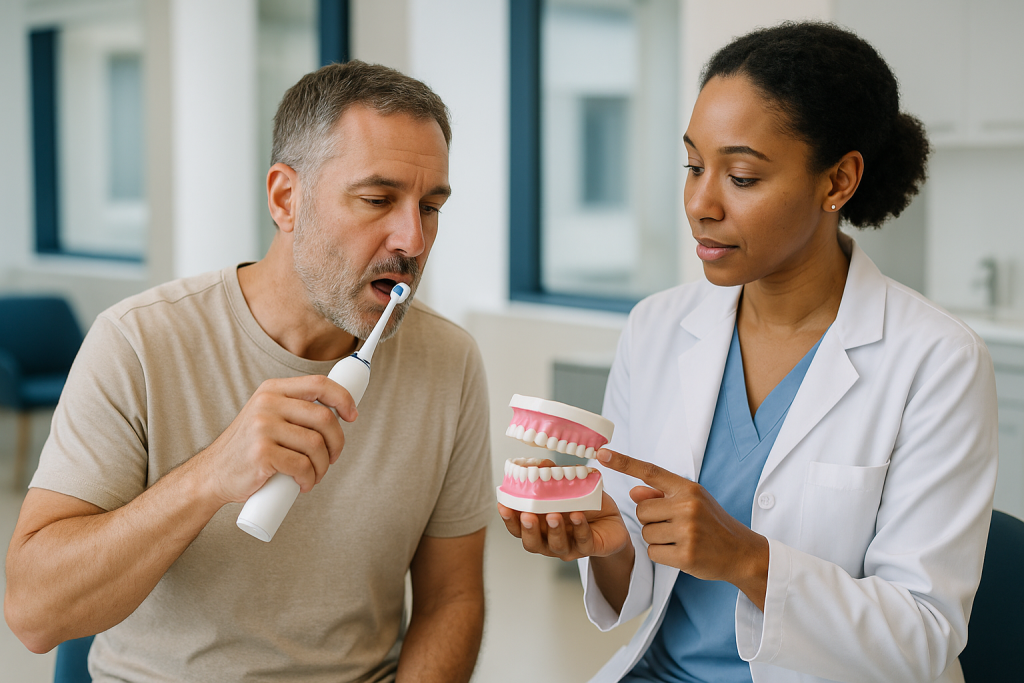
An electric toothbrush replaces that variability with a motor. Oscillating-rotating models have a small round head that spins a fraction of a turn one way, then the other, several thousand times a minute, while also pulsating slightly in and out. Sonic models use a more traditional oblong head that vibrates side to side at very high frequency, often tens of thousands of movements per minute. Both designs produce far more bristle movements than a hand can, so the same two minutes cover more surface area with more consistent pressure.
Sonic brushes are also marketed on a secondary mechanism: the rapid vibration agitates the toothpaste-and-saliva mixture, creating fluid movement that manufacturers say disturbs plaque slightly beyond where the bristles touch. Laboratory studies support that fluid dynamics exist; whether they add meaningful cleaning in a real mouth is harder to prove, and the trials do not show sonic brushes clearly outperforming oscillating ones.
Two features that come standard on most powered brushes may explain as much of the benefit as the motor itself. A two-minute timer, often with a buzz every thirty seconds to signal a change of quadrant, quietly corrects the most common brushing failure, which is stopping too soon. Surveys consistently find that adults who believe they brush for two minutes typically manage closer to forty-five seconds. A pressure sensor that lights up or stalls the motor when you push too hard addresses the second failure, scrubbing gums into recession.
Put simply, the electric toothbrush wins less by cleaning better in expert hands than by making ordinary hands behave more like expert ones.
Oscillating-rotating vs sonic: does the type of electric toothbrush matter?
Ask which brand is better and you will get strong opinions and weak data. The two dominant designs on the market are the small round oscillating-rotating head and the vibrating sonic head, and the question of which is superior is one of the most-searched in dentistry.
The 2014 Cochrane review addressed it directly. Oscillating-rotating brushes had the largest body of trial evidence and showed a consistent benefit over manual brushing. Sonic and other side-to-side designs also beat manual brushes, but with fewer trials behind them. When the reviewers compared powered designs against each other, they found insufficient evidence to say one type was clinically better. Later trials funded by manufacturers have reported small advantages in one direction or the other, and a reasonable reader should weigh sponsorship when reading them.
What the trials cannot capture is fit. A round oscillating head is small, which some people find easier to angle behind the back molars and along the gumline; others find it fiddly. A sonic head feels closer to a manual brush and may suit someone with a sensitive gag reflex or a strong preference for the familiar stroke. Noise, vibration in the handle and how the device feels against the gums are matters of taste, and taste predicts whether a brush gets used every day.
Dentists asked which type they recommend tend to give a version of the same answer: whichever one their patient will use for two full minutes, twice a day, with a timer and a pressure sensor. That is not a dodge. It is what the evidence actually permits them to say.
If you already own one type and use it well, there is no trial-based reason to switch to the other.
What electric toothbrush do most dentists recommend, and why?
Dentists rarely recommend a model. They recommend features, and the list is shorter than the marketing suggests.
First on nearly every clinician’s list is a two-minute timer with quadrant pacing. The NHS advice to brush for two minutes is not arbitrary; plaque removal in trials rises steeply with brushing time up to about that mark, then flattens. A timer converts a vague intention into a measured task.
Second is a pressure sensor. Gum recession, the slow retreat of gum tissue that exposes the sensitive root surface, is strongly associated with aggressive scrubbing. A sensor that flashes or reduces power when pressure crosses a threshold is a small piece of engineering that solves a common clinical problem.
Third is a soft-bristled, replaceable head. Soft bristles clean plaque as effectively as medium or hard ones in comparative studies and cause less wear on enamel and gums. Heads should be replaced roughly every three months, or sooner once the bristles splay, because worn bristles lose their cleaning edge.
Beyond those three, the evidence thins out fast. Multiple cleaning modes, whitening settings, smartphone apps that map your brushing and artificial-intelligence coaching may help a motivated person stay engaged, and engagement is worth something. But no randomized trial shows that a brush with an app produces healthier gums than the same brush without one.
There is one more thing dentists say that rarely makes it into buying guides: a well-used manual brush beats a badly used electric one. The Cochrane numbers describe average results in groups. An individual with excellent manual technique can match them; an individual who lets a powered brush sit idle cannot.
So the honest recommendation is a timer, a pressure sensor, a soft head, and whichever handle you will pick up tonight and again tomorrow morning.
Does flossing actually work? What the trials show
Flossing has had a rough decade in the headlines, and much of the skepticism traces back to that 2019 Cochrane review and its predecessor. The finding was not that flossing is useless. It was that the evidence for flossing is weaker than its universal recommendation implies.
Here is what the pooled trials showed. Adding floss to brushing reduced gingivitis, measured by bleeding and inflammation indices, at one, three and six months. The size of the effect was small to moderate, and the certainty was rated low, because most trials were brief, enrolled fewer than a hundred people and did not always conceal from assessors which group participants were in. For plaque, the evidence was very low certainty and inconsistent; some trials found floss removed more plaque, others found no difference.
Crucially, no trial has been designed to answer the question that matters most: does a lifetime of flossing prevent cavities between the teeth or slow the progression to periodontitis? Periodontitis is the advanced form of gum disease in which the bone supporting the teeth is gradually lost. Answering that would require following thousands of people for decades, and nobody has funded it.
The biological rationale remains strong. A toothbrush cannot reach the tight contact points between adjacent teeth, and those surfaces account for a substantial share of adult cavities and gum inflammation. Something has to clean them. Floss, interdental brushes and water flossers are the candidates, and the trials suggest all of them help somewhat.
Why, then, does guidance still say floss daily? Because a low-certainty benefit with essentially no risk and a plausible mechanism is a reasonable thing to recommend, and because the alternative, leaving those surfaces untouched, has no evidence in its favor at all. The absence of a large trial is not the presence of proof that flossing fails.
Water flosser vs flossing: which cleans between teeth better?
This is the question the viral videos claim to have settled, and it is the one the trials answer least confidently.
Water flossers deliver a pulsing jet, typically adjustable in pressure, that flushes debris and loosely attached bacteria from between the teeth and just beneath the gumline. In the 2019 Cochrane review, oral irrigators added to brushing produced low-certainty evidence of reduced gingivitis at one month compared with brushing alone. For plaque, the evidence was very low certainty and mixed.
Compared directly against string floss, the available trials were few, small and short. Some reported that water flossers reduced gum bleeding more than floss; others found the two roughly equivalent; the reviewers could not draw a firm conclusion. A pattern worth noticing is that several of the trials favoring irrigators were funded by irrigator manufacturers, which does not invalidate them but does warrant caution.
Where water flossers plausibly shine is not in the average adult mouth but in specific situations. People wearing fixed braces cannot easily thread floss around brackets and wires, and a water jet reaches those areas with little effort. Someone with a dental implant, a bridge, or limited hand dexterity from arthritis or a stroke may find string floss nearly impossible and a water flosser entirely manageable. In those cases the practical question is not “which is better” but “which will actually happen every day,” and the answer is obvious.
What the trials do not support is the claim that a water flosser makes floss obsolete for everyone. Floss physically scrapes the tight contact points where two teeth touch; a water jet flushes but does not scrape in the same way. Many dental professionals suggest that people who tolerate both use both, and that framing, unlike the viral one, is consistent with what the evidence shows.
Comparison table: electric toothbrush, manual brush, floss, water flosser and interdental brushes
The table below summarizes the trial evidence in one place. “Evidence strength” uses the certainty ratings from the Cochrane reviews described above; “best suited to” reflects mainstream clinical guidance rather than trial data.
| Tool | What trials show | Evidence strength | Best suited to |
|---|---|---|---|
| Electric toothbrush | About 11 to 21 percent less plaque and 6 to 11 percent less gingivitis than manual over one to three-plus months | Moderate (56 randomized trials) | Most adults; anyone who under-brushes or scrubs too hard |
| Manual toothbrush | Effective when used for two minutes with good technique; slightly less plaque removal on average | Moderate (as the comparator in the same trials) | People with good technique, travelers, budget-limited households |
| String floss | Small to moderate reduction in gingivitis when added to brushing; plaque effect unclear | Low (gingivitis), very low (plaque) | Tight contacts between teeth; people with good dexterity |
| Water flosser | Reduced gingivitis versus brushing alone at one month; plaque evidence inconsistent; not clearly better or worse than floss | Low (gingivitis), very low (plaque) | Braces, implants, bridges, limited dexterity, gag-prone users |
| Interdental brushes | May reduce gingivitis more than floss where gaps allow | Low | Wider spaces between teeth, gum recession, periodontal patients |
Two things stand out. The device with the strongest evidence is the electric toothbrush, and even that evidence measures plaque and gum inflammation over months rather than cavities and tooth loss over decades. Every tool for cleaning between the teeth sits on lower-certainty ground, which means the best choice for most people is the one they will actually use daily, guided by their own dentist’s knowledge of their mouth.
The table also explains why buying guides and clinical advice so often diverge. Guides rank on features that can be tested in a week. Clinicians care about outcomes that take years, and about the habit that connects them.
Who benefits most from switching to an electric toothbrush
Averages hide a lot. The Cochrane numbers describe the typical difference between groups, but the benefit of a powered brush is not spread evenly, and certain people stand to gain far more than others.
Anyone with reduced hand function is at the front of that line. Arthritis, Parkinson’s disease, the after-effects of a stroke, or simply the grip changes of older age make the fine wrist motions of good manual brushing difficult. A powered handle does the motion; the user only needs to guide it. Occupational therapists often suggest this before any other oral-care change.
People with gum disease form a second group. Gingivitis is reversible with thorough daily plaque removal, and the extra margin a powered brush provides may be the difference between gums that bleed and gums that do not. For those already diagnosed with periodontitis, a dentist or hygienist will usually recommend a powered brush alongside interdental cleaning as part of a managed plan, and the trials on gingivitis reduction support that reasoning even though they do not measure bone loss directly.
Orthodontic patients are a third. Brackets and wires trap plaque and make the gumline hard to reach; a small oscillating head or a sonic brush with an orthodontic head, paired with a water flosser, can reach places a manual brush struggles with.
Chronic under-brushers are the largest group and the least often mentioned. If you know your two minutes is really one, the built-in timer alone may deliver most of the benefit.
Who gains least? Someone with healthy gums, excellent technique and the discipline to brush a full two minutes twice a day. For that person the electric toothbrush is a convenience, not a necessity, and there is nothing in the evidence that says they must switch.
Technique matters more than the tool
Every clinician quoted in the trend coverage says some version of this, and it is worth spelling out what good technique actually looks like, because it is where most of the real-world benefit is won or lost.
Time comes first. Two minutes, twice a day, is the standard from the NHS, Mayo Clinic and MedlinePlus alike. Brushing before bed matters most, because saliva flow drops overnight and plaque left on the teeth has hours of undisturbed contact with enamel. Brushing at one other time of day, often morning, completes the pair.
Angle comes second. Hold the bristles at roughly 45 degrees to the gumline so that the tips reach slightly under the gum edge, where plaque accumulates and gingivitis begins. With a manual brush, use short, gentle strokes; with a powered brush, simply hold the head in place for a couple of seconds on each tooth surface and let the motor work. Scrubbing back and forth with a powered brush defeats its purpose and wears the gums.
Coverage comes third. Outer surfaces, inner surfaces, chewing surfaces, and the inside of the lower front teeth, which people skip more than any other area. A quadrant timer helps here by forcing thirty seconds on each quarter of the mouth.
Fluoride toothpaste is the fourth element, and arguably the most important. Fluoride is a mineral that strengthens enamel and helps reverse the earliest stages of decay. The NHS specifically advises spitting out excess toothpaste rather than rinsing with water afterward, so that fluoride stays in contact with the teeth longer.
Finally, clean between the teeth once a day with floss, interdental brushes or a water flosser, ideally before brushing at night so the fluoride can reach the freshly cleaned surfaces. Do those five things and the brand on the handle becomes a footnote.
Common myths about electric toothbrushes, flossing and water flossers
The viral claims deserve direct answers, so here they are, one at a time.
“A water flosser replaces string floss for everyone.” Not supported. Head-to-head trials are few, small and mixed, and Cochrane reviewers could not declare a winner. Water flossers reduce gum inflammation compared with brushing alone and are excellent for braces, implants and limited dexterity. They have not been shown to do everything floss does at the tight contact points.
“Flossing has been proven not to work.” Also not supported. The trials show a small to moderate reduction in gingivitis with low-certainty evidence. Low certainty means the studies were weak, not that the effect was absent.
“Manual brushing is obsolete.” Manual brushes remain effective with good technique. The powered advantage is real but modest, and a diligent manual brusher can match the average powered-brush result.
“More expensive means more effective.” No randomized trial shows that premium features such as app connectivity, multiple modes or pressure mapping produce better plaque or gum outcomes than a basic model with a timer and pressure sensor.
“Electric toothbrushes wear away enamel.” Used with a soft head and a pressure sensor, powered brushes cause no more wear than manual ones in comparative studies, and often less, because they discourage scrubbing. Excessive force with any brush is the real culprit.
“Sonic is scientifically superior to oscillating” or the reverse. The trials do not settle this. Both beat manual; neither clearly beats the other.
“Bleeding gums mean you should stop flossing.” Bleeding when you first start cleaning between the teeth usually signals existing gingivitis, and gentle daily cleaning typically reduces it within a couple of weeks. Bleeding that persists beyond that is a reason to see a dentist, not to stop.
Each of these myths contains a grain of truth stretched past what the evidence bears. The correction, in every case, is the same: smaller effects, lower certainty, and a lot depending on the person holding the device.
Can an electric toothbrush damage gums or enamel? Safety and side effects
Powered brushes are among the safest devices in a household, but they are not free of downsides, and the trials looked for them.
The 2014 Cochrane review specifically examined adverse events and found no evidence that powered brushes caused more soft-tissue injury or gum recession than manual brushes. Several trials that measured gum abrasion found either no difference or slightly less trauma in the powered group, most likely because pressure sensors and the instruction to hold rather than scrub reduce the force applied.
That said, gum recession and enamel wear at the gumline, known as abrasion, do occur in people who brush too hard with any tool. The warning signs are gums that appear to have pulled back from the teeth, a notch or groove near the gumline you can feel with a fingernail, and new sensitivity to cold. A powered brush used with heavy pressure and a hard head can produce these just as a manual one can. Choosing a soft head, letting the pressure sensor guide you and replacing worn heads every three months are the standard preventive steps.
Some people experience mild gum tenderness or a tickling sensation in the first week of switching to a powered brush. This usually settles as the tissue adapts. Persistent soreness, ulcers or bleeding that worsens rather than improves is not normal adaptation and should be checked.
Two practical notes round out the picture. Powered brushes with vibrating heads can occasionally loosen very old or fragile fillings or crowns; anyone with extensive dental work who notices a new rough edge or a wobbly restoration should mention it to their dentist. And because these are electrical devices used in a wet room, follow the manufacturer’s charging instructions and keep chargers away from sinks and baths.
None of this changes the overall verdict: used as designed, an electric toothbrush is at least as gentle on gums and enamel as a manual brush, and often gentler.
Electric toothbrushes for children and older adults
Age changes the calculation at both ends of life, and the guidance is more specific than most buying guides acknowledge.
For children, the NHS advises starting to brush as soon as the first tooth appears, using a fluoride toothpaste in a smear for children under three and a pea-sized amount from age three to six, and supervising brushing until at least age seven. Manual and powered brushes are both acceptable; a small-headed powered brush with a timer can help a fidgety child reach the full two minutes and may make brushing feel less like a chore. Some children dislike the vibration, and a manual brush they will tolerate beats a powered one they will fight. The trials on powered brushes in children are fewer than in adults but point in the same direction: modestly less plaque, no excess harm.
Flossing in children becomes relevant once two teeth touch, usually when the back baby molars come in. Parents often find floss picks or a water flosser on a low setting easier than string floss in a small mouth, and any of these is reasonable.
Older adults face a different set of challenges. Reduced grip strength, dry mouth from common medicines, receding gums that expose root surfaces, and a lifetime of fillings and crowns all make thorough cleaning harder and more important. Root surfaces lack enamel and decay more easily, so gumline plaque control matters more with age, not less. A powered brush with a soft head and a pressure sensor addresses dexterity and force at once, and interdental brushes often fit the wider spaces that develop between older teeth better than floss does.
For someone caring for a partner or parent with dementia or physical limitations, a powered brush can also make assisted brushing quicker and gentler. The principle is the same at every age: the best tool is the one that gets the job done reliably in that particular mouth.
When to see a doctor or dentist
No home device, powered or otherwise, replaces professional care, and certain signs mean the tool is no longer the issue.
See a dentist promptly if your gums bleed every time you brush or clean between your teeth for more than two to three weeks after starting a consistent routine. Early gingivitis usually improves within that window; bleeding that persists may signal periodontitis, which requires professional assessment and treatment.
Other red-flag signs that warrant an appointment rather than a new gadget include:
- Gums that have visibly pulled back from the teeth, or teeth that look longer than they used to
- Teeth that feel loose, have shifted position, or no longer fit together the way they did
- Persistent bad breath or a bad taste that does not improve with thorough cleaning
- Pus between the teeth and gums, or a swelling on the gum that may be an abscess
- Pain, sensitivity or a dark spot on a tooth that lasts more than a few days
- A sore, white or red patch, or lump anywhere in the mouth that has not healed within three weeks
- Any facial swelling, fever or difficulty swallowing alongside tooth or gum pain, which needs same-day care and, if breathing is affected, emergency services
People with diabetes, heart disease, a weakened immune system, or who are pregnant should be especially attentive to gum changes, because gum disease is more common and can progress faster in these groups, and should discuss any bleeding or swelling with both their dentist and their doctor.
Routine check-ups matter even when nothing hurts. A dentist or hygienist can see plaque and early decay you cannot, can tell you which surfaces your current tools are missing, and can recommend whether an electric toothbrush, a water flosser, floss or interdental brushes suit the specific shape of your mouth. Every choice described in this article is a reasonable starting point; your own clinician’s advice, based on an examination, should override it.
Frequently asked questions
Are electric toothbrushes really better than manual toothbrushes?
Yes, modestly. Pooled randomized trials show powered brushes remove about 11 to 21 percent more plaque and reduce gum inflammation by roughly 6 to 11 percent more than manual brushes over one to several months. The evidence is rated moderate certainty. The benefit depends on brushing for a full two minutes with a soft head and light pressure; a well-used manual brush can match the average powered result.
What is the best electric toothbrush to buy?
No trial identifies a single best model. Clinicians consistently point to three features that matter: a two-minute timer with quadrant pacing, a pressure sensor that warns when you push too hard, and a soft replaceable head changed about every three months. Beyond those, extras such as multiple modes and apps have no randomized-trial evidence of better gum or plaque outcomes. Choose the handle you will use twice daily.
What electric toothbrush do most dentists recommend?
Most dentists recommend features rather than brands: a built-in timer, a pressure sensor and soft bristles. Both oscillating-rotating and sonic designs have trial evidence of beating manual brushing, and neither has been shown to clearly outperform the other. Dentists often add that the right brush is the one a patient will actually use for two full minutes, and that technique outweighs the device.
Which is better, an oscillating-rotating or a sonic electric toothbrush?
The trials do not settle this. Oscillating-rotating brushes have the largest body of randomized evidence against manual brushes, while sonic brushes also beat manual brushing in fewer studies. Direct comparisons between the two designs were judged insufficient by Cochrane reviewers to name a winner. Later manufacturer-funded trials report small advantages in both directions. Comfort, head size and whether you will use it daily are the deciding factors.
Does flossing actually work, or is it a myth?
Flossing does help, but the evidence is weaker than its universal recommendation suggests. A 2019 Cochrane review found low-certainty evidence that adding floss to brushing reduces gingivitis at one, three and six months, with unclear effects on plaque. Low certainty reflects small, short trials, not proof of no benefit. Because a toothbrush cannot reach between teeth, daily interdental cleaning of some kind remains standard advice.
Is a water flosser as good as flossing?
Possibly, but the trials cannot say for certain. Water flossers reduce gum inflammation compared with brushing alone, with low-certainty evidence. Head-to-head comparisons with string floss are few, small and mixed, and some were manufacturer-funded. Water flossers are particularly useful for braces, implants, bridges and limited hand dexterity. Many dental professionals suggest using both a water flosser and floss if you tolerate them.
Can an electric toothbrush damage your gums or enamel?
Not when used as designed. Cochrane reviewers found no evidence that powered brushes cause more gum injury or recession than manual brushes, and some trials showed less. Damage comes from excessive force with any brush, hard bristles or worn heads. Use a soft head, let the pressure sensor guide you, hold rather than scrub, and replace the head roughly every three months. Persistent soreness or new sensitivity warrants a dental check.
How long should I brush with an electric toothbrush?
Two minutes, twice a day, the same as with a manual brush. Plaque removal in trials rises steeply with brushing time up to about two minutes and then levels off. Most powered brushes include a timer that buzzes every thirty seconds to signal moving to the next quarter of the mouth. Brush before bed and at one other time daily, use fluoride toothpaste, and spit rather than rinse afterward.
Should children use an electric toothbrush?
They can, but they do not have to. Guidance from the NHS supports either a manual or powered brush for children, with a smear of fluoride toothpaste under age three, a pea-sized amount from three to six, and adult supervision until at least age seven. A small-headed powered brush with a timer may help a child reach two minutes, but a manual brush a child accepts beats a powered one they resist.
How often should I replace the head on my electric toothbrush?
About every three months, or sooner if the bristles look splayed or frayed. Worn bristles lose their cleaning edge and can be rougher on gums. The same three-month rule applies to manual brushes. Many powered heads have indicator bristles that fade in color as a reminder. Replacing the head after an illness such as a cold or strep throat is also commonly advised, though evidence for this is limited.
References
This article is for general information only and is not a substitute for professional medical advice. Please consult a qualified doctor about your individual situation.

More from the Blog

Eye Vitamins and Lutein: What the AREDS Trials Actually Showed
The AREDS trials showed that a specific antioxidant and zinc formula modestly slows progression in people who already have intermediate age-related macular degeneration, and…

Receding Gums: Causes, Whether They Grow Back and the Treatments That Help
Receding gums happen when gum tissue pulls away from a tooth and exposes more of its root, most often because of gum disease, aggressive…
Earwax Removal: Safe Methods, the Cotton-Bud Problem and Why Ear Candling Is Dangerous
Earwax removal is rarely necessary because the ear canal cleans itself, but when wax blocks hearing or causes discomfort, the safest home approach is…

Swimmer’s Ear: Causes, Treatment and Prevention
Swimmer's ear (acute otitis externa) is an infection of the skin lining the outer ear canal, usually caused by bacteria that multiply when water,…