

Endometriosis and Fertility: What the Diagnosis Changes, and the Options Step by Step
Key Takeaways
- Roughly 30 to 50 percent of people with endometriosis experience infertility, which means half or more conceive without any treatment.
- Disease stage predicts pain poorly and fertility only loosely; the Endometriosis Fertility Index, which weighs tube and ovary function plus age, predicts non-IVF pregnancy after surgery better than stage alone.
- Laparoscopic removal of lesions in minimal-to-mild disease modestly raises pregnancy rates in randomized trials, but removing endometriomas before IVF can lower egg yield without improving outcomes.
- Hormonal treatments for endometriosis suppress ovulation while taken and do not improve natural fertility after stopping, according to randomized trial data.
- IVF live birth rates in endometriosis are broadly comparable to other infertility diagnoses once age and ovarian reserve are matched, even in stage IV disease.
- Observational studies link endometriosis to modestly higher rates of ectopic pregnancy, preterm birth and placenta previa, so early ultrasound and informing your obstetric team are sensible.
Most people with endometriosis can conceive, though roughly 30 to 50 percent experience some difficulty. The diagnosis mainly changes timing: it is a reason to seek a fertility evaluation sooner rather than to wait a full year. Options move stepwise from a workup through laparoscopic surgery, ovulation induction with insemination, and IVF, with the best path depending on age, disease stage, ovarian reserve and partner factors.
The comment that keeps resurfacing under endometriosis videos this season is some version of “I was told I’d never have kids.” Millions of views, thousands of replies, and a pattern of advice that ranges from sensible to flatly wrong: get pregnant now to “cure” it, skip the birth control that “caused” it, insist on surgery before anything else. As of this writing (spring 2026), searches for endometriosis and fertility are climbing again, pushed by those viral threads and by a run of newer hormonal treatments and updated national guidance that have put the disease back in the news.
What the comment threads rarely capture is how ordinary a good outcome is. A diagnosis of endometriosis is a diagnosis of a chronic inflammatory condition, not a verdict on parenthood. It does change a few things, and it changes them in a fairly predictable order.
This piece walks through that order: what the disease does to the reproductive system, which stage matters and which doesn’t, what age changes, and what the evidence really shows for each step from watchful waiting to IVF.
What changed recently in endometriosis care
Three developments explain why this topic is back in feeds and search bars, and none of them is a cure.
The first is scale. When the World Health Organization refreshed its endometriosis fact sheet in March 2023, it put a global number on the condition: roughly 190 million people of reproductive age, or about 10 percent of that population. That figure has been repeated in news coverage ever since, and it reframed endometriosis from a niche gynecologic complaint into one of the most common chronic diseases affecting women and girls worldwide.
The second is medicines. Since 2018, US regulators have approved a newer class of oral hormonal drugs, GnRH antagonists, for endometriosis-associated pain, with a combination tablet in that class approved in August 2022. These are pain treatments; they suppress ovulation while you take them and are not fertility treatments. Their arrival, though, has generated marketing, patient forums and a wave of confusion about whether “treating the endometriosis” and “treating the infertility” are the same project. They are not, and the sections below keep them separate.
The third is guidance. National bodies in the UK and elsewhere have updated their endometriosis recommendations within the past two years, with a consistent emphasis on shortening the diagnostic delay that the NHS and others still describe as averaging many years, and on considering fertility wishes at the moment of diagnosis rather than after pain treatment has failed. The direction is clear: ask about pregnancy plans early, because the answer changes which treatment comes first.
Put those together and you get a condition that is more visible, more treatable for pain, and more explicitly linked in guidelines to fertility planning. What has not changed is the underlying biology, which is where any honest explanation has to start.
What is endometriosis, and how does it affect fertility?
Endometriosis is a condition in which tissue resembling the lining of the uterus grows outside it, most often on the ovaries, the fallopian tubes, the ligaments holding the uterus, and the lining of the pelvis. That tissue responds to the monthly hormone cycle, so it thickens and bleeds with no exit route. The body reacts the way it reacts to any internal injury: inflammation, then scar tissue.
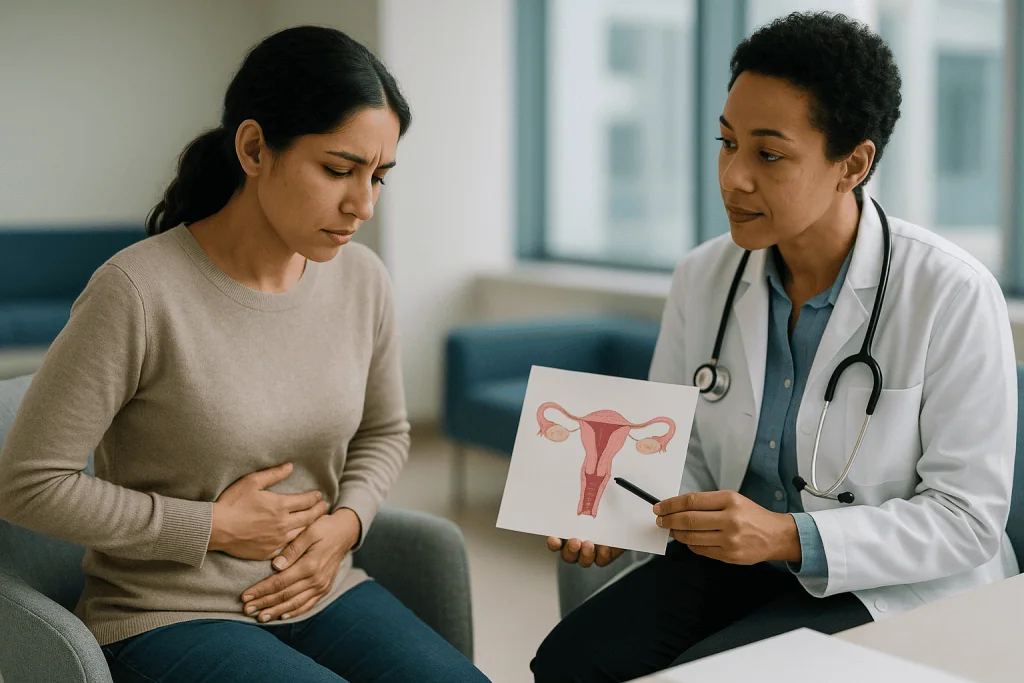
Fertility can be affected through several routes at once, which is why the effect varies so much from person to person.
- Mechanical. Scar tissue, called adhesions, can glue the ovary to the pelvic wall or kink a fallopian tube. An egg released from the ovary has to be caught by the tube’s fringed end; if that end is stuck down or blocked, the egg may never get there.
- Inflammatory. The fluid bathing the pelvic organs in endometriosis carries higher levels of inflammatory molecules. Laboratory and observational studies suggest this environment can impair sperm movement, egg quality and early embryo development, even when the anatomy looks normal.
- Ovarian. Cysts of endometriosis inside the ovary, called endometriomas, can crowd out healthy ovarian tissue. Surgery to remove them can reduce it further. Either way the result is a smaller “egg bank,” known as ovarian reserve.
- Uterine. Some research points to subtle changes in how receptive the uterine lining is to an implanting embryo, though this is the least settled of the four mechanisms.
Notice what is missing from that list: endometriosis does not stop ovulation in most people, and it does not damage eggs in a way that makes conception impossible. Mainstream sources such as the Cleveland Clinic put the proportion of people with endometriosis who experience infertility at 30 to 50 percent, which means half or more conceive without any special help. The disease tilts the odds; it rarely closes the door.
Can you still be fertile if you have endometriosis?
Yes, and the plainest way to see it is to flip the statistics around. If 30 to 50 percent of people with endometriosis have trouble conceiving, then 50 to 70 percent do not. Many of them never learn they have the disease until a scan during pregnancy or a surgery for something else turns it up.
The more useful measure for anyone actively trying is monthly fecundity, the chance of conceiving in any single cycle. In couples with no fertility problem, that chance is commonly estimated at 15 to 20 percent per month. Reproductive medicine societies have long cited a range of roughly 2 to 10 percent per month in untreated endometriosis, with the lower end applying to more advanced disease. Those are averages from observational cohorts rather than trial data, so treat them as a ballpark, but they carry an important message: a lower monthly chance is not a zero chance. It means conception may take more cycles, and that time matters more than it would otherwise.
That is really the heart of what the diagnosis changes. Standard advice for a healthy couple is to try for 12 months before seeking an evaluation if the woman is under 35, and six months if she is 35 or older. With a known endometriosis diagnosis, many clinicians reasonably suggest moving that conversation earlier, sometimes to the point of diagnosis itself. This is expert opinion rather than trial-proven, but it follows logically from the arithmetic above.
Fertility is also not a fixed trait. Someone with mild disease and open tubes at 28 may conceive easily; the same person at 38, after an endometrioma has been removed, faces a different picture. The question “am I fertile?” is better asked as “what is my current chance, and what is changing it?” The next two sections take those two variables, stage and age, in turn.
What stage of endometriosis causes infertility?
The most widely used staging system, from the American Society for Reproductive Medicine, scores what a surgeon sees at laparoscopy, a keyhole operation to look inside the abdomen. Points are given for the size and depth of lesions and for adhesions, and the total is grouped into four stages: I (minimal), II (mild), III (moderate) and IV (severe).
Two facts about this system surprise almost everyone.
First, stage correlates poorly with pain. Someone with stage I disease can have disabling cramps; someone with stage IV can be nearly pain-free. Second, stage correlates only loosely with fertility. Higher stages do carry lower natural conception rates on average, largely because they include more adhesions and endometriomas, the mechanical and ovarian mechanisms described earlier. But minimal and mild disease also reduce fecundity, through inflammation rather than blockage, and some people with stage IV disease conceive naturally.
Because of these gaps, a second tool, the Endometriosis Fertility Index, was developed specifically to predict the chance of pregnancy without IVF after surgery. It combines the surgical findings with age, how long the couple has been trying and prior pregnancies, and it weighs the functional state of the tubes and ovaries more heavily than lesion count. Validation studies have found it predicts non-IVF pregnancy better than stage alone, though these are observational cohorts rather than randomized trials.
So which stage “causes” infertility? None, exclusively. The honest framing is that stage III and IV disease, particularly with endometriomas on both ovaries or tubes that are blocked, make natural conception considerably less likely and often shift the conversation toward IVF sooner. Stage I and II disease lower the monthly odds more modestly and leave more options open, including surgery followed by a period of trying. If you have had a laparoscopy, ask your surgeon for both the stage and, if calculated, the fertility index; the second number tells you more about what to do next.
What the evidence actually says about endometriosis and fertility treatment
Fertility research in endometriosis is harder to run than it sounds. The disease is usually confirmed only at surgery, participants are understandably reluctant to be randomized to “no treatment,” and live birth, the outcome that matters, takes a year to measure. The result is a body of evidence that is strong in places and thin in others. Here is how it grades out.
Reasonably strong (randomized trials, pooled in systematic reviews): Laparoscopic surgery that removes or destroys visible lesions in minimal-to-mild disease increases the chance of pregnancy compared with diagnostic laparoscopy alone. The effect is real but modest, and reviewers have rated the certainty as low to moderate because of small trials and inconsistent outcome reporting. Hormonal suppression on its own, whether combined contraceptive pills, progestins or GnRH analogs, does not improve natural fertility, and randomized data support that conclusion; these drugs block ovulation while taken.
Moderate (mostly observational, some trials): IVF achieves live birth rates in endometriosis that are broadly comparable to those in other causes of infertility once age and egg number are accounted for, though some cohorts show lower egg yields, especially after endometrioma surgery. Removing endometriomas before IVF does not clearly improve IVF outcomes and can lower ovarian reserve; the current lean is toward operating only for pain, large cysts or diagnostic uncertainty.
Weak or unsettled (small trials, conflicting reviews): Giving a course of GnRH agonist suppression for several months before IVF was once thought to improve outcomes; more recent systematic reviews rate that evidence as very low certainty. Whether surgery for moderate-to-severe disease improves natural conception is supported by cohort data but has not been tested in a randomized trial. Diet, supplements and “anti-inflammatory” protocols have essentially no fertility outcome data.
Expert opinion: Seeking evaluation earlier than the standard 12 months, and prioritizing fertility goals over pain suppression when both are present, are consensus positions rather than trial findings.
The pattern is instructive. The interventions with the best evidence are the ones that either fix something mechanical or bypass the pelvis altogether. The ones with the weakest evidence are the ones most heavily promoted online.
What age is best to get pregnant with endometriosis?
There is no endometriosis-specific “best age,” and any source that names one is guessing. What exists is a well-documented decline in fertility with age that applies to everyone, layered on top of a disease that can accelerate one part of that decline.
The general curve is familiar. Egg number and egg quality both fall through the 30s, with the drop steepening after about 35 and again after 40. Miscarriage risk rises along the same curve, largely because of chromosomal errors in older eggs. None of this is unique to endometriosis.
What endometriosis adds is a second pressure on ovarian reserve. Endometriomas can replace healthy ovarian tissue, and the surgery to remove them, particularly when it is repeated or involves both ovaries, can remove more. Observational studies consistently show lower levels of anti-Müllerian hormone, a blood marker that reflects the remaining egg supply, after endometrioma surgery. So a 32-year-old with two prior ovarian surgeries may have the reserve of someone considerably older. Age still matters most, but the diagnosis can shift where an individual sits on the curve.
That leads to a more practical version of the question: when should someone with endometriosis start thinking concretely about pregnancy or about preserving the option? Reasonable answers, drawn from mainstream guidance and expert opinion rather than trials:
- If you want children and are ready, there is no medical reason to delay because of the diagnosis; earlier is generally easier for everyone.
- If you are not ready, a conversation about ovarian reserve testing is worth having, especially if you have endometriomas or are considering ovarian surgery.
- If you are facing surgery on one or both ovaries and may want children later, ask before the operation whether egg freezing should be discussed first. Evidence that freezing improves eventual live birth in endometriosis is observational and limited, but the biology is straightforward.
The decision about timing belongs to you and your clinician together. The disease does not dictate a birthday; it argues for having the conversation sooner.
Step one: the fertility workup after an endometriosis diagnosis
Before anyone recommends surgery or IVF, the sensible first step is the same evaluation any couple with fertility concerns receives, because endometriosis is frequently not the only factor in play. Roughly a third of infertility cases involve a male factor, and finding one early can change the whole plan.
A standard workup usually includes several elements, and understanding them helps you follow the reasoning that comes later.
- Ovulation assessment. A menstrual history, sometimes with a mid-cycle hormone test, confirms that eggs are being released. Most people with endometriosis ovulate normally.
- Ovarian reserve testing. A blood test for anti-Müllerian hormone and a transvaginal ultrasound counting small follicles estimate the remaining egg supply. Neither predicts natural conception well, but both help predict how someone will respond to IVF medication and whether time is a pressing factor.
- Tubal patency. A hysterosalpingogram, an X-ray with dye passed through the cervix, or a saline ultrasound checks whether the fallopian tubes are open. Blocked tubes move the conversation directly toward IVF or surgery.
- Pelvic imaging. Skilled transvaginal ultrasound can now identify endometriomas and, in experienced hands, deep infiltrating disease. MRI adds detail when surgery is being planned. Neither replaces laparoscopy for confirming superficial disease, but many clinicians no longer insist on surgery just to make the diagnosis.
- Semen analysis. For a partner producing sperm, this is quick, non-invasive and frequently informative.
At the end of this step, most couples fall into one of three broad groups: endometriosis appears to be the main issue and the anatomy is largely intact; endometriosis coexists with another significant factor such as low sperm count or blocked tubes; or ovarian reserve is low enough that time itself is the main constraint. Each group points toward a different next step, which is why skipping the workup and heading straight to surgery, a common piece of forum advice, can send someone down the wrong path.
Step two: does surgery for endometriosis help you get pregnant?
Sometimes, for some people, modestly. That is the accurate answer, and it is worth unpacking because surgery is the most emotionally loaded decision in this pathway.
The best-studied scenario is minimal-to-mild disease found at laparoscopy in someone with otherwise unexplained infertility. Randomized trials comparing removal or destruction of lesions with simply looking and closing have found a higher pregnancy rate in the treated group. Pooled analyses put the benefit in the range of a meaningful but not dramatic increase, and rate the certainty as low to moderate. In plain terms: if a surgeon is already inside for diagnosis, treating what they find is reasonable and likely helps a little. Scheduling an operation purely to improve fertility in mild disease is a closer call, and many specialists now weigh it against going directly to fertility treatment.
Moderate-to-severe disease is less clear-cut. Observational cohorts suggest that surgery restoring normal anatomy, freeing adhesions and removing large lesions, improves natural conception rates afterward, and the Endometriosis Fertility Index was built on exactly this kind of data. No randomized trial has tested it, partly because withholding surgery from someone with a frozen pelvis is hard to justify. The decision here typically hinges on whether pain is also a problem, how much ovarian reserve would be at risk, and whether the tubes can realistically be restored.
Endometriomas deserve their own caution. Removing the cyst wall can take healthy ovarian tissue with it, and the fall in anti-Müllerian hormone afterward is well documented. If the main goal is pregnancy through IVF and the cyst is not causing pain or obstructing egg retrieval, current expert guidance often favors leaving it alone.
Two practical points follow. Surgical experience matters, and the person operating should be comfortable both excising disease and protecting the ovary. And surgery buys a window rather than a permanent fix; recurrence over the following years is common, so the months after an operation are usually the most valuable time to try or to move to the next step.
Step three: IUI, IVF and endometriosis and fertility treatment
When natural conception has not happened within a reasonable window, or when the workup shows tubal damage, low reserve or a male factor, assisted reproduction becomes the next rung. Two approaches dominate, and they suit different situations.
Ovulation induction with intrauterine insemination (IUI) uses fertility medicines to mature more than one egg in a cycle, then places prepared sperm directly in the uterus at ovulation. It requires at least one open tube and a reasonable sperm count. For minimal-to-mild endometriosis with intact anatomy, trial data show it raises the per-cycle pregnancy rate compared with trying naturally, though the absolute gain per cycle is modest and most clinicians cap the number of attempts, often at three to four, before moving on. In moderate-to-severe disease its value is doubtful, because the underlying problem is often mechanical.
In vitro fertilization (IVF) retrieves eggs directly from the ovaries, fertilizes them in the laboratory and transfers an embryo into the uterus. It sidesteps blocked tubes, adhesions and much of the inflamed pelvic environment, which is why it is the most effective option for severe disease. Large registry analyses show live birth rates for endometriosis that are broadly similar to other diagnoses when matched for age and egg number. Some studies note fewer eggs retrieved, particularly after ovarian surgery, which circles back to the reserve concerns above.
A few endometriosis-specific wrinkles come up in IVF planning, and each is a conversation rather than a rule:
- Whether to suppress the disease with hormones for weeks or months before starting. Older reviews suggested benefit; recent ones rate the evidence very low certainty.
- Whether an endometrioma should be drained or removed before egg retrieval. Usually not, unless it is large or in the way.
- Whether to freeze all embryos and transfer later. Some clinics favor this to let the ovaries and lining settle; the supporting data are observational.
The step-by-step logic is not a rigid ladder. Someone who is 39 with an AMH in the low range and stage IV disease may sensibly skip both surgery and IUI. Someone who is 29 with stage II disease and a normal workup may reasonably try for six months after laparoscopy before anything else. The steps are a menu ordered by invasiveness; the order you take them in depends on your numbers.
Do hormone treatments for endometriosis improve fertility?
No, not directly, and this is one of the most consequential misunderstandings in the online conversation.
The hormonal medicines used for endometriosis all work by dampening the estrogen-driven cycle that feeds the lesions. Combined contraceptive pills, progestin-only pills and implants, the hormonal IUD, GnRH agonists and the newer GnRH antagonists differ in how they do it and in their side-effect profiles, but they share a feature that matters here: while you are taking them, you generally do not ovulate or cannot conceive. They are, functionally, contraceptives. Randomized trials have confirmed that suppressing the disease for a period and then stopping does not raise natural pregnancy rates afterward compared with not suppressing at all.
That does not make these treatments irrelevant to someone hoping for a child. They can be valuable in three ways. They control pain during the years before someone is ready to conceive. They may slow the growth of lesions, though whether this protects future fertility is unproven. And in the IVF setting, a period of suppression before stimulation has been studied as a way to improve outcomes, with results that are, as noted above, inconsistent and of low certainty.
Side effects vary by drug class. Progestins commonly cause irregular bleeding and mood changes. GnRH agonists and antagonists lower estrogen and can bring hot flashes, sleep disturbance and, with longer use, loss of bone density, which is why many are prescribed with “add-back” hormones and for limited durations. These are decisions about dose, duration and combination that belong entirely to the prescribing clinician; nothing here should be read as guidance to start, stop or adjust anything.
The practical upshot for fertility is a sequencing question. If pregnancy is the near-term goal, hormonal suppression is usually paused, because it prevents the very thing you are trying to achieve. If pregnancy is years away, controlling pain now and revisiting fertility later is a perfectly sound plan. What does not work is hoping that a pain treatment will double as a fertility treatment.
When to see a doctor: if you are on any of these medicines and develop severe or worsening pelvic pain, heavy bleeding that soaks through protection hourly, chest pain, shortness of breath, calf pain or swelling, sudden severe headache, or symptoms of depression, contact your prescriber promptly. If you are considering trying to conceive, discuss the timing of stopping treatment with them rather than stopping on your own.
Comparing the options: a summary table
The table below distills the sections above into one view. It is a map of the evidence, not a recommendation for any individual; the right cell for you depends on age, ovarian reserve, tubal status, partner factors and pain.
| Option | Typically considered when | What the evidence shows | Strength of evidence | Main trade-off |
|---|---|---|---|---|
| Timed trying (expectant management) | Younger age, minimal-to-mild disease, normal workup | Many conceive within 6 to 12 months; per-cycle chance lower than average | Observational cohorts | Uses time, which matters more with age |
| Laparoscopic excision or ablation | Disease found at diagnostic laparoscopy; pain plus infertility; distorted anatomy | Modest increase in pregnancy in stage I to II; cohort benefit in stage III to IV | Randomized trials (low to moderate certainty) for mild disease; observational for severe | Surgical risk; possible loss of ovarian reserve if ovaries are operated on |
| Ovulation induction with IUI | Open tubes, adequate sperm, stage I to II | Higher per-cycle pregnancy rate than natural trying | Randomized trials | Limited number of useful cycles; multiple pregnancy risk |
| IVF | Blocked tubes, severe disease, low reserve, male factor, failed earlier steps | Live birth rates comparable to other infertility causes when matched for age | Large registry and cohort data | Most invasive and demanding; egg yield may be lower after ovarian surgery |
| Hormonal suppression alone | Pain control when pregnancy is not the near-term goal | No improvement in natural fertility after stopping | Randomized trials | Prevents conception while in use |
| Suppression before IVF | Selected IVF cases, clinician discretion | Inconsistent results | Very low certainty | Delays the IVF cycle by weeks to months |
| Egg freezing | Endometriomas or planned ovarian surgery, pregnancy not yet wanted | Preserves eggs at current age; live birth data in endometriosis limited | Observational, limited | Requires an IVF-like stimulation cycle; no guarantee of later use |
Read across the rows and a theme emerges. The options with the firmest evidence either correct a physical problem or route around it. The rows with the weakest evidence are the ones that try to change the disease itself in the hope that fertility follows. That is why most fertility specialists, when both pain and pregnancy are on the table, will ask which matters more to you right now, and let the answer set the order.
Fibroids and fertility: how they differ from endometriosis
Endometriosis is often discussed in the same breath as uterine fibroids, and the two conditions do share territory: both are common, both are estrogen-responsive, both can cause heavy or painful periods, and both can coexist in the same person. Beyond that, they behave quite differently, and confusing them leads to confused expectations about fertility.
Fibroids are noncancerous growths of the uterine muscle. According to the Mayo Clinic, most people develop at least one by the time they reach menopause, and the majority never cause symptoms. Their effect on fertility depends almost entirely on location.
- Submucosal fibroids, which bulge into the uterine cavity, are the ones most consistently linked to lower pregnancy rates and higher miscarriage risk, presumably by distorting the surface where an embryo implants.
- Intramural fibroids, within the muscle wall, have a more debated effect; large ones that distort the cavity probably matter, small ones probably do not.
- Subserosal fibroids, on the outer surface, generally have little impact on conception.
The evidence on treating fibroids for fertility mirrors that pattern. Removing submucosal fibroids through the cervix with a thin camera, a hysteroscopic myomectomy, is supported by observational data and small trials showing improved pregnancy rates. Removing intramural fibroids that do not distort the cavity has not been shown to help and carries surgical risk to the uterus.
The contrast with endometriosis is useful. Fibroids affect fertility mainly through a single, local mechanism inside the uterus, and imaging can usually identify the culprit precisely. Endometriosis works through several diffuse mechanisms across the pelvis, and its extent is often underestimated on imaging. Fibroids rarely reduce ovarian reserve; endometriosis, via endometriomas and ovarian surgery, can. Both conditions can be treated with the same hormonal medicines for symptoms, and in both cases those medicines suppress fertility while taken rather than restoring it.
If you have both diagnoses, the fertility plan usually addresses whichever is more likely to be the limiting factor first, and imaging plus the workup described earlier is how that judgment gets made.
Can you still get pregnant after endometriosis, and what does pregnancy look like?
“After” is a slippery word here, because endometriosis is chronic and there is no single moment when it is over. People ask this question in two senses, and both deserve an answer.
The first sense is after surgery or after years of the disease. Yes, pregnancy remains possible; the months after a well-performed laparoscopy are often the window with the highest natural conception rates, and IVF success is not meaningfully reduced by a history of the disease once age and egg supply are accounted for. Recurrence is common in the years following surgery, so the plan is usually to use that window rather than wait.
The second sense is pregnancy itself: does endometriosis change how a pregnancy goes? Here the picture is reassuring but not entirely blank. Large observational studies, including national registry analyses, have associated endometriosis with somewhat higher rates of several complications: ectopic pregnancy (an embryo implanting outside the uterus, usually in a tube), miscarriage, preterm birth, placenta previa (the placenta lying over the cervix), pre-eclampsia and cesarean delivery. The increases are generally modest in absolute terms, the studies cannot fully separate the disease from the fertility treatments many participants used, and most pregnancies in people with endometriosis are uncomplicated.
What this means in practice is awareness rather than alarm. Your obstetric team should know about the diagnosis. Early ultrasound to confirm the pregnancy is inside the uterus is standard after fertility treatment anyway and is sensible for anyone with endometriosis. Beyond that, most people receive routine prenatal care.
One frequently reported experience is that endometriosis symptoms ease during pregnancy. The hormonal environment of pregnancy, dominated by progesterone and with no menstruation, tends to quiet the lesions. This is real for many people and temporary for most; it is also the kernel of truth inside the most persistent myth about the disease, which the next section takes on directly.
Common myths about endometriosis and fertility
The viral threads that made this topic trend contain a handful of claims that come up so often they deserve point-by-point correction. Each one has a grain of something real inside it, which is exactly why it spreads.
“Endometriosis means you’re infertile.” False. Between half and two thirds of people with the diagnosis conceive without treatment, and most of the remainder have effective options. The disease lowers monthly odds; it does not remove them.
“Get pregnant and it will cure the endometriosis.” False, and potentially harmful advice. Pregnancy often suppresses symptoms for its duration and sometimes for a period afterward, because the hormonal environment quiets the lesions. The disease typically returns once cycles resume. No mainstream medical body recommends pregnancy as a treatment.
“Birth control caused my endometriosis.” Not supported. Hormonal contraception is one of the first-line treatments for endometriosis pain precisely because it suppresses the cycle that drives lesions. What is true is that contraception can mask symptoms for years, so the diagnosis sometimes arrives shortly after stopping it, which feels like cause and effect but is closer to a curtain being pulled back.
“Stage IV means pregnancy is impossible.” False. Severe disease lowers natural conception rates and often points toward IVF, but IVF success in stage IV disease is comparable to other diagnoses when age and egg supply are similar, and natural pregnancies in stage IV do occur.
“Surgery is always the first step for fertility.” Not the case. Surgery has the best evidence in mild disease discovered during diagnostic laparoscopy. Operating on endometriomas before IVF can lower egg yield without improving outcomes. The first step is the workup.
“A hysterectomy cures it.” Misleading in this context. Removing the uterus ends menstruation and often helps pain, but lesions outside the uterus can persist, and it ends the possibility of carrying a pregnancy. It is not a fertility strategy at all.
“An anti-inflammatory diet will restore fertility.” Unproven. Diet can matter for general health and some people report symptom relief, but no controlled study shows a dietary protocol improving pregnancy or live birth rates in endometriosis.
When to see a doctor about endometriosis and fertility
Two different timelines run through this topic: the slow one, about planning a pregnancy, and the fast one, about symptoms that need attention now. Both matter.
On the planning timeline, make an appointment if:
- You have a known or suspected endometriosis diagnosis and are thinking about pregnancy in the next year or two, even if you are not ready to start trying. The conversation about reserve, timing and treatment sequence is more useful early.
- You have been trying to conceive for six months without success and have endometriosis, regardless of age. The standard 12-month wait under 35 is reasonable for the general population; many clinicians shorten it for this diagnosis.
- You are 35 or older and have been trying for six months, or 40 or older and have just started trying.
- Surgery on one or both ovaries is being proposed and you may want children later. Ask whether fertility preservation should be discussed first.
- Your periods are so painful that they disrupt work, school or daily life, or you have pain with sex, bowel movements or urination, and you have not yet been evaluated. Years of undiagnosed disease is the pattern national health services are trying to break.
On the urgent timeline, seek same-day care or emergency services if:
- You have a positive pregnancy test and develop sharp one-sided pelvic pain, shoulder-tip pain, dizziness or fainting, or vaginal bleeding. These can signal an ectopic pregnancy, which is more common with endometriosis and is a medical emergency.
- You have sudden, severe abdominal or pelvic pain, especially with nausea or vomiting, which may indicate a ruptured or twisted ovarian cyst.
- You have a fever with pelvic pain, particularly after any procedure.
- You are bleeding heavily enough to soak through a pad or tampon every hour for several hours, or you feel faint or breathless.
- You are taking hormonal treatment and develop chest pain, shortness of breath, calf pain or swelling, a sudden severe headache, or vision changes.
Every treatment decision in this pathway, from whether to operate to when to move to IVF to how to handle medicines around conception, rests with your treating clinician, who has your imaging, your bloodwork and your history. This article is meant to make that conversation richer, not to replace it.
Frequently asked questions
Can you still be fertile if you have endometriosis?
Yes. Most people with endometriosis can conceive, and mainstream estimates suggest 50 to 70 percent do so without medical help. The disease lowers the chance of pregnancy in any single cycle, from a typical 15 to 20 percent to somewhere in the range of 2 to 10 percent depending on severity, which means conception may take longer. That is a reason to seek evaluation sooner, not a sign that pregnancy is out of reach.
What stage of endometriosis causes infertility?
No single stage causes infertility. Stage III and IV disease, especially with endometriomas or blocked tubes, lower natural conception rates more sharply and often lead clinicians toward IVF earlier. Stage I and II disease reduce monthly odds more modestly through inflammation rather than blockage. People with stage IV disease do conceive naturally, and people with stage I disease can struggle, which is why stage alone is a poor predictor and clinicians increasingly use the Endometriosis Fertility Index.
What age is best to get pregnant with endometriosis?
There is no endometriosis-specific best age. Fertility declines with age for everyone, steepening after about 35, and endometriosis can add a second pressure by reducing ovarian reserve through endometriomas or ovarian surgery. If you want children and are ready, there is no reason to delay because of the diagnosis. If you are not ready, a conversation about ovarian reserve testing and, in some cases, egg freezing is worth having earlier than you might otherwise.
Can you still get pregnant after endometriosis surgery?
Yes, and the months following a well-performed laparoscopy are often the window with the highest natural conception rates, because anatomy has been restored and recurrence has not yet occurred. Randomized trials show a modest improvement in pregnancy rates after surgery for mild disease, and observational data support benefit in more severe disease. Surgery on the ovaries themselves can lower egg supply, so discuss fertility goals with your surgeon before the operation.
Does endometriosis affect pregnancy once you conceive?
Most pregnancies in people with endometriosis are uncomplicated. Large observational studies do show modestly higher rates of ectopic pregnancy, miscarriage, preterm birth, placenta previa and cesarean delivery, though these studies cannot fully separate the disease from the fertility treatments many participants used. Practically, this means telling your obstetric team about the diagnosis and having an early ultrasound to confirm the pregnancy is in the uterus, then receiving routine prenatal care.
Do birth control pills or other hormone treatments improve fertility in endometriosis?
No. Hormonal treatments such as combined pills, progestins and GnRH agonists or antagonists suppress the cycle that drives lesions and control pain, but they prevent conception while taken and randomized trials show no improvement in natural fertility after stopping. They can be valuable for managing symptoms before you are ready to conceive. Any decision about starting, pausing or stopping them around a pregnancy attempt belongs with your prescribing clinician.
Is IVF less successful if you have endometriosis?
Generally no. Large registry analyses find live birth rates in endometriosis broadly similar to those in other infertility diagnoses once age and egg number are taken into account. Some studies report fewer eggs retrieved, particularly in people who have had ovarian surgery for endometriomas, which is one reason specialists now hesitate to remove cysts before IVF unless they cause pain or block access to the ovary.
How are fibroids and fertility different from endometriosis and fertility?
Fibroids are noncancerous muscle growths of the uterus, and their effect on fertility depends almost entirely on location: submucosal fibroids inside the cavity are linked to lower pregnancy rates, while those on the outer surface usually are not. Endometriosis acts through several mechanisms across the pelvis, including inflammation and adhesions, and can reduce ovarian reserve. Both are estrogen-responsive and can coexist, so imaging and a full workup decide which to address first.
Does pregnancy cure endometriosis?
No. Pregnancy often eases symptoms because the hormonal environment quiets the lesions and menstruation stops, and some people enjoy relief for a period afterward. The disease typically returns once cycles resume. No mainstream medical body recommends pregnancy as a treatment for endometriosis, and choosing to conceive should rest on whether you want a child, not on the hope of controlling the disease.
How soon should I see a fertility specialist if I have endometriosis?
Many clinicians suggest seeking evaluation after about six months of trying regardless of age, rather than the standard 12 months advised for the general population under 35. If you are 35 or older, six months is the usual threshold anyway, and at 40 or older an early visit is reasonable. If ovarian surgery is being proposed and you may want children later, ask about fertility preservation before the operation.
References
- World Health Organization – Endometriosis fact sheet
- Cleveland Clinic – Endometriosis
- NHS – Endometriosis
- NIH Eunice Kennedy Shriver National Institute of Child Health and Human Development – Endometriosis
This article is for general information only and is not a substitute for professional medical advice. Please consult a qualified doctor about your individual situation.

More from the Blog
Which Artificial Fertilisation Method Fits Your Case? IUI, IVF and ICSI Compared by Specialists
IUI, IVF and ICSI are not rungs on a ladder that everyone climbs in order. IUI places prepared sperm in the uterus around ovulation…
How Male Infertility Treatment Is Chosen: From Lifestyle Changes to Sperm Retrieval
Male infertility treatment options are chosen by working backward from the cause found on semen analysis, hormone tests, a physical exam and sometimes genetic…
IVF Success Rates by Age: What the Registries Report, Cycle by Cycle
IVF success rates fall with the age of the person providing the eggs. Registry data show roughly one in three embryo transfers leads to…
Which Female Infertility Treatment Comes First? Medication, IUI, Surgery or IVF in Order
For most people, female infertility treatment follows a stepped order: a full evaluation of both partners first, then the least invasive option that matches…
IUD Insertion Pain: Why the Guidance Changed and What Pain Relief You Can Ask For
IUD insertion pain ranges from mild cramping to severe, and updated US guidance now tells clinicians to counsel every patient about it and to…
After IUI Insemination: The Same-Day Return to Routine and the Two-Week Wait Explained
After IUI, most people rest on their back for a few minutes and then return to ordinary activities the same day; bed rest has…