

Endoscopy and Colonoscopy on the Same Day: How Combined Procedures Are Planned
Key Takeaways
- Combining an upper endoscopy and colonoscopy uses two separate scopes in one sedated session, typically totaling 45 to 90 minutes of examination time based on Mayo Clinic's ranges for each procedure.
- Most units perform the upper endoscopy first, but no major guideline shows one sequence is clinically superior, so the order is a matter of workflow and clinician preference.
- The colonoscopy bowel preparation automatically satisfies the fasting requirement for the upper scope, so a combined session means one preparation, not two.
- Visual findings are known before you wake, but biopsy and polyp pathology take days to a few weeks according to Mayo Clinic and NHS guidance.
- Blood thinners, diabetes medicines, and iron supplements all need a specific pause-and-restart plan from your prescribing clinician; never adjust them yourself.
- Severe or worsening abdominal pain, heavy rectal bleeding, vomiting blood, fever, or chest pain after the procedure are red flags that need urgent medical attention.
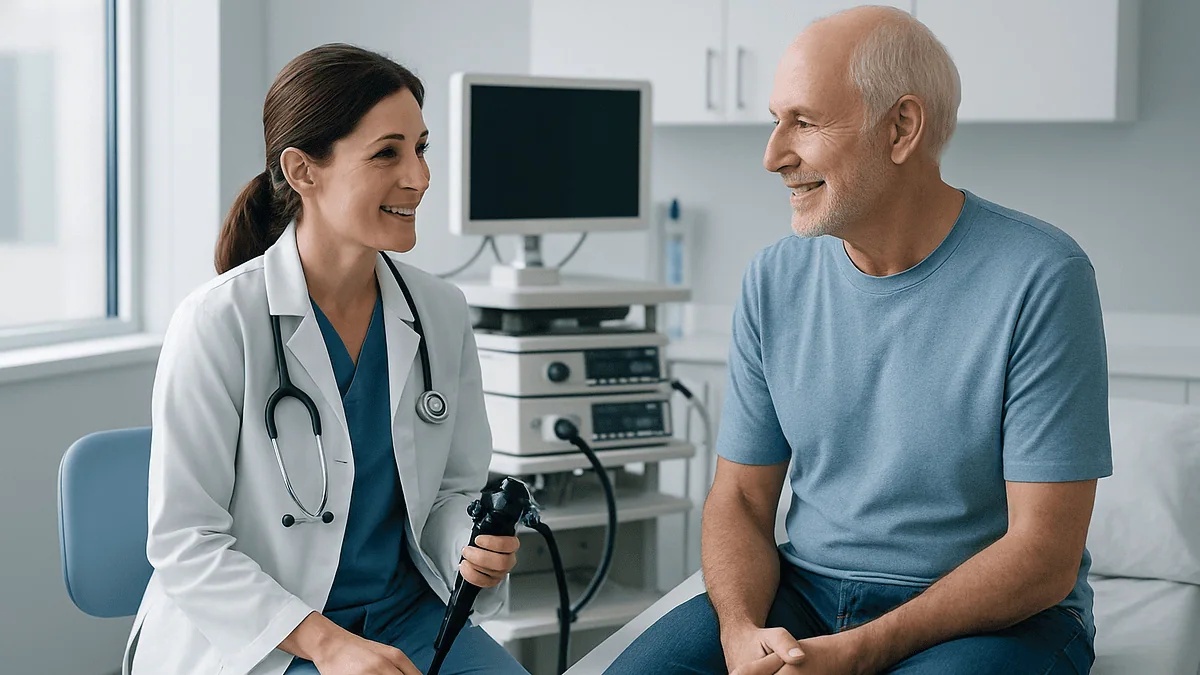
An endoscopy and colonoscopy on the same day means a gastroenterologist examines the upper digestive tract and the large bowel during one sedated session, usually the upper scope first. Doctors combine them when symptoms or findings point to both areas, so you prepare, fast, and recover once. Suitability depends on your health, medicines, and bowel preparation, which your care team assesses beforehand.
The letter arrives with two words underlined: upper and lower. Somewhere between reading the appointment time and reading the fasting instructions, a familiar question forms. Two scopes, one morning. Is that normal? Is it wise? And how does anyone plan the sequence of a camera that goes down the throat and a camera that goes up the other way?
It is more ordinary than it sounds. Gastroenterologists book an endoscopy and colonoscopy same day for many people whose symptoms could come from either end of the digestive tract, or from both. Unexplained anemia is the classic example. So is weight loss that nobody can account for, or a change in bowel habit alongside heartburn that will not settle.
What follows is the version of the planning conversation that rarely fits into a ten-minute clinic visit: what the two examinations look at, why the order matters less than most people fear, how the preparation is stitched together, and what the day after usually feels like.
Why doctors book an endoscopy and colonoscopy same day
The digestive tract is one continuous tube, roughly the length of a garden hose, and symptoms rarely announce which end they come from. Iron-deficiency anemia is a good illustration. Slow blood loss can come from a stomach ulcer, an inflamed esophagus, a bowel polyp, or a colon cancer. Looking at only one end answers half the question.
That is the first reason for combining. When the clinical picture leaves both the upper and lower tract on the list of possibilities, doing both examinations in one visit shortens the path to an answer. Mayo Clinic describes upper endoscopy as the standard way to investigate symptoms such as persistent heartburn, difficulty swallowing, and upper abdominal pain, while colonoscopy investigates rectal bleeding, chronic diarrhea, and changes in bowel habit, as well as screening for colon cancer.
The second reason is practical. Both procedures need fasting. Both are usually done with sedation, which means a day off work, someone to take you home, and a period of not driving. Doing them separately doubles all of that. Doing them together means one preparation, one intravenous line, one recovery.
The third reason is often unspoken: some conditions genuinely affect both regions. Celiac disease is diagnosed with biopsies from the small intestine reached by the upper scope, yet its symptoms overlap with irritable bowel and inflammatory bowel disease, which are assessed from below. Crohn’s disease can appear anywhere from mouth to anus. A combined session lets the same clinician see the whole picture at once, rather than piecing together two reports written weeks apart.
None of this makes a combined procedure automatic. It is a judgment about whether both regions need looking at, and whether you are well enough for a slightly longer session. That judgment sits with the team who reviewed your history.
Endoscopy vs colonoscopy: what each scope actually looks at
The word endoscopy simply means looking inside the body with a flexible tube that carries a camera and a light. When people say “an endoscopy” without qualifying it, they usually mean an upper endoscopy, also called a gastroscopy or EGD. EGD stands for esophagogastroduodenoscopy, which is a long way of listing the three places it visits: the esophagus (the food pipe), the stomach, and the duodenum (the first part of the small intestine).
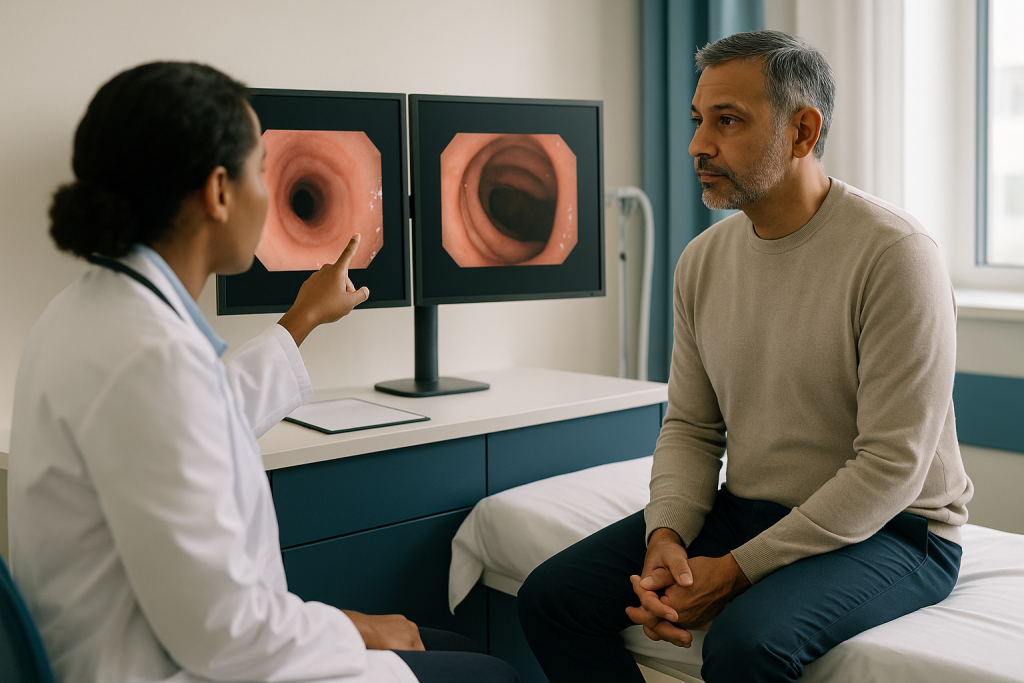
A colonoscopy uses a longer, slightly thicker flexible scope introduced through the anus to examine the rectum and the entire large bowel, or colon, up to the point where it joins the small intestine. MedlinePlus notes that the colon is around five feet long in an adult, which is why the examination takes longer than the upper one.
Both scopes do more than look. Each has a narrow channel through which the doctor can pass tiny instruments. That allows a biopsy, which is a pinch of tissue smaller than a grain of rice, taken for examination under a microscope. During colonoscopy, the same channel is used to remove polyps, the small growths on the bowel lining that can slowly turn into cancer over years if left in place.
The two examinations are distinct in one other way. The upper tract needs only to be empty of food, so fasting for several hours is enough. The colon has to be cleaned out with a laxative preparation, because stool hides the lining and any polyps on it. Cleveland Clinic is blunt about this: the quality of the bowel preparation is one of the biggest determinants of how much the doctor can see.
Understanding that distinction explains most of the planning decisions that follow.
What actually happens during an upper endoscopy and colonoscopy together
You arrive fasted, in loose clothes, with someone who has agreed to take you home. A nurse checks your identity, allergies, and medicines, places a small plastic cannula in a vein on the back of your hand, and attaches monitors for heart rate, blood pressure, and oxygen levels. A gastroenterologist or anesthesiologist explains the sedation and takes your consent, which is your chance to ask any question that has been nagging.
Sedation for combined procedures is most often intravenous. Depending on where you are treated and your own health, that may be conscious sedation, in which you are drowsy and relaxed but able to respond, or deeper sedation given by an anesthesia specialist, in which most people remember nothing. General anesthesia with a breathing tube is uncommon for routine cases, but your team will tell you what is planned for you.
Once you are comfortable, you lie on your left side. A soft mouth guard protects your teeth. The upper scope is passed over the tongue and down the esophagus; the doctor puffs a little air into the stomach to open its folds, inspects the lining, and takes any biopsies. Mayo Clinic gives a typical upper endoscopy time of 15 to 30 minutes.
Without moving you from the bed, the team then turns to the colonoscopy. The scope is advanced gently around the bends of the colon to the far end, and the careful inspection happens on the way back out. Polyps are removed as they are found. Mayo Clinic describes a colonoscopy as typically taking 30 to 60 minutes.
Then the scope comes out, the monitors stay on, and you are wheeled to recovery. For most people the whole clinical part of the visit is under an hour and a half, not counting check-in and waking up.
Which one comes first? What the evidence says about sequence
Most units do the upper endoscopy first, then the colonoscopy. The logic is practical rather than dramatic. The upper examination is shorter, so if a patient tolerates sedation poorly or an unexpected finding changes the plan, the team learns that early. The mouth guard and the equipment for the upper scope are already in place at the start. And starting from the top means the first thing you experience is the briefer, more predictable of the two.
Some clinicians prefer the reverse, and their reasoning is worth hearing too. Colonoscopy involves insufflating, or inflating, the bowel with gas so the lining can be seen. Doing it first, then the upper scope, means the stomach is examined after that gas has partly been released, and some doctors feel the upper views are marginally easier. Others argue that doing colonoscopy first and upper endoscopy second reduces the very small chance that reflux of stomach contents into the throat occurs during the longer lower procedure.
Small clinical studies have compared the two orders, looking at sedation needs, patient comfort, and how long the whole session takes. No major guideline body has concluded that one order is clearly superior for all patients. In practice, the choice reflects the unit’s routine, the individual doctor’s habit, and specific features of your case, such as whether a breathing tube is planned.
The honest summary is this: the sequence is a matter of workflow and clinician preference, backed by no strong evidence either way. You are entitled to ask which order is planned and why. You are unlikely to be given a reason that changes the outcome of your day.
How long does an endoscopy and colonoscopy take, and how long are you asleep?
Two clocks matter here, and patients often confuse them. One is the procedure time, when a scope is actually inside you. The other is the sedation time, from the first drowsiness to being alert enough to go home. The second is always longer.
For the procedure itself, add together the typical ranges quoted by Mayo Clinic: 15 to 30 minutes for the upper endoscopy and 30 to 60 minutes for the colonoscopy. A combined session therefore commonly occupies 45 to 90 minutes of scope time, with the transition between the two adding a few minutes. Biopsies and polyp removal push the total toward the upper end; a straightforward examination of a well-prepared colon sits toward the lower end.
How long you are “asleep” depends on the type of sedation. With conscious sedation, many people drift in and out and have patchy memories of the room. With deeper propofol-based sedation given by an anesthesia specialist, most people remember nothing from the first few seconds of the medicine to waking in recovery, then feel clearer within about half an hour. Your team will tell you which is planned; the decision belongs to them and depends on your medical history.
Recovery on the unit usually lasts around an hour, while nurses check your observations, offer a drink, and confirm you can walk steadily. Mayo Clinic advises that you should not drive, operate machinery, or make important decisions for the rest of the day after sedation, and many units frame this as a full 24 hours.
Plan for roughly half a day away from normal life, including check-in and waiting. Bring nothing that needs concentration afterward.
Who is usually offered a combined procedure, and who is asked to wait
Combined examinations are common for adults with iron-deficiency anemia of unknown cause, unexplained weight loss, a positive stool blood test alongside upper symptoms, or suspected conditions that can involve both ends of the tract, such as celiac disease with bowel symptoms or Crohn’s disease. People already due for colonoscopy screening who also have persistent reflux or swallowing symptoms may be offered both in one visit rather than two.
Screening itself does not require the upper scope. CDC recommends that adults at average risk begin regular colorectal cancer screening at age 45, and colonoscopy is one of several accepted options. Adding an upper endoscopy to a screening colonoscopy is only done when there is a separate indication for it; there is no evidence supporting routine upper endoscopy in people without upper symptoms.
Some people are asked to wait, or to have the two procedures on separate days. The reasons are about safety of a longer sedation rather than about the scopes themselves. Severe heart or lung disease, recent heart attack or stroke, poorly controlled diabetes, or sleep apnea that makes sedation riskier may all lead a team to shorten each session or bring in an anesthesia specialist. Pregnancy usually shifts non-urgent endoscopy until after delivery unless there is a pressing reason.
People on anticoagulant or antiplatelet medicines, which reduce the blood’s ability to clot, are not excluded, but the plan for those medicines has to be settled with the prescribing clinician in advance, because polyp removal and biopsies cause small amounts of bleeding. Never stop such a medicine on your own initiative.
Frailty and difficulty completing the bowel preparation are also reasons a team might stage the tests. The decision rests with them, using your whole history.
Is it safe to have an endoscopy and colonoscopy done at the same time?
Both procedures have long safety records, and combining them does not create a new category of risk. It stacks two well-understood sets of risks and adds a somewhat longer period of sedation. Whether that total is acceptable for you is exactly the assessment your team performs before booking.
Mayo Clinic lists the main colonoscopy risks as bleeding from a biopsy or polyp-removal site, a reaction to the sedative, and perforation, which is a tear in the bowel wall. For upper endoscopy, the same source lists bleeding, infection, perforation of the esophagus or stomach lining, and sedation reactions. All are described as uncommon; perforation in particular is rare. The risk of a bleeding complication rises when polyps are removed, which is why the medicine review before the procedure is so thorough.
Sedation is the variable that most changes with a combined session. A longer procedure means more medicine and more time with a slightly lower breathing drive, which is why oxygen levels are monitored continuously and supplementary oxygen is often given through a small nasal tube. People with sleep apnea, severe lung disease, or heart failure are those for whom this matters most, and an anesthesia specialist may be involved.
One question patients ask is whether gas from the colonoscopy or reflux from the stomach could cause trouble when both are done back to back. Teams manage this by suctioning the stomach during the upper scope, by sequencing the procedures, and by positioning you on your side throughout. Aspiration, in which stomach contents enter the airway, is a recognized but rare sedation complication, and fasting instructions exist precisely to minimize it.
Follow the fasting and medicine instructions exactly, and tell the team about anything that has changed since your last conversation.
Combined endoscopy and colonoscopy prep: fasting, laxatives and medicines
The preparation for a combined session is essentially the colonoscopy preparation, because it is the more demanding of the two and automatically satisfies the upper scope’s need for an empty stomach.
Most bowel preparations follow a similar shape. For a day or more beforehand you switch to a low-fiber diet, then to clear liquids only. In the hours before the appointment, or split between the evening before and the morning of, you drink a prescribed laxative solution that empties the colon. NHS guidance describes the resulting diarrhea as expected and stresses staying close to a toilet and drinking clear fluids to avoid dehydration. The exact schedule and product come from your unit, not from this article.
Fasting for the upper scope adds one important detail: your unit will tell you when the last clear liquids are allowed, typically a couple of hours before sedation, and after that nothing by mouth. Because laxative solutions are drunk during the clear-fluid window, the two sets of instructions interlock; the written sheet you receive will already have reconciled them.
Medicines are where the most questions arise. Blood thinners, antiplatelet drugs, insulin and other diabetes medicines, iron tablets, and certain weight-loss injections that slow stomach emptying all need a specific plan. Iron, for example, darkens the stool and coats the bowel wall, so it is usually paused for several days beforehand. Diabetes medicines need adjustment because you will be fasting. None of these decisions should be made by you alone; the prescribing clinician sets them, and the endoscopy unit will ask whether that conversation has happened.
Tell the team about supplements too, including herbal products, some of which affect clotting.
Which is more uncomfortable, an endoscopy or a colonoscopy?
With sedation, most people remember little of either, which makes the honest answer “neither, in the way you are imagining.” Without sedation, the two feel different and people rank them differently.
Upper endoscopy’s discomfort is mainly gagging as the scope passes the back of the throat, plus a sensation of fullness when air is introduced into the stomach. It is brief, usually over in under a quarter of an hour according to NHS estimates, and a numbing spray to the throat is often used. Some people who have had it unsedated describe it as unpleasant but tolerable; others find the gag reflex overwhelming and choose sedation next time.
Colonoscopy’s discomfort is cramping and bloating as the bowel is inflated and the scope negotiates bends, particularly at the two corners near the spleen and liver. It lasts longer. People with a long or looping colon, previous pelvic surgery, or inflammatory bowel disease tend to report more cramping. Many units now use carbon dioxide instead of room air for insufflation because it is absorbed faster, which reduces bloating afterward.
Individual variation is large. Anxiety amplifies both experiences, and a calm room with a nurse talking you through the steps genuinely changes how a procedure is remembered. That is one argument for combining: you face one episode of anticipatory anxiety, not two.
Afterward, the upper scope typically leaves a sore throat for a day or so. The colonoscopy leaves gas and mild cramps that ease as you pass wind, which the recovery nurses will positively encourage. Neither should leave you with severe or worsening pain; that is a signal to call, described later in this article.
Same-day combined session versus two separate appointments
Choosing between one combined visit and two separate ones is rarely the patient’s decision alone, but understanding the trade-offs makes the conversation with your team more useful. The table below sets them side by side, using typical ranges rather than promises.
| Factor | Combined same-day session | Two separate appointments |
|---|---|---|
| Bowel preparation | Once | Once for colonoscopy; fasting only for upper scope |
| Sedation episodes | One, somewhat longer | Two, each shorter |
| Scope time (Mayo Clinic typical ranges) | About 45–90 minutes total | 15–30 minutes, then 30–60 minutes on another day |
| Days off work / driving restriction | One | Two |
| Escort needed | One occasion | Two occasions |
| Suitability | Most adults without severe heart or lung disease | Often preferred for frail patients or complex sedation needs |
| Results and follow-up | Single report and one biopsy timeline | Two reports, possibly weeks apart |
The combined option wins on convenience and on getting a unified picture quickly. Separate appointments win when a shorter sedation is safer, when a colonoscopy needs to be rescheduled for poor preparation, or when the upper scope is urgent and cannot wait for the bowel preparation to be organized.
Neither approach is medically “better” in the abstract. The right choice is the one that fits your health and the question your doctors are trying to answer.
Do you get colonoscopy and endoscopy results immediately?
Partly. The gastroenterologist sees the lining of your digestive tract in real time, so the visual findings are known before you wake up. Whether you hear them immediately depends on the unit’s practice and on your sedation.
Many doctors come to the recovery area to give a brief summary: whether the examination was complete, whether anything was found, whether polyps were removed, and whether biopsies were taken. Because sedation blunts memory, MedlinePlus and Mayo Clinic both advise having your escort present for this conversation or asking for the summary in writing. It is common to be handed a printed report with photographs before you leave.
What you will not have immediately is the pathology. Any biopsy or removed polyp goes to a laboratory, where it is processed, sliced, stained, and examined by a pathologist. Mayo Clinic notes that biopsy results typically take a few days; NHS guidance describes waiting a few weeks for some results, reflecting different laboratory pathways. Your unit will tell you its usual turnaround and how you will be contacted.
The pathology report is what determines the next step. For polyps, it establishes the type and whether any showed early cancerous change, which in turn sets the interval before your next colonoscopy. For upper biopsies, it may confirm or exclude conditions such as celiac disease, a stomach infection with the bacterium Helicobacter pylori, or Barrett’s esophagus, a change in the lining of the food pipe linked to long-standing reflux.
If you have heard nothing by the time you were told to expect results, phone the unit. Reports do occasionally sit unread, and chasing is reasonable.
What the following days usually look like
The first afternoon is mostly about sedation wearing off. Expect to feel drowsy, slightly unsteady, and forgetful for several hours. Mayo Clinic’s instruction not to drive, return to work, or sign important documents for the rest of the day is not caution for its own sake; judgment and reaction time are measurably impaired even when you feel fine. Eat lightly once you are hungry. Most people can return to a normal diet the same evening unless told otherwise, for example after removal of a large polyp.
Bloating and passing wind are the dominant sensations from the colonoscopy, and they ease over hours. Walking around the house helps more than lying still. A mildly sore throat from the upper scope is common and settles within a day or two; cool drinks and soft foods help.
Spotting a small amount of blood in the first stool after polyp removal or biopsy is normal. What is not normal is passing clots, large volumes of blood, or bleeding that continues into the following day, all of which need a call. A little tenderness around the abdomen is expected; severe or steadily worsening pain is not.
By the second day most people feel entirely themselves and are back at work. Fatigue occasionally lingers a little longer, partly because the bowel preparation disrupts sleep and hydration the night before. Drinking well helps.
Over the following one to three weeks the pathology arrives, and any follow-up conversation happens. If medicines such as blood thinners or iron were paused, restart them only on the schedule your prescribing clinician gave you, not on a guess. If you were not given a restart plan, ask before you leave the unit.
What people often get wrong about combined procedures
“Doing both means my doctor thinks it is cancer.” It means two regions need examining. Iron deficiency, celiac disease, reflux, inflammatory bowel disease, and benign polyps are all common reasons. Cancer is on the list because excluding it matters, not because it is the expectation.
“The same scope is used for both ends.” It is not. The upper and lower scopes are separate instruments, different in length and diameter, and each is cleaned and disinfected through a validated reprocessing cycle between patients. The order of the procedures has nothing to do with contamination.
“I will be under general anesthesia for hours.” Most combined sessions use intravenous sedation, not general anesthesia, and typical scope time is 45 to 90 minutes based on the Mayo Clinic ranges for each procedure. Waking is usually quick.
“If they find a polyp they will book another appointment to remove it.” Almost all polyps are removed during the colonoscopy itself, which is one of the main reasons colonoscopy is valued as a screening test. Only very large or awkwardly placed growths are sometimes referred for a separate session.
“I can drive myself home if I feel fine.” You cannot. Every mainstream source, including Mayo Clinic and MedlinePlus, requires an escort after sedation. Units will not discharge you to drive.
“I can skip the bowel preparation because the upper scope is the important one.” An inadequately prepared colon cannot be examined properly, and the colonoscopy may have to be repeated. The preparation is the part of the day you control, and it is the part that most affects the quality of the answer.
“Results will be ready when I wake up.” Visual findings, yes. Pathology, no; that takes days to weeks.
Questions to ask your care team before a combined session
A good pre-procedure conversation is a two-way exchange, and the team will expect questions. These are the ones that most often change what a patient does or how they feel about the day.
- Why do I need both examinations, and what are you hoping each one will show or rule out?
- Which order will you do them in, and does that matter in my case?
- What kind of sedation is planned, who will give it, and how long should I expect to be drowsy afterward?
- Given my heart, lung, or sleep apnea history, is a combined session appropriate for me, or would you rather split them?
- Exactly which of my medicines should I pause, when, and when do I restart them? Has this been agreed with the doctor who prescribes them?
- What should I do about my diabetes medicines while I am fasting?
- When are my last solid food and last clear liquids, and how does that fit with the laxative timing?
- If polyps are found, will you remove them today, and what does that mean for bleeding risk?
- How and when will I get the visual findings, and how and when will I get biopsy results?
- Who do I call if I have pain, bleeding, or fever in the days afterward, including out of hours?
- Do I need someone with me for the whole recovery period, or only for the journey home?
Write the answers down or ask for them in writing. Sedation can erase the memory of a conversation that felt perfectly clear at the time, which is one more reason your escort should be in the room when the doctor gives the summary.
When to call your doctor after an endoscopy and colonoscopy
Most people leave the unit with mild bloating, a scratchy throat, and a strong desire for lunch. A small minority develop a complication, and the pattern of symptoms that matters is the same whether one or two procedures were done. Serious problems are rare, but they are time-sensitive.
Seek urgent medical attention, calling emergency services if the symptoms are severe, for any of the following:
- Severe, persistent, or steadily worsening abdominal pain, especially if your abdomen feels hard or bloated and tender to touch
- Passing large amounts of blood or clots from the rectum, or bleeding that continues rather than settling after the first stool
- Vomiting blood or material that looks like coffee grounds
- Black, tarry stools in the days after the procedure
- Fever, shaking chills, or a racing heart
- Chest pain, pain on swallowing that worsens, or difficulty breathing, which can signal a problem in the esophagus after an upper scope
- Fainting, severe dizziness, or confusion after the sedation should have worn off
These signs can indicate perforation, significant bleeding, infection, or a sedation-related problem. Cleveland Clinic and Mayo Clinic both list them as reasons to contact the endoscopy unit or emergency care without waiting to see whether things improve.
For less dramatic concerns, such as a sore throat lasting beyond a couple of days, mild persistent cramping, or uncertainty about when to restart a paused medicine, phone the unit or your prescribing clinician during working hours. Keep the discharge sheet with the contact numbers somewhere visible, and make sure your escort knows where it is.
You know your own body. If something feels wrong and is not on this list, that is still a reason to call.
Frequently asked questions
How long are you asleep for a colonoscopy and endoscopy done together?
Usually about an hour to an hour and a half of sedation, covering roughly 45 to 90 minutes of combined scope time based on Mayo Clinic’s typical ranges of 15 to 30 minutes for upper endoscopy and 30 to 60 minutes for colonoscopy. Whether you are fully unconscious or drowsy depends on the sedation type your team chooses. Expect to feel groggy for the rest of the day.
Is it safe to have an endoscopy and colonoscopy done at the same time?
For most adults, yes. Combining them adds no new type of risk; it stacks the small, well-documented risks of each procedure, such as bleeding, perforation, and sedation reactions, within one slightly longer sedation. People with severe heart or lung disease or significant sleep apnea are assessed more carefully and may be advised to split the tests. Your team makes that judgment.
Which is more uncomfortable, an endoscopy or a colonoscopy?
With sedation, most people remember little of either. Unsedated, the upper endoscopy causes brief gagging and fullness, while colonoscopy causes longer-lasting cramping and bloating from air in the bowel. People rank them differently depending on their gag reflex, anxiety, and bowel anatomy. Afterward, the upper scope leaves a mild sore throat and the colonoscopy leaves gas that passes within hours.
Do you get colonoscopy and endoscopy results immediately?
Visual findings, usually yes: the doctor typically gives a brief summary in recovery and often a printed report with images. Biopsy and polyp results come later, because the tissue is examined by a pathologist. Mayo Clinic describes a few days for biopsy results, while NHS guidance mentions up to a few weeks. Ask your unit how and when you will be contacted.
Can an upper endoscopy and colonoscopy be done together for screening?
Colonoscopy alone is the screening test; CDC recommends average-risk adults begin colorectal screening at 45. An upper endoscopy is added only when there is a separate reason, such as persistent reflux, swallowing difficulty, or unexplained anemia. There is no evidence supporting routine upper endoscopy in people without upper digestive symptoms, so it is not part of standard screening.
How long does an endoscopy and colonoscopy take from arrival to leaving?
Plan for around half a day. Check-in, consent, and cannula placement take a while; scope time is typically 45 to 90 minutes combined using Mayo Clinic’s ranges; recovery on the unit adds about an hour while sedation wears off and nurses confirm you are steady. You then need an escort home and should not drive for the rest of the day.
What is the combined endoscopy and colonoscopy prep like?
It is essentially the colonoscopy preparation, which also empties the stomach for the upper scope. That means a low-fiber diet, then clear fluids only, then a prescribed laxative solution that causes diarrhea in the hours before the appointment. Your unit tells you exactly when to stop all liquids. Medicine adjustments, especially blood thinners and diabetes drugs, must be agreed with your prescribing clinician in advance.
Which is done first, the endoscopy or the colonoscopy?
Most units do the upper endoscopy first because it is shorter and the equipment is already positioned, then proceed to colonoscopy without moving you. Some clinicians prefer the reverse order. Small studies comparing sequences have not shown a clear clinical advantage either way, and no major guideline mandates an order. Ask your team which they plan and why.
Endoscopy vs colonoscopy: what is the actual difference?
An upper endoscopy examines the esophagus, stomach, and duodenum through a scope passed via the mouth and needs only fasting. A colonoscopy examines the rectum and the whole large bowel through a longer scope passed via the anus and requires a laxative preparation to clear stool. Both can take biopsies; colonoscopy also removes polyps, which is why it doubles as a cancer-prevention test.
Can I go back to work the day after a combined endoscopy and colonoscopy?
Most people can. Sedation effects should have cleared by the next morning, and residual symptoms are usually limited to mild bloating or a scratchy throat. Mayo Clinic advises no driving or important decisions on the day itself. If a large polyp was removed or you were given specific diet or activity restrictions, follow those instead and ask the unit if anything is unclear.
References
- MedlinePlus – EGD (esophagogastroduodenoscopy)
- MedlinePlus – Colonoscopy
- Cleveland Clinic – Colonoscopy
- CDC – Screening for Colorectal Cancer
This article is for general information only and is not a substitute for professional medical advice. Please consult a qualified doctor about your individual situation.

More from the Blog
Cirrhosis Complications: Swelling, Confusion or Bleeding and Why They Need Urgent Care
Swelling of the abdomen or legs, new confusion or drowsiness, and any bleeding or black stools are the main cirrhosis complications warning signs. Each…

The Bristol Stool Chart: What Your Stool Type Says About Your Gut
The Bristol stool chart sorts stool into seven types by shape and firmness. Types 1 and 2 (hard lumps or lumpy sausages) usually signal…

Do All Hepatitis B Patients Need Antiviral Medicine? How Specialists Decide
Not everyone with hepatitis B needs antiviral medicine. Most adults who catch it acutely clear the virus on their own, and many people with…
Will Diverticulitis Come Back? What Follow-Up Care Does to Lower the Odds of Another Attack
Diverticulitis can return, but most people who recover from a first uncomplicated attack never have another. Consumer health summaries put the chance of a…

Living With Autoimmune Hepatitis: Alcohol, Vaccines, Work and Long-Term Liver Check-Ups
Most people living with autoimmune hepatitis lead full lives on long-term immune-suppressing medicine, with regular blood tests to confirm the liver stays quiet. Alcohol…

Fever, Pain or Yellow Skin After Gallbladder Surgery: Signs Your Team Wants to Hear About
A low temperature in the first day or two after gallbladder surgery is common and usually settles. A fever of 101°F (38.3°C) or higher,…