

Epididymitis vs Testicular Torsion: How Urologists Separate the Two and Why Speed Matters

Key Takeaways
- Testicular torsion cuts off blood flow within minutes, and references cited here report salvage rates near 90 to 100 percent when relieved within about six hours, falling to roughly 50 percent at 12 hours and about 10 percent by 24 hours, measured from the onset of pain, not arrival at hospital.
- Epididymitis builds over one to several days and typically comes with urinary burning, discharge or fever, whereas torsion strikes suddenly and often brings nausea or vomiting with no urinary symptoms.
- Loss of the cremasteric reflex and a high-riding, horizontally lying testicle point toward torsion, while relief of pain on lifting the scrotum is no longer considered a reliable sign of epididymitis.
- Doppler ultrasound shows reduced or absent blood flow in torsion and normal or increased flow in epididymitis, but partial or intermittent torsion can produce a falsely reassuring scan, so a convincing history still matters.
- Pain from epididymitis usually eases within about three days of appropriate antibiotics, yet swelling and tenderness can persist for weeks, and failure to improve by day three is a reason for reassessment.
- Surgeons fix both testicles during torsion surgery because the bell-clapper anatomy that allows twisting is frequently present on both sides.
Epididymitis is inflammation of the coiled tube behind the testicle, usually from infection, and tends to build over hours to days. Testicular torsion is a twisted spermatic cord that cuts off blood flow, typically striking suddenly with severe pain and nausea. Because a twisted testicle can be lost within hours, sudden severe testicular pain is treated as torsion until an examination and Doppler ultrasound show otherwise.
A fifteen-year-old wakes at two in the morning, curled around a pain he cannot describe to his father without embarrassment. Down the same hospital corridor, a man in his thirties has spent four days telling himself the ache on one side would settle, and now he cannot sit comfortably in the waiting room chair. Both have a swollen, tender scrotum. One of them has perhaps a few hours before something irreversible happens. The other has time.
That is the whole tension in the question of epididymitis vs testicular torsion. The two conditions can look alike to a worried person in a bathroom mirror, yet they behave nothing alike inside the body, and the clinician’s job is to sort them fast enough to protect the one who cannot wait.
This explainer walks through how that sorting happens, what the ultrasound can and cannot settle, why the clock is so unforgiving in torsion, and what the days after each diagnosis usually feel like.
Epididymitis vs testicular torsion: the one question that decides the night
Every emergency clinician who sees a tender scrotum starts from the same assumption: this could be torsion. Not because torsion is the most common explanation, but because it is the one that punishes delay. Epididymitis, the far more frequent diagnosis in adults, is uncomfortable and needs treatment, yet it rarely takes anything away from a person who is seen a day late. Torsion can take the testicle itself.
The two conditions share a neighborhood. The epididymis is the tightly coiled tube that sits along the back of each testicle and stores sperm as they mature. The spermatic cord is the bundle of blood vessels, nerves and the sperm-carrying duct that suspends the testicle in the scrotum. Inflammation in the first structure is epididymitis. A twist in the second is torsion. Because they sit within a centimeter or two of each other, both produce pain and swelling on one side, and both can make the skin look red and feel warm.
What separates them is mechanism, and mechanism shapes the story a patient tells. Infection or irritation of the epididymis is a slow-burning process; the tube swells over hours and days as immune cells arrive. A twist of the cord is mechanical and abrupt; blood flow drops the moment the vessels kink, and pain follows within minutes.
So the first act of separating epididymitis from testicular torsion is not a scan. It is a question: when did this start, and how quickly did it get bad? The answer does not close the case, but it sets the tempo for everything that follows, and the Mayo Clinic and other mainstream sources describe exactly this triage logic, with sudden severe pain treated as an emergency until proven otherwise.
What actually happens when a testicle twists
Picture a pendulum hanging from a cord. Normally the testicle is anchored to the inside of the scrotum by tissue attachments that keep it from spinning. In some people, the covering membrane wraps too high around the cord, leaving the testicle free to rotate like a bell clapper inside a bell. Urology texts call this the bell-clapper deformity, and StatPearls, hosted by the NIH, describes it as the anatomical variant that makes torsion possible.

When the testicle rotates, the spermatic cord twists on itself. Veins, which have thin walls and low pressure, close first. Blood continues to enter through the tougher artery but cannot leave, so the testicle swells and becomes congested. As the twist tightens, arterial inflow stops too. Tissue that is starved of oxygen begins to die. The testicle’s germ cells, which produce sperm, are especially sensitive to this loss of blood supply, which is why fertility as well as the organ itself is at stake.
The pain is severe because the testicle is densely supplied with nerves that also carry signals to the abdomen. Many people with torsion feel sick to their stomach or vomit, and some feel the pain mainly in the lower belly or groin rather than the scrotum. MedlinePlus notes that torsion can occur during sleep, after physical activity, after minor trauma, or with no trigger at all.
Torsion can also be partial or intermittent. A testicle may twist, cause a wave of pain, then untwist on its own, leaving a person with a history of brief episodes that resolved. Urologists take those stories seriously, because a testicle that has twisted once is prone to twisting again, and the next episode may not release.
What actually happens in epididymitis
Epididymitis is an inflammatory process rather than a mechanical one. Something irritates the epididymis, the body sends immune cells, and the tube swells, thickens and becomes exquisitely tender to touch. In younger, sexually active adults the trigger is most often a sexually transmitted bacterium; the CDC treatment guidelines identify chlamydia and gonorrhea as the leading causes in people aged roughly 14 to 35. In older adults, and in anyone with a urinary tract abnormality or recent catheter, bacteria that normally live in the gut can travel up the urinary tract and into the epididymis. When the inflammation spreads to the testicle itself, the diagnosis becomes epididymo-orchitis.
Not every case is infectious. Reflux of urine into the sperm duct during heavy lifting or straining can inflame the tube without bacteria. Some medicines used for heart rhythm disorders are recognized causes of non-infectious epididymitis, and the Mayo Clinic lists viral infections such as mumps as another route, particularly when the testicle is involved.
The pace is the tell. Swelling builds over one to several days. Pain often starts as a dull heaviness and grows steadily rather than arriving all at once. People frequently notice burning when urinating, a need to go more often, or a discharge from the penis, because the urinary and reproductive tracts share plumbing and the same infection often affects both. A low fever is common.
Blood flow, crucially, is preserved and often increased. Inflamed tissue draws more blood, not less, and that difference is exactly what a Doppler ultrasound is designed to detect. The epididymis itself may feel like a firm, hot ridge along the back of the testicle, distinct from the testicle proper, at least early on before swelling blurs the boundaries.
Who is most likely to have which, and who is usually asked to wait
Age reshapes the odds. The Mayo Clinic reports that testicular torsion affects about 1 in 4,000 males younger than 25, with the peak between ages 12 and 18, when the testicles grow rapidly and any laxity in their anchoring becomes consequential. A second, smaller cluster occurs in newborns, where the twist can happen before or shortly after birth. Torsion in adults over 30 is uncommon but not impossible, so age alone never excludes it.
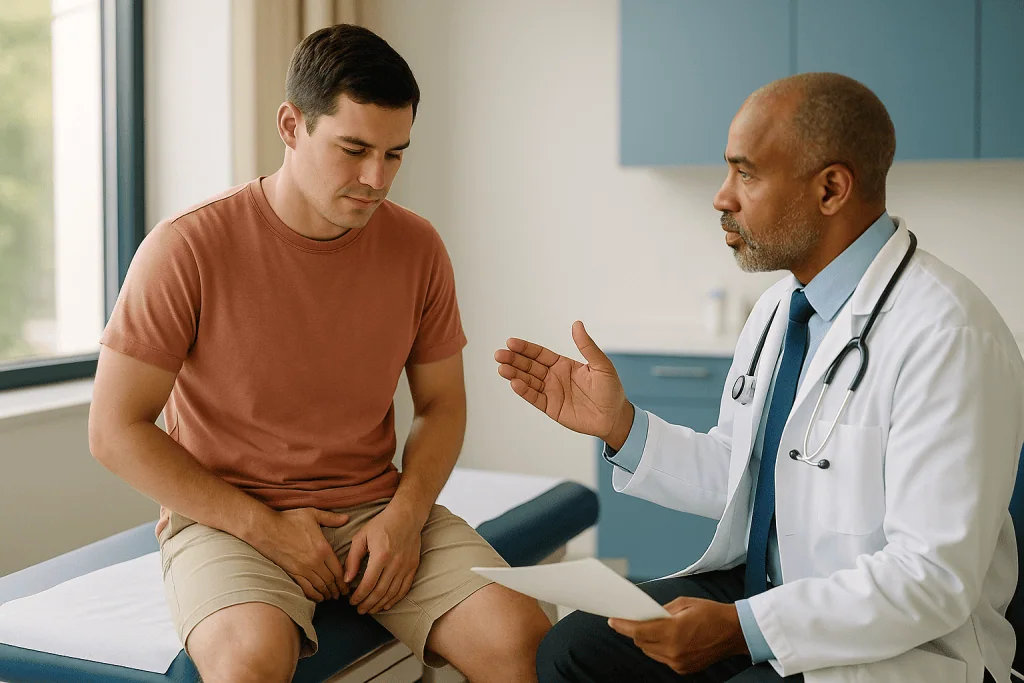
Epididymitis runs the other way. It is the most common cause of scrotal pain in adult men and rises in frequency with sexual activity in young adulthood and again with urinary tract conditions in later life. In boys before puberty, a third diagnosis enters the picture: torsion of a small appendage attached to the testicle or epididymis. This is painful but does not threaten the testicle, and it is often managed with rest and pain control once torsion of the cord itself has been excluded.
Who is asked to wait? In practice, almost nobody with acute scrotal pain is told to go home and observe. Emergency departments prioritize suspected torsion above nearly every other non-life-threatening complaint because the treatment window is measured in hours. A person whose pain has built gradually over several days, who has urinary symptoms, and whose ultrasound shows brisk blood flow to the testicle is the one who can be treated for epididymitis and followed up in clinic.
The decision about who goes to the operating room and who goes home with a prescription belongs to the treating team, and it is made on the combination of story, examination and imaging rather than on any single factor. What a patient can do is arrive early and describe the timeline honestly, including any brief prior episodes.
How urologists separate epididymitis from testicular torsion at the bedside
Before any machine is switched on, the examination begins with a conversation. Sudden onset, pain that reached maximum intensity within an hour, nausea or vomiting, and an absence of urinary symptoms all push the clinician toward torsion. Gradual onset over days, burning on urination, discharge, fever, and a recent new sexual partner or recent urinary procedure push toward epididymitis. Neither story is decisive on its own.
The physical examination adds several clues. In torsion the affected testicle often sits higher than its partner and may lie horizontally instead of vertically, because the twisted cord has shortened and rotated it. The whole testicle is tender and hard. In epididymitis the tenderness is often localized at first to the back of the testicle where the epididymis lies, and the testicle itself may hang normally.
One reflex carries particular weight. Stroking the inner thigh normally makes the testicle on that side rise briefly, a response called the cremasteric reflex. StatPearls describes the loss of this reflex as one of the more reliable examination findings in torsion, because the twisted cord disrupts the muscle that produces it. The reflex is usually preserved in epididymitis. It is not infallible; it can be absent in some healthy people and occasionally present in torsion, which is why it is one input rather than a verdict.
An older sign, relief of pain when the scrotum is lifted, was once taught as a marker of epididymitis. Current sources, including StatPearls, treat it as unreliable, and most urologists no longer rely on it. Some centers use structured scoring tools that combine swelling, hardness, nausea, position and the cremasteric reflex to estimate torsion risk and decide whether a patient should go straight to surgery without waiting for imaging.
Epididymitis vs testicular torsion at a glance
Tables flatten nuance, and real patients rarely fit every row. Still, laying the two conditions side by side shows why clinicians weigh the timeline so heavily and why the ultrasound is decisive when the story is mixed.
| Feature | Testicular torsion | Epididymitis |
|---|---|---|
| Underlying problem | Spermatic cord twists, cutting blood supply | Inflammation of the epididymis, usually infectious |
| Typical onset | Sudden, often within minutes; may wake a person from sleep | Gradual, over one to several days |
| Peak age group | 12 to 18, also newborns (Mayo Clinic) | Sexually active adults 14 to 35; older adults with urinary conditions (CDC) |
| Nausea or vomiting | Common | Uncommon |
| Urinary burning or discharge | Usually absent | Common |
| Fever | Uncommon early | Common, often low grade |
| Testicle position | Often high-riding, may lie horizontally | Usually normal position |
| Cremasteric reflex | Often absent | Usually present |
| Doppler ultrasound blood flow | Reduced or absent | Normal or increased |
| Urgency | Surgical emergency, hours matter | Prompt treatment, not usually surgical |
| Usual treatment | Surgical untwisting and fixation of both testicles | Antibiotics when infectious, rest, support, pain control |
Two cautions. First, a person with epididymitis whose swelling has become severe can develop a hard, uniformly tender testicle that mimics torsion, and a person with an early or partial torsion can have surprisingly mild findings. Second, the two are not mutually exclusive in every case; a swollen, inflamed testicle may occasionally twist, which is discussed later in this article. The table is a map of tendencies, and the treating team reads the territory.
Testicular torsion ultrasound: what Doppler can and cannot rule out
Doppler ultrasound is the imaging test of choice because it does two things at once. Standard grayscale ultrasound shows the size, texture and position of the testicle and epididymis. The Doppler function measures movement of blood within the vessels and paints it in color on the screen, so the radiologist can see whether the testicle is receiving flow and compare it directly with the other side.
In classic torsion, the color disappears. The testicle shows little or no arterial signal, the cord may appear as a twisted knot above it, and the tissue may look swollen and heterogeneous if it has been without blood for some time. In epididymitis, the picture is the opposite: the epididymis is enlarged and lights up with increased flow, and the testicle itself shows normal or heightened signal.
The limitations matter as much as the strengths. Blood flow in the testicles of young children is low even in health, and a small testicle with sparse vessels can be hard to interpret. Partial or intermittent torsion may leave enough flow to produce a falsely reassuring image, and a testicle that untwisted shortly before the scan can show increased flow as blood rushes back, mimicking inflammation. StatPearls notes that ultrasound is highly sensitive but not perfect, and that a normal Doppler does not override a convincing clinical picture.
This is why urologists sometimes take a patient to the operating room without imaging when the story and examination are strongly suggestive and the scan would cost precious time. The exploration itself is the definitive test; if the testicle is not twisted, the surgeon can still inspect it, confirm the alternative diagnosis, and fix the testicle in place if the anatomy looks prone to twisting. A scan that reassures is valuable. A scan that delays is not.
Testicular torsion time limit: why the first six hours matter
The phrase people search for is testicular torsion time limit, and the honest answer is that there is no single cliff edge, only a steep slope. Tissue deprived of oxygen does not die all at once; it dies progressively, and the chance of saving the testicle falls with each hour the cord stays twisted.
The figures quoted in urology references are consistent. Cleveland Clinic and StatPearls describe testicular salvage rates in the range of 90 to 100 percent when the twist is relieved within about six hours of the onset of pain, falling to roughly 50 percent by around 12 hours, and to about 10 percent or less once 24 hours have passed. These are population averages drawn from surgical series, not predictions for any individual. Degree of twist matters too: a cord rotated a full turn or more strangles the vessels faster than a partial rotation, which is one reason some people retain viable tissue beyond the typical windows and others lose it sooner.
That six-hour figure is measured from when the pain began, not from when the person reached hospital. A teenager who wakes at two in the morning, waits until his parents rise, eats breakfast, and is driven in at eight has already spent the entire favorable window. This is the single most important practical point in the whole comparison of epididymitis and testicular torsion, and it is why clinicians tolerate a high rate of negative explorations rather than risk missing a real twist.
Is it ever too late to seek care? No. Even beyond 24 hours, surgery is usually still performed, because a dead testicle left in place can become infected or provoke an immune reaction, and because the surgeon will fix the other testicle to protect it. The outcome for the affected side may be poor, but the decision to be seen is never wrong.
What happens in torsion surgery
The operation is called scrotal exploration, and it is usually done under general anesthesia so the patient is fully asleep. The surgeon makes a small incision in the scrotum, brings the testicle into view, and untwists the cord. What happens next depends on how the tissue looks once blood begins to return. The surgeon watches for several minutes, sometimes wrapping the testicle in warm saline-soaked gauze, to see whether the dusky purple color pinks up.
If it does, the testicle is considered viable and is stitched to the inside of the scrotal wall in a procedure called orchiopexy, so it cannot rotate again. If the tissue remains black and does not recover, the surgeon removes it, a procedure called orchiectomy. MedlinePlus explains that the decision is made in the operating room based on the appearance of the tissue, and the patient and family are told what was found afterward.
In almost every case, the surgeon also fixes the unaffected testicle. The bell-clapper anatomy that allowed one side to twist is frequently present on both sides, and securing the healthy testicle removes the risk of a second emergency later. This is done through the same incision or a small second one.
Before surgery, some clinicians attempt manual detorsion, rotating the testicle outward with the hands in the way one would open a book, because most twists occur inward. When it works, pain eases within seconds, but it is a temporary measure to buy time, not a substitute for the operation, since the anatomy that permitted the twist is unchanged and the cord may not be fully untwisted.
Risks are those of any scrotal surgery: bleeding, infection of the wound, a collection of blood in the scrotum, and loss of the testicle if it was already beyond recovery. The alternative to surgery in confirmed torsion is losing the testicle, which is why the treating team rarely presents it as a choice.
How epididymitis is treated, and what antibiotics actually do
Once torsion has been excluded, treatment of epididymitis turns on its likely cause. When a sexually transmitted infection is probable, the CDC guidelines recommend antibiotics chosen to cover both chlamydia and gonorrhea, since the two often travel together and a urine test may take days to return. When gut bacteria are more likely, because of age, recent instrumentation of the urinary tract or insertive anal intercourse, a different class of antibiotic that concentrates well in urinary tissue is typically used. The prescribing clinician selects the agent, duration and any adjustments; this article describes mechanism, not regimens.
Antibiotics work by killing or halting the growth of the bacteria driving the inflammation. They do not instantly deflate a swollen epididymis. The immune response that caused the swelling winds down over days once the bacterial stimulus is removed, which is why pain usually eases before size returns to normal. The CDC advises that a person whose symptoms have not begun to improve within about three days of starting treatment should be reassessed, because the diagnosis may be wrong, the organism may be resistant, or an abscess may have formed.
Supportive measures carry real weight. Bed rest for the first day or two, elevating the scrotum on a rolled towel while lying down, wearing supportive underwear, and applying cold packs wrapped in cloth all reduce the pull on an inflamed structure and ease discomfort. Over-the-counter anti-inflammatory pain relievers are commonly suggested by clinicians when there is no reason to avoid them; the choice belongs to the person prescribing or advising.
Sexual partners need attention when an STI is the suspected cause. The CDC recommends that recent partners be evaluated and treated, and that sexual contact be avoided until both the patient and partners have completed treatment and are symptom-free, to prevent reinfection. Non-infectious epididymitis is managed with the supportive measures alone, and any medicine suspected of causing it is reviewed by the prescribing team.
How long does epididymitis last, and what recovery looks like after torsion
People treated for epididymitis often feel the pain shift within the first two or three days of antibiotics, as the CDC and Mayo Clinic describe. Swelling is slower. The epididymis may stay enlarged and firm for several weeks, and the Mayo Clinic notes that tenderness can linger for weeks or, in some people, a few months after the infection itself has cleared. Fever should settle within days; if it climbs again, or the scrotum becomes more swollen rather than less, that is a reason to return promptly.
A small proportion of people develop chronic epididymitis, defined as pain lasting longer than roughly six weeks. The cause is often unclear and may involve nerve sensitization rather than persistent infection. It is managed with anti-inflammatory approaches, physical therapy of the pelvic floor in some cases, and nerve-targeted treatments chosen by a urologist; repeat antibiotics without evidence of infection are generally not helpful.
After torsion surgery, recovery follows a different arc. Most people go home the same day or the next morning. Scrotal bruising and swelling peak over the first few days, and supportive underwear and cold packs are the mainstay. The Cleveland Clinic advises avoiding strenuous activity and sexual activity for a period the surgeon specifies, typically a few weeks, while the internal stitches hold the testicle in place and the wound heals. Pain is usually manageable with medicines the surgical team advises.
If the testicle was removed, a follow-up conversation usually covers three things: the remaining testicle almost always produces enough testosterone and sperm for normal function, a silicone prosthesis can be placed later for appearance if the person wishes, and the fixed remaining testicle is protected from future twisting. If the testicle was saved, urologists sometimes arrange a follow-up ultrasound over the following months, because a testicle that was deprived of blood for hours can shrink even when it initially appeared to recover.
Can epididymitis cause torsion? Untangling the overlap
The two diagnoses are usually treated as alternatives, but the question of whether one can cause the other is fair, and the honest answer is: rarely, and not in the way most people imagine.
Epididymitis does not weaken the cord or loosen the testicle’s anchoring. The bell-clapper anatomy that permits torsion is present from birth, and inflammation does not create it. What inflammation can do is increase the weight and mobility of the testicle within the scrotum, and there are published case reports, indexed in PubMed, of torsion developing in a testicle already swollen by epididymo-orchitis. These are unusual enough to be written up individually, which tells you how uncommon the sequence is.
The reverse relationship deserves more attention. A testicle that twists and then untwists on its own is left with a surge of returning blood, swelling, and tenderness that can look, on ultrasound, exactly like inflammation. Such a person may be diagnosed with epididymitis, given antibiotics, and improve, when what actually happened was an intermittent torsion. If episodes recur, the true diagnosis may only surface when a twist finally fails to release. Urologists therefore listen carefully for a history of sudden brief pains that resolved spontaneously, and a clinician who suspects intermittent torsion may recommend elective fixation of both testicles to prevent the emergency version.
There is one more overlap. Torsion of a small testicular appendage, common in boys aged around 7 to 12 according to StatPearls, produces localized tenderness at the top of the testicle and sometimes a bluish dot visible through the skin. It is neither epididymitis nor torsion of the cord, but it is frequently mistaken for one or the other. Once ultrasound confirms normal blood flow to the testicle itself, it is managed without surgery.
So the practical message is not that epididymitis leads to torsion. It is that any new episode of sudden severe pain, even in someone recently treated for epididymitis, deserves a fresh evaluation rather than an assumption that the old diagnosis explains the new pain.
What people often get wrong
Several ideas circulate online that can cost someone a testicle or send them chasing the wrong problem. Correcting them is worth a section of its own.
Ejaculation can untwist a torsion. It cannot. The twist is in the spermatic cord above the testicle, and the muscular contractions of ejaculation do not rotate the cord. Attempting sexual activity during severe scrotal pain wastes time and may worsen pain. The only interventions that untwist a cord are manual detorsion by a clinician and surgery.
If the pain eases, the danger has passed. Pain can fade for two very different reasons: the cord has untwisted, or the nerves have died along with the tissue. Reduced pain after hours of severe torsion is not reassuring. The Mayo Clinic specifically warns that pain that goes away on its own still requires medical evaluation.
Torsion only happens to teenagers. The peak is adolescence, but MedlinePlus and Mayo Clinic both note it occurs at any age, including adults and newborns. Age lowers the probability; it does not remove it.
Epididymitis is always sexually transmitted. In young adults it usually is, but in older adults, in people with urinary tract abnormalities, and after catheterization or prostate procedures, gut bacteria are the typical cause. Non-infectious epididymitis from urine reflux or certain medicines also exists. Assuming an STI can strain a relationship and delay the right investigation.
Antibiotics should make the swelling vanish in a day. Pain typically improves within a few days, but the CDC and Mayo Clinic describe swelling and tenderness that can persist for weeks. Persistent firmness after an otherwise successful course is common and is not, by itself, a treatment failure.
A normal ultrasound guarantees it is not torsion. It very likely does, but partial and intermittent torsion can slip through. A convincing history still matters after a reassuring scan, and clinicians may keep a person under observation or repeat imaging for that reason.
Questions to ask your care team
Scrotal emergencies happen fast, and it is easy to leave with a diagnosis and no understanding of what it means. These questions, asked at the bedside or at follow-up, help fill the gaps. They are prompts, not a script, and the answers will differ from person to person.
- Has torsion been ruled out, and what was that decision based on: the examination, the ultrasound, or both?
- If the diagnosis is epididymitis, what do you think caused it, and which tests have been sent to confirm that?
- When should I expect the pain to ease, and what change would mean I should come back sooner than planned?
- Do I need to arrange testing or treatment for a sexual partner, and how long should we avoid sexual contact?
- If surgery was done, was the testicle saved, and was the other side fixed in place as well?
- Is there any reason to think this could recur, and are there symptoms in the future that should send me straight back to the emergency department?
- Will a follow-up ultrasound be needed, and if so, roughly when?
- Are there activities, sports or lifting I should hold off on, and for how long?
- If the testicle was removed, what does this mean for hormone levels and fertility, and is a prosthesis something we could discuss later?
- Who do I contact after hours if something changes?
Parents accompanying an adolescent may want to ask separately how to explain the diagnosis to their child in a way that is honest without frightening, and how to make sure the young person knows to report future episodes rather than hide them. Embarrassment is one of the most common reasons for delay in torsion, and a frank conversation now is the best prevention for the next time.
When to call your doctor
The rule is simple and does not bend: sudden, severe pain in one testicle is an emergency until a clinician has examined it. Do not wait to see whether it improves overnight, do not try home remedies, and do not assume a previous diagnosis of epididymitis explains a new, abrupt pain. Go to the nearest emergency department or call emergency services immediately if you or your child notice any of the following.
- Testicular or lower abdominal pain that came on within minutes and is severe, especially with nausea or vomiting.
- A testicle that appears higher than usual, lies sideways, or feels hard and uniformly tender.
- Pain that suddenly eased after hours of severity, since this can signal tissue death rather than recovery.
- Scrotal pain in an infant or young child, who may show it only as inconsolable crying, refusal to walk, or a swollen discolored scrotum.
- Repeated episodes of brief, sharp testicular pain that resolved on their own, even without current pain.
For people already diagnosed with and being treated for epididymitis, contact the treating team the same day, or attend urgently, if the pain worsens rather than improves after about three days of antibiotics, if a high fever develops or returns, if the scrotum becomes more swollen, red or shiny, if a fluctuant soft area suggests a collection of pus, or if you cannot pass urine. The CDC guidance on reassessment after 72 hours without improvement exists precisely because a missed torsion, a resistant organism or an abscess can hide behind an epididymitis label.
After torsion surgery, call the surgical team for heavy bleeding through the dressing, rapidly enlarging swelling, spreading redness, pus from the wound, fever, or pain that escalates rather than settles. None of these is necessarily dangerous, but each deserves a look rather than a guess. Every decision about tests, medicines and further surgery rests with the clinicians caring for you; the job of this article is only to make sure you get to them in time.
Frequently asked questions
Can epididymitis turn into testicular torsion?
Only rarely, and inflammation does not create the anatomy that allows twisting. A few published case reports describe torsion developing in a testicle already swollen by epididymo-orchitis, which shows how uncommon it is. The more frequent problem runs the other way: a torsion that untwists on its own can look like epididymitis on ultrasound. Any new sudden severe pain, even during treatment for epididymitis, needs a fresh evaluation.
How late is too late for testicular torsion?
It is never too late to be seen, but the chance of saving the testicle falls steeply with time. Cleveland Clinic and StatPearls cite salvage around 90 to 100 percent within about six hours, roughly 50 percent at 12 hours and about 10 percent after 24 hours. Surgery is still usually performed beyond that point to remove dead tissue and protect the other testicle.
Does epididymitis go away completely?
In most cases, yes, when the cause is identified and treated. Pain typically improves within a few days of appropriate antibiotics, while swelling and tenderness can take weeks to settle. A minority of people develop chronic epididymitis with pain beyond about six weeks, which is managed differently. Follow-up with the treating clinician is the way to confirm that the infection has cleared and nothing else is going on.
Can ejaculating fix testicular torsion?
No. The twist is in the spermatic cord above the testicle, and the contractions of ejaculation do not rotate the cord. Attempting it wastes time in a situation where each hour reduces the chance of saving the testicle. Only manual detorsion by a clinician or surgery can untwist the cord, and surgery is needed regardless to fix the testicle in place and prevent recurrence.
What does a testicular torsion ultrasound show?
Doppler ultrasound shows reduced or absent blood flow to the affected testicle, sometimes with a visible twist in the cord, whereas epididymitis shows an enlarged epididymis with normal or increased flow. The scan is highly sensitive but not perfect: partial or intermittent torsion can leave enough flow to appear reassuring, so urologists may operate on a strong clinical picture even when the image is equivocal.
How long does epididymitis last?
Pain often begins to ease within two to three days of starting the right antibiotic, according to CDC and Mayo Clinic guidance. Swelling and firmness resolve more slowly and can persist for several weeks; the Mayo Clinic notes tenderness may linger for a few months in some people. Pain lasting more than about six weeks is classified as chronic epididymitis and warrants review by a urologist.
Is there a testicular torsion time limit for surgery?
There is no cutoff after which surgery is not offered. Outcomes are best within about six hours of pain onset and worsen progressively, but surgeons typically still explore the scrotum after 24 hours or more, because a dead testicle should be removed and the other side fixed to prevent future torsion. The window influences what the surgeon finds, not whether the operation happens.
Can testicular torsion happen in adults?
Yes, although it is much less common than in adolescents. The Mayo Clinic reports the condition affects about 1 in 4,000 males under 25, with the peak between 12 and 18, but both Mayo Clinic and MedlinePlus note it can occur at any age. Adults with sudden severe testicular pain are evaluated for torsion just as teenagers are, since age lowers the odds without eliminating them.
Why do surgeons fix both testicles during torsion surgery?
Because the bell-clapper anatomy that let one testicle rotate is frequently present on the other side too. Stitching the unaffected testicle to the scrotal wall during the same operation removes the risk of a second emergency later. It adds little to the procedure and is standard practice described by MedlinePlus and StatPearls, though the surgeon confirms the plan with each patient or family.
Do partners need treatment if epididymitis is caused by an STI?
Yes. The CDC recommends that recent sexual partners of someone with epididymitis caused by chlamydia or gonorrhea be evaluated and treated, and that sexual contact be avoided until both the patient and partners have completed treatment and are free of symptoms. This prevents reinfection and protects the partner from complications of an untreated infection. The treating clinician can advise on how to arrange partner testing.
References
- Epididymitis – STI Treatment Guidelines – CDC
- Testicular torsion – MedlinePlus Medical Encyclopedia
- Testicular Torsion: Symptoms, Diagnosis & Treatment – Cleveland Clinic
- Testicular Torsion – StatPearls – NCBI Bookshelf (NIH)
This article is for general information only and is not a substitute for professional medical advice. Please consult a qualified doctor about your individual situation.

More from the Blog
Flying Home After Ureteroscopy With a Stent: What International Patients Plan For
There is no fixed medical rule for flying after ureteroscopy with a stent in place. Most people are considered ready to travel once the…

Endoscopic Injection vs Ureteral Reimplantation for VUR: What Parents Compare
Endoscopic injection treats vesicoureteral reflux by placing a small bulking gel beneath the ureter opening through a thin camera, usually as a same-day procedure…

Do You Need Urodynamic Testing Before Stress Incontinence Surgery? What the Test Shows
Not always. Urodynamic testing measures how the bladder stores and empties urine, but trials and guidelines agree that women with straightforward stress incontinence, confirmed…

Following an Erectile Dysfunction Plan: Follow-Up Visits, Side Effects and Lifestyle Care
Following an erectile dysfunction plan usually means a first review within a few weeks to a few months of starting treatment, then periodic check-ins…
When Does a Circumcision Need Revision? Excess Skin, Adhesions and Planning a Second Procedure
A circumcision usually needs revision only when a specific, persistent problem remains after healing: a large rim of leftover foreskin that traps moisture or…

The Two Days Before a PSA Test: Why Cycling, Ejaculation and Hard Exercise Are Paused
Before a PSA test, most guidelines ask you to avoid ejaculation and vigorous exercise, including cycling, for about 48 hours, and to postpone the…