

Exosome Facials: What Is Actually in the Vial and Why Regulators Are Watching
Key Takeaways
- An exosome is a cell-released vesicle roughly 30 to 150 nanometers wide, small enough that more than 50 would fit across a single red blood cell.
- As of 2025 no exosome product is approved by the FDA for any use; products sold for aesthetics are labeled as cosmetics or marketed outside the rules.
- Intact skin blocks most molecules heavier than about 500 Daltons, so exosomes, measured in millions of Daltons, only stand a chance of entering through microneedling or laser channels.
- The best human study to date is a 2020 randomized split-face trial of 25 adults with acne scars showing extra improvement and less redness on the exosome-treated side over 12 weeks.
- In a 2019 US cluster, people became seriously ill after receiving unapproved exosome products, and contamination during manufacturing and handling was the central concern.
- Exosomes contain no living cells, so they are not stem cells, and a vial labeled for topical use does not become an injectable because a clinic chooses to inject it.
An exosome facial applies a solution of tiny cell-derived particles called exosomes to the skin, usually right after microneedling, with the aim of calming redness and improving texture. Early small studies are encouraging but not conclusive, no exosome product is approved by US regulators for any use, and the contents of vials vary widely, so safety and results depend heavily on the product and the clinician.
The clip runs fourteen seconds. A face, freshly microneedled and blotchy pink, gets a clear liquid dripped across it from a small glass vial. Cut to the next morning: calm, even, almost glowing. The caption reads simply, ‘exosomes’. As of mid-2025, versions of that video have been viewed tens of millions of times, and the exosome facial has moved from a niche offering in a handful of aesthetic practices to one of the most-searched skin treatments in the United States.
Two things are driving the surge at once. Social media has made the before-and-after irresistible, and a growing catalogue of freeze-dried exosome products, sourced from everything from umbilical cords to rose stems, has made the treatment easy to add to a menu. At the same time, the US Food and Drug Administration has kept exosome products on its watch list, repeating that none is approved and sending warning letters to firms that market them.
So what, precisely, is in that vial? And why does a treatment that looks like a glorified serum have regulators paying such close attention? The honest answer is more interesting than the hype.
What is an exosome facial, exactly?
Start with the word itself. An exosome is a minuscule bubble, roughly 30 to 150 nanometers across, that cells release to carry messages to other cells. To picture the scale, a single red blood cell is about 7,000 nanometers wide; you could line up more than 50 exosomes across it. Scientists group exosomes under the broader label extracellular vesicles, meaning any membrane-wrapped packet shed by a cell. Inside travel proteins, fats and short strands of genetic material called RNA that can change how a receiving cell behaves.
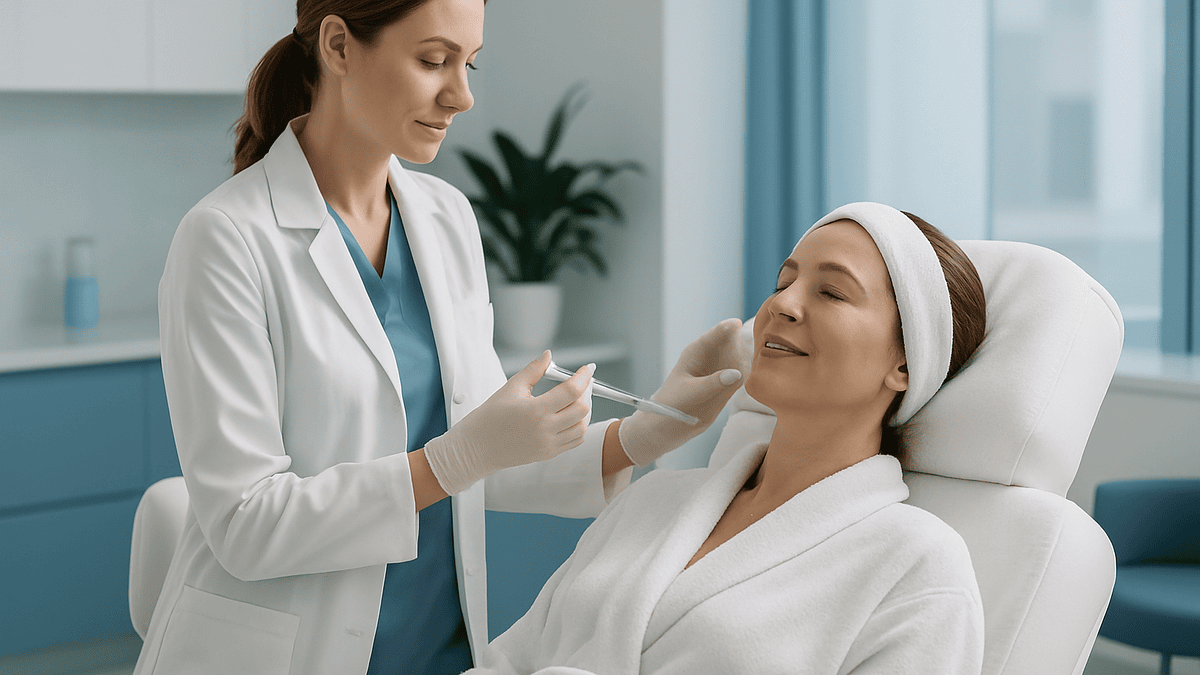
An exosome facial is not a facial in the cleanse-steam-mask sense. In almost every version offered today, the skin is first treated with microneedling, a procedure in which a device studded with fine needles makes thousands of controlled micro-punctures, or with a fractional laser, which does something similar with beams of light. A vial of exosome solution is then applied to the treated skin and left to absorb. The theory is that the tiny channels let the vesicles reach the living layers of skin, where they might speed repair and quiet inflammation.
Readers who remember the so-called vampire facial will spot the family resemblance. That treatment used platelet-rich plasma, or PRP, a concentrate spun from the client’s own blood that is rich in cell fragments called platelets and their growth factors. Exosomes are pitched as the next step: no blood draw, a shelf-stable powder, and a purer signaling package.
The catch, and the reason this article exists, is that the exosome facial is really two separate treatments stacked together. One of them, microneedling, has years of published trials behind it. The other, the contents of the vial, is a fast-moving marketplace of products that differ in origin, purity, potency and legal status. Separating what each part contributes is the whole task.
What changed recently: the timeline behind the trend
Exosomes are not new to science. Cell biologists described them in the 1980s and spent decades treating them as cellular garbage bags before realizing they were more like courier vans. A 2020 review in the journal Science by Raghu Kalluri and Valerie LeBleu, listed in the references below, summarized what had become clear by then: exosomes shuttle proteins and RNA between cells, they influence immunity and tissue repair, and they also help cancers communicate with their surroundings. That dual character matters later.
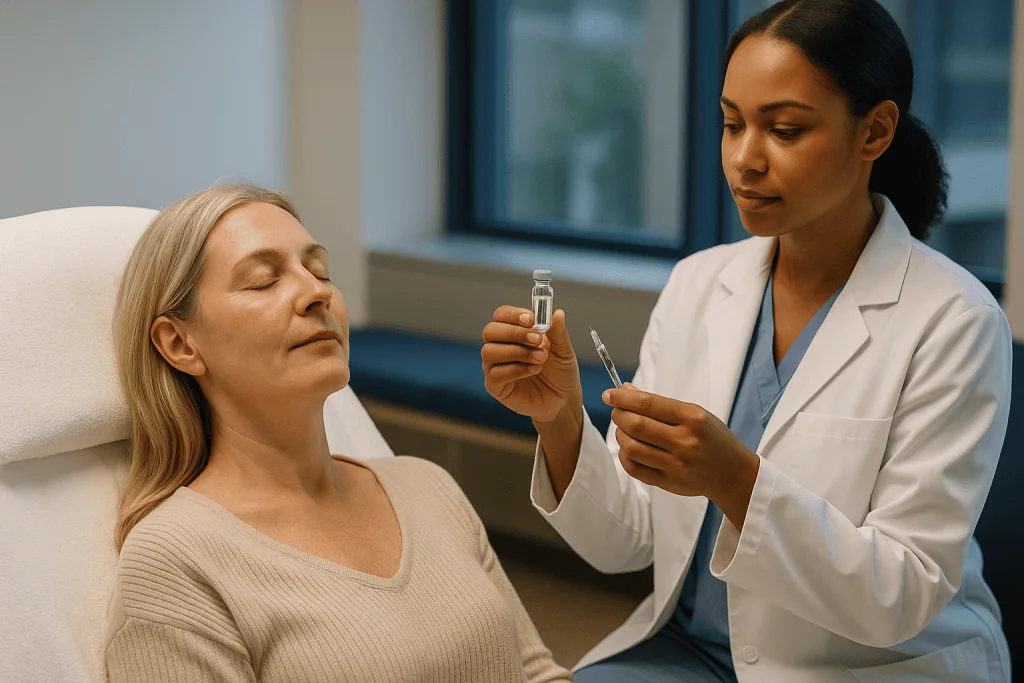
The consumer story turned in December 2019. That month the FDA issued a public safety notification after several patients in Nebraska became seriously ill following treatment with unapproved exosome products. The agency stated plainly that there were no FDA-approved exosome products and that clinics offering them were doing so outside the law. Warning letters to manufacturers and distributors followed and have continued in the years since.
Between 2021 and 2024 the market adapted rather than retreated. Human-derived products intended for injection became harder to sell openly, so the field pivoted toward vials labeled ‘cosmetic, for topical use only’, and toward non-human sources: bovine colostrum, the first milk produced by cows, and plant-derived vesicles from rose, ginseng and centella. These sidestep the rules that govern human tissue, though they do not escape the rule that a cosmetic may not claim to change the structure of skin.
Through 2024 and into 2025, short-form video did the rest. Post-laser recovery clips, celebrity mentions and clinic marketing pushed search interest for the exosome facial to its highest level yet. Small clinical studies kept appearing, most of them single-center, many with industry involvement, and reviews began pooling them. The summary those reviews reach, as we will see, is a cautious ‘promising, unproven’. The regulatory position has not changed: as of this writing, no exosome product carries approval from the FDA for any medical or cosmetic use.
Exosomes and skin: what the vesicles actually do in a wound
To understand the appeal, picture skin as a construction site after damage. Fibroblasts, the cells that manufacture collagen, need to be told to migrate in and get to work. Collagen itself is the protein scaffold that gives skin its firmness, and from about the mid-twenties adults lose roughly one percent of it each year. Blood vessels must sprout to feed the repair. Immune cells arrive, and the balance between the ones that inflame and the ones that clean up decides whether the site heals smoothly or scars.
Exosomes are one of the ways cells coordinate all this. In laboratory dishes and in mice, vesicles harvested from mesenchymal stem cells, a type of adult stem cell found in bone marrow, fat and umbilical cord tissue, have been shown to nudge fibroblasts to move faster and make more collagen, to encourage new blood vessel growth, and to shift immune cells called macrophages toward their repair mode. They do this partly through cytokines, the chemical signals cells use to talk, and partly through microRNAs, tiny genetic switches that turn genes up or down in the receiving cell.
That is real biology, and it explains why regenerative medicine researchers are excited about exosomes for chronic wounds, burns and heart tissue. It is also where the consumer marketing quietly changes the subject. Almost all of the mechanistic evidence comes from cultured cells and animals, often using freshly prepared vesicles at concentrations that bear no relation to a freeze-dried cosmetic vial.
Aging skin, as MedlinePlus describes it, thins in the outer layer, produces less oil, loses pigment cells unevenly and gradually gives up its collagen and elastin. Those are slow structural changes. Whether a signaling packet applied to the surface can meaningfully reverse any of them in a living human face is a question the exosomes-and-skin literature has barely begun to answer.
What is actually in the vial?
Ask three clinics what their exosomes come from and you may get three different answers, all delivered with equal confidence. The vials fall into four broad families.
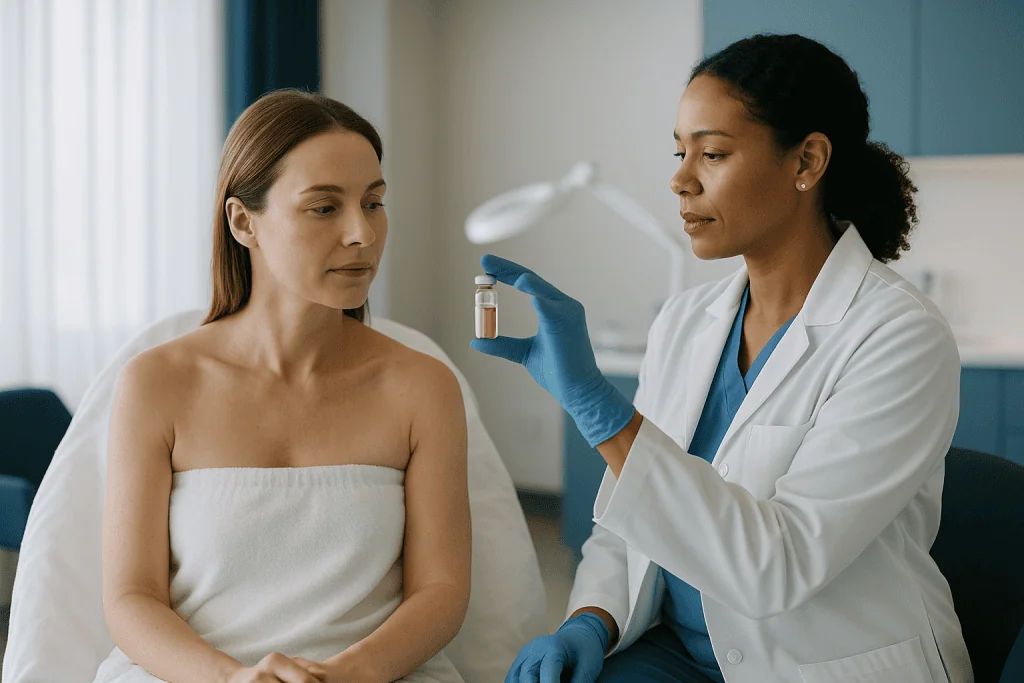
- Human cell-derived: vesicles collected from the fluid in which donated stem cells, most often from umbilical cord, placenta or fat tissue, were grown. Products in this family are the ones that triggered the 2019 safety alert and remain the most tightly regulated.
- Platelet-derived: vesicles isolated from pooled human platelets, marketed as a concentrated, standardized cousin of PRP.
- Bovine: vesicles from cow colostrum or milk, chosen because milk naturally contains enormous numbers of them.
- Plant-derived: technically ‘plant extracellular vesicles’ from rose stem cells, ginseng, aloe or centella. They are exosome-like in size and structure but are made by plant cells for plant purposes.
Most products arrive as a lyophilized powder, meaning freeze-dried, that is mixed with sterile saline or a serum base just before use. Labels frequently advertise particle counts in the billions per vial. That figure sounds precise but tells you little: it counts every vesicle-sized particle, including empty ones and fragments, and there is no agreed test of what a potent exosome dose for skin would even be.
The vial is also rarely exosomes alone. Many formulas add hyaluronic acid, peptides, growth factors, antioxidants and preservatives. When a client’s skin looks calmer the next day, any of those ingredients, or the plain act of hydrating freshly needled skin, could be responsible.
Independent characterization is the missing piece. In a research setting, scientists confirm exosomes by measuring particle size, imaging them and testing for marker proteins on their surface. Few cosmetic suppliers publish that data, and freeze-drying, shipping and storage can rupture vesicles long before they reach a face. The honest label for many products would read: contains particles of exosome size from a stated source, in an unknown state of integrity, alongside several conventional skincare actives.
How an exosome facial is done in practice
The appointment itself is unremarkable to watch, which is part of its charm. The skin is cleansed and a numbing cream sits for a while. A clinician then passes a microneedling pen or a fractional laser across the face in overlapping strokes. Depth and energy are adjusted for the area; the forehead and cheeks tolerate more than the thin skin under the eyes. Pinpoint bleeding is common and expected.
Immediately afterward, while the channels are open, the reconstituted exosome solution is dripped or brushed on and gently pressed in. Some practices layer a hydrating mask over the top or apply a second coat before the client leaves. Sunscreen, no makeup for a day, and no active ingredients such as retinoids or acids for several days are the usual instructions, the same aftercare microneedling alone would call for.
What happens next is where practices diverge. The mildest version is exactly what has been described: topical application to freshly treated skin, with products labeled for cosmetic use. The more aggressive version, still offered in places, involves injecting exosome products into the skin or under it, sometimes into the scalp for hair loss. In the United States, injecting these products falls outside what any current label permits and is precisely what regulators have warned against. A product labeled ‘for topical use only’ does not become an injectable because a clinic has a syringe.
Treatments are usually sold as a course rather than a one-off, and results, where they occur, are described in terms of weeks. Downtime is generally a day or two of redness and a few days of dryness or flaking, again attributable to the microneedling.
A useful mental exercise for anyone considering the treatment: imagine the identical appointment with a vial of plain hyaluronic acid serum in place of the exosomes. Every published trial that matters has had to ask what the vial adds beyond that. So should the client.
Can exosomes even get through the skin?
Here is the physics problem the marketing rarely mentions. The outermost layer of skin, the stratum corneum, is a stack of dead, flattened cells sealed with fats, and it is remarkably good at keeping things out. Dermatologists use a rule of thumb known as the 500-Dalton rule: molecules heavier than about 500 Daltons, the unit chemists use for molecular mass, rarely cross intact skin in meaningful amounts. Most prescription creams are built around molecules well under that limit.
An exosome is not a molecule. It is a structure measured in millions of Daltons and roughly 100 nanometers across, wrapped in its own membrane. Relative to the gaps in a healthy skin barrier, it is a beach ball at a keyhole. Applied to intact skin, exosomes almost certainly stay on the surface, which is why serious exosome skincare is always paired with something that breaks the barrier first.
Microneedling does create channels, and laser resurfacing does more so. But those channels are temporary; studies of microneedle-treated skin suggest the pores begin to close within hours. The vesicles must reach the living dermis intact, survive in the fluid there, and be taken up by the right cells before that window shuts. Freeze-dried products must also have survived reconstitution with their membranes whole; a burst exosome is just a puddle of proteins and RNA that degrades quickly.
None of this is impossible. Animal studies have shown that vesicles can be delivered through microchannels and can be found in deeper skin afterward. What has not been shown in humans is how much of a typical cosmetic vial actually arrives where it is supposed to act, in what condition, and whether the amount is enough to change cell behavior.
That uncertainty explains a pattern in the clinical literature: the effects most consistently reported are short-term ones, such as less redness and faster surface healing, which could plausibly be produced by soothing ingredients acting at the surface rather than by deep exosome signaling.
What does an exosome facial do? The claims, one by one
Clinic menus tend to list benefits in a single breath. Taken separately, each claim rests on a different amount of evidence.
Faster recovery after laser or microneedling. This is the most plausible claim and the best studied. Small trials comparing treated skin with and without exosomes report less redness and quicker settling on the exosome side within the first days. Plausible, modestly supported, and also achievable in part with good hydration and barrier repair.
Improved texture and fine lines. Photographic and patient-rated improvements appear in several small studies, but microneedling on its own produces the same kind of improvement, and few studies were designed to isolate the vial’s contribution. Weak to moderate support for the combined treatment; unclear how much is the exosomes.
Acne scars. A handful of split-face studies, in which one side of the face receives the add-on and the other does not, suggest an extra benefit when exosomes are combined with resurfacing. Small numbers, short follow-up.
Pigmentation and melasma. Laboratory work shows some vesicles can dampen melanin production in cultured cells. Human data is sparse. Anyone with melasma should know that heat and trauma from resurfacing can also worsen it.
Pore size, ‘glow’ and hydration. Subjective, short-lived, and indistinguishable in most reports from what a hydrating serum on needled skin achieves.
Hair regrowth. A separate and increasingly marketed use, mostly by scalp injection, with early-stage evidence and the highest regulatory exposure because it involves injecting unapproved products.
Collagen banking, the idea that treatments now build a reserve against future aging, is a marketing phrase rather than a measured outcome. No study has followed exosome-treated skin for years.
The pattern is clear enough. Where the claim is short-term and surface-level, the evidence is thin but supportive. Where it is structural and long-term, the evidence largely does not yet exist.
What the evidence actually says, graded honestly
Medical evidence comes in tiers. At the top sit randomized controlled trials, in which participants are assigned by chance to treatment or comparison so that differences can be attributed to the treatment. Below them come observational studies, which follow people who chose a treatment, and case series, which describe a handful of patients. At the bottom is expert opinion. Systematic reviews then pool the trials and judge the overall certainty.
For the exosome facial, the ladder is short. The most cited human study is a 2020 randomized split-face trial in which 25 adults with acne scars received fractional laser to both sides of the face, with adipose-derived stem cell exosomes applied to one side. Over 12 weeks the exosome side showed greater scar improvement and less post-treatment redness. It was a genuine randomized design, and its result is encouraging. It was also a single center, a single product, a small group, a short follow-up, and no one has yet published a large independent replication.
The rest of the human literature consists of pilot studies with plant or bovine vesicles applied after microneedling, mostly under 40 participants, often without a proper control side, frequently with the manufacturer involved and outcomes judged by photographs and questionnaires. Reviews pooling this work describe the results as consistently positive but the certainty as low or very low because of small samples, varied products and short follow-up.
Compare that with microneedling alone, supported by multiple randomized trials for acne scarring and photoaging, or with prescription retinoids, backed by decades of controlled data for fine lines. The exosome add-on is at least a full tier below both.
A fair summary reads like this. Mechanism: strong in the laboratory. Short-term post-procedure soothing in humans: weakly supported. Long-term structural benefit: unproven. Safety of topical cosmetic-grade products on intact or lightly needled skin: probably favorable but not systematically studied. Anyone who tells you the science is settled, in either direction, is ahead of the data.
Which is better, microneedling or exosomes?
The question is a little like asking whether the oven or the seasoning matters more. Exosomes are almost never used without a resurfacing step, so the real comparison is microneedling alone versus microneedling plus an add-on. The table places the common options side by side.
| Option | What it is | Strength of evidence for skin texture and scars | US regulatory status |
|---|---|---|---|
| Microneedling alone | Controlled micro-punctures that trigger collagen remodeling | Moderate: multiple randomized trials | Devices cleared for use; procedure well established |
| Microneedling + PRP | Client’s own platelet concentrate applied or injected | Low to moderate: several small trials show modest added benefit | Uses the person’s own blood; kits regulated as devices |
| Microneedling + exosomes | Cell- or plant-derived vesicle solution applied topically | Low: one small randomized split-face trial, pilot studies | No exosome product approved; cosmetic labeling common |
| Prescription retinoid cream | Vitamin A derivative that speeds cell turnover and collagen production | High: decades of controlled trials | Approved prescription medicine |
| Fractional or ablative laser | Light energy that removes or heats columns of skin | Moderate to high for scars and photoaging | Devices cleared; operator-dependent |
Read across the rows and a pattern emerges. The treatment with the strongest evidence for lasting change is the least glamorous: a prescription cream used consistently, plus daily sunscreen, which the Mayo Clinic lists among the most effective measures against wrinkles. Microneedling earns its place for scarring and texture. Exosomes sit at the bottom of the evidence column for now, not because they have failed, but because they have barely been tested.
So which is better? For most people, the microneedling is doing the heavy lifting, and the add-on is an optional variable with uncertain benefit and uncertain contents. That is not a reason to dismiss it. It is a reason to price it honestly in your own mind as an experiment rather than a proven upgrade.
Why regulators are watching exosome products
The legal logic is simpler than the biology. In the United States, a product is a cosmetic if it is meant to cleanse, beautify or alter appearance without affecting the body’s structure or function. It becomes a drug, and specifically a biologic, a medicine made from living sources, the moment it is intended to treat a condition or change how tissue works. Biologics need approval before they can be sold, and experimental ones may only be given to people inside a registered clinical trial under an investigational new drug application, the permit that allows testing in humans.
Every exosome product on the aesthetic market sits on one side of that line or the other, and the marketing frequently puts it on the wrong side. A vial labeled cosmetic that is promoted as regenerating collagen, healing scars or regrowing hair is being marketed as a drug without approval. A vial derived from human cells is also subject to rules on donor screening and manufacturing sterility, because a contaminated biological product can transmit infection. The 2019 events that prompted the FDA’s public notification were, in short, a failure of exactly those controls.
Regulators are watching for three reasons. First, patient harm has already occurred with injected products. Second, the field is moving faster than oversight: new sources, new suppliers and new claims appear monthly. Third, exosomes are a genuinely promising area of medicine, and unproven consumer products can erode trust in the legitimate trials underway for wounds and other conditions.
The picture is similar abroad. In the United Kingdom and the European Union, human-cell-derived exosome products fall under rules for advanced therapy medicines and require authorization that none currently holds; cosmetic-labeled products face the same limits on medical claims.
None of this makes the clinician offering a topical exosome facial a bad actor. Many use cosmetic-labeled products within their labels. It does mean the client is stepping into a space where the usual guarantees of a licensed medicine, consistent contents, demonstrated safety, a system for reporting harms, are not in place.
What is the dark side of exosomes? Risks and unknowns
Searches for the ‘dark side’ of exosomes spike alongside the glowing videos, and the question deserves a measured answer rather than a scary one. The risks sort into three groups: known, plausible and theoretical.
Known. Infection from contaminated product is the documented harm. The 2019 cluster involved people who became seriously ill after receiving unapproved exosome preparations, and investigation pointed to problems with how the products were made and handled. Bacterial contamination and endotoxin, a fever-provoking fragment of bacterial cell walls, are the specific concerns. The risk is highest with injection and lowest with topical use on intact skin.
Plausible. Allergic or immune reactions to foreign proteins, whether from human donors, cow colostrum or plants, are possible on freshly needled skin. So is ordinary post-procedure trouble: prolonged redness, flare of acne or cold sores, and darkening of the skin after inflammation, which affects people with deeper skin tones more often. Product variability means a good experience with one vial says little about the next.
Theoretical. This is where the biology from the Science review comes back. Exosomes are messengers, and in cancer they help tumors recruit blood vessels and dodge immune attack. No one has shown that cosmetic exosomes promote skin cancer, and the doses and routes are very different. But applying an uncharacterized signaling cargo to sun-damaged skin, repeatedly, without long-term follow-up, is an experiment whose outcome is unknown rather than known to be safe. Serious researchers say so themselves.
There is also the quieter risk of missed diagnosis. A persistent rough patch, a scar that changes, or hair loss with an underlying cause deserve a medical evaluation before they are treated as cosmetic problems. A treatment menu is not a substitute for that conversation.
Balanced against all this: topical, cosmetic-grade products applied after microneedling appear, in the small studies available, to be well tolerated. The dark side is less a hidden danger than an absence of the safety data a licensed medicine would have to provide.
Common myths about exosome facials, corrected
Viral formats reward confident sentences, and several have hardened into folklore. Here are the ones that circulate most, alongside what the evidence supports.
Exosomes are stem cells. They are not. Stem cells are living cells that can divide and mature into other cell types, as MedlinePlus explains. Exosomes are inert packets that some stem cells release. A vial contains no cells at all, which is exactly why marketers can call the product acellular and why it cannot do what a living cell does.
Plant exosomes talk to human cells the same way human ones do. Plant vesicles are real and interesting, but they evolved to carry plant signals. Laboratory studies show some can be taken up by human cells; whether they deliver useful instructions once inside is an open question, not a settled fact.
The product is made in an FDA-approved lab, so it is FDA-approved. Facilities can be registered or inspected; that is not approval of a product. No exosome product is approved.
More billions per vial means better results. Particle counts include fragments and empty vesicles and are measured differently by different suppliers. There is no established dose-response for skin.
Results are permanent, or you are banking collagen for later. No study has followed treated skin beyond a few months. Permanence is a promise, not a finding.
Natural sources mean no risk. Cow colostrum and plant extracts can still provoke allergy, and any product applied to needled skin needs to be sterile regardless of where it began.
It replaces retinoids, sunscreen or prescription care. Nothing in the exosome literature approaches the evidence base for daily sun protection or a prescribed retinoid, and no reputable clinician suggests otherwise.
A myth that runs the other way deserves correction too: exosomes are not a scam by definition. The underlying science is serious, and the eventual arrival of properly tested, approved products is plausible. The problem is timing. The marketplace has simply arrived years before the evidence.
Is an exosome facial worth it? An honest framework
Worth is personal, so rather than a verdict, here is the way a cautious dermatology-minded editor would think it through.
Begin with the problem, not the product. Redness and slow recovery after a planned laser session is the scenario where exosomes have the most plausible and best-supported role; if that is the goal, the add-on is a reasonable experiment. Fine lines and general dullness are better served first by the boring, proven pair of daily broad-spectrum sunscreen and a retinoid chosen with a clinician, with microneedling as a well-evidenced step up. Acne scars respond to microneedling and laser on their own, and the exosome benefit on top is real in one small trial and unconfirmed elsewhere. Melasma and rosacea call for a diagnosis and a treatment plan before any resurfacing at all.
Next, weigh the comparator. If a practice offers the same microneedling session without the vial, most of the expected benefit is likely still there. The question becomes whether an uncertain increment justifies the extra step and the unknowns that come with it.
Then look hard at the vial. A product labeled for topical cosmetic use, from a supplier willing to share what it is derived from and how it is tested, applied by someone who follows that label, is the lowest-risk version of the treatment. An injected product, a vague origin story or medical-sounding promises move the whole thing into a different risk category.
Finally, consider what would count as success. If a calmer face for a few days after a laser is the goal, expectations may well be met. If the goal is visibly turned-back years that last, the evidence cannot yet support that hope, and disappointment is the likeliest outcome.
The opinion this magazine holds, grounded in the studies available: as a modest post-procedure add-on with a transparent product, an exosome facial is a defensible experiment. As a stand-alone anti-aging strategy, it is not yet earned.
Questions to ask before you book an exosome treatment
Good practitioners welcome informed questions; the quality of the answers tells you as much as the answers themselves. These are the ones worth carrying into a consultation.
- What is the product derived from, human cells, platelets, cow colostrum or plants, and can you show me the supplier’s documentation?
- How is the vial labeled, and will it be used exactly as the label states? A topical-only product should stay topical.
- What testing does the supplier perform for sterility and for endotoxin, and is a batch certificate available?
- Who will perform the microneedling or laser, what are their qualifications, and who supervises medically?
- What results have you seen in people with my skin type and concern, and how long did they last?
- What would the same session cost me in downtime and risk without the exosome step, and what do you expect the vial to add?
- How do you handle a reaction, and how quickly can I be seen if something goes wrong?
- Do you report adverse events, and to whom?
Certain answers should slow you down. Any suggestion that the product is approved for treating skin or hair, any plan to inject a product labeled for surface use, an unwillingness to name the source, or promises of permanent or guaranteed change are all signals that marketing has outrun the evidence and possibly the rules.
Some people should pause before any resurfacing treatment, exosomes or not: those with active skin infection or cold sores, a history of keloid scarring, current or recent use of oral isotretinoin, uncontrolled diabetes, a weakened immune system, or pregnancy. Those decisions belong with the treating clinician and, where relevant, the physician managing the underlying condition.
One more question is worth asking yourself rather than the clinic: what am I hoping to see in the mirror, and is there a treatment with stronger evidence that could get me there first? Often there is.
When to see a doctor after an exosome facial
Most people who have microneedling with a topical product will experience a day or two of redness, mild swelling and some dryness, and nothing more. A small number will need medical attention, and knowing the signs in advance turns a frightening moment into a manageable one.
Seek urgent or emergency care for signs of a serious allergic reaction: swelling of the lips, tongue or throat, difficulty breathing, widespread hives, dizziness or a feeling of faintness within hours of treatment. Treat these as an emergency regardless of how minor the procedure seemed.
Contact a doctor promptly, the same day if possible, if you notice:
- Redness that spreads outward, feels hot or increasingly painful after the first 48 hours rather than settling.
- Pus, yellow crusting, blisters or open sores appearing on treated skin.
- Fever, chills, or feeling generally unwell in the days after treatment.
- Clusters of small painful blisters, which may signal a cold sore flare spreading across needled skin.
- New dark patches or a marked worsening of existing pigmentation over the following weeks.
- Firm lumps, nodules or thickened scar-like areas developing where the product was applied or injected.
A dermatologist is also the right first stop before treatment for anyone with melasma, rosacea, active acne, a history of keloids, or unexplained hair loss, because each of these has a diagnosis and prescription options with far stronger evidence than any exosome product, and because resurfacing can make some of them worse. If you take a prescribed medicine that affects skin healing or immunity, do not stop or adjust it to prepare for a cosmetic treatment; raise the question with the prescribing clinician instead.
Everything in this article is background for that conversation, not a replacement for it. Whether a treatment is appropriate, which product is used, and how any reaction is handled are decisions for the clinician who examines you.
Frequently asked questions
What does an exosome facial do?
An exosome facial applies a solution of cell-derived vesicles to skin that has just been microneedled or lasered, aiming to speed healing, reduce redness and improve texture. The best-supported effect in small human studies is calmer, faster-settling skin in the days after resurfacing. Claims of long-term collagen rebuilding or lasting wrinkle reduction have not been tested in trials long enough to confirm them.
What is the dark side of exosomes?
The documented harm is infection from contaminated, unapproved products, seen in a 2019 US cluster after injected exosomes. Plausible risks include allergic reactions to human, bovine or plant proteins on freshly needled skin and post-inflammatory darkening. The theoretical concern is that exosomes are biological messengers, including in cancer, and no long-term human safety data exists for repeated cosmetic use. Topical cosmetic-grade products appear well tolerated in small studies.
Is an exosome facial worth it?
It depends on the goal. As an add-on to a planned laser or microneedling session to reduce downtime, it is a reasonable, low-risk experiment when a transparent topical product is used as labeled. As a primary anti-aging strategy, the evidence does not yet justify it; daily sunscreen, a clinician-guided retinoid and microneedling alone all have stronger data. Treat it as unproven, not as an established upgrade.
Which is better, microneedling or exosomes?
Microneedling has the stronger evidence, with multiple randomized trials for acne scars and photoaging. Exosomes are almost never used alone; they are an add-on whose extra benefit rests on one small randomized split-face trial and several pilot studies. In practice the microneedling is doing most of the work, and the exosome step is an optional variable with uncertain contents and uncertain gain.
Do exosomes skin products actually penetrate the skin?
Not through intact skin in any meaningful amount. The outer barrier blocks most molecules above about 500 Daltons, and an exosome is millions of Daltons and about 100 nanometers wide. Microneedling and laser create temporary channels that may let some vesicles reach deeper layers, but how many arrive intact in human skin, and whether that is enough to change cell behavior, has not been established.
Are exosome facials FDA approved?
No. The FDA has stated since 2019 that there are no approved exosome products and has issued warning letters to companies marketing them. Products used in aesthetics are typically labeled as cosmetics for topical use, which limits the claims that may legally be made about them. A registered or inspected manufacturing facility is not the same as an approved product.
Are exosomes the same as stem cells?
No. Stem cells are living cells that can divide and develop into other cell types. Exosomes are tiny, non-living packets of proteins and genetic material that some cells, including stem cells, release to signal to others. An exosome vial contains no cells, which is why products are described as acellular and why they cannot replicate or become new tissue.
Where do the exosomes in these vials come from?
Sources vary widely. Some products are derived from human stem cells grown from umbilical cord, placenta or fat tissue; some from pooled human platelets; some from cow colostrum; and a growing number from plants such as rose, ginseng or centella, which produce exosome-like vesicles. Many vials also contain hyaluronic acid, peptides and growth factors, so any visible effect cannot be attributed to exosomes alone.
How long do exosome facial results last?
Nobody knows with confidence. Published studies have followed participants for weeks to a few months, and the effects reported, mainly less redness and improved texture, were measured within that window. No study has tracked exosome-treated skin for years, so claims of permanent results or banked collagen are marketing language rather than measured outcomes.
Can exosomes help with hair loss?
Early laboratory and animal studies suggest certain exosomes can stimulate hair follicle cells, and small human reports exist, but the evidence is preliminary. Most hair applications involve injecting unapproved products into the scalp, which carries the highest regulatory and safety concern. Anyone with hair loss should first see a doctor for a diagnosis, because several causes have approved treatments with far stronger evidence.
References
This article is for general information only and is not a substitute for professional medical advice. Please consult a qualified doctor about your individual situation.

More from the Blog

Microsurgery Risks Explained: Why Blood Flow Is Watched Hourly in the First Days
Microsurgery complications most often involve the tiny reconnected blood vessels that feed transplanted tissue, called a flap. A clot in the artery or vein…

Scar Treatment Results: What Realistic Improvement Looks Like and Why Sessions Repeat
Realistic scar treatment results mean a scar that is flatter, softer, paler and less noticeable, not a scar that vanishes. Scar tissue is permanent,…

Neck Lift Recovery Time: Healing Stages, Scars and Results That Settle
Most people look socially presentable about two to three weeks after a neck lift, once visible bruising fades and swelling starts to settle. Full…
How to Prepare for Microneedling: Sun, Retinoids and the Two Weeks Before Your Session
Preparing for microneedling usually means keeping the skin out of strong sun and free of sunburn or tan for the two weeks beforehand, pausing…
IPL Photorejuvenation Results: Why Spots Darken Before They Fade and How Sessions Build
IPL photorejuvenation results usually appear gradually. Treated brown spots often turn darker and coffee-ground-like for several days before flaking away over one to two…

Surface Reconstruction Recovery: Early Supervised Walking, Physical Therapy and Milestones
Surface reconstruction recovery after ocular surface surgery usually unfolds in stages: the corneal surface layer re-covers over days, comfort and light sensitivity settle over…