

Eyebrow Transplant Results Over the First Year: Shedding, Regrowth and When the Shape Settles
Key Takeaways
- Transplanted brow follicles keep their scalp growth cycle, which the NIH describes as years in the growth phase versus months for native brow hair, so lifelong trimming is expected.
- Shock shedding between roughly weeks two and eight removes the old hair shaft, not the follicle; grafts that truly fail are usually lost in the first days.
- Visible regrowth typically begins around months three to four, with most density arriving between six and nine months and the final assessment at about twelve.
- Early regrowth is finer and may point in odd directions; the hair caliber thickens and the angle matures as surrounding skin remodels over subsequent months.
- Before and after photos are only meaningful when the interval is labeled and lighting, angle and grooming are matched between the two images.
- Active alopecia areata, untreated hair-pulling, or a recent and potentially reversible medical cause of brow loss are the usual reasons a team asks a patient to wait.
Eyebrow transplant results change markedly across the first year. Most transplanted hairs shed within roughly two to eight weeks, then regrow from about month three or four. Density keeps building through months six to nine, and surgeons generally judge the final shape and thickness at around twelve months. Because the hairs keep scalp-type growth behavior, regular trimming and training usually remain part of long-term care.
Three weeks after her procedure, a patient leans into the bathroom mirror, tilts her head toward the light and counts. Six short hairs lie on the white sink. Yesterday it was four. The brows that looked promisingly dark and defined on day two are now patchier than before surgery, and the thought that arrives uninvited is the one every surgeon hears: did it fail?
It almost certainly did not. Shedding is the expected second act of a story that plays out over twelve months, and the person who understands that story in advance spends far less of the year worrying. Eyebrow transplant results in the first year follow a sequence that is remarkably consistent, even though the pace varies from person to person.
This explainer walks through that sequence month by month: what the follicles are doing under the skin, why the early weeks look worse before they look better, when the shape finally settles, and what the evidence does and does not tell us about how long the result lasts.
Why eyebrow transplant results in the first year cannot be judged early
The single most useful idea to carry through the year is this: a transplanted hair and the follicle beneath it are on different schedules. The follicle, the tiny pocket of living cells in the skin that manufactures hair, is what the surgeon moves. The hair you can see is just the shaft it produced before it was relocated. Once a follicle has been lifted out of the back of the scalp and placed in the brow, it usually drops that old shaft and starts over.
Hair grows in cycles. The growth phase is called anagen, the resting phase is telogen, and a brief transition between them is catagen. According to the NIH physiology summary on hair, scalp follicles spend roughly two to six years in anagen, whereas eyebrow follicles have a far shorter growth phase, on the order of months, which is why native brow hairs stay short. The stress of being moved tips a transplanted follicle out of anagen and into rest. It then needs time to cycle back into growth, and that resting interval is what produces the quiet, discouraging gap in the middle of the first months.
MedlinePlus and Cleveland Clinic both describe the same arc for hair transplants in general: early shedding, regrowth after a few months, and continued thickening through much of the first year. For the brow, two extra factors stretch the judging period. The area is small, so every missing hair is visible, and the hairs must be trained to lie in a specific direction. Both take time to read accurately.
So the honest answer to “how does it look?” at week three, month two or even month five is the same: not yet finished. Surgeons generally reserve their verdict on density, symmetry and shape for the twelve-month mark.
How an eyebrow transplant actually works, step by step
An eyebrow transplant is hair restoration surgery scaled down to a few square centimeters. The surgeon takes hair-bearing skin from a donor area, nearly always the back or side of the scalp, separates it into grafts, and places those grafts into tiny incisions along the brow. A graft is a small unit of tissue containing one or more follicles; for brows, single-hair grafts are preferred because a natural brow is made of individual hairs, not clumps.
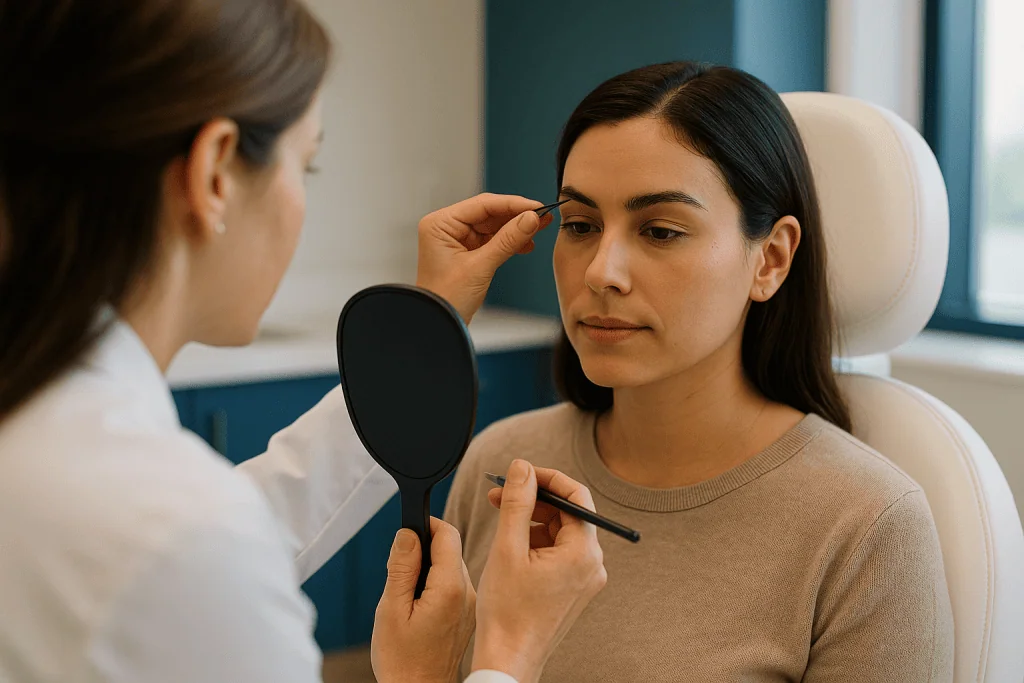
MedlinePlus describes the two main harvesting methods used across hair transplantation. In follicular unit extraction, often shortened to FUE, follicles are removed one at a time with a small punch, leaving dot-like marks that fade. In follicular unit transplantation, or the strip method, a narrow strip of scalp is removed and divided under magnification, leaving a thin linear scar hidden by surrounding hair. Either can supply brow grafts; the choice usually depends on how many hairs are needed and the patient’s scalp.
Placement is where brow surgery differs most from scalp work. Native eyebrow hairs emerge almost flat against the skin and change direction across the brow: upward at the inner end, then angling outward and slightly downward toward the tail. The surgeon makes each recipient incision at the angle and direction the hair should eventually follow, then slides a single follicle into it. Cleveland Clinic notes that the procedure is typically done under local anesthetic, with the patient awake, and takes several hours because of the precision involved.
Everything after that depends on biology rather than technique: whether the follicle survives the move, when it re-enters growth, and how faithfully the hair follows the angle it was given.
Who is usually a candidate, and who is usually asked to wait
People come to this procedure by several routes. Some have overplucked for years and the follicles never recovered. Others have lost brow hair to scarring from injury, burns or surgery. Some were born with sparse brows, and some lost hair to thyroid disease, alopecia areata or chemotherapy. The common thread is that the brow is not expected to regrow on its own.
Candidates generally share a few features. They have a stable donor area of healthy scalp hair. Their underlying cause of brow loss is identified and, where relevant, controlled. They understand that the result is a year-long process and that trimming will be part of life afterward.
Several groups are usually asked to pause rather than proceed:
- People with active, untreated alopecia areata or another inflammatory hair condition, because the immune process that removed the native hairs can remove transplanted ones too. Mayo Clinic describes alopecia areata as patchy, immune-related hair loss that can recur.
- People with hair-pulling behavior that has not yet been addressed, since new hairs face the same risk.
- Anyone whose brow loss began recently and might reverse once a medical cause such as thyroid imbalance is treated.
- People with unrealistic expectations about density or about being finished in a few weeks.
The NHS reminds readers that hair transplant surgery is a cosmetic procedure with real surgical risks, and that a frank consultation is the moment to raise medical history, medicines that affect bleeding, and scalp conditions. Whether and when to operate is a decision for the treating team, made with the patient, after that conversation.
The first week: swelling, crusts and the brows that look finished too soon
The first few days are a slightly surreal preview. The transplanted hairs are visible immediately, so the brow can look fuller and darker than it has in years, even though not a single follicle has started growing yet. Enjoy it, but hold it lightly; it is the trailer, not the film.
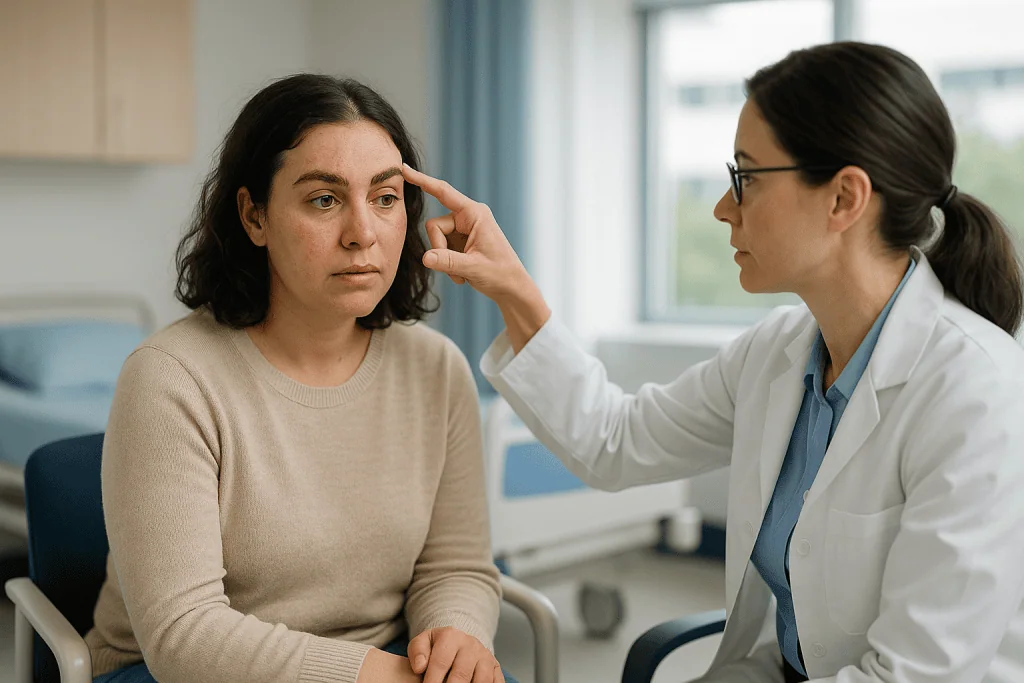
Around each graft a small crust forms where the incision was made. Cleveland Clinic describes these scabs falling away over the first week or so as the skin seals. There may be pinkness along the brow and mild swelling that can drift downward toward the eyelids, since fluid follows gravity. Some tenderness or tightness in the donor area at the back of the head is common, and MedlinePlus notes that numbness or tingling around transplant sites can persist for weeks as small sensory nerves recover.
Care instructions in this window are protective rather than cosmetic. Teams typically ask patients to avoid rubbing or picking, to keep the brow dry for a specified period, to sleep with the head elevated to limit swelling, and to avoid heavy exertion that raises blood pressure to the face. Follow the written instructions from your own team; they know how the grafts were placed and what they saw during surgery.
Two things are worth not doing. The first is comparing your week-one brow with online photographs labeled “final result”; the two are not the same stage. The second is deciding the shape is wrong. Swelling, crusting and the surgeon’s slight overcorrection for expected shrinkage all distort the picture in week one. The shape you will actually live with is many months away.
The eyebrow transplant shedding phase: weeks two to eight
Somewhere between the second and eighth week, the hairs start to fall. Cleveland Clinic and MedlinePlus both describe this as expected after any hair transplant, and surgeons often call it shock loss or shock shedding. The follicle, having been cut off from its blood supply and reconnected in a new site, reacts by shutting down production and releasing its shaft. The living part stays put under the skin.
What makes this phase hard is not pain but perception. The brow goes from its week-one preview back to something close to the pre-surgery baseline, and occasionally slightly thinner, because the trauma of the incisions can also push a few native hairs into rest. On a scalp, that loss is diluted across thousands of hairs. On a brow, it is right there in the mirror every morning.
A few points help people get through it:
- Shedding is not graft loss. Grafts that fail usually do so in the first few days, when the follicle has not yet re-established blood flow. Hairs that fall at week four almost always come from follicles that have already taken.
- Not every hair sheds. Some follicles skip the resting phase entirely and keep growing, which is why the brow can look unevenly spotty rather than uniformly bare.
- The skin itself has usually healed by now, and any residual pinkness is fading.
This is also the window in which patients most often message their teams in alarm. That is normal and welcome; a quick photo review can distinguish ordinary shedding from the rarer problems listed later in this article. What you should not do during the shedding phase is judge the surgery, count hairs, or change the aftercare plan without checking.
Eyebrow transplant at 4 months: first regrowth and why it looks uneven
Then, quietly, something changes. Fine, soft hairs begin to break the surface, usually starting around the third month and becoming noticeable by the fourth. Cleveland Clinic’s overview of hair transplants describes new growth typically appearing within a few months of surgery; the brow follows the same biological clock, so the eyebrow transplant at 4 months is often the first moment the result feels real.
The early hairs are not the final hairs. They tend to be thinner, lighter and sometimes a slightly different texture, because a follicle re-entering anagen begins by producing a narrower shaft that thickens over subsequent weeks. Some emerge pointing in odd directions before settling. And they do not arrive together. Follicles that were placed within minutes of each other can wake weeks apart, which is why a four-month brow often has a confident inner section and a sparse tail, or a dense patch beside a gap.
Unevenness at this stage is the rule rather than a sign of trouble. The hairs that are still absent are, in most cases, simply later. Patience here is not passive; there is useful work to do.
This is when many teams introduce grooming. Because the transplanted follicles retain scalp behavior, the new hairs will grow long, and letting them run wild makes the brow look stragglier than it is. A clean trim of the longest hairs at the length your team advises, and gentle daily brushing in the intended direction, start the training process that continues for months. Some people find a small amount of brow gel helps the hairs lie flat while the follicle’s angle matures.
Months six to nine: density, direction and settling the shape
If month four is the first draft, months six to nine are the heavy editing. The majority of follicles that are going to grow have now started, the shafts have thickened toward their mature caliber, and the brow finally has enough hair to be read as a shape rather than a collection of hairs. Cleveland Clinic describes most of the visible new growth after a hair transplant appearing in the six-to-nine-month range, with further filling in afterward; brow surgeons generally observe the same curve.
Direction becomes the main preoccupation. A newly emerged hair may stand up or splay outward even when the incision was angled correctly, because the hair takes the path of least resistance through healing tissue before the surrounding skin remodels around the follicle. Over these months the angle matures. Daily brushing in the intended direction and periodic trimming keep the hair from establishing a kink. People are often surprised by how much the brow seems to flatten and smooth between month six and month nine without any additional intervention.
Symmetry also tends to improve, for an unglamorous reason: the side that woke later catches up. Asymmetry that looked worrying at month four is frequently much less noticeable by month eight.
Texture may still differ slightly from native brow hair. Scalp hair is usually finer at the brow’s thinner end and coarser in the body; a skilled placement uses that, putting the finest single hairs at the edges and tail. Where texture mismatch remains obvious, trimming reduces it, and a review with the surgeon toward the end of this period can establish whether a small refinement session later would help. That judgment belongs to the treating team.
Eyebrow transplant results first year: a month-by-month summary
The table below gathers the typical sequence described in MedlinePlus and Cleveland Clinic resources on hair transplantation and applies it to the brow. The ranges are typical, not promised; individuals shift earlier or later by weeks, and the right benchmark is your own team’s assessment, not a chart.
| Timeframe | What is usually happening | What it tends to look like | Typical care focus |
|---|---|---|---|
| Days 1–7 | Grafts anchoring; crusts forming and lifting | Full-looking brow with pinkness and small scabs; possible eyelid swelling | Protect grafts, keep clean and dry as instructed, sleep elevated |
| Weeks 2–8 | Shock shedding; follicles enter rest | Hairs fall; brow returns to baseline or slightly sparser | Reassurance, no picking, routine follow-up photos |
| Months 3–4 | Follicles re-enter growth | Fine, patchy new hairs; uneven density | First trims, daily brushing to train direction |
| Months 6–9 | Most growth established; shafts thickening | Readable shape; improving symmetry and lie | Regular trimming, gel if advised, interim review |
| Months 10–12 | Late follicles filling in; angles maturing | Settled shape and near-final density | Twelve-month assessment; discuss any refinement |
Two patterns in that table deserve emphasis. First, the curve is not linear. Almost nothing visible happens between week three and month three, and then a great deal happens between month three and month nine. People who expect steady weekly progress become discouraged; people who expect a plateau followed by a surge cope far better.
Second, the care focus shifts from protection to grooming around the third month, and grooming never fully stops. Trimming is part of owning a transplanted brow, not a sign that something went wrong.
How long do brow transplants last, and why the hair keeps growing long
How long do brow transplants last? The honest answer is that the transplanted follicles are expected to keep producing hair for as long as they would have in their original location, because of a principle called donor dominance. A follicle carries its own genetic instructions with it. Hair from the back of the scalp is generally resistant to the hormone-driven thinning that affects the top of the head, which is exactly why it is chosen as donor hair; MedlinePlus and Mayo Clinic both describe transplantation as moving hair from areas that resist loss to areas that need it.
Donor dominance has a consequence people sometimes forget. Because the follicle keeps its scalp identity, it also keeps its scalp growth cycle, which the NIH physiology literature puts at years rather than months in anagen. Left untrimmed, a transplanted brow hair will grow as long as scalp hair. Some surgeons report that growth seems to slow or shorten after a few years, and some patients describe needing to trim less often, but this is observation rather than established evidence. The safe assumption is lifelong trimming, roughly as often as your team suggests, with pleasant surprise if it turns out to be less.
Permanence has limits, and it is fair to name them. If brow loss was caused by an immune process such as alopecia areata and that process reactivates, transplanted hairs can be affected. Native hairs around the grafts may continue to thin with age, changing the overall look even though the grafts persist. Scarring conditions may compromise the blood supply the follicles rely on. And aging skin changes the brow’s position and the way hair lies.
So “permanent” is reasonable shorthand, provided it means “the follicles are expected to keep working,” not “the brow will never change.”
Reading eyebrow transplant before and after photos honestly
Searching for eyebrow transplant before and after images is one of the most common things people do before and after surgery, and the photographs can be genuinely informative. They can also mislead, not necessarily through dishonesty but through the ordinary physics of photography. A few habits make you a better reader.
Check the stage. A photo taken at day two shows unshed grafts, not growth. A photo at month four shows a draft. Only images at or beyond twelve months show results in the sense this article uses. Reputable sets label the interval; if there is no label, assume you do not know.
Match the lighting and angle. Brow hair casts shadow, and a lamp placed slightly above and in front of the face makes any brow look denser. A before image under flat overhead light next to an after image under warm, angled light exaggerates change. The head tilt matters too: a slight downward tilt foreshortens the brow and compresses hairs together.
Look for grooming. A trimmed, brushed, lightly gelled after image is a legitimate representation of how a transplanted brow is meant to be worn, but it should be compared with a groomed before, not a bare one. Makeup or tinting in either image changes everything.
Finally, notice what the photos cannot show: how the hair lies on an ordinary morning before grooming, how it looks in profile, and how the texture feels. Those are the things to ask about in consultation, ideally while looking at a surgeon’s own long-term series rather than a stranger’s highlight reel. Photos are evidence of what is possible for someone, not a forecast for you.
What people often get wrong about brow transplant results
Myths cluster around this procedure, partly because online content skews toward week-one photographs and twelve-month reveals with nothing in between. A few corrections, in rough order of how much grief they prevent.
“Shedding means the grafts died.” It almost never does. Shedding is the follicle cycling, and MedlinePlus describes it as an expected stage after hair transplantation. Grafts that genuinely fail are usually lost in the first days, not weeks later.
“You can judge the result at three or four months.” You can judge that follicles are waking up. Density, direction and symmetry are still in motion until roughly the one-year mark.
“Transplanted brow hair becomes brow hair.” It does not. Donor dominance means the follicle keeps its scalp growth cycle, so trimming continues indefinitely. People who skip this step are the ones who end up disappointed by “unruly” brows.
“If a celebrity had it done, the result I saw is typical.” Public figures sometimes discuss having brow procedures, but a single well-lit, professionally groomed example says nothing about average outcomes, and this magazine does not speculate about any individual’s medical history.
“Twenty years on, the hair will have fallen out.” The question about what happens two decades after a hair transplant is a fair one. Donor-dominant follicles are expected to persist; what changes over decades is the surrounding native hair, skin laxity and brow position. Long-term published data specific to brows are limited, and it is more honest to say that than to quote a figure.
“More grafts always means a better brow.” Overpacking a brow produces an unnatural, uniform density. Natural brows are denser in the body and thin at the edges; good design copies that.
Risks, touch-up sessions and the alternatives worth knowing
Every surgical procedure carries risk, and the NHS and Cleveland Clinic list the main ones for hair transplantation plainly: infection, bleeding, swelling, numbness or altered sensation, small cysts where a hair grows under the skin (folliculitis or ingrown hairs), visible scarring in the donor area, and grafts that do not take. For the brow specifically, add hairs that grow at the wrong angle, texture that stays noticeably coarser than native hair, and asymmetry.
Most of these are manageable. Ingrown hairs usually resolve or are released in clinic. Mis-angled hairs are tamed by trimming or, rarely, removed. Asymmetry and thin spots are the most common reasons for a second, smaller session, which surgeons typically discuss only after the twelve-month assessment, since gaps at month six are often simply late growth. Whether a refinement is appropriate, and when, is the treating team’s call.
Alternatives deserve a fair hearing, because surgery is not always the right first step:
- Treating the underlying cause. Mayo Clinic notes that hair loss from thyroid disorders, nutritional deficiency or certain medicines may improve when the cause is addressed.
- Topical medicines. Minoxidil, a topical agent thought to prolong the growth phase of follicles, is used on-label for scalp hair loss; brow use is off-label and evidence is limited. Any trial of it is a prescriber’s decision.
- Cosmetic approaches. Pencils, powders, tinting and semi-permanent pigment techniques involve no surgery and can be reversed or adjusted, though pigment fades and does not move like hair.
- Waiting. Overplucked brows sometimes recover partially over many months once plucking stops.
A good consultation covers all of these before scheduling anything.
Questions to ask your care team before and during the first year
The quality of a year like this depends heavily on the quality of a few conversations. These questions tend to surface the information that matters most.
Before surgery
- What do you think caused my brow loss, and is there any chance it would regrow or recur without surgery?
- Which harvesting method do you recommend for me, and why?
- Roughly how many single-hair grafts are you planning, and how did you arrive at that for my brow shape?
- Can I see your own patients at twelve months or later, in similar lighting to their before photos?
- How will you decide the direction and angle of each hair, and how do you handle the tail, where the hair should angle downward?
In the first weeks
- When can I wash the area normally, and what should I do if a crust lifts early?
- What does ordinary shedding look like, and what would make you want to see me sooner?
- Are there activities, sleeping positions or products you want me to avoid, and for how long?
From month three onward
- When should I start trimming, to what length, and how often?
- How should I brush or set the hairs to train direction?
- At what point will you assess density and symmetry, and what would prompt a second session?
- If some hairs stay coarse or point the wrong way, what are the options?
Write the answers down. The team’s guidance about trimming length, washing and follow-up timing overrides anything in a general article, including this one, because it is tailored to how your grafts were placed and how your skin is healing.
When to call your doctor
Most of what happens in the first year is expected, including the shedding that feels like a setback. A few signs are not expected and warrant a prompt call to the surgical team or, if the team cannot be reached, same-day medical advice.
Call promptly if you notice:
- Spreading redness, warmth, increasing pain or swelling at the brow or donor site after the first few days, especially with yellow or green discharge; MedlinePlus and the NHS list infection among the recognized complications of hair transplantation.
- Fever or feeling generally unwell in the days after surgery.
- Bleeding that does not stop with gentle pressure.
- Swelling that closes the eye, changes vision, or causes severe headache.
- A tender lump at a graft site that is enlarging or has a pus point, which may be an ingrown hair or cyst needing release.
- Any sudden loss of native brow or scalp hair in patches, which could suggest an inflammatory process the team should evaluate.
- Grafts that have visibly lifted out of the skin, particularly within the first week.
Seek emergency care for signs of a serious allergic reaction, such as difficulty breathing, swelling of the lips or tongue, or widespread hives, which can occur with any medicine or anesthetic.
The first year also includes slower concerns that deserve a scheduled rather than urgent conversation: persistent asymmetry past month nine, hairs that will not lie flat despite training, texture that stands out, or numbness that has not improved after several months. None of these are emergencies, and all of them are easier to address when raised at a planned review rather than left until the twelve-month assessment. Whatever you observe, the people who know your case are the right ones to interpret it.
Frequently asked questions
How long do brow transplants last?
Transplanted follicles are expected to keep producing hair indefinitely, because hair from the back of the scalp carries its own resistance to hormone-driven thinning wherever it is placed, a principle called donor dominance. What can change over time is the native hair around the grafts, skin position with age, and any underlying inflammatory condition that recurs. Long-term brow-specific studies are limited, so “expected to persist” is more accurate than a guaranteed lifespan.
What does the eyebrow transplant shedding phase look like?
Between roughly the second and eighth week, most transplanted hairs fall out, often a few at a time, and the brow returns to something close to its pre-surgery appearance. The follicles remain under the skin in a resting phase. Not every hair sheds, so the brow may look unevenly spotty. MedlinePlus and Cleveland Clinic describe this as an expected stage after hair transplantation, not a sign of failure.
What should an eyebrow transplant look like at 4 months?
At four months most people see fine, soft new hairs emerging unevenly, with some areas filling in and others still sparse. The hairs are usually thinner than their final caliber and may point in different directions. This is a draft stage, not a result; follicles continue to wake up and thicken through months six to nine. Teams often begin trimming and direction training around this point.
Can I trust eyebrow transplant before and after photos?
They are useful when the interval is labeled, the before and after were taken under similar lighting and head angle, and grooming is comparable in both images. Photos taken in the first days show unshed grafts rather than growth, and anything before twelve months is still changing. Ask a surgeon to show their own long-term series rather than relying on images found online.
What happens 20 years after a hair transplant?
Donor-dominant follicles are expected to keep growing hair for decades, because they retain the genetics of the resistant scalp area they came from. Over twenty years the surrounding native hair may continue to thin, skin loosens and the brow position shifts, so the overall appearance changes even if the grafts persist. Published long-term data specific to eyebrow transplants are limited, so this is based on hair transplant principles rather than brow-specific studies.
Why does transplanted eyebrow hair grow so long?
Because the follicle keeps its scalp identity. The NIH physiology literature describes scalp hair spending years in its growth phase, whereas native eyebrow hair grows for only months before resting, which is why brows stay short. A relocated scalp follicle continues its longer cycle in the brow, so the hair will keep lengthening until trimmed. Regular trimming is a permanent part of maintaining a transplanted brow.
Will the new eyebrow hairs lie flat and point the right way?
Usually, with time and training. The surgeon angles each incision to match natural brow direction, but newly emerged hairs often stand up or splay at first because they push through healing tissue. Over months the surrounding skin remodels and the angle matures. Daily brushing in the intended direction, trimming and sometimes a light brow gel help. A few persistently wayward hairs can be trimmed short or, rarely, removed.
Does an eyebrow transplant leave scars?
In the brow, incisions are tiny and generally heal without visible marks. The donor area is where scarring occurs: follicular unit extraction leaves small dot-like marks that fade and are hidden by surrounding hair, while the strip method leaves a thin line concealed by hair above and below it. The NHS and Cleveland Clinic list scarring among recognized risks, and how noticeable it is depends on skin type and healing.
What celebrity has had eyebrow transplants?
Some public figures have spoken openly about having brow procedures, but this magazine does not discuss or speculate about any individual’s medical history. More importantly, a single professionally lit and groomed example tells you nothing about typical outcomes or about what is realistic for your own hair, skin and cause of brow loss. A surgeon’s own series of long-term patients is far more informative.
When is it safe to pluck, wax or tint a transplanted eyebrow?
Only after your surgical team confirms the grafts are secure and the skin has fully healed, which is generally well beyond the first weeks. Plucking a transplanted hair risks removing the follicle you waited months to grow, so most teams prefer trimming over plucking indefinitely. Tinting or dyeing can help match transplanted hair to native brow color; ask your team about timing and patch testing.
References
This article is for general information only and is not a substitute for professional medical advice. Please consult a qualified doctor about your individual situation.

More from the Blog
Unshaven (U-FUE) Hair Transplant Recovery: Hiding Redness, Washing Long Hair and Work Return
Unshaven FUE recovery follows the same biology as any follicular unit extraction, but the surrounding long hair changes the practical details. Grafts typically anchor…
What Robotic Hair Surgery Results Depend On: The Robot, the Team and Time
Robotic hair surgery results depend far more on the donor hair supply, the surgical team's planning and graft handling, and the pattern of underlying…
How Many Days in Turkey for a Hair Transplant? The Realistic Itinerary
Plan for five to seven days in Turkey for a hair transplant. The procedure itself usually takes one day (about four to eight hours),…
When Does an Old Hair Transplant Need Repair? Hairline Angle, Pluggy Grafts and Uneven Density
An old hair transplant usually needs repair when it no longer looks natural or no longer matches the rest of the scalp: a hairline…

Scalp Micropigmentation Risks: Pigment Spread, Color Shift and Allergic Reactions Explained
Scalp micropigmentation risks are mostly the risks of any cosmetic tattoo applied to a thin, sun-exposed area of skin: pigment can spread and blur…
Biofibre Hair Implants: What UK Patients Should Know Before Considering Them
Biofibre hair implants are synthetic polyamide fibers anchored into the scalp, not a transplant of living hair. The fibers never grow, shed at an…