

Farsightedness (Hyperopia): How It Develops and How Eye Doctors Plan Correction
Key Takeaways
- Farsightedness means light focuses behind the retina, usually because the eyeball is slightly short or the cornea is flatter than average, and it is largely inherited.
- A young eye can hide hyperopia by over-focusing, which is why a child can pass a distance screening yet still get headaches and avoid reading.
- Eye doctors often use cycloplegic drops that temporarily relax the focusing muscle, because without them part of the prescription can stay hidden.
- Mild hyperopia with no symptoms frequently needs no correction, while unequal or high hyperopia in children is corrected early to protect against amblyopia and eye turn.
- The prescription often appears to worsen around age 40 because the stiffening lens can no longer compensate, not because the eye shape has changed.
- Laser correction for hyperopia is generally less predictable than for myopia, can regress, and does not prevent the later need for reading glasses.
Farsightedness, also called hyperopia or long-sightedness, is a refractive error in which light focuses behind the retina, usually because the eyeball is slightly short or the cornea is flatter than average. Distant objects may look clear while near tasks strain the focusing muscle. Eye doctors measure it in diopters, often with pupil-relaxing drops, then plan correction with glasses, contact lenses or, for some adults, refractive surgery.
The school nurse’s note said everything was fine. The child had read the bottom line of the chart from across the room without a blink. So why, three evenings a week, did homework end with rubbing eyes, a hand pressed to the forehead and a book pushed away in frustration?
That gap, between a passed distance test and real trouble up close, is where a lot of farsightedness hides. It is the opposite problem to the one most people picture when they think of needing glasses, and it behaves differently at every age. A toddler can focus straight through it. A thirty-year-old starts noticing it in a dim restaurant. A fifty-year-old suddenly cannot read a label at all and assumes something broke overnight.
This guide is farsightedness explained from the inside out: what the eye is physically doing, why the condition can stay silent for decades, how eye doctors measure it and the reasoning they use to decide whether correction is needed, which kind, and when it is sensible to wait.
Farsightedness explained: what the eye is actually doing
Every eye is a small camera with two lenses in series. The cornea, the clear dome at the front, does most of the bending of incoming light. Behind it sits the crystalline lens, a flexible structure that fine-tunes the focus. Together they aim light at the retina, the light-sensitive lining at the back of the eye. Sharp vision means the focal point lands exactly on that lining.
In farsightedness the focal point lands behind the retina instead. According to Mayo Clinic, that usually happens because the eyeball is a little shorter than average from front to back, or because the cornea is flatter than it should be and bends light too weakly. The image reaching the retina is therefore still slightly out of focus, like a projector pointed at a wall that has been moved too close.
What makes hyperopia unusual is that the eye has a built-in correction mechanism. A ring of muscle inside the eye, the ciliary muscle, can squeeze the lens into a rounder shape and add focusing power. Eye doctors call this accommodation. A young, mildly farsighted eye can accommodate its way to clear vision at distance and often at near as well, which is why so many people never know they have it.
The cost of that compensation is effort. Near work demands even more lens power on top of the baseline correction the eye is already supplying, so the ciliary muscle works hardest exactly when you read, sew or scroll. The NHS describes the result as eye strain, tired eyes and headaches after close tasks. Nothing is damaged by the effort, but the fatigue is real, and it tends to increase as the lens stiffens with age and accommodation runs short.
How does farsightedness develop in the first place?
Most farsightedness is not something that happens to an eye; it is the shape the eye was built with. Mayo Clinic notes that the condition tends to run in families, and the main variables are inherited: the length of the eyeball and the curvature of the cornea. A difference of a fraction of a millimeter in axial length is enough to move the focal point off the retina.

Nearly all babies are born farsighted. A newborn’s eye is small, and as the child grows the eyeball lengthens, which gradually moves the retina back toward the focal point. This process is often called emmetropization, meaning the eye’s natural drift toward zero refractive error. In many children it finishes the job and the hyperopia simply fades. In others the eye stops growing while it is still a little short, and a measurable farsightedness remains.
Less commonly, farsightedness appears or increases later in life for structural reasons. Cleveland Clinic lists a few: the crystalline lens can lose power, certain retinal conditions can alter the eye’s effective length, and some medicines or medical conditions can shift focus temporarily. These are uncommon causes, and part of an eye doctor’s job is to distinguish ordinary inherited hyperopia from a change that needs a closer look.
One pattern catches people by surprise. A person who was “never farsighted” may be told in their forties that they are. In most cases the hyperopia was always there, quietly cancelled out by accommodation. As the lens stiffens with age, the eye loses the ability to compensate, and a prescription that was latent, meaning hidden, becomes manifest, meaning it now shows up on testing and in daily life.
What is long-sightedness, and is it the same as hyperopia?
Yes. Long-sightedness, farsightedness and hyperopia are three names for one condition. The NHS uses “long-sightedness” in the UK; US clinicians and patient sites such as MedlinePlus and Mayo Clinic say “farsightedness”; “hyperopia” is the clinical term you will see on a prescription or a referral letter. If you search any of them you will reach the same medical territory.
The names all describe where vision is easiest. A long-sighted person generally finds far objects less of a struggle than near ones. That is a tendency, not a rule. With a higher degree of hyperopia, or once accommodation declines, distance vision blurs too, and some people with significant farsightedness see poorly at every range without correction.
A related term that often causes confusion is presbyopia. Presbyopia is the age-related stiffening of the lens that makes near focus harder for almost everyone from around the age of 40, as Mayo Clinic describes it. It feels like farsightedness, and the two can coexist, but they have different mechanisms. Hyperopia is a mismatch between the eye’s length and its optics; presbyopia is a loss of focusing flexibility. A nearsighted person can develop presbyopia too, which is why some people end up holding a menu at arm’s length while still needing glasses to drive.
A simple way to keep them straight: hyperopia is about the shape you were born with, presbyopia is about the age you have reached, and the word “long-sightedness” simply tells you which half of the world is easier to see.
Nearsighted vs farsighted: a side-by-side comparison
People often describe the two conditions as mirror images, and optically that is fair. In nearsightedness (myopia) the eye is too long or the cornea too steep, so light focuses in front of the retina and distant objects blur. In farsightedness the eye is too short or the cornea too flat, so light focuses behind the retina. The prescriptions have opposite signs: minus lenses for myopia, plus lenses for hyperopia, as MedlinePlus explains.
| Feature | Nearsightedness (myopia) | Farsightedness (hyperopia) |
|---|---|---|
| Where light focuses | In front of the retina | Behind the retina |
| Usual eye shape | Longer than average, or steeper cornea | Shorter than average, or flatter cornea |
| Which vision suffers first | Distance | Near, and sometimes everything at higher levels |
| Can the eye self-correct by focusing? | No | Partly, while accommodation is strong |
| Prescription sign | Minus (concave lens) | Plus (convex lens) |
| Typical course in childhood | Often increases during growth | Often decreases as the eye lengthens |
| Common early clue | Squinting at the board or TV | Headache or fatigue after close work |
The practical differences matter more than the symmetry. A myopic eye cannot hide its error; the blur is there from day one, and children get picked up on school screening. A hyperopic eye can mask its error for years, so the first clue is often indirect: avoiding reading, a headache that arrives late in the day, or an eye that drifts inward during close work.
Childhood trajectories also run in opposite directions. Myopia tends to progress as the eye keeps growing, which is why eye doctors monitor nearsighted children closely. Hyperopia usually lessens with growth, which gives clinicians room to watch and wait when the degree is mild. Neither is better or worse to have; what matters is whether it is measured and managed in time.
What distance is farsightedness, and what does it feel like day to day?
There is no single distance at which farsightedness starts. The question usually comes from people trying to understand why they see the road sign but not the text message. The answer is that hyperopia does not draw a line in space; it adds a fixed focusing debt that the eye must pay at every distance, and near objects simply demand more focusing power on top of that debt.
Think of it as carrying a backpack. At distance the pack is light and a young eye barely notices it. Each step closer adds weight. At reading distance the load is heaviest, and that is where the muscle gives out first. Someone with mild hyperopia may be comfortable with a book at a normal reading distance, while someone with a higher degree struggles with a phone, then a computer screen, then eventually the far wall.
Mayo Clinic and the NHS describe the day-to-day experience in similar terms: nearby objects appear blurry or need extra effort, the eyes feel tired or ache after reading or screen use, headaches follow sustained close work, and there may be a tendency to squint. Some adults notice that near tasks are fine in bright daylight and harder in a dim room, because a wider pupil in low light makes focusing errors more noticeable.
None of these experiences diagnoses anything on their own. Tired eyes after a long day have many causes, from dry eye to poor lighting to a monitor set too high. The only reliable way to know whether hyperopia is the explanation is a measured refraction by an optometrist or ophthalmologist, which is why a described symptom should be a prompt to book an exam rather than a verdict.
Hyperopia in children: why it hides and why it matters
A child’s ciliary muscle is powerful and the lens is supple, so a farsighted child can usually focus through the error and read a distance chart perfectly. This is the paradox parents run into: the school screening is passed, yet the child dislikes books, loses their place on the page or complains that reading makes their head hurt. Mayo Clinic specifically notes that farsightedness in children is easy to miss for this reason.
Two things make childhood hyperopia worth catching. The first is amblyopia, often called lazy eye: when one eye is markedly more farsighted than the other, or both are highly farsighted, the brain may receive a persistently blurred image and fail to develop normal vision in that eye. The second is strabismus, a misalignment of the eyes. The heavy focusing effort needed to overcome hyperopia is linked, in the brain, to the reflex that turns the eyes inward, so some farsighted children develop an inward eye turn, particularly during close work. Cleveland Clinic lists both as reasons eye doctors take moderate and high hyperopia seriously in young children.
Timing matters because the visual system is still wiring itself in early childhood. The NHS schedules eye checks for newborns, again at around 6 to 8 weeks, at about 1 year and before a child starts school, with routine sight tests after that. Mayo Clinic recommends screening before a child’s third birthday, then at around age 3, before first grade and every couple of years through the school years. If an eye turn, a persistent head tilt or an obvious preference for one eye appears between checks, that is a reason to be seen sooner.
The reassuring side is that mild hyperopia in a young child is usually monitored rather than corrected, since growth often reduces it. Correction is reserved for degrees that threaten visual development or cause real symptoms, and the eye doctor’s judgement, not the number alone, decides.
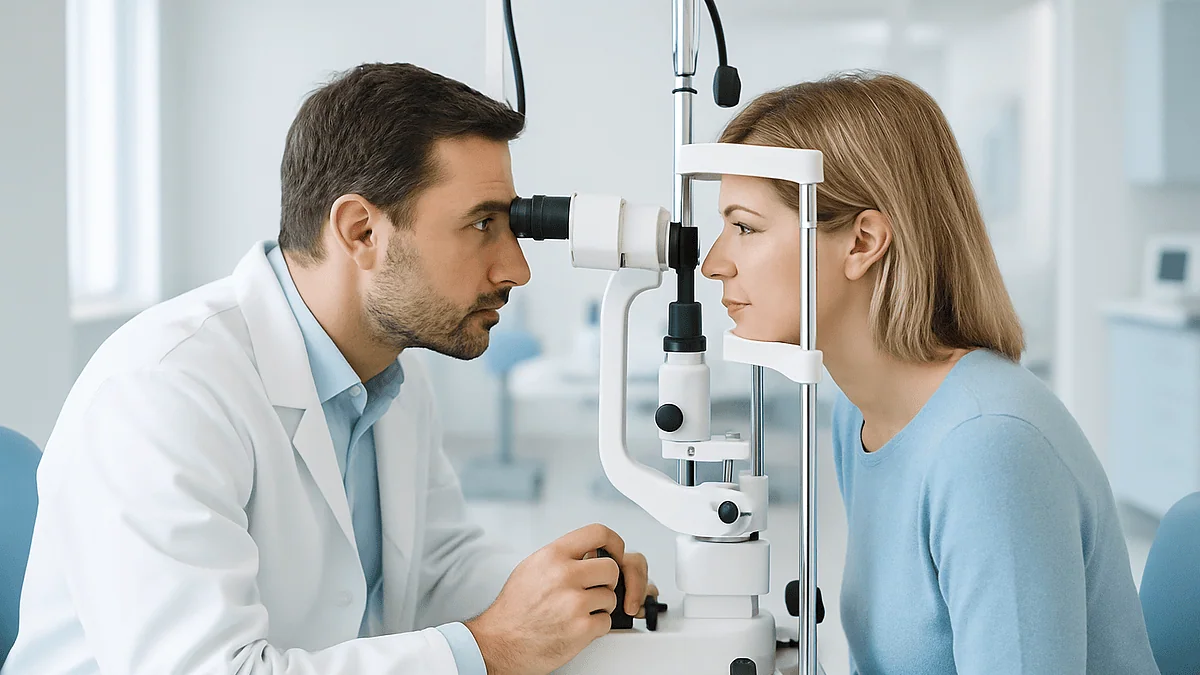
How eye doctors diagnose farsightedness
A comprehensive eye exam does three jobs: it measures the refractive error, it checks how the eyes work together, and it looks at the health of the eye structures. For hyperopia the first two matter most, and the method is more careful than many people realize.
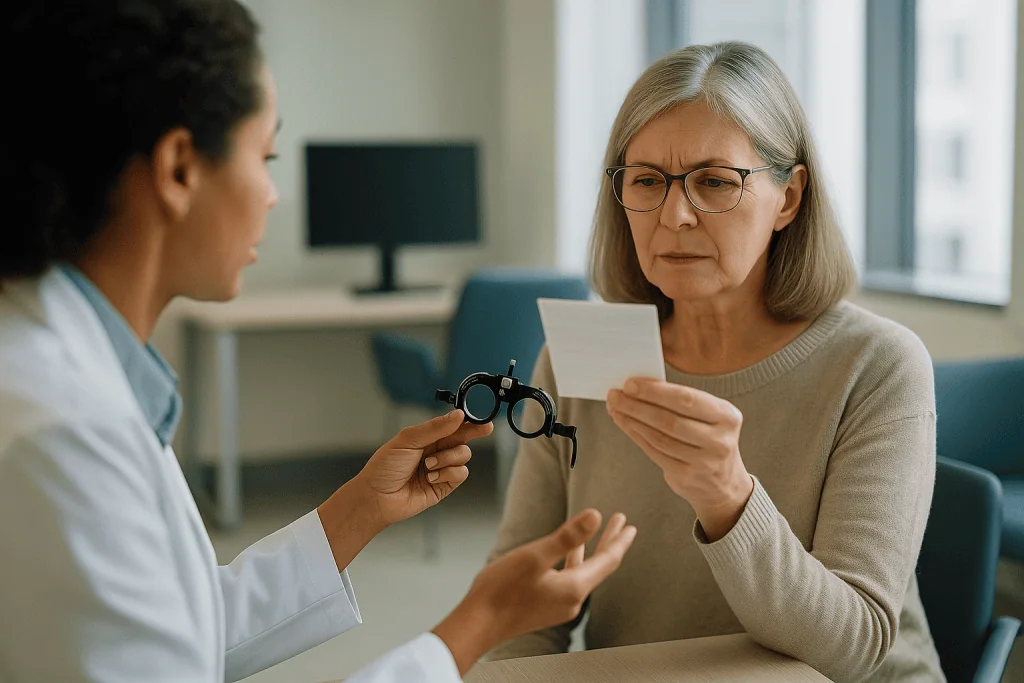
Refraction is the measurement of how much lens power the eye needs. It can start with an automated instrument, then continues with the familiar “better one or two?” routine using trial lenses. The result is expressed in diopters, a unit of lens power; a plus value indicates farsightedness. MedlinePlus describes the visual acuity test, read at a standard distance of about 20 feet, as part of this process, together with tests of eye movement, alignment and the retina.
The special problem with hyperopia is that a strong focusing muscle can hide part of the prescription. A person may measure as barely farsighted while actively accommodating, yet carry a much larger latent error. To unmask it, eye doctors often use cycloplegic eye drops, a class of drops that temporarily relax the ciliary muscle so the eye cannot compensate. Mayo Clinic notes that these drops are commonly used in children for exactly this reason. They also widen the pupil, which lets the clinician examine the retina and optic nerve. The effects wear off over hours, sometimes into the next day, and the drops are chosen and given by the clinician; nothing about them is a home decision.
The exam also checks the eyes together. Because hyperopia can trigger an inward turn, the clinician will look for alignment at distance and near, test depth perception and assess whether each eye sees equally well. In children, this part can determine whether glasses are prescribed primarily for clarity or primarily to keep the eyes straight and the visual system developing evenly.
How eye doctors plan correction: the reasoning behind the prescription
A hyperopic prescription is not simply the number from the refraction copied onto a lens order. Eye doctors weigh several factors, and the same measurement can lead to different plans for different people.
The first consideration is symptoms. Mild hyperopia that causes no strain, no headache and no reduced acuity often needs no correction at all, as the NHS points out; the eye is managing on its own. The second is age. A child with a powerful focusing reserve and a prescription likely to shrink with growth may be watched. An adult losing accommodation in their forties may need correction for the same number that was ignored twenty years earlier.
The third is the full or partial correction question. Giving a young, strongly accommodating patient the complete cycloplegic prescription can feel like too much at first, because the eye has grown used to doing the focusing itself. Clinicians sometimes prescribe part of the measured error and increase it later, or they prescribe the full amount when eye alignment or amblyopia is the priority. This is a judgement call based on the individual exam.
Fourth is the difference between the two eyes. Unequal hyperopia, called anisometropia, carries a higher risk of amblyopia in children and of discomfort in adults, so correction is often advised earlier even when the larger number is modest.
Finally, the plan considers what the person actually does all day. A graphic designer, a long-haul driver and a nine-year-old have different visual demands. The result is a plan that might say: no glasses yet, re-check in a year; or reading glasses for close work only; or full-time glasses; or, for an adult with a stable prescription, a conversation about contact lenses or surgery. Each path is reasonable in the right person, and the treating clinician is the one who matches the path to the eye in front of them.
Farsighted glasses all the time, or only for reading?
The honest answer is: it depends on why they were prescribed, and the person who prescribed them should tell you which. There is no single rule for everyone with hyperopia.
Glasses for farsightedness use convex lenses, thicker in the center than at the edge, which add the focusing power the eye lacks and move the focal point forward onto the retina. For an adult with mild hyperopia and symptoms only during close work, the clinician may suggest wearing them for reading and screens, taking them off for walking around. Nothing is harmed by either approach, and taking glasses off does not make the eyes “lazy” or weaker in adults; the muscle simply goes back to doing the compensating it has always done.
For children the advice is often different and more specific. When glasses are prescribed to control an inward eye turn or to protect a weaker eye from amblyopia, the eye doctor usually asks that they be worn throughout waking hours, because the therapeutic effect depends on the eyes being relieved of focusing strain consistently. In that situation, part-time wear can undermine the purpose of the prescription. Mayo Clinic and Cleveland Clinic both describe glasses as the usual first-line approach in children, with the wearing schedule set by the examining clinician.
Higher degrees of hyperopia in adults also tend to call for full-time wear, simply because distance vision is affected as well as near.
Two practical notes. New plus lenses can take a few days to feel natural, since objects may look slightly larger and the eye has to learn to stop over-focusing. And if the glasses make things worse rather than better after that adjustment period, that is useful information for the prescriber, not a sign to give up on correction.
Contact lenses for farsightedness: what the options look like
Contact lenses correct hyperopia the same way glasses do, by adding plus power, but they sit on the tear film over the cornea and move with the eye. Mayo Clinic lists soft lenses and rigid gas-permeable lenses as the main categories, each available in daily disposable, two-weekly or monthly replacement schedules depending on the design.
Many people with hyperopia find contacts give a wider field of view and a more natural image size than glasses, especially with higher prescriptions, where spectacle lenses can be noticeably thick and magnify the eyes. Lenses are also practical for sport. Those are genuine advantages, and they are the reasons an eye doctor may raise contacts as an alternative once a prescription is stable.
The trade-offs are hygiene and comfort. A contact lens is a medical device resting on a living surface. The risk that matters most is infection of the cornea, which the NHS and Mayo Clinic both link to poor hygiene, sleeping in lenses not designed for it, and exposure to water. Dry eye, which becomes more common with age and with heavy screen use, can make lens wear uncomfortable and is one reason some adults with hyperopia return to glasses in their forties and fifties.
For people who have both hyperopia and presbyopia, multifocal contact lenses and a technique called monovision, in which one eye is corrected for distance and the other for near, are possibilities an eye doctor may discuss. Both involve a period of adaptation and suit some people better than others.
Children are sometimes fitted with contact lenses, particularly for high or unequal prescriptions, but this is a specialist decision made with the family and depends on the child’s maturity and the ability to manage lens care safely.
Refractive surgery for hyperopia: who it is usually for and who is asked to wait
Refractive surgery reshapes the cornea so that it bends light more strongly, moving the focal point forward onto the retina without a lens in front of the eye. For hyperopia the procedures Mayo Clinic describes include LASIK, which lifts a thin flap and reshapes the tissue beneath with a laser; LASEK and PRK, which reshape the surface without a flap; and, for some older adults, lens-based options in which the natural lens is replaced with an artificial one.
Who is usually considered? Adults whose prescription has been stable, whose eyes are healthy, and whose degree of hyperopia falls within the range a given technique can reliably correct. Mayo Clinic notes that outcomes for farsightedness are generally less predictable than for nearsightedness, especially at higher prescriptions, which is one reason surgeons set tighter limits for hyperopic correction. A stable prescription matters because the cornea is reshaped once; if the eye is still changing, the result changes with it.
Who is usually asked to wait, or advised against? People whose prescription has shifted recently; those who are pregnant or breastfeeding, since hormones can alter refraction; people with significant dry eye, thin corneas, keratoconus, uncontrolled diabetes or certain autoimmune conditions; and anyone with active eye disease. Young people are generally asked to wait until the eye has finished changing. In every case the surgeon’s own assessment, including corneal mapping and a cycloplegic refraction, decides eligibility.
The risks Mayo Clinic lists are worth knowing in plain terms: dry eyes, glare and halos around lights, undercorrection or overcorrection, regression toward the original prescription, flap problems in flap-based procedures, and, rarely, loss of best corrected vision. Surgery also does not prevent presbyopia; an adult corrected for distance in their thirties should expect reading glasses later, just as everyone else does.
Surgery is a choice, never a requirement. Glasses and contact lenses remain fully valid long-term options, and a good surgical consultation spends as much time on reasons to decline as on reasons to proceed.
Does farsightedness get worse with age? Hyperopia and presbyopia together
The number on the prescription often rises in midlife, which feels like the condition is worsening. In most cases the hyperopia itself has not changed. What has changed is the eye’s ability to hide it.
Through childhood and early adulthood the lens is soft and the ciliary muscle can round it up easily, supplying plus power on demand. From the late thirties onward the lens gradually stiffens. Mayo Clinic places the usual onset of noticeable presbyopia at around age 40. For someone with no refractive error, this shows up as trouble with small print. For someone with latent hyperopia it shows up earlier and harder, because the eye was already spending its focusing reserve just to see at distance, and now there is nothing left over for near.
That is why a person can be told in their mid-forties that they are “quite farsighted” after a lifetime of unaided vision. The latent prescription has become manifest. It is also why the first glasses for hyperopia in midlife are sometimes needed for distance as well as reading, which can be an unwelcome surprise to someone expecting a simple pair of readers.
Correction in this phase typically involves one of three approaches: separate pairs for distance and near, bifocal or progressive lenses that put both in one frame, or multifocal contact lenses. Which one suits a person depends on their work, how they tolerate adaptation, and personal preference, and the eye doctor will usually offer a trial rather than a decree.
Beyond the sixties, the NHS notes that regular eye tests are recommended at least every two years for adults, and more often if advised, because midlife eye exams also screen for glaucoma, cataract and retinal change that have nothing to do with refractive error but share the same appointment. Mayo Clinic’s schedule for adults without risk factors suggests an exam every 2 to 4 years between 40 and 54, every 1 to 3 years from 55 to 64, and every 1 to 2 years after 65.
What the following days and weeks usually look like after correction
Correction for hyperopia has a timeline, and knowing it in advance removes most of the worry.
With new glasses, the first week is an adjustment. Plus lenses make objects appear slightly larger and can create a brief feeling that the floor is closer or that edges curve. The eye also has to unlearn its habit of over-focusing, and in the meantime some people feel that vision through the new lenses is softer than their unaided vision at distance. That is expected, particularly after a cycloplegic refraction that revealed a larger prescription than the person was used to. Most people adapt within days; if clear vision has not settled after a couple of weeks, or if headaches are worse rather than better, the prescriber will want to re-check the measurement and the fitting.
Children often adapt faster than adults, but parents should expect some resistance at first and should keep to the wearing schedule the eye doctor set, especially when glasses are part of amblyopia or eye-turn management. A follow-up visit is usually arranged within months to see how alignment and acuity are responding.
After laser refractive surgery, Mayo Clinic describes a period of blurry, watery, light-sensitive vision in the first hours, improving over days, with final results taking weeks to months as the cornea heals and stabilizes. Dry eye is common during this phase and is managed by the surgical team. Driving, swimming, eye makeup and contact sports each have their own waiting periods set by the surgeon. Follow-up appointments in the first days and weeks are not optional; they are how early complications are caught.
Hyperopic laser correction in particular can drift slightly over the first months as the cornea settles, which is why surgeons talk about regression and why the final assessment of the result waits until the eye is stable. If an enhancement is ever considered, that is a separate decision made on a stable eye, not a promise built into the first procedure.
What people often get wrong about farsightedness
“Farsighted means I see far perfectly.” Not necessarily. With low hyperopia and a young eye, distance vision is usually fine. With higher degrees, or as accommodation declines, distance blurs too. The name describes which end of the range is easier, not which end is guaranteed.
“I passed the school screening, so my child’s eyes are fine.” Distance screening is designed to catch myopia and does it well. A farsighted child can read the chart by focusing harder, so hyperopia and its complications, amblyopia and eye turn, are among the things a screening can miss. A full exam with a cycloplegic refraction is a different test.
“Wearing glasses makes your eyes dependent and weaker.” In adults, there is no evidence that correct glasses weaken the eye. What people experience is contrast: after a period of comfortable, effortless vision, going back to unaided focusing feels harder than it did before, because it always was hard and they had simply stopped noticing. In children the opposite is true; prescribed glasses are sometimes essential to normal visual development.
“Reading glasses from a store fix farsightedness.” Ready-made readers add the same plus power to both eyes and can help some adults with mild symmetrical hyperopia or presbyopia with near tasks. They cannot correct astigmatism or unequal prescriptions, and they do nothing for distance. They are not a substitute for an exam, which is also screening for eye disease.
“Eye exercises will reverse it.” Hyperopia is a matter of eye length and corneal curvature. No exercise changes those. Exercises are sometimes used by clinicians for specific eye-coordination problems, which is a different thing, and they are not a treatment for refractive error.
“Surgery means never needing glasses again.” Laser correction treats the refractive error present at the time. It does not stop presbyopia, and hyperopic corrections can regress. Many people who have surgery still use reading glasses later in life.
Questions to ask your care team about hyperopia correction
A good consultation runs on good questions. These are the ones that tend to change the plan or settle the worry, phrased so you can take them into the room.
- How farsighted am I, in diopters, and was that measured with drops? If not, would a cycloplegic refraction change the number?
- Is my prescription the same in both eyes? If not, what does the difference mean for me, or for my child?
- Do I actually need correction now, or is this something you would monitor? What would make you change that advice?
- Is this prescription the full measured amount or a partial one, and why?
- Should the glasses be worn all the time or only for close work, and what happens if they are worn less than advised?
- For a child: are there signs of amblyopia or an eye turn, and what are we trying to achieve with the glasses beyond clear vision?
- How often should we come back, and what will you be checking at each visit?
- Am I a reasonable candidate for contact lenses, and which type would you suggest trying first?
- If I am considering surgery: which procedure fits my degree of hyperopia, what are the specific risks for my eyes, and what would make you advise against it?
- Will any correction I have now change what I need in my forties and beyond?
- Are there other findings from the exam, such as the pressure in my eyes or the appearance of the retina, that I should know about?
Bring the last prescription if you have one; the trend over time is often more informative than a single reading. Bring a short description of when symptoms appear, since “headache after an hour on the laptop” tells the clinician more than “tired eyes.” And if a child is the patient, a note from a teacher about reading behavior is genuinely useful evidence.
When to call your doctor
Farsightedness itself is not an emergency. Some of the things that can accompany it, or be mistaken for it, are. The following warrant a same-day call to an eye doctor or emergency service rather than waiting for a routine appointment.
- Sudden loss or sudden blurring of vision in one or both eyes, even if it recovers.
- A new eye turn in a child, an eye that drifts inward or outward, a persistent head tilt, or a child who starts closing or covering one eye.
- Double vision that is new.
- Eye pain, especially with redness, nausea or halos around lights, which can signal a sharp rise in pressure inside the eye.
- A shower of new floaters, flashes of light, or a curtain or shadow across part of the vision, which can indicate a retinal tear or detachment.
- After refractive surgery: increasing pain, worsening rather than improving vision, discharge, or a feeling that something has moved in the eye.
- In a contact lens wearer: a red, painful, light-sensitive eye, which should be assumed to be an infection until examined; remove the lens and seek care the same day.
- A white reflection in a child’s pupil in photographs, or any sudden change in a child’s eye appearance.
For the quieter signs, such as persistent headaches after close work, eye fatigue, a child avoiding reading or holding books unusually close, or a feeling that an existing prescription no longer works, a routine appointment is appropriate. The NHS recommends adults have a sight test at least every two years, and more often if advised, because the appointment screens for conditions that have no early symptoms at all.
Whatever the finding, the decision about whether and how to correct hyperopia, and whether anything more serious is present, rests with the examining optometrist or ophthalmologist. This article explains the reasoning; it cannot replace the exam.
Frequently asked questions
What distance is farsightedness?
There is no fixed distance at which farsightedness begins. Hyperopia adds a constant focusing shortfall that the eye must overcome at every range, and near objects simply require more focusing power than distant ones. With mild hyperopia and a young eye, only close reading may be affected; with higher degrees or with age, screens and eventually distant objects blur as well. An eye doctor measures the error in diopters, not in feet or meters.
What is long-sightedness and how is it different from farsightedness?
Long-sightedness and farsightedness are the same condition, known clinically as hyperopia. The NHS uses the term long-sightedness; US sources say farsightedness. Both describe an eye that focuses light behind the retina, making near vision the harder task. It should not be confused with presbyopia, the age-related stiffening of the lens that affects near focus in most people from about 40, which can occur with or without hyperopia.
What does it mean if someone has a farsighted personality?
Nothing medical. “Farsighted” as a personality description is a figure of speech meaning someone who plans ahead and anticipates consequences, borrowed from the idea of seeing far. It has no connection to the eye condition, and having hyperopia does not shape temperament or thinking style. If the question arose because of a vision concern, the only meaningful farsightedness is the one measured in an eye exam.
Should I wear my farsighted glasses all the time?
Follow the wearing schedule your prescriber gave you, because it depends on why the glasses were issued. Adults with mild hyperopia and symptoms only during close work are often told to wear them for reading and screens. Higher prescriptions usually mean full-time wear. Children whose glasses manage an eye turn or protect against amblyopia are generally asked to wear them throughout waking hours, since part-time wear can undermine the purpose of the correction.
Is hyperopia in children something to worry about?
Mild hyperopia in a young child is common and often lessens as the eye grows, so it is usually monitored rather than treated. Moderate or high hyperopia, or a big difference between the eyes, matters more because it can lead to amblyopia or an inward eye turn during the years when vision is still developing. Scheduled childhood eye checks and a full exam with cycloplegic drops are how eye doctors decide which children need glasses now.
Nearsighted vs farsighted: which is more common?
Both are common, and prevalence varies with age. Nearly all infants are born farsighted and most grow out of it, while myopia tends to appear and progress in school years and has become more frequent in many populations. Farsightedness often resurfaces as a noticeable problem in midlife when accommodation declines. The more useful question for any individual is which one they have, which only a measured refraction can answer.
Can farsightedness go away on its own?
In children, often yes to a degree: the eyeball lengthens with growth, moving the retina toward the focal point, and mild hyperopia frequently fades. In adults the eye shape is set, so the hyperopia itself does not disappear. What changes is how well the eye can mask it, and that masking ability declines with age. This is why a prescription that seemed unnecessary in youth may become needed later.
Why did my eye doctor use drops before measuring my prescription?
The drops were almost certainly cycloplegic, a class that temporarily relaxes the focusing muscle inside the eye. In hyperopia the muscle can hide part of the prescription by over-focusing during the test, so the measurement without drops can read lower than the true error. Relaxing the muscle reveals the full amount. The drops also widen the pupil for a retinal check. Blur and light sensitivity are expected and wear off over hours.
Does laser eye surgery work for farsightedness?
Laser procedures such as LASIK and PRK can correct hyperopia by steepening the central cornea, but Mayo Clinic notes that results for farsightedness are generally less predictable than for nearsightedness, particularly at higher prescriptions, and some correction can regress over time. Candidacy depends on a stable prescription, healthy corneas and no active eye disease. Surgery does not prevent presbyopia, so reading glasses may still be needed later. The surgeon’s assessment decides.
Can store-bought reading glasses correct farsightedness?
They can help some adults with mild, equal hyperopia or presbyopia with near tasks, because they add plus power to both eyes. They cannot correct unequal prescriptions or astigmatism, and they do nothing for distance vision. Using them is not harmful in adults, but it is not a substitute for an eye exam, which measures each eye separately and also screens for conditions such as glaucoma and retinal disease that have no early symptoms.
References
This article is for general information only and is not a substitute for professional medical advice. Please consult a qualified doctor about your individual situation.
Add us as a Preferred Source to see more of our trusted health content across Google Search, AI Overviews and Discover.

More from the Blog

LASIK, SMILE or PRK for Myopia: A Neutral Comparison of the Three Laser Routes
LASIK, SMILE and PRK all treat myopia by using a laser to flatten the cornea so light focuses on the retina. LASIK lifts a…
Smart Lens Recovery: Drops, Adaptation Weeks and When Both Eyes Work Together
Smart lens recovery, meaning recovery after a multifocal or trifocal intraocular lens is implanted during cataract or lens-replacement surgery, usually involves a protective shield…
How Long Does a Black Eye Last? Healing Stages by Color and Signs That Need Care
A typical black eye lasts about 2 to 3 weeks, according to NHS guidance. Swelling peaks within the first two days, the bruise darkens…
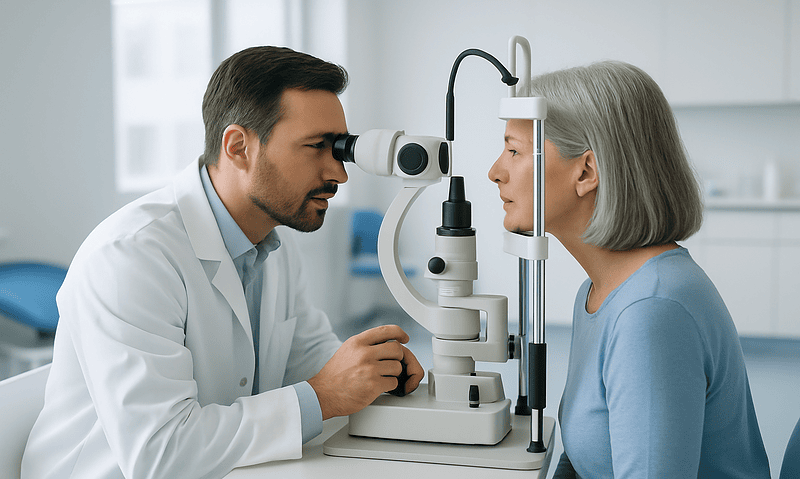
How Conjunctivitis Spreads and Runs Its Course: Viral, Bacterial and Allergic Pink Eye
Conjunctivitis spreads mainly by touch: infected tears or discharge reach the fingers, then a towel, pillow, doorknob or another person's eye. Viral pink eye…

Adapting to a Multifocal Lens: Why the Brain Needs Weeks and What Helps
Adapting to a multifocal lens usually takes weeks rather than days because the lens splits incoming light into several focal points at once, and…
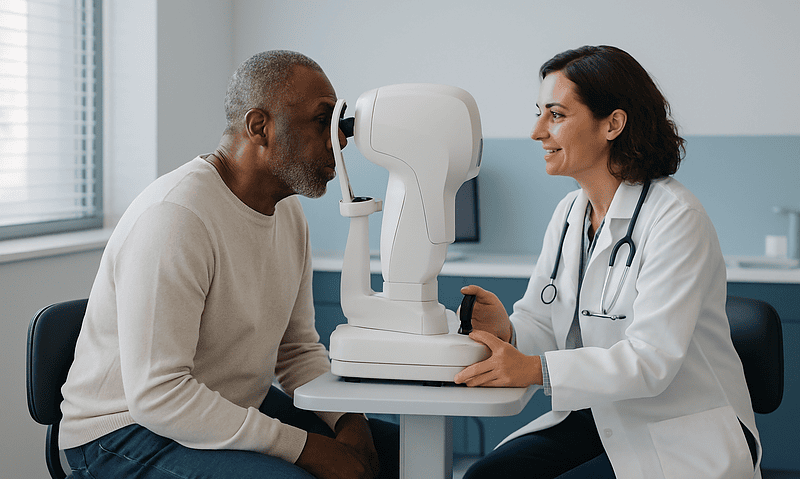
What Retinal Scans Reveal in Diabetic Retinopathy: Swelling, Leaks and New Vessels
A diabetic retinopathy OCT scan is a painless light-based imaging test that produces a cross-section of the retina, the light-sensing layer at the back…