Farsightedness Treatment
Farsightedness, or hyperopia, is a refractive error that makes near vision blurry. Treatment may include glasses, contact lenses, or laser vision correction after a detailed eye examination.
Quick answer
Farsightedness, or hyperopia, is a refractive error in which light focuses behind the retina, making nearby objects appear blurry while distance vision may remain clearer. At Acibadem, treatment begins with a detailed eye examination and may include glasses, contact lenses, or laser vision correction selected according to the eye’s structure and the patient’s visual needs.
Farsightedness (Hyperopia): What It Is and When to Treat It
Farsightedness, known medically as hyperopia, is a refractive error in which light entering the eye focuses behind the retina instead of directly on it. The result is that near objects, a book, a phone screen, a needle and thread, look blurred or demand extra visual effort, while distance vision often remains comparatively clear. Hyperopia affects both children and adults, and in most cases it can be corrected with glasses, contact lenses or, for selected adults, refractive surgery.
Many people first notice the problem during close work: reading small print, using a phone, working at a computer, or helping a child with homework. For some patients, the issue is not obvious blur at all. Instead, they describe tired eyes, headaches after reading, burning sensations, or difficulty concentrating after a period of close work. Because young eyes can partly compensate for hyperopia by focusing harder, the condition can go unrecognised for years, surfacing only as vague discomfort or a failed vision screening.
For most patients, the questions are broader than the blur itself. You may want to know whether your diagnosis is accurate, whether you need glasses or contact lenses, whether laser vision correction is suitable for your eyes, and what follow-up will involve. Parents may be worried about a child’s school performance or an eye that seems to turn inward. Adults may be concerned about growing dependence on reading glasses, persistent eye strain, or whether their hyperopia is connected to age-related vision changes.
Farsightedness is common, and in many cases it can be managed effectively. The starting point is a detailed eye examination that measures the true refractive error, assesses the health of the whole eye, and establishes whether hyperopia is the only cause of the symptoms. Treatment may be as simple as prescription glasses, as flexible as contact lenses, or, for carefully selected adults, a form of laser vision correction or lens-based refractive surgery. At Acibadem, farsightedness is evaluated within a structured ophthalmology pathway that looks beyond the prescription alone: the aim is to understand how your eyes focus, how they work together, and whether any associated conditions need attention before a treatment plan is recommended.
What is the meaning of farsightedness?
Farsightedness means that the eye’s optical system is not strong enough for its length, so the sharpest point of focus falls behind the retina rather than on it. The name reflects what most people experience: far objects are seen more easily than near ones. It is worth knowing that the label is a simplification. People with significant hyperopia may find that distance vision is also blurred, and young people with mild hyperopia may see clearly at all distances while paying a hidden price in focusing effort. The meaning of the term, then, is best understood as a description of where the eye focuses light, behind the retina, rather than a fixed statement about what any individual can or cannot see.
What is another term for farsightedness?
Hypermetropia and hyperopia are both alternative terms for farsightedness, and in British English the condition is often called long-sightedness. All of these words describe exactly the same focusing error; the difference is simply regional and professional usage. In clinical notes and prescriptions you may see the abbreviation for hyperopic correction written as a plus power, because the corrective lens adds focusing strength to the eye. If your previous records use one term and a new clinic uses another, nothing about your diagnosis has changed, only the vocabulary.
Is hypermetropia a disease?
Although the search phrase hypermetropia disease is common online, hypermetropia is a refractive error rather than a disease. The eye is usually structurally healthy; it is simply shaped in a way that places the focal point behind the retina. That distinction matters for how you think about treatment. A refractive error is corrected or compensated for, not treated in the way an infection or inflammation is treated. At the same time, significant hyperopia can be associated with genuine medical issues, amblyopia and eye-turn in children, or a narrower drainage angle in some adult eyes, which is why a full eye-health examination accompanies any refraction.
What does a person with hyperopia see?
A person with hyperopia typically sees near objects as blurred, soft or effortful, while distant objects appear clearer. In mild cases, especially in younger people, vision may seem normal at every distance because the eye’s internal focusing muscle quietly compensates; the person then notices fatigue, headaches or slow refocusing rather than blur. In moderate cases, reading and screen work become genuinely difficult without correction. In high hyperopia, blur can affect all distances, because no amount of focusing effort can move the image forward onto the retina. What a farsighted person sees therefore depends on three things: the strength of the prescription, their age, and how long they have been asking their focusing system to work overtime.
What Causes Farsightedness
Farsightedness happens when the optical power of the eye does not match its length. Three anatomical variations can produce this mismatch: the eyeball may be slightly shorter than average from front to back, the cornea may be flatter than average and therefore bend light less strongly, or the crystalline lens inside the eye may contribute less focusing power than the eye’s length requires. Any of these, alone or in combination, pushes the focal point behind the retina.
What is the main cause of hyperopia?
The main cause of hyperopia is an eye that is shorter than average, which is largely determined by genetics and by how the eye grows during childhood. Most babies are born with a degree of hyperopia; as the eye grows, the mismatch usually reduces, and many children naturally grow towards normal focusing. When that process is incomplete, hyperopia persists into adulthood. Persistent hyperopia in a child is a variation in eye growth rather than a structural congenital disease, but higher degrees still deserve early attention because of their effect on visual development. Less commonly, hyperopia can appear or increase after certain eye conditions or eye surgery, which is one more reason a full examination accompanies the measurement of the prescription.
Latent hyperopia: how young eyes hide the problem
Latent hyperopia is farsightedness that is partly concealed by the eye’s own focusing effort, a process called accommodation. Young people can often compensate for mild hyperopia by contracting the focusing muscle inside the eye, which effectively adds the missing optical power. This compensation can hide the prescription during routine daily activities and even during a standard eye test, but it may cause headaches, eye fatigue or intermittent blur: the muscle is working constantly, even for distance vision. As people get older, the ability to accommodate declines. Hyperopia that was invisible at twenty becomes noticeable at thirty-five and unmistakable after the onset of presbyopia, the normal age-related loss of near focusing ability. This is why some adults feel their eyes have suddenly “worsened” when in fact a long-standing hyperopia has simply been unmasked.
Farsighted or Nearsighted: Two Opposite Focusing Errors
What is the difference between nearsightedness and farsightedness?
The nearsighted meaning is the mirror image of farsightedness: a nearsighted (myopic) eye focuses light in front of the retina, so close objects are seen clearly while distant objects are blurred, whereas a farsighted eye focuses light behind the retina, so near objects are the problem. A near sighted eye is usually slightly longer than average or has a steeper cornea; a farsighted eye is usually slightly shorter or has a flatter cornea. The two errors are corrected with opposite lens types, minus-powered lenses for myopia, plus-powered lenses for hyperopia, and they behave differently over a lifetime. Myopia typically develops and progresses during school years; hyperopia is often present from early childhood and becomes more symptomatic with age as focusing reserve declines.
Is hyperopia worse than myopia?
Neither hyperopia nor myopia is worse in a general sense; they carry different considerations, and severity matters more than category. Both are refractive errors that can usually be corrected well. Each is associated with its own set of concerns that an ophthalmologist watches for: significant hyperopia in children can contribute to amblyopia and inward eye-turn if untreated, and shorter hyperopic eyes may have narrower internal drainage angles that deserve monitoring in adulthood; higher degrees of myopia carry their own retinal considerations. The practical answer for any individual comes from an examination, not from comparing labels. A low, well-corrected prescription of either kind typically has little impact on daily life; a high, uncorrected prescription of either kind can affect function considerably.
Who May Need Treatment for Farsightedness
You may need treatment for farsightedness if near vision is blurred, close work causes fatigue, or your eyes feel strained even when distance vision seems acceptable. Some patients have obvious symptoms; others only discover they are farsighted after an eye examination arranged for headaches, reading difficulty or a failed vision screening.
Common symptoms of hyperopia include:
- Blurred near vision, especially during reading or computer use
- Headaches after close work
- Eye strain, aching or burning sensations
- Difficulty refocusing when shifting between distance and near tasks
- Squinting, or holding reading material farther away
- Reduced concentration during study or desk work
- Intermittent double vision or eye fatigue in some cases
- In children: avoidance of reading, losing their place on the page, poor school performance, or an eye that turns inward
Children deserve particular attention because they rarely complain of blur: a child who has always seen the world one way has no comparison to draw on. Behavioural signs are often the first clue: reluctance to read, sitting very close to work, closing one eye, or declining performance at school. Significant hyperopia in childhood can interfere with visual development, so an examination is worthwhile whenever these signs appear or a screening result is uncertain.
Several patient situations commonly lead to treatment. A child is referred after a school screening or because of a crossed eye. A university student develops headaches with long reading sessions. A professional experiences increasing strain with screen use. A person in their forties feels that near vision is changing quickly and wonders whether hyperopia, presbyopia or both are involved. Another patient already wears glasses or contact lenses and wants to know whether laser correction could reduce dependence on them. Each of these situations calls for the same starting point, accurate measurement, but often leads to a different plan.
Treatment is appropriate when hyperopia contributes to functional limitation, discomfort or the risk of associated problems. Even mild farsightedness may deserve correction if it causes symptoms. Conversely, some people with low hyperopia and no symptoms need only observation and periodic eye examinations.
How Farsightedness Is Diagnosed
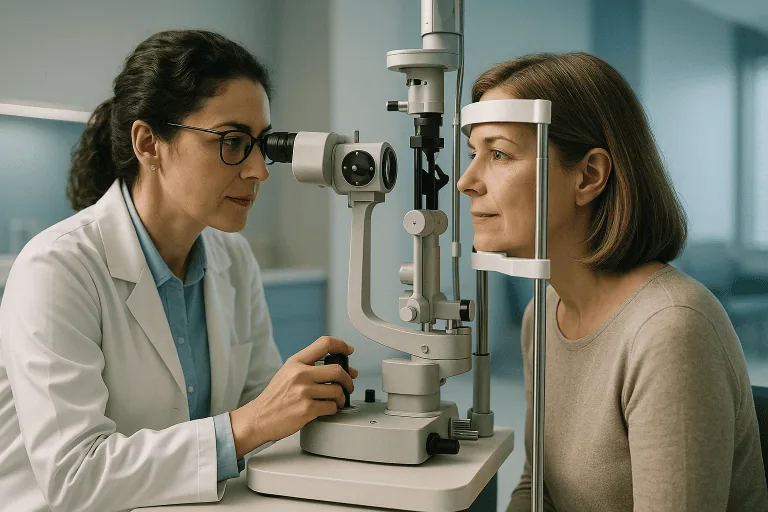
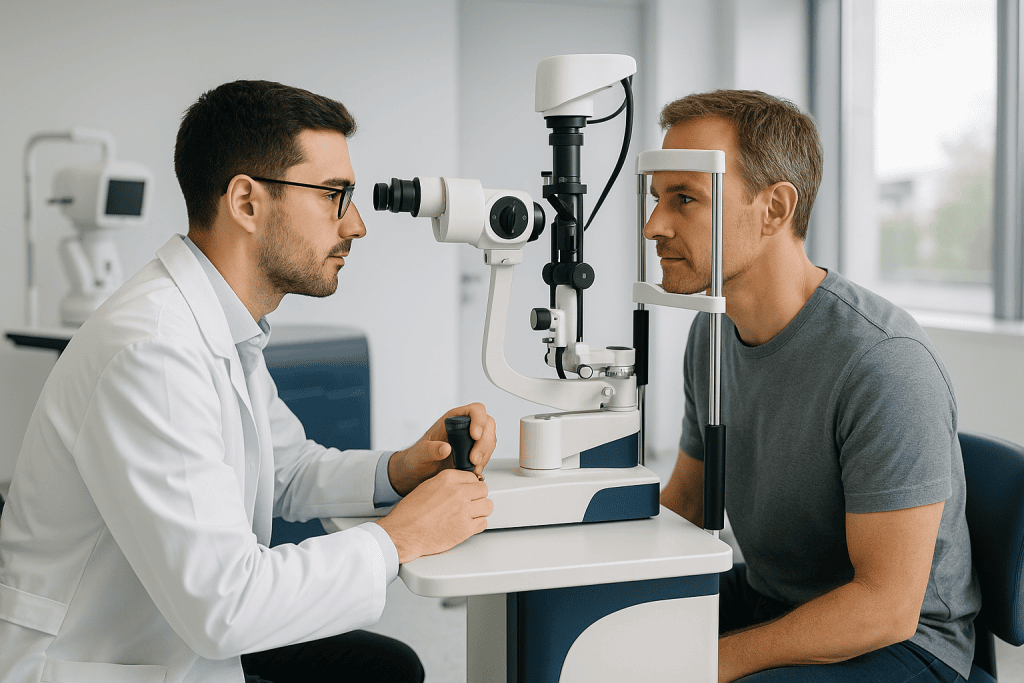
Diagnosis begins with a comprehensive eye examination. This usually includes visual acuity testing, refraction to measure the prescription, assessment of both distance and near vision, evaluation of how the two eyes work together, and a health examination of the front and back of the eye. The examination establishes not only the size of the refractive error but whether it fully explains the symptoms: an important distinction, because eye strain and blur have many possible causes.
In children and in some adults, the doctor may use dilating drops to relax the focusing muscle before measuring the prescription. This is called cycloplegic refraction, and it is particularly useful because young eyes can hide farsightedness by over-focusing during the test. Without cycloplegia, latent hyperopia can be substantially underestimated, leading to a prescription that corrects only part of the problem.
Additional tests are added when surgical correction is being considered. These may include corneal mapping (topography or tomography), corneal thickness measurement, tear film evaluation, pupil assessment, eye pressure testing and detailed retinal examination. These steps determine whether laser vision correction is safe and appropriate for your particular eyes, or whether another option would serve you better.
General health is also part of the picture, because systemic conditions can influence the eyes. Thyroid diseaseparticularly Graves diseasecan affect the eyelids and ocular surface, and inflammatory conditions such as Crohn disease are occasionally associated with eye inflammation. None of these causes hyperopia, but they can affect measurement accuracy, contact lens comfort and surgical candidacy, so they belong in the conversation with your ophthalmologist.
Conditions and Indications Addressed by Farsightedness Treatment
Farsightedness treatment addresses a refractive error, but it can also improve symptoms and functional concerns related to how the eyes focus and work together. The plan may be straightforward for isolated hyperopia, or more comprehensive when other eye conditions are present.
Common indications include:
- Simple hyperopia: near vision is blurred because the eye does not focus light strongly enough on the retina.
- Latent hyperopia: the farsightedness is partly hidden by the eye’s focusing effort and becomes apparent during cycloplegic refraction or when symptoms develop.
- Hyperopia with astigmatism: the cornea or lens has an uneven curvature, causing blur or distortion at more than one distance.
- Hyperopia with presbyopia: adults over about forty may have both farsightedness and age-related near focusing difficulty, requiring a tailored plan for distance, intermediate and near vision.
- Eye strain from close work: correcting hyperopia can reduce the effort needed for reading, studying or screen use.
- Accommodative esotropia in children: significant farsightedness can cause a child’s eye to turn inward when trying to focus; glasses may help control alignment.
- Amblyopia risk in children: unequal or high hyperopia can hold back vision development in one or both eyes if not corrected early.
- Contact lens intolerance: patients who cannot comfortably wear contact lenses may explore glasses or surgical alternatives.
- Desire to reduce dependence on corrective lenses: selected adults may be candidates for laser or lens-based correction after a detailed evaluation.
Hyperopia treatment may also form part of a broader eye care plan when cataracts, dry eye disease, corneal conditions, glaucoma risk or retinal disease are present. In these cases, correcting the refractive error without addressing the underlying eye health issue would be incomplete. A thorough examination establishes the full picture before decisions are made.
Can Hyperopia Be Corrected? The Treatment Options
Yes, hyperopia can be corrected, and for most people the correction is straightforward. Treatment works by changing the way light focuses inside the eye so that the image lands on the retina rather than behind it, which makes near vision clearer and reduces the effort of focusing. Correction does not remove the diagnosis in every case; rather, it corrects or compensates for the focusing problem. The main options are:
- Prescription eyeglasses: often the first and simplest treatment, especially for children, people with eye strain, and patients who prefer a non-invasive option. Hyperopia lenses add focusing power so light converges on the retina.
- Contact lenses: a practical choice for many adults and teenagers who want wider peripheral vision, fewer lifestyle limitations, or freedom from glasses for sport and social activities.
- Laser vision correction: in selected adults, laser procedures reshape the cornea to increase its focusing power and reduce dependence on glasses or contact lenses.
- Lens-based procedures: for certain patients, especially those with high hyperopia, early cataract changes or presbyopia-related concerns, replacing or supplementing the eye’s natural lens may be considered.
- Treatment of associated issues: dry eye, eye muscle imbalance, amblyopia in children, or other eye conditions may need management as part of the overall plan.
The most appropriate treatment is never chosen from the prescription alone. Two patients with the same degree of hyperopia may need different solutions because of their age, occupation, hobbies, tear film quality, corneal measurements, pupil size and expectations for distance and near vision. A careful examination matches the treatment to the person, not just to the number on the prescription.
Can LASIK fix farsightedness?
LASIK and related laser procedures can correct farsightedness in appropriately selected adults by reshaping the cornea to steepen its central curvature, increasing the eye’s focusing power. Whether laser correction is right for you depends on the size and stability of your prescription, corneal thickness and shape, ocular surface health, pupil characteristics and your age. Hyperopic laser treatment has practical limits: very high prescriptions may fall outside the range where corneal reshaping is sensible, and adults with presbyopia need honest counselling that reading glasses may still be needed later, because presbyopia progresses regardless of surgery. Some patients discuss blended vision or monovision strategies that balance distance and near focus, but these require careful counselling and often a trial with contact lenses before any surgery. When the cornea is unsuitable, a lens-based procedure may be the safer route, which is why the evaluation, not the patient’s preference alone, drives the recommendation.
How Farsightedness Treatment Is Performed
The treatment pathway begins with accurate diagnosis and a conversation about your daily visual needs. It helps to bring previous eye prescriptions, contact lens details, past eye surgery records, and any reports related to glaucoma, retinal disease, cataracts or corneal problems. If you wear contact lenses, you may be advised to stop wearing them for a period before certain measurements, particularly when laser vision correction is being considered: contact lenses can temporarily alter corneal shape, and reliable measurements are essential to safe planning.
Step 1: Comprehensive eye examination
The ophthalmology team evaluates visual acuity, refractive error, eye pressure, corneal clarity, lens status, retinal health and, where relevant, eye alignment. In children and in adults with variable results, dilating drops may be used to reveal the full amount of hyperopia. If surgery is being considered, advanced imaging analyses corneal shape, thickness, surface regularity, tear film quality and other safety factors. This stage matters because not every patient with farsightedness is a candidate for every treatment. High prescriptions, thin corneas, irregular corneal maps, significant dry eye, unstable refraction, pregnancy-related vision changes, uncontrolled autoimmune disease, cataracts or retinal concerns can all change the recommendation.
Step 2: Choosing the most appropriate correction
For many patients, glasses remain the most reliable and flexible treatment. Hyperopia lenses add focusing power, making it easier for light to reach the retina in focus. Children may need full-time wear if the prescription is significant, if eye alignment is affected, or if there is a risk of amblyopia. Adults may use glasses for reading, computer work or full-time correction, or choose progressive lenses that help at multiple distances.
Contact lenses provide another non-surgical option. Soft lenses, toric lenses for astigmatism, multifocal designs or customised lenses may be considered depending on the prescription and the state of the eye surface. Fitting includes measurement, trial lenses, comfort assessment, vision testing and education on hygiene, proper handling is essential to reduce the risk of infection or inflammation.
For selected adults, refractive surgery is discussed. Laser correction reshapes the cornea to increase its focusing power, planned from your diagnostic measurements. Lens-based refractive procedures may be considered when laser correction is not ideal or when lens changes are already present; these are more commonly discussed in older adults, in patients with higher hyperopia, or in patients who also have cataracts. The decision is individualised, because lens procedures carry different benefits, risks and recovery considerations from corneal laser treatment.
Step 3: The procedure or fitting process
If glasses are chosen, the prescription is translated into lenses suited to your needs, single-vision near glasses, distance correction, computer glasses, bifocals or progressives. Adaptation can take a few days to a few weeks, particularly with progressive lenses or a first prescription. If contact lenses are chosen, the process covers lens selection, fitting, assessment of movement and comfort, and instruction on cleaning, insertion, removal, replacement schedules and safe wear, with follow-up visits to confirm the lenses provide clear vision without harming the cornea.
If laser vision correction is chosen, a typical treatment day follows a clear sequence:
- Final measurements are confirmed and the treatment plan is reviewed with you.
- Numbing eye drops are applied; no general anaesthesia is needed for standard corneal laser procedures.
- The laser reshapes the cornea according to the personalised plan. The laser stage itself is usually brief, although preparation and checks mean you should expect to spend longer at the clinic.
- The surgeon examines the eye, and you go home the same day with protective instructions, prescribed eye drops and a follow-up schedule.
The technologies used across evaluation and treatment may include computerised refraction systems, corneal topography or tomography, optical measurements of eye structures, tear film analysis, retinal imaging and laser platforms for corneal reshaping. Their shared purpose is to make the invisible details of the eye measurable, so that candidacy decisions and treatment plans rest on data rather than assumption.
Step 4: Recovery and follow-up
Recovery depends on the treatment. With glasses, improvement is usually immediate, though adaptation takes time. With contact lenses, vision may improve as soon as the right lens is fitted, but comfort and handling skills develop with practice. After laser correction, many patients notice improved functional vision within days, but vision can fluctuate during healing, hyperopic corrections in particular can take time to settle, and dryness, glare, halos, light sensitivity or mild irritation may occur temporarily. Follow-up is essential after any surgical procedure and important for children, patients with high prescriptions and contact lens users. Your care team will explain the follow-up schedule in advance and how longer-term monitoring of your eyes will be arranged.
Why Acting Early Matters
Farsightedness is rarely urgent, but delayed evaluation allows avoidable symptoms to continue. In adults, untreated hyperopia can mean persistent headaches, reduced productivity, eye fatigue and difficulty with reading or screen-based work. Patients often compensate unconsciously by straining the focusing system; that effort becomes steadily less sustainable with age, which is why symptoms tend to build rather than fade.
In children, early diagnosis is particularly important. Significant hyperopia can interfere with visual development, contribute to amblyopia, or cause an eye to turn inward. Because children seldom complain of blur, changes in behaviour are often the first sign, avoiding reading, losing their place on the page, squinting, closing one eye, or slipping school performance. Correcting the refractive error during the years when the visual system is still developing gives the child’s vision the best conditions to mature.
For adults considering laser vision correction, timing matters for a different reason: the prescription should be stable and the eye surface healthy before surgery. Managing dry eye, allergy, eyelid inflammation or other surface conditions beforehand improves both comfort and measurement accuracy. If cataracts or other eye disease are present, the refractive plan may need to change entirely. Acting early creates room for the correct sequence of care rather than a rushed decision.
Benefits of Farsightedness Treatment
The benefits of treatment depend on the degree of hyperopia, your age, your symptoms and the method used, but the goals are consistent: clearer near vision, less strain and more comfortable daily function.
| Benefit | What It Means for You |
|---|---|
| Clearer near vision | Reading, phone use, computer work and other close tasks may become easier and more comfortable. |
| Reduced eye strain | Correcting the focusing error can lessen headaches, fatigue and discomfort caused by prolonged visual effort. |
| Improved function at work or school | Concentration during study, desk work, digital tasks or detailed manual activities may come more easily. |
| Support for healthy visual development in children | Early correction can help manage amblyopia risk, eye alignment problems and learning-related visual barriers. |
| More lifestyle flexibility | Contact lenses or surgical options may reduce dependence on glasses for selected patients. |
| Personalised long-term vision planning | The plan can account for presbyopia, cataract risk, dry eye and future changes in visual needs. |
Recovery Timeline After Farsightedness Treatment
Recovery varies with the method, glasses, contact lenses, laser correction or lens-based surgery, but most patients return to normal routines quickly with the right guidance.
| Time Period | What Patients Can Expect |
|---|---|
| Day 1 | With glasses or contact lenses, vision often improves immediately, though adaptation may be needed. After laser correction, mild irritation, watering, light sensitivity or fluctuating vision can occur. |
| First week | Patients with new glasses continue adapting to the lens design. Contact lens users refine handling and wear time. After laser treatment, follow-up visits check healing, eye pressure where needed, and the response to drops. |
| First month | Visual comfort usually becomes more stable. Dryness or night-vision symptoms after laser correction often improve gradually, though some patients need longer treatment for ocular surface symptoms. |
| Longer term | Regular eye examinations monitor prescription changes, eye health, contact lens safety and age-related needs such as presbyopia or cataracts. |
What Influences a Good Result
A good result in farsightedness treatment is not defined only by reading the smallest line on an eye chart. It also includes comfort, stability, safety, and whether the correction fits your daily life. Several factors influence the outcome, and it is worth understanding them before deciding on a path.
Accurate measurement is central. Hyperopia can be underestimated when the eye’s focusing muscle is active during testing, especially in children and young adults, so cycloplegic refraction may be necessary to uncover the true prescription. For surgical planning, stable and repeatable measurements are essential: a plan built on a partial number corrects only part of the problem.
Age and focusing ability shape both symptoms and choices. A young patient may compensate for hyperopia but develop strain. A patient in their forties or fifties may have hyperopia and presbyopia together, requiring a plan that considers distance, intermediate and near vision. The right goal differs between a pilot, an office professional, a surgeon, a teacher and a patient who spends long hours reading.
Prescription strength and stability matter. Mild hyperopia may be managed with occasional glasses; moderate or high hyperopia may require full-time correction. Surgical options are usually considered only when the prescription has been stable and the eye meets safety criteria.
Corneal shape and thickness are decisive for laser correction. A healthy, regular cornea with adequate thickness is needed for corneal laser procedures. When the measurements raise concern, non-surgical correction or a lens-based approach may be the safer choice.
Ocular surface health influences both comfort and visual quality. Dry eye disease, allergies, eyelid inflammation and contact lens intolerance should be identified and managed. A healthy tear film improves diagnostic accuracy before treatment and comfort after it.
Associated eye conditions can change the plan. Cataracts, glaucoma risk, retinal disease, amblyopia, strabismus, keratoconus or previous eye surgery all require careful assessment. In some cases, the priority is treating the underlying condition before any refractive correction.
Realistic expectations complete the picture. Glasses and contact lenses can provide excellent correction but require ongoing use and care. Laser surgery can reduce dependence on corrective lenses in well-selected patients, but reading glasses may still be needed later because presbyopia progresses with age, and some patients need enhancement treatment or continue to use glasses for particular tasks. Adherence to follow-up and instructionsusing prescribed drops after surgery, keeping to safe contact lens habits, attending recommended checkups, supports safety throughout.
How Acibadem Approaches Farsightedness Evaluation and Treatment
Deciding how to correct farsightedness is both medical and practical: you want confidence in the diagnostic process, clarity about the options, and a realistic picture of what follow-up will involve. Acibadem’s ophthalmology services are structured around careful evaluation, with the diagnostic work done before any treatment is proposed.
Patients are evaluated by ophthalmologists who consider both refractive goals and overall eye health. When additional expertise is needed, care can involve related specialists, paediatric ophthalmology, cornea and external disease, cataract and refractive surgery, retina, glaucoma or strabismus. This multidisciplinary approach is particularly valuable when hyperopia is associated with amblyopia, eye alignment problems, cataracts, corneal irregularity or other conditions that affect treatment selection.
Diagnostic pathways may include detailed refraction, dilated examination, corneal imaging, ocular surface assessment, retinal evaluation and the other measurements used to determine whether glasses, contact lenses, laser correction or lens-based treatment is most appropriate. For patients considering laser vision correction, the evaluation is intentionally selective: not every person who wants surgery should have surgery. The surgeon assesses whether the cornea is suitable, whether the prescription sits within an appropriate range, whether dry eye is controlled, and whether the near-vision goals are realistic. When surgery is not the best option, the responsible recommendation may be glasses, contact lenses, medical treatment of the ocular surface, or a different surgical pathway, and that is stated plainly.
Practical planning is part of good eye care, and it matters more than it might seem: contact lenses may need to be left out for a period before certain measurements, pupils are dilated on examination days, postoperative visits follow a set schedule, and temporary driving restrictions can apply after some procedures. All of this is explained in advance so that appointments can be planned realistically. Many patients also seek a second opinion before proceeding with laser or lens surgery; an independent review can clarify whether the diagnosis is complete, whether the prescription is stable, whether the proposed treatment is appropriate, and what alternatives exist, particularly useful for patients who have heard different things in different clinics or who have complex eye histories.
Choosing the Right Correction for You
Farsightedness is common, but the right treatment is personal. Some patients need nothing more than an updated prescription. Others need a paediatric eye care plan, a contact lens fitting, treatment for dry eye, or a detailed candidacy assessment for laser or lens-based correction. What unites all of these paths is the starting point: an examination that measures the true refractive error, latent hyperopia included, and evaluates the health of the whole eye. From there, the choice between glasses, contact lenses and surgery becomes a matter of matching each option’s strengths and limits to your age, your prescription, your eye health and the way you actually use your vision every day.
Preparation
- A comprehensive eye examination is performed to measure refractive error, corneal thickness, eye pressure, and overall eye health. Patients may need to stop wearing contact lenses for a period before laser assessment. The ophthalmologist reviews suitability, expectations, medications, and any conditions such as dry eye.
Aftercare
- Vision may fluctuate for a few days, and prescribed eye drops should be used as directed. Patients should avoid rubbing the eyes, swimming, and dusty environments during early healing. Follow-up visits are important to monitor recovery and visual results.
Frequently Asked Questions
What affects the cost of farsightedness treatment?
The cost depends on the correction method, the degree of hyperopia, associated astigmatism or presbyopia, diagnostic tests, surgeon and hospital factors, technology used and what is included in aftercare. A specialist examination is needed before a reliable quote can be prepared.
How can I get a personalised quote for hyperopia correction in Turkey?
You can request a free consultation and share your current prescription, previous eye reports and any relevant medical history. The care team can then advise which examinations are needed and prepare a personalised estimate based on your suitability and treatment plan.
Is laser vision correction always available for farsightedness?
No. Laser treatment depends on corneal shape, corneal thickness, tear film, prescription stability and overall eye health. If laser correction is not suitable, glasses, contact lenses or lens-based options may be discussed by the specialist.
What should be included in a treatment package?
Patients should ask whether the package includes the eye examination, diagnostic tests, surgeon assessment, procedure if suitable, medications, follow-up visits, interpreter support and travel coordination. Inclusions vary by provider, so written confirmation is important.
Will insurance cover farsightedness treatment?
Coverage varies by country, insurer and policy. Glasses or contact lenses may be treated differently from elective refractive procedures. Patients should confirm coverage directly with their insurer and request a written estimate from the clinic.
Medically reviewed by the Acıbadem International Medical Board September 13, 2026
See our medical review board →
Update history
- PublishedJune 8, 2026
- Medical review approvedSeptember 13, 2026
- Last content updateSeptember 12, 2026
References1
- Farsightedness medlineplus.gov
Trusted care for international patients
From the Acibadem Blog

Glasses, Contacts or Laser for Farsightedness: How the Decision Usually Unfolds
Farsightedness treatment options usually begin with glasses, which correct the focusing error with a convex lens and carry no medical risk. Contact lenses offer…
Can Laser Eye Surgery Correct Farsightedness? What Makes Someone a Candidate
Yes. Laser eye surgery, including LASIK and surface procedures such as PRK, can correct mild to moderate farsightedness (hyperopia) by steepening the central cornea…