

Fat Transfer Recovery Timeline: Healing the Donor Site and the Grafted Area at the Same Time

Key Takeaways
- Fat transfer recovery involves two sites with opposite needs: the liposuction donor site is compressed to control fluid, while the grafted area is protected from any pressure so new blood vessels can grow into the fat.
- The donor site is usually the more painful zone in the first week, and the NHS suggests planning around two weeks away from work after liposuction, longer for physical jobs.
- Volume loss in the grafted area around weeks three to six reflects swelling draining and non-viable fat being reabsorbed, which the NHS describes as a normal part of the procedure rather than a failure.
- The final shape after fat transfer can take up to six months to settle, according to the NHS, so early comparisons to the planned result are misleading.
- Grafted fat is living tissue that enlarges or shrinks with your body weight, so weight stability protects the result more than any product marketed for graft survival.
- Fever above 100.4°F (38°C), spreading redness, calf pain, chest pain or sudden breathlessness after fat transfer are red flags that warrant same-day medical contact, as outlined by MedlinePlus.
Fat transfer recovery time runs on two clocks. The liposuction donor site is usually the sorer one, with bruising and swelling that ease over several weeks and a compression garment worn for a similar period. The grafted area looks swollen and overfull at first, then gradually loses volume as unsupported fat cells are reabsorbed. The NHS notes the final shape can take up to six months to settle.
The morning after surgery, most people are surprised by which part hurts. The cheeks, breasts or hips that received the new fat feel tight and puffy, but oddly calm. The hips or belly where the fat was taken feel as if someone has been kneading them with a rolling pin. Two sets of dressings, two very different sensations, one body trying to heal both at once.
That double act is what makes fat transfer recovery time confusing to read about online. Most guides describe the result and forget the donor site; others describe liposuction recovery and forget that the fat has to survive somewhere new. In reality you are managing a bruised harvest zone and a fragile, freshly grafted zone on the same calendar, and they do not keep pace with each other.
What follows is the honest version: what happens in the first three days, why week three can feel like a step backward, when the shape finally settles, and which signs mean you should stop reading and call your team.
What actually happens during a fat transfer
Fat transfer, also called fat grafting or autologous fat transfer, is a procedure in which fat is removed from one part of your body and injected into another. Autologous simply means the tissue is your own, so there is no foreign implant and no risk of rejection in the immunological sense.
The operation has three stages. First, the surgeon performs liposuction, a technique that suctions fat through a thin hollow tube called a cannula, inserted through incisions only a few millimeters long. Before suctioning, the area is usually infused with tumescent fluid, a mixture of salt water, a local anesthetic and a medicine that narrows blood vessels to limit bleeding. This fluid is why the donor site feels heavy and leaks a pink-tinged liquid for a day or two afterward, as MedlinePlus describes for liposuction generally.
Second, the harvested fat is processed. Surgeons let it settle, filter it, rinse it or spin it in a centrifuge, a device that separates dense fat cells from blood, oil and fluid. The goal is a clean, concentrated graft.
Third, the fat is injected into the target area in many thin threads rather than one large deposit. This matters biologically: a transplanted fat cell has no blood supply of its own, so it survives only if it sits close enough to existing tissue for new capillaries to grow into it within days. Fat placed in a thick clump tends to die in the middle, which is one reason large single-session volumes are limited.
Depending on how many areas are treated, the NHS notes fat transfer may be done under local anesthetic with sedation or under general anesthetic, sometimes with an overnight stay. Your team will tell you which applies to your plan.
Why fat transfer recovery time means healing two sites at once
Think of the donor site as a bruise the size of a dinner plate, and the grafted area as a new plant that has just been bedded into soil. Both are healing, but they need opposite things.
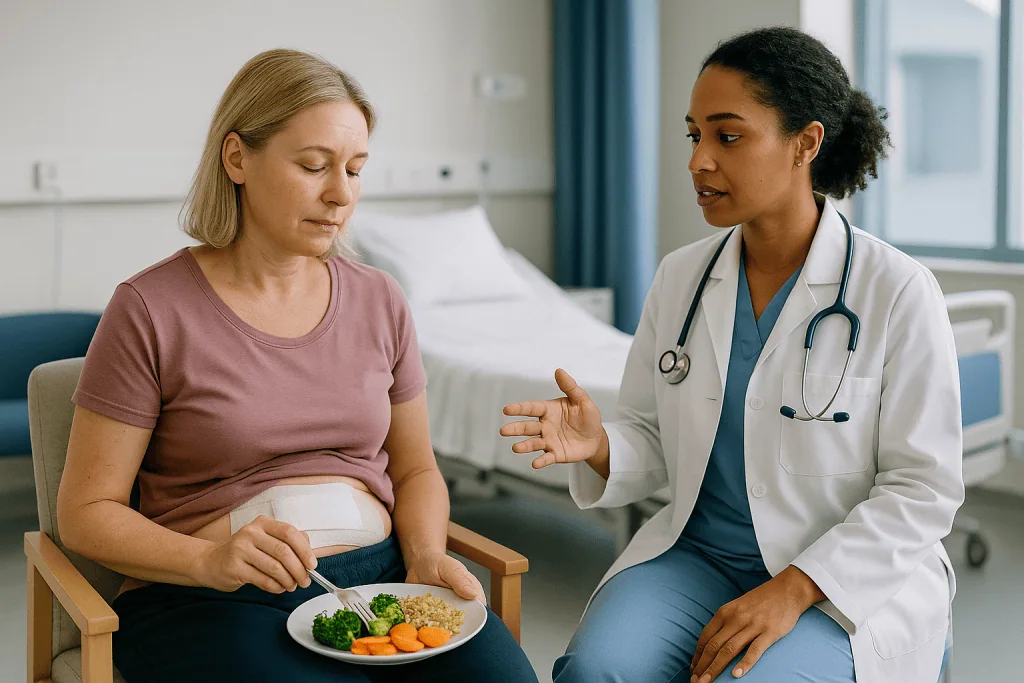
The donor site has been through a mechanical process. The cannula creates a network of tiny tunnels through the fat layer, blood vessels are disrupted, and fluid collects in the spaces left behind. Healing here means controlling swelling, letting bruising clear and encouraging the skin to re-drape over the smaller fat layer. Compression garments, which the Mayo Clinic notes are commonly worn for a few weeks after liposuction, help by reducing fluid buildup and supporting the tissue while it settles.
The grafted area is a biological process. The injected fat cells are in a race: they need oxygen and nutrients from surrounding tissue within the first days, and new blood vessels have to grow into the graft, a process called revascularization. Anything that squeezes the area, starves it of blood flow or shears the delicate new vessels can reduce how much fat survives. That is why surgeons ask you to avoid pressure on the grafted area rather than compress it, and why the two sites often come with contradictory instructions.
The sensations differ too. Donor-site pain is typically described as deep soreness, like an intense workout combined with a bruise, and it is usually the dominant discomfort in week one. Grafted areas tend to feel tight, swollen and numb rather than painful. Knowing this in advance stops people from worrying that the quiet, puffy side is the one in trouble. Usually it is behaving exactly as expected.
The first 72 hours after fat transfer
The first three days are about fluid, bruising and rest, in roughly that order.
On day one you will likely feel groggy from anesthesia and notice damp dressings over the donor incisions. That leakage is mostly tumescent fluid and a small amount of blood finding its way out; MedlinePlus lists this drainage as a normal part of early liposuction recovery. Your team will show you how to change pads and when the leaking should taper off.
Swelling in both zones typically builds over the first two to three days rather than peaking immediately. The grafted area may look considerably larger than the planned result, which is expected and not a sign that too much fat was placed. Bruising spreads and changes color as blood breaks down under the skin.
Pain control is planned by your surgical team. Many people are prescribed short courses of pain relievers; some classes of over-the-counter anti-inflammatory medicines and any blood-thinning medicines can affect bruising and bleeding, so follow the specific list you were given and ask before adding anything, including supplements.
Movement matters even now. Gentle walking around the house from the first evening keeps blood moving in the legs, and MedlinePlus notes that immobility after surgery is a recognized risk factor for deep vein thrombosis, a clot in a deep leg vein. Walk slowly, often and briefly.
Sleep and sitting positions depend entirely on where the fat went. After buttock grafting you will be told how to avoid direct pressure; after facial grafting you may be asked to sleep on your back with your head raised; after breast grafting you may be asked to avoid sleeping face down. These instructions protect the graft during its most vulnerable window.
Weeks one and two: bruising, numbness and going back to work
By the end of the first week the leaking has usually stopped, the worst of the soreness is behind you and the bruising has started its color parade from purple to green to yellow. Small incisions are checked, and any non-dissolving stitches are typically removed at a follow-up visit.
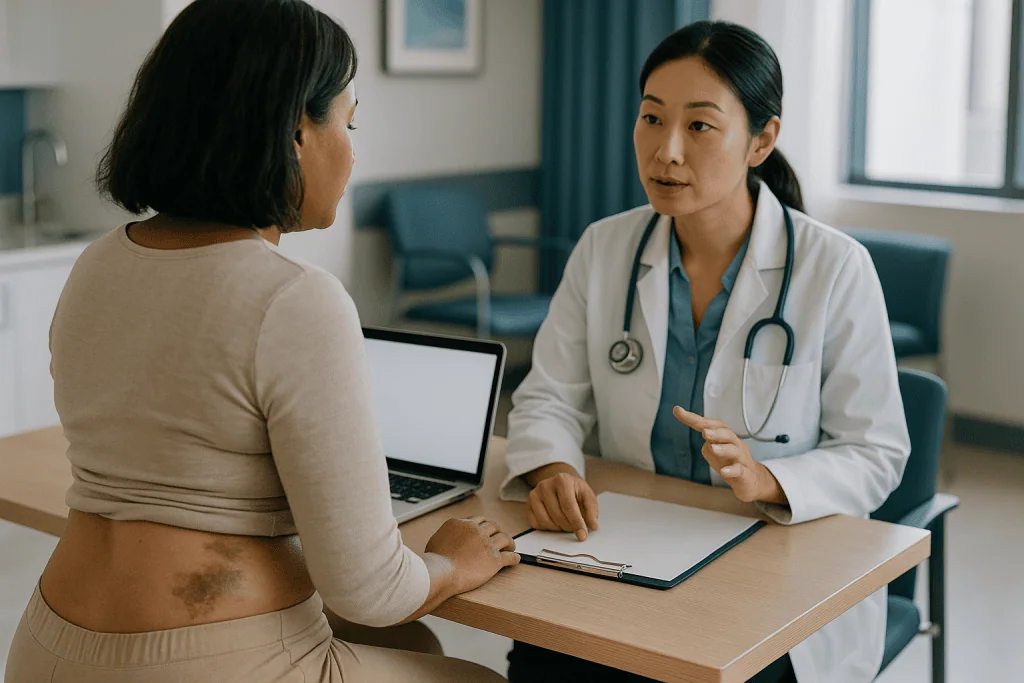
Numbness is common at both sites and can be unsettling. Fine sensory nerves in the skin are disturbed by both liposuction and injection, and they recover slowly. The Mayo Clinic notes that numbness after liposuction is usually temporary, though it can linger for weeks or longer. Itching as sensation returns is also common and is generally a sign of healing rather than a problem.
Most people ask about work at this point. The NHS suggests planning for roughly two weeks off after liposuction, with longer for physically demanding jobs, and the same planning applies when liposuction is part of a fat transfer. A desk-based role may be manageable earlier if pain is controlled and you can protect the grafted area, for example by using a special cushion after buttock grafting. Your team will give you a personal timeline.
Compression garments over the donor site usually continue through this period. They can feel tedious, particularly in warm weather, but they reduce fluid buildup and help skin settle onto its new contour. The grafted area, by contrast, still needs protection from pressure, tight clothing and vigorous rubbing.
Visually, this can be an awkward stretch. The grafted area often still looks overfilled while the donor site looks swollen rather than slimmer. If you compare yourself to the pre-operative plan now, you will be disappointed for no good reason. The comparison that matters is the one at several months.
Weeks three to six: the fat transfer swelling timeline and why the shape keeps changing
Around week three, many people report the same thing: the grafted area looks smaller than it did last week. Two processes are running at once, and together they create the illusion of a result slipping away.
The first is straightforward. Swelling is draining, so the tissue that looked plump because of fluid is now showing its true volume.
The second is the reabsorption of fat that did not survive. Fat cells that failed to gain a blood supply in the early days die and are gradually cleared by the body’s immune cells over the following weeks. The NHS is explicit that some transferred fat being reabsorbed is a normal part of the procedure, not a complication. How much survives varies widely between people and between body areas, and no published technique reliably predicts it in advance. A surgeon who told you that a certain fraction would stay was estimating from experience, not measuring your tissue.
The donor site is changing too. Firm, lumpy or ropey patches under the skin are common in this window as the internal tunnels heal and scar tissue matures. These areas usually soften over the following months.
Activity restrictions begin to ease, but not all at once. Both the NHS and the Mayo Clinic advise avoiding strenuous exercise for several weeks after liposuction, and grafted areas are often given the same or longer protection because raised heart rate and impact can increase swelling and disturb healing tissue. Walking generally continues to be encouraged.
This is the point where patience is genuinely a clinical tool. The shape you see at week four is neither the result nor a failure; it is an intermediate frame in a slow-motion film.
How long does it take for a fat transfer to look good?
Most people want a single date. The honest answer is a range: the grafted area usually starts to look natural once the bulk of the swelling has gone, and the NHS advises that it can take up to six months for swelling to settle fully and for the true result of a fat transfer to be visible.
Why so long? The two healing curves cross. Swelling falls steadily from the first week, while the volume of surviving fat stabilizes only after the body has finished clearing cells that did not take. Until both curves flatten, the picture keeps changing. The Mayo Clinic makes a similar point about liposuction alone, noting that the final contour of a treated area typically emerges over several months as swelling resolves.
Body region matters. Facial grafts are small, sit in thin tissue and are visible from all angles, so early puffiness is obvious but tends to clear relatively quickly. Breast and buttock grafts involve larger volumes and deeper tissue, so the settling period tends to run longer. Hands, with almost no fat padding of their own, can look dramatically swollen at first and then thin noticeably as excess fluid leaves.
Lighting, weight and menstrual cycle can all shift the appearance day to day. Surgeons often suggest photographing the area in the same spot, in the same light, at set intervals such as two weeks, six weeks, three months and six months, so you compare like with like instead of trusting a mirror at seven in the morning.
If something looks asymmetric or unusually hard at any stage, mention it at follow-up rather than waiting for it to resolve on its own. Most early irregularities settle; the ones that do not are easier to plan for when they are documented early.
Fat transfer recovery time by area: face, breast, buttock and hands
The pattern of recovery is similar everywhere, but the practical details differ. This table summarizes what usually distinguishes each area. Timeframes are typical ranges drawn from general NHS and Mayo Clinic guidance on liposuction and fat transfer, not promises for any individual.
| Grafted area | Usual donor sites | Main grafted-area caution | Typical settling pattern |
|---|---|---|---|
| Face (cheeks, under-eyes, temples, lips) | Abdomen, inner thighs | No pressure from sleeping face-down, glasses or massage until cleared | Bruising and puffiness are very visible early; shape settles as swelling clears, with final volume judged over months (NHS) |
| Breast (asymmetry, reconstruction, modest enhancement) | Abdomen, flanks, thighs | Soft support only; no compression bra unless instructed; avoid lying prone | Larger volumes mean longer swelling; new baseline imaging may be advised because grafted fat can produce benign calcifications |
| Buttock and hips | Abdomen, flanks, back, thighs | Avoid direct sitting pressure for the period your surgeon specifies; use approved cushions | Combined large-volume liposuction and grafting; both sites swell heavily and settle over several months |
| Hands | Abdomen, thighs | Limit heavy gripping and tight rings early | Striking early swelling because the tissue is thin; volume drops noticeably as fluid clears |
Two threads run through every row. The donor site follows liposuction rules: compression, walking, a gradual return to activity. The grafted area follows graft rules: protection from pressure, no vigorous manipulation, and time. Where the two sets of instructions seem to conflict, for example a garment that also presses on grafted hips, ask your team how they want you to manage it rather than guessing.
How to keep fat alive after fat transfer: what the evidence actually supports
This is the question people search most, and it deserves a candid answer. Most advice about protecting a graft comes from mechanism and surgical experience rather than large controlled trials. That does not make it wrong, but it means the confidence level is moderate, and no habit can guarantee a particular amount of survival.
The strongest principle is blood supply. New fat lives only if capillaries grow into it, so anything that reduces blood flow to the area in the first weeks is plausibly harmful. That is the reasoning behind three common instructions: avoid direct pressure on the graft, avoid tight clothing over it, and do not smoke. Nicotine constricts small blood vessels, and the NHS lists smoking among the factors that slow wound healing and raise complication risk after cosmetic surgery.
The second principle is stability. Grafted fat behaves like the fat it came from. If you gain weight, the grafted cells enlarge; if you lose a significant amount, they shrink. Surgeons generally ask that weight be stable before surgery and for the settling period afterward, so the result reflects the graft rather than a diet.
The third is restraint. Massage, heat, vigorous exercise and early sun exposure are usually discouraged for several weeks because they increase swelling or shear delicate tissue. Ice directly on a graft is also often discouraged for the same blood-flow reasons; ask before applying anything.
What the evidence does not support is any supplement, cream or device marketed as boosting graft survival. Reasonable nutrition, hydration and sleep help wound healing in general, but nothing you can buy has been shown to change how much fat takes. Spend the effort on following the specific protection plan you were given.
Who fat transfer is usually for, and who is usually asked to wait
Fat transfer is typically offered to adults who want to restore or add volume in a specific area and who have enough spare fat to harvest. Common uses include filling hollows in the face that come with age or weight loss, correcting breast asymmetry or refining the result of breast reconstruction, adding fullness to the buttocks and hips, softening the appearance of scars or depressions, and rejuvenating the backs of the hands.
Very lean people may be told they are not good candidates simply because there is too little fat to collect, and the surgeon cannot take it from where it is structurally needed. This is a physical limit, not a judgment.
Several groups are commonly asked to wait or to consider a different approach:
- People who smoke or vape nicotine, because of impaired healing and blood flow; teams typically ask for a nicotine-free period before and after surgery.
- People whose weight is actively changing or who plan significant weight loss, since the graft will shrink or grow with them.
- People planning pregnancy or currently breastfeeding, particularly for breast grafting.
- People with poorly controlled diabetes, bleeding disorders, or an active infection anywhere in the body.
- People with a history of breast cancer or ongoing cancer treatment, where fat transfer to the breast should be planned jointly with the oncology team.
- Anyone under 18, which the NHS notes applies to cosmetic procedures generally.
Realistic expectations are also a candidacy issue. Someone hoping for a dramatic, guaranteed volume change in one session may be steered toward a staged plan or a different option. The decision about whether and when to proceed always sits with the treating team, who can weigh your history against what the procedure can reliably deliver.
What are the downsides of fat transfer?
Every procedure has trade-offs, and fat transfer has some that are unusual because it involves two operative sites and a living graft.
The defining downside is unpredictability. A portion of the transferred fat will not survive, and the NHS notes that some people need a second procedure to reach the volume they were hoping for. You are, in effect, signing up for a result that will be judged months later and might require a repeat.
Common, usually temporary effects include bruising, swelling, numbness and discomfort at both sites. Contour irregularities at the donor site, such as dents, waves or asymmetry, can occur after liposuction, as the Mayo Clinic describes, and are more likely when large volumes are removed or skin elasticity is poor.
At the grafted area, fat can form small firm lumps or oil cysts, pockets of liquefied fat from cells that died. In the breast these can calcify and appear on mammograms; radiologists can usually distinguish them from suspicious findings, but it is one reason to tell every future imaging provider that you have had fat grafting.
General surgical risks apply: infection, bleeding, fluid collections known as seromas, scarring at incision points and blood clots in the legs or lungs. MedlinePlus lists reduced mobility after surgery among the recognized contributors to deep vein thrombosis.
The rarest and most serious risk is fat embolism, in which fat enters the bloodstream and travels to the lungs or brain. The NHS lists it as a potential complication of fat transfer. It has been most associated with large-volume buttock grafting, and surgical technique has evolved in response, but no procedure removes the risk entirely. Ask how your surgeon addresses it.
Is a facial fat transfer worth it? Weighing durability against unpredictability
Worth is personal, but the trade-offs can be laid out plainly. Facial fat transfer competes mainly with injectable fillers and, in some cases, with implants or lifting surgery.
Hyaluronic acid fillers, gels made from a sugar molecule that occurs naturally in skin, are placed in an office visit with minimal downtime. Their results are temporary, they can be dissolved with an enzyme if needed, and the amount is precisely controlled. Their weaknesses are the ongoing need for repeat sessions and the cumulative cost in time and appointments.
Fat, by contrast, is living tissue. The portion that survives is expected to persist and to age with your face, and the material is your own. Against that, you accept a surgical recovery with a sore donor site, a settling period that the NHS describes as up to six months, visible early puffiness, and a final volume that cannot be dialed in with the precision of a syringe of gel. If the surviving amount is less than hoped, correction means another procedure rather than a quick top-up.
Solid implants for the cheeks or chin offer predictable volume and shape but introduce a foreign object with its own risks of shifting or infection.
The people who tend to feel a facial fat transfer was worthwhile are usually those who wanted broad, soft volume restoration across several areas, who could accept a staged plan, and who had the time to recover properly. Those who wanted a specific, guaranteed change in one small spot, or who could not take time away from work and social life, often find fillers a better fit. Neither choice is superior in the abstract; the right one depends on your goals and your tolerance for uncertainty, which is a conversation for your consultation.
How long does fat grafting last once the swelling is gone?
Once the settling period is over, the fat that remains is not a temporary product. It is your own tissue, with its own blood supply, and it behaves like fat anywhere else in your body. The NHS describes fat transfer results as long-lasting for the portion of graft that survives.
That phrasing hides two important caveats. The first is weight. Grafted fat cells enlarge and shrink with your overall body fat, so a large weight loss after facial grafting can hollow the face again, and a gain after buttock grafting can enlarge the area beyond what was planned. Stability protects the result more than any product.
The second is aging. Fat transfer adds volume, but it does not stop skin from losing elasticity, bones from remodeling or gravity from working. A face grafted at fifty will still change over the following decade; it will simply change from a fuller starting point.
Some people choose a second, smaller session after the first has fully settled to refine areas where less fat survived. Others never need one. Because retention varies so much between individuals, surgeons generally avoid quoting a fixed lifespan and instead talk in terms of expected durability for whatever remains at the six-month mark.
For breast grafting, longevity carries a screening footnote. Grafted fat can create benign calcifications or oil cysts visible on mammograms years later. Tell any future imaging service about your surgery so they can interpret the pictures correctly, and ask your team whether a new baseline mammogram after healing is appropriate in your case.
What people often get wrong about fat transfer recovery
Some misunderstandings show up in almost every consultation. Correcting them early saves a lot of needless worry.
“The size at day three is the result.” It is not. Early volume is a mixture of fat, swelling and fluid. The NHS is clear that the true result of a fat transfer is judged after swelling settles, which can take up to six months.
“My result is disappearing at week three, so it failed.” Volume loss in this window reflects swelling clearing and non-viable fat being reabsorbed. Both are expected. Genuine problems tend to announce themselves with pain, redness or fever, not with quiet shrinkage.
“Compression helps everything heal.” Compression is for the donor site. Pressure on a fresh graft can compromise its fragile blood supply, which is why surgeons protect grafted areas rather than squeeze them.
“Massage will smooth the lumps.” Early massage of a graft is usually discouraged. Donor-site firmness typically softens with time; ask before manipulating either area.
“More fat injected means more fat survives.” The opposite tends to be true. Fat has to sit close to living tissue to gain a blood supply; overpacking creates regions that die and turn into oil cysts. Surgeons deliberately limit single-session volume.
“The donor site is the easy part.” For many people it is the more painful part in the first week and the slower part to feel normal, with numbness and firmness that can persist for months, as the Mayo Clinic notes for liposuction.
“Fat transfer to the face removes wrinkles permanently.” Fat restores volume. Fine lines from movement and sun damage are a different problem, and aging continues afterward.
“If I stay very still, more fat will take.” Protecting the graft from pressure is sensible. Lying motionless for days is not; MedlinePlus lists immobility as a clot risk, and gentle walking is part of every recovery plan.
Questions to ask your care team before and after fat transfer
A good consultation should leave you with fewer questions, not more. These are the ones that tend to matter most for recovery, phrased so you can bring them to your appointment.
- Which areas will you take fat from, and what will the donor site look and feel like in the first two weeks?
- How will the fat be processed and injected, and how do you limit the risk of fat embolism in the area I am having treated?
- How much of the transferred fat do you generally expect to survive, and how will we judge that? At what point would we discuss a second session?
- What exactly should I do about pressure on the grafted area: sleeping position, sitting, clothing, glasses, bras or cushions, and for how long?
- How long will I wear a compression garment on the donor site, and how do I manage it if it overlaps a grafted area?
- When can I return to desk work, to physical work, to walking for exercise and to strenuous training?
- Which pain relievers and other medicines, including supplements, should I stop before surgery or avoid afterward, and who decides when I restart them?
- What is your policy on nicotine before and after the procedure?
- If I have had breast grafting, should I have a new baseline mammogram after healing, and what should I tell future imaging providers?
- What follow-up visits are planned, and how do I reach the team after hours if something worries me?
- If I live far away, when is it safe to travel home, and who will provide follow-up locally?
Write the answers down. The instructions for the donor site and the grafted area will differ, and it is easy to mix them up on day two when you are tired and sore. A single page of your team’s specific rules is worth more than any general article, including this one.
When to call your doctor: red-flag signs after fat transfer
Most of what you will feel in the first weeks is expected: soreness, swelling, bruising, numbness and a shape that keeps changing. A small number of symptoms are different in kind and need same-day contact with your surgical team or emergency care.
Seek care urgently if you notice any of the following. MedlinePlus lists fever above 100.4°F (38°C), spreading redness, warmth, increasing pain, or pus-like drainage around a wound as signs of possible surgical site infection. Sudden shortness of breath, chest pain, a racing heartbeat, coughing up blood or new confusion can indicate a clot or fat traveling to the lungs and are emergencies; call emergency services rather than driving yourself. Pain, swelling or warmth in one calf may signal deep vein thrombosis and also needs prompt assessment.
Contact your team the same day for heavy bleeding that soaks through dressings and does not slow with gentle pressure, a rapidly enlarging, tense or very painful area at either site, skin over the graft or donor site that turns dusky, pale or dark, sudden new asymmetry, or, after facial grafting, any change in vision or severe headache.
Less urgent but still worth a call: a persistent lump that is growing rather than softening, numbness that spreads instead of shrinking, or a low-grade fever that lingers beyond a day.
The general rule is simple. Gradual, expected changes can wait for your scheduled follow-up. Anything sudden, worsening or accompanied by fever or breathing symptoms should not. Your team would far rather hear about a false alarm than miss a real one, and every decision about further treatment belongs to them, not to a search engine.
Frequently asked questions
How long does it take for a fat transfer to look good?
The grafted area usually starts to look natural once most swelling has cleared, and the NHS advises that the final result of a fat transfer can take up to six months to become visible. Early on the area looks overfilled; around weeks three to six it often looks smaller as fluid drains and unsupported fat is reabsorbed. The shape you see at several months, not at several days, is the one to judge.
How do you keep fat alive after fat transfer?
The most supported measures protect blood flow to the graft: avoid direct pressure, tight clothing and massage over the area for the period your surgeon specifies, do not smoke or use nicotine, and keep your weight stable. Gentle walking and reasonable nutrition support general healing. No supplement, cream or device has been shown to increase graft survival, and even careful behavior cannot guarantee how much fat will take.
What are the downsides of fat transfer?
The main downside is unpredictability: a portion of the transferred fat does not survive, and the NHS notes some people need a repeat procedure. Other risks include bruising, numbness, lumps or oil cysts, donor-site contour irregularities, infection, seromas, blood clots and scarring. Grafted fat in the breast can calcify and show on mammograms. Fat embolism is rare but serious and is listed by the NHS as a potential complication.
Is a facial fat transfer worth it compared with fillers?
That depends on what you value. Fat is your own living tissue and the surviving portion is expected to last, but it requires surgery, a sore donor site, visible early puffiness and a settling period of up to six months, with a final volume that cannot be precisely controlled. Fillers are quicker, adjustable and reversible but temporary. People wanting broad, soft volume restoration often lean toward fat; those wanting a small, precise, low-downtime change often prefer fillers.
How much fat transfer donor site pain is normal?
Deep soreness at the donor site, similar to a hard bruise, is typical and usually dominates the first week before easing steadily. Firmness, numbness and tenderness can persist for weeks, and the Mayo Clinic notes numbness after liposuction is usually temporary. Pain that worsens after initially improving, or that comes with fever, spreading redness, heat or drainage, is not normal and should prompt a same-day call to your surgical team.
When can I sit down after buttock fat transfer?
Your surgeon will give you a specific period during which direct sitting pressure on the grafted area should be avoided, along with guidance on approved cushions that shift weight to the thighs. The reason is biological: pressure in the first weeks can compromise the fragile new blood supply the graft depends on. Follow the exact timeline you were given rather than a general figure, since it depends on the volume placed and your surgeon’s technique.
When can I exercise after fat grafting?
Gentle walking is usually encouraged from the first day because it helps prevent blood clots, which MedlinePlus links to immobility after surgery. Both the NHS and the Mayo Clinic advise avoiding strenuous exercise for several weeks after liposuction, and grafted areas are often protected for as long or longer because impact and raised blood pressure increase swelling. Your team will clear you for specific activities at follow-up visits.
Can the transferred fat move or shift to a different area?
Once grafted fat has gained a blood supply in the first weeks, it is fixed in place like any other tissue and does not migrate. In the very early period, heavy pressure can distort or damage the graft, which is why surgeons restrict sitting, sleeping positions and tight clothing over the area. What people sometimes perceive as movement is usually uneven survival, where more fat took in one spot than another.
How soon can I fly or travel home after fat transfer?
There is no universal number; it depends on the areas treated, the volume of liposuction and your clot risk. Long periods of sitting are a recognized contributor to deep vein thrombosis, as MedlinePlus notes, and sitting itself may be restricted after buttock grafting. Ask your surgeon when travel is reasonable, how to move and hydrate during the journey, and who will provide follow-up care and handle complications once you are home.
Will I need a second fat transfer?
Some people do and some do not. Because a variable portion of grafted fat is reabsorbed, the NHS notes that a repeat procedure is sometimes needed to reach the intended volume. Surgeons generally wait until the first graft has fully settled, often around six months, before assessing whether more fat is wanted. Whether a second session is appropriate, and how much fat is available to harvest, is a decision for you and your treating team.
References
- NHS: Surgical fat transfer
- NHS: Liposuction
- MedlinePlus: Liposuction
- MedlinePlus: Surgical wound infection: treatment
This article is for general information only and is not a substitute for professional medical advice. Please consult a qualified doctor about your individual situation.

More from the Blog
Buttock Lift Scars and Daily Life: Placement, Fading and Choosing Clothing While Healing
Buttock lift scars usually run horizontally along the upper edge of the buttocks, just below the waistline, where most underwear or swimwear can cover…

Body Contouring Recovery Milestones: Compression, Tightness and the Return to Daily Life
Body contouring recovery milestones follow a broadly predictable sequence rather than fixed dates. Drains, if used, usually come out within days; a compression garment…
Weight Changes After Fat Transfer: What Happens to Grafted Fat When Your Body Changes
Weight gain after fat transfer affects grafted fat the same way it affects fat anywhere else in the body: surviving fat cells enlarge, so…
HD Liposculpture vs Standard Liposuction: What Sculpting Around Muscle Lines Adds
HD liposculpture is a variant of liposuction in which the surgeon removes fat selectively, in layers, to reveal the outlines of underlying muscles such…
Fat Grafting Complications: Oil Cysts, Lumps and Asymmetry, and How Each Is Managed
Fat grafting complications most often include oil cysts, firm lumps from fat necrosis, uneven volume or asymmetry, bruising, numbness and infection, with fat embolism…

Can Fat Grafting Improve Scars and Contour Defects? When Surgeons Recommend It
Fat grafting can improve some scars and contour defects. A surgeon removes a small amount of a person's own fat by liposuction, processes it,…