

Brazilian Tummy Tuck Recovery: Compression, Early Walking and Protecting the Repaired Muscles

Key Takeaways
- "Brazilian tummy tuck" is a marketing label for abdominoplasty usually combined with liposuction, so recovery follows standard tummy tuck guidance rather than a separate pathway.
- Mayo Clinic and the NHS both describe wearing a compression garment for about six weeks, firm enough to support but never tight enough to restrict breathing or mark the skin.
- Walking within hours of surgery works the calf pump that pushes blood out of the deep leg veins, directly lowering the risk of deep vein thrombosis that the NHS links to surgery and immobility.
- The stitched muscle layer is held by sutures at first and only later by scar tissue, which is why coughing without splinting, lifting and straining are restricted for roughly six weeks.
- Days two to four are commonly the hardest, because inflammation peaks around 48–72 hours while local anesthetic has worn off and constipation adds abdominal pressure.
- Losing roughly 20 pounds after surgery can leave new skin laxity, which is why stable weight before the operation is treated as a prerequisite in mainstream guidance.
Brazilian tummy tuck is a marketing name for abdominoplasty, often combined with liposuction, so recovery follows the same pattern as any tummy tuck. Most people wear a compression garment for about six weeks, begin short walks within the first day to lower clot risk, and avoid lifting, twisting and strenuous exercise for roughly six weeks while the stitched muscle layer heals. The surgical team sets the exact plan for each person.
The first walk is only about twelve steps: bed to door, door to hallway, hallway back to bed. She is bent forward like someone searching for a dropped key, one hand hovering over the binder around her middle, a nurse at her elbow counting out loud. It is not graceful. It is, according to the evidence, the single most useful thing she will do that day.
People researching brazilian tummy tuck recovery tend to arrive with the same three worries: how tight the garment should feel, whether walking so soon will tear something, and what the stitched muscles can and cannot take. Underneath those questions sits a fourth, quieter one: how do I tell ordinary post-surgical misery from a real problem?
This explainer works through all four, using what mainstream guidance actually says about abdominoplasty rather than what recovery forums promise. Where the evidence is thin, we say so.
What is a Brazilian tummy tuck, and what is the recovery actually repairing?
Start with the name, because it causes confusion. “Brazilian tummy tuck” is not a distinct operation with its own guideline. It is a label some practices use for a full abdominoplasty (surgical removal of loose skin and fat from the abdomen, with tightening of the underlying muscle layer) that is combined with liposuction of the flanks and waist, and often placed with a lower scar line. Strip away the branding and you are recovering from abdominoplasty plus liposuction. That matters, because the mainstream evidence base for recovery applies directly.
Mayo Clinic describes the core steps: the surgeon makes a horizontal incision low on the abdomen, lifts the skin and fat as a single flap up to the ribs, removes excess tissue, repairs the muscle layer with sutures, repositions the navel and closes the skin. When liposuction is added, thin cannulas (hollow tubes) are passed under the skin of the sides to suction fat, which creates an additional zone of bruising and swelling.
So the body is healing three separate injuries at once. The first is a long incision that must knit at the skin surface. The second is a wide area where skin was separated from muscle and now has to reattach, which is why fluid pockets can form. The third is the muscle repair itself, a line of sutures under constant tension from every breath, cough and sit-up.
Everything in the weeks that follow, from the garment to the hunched walking posture, exists to protect one of those three healing zones. Once you know which rule serves which zone, the instructions stop feeling arbitrary.
What happens to the abdominal muscles during the operation?
The two long muscles running from ribs to pelvis are the rectus abdominis, the pair people picture when they say “abs.” They are joined in the midline by a strip of tendon-like tissue called the linea alba. Pregnancy and significant weight change can stretch that strip so the two muscles drift apart, a condition called rectus diastasis (a widening of the gap between the straight abdominal muscles). The muscles themselves are usually intact; the connective tissue between them has simply stretched.
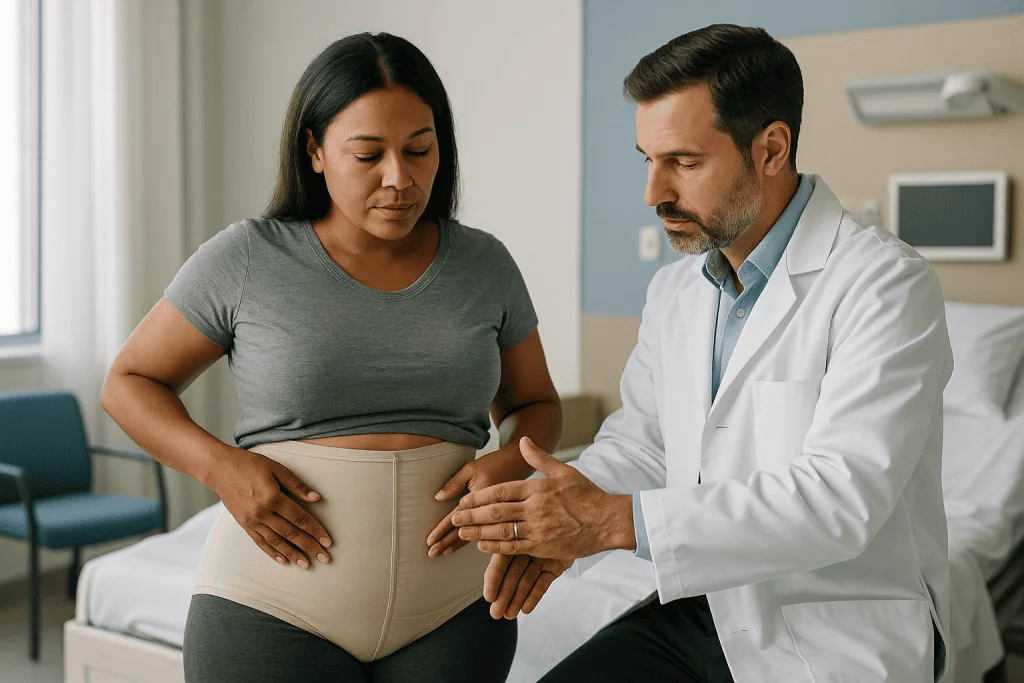
During a tummy tuck the surgeon addresses this with plication, which means folding and stitching the stretched sheath back toward the midline with rows of permanent or slowly dissolving sutures. MedlinePlus describes this as tightening the muscles and connective tissue of the abdominal wall. Think of taking in a loose waistband with a strong seam rather than cutting the fabric.
The important point for recovery is that the sutures hold the repair at first, and only later does the body’s own scar tissue take over. Scar collagen is laid down over weeks and keeps remodeling for months. In the early period, a hard cough, a heavy lift or a sudden twist loads that seam before biological healing has reinforced it.
That is why the repaired muscles, rather than the skin scar, drive most of the activity restrictions. Skin edges are protected by tape and dressings. The plication is protected only by what you choose not to do. Surgeons differ in exactly how they stitch and how conservative they are afterward, which is one reason written instructions from your own team override anything general, including this article.
Who is usually offered a tummy tuck, and who is asked to wait?
Abdominoplasty is not a weight-loss operation and mainstream guidance is consistent on that. Mayo Clinic frames the typical candidate as someone at a stable weight who has excess skin and weakened abdominal muscles after pregnancy, ageing or substantial weight loss, and who does not smoke or is prepared to stop.
Several groups are usually asked to wait, and the reasons are mechanical or safety-related rather than cosmetic:
- People who plan further pregnancy, because a future pregnancy stretches the repaired muscle layer again.
- People still actively losing weight, because further loss can leave new loose skin over the tightened area.
- People who smoke, since nicotine narrows small blood vessels and impairs healing of the lifted skin flap; Mayo Clinic lists smoking as a factor that raises complication risk.
- People with poorly controlled diabetes, heart or lung disease, or a personal history of blood clots, where the risk of anesthesia and immobility needs careful assessment.
- People with a body mass index above the range the surgical team considers safe, because seroma and wound problems are more common with higher BMI.
None of these is a permanent no. They are reasons to sort something else out first. The NHS advises that anyone considering cosmetic surgery take time, understand the risks and limitations, and discuss expectations honestly with a qualified surgeon before deciding.
Recovery planning belongs in that conversation too. A person living alone on a third-floor walk-up, or caring for a toddler who needs lifting, faces a different first fortnight from someone with help at home. Being asked to wait until support is in place is a clinical judgement, not a rejection.
Brazilian tummy tuck recovery timeline: what the first six weeks usually look like
Timelines vary with the extent of surgery, whether liposuction was added, and the individual. The ranges below are drawn from NHS and Mayo Clinic patient guidance on abdominoplasty and should be read as typical, not promised.
| Period | What is commonly happening | Source of the range |
|---|---|---|
| Day of surgery to day 2 | Hospital stay of 1–2 nights is common; drains in place; first assisted walks; upright posture is difficult | NHS tummy tuck guidance |
| Days 3–7 | Peak swelling and tightness; drains often removed within the first days once output falls; short frequent walks at home | Mayo Clinic |
| Weeks 2–3 | Posture straightens gradually; many people manage light desk tasks; garment still worn most of the day | NHS |
| Weeks 4–6 | Return to work commonly falls in this window for non-manual jobs; driving resumes when braking and turning are comfortable and cleared by the team | NHS |
| Around week 6 | Compression usually stopped and strenuous exercise usually reintroduced on the surgeon’s advice | Mayo Clinic, NHS |
| Months 3–12 | Scar softens and fades; residual swelling and numbness settle slowly; final shape becomes clearer | NHS |
The NHS notes that it can take around six weeks to recover fully and that people usually need 4–6 weeks off work, depending on the job. Mayo Clinic advises avoiding strenuous activity for about six weeks.
Two things this table cannot show: recovery is rarely a straight line, and the first week feels longer than the other five combined. A good day followed by a swollen, sore day is normal. What should not happen is a sudden turn for the worse, which is covered in the red-flag section later.
What are the worst days of tummy tuck recovery?
Ask a room of people who have had abdominoplasty and most will point to days two through four. The anesthesia has worn off, the local anesthetic infused during surgery has faded, swelling is climbing toward its peak, and the novelty of being home has been replaced by the reality of not being able to stand upright or roll over unaided.
There are physiological reasons for that window. Inflammation after any surgery builds over the first 48–72 hours before it plateaus, so tightness and pressure increase even as the incision itself is quietly healing. The plication produces a specific sensation people describe as a band pulled across the middle; every cough tugs on it. Constipation, common after anesthesia and opioid-class pain relief, adds a second source of abdominal pressure at exactly the wrong moment.
Mood tends to dip in the same window. Disturbed sleep, limited mobility and the sight of drains and bruising can make a routine recovery feel like a mistake. That reaction is common and usually lifts as walking becomes easier toward the end of the first week.
What helps, according to standard post-operative guidance, is unglamorous: taking pain relief as prescribed rather than waiting for pain to peak, walking briefly and often, sleeping in a bent-knee position, keeping the bowels moving with fluids and whatever your team has advised, and asking for help with anything below waist height. Decisions about any medicine, including stool softeners or stronger pain relief, belong to the prescribing clinician.
Comparing yourself to other patients online is the one thing that reliably makes these days worse. Extent of surgery, whether liposuction was included and individual pain thresholds vary far more than social media suggests.
Why does the compression garment after tummy tuck matter so much?
The binder or garment you wake up in is doing four jobs at once, which is why teams are firm about it.
First, it applies gentle even pressure over the wide area where skin was lifted off the muscle. That reduces the space in which fluid can collect and encourages the flap to reattach to the tissue beneath it. Seroma (a pocket of clear fluid under the skin) is one of the most common complications after abdominoplasty, and compression is a standard part of limiting it, alongside drains.
Second, it limits swelling by opposing the leak of fluid from small vessels damaged during surgery and liposuction. Third, it gives the repaired muscles external support, so coughing, standing and turning load the plication a little less. Fourth, most people simply find it more comfortable; the abdomen feels contained rather than exposed.
How tight is right? Firm but not painful, without pinching, rolling at the edges or leaving deep marks, and without any numbness in the legs or difficulty breathing deeply. A garment so tight that it creases the skin can compromise blood flow to the flap, which is the opposite of the goal. If you cannot take a full breath, it is too tight.
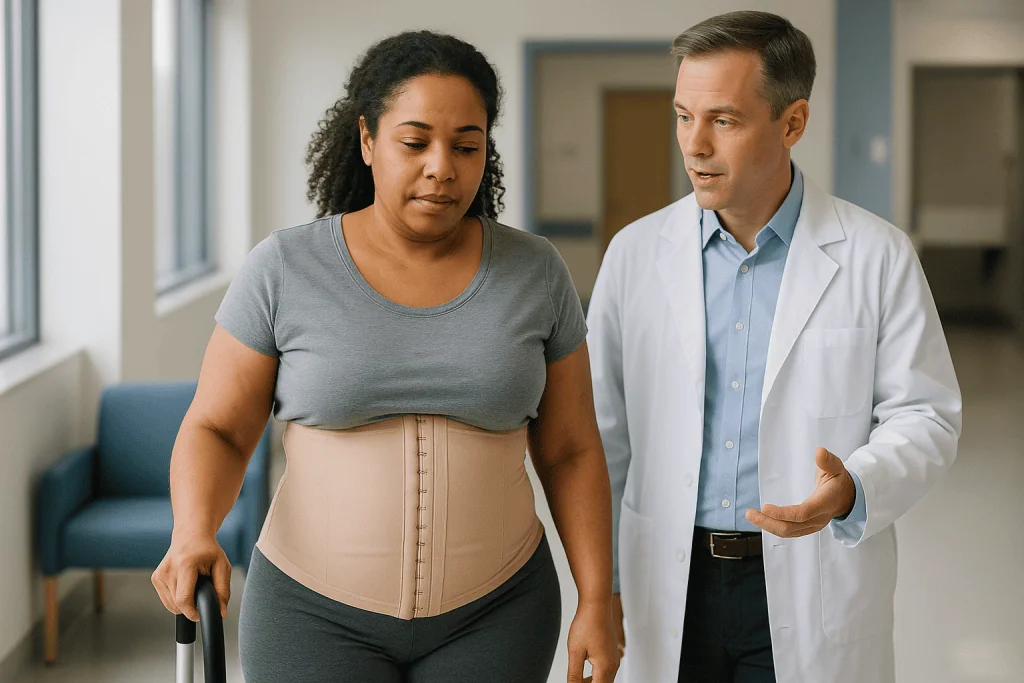
How long is typical? Mayo Clinic and the NHS both describe wearing an abdominal binder or compression garment for about six weeks, usually around the clock at first and then for fewer hours as swelling settles. Some teams switch from a surgical binder to a softer garment after the first couple of weeks. Follow your own instructions on washing and changing, since a damp or soiled garment against a fresh incision is a wound-care problem, not a fashion one.
How soon should you walk after a tummy tuck, and why does it prevent clots?
Within hours, with help. That is the standard expectation after abdominoplasty, and it is grounded in the physiology of blood clots rather than a wish to get you out of bed.
Deep vein thrombosis, or DVT, is a clot that forms in a deep vein, usually in the calf or thigh. The NHS lists recent surgery, lying still for long periods and being overweight among the main risk factors. All three can apply after a tummy tuck. If part of a clot breaks off and travels to the lungs it causes a pulmonary embolism, which is life-threatening. Abdominoplasty carries a higher clot risk than many other cosmetic operations because the procedure is long, the patient is positioned flexed, and the tightened abdomen can raise pressure on the veins draining the legs.
Walking works because the calf muscles act as a pump. Each step squeezes the deep veins and pushes blood back toward the heart, so it does not pool and clot. Even a slow shuffle to the bathroom and back every couple of hours counts. Between walks, pumping the ankles and bending the knees while in bed keeps the same pump running.
Several other measures may be layered on by the surgical team: compression stockings, inflatable leg sleeves in hospital, and in some cases an anticoagulant (a medicine that slows the clotting process). Whether that class of medicine is used, and for how long, depends on an individual risk assessment, and the decision sits with the treating team.
The walking itself should be bent slightly forward at first, in short bouts, gradually straightening over 1–2 weeks. It should never be brisk exercise in the early days; the aim is circulation, not fitness.
How do you protect the repaired muscles in the first weeks?
The plication is the one part of your surgery you actively guard, and the guarding is mostly about avoiding sudden increases in pressure inside the abdomen. Five movements account for most of the risk.
Coughing and sneezing spike abdominal pressure sharply. Splinting, which means pressing a folded pillow or both hands firmly over the abdomen as you cough, spreads that force and is a standard technique after any abdominal operation. Straining on the toilet does the same thing more slowly, which is why constipation is treated as a surgical issue rather than an inconvenience.
Lifting recruits the abdominal wall before you notice it. A common early rule is nothing heavier than a light bag or a full kettle, with children, laundry baskets and pets on the restricted list. The NHS advises avoiding heavy lifting and strenuous activity for several weeks after a tummy tuck.
Getting out of bed is an underrated hazard. The safe method is to roll onto your side as a single unit, drop your legs over the edge and push up with your arms, so the abdominal muscles never do a sit-up. Raising the head of the bed or using a wedge makes this easier.
Twisting and reaching, especially overhead, stretch the flap and pull on the midline seam. Keep frequently used items at waist height for the first fortnight.
Around six weeks, as Mayo Clinic’s guidance suggests, most teams begin lifting these restrictions, but they do so on the basis of how the individual is healing. If something you do produces a sharp pulling pain in the midline, stop, and mention it at your next review rather than testing it again.
Can I sleep on my side 2 weeks after a tummy tuck?
Often yes, with a pillow between the knees and another supporting the abdomen, but only if your surgeon has not asked you to stay on your back longer. The honest answer is that sleeping after tummy tuck surgery is governed more by comfort and tension on the incision than by a hard rule.
For the first week or so most teams recommend the beach-chair position: head and shoulders raised, knees bent and supported. That posture keeps the skin flap slack so the incision is not pulled taut, reduces pressure on the plication, and makes getting up easier. A recliner, an adjustable bed or a stack of wedges all achieve it.
Side-lying becomes reasonable once two things are true. The first is that rolling over no longer produces a sharp pull along the incision or the midline. The second is that drains, if still present, can be kept from kinking or tugging. Many people reach that point around the second week; others are more comfortable staying reclined for three or four. Neither is wrong.
Stomach sleeping is a separate matter and is generally discouraged until the surgeon confirms the repair is well healed, because it loads the full body weight onto the incision and the muscle seam.
A few practical points help. Get into and out of bed using the log-roll technique described earlier. If you wake bent on your side with your knees pulled up, do not force yourself straight quickly. Sleep is also a recovery tool in its own right; if garment discomfort or positioning is keeping you awake night after night, say so at follow-up, since small adjustments are usually possible.
Tummy tuck drains, swelling and numbness: what is normal?
Drains are thin flexible tubes placed under the skin flap and led out through small openings, ending in a bulb that holds gentle suction. Their job is to remove the fluid that collects in the space where skin was separated from muscle. Mayo Clinic describes them as commonly staying in for several days; the usual trigger for removal is output falling below a threshold your surgeon sets, not a fixed date. Some surgeons use quilting sutures instead of or alongside drains to close that space internally.
Caring for drains means recording output as instructed, keeping the exit sites clean and dry, securing the bulbs so they do not pull, and watching the fluid. Pinkish or pale yellow fluid is expected. Bright red blood in quantity, cloudy or foul-smelling fluid, or a sudden increase in volume should be reported.
Swelling behaves differently from what people expect. It rises for the first few days, plateaus, then recedes slowly over months rather than weeks, and it often gathers just above the incision where lymphatic drainage was interrupted. Liposuctioned flanks can stay lumpy and bruised for weeks. The NHS notes that final results may take several months to become clear because of this.
Numbness is almost universal. Sensory nerves running through the fat layer are cut when the flap is lifted, so a band of skin between navel and incision feels wooden or tingly. Sensation returns gradually, often over months, and in a minority of people some areas stay permanently dull. That is a known trade-off, not a complication.
What is not normal: one side swelling faster than the other, a tense shiny area, spreading redness or a fever. Those belong in the red-flag section.
When can I exercise after tummy tuck surgery?
Walking is exercise from day one, and it is the only kind you should be doing for the first few weeks. Everything else returns in stages that depend on which healing zone it stresses.
The general framework in NHS and Mayo Clinic guidance is roughly six weeks before strenuous exercise, with the specifics set by the surgical team. A typical progression looks like this:
- Weeks 1–2: short frequent walks indoors, gradually lengthening; no cardio beyond that.
- Weeks 3–4: longer flat walks; some teams allow a stationary bike at easy effort with no leaning forward on the handlebars.
- Weeks 4–6: light lower-body and arm work without load through the trunk; still no running, jumping or twisting sports.
- After six weeks, on clearance: progressive return to running, swimming once the incision is fully closed, and resistance training.
- Core-specific work such as crunches, planks and heavy lifting is usually the last to return, often after 8–12 weeks, because it loads the plication most directly.
Those windows are ranges, not a schedule. Someone who also had extensive liposuction, or who develops a seroma, will be held back longer.
How to judge readiness in real time: an activity is too much if it produces sharp midline pulling, new swelling the next day, or fluid leaking from the incision. Soreness in the legs from walking is fine. Any bulge appearing in the abdomen when you strain is not, and needs assessment.
People who exercised regularly before surgery often find the wait harder than the pain. It helps to reframe the six weeks as protecting an investment; a repair that stretches early cannot be tightened again without another operation.
What happens if you lose 20 lbs after a tummy tuck?
It depends on where you started and how the weight comes off, but the short answer is that further significant weight loss can undo part of what the surgery achieved. This is the reason Mayo Clinic and the NHS both describe stable weight as a prerequisite rather than a nicety.
A tummy tuck removes a fixed amount of skin and tightens what remains to fit the body at the time of surgery. If fat volume under that skin then shrinks substantially, the skin has to contract to match. Skin in a younger person with good elasticity may manage a modest change. Skin that has already been stretched by pregnancy or prior weight cycling often will not, and new looseness can appear, particularly in the upper abdomen and flanks that were not directly excised.
Twenty pounds is roughly 9 kilograms. For a person whose weight was already stable and near their long-term range, losing that much is a meaningful change and may leave some laxity. For someone still well above their own target, it may simply improve the overall contour. There is no percentage threshold in the guidance that predicts who will need a revision; surgeons judge it on skin quality and the pattern of loss.
Gaining a similar amount pulls the other way. Fat accumulates under the tightened skin and on the flanks, and the repaired muscles are stretched from within. A pregnancy does the same thing more dramatically, which is why teams ask whether further children are planned.
The practical takeaway is not to avoid healthy weight change forever. It is to reach a weight you can realistically hold for years before surgery, and to treat any large planned change afterward as a conversation with your surgeon, not a surprise.
What people often get wrong about brazilian tummy tuck recovery
Myths cluster around this operation, partly because the branding suggests something exotic. The evidence corrects most of them.
“The Brazilian version heals faster.” There is no separate healing pathway for a marketing label. Recovery length tracks the extent of skin removal, whether the muscles were plicated and how much liposuction was added. If anything, adding liposuction extends bruising and swelling rather than shortening it.
“Tighter compression means a flatter result.” Compression limits seroma and swelling; it does not sculpt. A garment tight enough to mark the skin can reduce blood flow to the flap and slow healing.
“Resting completely is safest.” Lying still is one of the strongest risk factors for deep vein thrombosis listed by the NHS. Short, frequent walks protect you; bed rest does not.
“Standing straight early shows you are healing well.” Forcing an upright posture in the first week pulls on the incision. The stoop is protective and resolves on its own.
“Once the drains are out, the danger has passed.” Seromas can form after drain removal, and clot risk persists for weeks. Vigilance continues past the first week.
“This is the hardest plastic surgery to recover from.” It is among the more demanding cosmetic operations because of the muscle repair and clot risk, but “hardest” is not a measurable clinical category, and recoveries vary enormously between individuals.
“Numbness means nerve damage that went wrong.” A dull band below the navel is expected after the flap is lifted, and sensation usually returns slowly over months.
The pattern in every myth is the same: something mechanical about healing gets replaced with a story about effort or branding. Healing is biology on its own schedule.
Questions to ask your care team before and after a tummy tuck
Written answers to these questions are worth more than any general article, because they describe your operation and your surgeon’s technique. Take the list to the consultation and again to the first follow-up.
Before surgery:
- Will the muscles be plicated, and if so how does that change my lifting and exercise restrictions?
- Is liposuction included, and where? How will that affect bruising and swelling?
- How is my personal blood clot risk being assessed, and what prevention will be used in hospital and at home?
- Will I have drains or quilting sutures, and how is drain removal decided?
- What garment will I go home in, how many hours a day should I wear it, and for how long?
- What help will I need at home in the first week, and for how long should someone stay with me?
After surgery:
- What drain output or wound appearance should prompt a call, and who do I call outside working hours?
- When may I shower, and how should the incision be cleaned?
- When can I sleep on my side, drive, return to work and start each stage of exercise?
- Which pain relief, and for how long, and what should I do if it is not enough? (The prescribing clinician makes all medicine decisions.)
- What should I do if I notice a bulge when I strain, or one side swelling more than the other?
- When are my follow-up appointments, and what will you be checking at each?
A team that welcomes these questions and answers them specifically is giving you the best possible tool for the weeks ahead. Vague reassurance is not a plan.
When to call your doctor
Ordinary recovery is uncomfortable, swollen and tiring. A complication usually announces itself as a change: something new, something one-sided or something getting worse instead of slowly better. Contact your surgical team the same day, or seek emergency care where indicated, for any of the following.
- Pain, swelling, warmth or tenderness in one calf or thigh, especially if the leg looks different from the other. The NHS lists these as signs of deep vein thrombosis, which needs urgent assessment.
- Sudden shortness of breath, chest pain that worsens when breathing in, coughing up blood, or feeling faint. These can indicate a pulmonary embolism and are an emergency; call emergency services.
- A fever, chills, or spreading redness, heat or a foul smell around the incision or drain sites, which suggest infection.
- Rapid one-sided swelling, a tense shiny area, or the abdomen feeling firm and increasingly painful, which may indicate a hematoma (a collection of blood) or seroma.
- Bright red bleeding that soaks dressings, or drain fluid that is suddenly bloody or greatly increased.
- A wound edge that opens, or skin near the incision turning dark, dusky or purple, which can signal poor blood supply to the flap.
- Nausea and vomiting that stop you keeping fluids down, or no bowel movement for several days despite the measures your team advised.
- Numbness, tingling or coldness in the legs while wearing the garment, which may mean it is too tight.
- A new bulge in the abdomen when you cough or strain.
Use the number your team gave you, day or night. Reporting something that turns out to be normal costs a phone call; missing a clot or an infection can cost far more. The surgeon who operated on you is best placed to judge, and every decision about what happens next rests with that team.
Frequently asked questions
What are the worst days of tummy tuck recovery?
Most people find days two to four the hardest. Inflammation builds toward its peak over the first 48–72 hours, the local anesthetic used in surgery has worn off, and constipation after anesthesia adds pressure on the abdomen. Mobility improves noticeably toward the end of the first week, and mood usually lifts with it.
What is the hardest plastic surgery to recover from?
There is no clinical ranking, but abdominoplasty is widely regarded as one of the more demanding cosmetic operations because it combines a long incision, a lifted skin flap and a muscle repair, with a higher clot risk than many other procedures. Individual experience varies more than the operation type does.
Can I sleep on my side 2 weeks after a tummy tuck?
Often yes, with a pillow between the knees and support under the abdomen, provided your surgeon has not asked you to stay reclined longer and rolling over does not pull sharply on the incision. Most teams recommend a bent-knee, head-raised position for at least the first week. Stomach sleeping waits until the repair is well healed.
What happens if you lose 20 lbs after a tummy tuck?
Losing about 9 kilograms after surgery can cause new looseness in the skin, especially in the upper abdomen and flanks, because the skin was tightened to fit the body at the time of the operation. How much laxity appears depends on skin elasticity and starting weight, which is why stable weight beforehand is recommended.
How long do you wear a compression garment after tummy tuck surgery?
Mayo Clinic and the NHS both describe wearing an abdominal binder or compression garment for about six weeks, usually around the clock at first and then for fewer hours as swelling settles. The garment should feel firm and supportive, never tight enough to restrict breathing, pinch or leave deep marks on the skin.
How does the tummy tuck recovery week by week usually progress?
The first week brings peak swelling, drains and a stooped walk. Weeks two to three see posture straighten and light tasks return. Weeks four to six are when many people return to non-manual work, based on NHS guidance, and around six weeks compression and exercise restrictions are usually eased on the surgeon’s advice.
When can I exercise after tummy tuck surgery?
Walking begins on the day of surgery and remains the only exercise for the first few weeks. Mayo Clinic and the NHS describe avoiding strenuous activity for about six weeks. Core-focused work such as crunches and heavy lifting usually returns last, often after 8–12 weeks, because it loads the repaired muscle layer most directly.
Why is early walking so important after a tummy tuck?
Walking makes the calf muscles squeeze the deep veins and push blood back toward the heart, preventing it from pooling and clotting. The NHS lists surgery and lying still as major risk factors for deep vein thrombosis, and abdominoplasty carries a higher clot risk than many cosmetic operations, so short frequent walks are protective.
How long do tummy tuck drains stay in?
Mayo Clinic describes drains commonly remaining for several days. Removal is usually decided by fluid output falling below a threshold your surgeon sets rather than by a fixed date. Some surgeons use internal quilting sutures instead, which can reduce or avoid the need for drains altogether.
Is numbness after a tummy tuck permanent?
Usually not, though it can be long-lasting. Lifting the skin flap cuts small sensory nerves, so a band of skin below the navel commonly feels dull or tingly. Sensation tends to return gradually over months. A minority of people keep some permanently reduced feeling, which is a recognized trade-off of the operation rather than a complication.
References
- NHS: Tummy tuck
- MedlinePlus: Abdominal wall surgery
- NHS: Deep vein thrombosis (DVT)
- MedlinePlus: Deep vein thrombosis
This article is for general information only and is not a substitute for professional medical advice. Please consult a qualified doctor about your individual situation.
Add us as a Preferred Source to see more of our trusted health content across Google Search, AI Overviews and Discover.

Planning This Treatment in Turkey
Our full guide for international patients: techniques, hospital stay, recovery and cost.
More from the Blog

When Do CoolSculpting Results Appear? Why Fat Freezing Takes Weeks to Show a Change
CoolSculpting is a brand name for cryolipolysis, a procedure that cools fat cells until they are damaged and gradually cleared by the body. Because…

When Labial Discomfort Becomes a Surgical Question: Non-Surgical Steps Before Labiaplasty
Labiaplasty for discomfort is surgery that reduces or reshapes the inner vulval lips, usually considered only after simpler measures have been tried. Most labial…

How Is a Cosmetic Gynecology Plan Chosen? Labiaplasty, Vaginoplasty or Perineoplasty
A cosmetic gynecology plan is chosen by matching one clearly described concern to the anatomy behind it. Labiaplasty reshapes the outer folds (labia), vaginoplasty…
When Does Lipedema Need Surgery? Compression, Lymphatic Drainage and the Surgical Step
Lipedema usually needs surgery only when a documented period of conservative care, including fitted compression, lymphatic drainage, movement and weight stabilization, has not controlled…

Hi Def Liposuction Recovery: Weeks in Compression, Bruising and When Definition Appears
Hi def liposuction recovery typically involves wearing a compression garment for several weeks, with bruising fading over the first few weeks and swelling settling…
Do You Need a Thigh Lift or Thigh Liposuction? How Skin Elasticity Decides
Whether you need a thigh lift or liposuction depends mainly on skin elasticity, not on how much fat is present. Liposuction removes fat and…