

Fever, Pain or Yellow Skin After Gallbladder Surgery: Signs Your Team Wants to Hear About

Key Takeaways
- A mild temperature below 101°F (38.3°C) in the first two days after gallbladder surgery is usually inflammatory or lung-related, while a fever that starts after day two more often points to infection or a bile collection.
- The NHS puts bile leakage at roughly 1 in 100 gallbladder operations and bile duct injury at about 1 in 500, and both tend to surface between day two and day seven, after most people have gone home.
- Right shoulder pain after laparoscopy is referred pain from carbon dioxide irritating the diaphragm and typically fades over a few days; pain that worsens after improving or spreads across the abdomen is a different signal.
- Yellowing of the whites of the eyes, dark urine, and pale stools together indicate blocked bile flow and always warrant same-day contact, or emergency care if fever or pain accompanies them.
- The CDC's sepsis warning signs, a racing heart, fever or feeling very cold, confusion, breathlessness, extreme pain, and clammy skin, mean emergency services, not a routine call.
- The NHS estimates about two weeks to resume usual activities after laparoscopic cholecystectomy and roughly 6–8 weeks after open surgery, with recovery expected to trend steadily in one direction.
A low temperature in the first day or two after gallbladder surgery is common and usually settles. A fever of 101°F (38.3°C) or higher, one that appears after day two, or one paired with worsening belly pain, yellow skin or eyes, vomiting, or confusion should be reported to your surgical team the same day, and sepsis warning signs need emergency care.
Three days after her laparoscopic gallbladder removal, a woman sits on the edge of the bath with a thermometer in her hand, reading 100.8°F for the second time that evening. The incision sites look fine. The shoulder ache the nurse warned her about has faded. And yet something feels off, and she cannot decide whether calling the surgeon’s line at 9 p.m. is sensible or dramatic.
That hesitation is the reason this article exists. Fever after gallbladder surgery sits in an awkward middle ground: often meaningless, occasionally the first hint of a complication that is far easier to manage when caught early. Add pain that changes character, or a faint yellow tint to the whites of the eyes, and the picture sharpens considerably.
What follows is a plain account of what surgical teams actually worry about after cholecystectomy, what they tend to shrug off, and how to tell the difference without a medical degree.
Why does fever after gallbladder surgery happen at all?
Cholecystectomy is the surgical removal of the gallbladder, the small pouch under the liver that stores bile. Most are done laparoscopically, through a few small cuts using a camera and long instruments, while a minority are open operations through a single larger incision. Either way, the body registers the event as an injury, and injury produces heat.
Here is the mechanism in one breath. Cutting and cauterizing tissue releases signaling proteins called cytokines. Those cytokines travel to the brain’s temperature center and nudge the thermostat upward. The result is a mild, short-lived rise, often called an inflammatory fever, that has nothing to do with bacteria. Shallow breathing under anesthesia can also leave small pockets of lung tissue partly collapsed, a state called atelectasis, which is another common source of early warmth.
Infection is a different process. Bacteria at a wound, in a pocket of leaked bile, or in the bile ducts multiply over hours and days, so infection-driven fevers tend to arrive later and climb rather than fade. The timing of a temperature, in other words, is often more informative than its exact number.
The NHS lists infection, bleeding, and leakage of bile among the recognized risks of gallbladder removal, alongside injury to the bile duct and to nearby organs. None is common, but each can announce itself with a temperature, and that is why teams ask you to keep a thermometer handy for the first week or two. Understanding fever after gallbladder surgery is really about learning to read that thermometer alongside the calendar and your other symptoms, not in isolation.
What does a low-grade temperature in the first 48 hours usually mean?
Ask a surgical resident what a temperature of 99.5°F on the evening of surgery means, and you will probably get a shrug. The first two days are the window when a mild rise is most likely to be inflammatory or lung-related rather than infectious. The body has just been operated on; it is entitled to run a little warm.
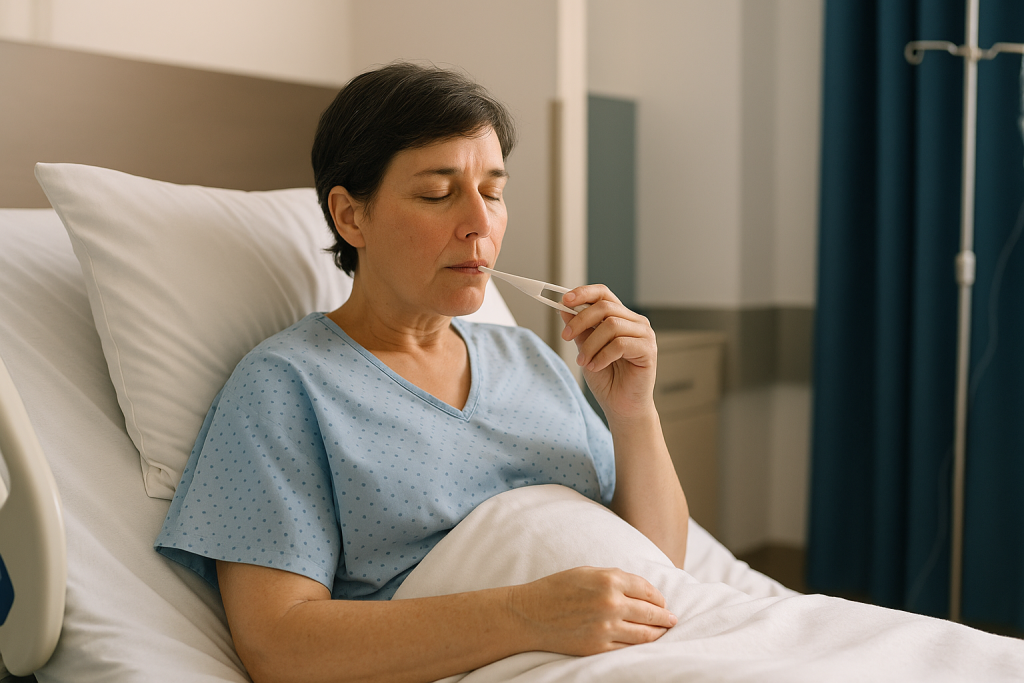
Several ordinary factors stack up in this period. Anesthetic drugs suppress the cough reflex, so mucus lingers in the airways. Pain discourages deep breaths. Fluids given during the operation shift around the tissues. Each of these can add a fraction of a degree without any bacteria involved. This is also why nurses badger patients to sit up, walk to the bathroom, and take slow deep breaths: expanding the lungs is the single most useful thing a person can do against early postoperative warmth.
Patient discharge guidance from MedlinePlus and Mayo Clinic converges on a practical threshold: a temperature above 101°F (38.3°C) is worth a phone call, at any stage. Below that line in the first two days, with no other worrying features, most teams are comfortable with watching and rechecking a few hours later.
Two caveats matter. A temperature that keeps stepping upward across the day, rather than drifting down, deserves attention even if it has not yet reached the threshold. And a chill or shaking episode, medically called rigors, is a stronger signal than the number alone, because it suggests the body is mounting a vigorous response to something. When in doubt, the phone call is never wrong; surgical teams would far rather field a reassuring conversation than meet a complication late.
Fever after gallbladder surgery from day three onward: when the odds shift
By the third or fourth day, the inflammatory heat of the operation itself should be fading. A new or rising temperature at this point changes the mental math for clinicians, because the causes that peak later are the ones that need action.
Surgical site infection is the most familiar. The CDC describes it as infection at the incision that typically shows within 30 days of an operation, with redness spreading beyond the wound edges, warmth, increasing tenderness, or cloudy drainage. Small port-site infections after laparoscopy are usually superficial and manageable, but they still need a clinician to look.
Deeper trouble is quieter at first. Bile that has leaked from a clip or a small duct can pool near the liver and become infected, forming a collection or abscess. The NHS puts bile leakage at roughly 1 in 100 gallbladder operations. A retained stone in the common bile duct, the main channel carrying bile to the intestine, can block flow and allow infection to climb into the ducts, a condition called cholangitis, which classically produces fever, right upper belly pain, and yellowing together.
Less obvious sources include a urinary infection from a catheter placed during surgery, a chest infection that grew out of early atelectasis, or a blood clot in the leg, which can cause low fever alongside calf swelling.
The practical takeaway is simple. Fever after gallbladder surgery that appears after day two, returns after settling, or comes with any new symptom is the pattern surgeons specifically ask to hear about. It does not mean something is wrong. It means the list of possibilities now includes things worth ruling out, often with a blood test and an ultrasound.
Pain after gallbladder surgery: expected soreness versus pain that changes
Some discomfort is guaranteed. The incisions ache, the abdominal wall feels bruised, and many people are startled by a sharp pain in the right shoulder or under the collarbone. That shoulder pain is referred pain from carbon dioxide gas used to inflate the abdomen during laparoscopy; the gas irritates the diaphragm, which shares a nerve pathway with the shoulder. Mayo Clinic and the NHS both describe it as common and expect it to ease over a few days as the gas is absorbed.
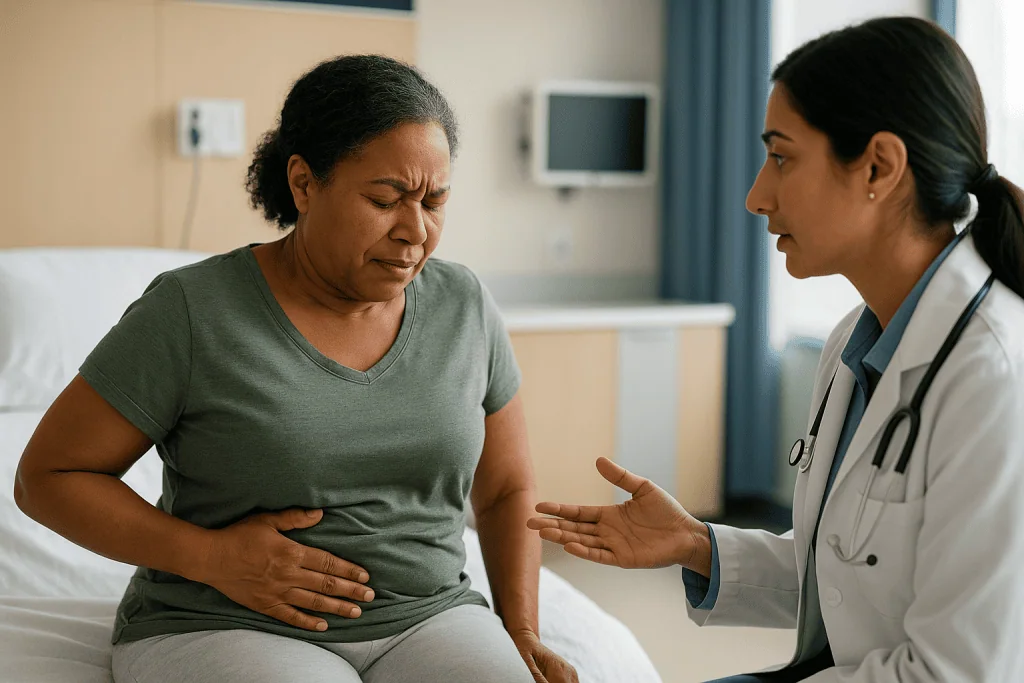
The pattern matters more than the intensity. Expected pain is worst on the first day or two, then improves steadily, responds to the pain plan your team prescribed, and stays roughly where the incisions are. Walking usually helps rather than hurts.
Pain that concerns surgeons behaves differently. It gets worse after having improved. It spreads across the whole abdomen rather than staying local. The belly becomes hard, tense, or exquisitely tender to light touch, which can indicate irritation of the abdominal lining from leaked bile or blood. Pain that sits deep in the right upper abdomen and comes with fever or yellowing points toward the bile ducts. Pain in one calf, particularly with swelling or warmth, raises the question of a clot.
Medications used for pain after gallbladder surgery generally fall into two classes: anti-inflammatory drugs that dampen the chemical signals of injury, and, for a short period in some patients, opioid analgesics that act on the nervous system’s pain pathways. Which combination, and for how long, is a decision for the prescribing clinician based on kidney function, bleeding risk, and other medicines. If the prescribed plan is not controlling the pain, that itself is information the team wants, rather than a reason to improvise.
Jaundice after gallbladder removal: what yellow skin is telling you
Jaundice is a yellow tint to the skin and the whites of the eyes caused by a buildup of bilirubin, a pigment made when the body breaks down old red blood cells. Normally the liver clears bilirubin into bile, which flows through the ducts into the intestine. After gallbladder removal, that flow should continue unimpeded. When it does not, bilirubin backs up into the blood, and the whites of the eyes are usually the first place it shows.
Three explanations dominate. A gallstone may have slipped into the common bile duct before or during surgery and lodged there, blocking flow. A clip or suture may be narrowing the duct. Or the duct itself may have been injured, which the NHS estimates at about 1 in 500 operations. Any of these can be silent for a day or two, then produce yellowing, dark tea-colored urine, pale or clay-colored stools, and itching, because bile salts accumulate under the skin.
Jaundice after gallbladder removal is never a wait-and-see symptom. It is always a same-day call, and if it arrives with fever or worsening pain, it belongs in an emergency department. Blocked bile is a medium bacteria enjoy, and the combination of blockage and infection can escalate quickly.
The reassuring part is that the investigation is usually straightforward. Blood tests measure bilirubin and liver enzymes. An ultrasound or a specialized MRI scan of the ducts shows where the flow is interrupted. Treatment depends on the cause and is decided by the surgical and gastroenterology teams together; a retained stone is often removed through an endoscope passed down the throat, while a duct injury needs specialist assessment. What patients can do is notice early, describe clearly, and not delay.
Bile leak after cholecystectomy: the complication behind many late fevers
When the gallbladder comes out, the surgeon clips the small duct that connected it to the main bile system and clips the artery that fed it. Occasionally a clip slips, a tiny accessory duct in the liver bed is not sealed, or tissue swells and later gives way. Bile then drips into the abdominal cavity instead of flowing toward the intestine. Cleveland Clinic and the NHS both list bile leak among the recognized complications of cholecystectomy, and the NHS figure of roughly 1 in 100 operations puts it in the uncommon-but-real category.
Bile is irritating. A small leak may produce vague bloating and a dull ache that seems out of proportion to the incisions. A larger one produces spreading abdominal pain, a distended belly, nausea, and low appetite. Because the leaked fluid is warm, stagnant, and nutrient-rich, bacteria colonize it, and fever typically follows a few days behind the pain. Some people also notice mild yellowing if enough bile is absorbed back into the bloodstream.
Timing is the tell. Bile leak after cholecystectomy most often declares itself between roughly day two and day seven, exactly the window when patients have gone home, stopped expecting problems, and are tempted to attribute a new ache to overdoing it.
Diagnosis usually starts with an ultrasound or CT scan showing fluid where fluid should not be, plus blood tests. Management ranges from simple drainage of the collection to an endoscopic procedure that places a small temporary tube in the bile duct so bile follows the path of least resistance back into the intestine, allowing the leak to seal. Those choices belong to the treating team. The patient’s contribution is recognizing that a belly that hurts more on day five than on day three is not normal recovery.
Sepsis after gallbladder surgery: signs that mean emergency care now
Sepsis is the body’s overwhelming, dysregulated response to an infection, in which the immune system’s chemicals begin damaging the body’s own organs. It is rare after gallbladder surgery, but it is the reason clinicians take late fevers seriously, because any postoperative infection, whether at a wound, in a bile collection, or in the ducts, can in principle progress to it.
The CDC groups the warning signs into a short, memorable set. A high heart rate or a weak pulse. Fever, or shivering, or feeling very cold. Confusion or disorientation. Shortness of breath. Extreme pain or discomfort. Clammy or sweaty skin. Cleveland Clinic adds low blood pressure, passing much less urine than usual, and a general sense of being extremely unwell that the person struggles to describe.
Two features distinguish sepsis after gallbladder surgery from an ordinary infection. The first is speed: someone who was merely feverish in the morning can be confused and breathless by evening. The second is that the whole body is involved, not just the operated area. A person with a simple wound infection has a sore, red incision and otherwise feels reasonably well. A person developing sepsis feels dreadful everywhere.
There is no home management for this. The CDC’s guidance is unambiguous: sepsis is a medical emergency, and the person or their family should call emergency services or go to the emergency department and say the word “sepsis” out loud, along with the fact of recent surgery. Early hospital treatment, which typically involves intravenous fluids and antibiotics chosen by the treating team along with finding and controlling the source of infection, is time-sensitive. Waiting to see whether the morning brings improvement is the one decision worth avoiding.
Typical recovery versus red flags: a side-by-side summary
Recovery rarely follows a script, but patterns exist. The table below sets the ordinary against the concerning, drawing on discharge guidance from MedlinePlus, Mayo Clinic, and the NHS. It is a prompt for a conversation with your team, not a substitute for one.
| Symptom | Usually part of normal recovery | Your team wants to hear about it |
|---|---|---|
| Temperature | Mild rise below 101°F (38.3°C) in the first 1–2 days, drifting down | 101°F or higher at any point; any fever that starts after day 2, returns, or comes with chills |
| Incision pain | Worst on days 1–2, improving daily, local to the cuts | Worsening after improving; spreading across the abdomen; hard or tense belly |
| Shoulder pain | Right shoulder ache from gas, fading over a few days | Shoulder pain with breathlessness or chest pain |
| Wound appearance | Slight pinkness at edges, small amount of clear fluid | Spreading redness, warmth, pus, foul smell, edges opening |
| Skin and eyes | Normal color | Any yellowing; dark urine with pale stools |
| Digestion | Mild nausea early; looser stools for some weeks | Repeated vomiting; unable to keep fluids down; no bowel movement plus swelling |
| General state | Tired, low appetite for a few days | Confusion, racing heart, breathlessness, clammy skin, very little urine |
Read the columns as trends rather than snapshots. A single reading of 100.4°F on day one means little; the same reading appearing fresh on day six, alongside a belly that has begun to swell, means a phone call before anything else. The right-hand column also describes the kinds of symptoms that justify an emergency department rather than a routine appointment when several appear together, or when confusion, breathlessness, or yellowing is among them.
Who is watched more closely after cholecystectomy, and who is asked to wait?
Not every recovery carries the same background risk, and surgical teams adjust how closely they follow people accordingly. Understanding where you sit helps you calibrate your own threshold for calling.
Several groups tend to get closer follow-up. People who had surgery during an acute attack of cholecystitis/">cholecystitis, meaning an inflamed and often infected gallbladder, rather than as a planned operation, start recovery with more inflamed tissue and a higher baseline chance of a collection or wound infection. Those whose operation was converted from laparoscopic to open, which the NHS notes happens in a minority of cases when the surgeon cannot see safely, have a larger wound and a longer recovery, with the NHS citing roughly 6–8 weeks for open surgery against about 2 weeks for laparoscopic. Older adults, people with diabetes, those taking medicines that suppress the immune system, and people with significant liver disease may mount a blunted fever response, so their infections can present with confusion or simply feeling unwell rather than a clear temperature. Cleveland Clinic notes that people who have had previous abdominal operations also carry extra scar tissue that can complicate surgery.
On the other side, some people are asked to wait before elective surgery is scheduled. Pregnancy often shifts timing to the second trimester or after delivery, depending on symptoms. Uncontrolled diabetes, recent heart attack, active chest infection, or a very recent severe attack may prompt a period of medical optimization first. These are judgment calls made by the surgical and anesthetic teams weighing the risk of operating against the risk of another gallstone episode.
For anyone in a higher-risk group, the same red flags apply, but with a lower bar. A subtle change, a new confusion in an older relative, or an unexplained lack of energy is enough reason to make contact.
What do the days and weeks after gallbladder removal usually look like?
Most laparoscopic cholecystectomies are day-case or single-night procedures. Mayo Clinic describes patients typically going home the same day, while open surgery usually means a hospital stay of a few days. Those first hours are about waking fully from anesthesia, keeping fluids down, passing urine, and walking a few steps.
Days one to three are the sore phase. Incisions ache, the shoulder gas pain peaks and starts to fade, and fatigue is out of proportion to the size of the wounds because anesthesia and the stress response linger. Appetite is often poor. This is also the phase of mild inflammatory warmth, which should be heading downward, not upward, by day two.
Days four to ten are the quiet danger zone. Most people feel noticeably better and start doing more, which is good. The trap is that the uncommon complications, bile leaks, collections, and wound infections, tend to surface here, and a new symptom is easy to blame on activity. The rule of thumb surgeons repeat is that recovery should trend in one direction; a step backward warrants a call.
Weeks two through six are about returning to normal life. The NHS suggests most people are back to usual activities about two weeks after laparoscopic surgery, with heavy lifting and strenuous exercise reintroduced gradually according to the team’s advice. Wounds are typically healed at the surface by then, though internal healing continues. Driving depends on being able to perform an emergency stop comfortably and on any pain medicine still in use; the treating team and insurer both have a view.
Digestion adapts over weeks to months. Without a reservoir, bile trickles steadily into the intestine, and some people notice looser stools or discomfort after fatty meals, which usually eases as the body adjusts.
Is it normal to feel sick after gallbladder removal?
Yes, within limits, and the limits are worth spelling out because “feeling sick” covers everything from mild queasiness to a serious warning sign.
Nausea in the first day or so is common and usually traces to anesthetic drugs, opioid pain relievers, or the gut waking slowly after being handled. It typically eases as those effects wear off and as you begin eating small amounts. Mayo Clinic and MedlinePlus both list nausea among expected early effects, and anti-nausea medicines, which work by blocking signaling chemicals in the gut and brain, may be part of the discharge plan at the team’s discretion.
Vomiting is a different matter. Repeated vomiting, an inability to keep fluids down, or vomiting accompanied by a swollen abdomen and no bowel movements can indicate that the intestine has temporarily stopped moving, called ileus, or in rare cases a mechanical obstruction. Cleveland Clinic and MedlinePlus discharge guidance ask patients to report persistent vomiting the same day, partly because dehydration compounds every other problem.
Diarrhea deserves its own mention. The NHS notes that some people have looser, more frequent stools for weeks after gallbladder removal, thought to relate to the continuous flow of bile into the intestine rather than the stored, meal-timed release the gallbladder provided. For most it settles; for a minority it lingers and needs discussion with a gastroenterologist about diet and, where appropriate, bile-acid-binding medicines chosen by the clinician.
Fatigue is the symptom people underestimate most. Feeling wiped out for a week or two is ordinary. Feeling progressively worse, sleepier, or confused is not, and in older adults that pattern can be the only visible sign of an infection brewing. Treat a downward slide in overall wellbeing with the same seriousness as a thermometer reading.
What people often get wrong about fever and pain after gallbladder surgery
Myths cluster around postoperative recovery, and several of them delay care.
“If the incisions look fine, there is no infection.” Wound appearance tells you about the wound. It says nothing about a bile collection sitting against the liver or bacteria in a bile duct. Late fever with clean incisions is precisely the pattern that prompts an ultrasound.
“A fever means I need antibiotics.” Early inflammatory fever does not respond to antibiotics because no bacteria are involved, and fever from a bile leak needs the leak addressed, not just a prescription. Whether an antibiotic is appropriate, and which class, is a decision for the clinician after examining you and often after imaging. Leftover antibiotics from a previous illness have no place here.
“Taking a fever reducer and feeling better means it was nothing.” Medicines that lower temperature work by resetting the brain’s thermostat; they treat the number, not the cause. A fever that vanishes for four hours and returns is still a fever that started after day two.
“Yellow eyes are just from being tired or dehydrated.” Neither causes true yellowing of the whites of the eyes. Jaundice always has a physical cause, and after gallbladder surgery the likely causes involve the bile ducts.
“Surgeons are too busy for small worries.” Surgical teams build phone lines and early clinic slots into their systems precisely because a five-minute call on day four can prevent a five-day readmission. Nobody is judged for checking.
“Getting sick after gallbladder removal means the operation failed.” Recovery symptoms and complications are separate from whether the gallstone problem was addressed. Most people with a complication still end up with the outcome they had surgery for, once the complication is managed by the team.
Questions to ask your care team before you go home
The most useful ten minutes of a hospital stay are often the discharge conversation, and it goes better with a list. Consider asking some or all of the following, and writing the answers down while a nurse is present.
- What temperature reading should prompt a call, and what should send me straight to the emergency department? Guidance from MedlinePlus and Mayo Clinic centers on 101°F (38.3°C), but your team may set a different threshold for your circumstances.
- Which number do I call in the evening or at the weekend, and who answers it? Knowing the route in advance removes the hesitation that delays care.
- Were there any findings during the operation, such as an inflamed gallbladder, difficult anatomy, spilled stones, or a conversion to open surgery, that make particular complications more likely for me?
- Was a drain left in, and if so, what color and volume of fluid is expected, and what change should I report?
- How should my incisions look each day, and how do I care for glue, staples, or dressings?
- Which of my prescribed medicines could mask a fever, and does that change how I should monitor myself?
- What pain pattern should I expect, and what would make you want to see me rather than talk on the phone?
- When is my follow-up appointment, and what tests, if any, are planned?
- Are there activities, foods, or drinks you would like me to avoid in the first two weeks, and why?
- If I develop yellowing of the eyes, should I call you or go to emergency care directly?
No single question is more important than the first two. A clear threshold and a working phone number turn an anxious night into a manageable one.
When to call your doctor, and when to go to the ER after gallbladder surgery
Call your surgical team the same day if any of the following appear, drawing on discharge guidance from MedlinePlus, Mayo Clinic, and the NHS: a temperature of 101°F (38.3°C) or higher; any new fever starting after the second day, or a fever that had settled and returns; chills or shaking episodes; pain that is getting worse rather than better, or that has spread beyond the incision area; an incision with spreading redness, warmth, pus, a foul smell, or edges pulling apart; nausea or vomiting that stops you keeping fluids down; a swollen abdomen with no bowel movements; new swelling, pain, or warmth in one calf; or any drain output that changes sharply in color or amount.
Go to the emergency department, or call emergency services, without waiting for a callback if you notice: yellowing of the skin or whites of the eyes, particularly with fever or pain; a rigid, board-hard abdomen that hurts with light touch; confusion, unusual drowsiness, or difficulty staying awake; a racing heart, breathlessness, or chest pain; clammy, mottled, or bluish skin; passing very little urine over many hours; heavy bleeding from an incision; or the constellation of signs the CDC lists for sepsis, a rapid heart rate, fever or feeling very cold, confusion, shortness of breath, extreme pain, and clammy skin. Tell the first person you speak to that you had gallbladder surgery and how many days ago.
If you are unsure which category you are in, choose the more cautious one. Surgeons would rather be interrupted than surprised, and emergency departments see postoperative patients routinely; nobody there will consider a recent-surgery fever a waste of their time. Every decision about tests, admission, and treatment rests with the clinicians who examine you. Your job is only to get the symptom in front of them promptly.
Frequently asked questions
When should I be concerned about a fever after surgery?
Be concerned when the temperature reaches 101°F (38.3°C) or higher, when a fever first appears after the second day, or when it returns after settling. MedlinePlus and Mayo Clinic discharge guidance use that threshold. A fever accompanied by chills, worsening abdominal pain, yellow skin, vomiting, or confusion is more urgent than the number alone. Early mild warmth on day one is common and usually reflects inflammation rather than infection.
When to go to the ER after gallbladder surgery?
Go to the emergency department for yellowing of the skin or eyes, a rigid or severely tender abdomen, confusion or unusual drowsiness, a racing heart, breathlessness, clammy skin, very little urine, heavy bleeding, or repeated vomiting that prevents you keeping fluids down. These signs suggest a bile duct problem, a significant leak, or developing sepsis. Tell staff you had gallbladder surgery and how many days ago so they can prioritize appropriately.
What are the symptoms of sepsis after gallbladder surgery?
The CDC lists a high heart rate or weak pulse, fever or shivering or feeling very cold, confusion, shortness of breath, extreme pain, and clammy or sweaty skin. Cleveland Clinic adds low blood pressure and reduced urine output. Sepsis is the body’s overwhelming response to infection and can develop over hours from a wound infection, bile collection, or cholangitis. It requires immediate emergency care; say the word sepsis when you arrive.
Is it normal to get sick after gallbladder removal?
Mild nausea, fatigue, poor appetite, and looser stools are common in the first days to weeks and usually settle. Nausea often traces to anesthetic and pain medicines wearing off. Repeated vomiting, inability to keep fluids down, a swelling abdomen, or feeling progressively worse rather than better are not normal and should be reported to your team the same day, since they can indicate ileus, a collection, or infection.
What causes jaundice after gallbladder removal?
Jaundice after gallbladder removal usually means bile flow is blocked, most often by a gallstone that has lodged in the common bile duct, less often by a clip narrowing the duct or by an injury to it, which the NHS estimates at about 1 in 500 operations. Bilirubin then backs up into the blood and tints the eyes and skin. It always needs same-day assessment with blood tests and imaging, and the treating team decides on management.
How do I know if I have a bile leak after cholecystectomy?
You cannot confirm it at home, but the pattern is suggestive: a dull or spreading abdominal ache that seems out of proportion to the incisions, bloating, nausea, low appetite, and then fever a few days later, typically between day two and day seven. Some people notice mild yellowing. The NHS cites bile leakage in roughly 1 in 100 operations. Diagnosis needs an ultrasound or CT scan and blood tests, so report the symptoms promptly.
How long does pain after gallbladder surgery normally last?
Incision pain is usually worst in the first one to two days and improves steadily, with most people back to ordinary activities around two weeks after laparoscopic surgery according to the NHS, and 6–8 weeks after open surgery. Shoulder pain from gas typically fades within a few days. Pain that worsens after improving, spreads, or makes the abdomen hard and tender is outside the normal pattern and should be reported.
Can a wound infection cause fever a week after laparoscopic gallbladder surgery?
Yes. The CDC describes surgical site infections as appearing within about 30 days of an operation, and small port-site infections after laparoscopy often surface in the first one to two weeks with spreading redness, warmth, tenderness, or cloudy drainage alongside a temperature. Most are superficial, but they need a clinician to assess the wound and decide whether any treatment is needed. Deeper infections can occur with clean-looking incisions, so fever alone still warrants a call.
Why do I have right shoulder pain after gallbladder surgery?
Surgeons inflate the abdomen with carbon dioxide gas to create working space during laparoscopy. Leftover gas irritates the diaphragm, and because the diaphragm shares a nerve pathway with the shoulder, the brain registers the pain there. Mayo Clinic and the NHS describe this as common and expect it to ease over a few days as the gas is absorbed. Shoulder pain with breathlessness or chest pain, however, needs urgent assessment.
Should I take my temperature every day after gallbladder surgery?
Checking once or twice daily for the first week or two is a reasonable habit many teams suggest, and more often if you feel warm, shivery, or unwell. Record the readings with the time and any other symptoms so you can describe the trend accurately. A single mild reading matters less than a rising pattern or a fever that appears after day two. Ask your team what threshold they want you to use.
References
- MedlinePlus: Gallbladder removal – laparoscopic
- NHS: Gallbladder removal
- Cleveland Clinic: Gallbladder Removal (Cholecystectomy)
- Cleveland Clinic: Sepsis
This article is for general information only and is not a substitute for professional medical advice. Please consult a qualified doctor about your individual situation.

More from the Blog

Living With Autoimmune Hepatitis: Alcohol, Vaccines, Work and Long-Term Liver Check-Ups
Most people living with autoimmune hepatitis lead full lives on long-term immune-suppressing medicine, with regular blood tests to confirm the liver stays quiet. Alcohol…

Can Cirrhosis Improve With Treatment? What Realistic Progress Looks Like Over Years
Cirrhosis can improve with treatment in a meaningful, measurable way, though established scar tissue rarely disappears completely. When the underlying cause is controlled, such…
What Happens During an ERCP: From Sedation to Clearing a Blocked Bile Duct
During an ERCP you are sedated, a flexible endoscope is passed through the mouth to the top of the small intestine, and a thin…

Resistant Starch: Why Cooled Rice and Potatoes Feed Your Gut Bacteria
Resistant starch is a form of starch that escapes digestion in the small intestine and is fermented by bacteria in the colon, producing short-chain…
What Happens During Band Ligation for Esophageal Varices: The Procedure Explained
Band ligation for esophageal varices is an endoscopic procedure in which a doctor passes a thin flexible camera down the throat, suctions a swollen…

Gallstones in Pregnancy, Diabetes or Older Age: How the Treatment Plan Is Adapted
Gallstones during pregnancy treatment usually starts with pain control, a short period of rest from fatty meals, and close monitoring, because most stones settle…