

Fever, Wound Redness or Bowel Trouble After Appendectomy: What to Watch and When to Call

Key Takeaways
- A mild temperature in the first 24 to 48 hours after appendectomy is usually the inflammatory response to surgery, while a fever that starts or rises after day two is the pattern that needs a call.
- The CDC defines a surgical site infection as one occurring within 30 days of the operation, so wound redness that spreads, heats up or drains cloudy fluid matters even in week three or four.
- Getting better and then getting worse, in pain, appetite or energy, is the single most reliable signal of a developing abscess, especially after a perforated appendix.
- Postoperative ileus and opioid-slowed bowels mean several days without a stool are common, but vomiting with bloating and no gas is a reason to call the same day.
- Mayo Clinic guidance suggests limiting activity for three to five days after laparoscopic surgery and ten to fourteen days after open surgery, with heavy lifting restricted longer by your team.
- Mild, movement-related twinges can persist for four weeks around port sites, whereas constant, deepening or returning pain deserves a surgical review.
A mild temperature in the first day or two after appendectomy is common and usually reflects the body's inflammatory response to surgery. A fever that appears or climbs after day two, especially with spreading wound redness, cloudy drainage, worsening belly pain, vomiting or no bowel movements, can signal a wound or deep infection and should prompt a same-day call to your surgical team.
It is the third night home. The incisions look fine, the hospital bracelet is finally in the trash, and then the thermometer reads a shade above normal. Suddenly every twinge in the belly feels like a message. Is this the ordinary ache of a body knitting itself back together, or the start of something the surgeon warned about?
That moment, half relief and half dread, is where most questions about fever after appendectomy begin. Appendicitis is one of the most common reasons for emergency abdominal surgery, which means thousands of people each week sit at a kitchen table trying to decide whether a reading, a red patch or a stubborn bowel deserve a phone call.
The honest answer is that timing and pattern matter more than any single number. This explainer walks through what the surgery does to your body, what ordinary healing looks like day by day, and which signs genuinely earn a call.
What actually happens during an appendectomy
An appendectomy is the surgical removal of the appendix, a finger-sized pouch attached to the first part of the large intestine. When it becomes inflamed, the condition is called appendicitis, and removing the organ remains the standard treatment in most cases, according to the Mayo Clinic.
Most operations today are laparoscopic, meaning the surgeon works through a few small cuts using a camera and slim instruments. Carbon dioxide gas is pumped into the abdomen to create working space. The appendix is separated from its blood supply, its base is sealed with staples or ties, and the organ is lifted out in a small bag. An open appendectomy, done through a single larger incision in the lower right abdomen, is still chosen when the appendix has burst, when scar tissue from earlier surgery is in the way, or when the camera view is unclear, as MedlinePlus describes.
Why does this matter for symptoms afterward? Each step leaves a trace. The gas can irritate the diaphragm, producing a peculiar ache in the shoulder for a day or two. The sealed stump and the small raw area where the appendix sat trigger a controlled inflammatory response. The incisions themselves heal from the inside out, which is why a scar can look angry for a while and still be perfectly healthy.
The anesthetic leaves its own footprint: slowed breathing, a sluggish gut and a dry mouth that can mimic illness. Understanding that the body has been deliberately injured and is now repairing itself is the first step in reading fever, redness or bowel changes without panic, and without dismissing the signs that do matter.
Why a low grade fever after appendectomy is common in the first two days
Tissue injury of any kind, including the careful injury of surgery, releases signaling proteins called cytokines. These molecules tell the brain’s thermostat to nudge body temperature upward. The result is a low grade fever, generally meaning a reading only modestly above normal, during the first 24 to 48 hours after an operation. Surgeons expect it, and most discharge instructions treat it as part of recovery rather than a warning.

Textbooks once blamed early postoperative fever on atelectasis, the partial collapse of small air sacs in the lungs when a sore patient breathes shallowly. The link turns out to be weaker than the old teaching suggested; shallow breathing and early fever often travel together without one clearly causing the other. Deep breathing and getting out of bed are still worth doing because they protect the lungs, not because they will necessarily switch the temperature off.
Dehydration adds a second layer. People eat and drink little before emergency surgery, lose fluid during the operation and may feel too queasy to catch up afterward. A dry body runs slightly warm. Pain and the anesthetic itself can also blunt the normal rhythm of sweating and breathing that keeps temperature steady.
What does a reassuring early fever look like? It stays modest, drifts downward over a day or two, and does not arrive with new symptoms. The person feels sore but improves a little each morning. Many patient discharge sheets, including those on MedlinePlus, set the threshold for a phone call at roughly 101°F (38.3°C), though your own team’s written instructions take precedence over any general number.
A temperature that fits this early, fading pattern is the body doing its job. The sections that follow explain how to recognize when the pattern changes.
Fever after appendectomy: when the pattern starts to matter
Timing is the surgeon’s first clue, and it can be yours too. A fever that begins after the second day, returns after it had settled, or climbs rather than fades belongs in a different category from the inflammatory warmth of the first 48 hours.
Later fevers tend to point to one of a handful of causes. A wound infection usually declares itself around day three to seven, as bacteria that reached the incision multiply enough to produce redness, warmth and sometimes cloudy fluid. A deeper collection of pus inside the abdomen, called an intra-abdominal abscess, typically shows up a little later and is far more likely after a burst appendix, as the NHS notes. Urinary infections are common after any hospital stay involving a catheter. Pneumonia can follow days of shallow breathing. Less often, a blood clot in the leg produces a low fever alongside calf swelling.
The company a fever keeps tells you as much as the thermometer. Chills or shaking, a racing heart, worsening rather than easing belly pain, repeated vomiting, a swollen tense abdomen, or feeling distinctly more unwell than the day before all raise the stakes. So does a fever that lingers beyond a couple of days, even if it is modest.
Height matters, but less than people assume. A dramatic spike is obviously concerning. Yet a persistent moderate fever that keeps someone from eating and moving can reflect a brewing abscess just as clearly. The rule of thumb used by many surgical teams is simple: a fever that arrives late, keeps rising, or brings new symptoms with it warrants a call that day. The decision about whether you need to be seen, scanned or treated always rests with the team that operated.
What are the signs of infection after an appendectomy?
Infection after appendectomy comes in two main forms, and they look quite different from the outside.
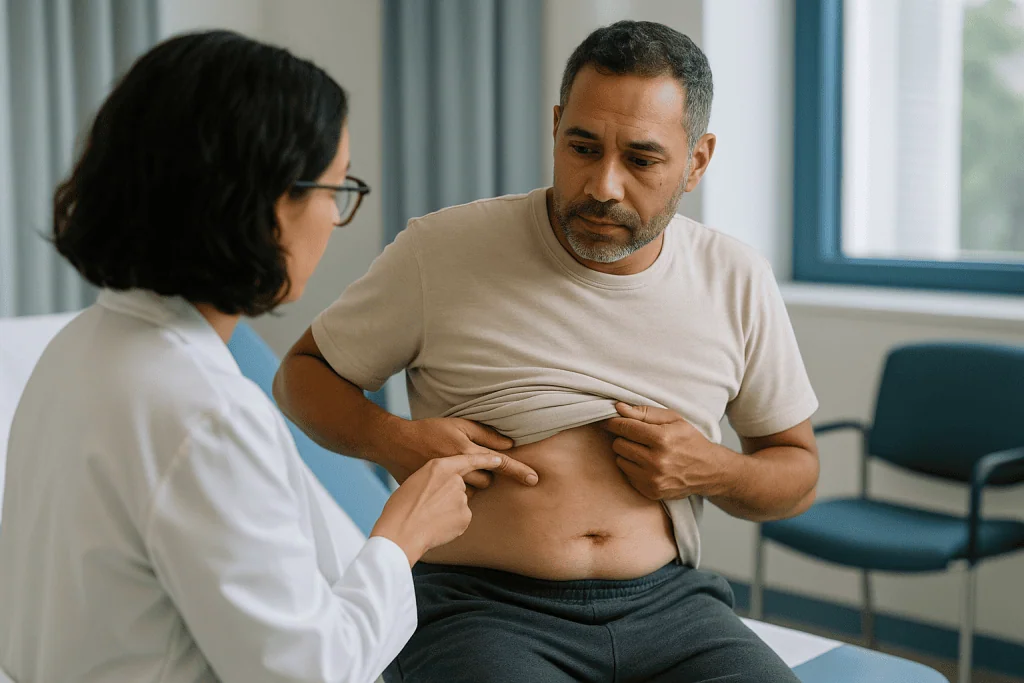
A surgical site infection involves the skin and tissue around the incision. The CDC defines it as an infection occurring in the part of the body where the surgery took place, usually within 30 days of the operation. The classic signs include:
- Redness that spreads outward from the incision rather than staying as a narrow pink rim
- Skin that feels hot and increasingly tender, with swelling that is firm rather than soft
- Drainage that is cloudy, yellow-green or foul-smelling, instead of a small amount of clear or faintly pink fluid
- An incision that begins to pull apart after it had sealed
- Fever accompanying any of the above
A deep infection, usually an abscess near where the appendix sat, is harder to see and easier to miss. Its signs are more about how you feel than how the wound looks: fever that appears days after surgery, belly pain that worsens after an initial improvement, bloating, nausea or vomiting, loss of appetite, and sometimes diarrhea or a feeling of pressure in the rectum because the collection sits low in the pelvis. The Mayo Clinic explains that such abscesses may need drainage with a needle or tube guided by imaging, along with antibiotics.
One pattern deserves emphasis: getting better and then getting worse. Normal recovery is a line that wobbles but trends upward. A clear reversal, where day five feels worse than day three, is the single most useful signal that something has changed. Antibiotics for a confirmed infection work by stopping bacterial growth; the choice, route and length of any course are decisions for the treating clinician, never something to adjust on your own.
Wound redness after appendectomy: normal healing or a surgical site infection?
Every incision goes through a short inflammatory phase that is, by design, red. Blood vessels widen around the cut to deliver immune cells and building blocks for new tissue. A pink or light red rim a few millimeters wide along the edges of each wound is expected in the first week, and so is mild bruising, since laparoscopic ports often pass near small skin vessels.
Healthy redness has a certain character. It stays close to the edges, fades a little each day, and does not feel hotter than the surrounding skin. Mild itching is a good sign, a side effect of new nerve endings and histamine release in healing tissue. A small amount of clear or straw-colored fluid, especially from the navel port, is also common in the first few days.
Infected redness behaves differently. It expands rather than contracts. Many surgical teams suggest tracing the edge of the red area with a skin-safe marker so you can see objectively whether it is growing. The skin becomes shiny, tight and warm. Tenderness increases instead of easing. Drainage turns thick, cloudy or smelly. Sometimes the edges of the incision separate, revealing a moist, yellow base.
Two look-alikes often cause alarm without being infections. Adhesive reactions from surgical tape or glue produce a sharply bordered red rectangle matching the dressing’s shape, often with small blisters, and tend to itch more than hurt. Suture irritation, where a dissolving stitch works its way to the surface, produces a tiny localized sore that settles once the stitch is removed or dissolves.
Caring for the wound is mostly about leaving it alone. Clean hands before touching, gentle washing with water, patting dry, and no ointments or soaking unless your team has specified them. Cleveland Clinic’s guidance on appendicitis stresses following the specific wound instructions you were given, since practices vary between surgeons.
Constipation after appendectomy, ileus and diarrhea: what bowel trouble means
The gut dislikes being handled. After abdominal surgery the intestines often go quiet for a day or two, a state called postoperative ileus, in which the normal muscular waves that move contents along temporarily stop. Bloating, a sense of fullness and no gas or stool are the typical result. Anesthetic agents, opioid pain medicines and the stress response all slow the bowel further.
Constipation after appendectomy is therefore nearly universal in the first days. Opioids act on receptors in the gut wall that reduce movement and increase water absorption, producing hard, infrequent stools. Less walking, less eating and less drinking compound the effect. Most people pass gas within a day or two and have a bowel movement within a few days of going home, according to MedlinePlus discharge guidance. Walking, fluids and fiber-rich foods as tolerated help; many surgeons also plan a stool softener or laxative, and that choice belongs to them.
Diarrhea can also appear, especially after a course of antibiotics, which disturb the normal bacterial balance in the colon. Loose stools for a few days are common. Watery diarrhea that is frequent, persists, contains blood, or arrives with fever and cramping needs medical attention, since antibiotic-associated colitis is a recognized complication after any antibiotic exposure.
The combination that worries surgeons most is bloating plus vomiting plus no gas, particularly if the abdomen becomes tense and tender. That picture can indicate an ileus that is not resolving, a bowel obstruction, or an abscess pressing on the intestine. Equally, new diarrhea paired with pelvic pressure and fever after a perforated appendix can be the way a pelvic abscess announces itself.
Ordinary bowel sluggishness improves with each day of movement and food. Bowel trouble that worsens, or that arrives with fever and pain, is a reason to call rather than wait.
Perforated appendix and abscess: why complicated cases need closer watching
Not every appendectomy carries the same risk afterward. The single biggest factor is whether the appendix had already burst, a condition surgeons call perforation. When the inflamed wall gives way, bacteria-laden contents spill into the abdomen, and the surgeon must wash out the area as well as remove the organ.
The NHS describes two consequences of a burst appendix: peritonitis, which is infection of the lining of the abdomen, and abscess, a walled-off pocket of pus. Both are treated with antibiotics and, for an abscess, often with drainage. Even after a successful operation, the risk of a new abscess forming in the days afterward is higher than in a straightforward case, which is why people with perforation usually stay in hospital longer and go home with a course of antibiotics, as the Mayo Clinic notes.
What should someone in this group watch for? The same signs as everyone else, but with a lower threshold for calling. A fever returning after discharge, abdominal pain that stops improving, bloating, vomiting, diarrhea or rectal pressure can each indicate a developing collection. These abscesses sometimes appear a week or more after surgery, when a person expected to be nearly back to normal.
Drainage tubes add their own questions. Some patients go home with a small drain in place to let fluid escape from the abdomen. A change in the drained fluid from thin and pink to thick, cloudy or foul-smelling, or a sudden increase in volume, should be reported. So should fluid leaking around the drain site or a drain that stops working.
Antibiotics in this setting work by suppressing the bacteria that spilled; the length of the course, typically days rather than weeks, is set by the surgical team based on how you respond. Completing it as prescribed, and calling before changing anything, is part of recovery.
Who usually has surgery right away, and who is asked to wait
Appendicitis is treated as an emergency, but the pathway is not identical for everyone, and knowing which track you were on explains a great deal about what to expect afterward.
Most people with a clear diagnosis and an appendix that has not burst are offered prompt surgery, usually laparoscopic, within hours of arriving. This is the simplest course and carries the lowest risk of later infection.
A second group arrives with an appendix that has already burst and formed a large abscess. Operating immediately through dense, inflamed tissue can be hazardous. The Mayo Clinic explains that in this situation the abscess may first be drained through a tube placed through the skin, with antibiotics to control the infection, and the appendix removed weeks later once inflammation has settled. This delayed operation is called an interval appendectomy. Whether it is always necessary is debated in the surgical literature, since some people never have another episode; the decision depends on age, imaging findings and individual risk, and belongs to the treating team.
A third approach, antibiotics without surgery, has been studied for uncomplicated appendicitis in adults. Mayo notes it may be an option for some people, with the trade-off that appendicitis can return and later surgery may still be needed. It is a shared decision, not a shortcut.
Why does this matter for fever and wound questions? Someone recovering from a drained abscess while waiting for an interval operation is still carrying an active infection and will be watched closely for recurrence. Someone who had a quick laparoscopic removal of an intact appendix should expect a smoother arc. Patients with diabetes, obesity, smoking history, steroid use or weakened immunity face higher infection risk after any operation and may be given more detailed wound instructions. Knowing your own track helps you read your symptoms in context.
Expected versus concerning: a day-by-day comparison
Recovery is easier to judge when the usual course sits next to the warning signs. The table below summarizes typical patterns after an uncomplicated laparoscopic appendectomy; people with a perforated appendix or open surgery often run a few days behind, and your team’s written instructions override any general guide.
| Sign | Usually expected | Worth a same-day call |
|---|---|---|
| Temperature | Mildly raised in the first 24–48 hours, then settling | Rising after day two, returning after it settled, around or above 101°F (38.3°C), or with chills |
| Incision | Narrow pink rim, mild bruising, slight clear or pinkish ooze, itching | Spreading redness, heat, firm swelling, cloudy or smelly drainage, edges opening |
| Pain | Sore, worse with movement, easing a little each day; shoulder ache from gas for 1–2 days | Pain increasing after it improved, severe or constant, tense swollen abdomen |
| Bowels | Bloating and no stool for a few days, gas returning first, loose stools after antibiotics | Vomiting with bloating and no gas, bloody or persistent watery diarrhea, no bowel function with fever |
| Appetite and energy | Low at first, improving steadily through the first week | Unable to keep fluids down, feeling progressively more unwell |
| Breathing | Shallow when sore, better with deep breaths and walking | Breathlessness, chest pain, coughing up discolored phlegm |
The thresholds in the middle column draw on discharge guidance from MedlinePlus and the surgical site infection definitions used by the CDC. The trend is the thing to track. Writing down temperature, pain and bowel function once a day for the first week turns a vague worry into a pattern you can describe clearly on the phone, and makes it far easier for your team to decide what to do next.
Laparoscopic appendectomy recovery time: what the following days and weeks usually look like
The arc after an uncomplicated keyhole operation is quicker than most people expect, and slower than they hope on day two.
Hospital stays are short. The NHS notes that after laparoscopic surgery most people go home within 24 hours, while open surgery or a burst appendix may mean several days. The Mayo Clinic suggests limiting activity for three to five days after laparoscopic surgery and ten to fourteen days after open surgery, with full recovery over a few weeks.
Days one to three are about movement and fluids. Soreness peaks, the gas-related shoulder ache fades, and short walks around the house become the main therapy. Most people manage light meals. Bowels are slow.
Days four to seven bring a noticeable shift. Pain medicine needs typically drop, bowel movements return, and many people with desk-based work feel ready to return within a week or two, according to MedlinePlus. This is also the window in which wound infections most often appear, so it is the week to keep an eye on the incisions.
Weeks two to four involve rebuilding. Walking distance grows, incisions fade from red toward pink, and energy returns unevenly, with good days followed by tired ones. Surgeons generally restrict heavy lifting and strenuous exercise for several weeks so the small fascial openings beneath the skin can strengthen; the exact period is set by your team.
Beyond four weeks, most people are back to usual activity. Scars continue to soften and lighten for months. People who had open surgery or a perforation should expect each phase to take longer, and should treat a late return of fever or pain, even weeks out, as a reason to call rather than something to ride out.
Lingering pain, sleeping on your side and other week-two questions
Once the acute soreness fades, a second wave of questions arrives, quieter but just as persistent.
Is pain four weeks after appendectomy normal? Mild, intermittent discomfort can last that long, particularly around the navel port, where the appendix was removed, or along an open incision. Healing fascia, the tough layer beneath the skin, is sensitive to stretching, and small nerves cut during surgery can produce tingling, numbness or brief sharp twinges for weeks. What distinguishes ordinary healing pain is its direction: it is gradually less frequent, provoked by movement, and not accompanied by fever or swelling. Pain that is constant, deepening, waking you at night, or returning after it had gone is different and deserves a conversation with your surgeon, since a late abscess, a hernia at a port site or an unrelated problem may need checking.
Sleeping on your side is usually fine as soon as it is comfortable, often within the first week after laparoscopic surgery. Nothing inside will come apart from lying on the wound. A pillow hugged against the abdomen, or tucked behind the back for support, makes rolling over easier. People who had open surgery or a drain often prefer their back for longer. Comfort is the guide.
Showering is typically allowed within a day or two, with patting the incisions dry; soaking in baths or pools is commonly discouraged until wounds have fully sealed, per MedlinePlus guidance. Driving should wait until you can brake hard without hesitation and are no longer taking sedating pain medicine. Eating normally can resume as appetite returns; there is no evidence that any particular diet speeds appendectomy healing.
Numbness around a scar often persists for months and may never fully resolve. It is a cosmetic and sensory nuisance, not a sign of trouble.
What people often get wrong about fever after appendectomy
Recovery myths spread quickly, partly because the surgery is so common that everyone knows someone with a story. A few deserve correcting.
Any fever means infection. Not in the first two days. The early inflammatory rise is a predictable response to tissue injury. The signals that matter are timing, trend and company, as earlier sections explain.
A normal temperature rules out a problem. Older adults, people on steroids or other immune-suppressing medicines, and those with diabetes may develop an abscess with little or no fever. For them, worsening pain, bloating or simply feeling unwell carries more weight than the thermometer.
Redness means the wound is infected. A narrow pink rim is part of healing. Infection shows itself through spreading, heat, firm swelling and cloudy drainage, as the CDC definition describes.
Antibiotics after surgery are optional once you feel better. After a perforated appendix, the course is prescribed to suppress bacteria already spilled into the abdomen. Stopping early because symptoms have eased is a decision that should only be made with the prescribing clinician.
Resting completely is safest. Lying still slows the bowel, encourages shallow breathing and raises the risk of blood clots. Short, frequent walks are among the best things a recovering person can do, which the Cleveland Clinic and others consistently recommend.
Keyhole surgery means nothing can go wrong inside. Small incisions reduce wound complications, but the operation inside the abdomen is the same. Deep infection, bleeding and bowel problems remain possible, especially after perforation.
Once past two weeks, you are in the clear. Wound infections can appear up to a month after surgery, and abscesses occasionally surface later still. A new fever at week three is a reason to call, not to assume a coincidental virus.
Questions to ask your care team before you go home
Discharge conversations are short and often happen while you are still groggy. Writing questions down beforehand, or asking a companion to take notes, makes the hour afterward far less confusing. The answers to these shape how you interpret every symptom in the weeks that follow.
- Was my appendix intact or had it perforated? Was there an abscess or peritonitis?
- Was the operation laparoscopic or open, and were any steps changed partway through?
- What temperature should prompt a call, and what number do I call at night or on weekends?
- Am I going home with antibiotics? What are they intended to treat, and for how long is the course planned?
- How should I care for the incisions, and when can they get wet? Should I remove or leave any dressings or glue?
- Do I have a drain? If so, what should the fluid look like, and what changes should I report?
- What is the plan for pain relief, and what should I do if the prescribed approach is not enough?
- What is expected for my bowels, and is anything planned to prevent constipation?
- When can I lift, drive, exercise and return to work, given the type of surgery I had?
- When is my follow-up, and who will tell me the pathology result on the appendix?
- Were there any findings during surgery that need further tests or imaging later?
Two of these questions carry extra weight. Knowing whether the appendix had burst changes your risk of a later abscess and sets the threshold for calling about fever or pain. Knowing the pathology plan matters because, uncommonly, the removed appendix reveals an unexpected finding that requires a follow-up discussion. Johns Hopkins Medicine encourages patients to clarify restrictions and warning signs before leaving, because instructions vary between surgeons and between laparoscopic and open approaches. If anything in this article conflicts with what your team told you, their instructions win.
When to call your doctor after appendectomy
Most recoveries never need an unscheduled call. When one is needed, it is almost always because a trend has reversed or a new symptom has appeared. Contact your surgical team the same day if you notice any of the following, and go to an emergency department if symptoms are severe or you cannot reach anyone.
- A fever that starts or rises after the second day, returns after settling, reaches the threshold on your discharge sheet (commonly around 101°F or 38.3°C, per MedlinePlus), or arrives with chills and shaking
- Redness spreading from an incision, skin that is hot and increasingly tender, cloudy or foul-smelling drainage, or a wound that opens
- Belly pain that gets worse instead of better, becomes severe or constant, or is accompanied by a hard, swollen abdomen
- Repeated vomiting, inability to keep fluids down, or bloating with no gas passing
- No bowel movement for several days despite walking and fluids, or diarrhea that is bloody, frequent or persistent
- Shortness of breath, chest pain, or coughing up discolored phlegm
- Pain, swelling or warmth in one calf
- Burning when passing urine, or passing very little urine
- Dizziness, fainting, a racing heartbeat or feeling markedly more unwell than the day before
Call immediately, rather than waiting for office hours, for severe abdominal pain with a rigid belly, high fever with confusion or drowsiness, heavy bleeding from a wound, or difficulty breathing. These can indicate peritonitis, sepsis, bleeding or a clot in the lung, all of which need urgent assessment, as the NHS complications guidance describes.
Describing what you see precisely helps: when the fever began, the highest reading, how the wound has changed, when you last passed gas or stool, and whether pain is improving or worsening. Your team will decide whether you need to be seen, examined, scanned or treated. Calling about something that turns out to be ordinary healing is never a mistake; recognizing an abscess a day earlier can shorten a recovery by weeks.
Frequently asked questions
What are the signs of infection after an appendectomy?
Spreading redness, heat, firm swelling, cloudy or foul-smelling drainage from an incision, and fever are the main signs of a wound infection. A deeper abscess shows itself differently: fever appearing days after surgery, belly pain that worsens after improving, bloating, vomiting or diarrhea. Any of these, particularly after a perforated appendix, warrants a same-day call to your surgical team, who will decide whether examination, imaging or treatment is needed.
Is a low grade fever after appendectomy normal?
In the first day or two, yes. Tissue injury from surgery releases chemicals that nudge body temperature upward, and dehydration adds to the effect. This early fever should stay modest and fade. A temperature that begins after the second day, climbs, returns after settling, or reaches the threshold on your discharge sheet, often around 101°F (38.3°C), is a different pattern and should prompt a call that day.
How long is laparoscopic appendectomy recovery time?
Most people go home within a day of keyhole surgery and feel able to resume light activity within about a week, according to NHS and Mayo Clinic guidance, with full recovery over a few weeks. Open surgery or a burst appendix typically adds days to the hospital stay and a week or more to recovery. Your surgeon sets the timing for lifting, exercise and return to work based on what was found during the operation.
Is it normal to have pain 4 weeks after appendectomy?
Mild, intermittent discomfort around the incisions, especially the navel, can last four weeks or more as deeper tissue heals and small cut nerves recover. Ordinary healing pain is provoked by movement, gradually less frequent, and not accompanied by fever or swelling. Pain that is constant, deepening, waking you at night or returning after it had gone should be reviewed by your surgeon.
When can I sleep on my side after an appendectomy?
As soon as it is comfortable, often within the first week after laparoscopic surgery. Lying on your side will not damage the internal repair or the incisions. Hugging a pillow against your abdomen or placing one behind your back makes rolling over easier. People who had open surgery or who went home with a drain often prefer sleeping on their back for a little longer; comfort is the guide.
What helps constipation after appendectomy?
Walking, drinking fluids and returning to fiber-rich foods as appetite allows are the most effective everyday measures, because they counter the bowel slowing caused by anesthesia, handling of the intestines and opioid pain medicine. Many surgeons also plan a stool softener or laxative; that choice belongs to them. Call your team if you have no bowel movement for several days despite these steps, or if bloating comes with vomiting and no gas.
How much wound redness is normal after appendectomy?
A narrow pink or light red rim along each incision, with some bruising and mild itching, is expected during the first week. Healthy redness stays close to the edges and fades daily. Redness that expands outward, feels hot, becomes firm and more tender, or appears with cloudy drainage suggests infection. Tracing the edge with a skin-safe marker helps you and your team judge whether it is growing.
Why do I need antibiotics after appendectomy if the appendix is already out?
After a perforated appendix, bacteria have already spilled into the abdomen, and antibiotics work by suppressing them while the body clears the remaining contamination. This lowers the chance of an abscess forming afterward. Uncomplicated cases usually need little or no antibiotic treatment beyond the dose given around the time of surgery. The type and length of any course is decided by your surgical team and should not be changed without them.
Can an abscess form weeks after appendectomy?
Yes, although it is uncommon after an intact appendix is removed. Abscesses are far more likely after perforation and typically appear within the first couple of weeks, but some surface later. The warning signs are a new fever, belly pain that worsens after improving, bloating, vomiting, diarrhea or pelvic pressure. Treatment usually involves imaging, antibiotics and sometimes drainage guided by a scan, all directed by the treating team.
When can I shower, drive and exercise after appendectomy?
Showering is typically allowed within a day or two, patting incisions dry and avoiding baths or pools until wounds have sealed. Driving should wait until you can brake hard without hesitation and are no longer taking sedating pain medicine. Light walking starts immediately; heavy lifting and strenuous exercise are usually restricted for several weeks so deeper tissue can strengthen. Your surgeon’s specific instructions take precedence over these general ranges.
References
- MedlinePlus Medical Encyclopedia: Appendectomy
- NHS: Appendicitis
- Cleveland Clinic: Appendicitis
- CDC: About Surgical Site Infections
This article is for general information only and is not a substitute for professional medical advice. Please consult a qualified doctor about your individual situation.

More from the Blog

Fever, Wound Redness or Bowel Trouble After Appendectomy: What to Watch and When to Call
A mild temperature in the first 24 to 48 hours after appendectomy is common and usually reflects the body's response to surgery, not infection.…

What Are the Warning Signs of a Bile Leak After Gallbladder Surgery? A Rare Risk Explained
A bile leak after gallbladder surgery is an uncommon complication in which bile escapes from the sealed duct stump or a bile duct into…

Fecal Incontinence After Childbirth: Why It Happens and How Pelvic Floor Specialists Help
Fecal incontinence after childbirth usually results from stretching or tearing of the anal sphincter muscles, or of the nerves that control them, during vaginal…

How Long Does Relief From Achalasia Balloon Dilation Usually Last? Realistic Expectations
Relief from pneumatic balloon dilation for achalasia typically lasts years rather than months, but it is rarely permanent. Large randomized follow-up found roughly four…

Is Gallbladder Surgery Different for Older Adults? How Age and Heart Conditions Shape the Plan
Gallbladder surgery is not fundamentally different for older adults, but the planning around it is. Surgeons weigh frailty, heart and lung conditions, medicines such…

Why Fecal Incontinence Happens: Muscle, Nerve and Stool Factors Specialists Look For
Fecal incontinence usually happens when one or more of three systems fails: the sphincter muscles that close the anus, the nerves that sense stool…