

Food Allergy Testing: Skin Prick vs Blood: What Each Can Tell You
Key Takeaways
- More than half of positive skin prick or blood test results reflect harmless sensitization, not true food allergy, history plus testing beats testing alone.
- A skin prick test delivers results in about 15 minutes; a wheal roughly 3 mm larger than the saline control typically counts as positive.
- The medically supervised oral food challenge, not any skin or blood test, is the gold standard for confirming or ruling out food allergy.
- Nine foods (milk, egg, peanut, tree nuts, soy, wheat, fish, shellfish, and sesame) cause about 90% of US food allergy reactions, and all must appear on labels.
- IgG 'food sensitivity' panels measure normal exposure to foods, not allergy, and major allergy organizations recommend against using them for diagnosis.
- Milk, egg, wheat, and soy allergies are outgrown by a majority of children, while peanut, tree nut, fish, and shellfish allergies persist into adulthood roughly 80–90% of the time.
Skin prick tests and blood tests both look for IgE antibodies to specific foods, but neither confirms a food allergy by itself. Skin tests deliver results in about 15 minutes; blood tests measure antibody levels in a lab over several days. Both produce frequent false positives, so allergists interpret them alongside your reaction history and may use a medically supervised oral food challenge when results are unclear.
The scrambled eggs were barely on the tray before the toddler’s lip started to puff. Twenty minutes later, hives bloomed across her chest like a rash of mosquito bites. Her father did what most of us would do: he opened his phone and typed “food allergy test near me.”
Here is what he found instead: a thicket of finger-prick kits, hair-analysis mailers, 96-food panels, and clinic pages, all promising answers. Some of those tests are genuinely useful. Some measure things that have nothing to do with allergy at all. And even the legitimate ones come with a catch that surprises almost everyone: a positive result often doesn’t mean you’re allergic.
Sorting the skin prick test from the blood draw, and both from the pretenders, turns out to matter more than which clinic you pick. So let’s do that sorting, with the evidence on the table.
Why a positive food allergy test doesn't always mean you're allergic
Start with the single most misunderstood fact in this entire field: skin prick and blood tests detect sensitization, not allergy. Sensitization means your immune system has produced IgE antibodies against a food protein. Allergy means those antibodies actually trigger symptoms when you eat the food. The two overlap, but far less than you’d expect.
Research summarized by the National Institute of Allergy and Infectious Diseases and Mayo Clinic suggests that more than half of positive skin or blood test results would not translate into a real reaction if the person ate the food under supervision. A child can carry measurable IgE to peanut and eat peanut butter every week without a single hive. Test that child on a broad panel, and the paperwork will say “positive” anyway.
This is why allergists insist on pairing any test with a detailed history: what you ate, how much, how fast symptoms appeared, what the symptoms looked like. A skin test that agrees with a convincing story is strong evidence. A skin test ordered as a fishing expedition, with no story behind it, mostly generates false alarms, and false alarms have costs. Families cut out foods needlessly, children’s diets narrow, and anxiety settles in around every restaurant menu.
Keep this frame in mind as we compare the two main tests. The question is never “which test is positive?” It’s “which test, combined with my history, gets closest to the truth?”
How does a skin prick test work?
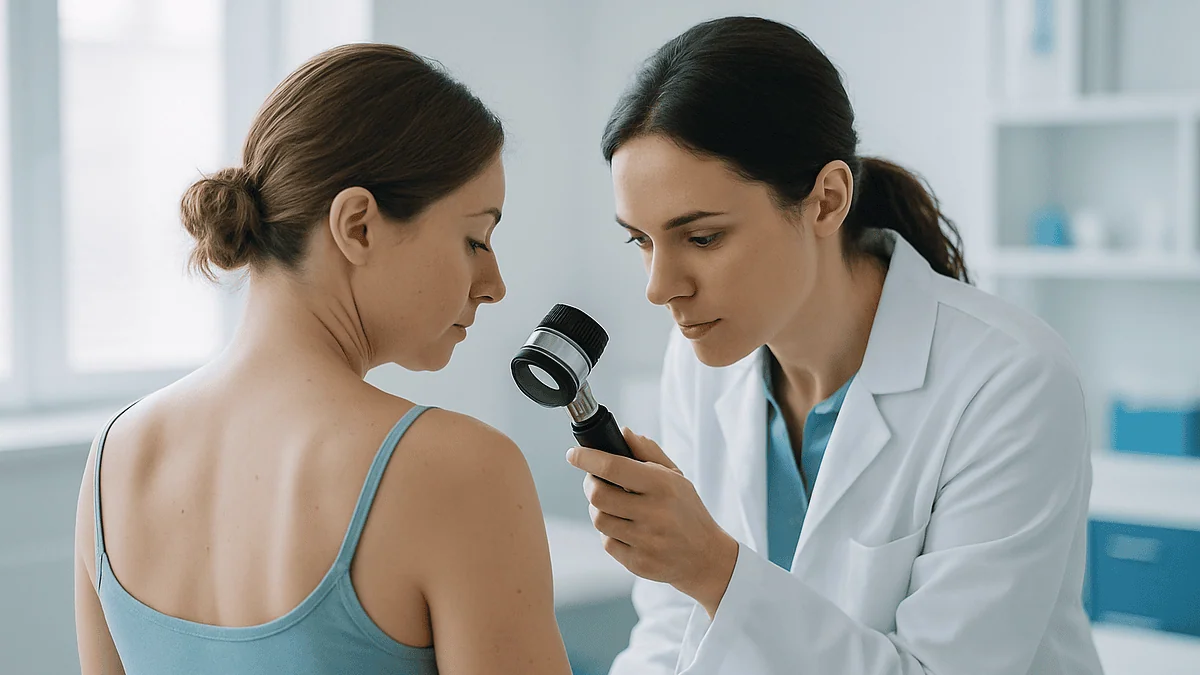
A skin prick test is elegantly low-tech. A nurse or allergist places small drops of liquid food extract on your forearm or upper back, often a dozen or more, arranged in a labeled grid, then pricks the skin through each drop with a tiny plastic or metal lancet. The prick barely breaks the surface; most adults describe it as a scratch, not a needle stick.
Then you wait about 15 minutes. If you’re sensitized to a food, the spot swells into a raised, itchy bump called a wheal, ringed by redness, essentially a miniature, contained hive. Clinicians measure the wheal, and a bump roughly 3 millimeters larger than the negative control typically counts as positive. Every test includes two controls: a histamine drop that should always react (proving your skin can respond) and a saline drop that shouldn’t (proving your skin isn’t reacting to everything).
The test’s strengths are speed and sensitivity. When a true allergy exists, skin testing catches it the vast majority of the time, which makes a clearly negative result genuinely reassuring. Its weakness is the flip side: specificity is modest, and false positives are common, especially in people with eczema or other reactive skin.
Serious reactions to skin prick testing itself are rare, which is one reason it’s performed in a medical setting rather than at home. Bigger wheals suggest a higher likelihood of true allergy, but wheal size does not predict how severe a reaction would be.
How does an allergy blood test work?
The blood test, a specific-IgE test, descended from what older reports called RAST, takes a different route to the same question. A single blood draw goes to a lab, where analyzers measure how much IgE antibody your blood carries against particular food proteins. Results come back in a few days to a week, reported as a number for each food tested.
Higher numbers mean a higher probability of true allergy, and allergists have published thresholds for foods like egg, milk, and peanut above which a real reaction becomes very likely. But two caveats matter. First, low positives are murky territory, heavily populated by sensitized-but-tolerant people. Second, and this trips up nearly everyone, the number reflects likelihood, not severity. A modest result does not mean your reactions will be mild.
Blood testing shines in specific situations:
- You take antihistamines you can’t pause, which would blunt a skin test but don’t affect blood results.
- Widespread eczema or another skin condition leaves no clear skin to test.
- A past reaction was severe enough that even the tiny exposure of a skin prick feels unwise.
- Your clinician wants to track antibody levels over years to see whether a childhood allergy is fading.
The trade-offs: a needle instead of a scratch, days instead of minutes, and generally higher cost. Accuracy-wise, per Cleveland Clinic and Mayo Clinic, skin and blood tests perform comparably, both sensitive, both prone to false positives, neither definitive alone.
Skin prick vs blood test: the honest side-by-side
Neither test “wins.” They answer the same underlying question, is there food-specific IgE?, through different windows, and allergists often use both when results conflict or stakes are high. Here’s how they compare on the details that actually affect your experience:
| Skin prick test | Specific-IgE blood test | |
|---|---|---|
| What it detects | IgE bound to immune cells in the skin | IgE circulating in the blood |
| Time to results | About 15 minutes, same visit | Several days to a week |
| Discomfort | Light scratches; itchy bumps if positive | One standard blood draw |
| Affected by allergy medicines? | Yes, antihistamines must usually be paused for several days first | No |
| Works with severe eczema? | Difficult, needs clear skin | Yes |
| False positives | Common | Common |
| Clearly negative result | Strong evidence against IgE allergy | Strong evidence against IgE allergy |
| Predicts reaction severity? | No | No |
| Typical setting | Allergist’s office | Any lab, ordered by a clinician |
Notice the pattern in that table: the two tests differ mostly in logistics, not in truth-finding power. Where they agree with your history, confidence rises sharply. Where they disagree, a positive blood test but negative skin test, say, that’s precisely when the third option enters the picture.
What is the most accurate food allergy test?
The most accurate food allergy test involves no needles and no lab at all. It’s the oral food challenge: eating the suspect food, in gradually increasing amounts, under direct medical supervision. Mayo Clinic and NIH guidelines both treat it as the diagnostic gold standard, and the double-blind, placebo-controlled version, where neither you nor the staff knows which servings contain the real food, is the reference against which every other test is judged.
A challenge typically unfolds over several hours. You start with a tiny amount, sometimes a crumb-sized dose mixed into another food, then step up every 15 to 30 minutes while staff watch for symptoms. Pass the full serving without reacting, and the allergy question is answered about as definitively as medicine allows. React, and you’re in the safest possible place for it, with emergency treatment steps away.
That built-in risk is exactly why challenges are never a first move and never a do-it-yourself project. Allergists reserve them for when the evidence is genuinely ambiguous: borderline test numbers, a history that doesn’t quite fit, or a child whose antibody levels have drifted down over the years, raising hope the allergy has been outgrown.
Used that way, the challenge is less a test than a verdict, and often a liberating one. A large share of supervised challenges end with the person eating the food safely, reclaiming something they may have avoided for a decade based on a wheal measured in millimeters.
What 8 foods cause 90% of allergies? (There are actually 9 now)
For years, the answer people memorized was eight: milk, eggs, peanuts, tree nuts, soy, wheat, fish, and crustacean shellfish. Together, these account for roughly 90 percent of food allergy reactions in the United States, which is why food labels must flag them explicitly. In 2023, sesame officially joined the list as the ninth major allergen under US labeling law: a change driven by how common sesame allergy turned out to be and how quietly sesame hides in foods like hummus, baked goods, and spice blends.
A few patterns within the nine are worth knowing:
- Milk and egg dominate early childhood and are the allergies most often outgrown, frequently by the school years.
- Peanut and tree nuts tend to persist; most children allergic to them remain allergic as adults.
- Fish and shellfish allergies often first appear in adulthood, shellfish is among the most common adult-onset food allergies.
- Wheat and soy allergies in children usually fade with age; adult wheat allergy is comparatively rare and sometimes confused with celiac disease, which is a different immune condition entirely.
These nine also shape testing strategy. An allergist evaluating a convincing reaction will usually test the plausible culprits from this list plus anything specific in your history, not all nine reflexively, and certainly not a 96-food panel. The broader the net, the more false positives it drags in.
What are 7 signs of a food allergy?
Timing is the tell. True IgE-mediated food allergy reactions typically begin within minutes to two hours of eating, and they recur reliably each time the food is eaten. According to Mayo Clinic and the NHS, the signs worth recognizing are:
- Hives or itchy, flushed skinraised welts that can spread across the body
- Tingling or itching in the mouthoften the very first sensation
- Swelling of the lips, face, tongue, or throat
- Digestive distressnausea, vomiting, cramping, or diarrhea arriving fast, not the next day
- Wheezing, coughing, or trouble breathingnasal congestion counts too
- Dizziness or lightheadednessa sign blood pressure may be dropping
- Anaphylaxisseveral systems reacting at once: throat tightening, breathing difficulty, a racing pulse, a plunge in blood pressure, loss of consciousness
The seventh is a medical emergency, full stop. Anaphylaxis can escalate within minutes and requires emergency treatment immediately, not a wait-and-see approach at home.
Just as useful is knowing what isn’t on this list. Bloating the next morning, fatigue, brain fog, joint aches, headaches hours or days later: these are real and worth investigating, but they don’t fit the IgE allergy pattern, and skin or blood allergy tests won’t explain them. Bringing a clear symptom timeline to your appointment, including photos of any hives, does more to sharpen the diagnosis than any panel of tests ordered blind.
Food allergy vs intolerance: why the difference changes everything
Confuse these two, and every test result becomes misleading. A food allergy is an immune-system event: IgE antibodies mistake a food protein for a threat and unleash histamine and other chemicals, producing hives, swelling, and, in the worst cases, anaphylaxis. A food intolerance is usually a digestive problem: your body struggles to process a food, but your immune system isn’t sounding alarms.
Lactose intolerance is the classic example. People with it lack enough lactase, the enzyme that digests milk sugar, so a milkshake brings bloating, gas, and cramps an hour or three later. Unpleasant, absolutely. Dangerous, no, and a milk allergy test will come back negative, because no IgE is involved. Similar logic applies to sensitivities to caffeine, histamine-rich foods, or certain fermentable carbohydrates.
Three practical differences follow, as Harvard Health lays out:
- Dose matters differently. Intolerances are graded: a splash of milk in coffee may be fine while a bowl of ice cream isn’t. Allergies can be triggered by trace amounts.
- Danger differs. Intolerances cause misery; IgE allergies can cause life-threatening reactions.
- Tests differ. Skin prick and specific-IgE blood tests only address allergy. Intolerances are diagnosed through history, structured elimination-and-reintroduction under clinical guidance, or targeted tests like breath testing for lactose.
Celiac disease sits in its own category: an immune reaction to gluten, but not an IgE one, diagnosed with entirely different blood work. If gluten is your concern, say so explicitly: an allergy panel won’t find celiac.
Why doctors don't recommend IgG "food sensitivity" tests
Walk through any wellness aisle online and you’ll find panels offering to test your “sensitivity” to 96 or even 200 foods from a finger prick. Nearly all of them measure IgG antibodies, and that’s the problem. IgG is a different antibody class from IgE, and producing IgG against a food appears to be a normal consequence of eating it. Some evidence suggests food-specific IgG may actually mark toleranceyour immune system filing a food under “harmless”, rather than any kind of reaction.
Run an IgG panel on a healthy person and it will light up with “reactive” foods, typically the ones they eat most often. Eggs, dairy, and wheat headline these reports for the simple reason that people eat a lot of eggs, dairy, and wheat. Major allergy and immunology organizations in the United States, Europe, and Canada have formally recommended against IgG food testing for diagnosing allergy or intolerance, a position Harvard Health has echoed in its consumer guidance.
The harm isn’t hypothetical. People receive reports flagging 20 or 30 foods, eliminate them all, and end up with restricted, socially exhausting diets chasing a result that never carried diagnostic meaning. In children, sweeping eliminations can compromise growth and nutrition. And the money involved is real: these panels commonly run into the hundreds of dollars, out of pocket.
If ongoing symptoms have you suspecting food, that suspicion deserves a proper workup, history, validated testing where appropriate, supervised elimination if needed, not a heat map of everything you had for lunch last month.
Can you trust an at-home food allergy kit?
It depends entirely on what the kit measures, and what you expect it to do. Sort the mail-order options into three bins:
- IgG “sensitivity” panels: not diagnostic for allergy or intolerance, for the reasons above. Skip them.
- Hair, muscle-response, or bioresonance tests: no scientific basis whatsoever. Hair contains no IgE and cannot reveal food allergy.
- Finger-prick IgE tests: these measure the same antibody class as a clinical blood test, so the chemistry can be legitimate. The problem is everything around the number.
That last bin deserves the nuance. An at-home IgE result arrives without the two things that make the number meaningful: a clinician taking your reaction history, and expert judgment about whether a low positive reflects true allergy or harmless sensitization. Remember that more than half of positive IgE results don’t correspond to real allergy. Handed a raw report, most people do the understandable thing, cut out every flagged food, and end up needlessly restricted. The reverse error is worse: treating a negative home result as permission to freely eat a food that previously caused throat tightness.
There’s also no one to answer the questions that actually matter. Should you carry emergency medication? Is a supervised challenge warranted? Could your symptoms be intolerance instead?
A reasonable rule: an at-home IgE test can be a conversation starter you bring to a clinician, never a conversation ender. If a kit’s marketing implies it can diagnose you outright, that overpromise tells you what you need to know.
Is food allergy testing worth it?
When it’s anchored to a real reaction history, emphatically yes. When it’s a shot in the dark, usually not. The dividing line is whether you have something specific to investigate.
Testing earns its keep in situations like these:
- You’ve had symptoms consistent with IgE allergy, hives, swelling, breathing trouble, rapid vomiting, within about two hours of eating, especially more than once with the same food.
- A child reacted to a first taste of egg, peanut, or milk, and the family needs a safe path forward.
- You’ve avoided a food for years after a childhood diagnosis and want to learn whether you’ve outgrown it. Roughly 60 to 80 percent of children outgrow milk and egg allergies, so retesting can literally expand a life.
- Eczema, asthma, or an existing food allergy puts you at higher risk, and a clinician recommends targeted evaluation.
Where testing disappoints is the broad, symptom-free screen: “test me for everything, just in case.” Because false positives multiply with every food added to a panel, indiscriminate testing tends to manufacture allergies on paper that don’t exist in the body. NIH-supported guidelines specifically discourage screening people without a suggestive history.
Cost is worth a clear-eyed look too. Clinician-ordered testing tied to symptoms is often covered by insurance; sprawling direct-to-consumer panels rarely are. The best value in this entire field may be the least glamorous purchase: a visit with a board-certified allergist who decides which tests you actually need, and which you don’t.
How to prepare for a food allergy test
A little preparation meaningfully improves what your appointment can accomplish. The single biggest factor for skin prick testing: antihistamines. These medicines suppress the very skin response the test measures, so clinics typically ask you to pause them for several days beforehand, follow your own clinic’s instructions rather than a general rule, and never stop a prescribed medicine without checking first. Blood tests aren’t affected, which is one reason your allergist may pivot to a blood draw if pausing medication isn’t practical.
Beyond that, the most valuable thing you can bring is information:
- A reaction timeline. What was eaten, roughly how much, how many minutes until symptoms, what the symptoms were, how long they lasted.
- Photos. Hives fade before appointments; a phone photo preserves the evidence.
- Ingredient lists or restaurant details from the meal in question: the culprit is sometimes a hidden ingredient, not the obvious one.
- Your full medication and supplement list, plus any history of eczema, asthma, or hay fever, which shape how results get interpreted.
On the day itself, expect a skin test visit to run 30 to 60 minutes, most of it waiting and wheal-measuring. Wear a shirt with sleeves that roll up easily, or one you don’t mind partially removing if the back is used. The itching at positive sites is real but short-lived, usually settling within a couple of hours.
One thing not to do beforehand: experiment with the suspect food at home to “confirm” your theory. If your history suggests real allergy, that experiment belongs in a supervised setting or nowhere.
When to see a doctor, and when to call 911
Some situations call for an appointment; one calls for an ambulance. Know the difference before you need it.
Call 911 immediately if you or someone near you shows signs of anaphylaxis after eating: throat tightness or trouble swallowing, difficulty breathing or wheezing, widespread hives paired with vomiting, sudden dizziness or fainting, or a feeling of dread with a racing pulse. If a prescribed emergency injector is available, use it right away, then still call 911, because symptoms can rebound hours later even after they appear to settle. Anaphylaxis is not a wait-and-see event; minutes matter.
Make a medical appointment soonideally with an allergist, if any of these apply:
- You’ve had hives, swelling, mouth itching, or rapid vomiting within two hours of eating, even once.
- The same food has caused symptoms on separate occasions.
- Your infant or child reacted to a newly introduced food, do not simply reintroduce it at home to check.
- You’re an adult with new reactions to shellfish, fish, or nuts; adult-onset allergy is more common than most people assume, affecting an estimated one in ten US adults by some CDC-referenced surveys.
- You’re considering cutting foods from a child’s diet for suspected allergy, elimination in growing children should happen under medical and nutritional guidance.
And see someone even if a home test told you everything is fine. A negative kit result cannot overrule a body that has already reacted. Your history is data; make sure a professional hears it.
What happens after the results: living with (or retiring) a diagnosis
A confirmed diagnosis is a beginning, not a sentence. The immediate work is practical: learning to read labels for your allergen, US law requires the nine major allergens to be declared plainly, briefing schools and restaurants, and, if your allergist prescribes one, carrying an emergency injector and knowing exactly when to use it. Families often find the first months the hardest; the routines genuinely do become second nature.
The longer arc is more hopeful than most people expect. Food allergies are not necessarily permanent. Milk, egg, wheat, and soy allergies fade in a majority of children, often by adolescence, which is why allergists retest periodically rather than filing the diagnosis away forever. Falling antibody levels over successive blood tests can signal that a supervised oral food challenge is worth attempting. Peanut, tree nut, fish, and shellfish allergies persist more stubbornly, roughly 80 to 90 percent continue into adulthood, but even there, periodic reassessment beats assumption.
Equally important is the other direction: retiring diagnoses that never should have existed. If your avoidance of a food rests on a decade-old panel result rather than an actual reaction, that’s precisely the case worth revisiting with an allergist. Supervised challenges regularly return foods to people’s plates, and with them, ease at birthday parties, potlucks, and airplane snack carts.
Either way, the endpoint is the same: a diet shaped by evidence rather than fear. That’s the honest promise of good testing, not a cure, but clarity, and a plan that fits the person actually holding the fork.
Frequently asked questions
What 8 foods are 90% of allergies?
Milk, eggs, peanuts, tree nuts, soy, wheat, fish, and crustacean shellfish have long accounted for roughly 90% of US food allergy reactions. Since 2023, sesame is officially the ninth major allergen under federal labeling law, so all nine must be declared plainly on packaged food labels. Milk and egg dominate in young children, while shellfish is among the most common allergies that first appears in adulthood.
What are 7 signs of a food allergy?
Seven hallmark signs are hives or itchy skin, tingling or itching in the mouth, swelling of the lips, face, tongue, or throat, rapid digestive symptoms like vomiting or cramps, wheezing or trouble breathing, dizziness or faintness, and anaphylaxis: a severe multi-system reaction. True IgE reactions typically begin within minutes to two hours of eating. Anaphylaxis is a medical emergency requiring an immediate 911 call.
What is the most accurate food allergy test?
The medically supervised oral food challenge is the most accurate food allergy test and the diagnostic gold standard. You eat gradually increasing amounts of the suspect food over several hours while clinicians monitor for reactions, with emergency treatment on hand. Skin prick and blood tests are useful screening tools, but both produce frequent false positives, so allergists use the challenge when results and history don’t clearly agree.
Is food allergy testing worth it?
Yes, when it’s tied to a real reaction history, symptoms like hives, swelling, or rapid vomiting within about two hours of eating a specific food. Targeted testing then clarifies the culprit and shapes a safety plan. Broad panels ordered without symptoms are generally not worth it, because false positives multiply with every food tested, often leading to unnecessary dietary restriction rather than useful answers.
Can a blood test miss a food allergy?
Rarely, but it can happen. Specific-IgE blood tests are highly sensitive, so a clearly negative result usually argues strongly against IgE-mediated allergy. Still, a small number of people with genuine allergies test low or negative, particularly early on. If you’ve had a convincing reaction despite a negative test, allergists may repeat testing, add a skin prick test, or arrange a supervised oral food challenge rather than dismiss your history.
Do at-home food allergy kits work?
Only partially, and only some of them. Finger-prick kits measuring IgE use legitimate chemistry but arrive without the clinical history and expert interpretation that make results meaningful, and over half of positive IgE results don’t reflect true allergy. Kits measuring IgG, hair, or ‘bioresonance’ have no diagnostic validity for allergy at all. Treat any home result as a conversation starter for a clinician, never a diagnosis.
What is the difference between a food allergy and a food intolerance?
A food allergy is an immune reaction: IgE antibodies trigger symptoms like hives, swelling, or breathing trouble within minutes to two hours, sometimes from trace amounts. A food intolerance is usually a digestive problem, like lactose intolerance, caused by an enzyme shortfall, producing bloating, gas, or cramps that are dose-dependent and uncomfortable but not life-threatening. Skin and blood allergy tests detect only allergy, not intolerance.
Can adults develop food allergies?
Yes. Food allergies can appear at any age, even to foods you’ve eaten safely for decades. Shellfish, fish, and tree nuts are among the most common adult-onset triggers, and CDC-referenced surveys suggest roughly one in ten US adults has a food allergy. New reaction symptoms after eating, hives, swelling, mouth itching, breathing changes, warrant a proper evaluation regardless of your age or eating history.
Can children outgrow food allergies?
Often, depending on the food. A majority of children, commonly cited as 60 to 80 percent, outgrow milk and egg allergies, and wheat and soy allergies frequently fade too, often by the school years or adolescence. Peanut, tree nut, fish, and shellfish allergies persist far more often, continuing into adulthood in roughly 80 to 90 percent of cases. Allergists retest periodically and may confirm with a supervised food challenge.
How do I prepare for a skin prick allergy test?
Pause antihistamines for several days beforehand, following your clinic’s specific instructions, since these medicines suppress the skin response the test measures, but never stop a prescribed medicine without checking first. Bring a detailed reaction timeline, photos of any hives, ingredient lists from suspect meals, and your full medication list. Expect the visit to take 30 to 60 minutes, with itchy bumps at positive sites fading within a few hours.
References
This article is for general information only and is not a substitute for professional medical advice. Please consult a qualified doctor about your individual situation.

More from the Blog

Whole Genome Sequencing and Polygenic Risk Scores: What Consumer Genomics Can Predict
Whole genome sequencing reads nearly all 3 billion letters of a person's DNA and can reliably identify rare single-gene variants linked to conditions such…

Protein in Urine: What a Urinalysis Finding Means for Your Kidneys
Protein in urine, called proteinuria, means the kidneys' filters are letting protein such as albumin leak through. A single positive result on a urinalysis…
Lynch Syndrome: The Inherited Cancer Risk Worth Knowing About
Lynch syndrome is an inherited condition, caused by a change in one of the DNA mismatch repair genes, that raises lifetime risk of colorectal,…

Genetic Testing: What It Can Detect and How Long Results Take
Genetic testing can detect single-gene conditions such as cystic fibrosis, sickle cell disease and Huntington disease, chromosome differences such as Down syndrome, inherited cancer…
Pap Smear vs HPV Test: What Each Detects and the New Screening Intervals
A Pap smear examines cervical cells under a microscope for abnormal changes, while an HPV test looks for the genetic material of high-risk human…

A Short History of DNA Testing, and How Long a Test Takes Today
Modern DNA testing began in September 1984, when British geneticist Alec Jeffreys developed DNA fingerprinting at the University of Leicester; the first criminal conviction…