

Pancreatic Cancer Screening: Who Is Considered High-Risk and What Surveillance Involves
Key Takeaways
- Average lifetime risk of pancreatic cancer is about 1.7 percent, roughly one in sixty, which is why routine screening of the general population fails the harm-versus-benefit test.
- Surveillance is offered when two or more relatives on the same side of the family have had pancreatic cancer with at least one being a parent, sibling or child, or when a pathogenic variant in STK11, CDKN2A, PRSS1, or, with an affected first-degree relative, BRCA1, BRCA2, PALB2, ATM or a Lynch gene is found.
- Start ages under the CAPS consensus range from 30 to 35 for STK11 carriers to 50 for familial cases, or ten years before the youngest affected relative's diagnosis, whichever comes first.
- Yearly endoscopic ultrasound and MRI with MRCP, usually alternated, plus a fasting glucose or HbA1c form the backbone of surveillance; CT is not used routinely because of cumulative radiation.
- In the largest cohort studies, most cancers found during scheduled surveillance were stage I with five-year survival near three-quarters, but no randomized trial has shown that surveillance lowers deaths, so the benefit is probable rather than proven.
- CA 19-9 is a monitoring marker, not a screening test: it is often normal in early tumors, rises in benign conditions, and cannot be produced at all by 5 to 10 percent of people.
Routine pancreatic cancer screening is not recommended for people at average risk, because no test has been shown to lower deaths and false alarms can lead to unnecessary surgery. Screening is offered only to high-risk groups: people with two or more affected close relatives, or carriers of certain inherited gene variants. It typically involves yearly endoscopic ultrasound or MRI, starting between ages 30 and 50 depending on the gene.
A reader wrote to us last week with a screenshot. A short video, several million views, a confident voice promising that a “simple blood test” can now catch pancreatic cancer years before symptoms. Her father died of the disease at 61. Should she ask for the test? Where? Why hadn’t her doctor mentioned it?
That video is one of dozens. As of mid-2026, pancreatic cancer screening is trending for two colliding reasons: a steady drumbeat of headlines about experimental blood tests still in research, and a growing awareness among people with a family history that a structured surveillance program actually exists for them. The two stories get blended online until nobody can tell what is proven from what is promising.
So this is the long version. Who genuinely counts as high-risk, what surveillance looks like on an ordinary Tuesday morning, what the evidence can and cannot support, and why the honest answer for most people is not a test at all but a conversation about family history.
What changed recently in pancreatic cancer screening
Nothing about the core advice has flipped. What has shifted is attention, and a few dates explain why the topic feels new even though the guidance is settled.
In August 2019, the U.S. Preventive Services Task Force reaffirmed its recommendation against screening adults who have no symptoms and no known elevated risk, grading it “D”, meaning the harms are judged to outweigh any benefit. That review found no randomized trials of screening and only small observational studies, all in high-risk groups.
In 2020, the international CAPS consortium (Cancer of the Pancreas Screening, a research network that has followed high-risk families since the late 1990s) published an updated consensus in the journal Gut. It spelled out who should be offered surveillance, at what age, with which tests, and how often. In 2022, the American Society for Gastrointestinal Endoscopy issued its own guideline that largely agreed: surveillance is reasonable for defined high-risk people, and not for anyone else.
Layered over that stable foundation is the noise of the past two years. Early-phase studies of blood-based tests, some looking at proteins, some at fragments of tumor DNA, have produced encouraging accuracy numbers in small, carefully selected groups. Those numbers travel fast on social media, usually without the phrase that matters most: not yet validated for screening. The National Cancer Institute’s screening summary, updated on a rolling basis, still lists no blood test as an established screening tool.
Put plainly: the guidelines have not changed since 2022. The volume of the conversation has. That gap between what is proven and what is being discussed is exactly where a careful explainer earns its keep.
Is there a pancreatic cancer screening test for everyone?
No. There is no equivalent of a mammogram or a colonoscopy for the pancreas, and the reason is arithmetic as much as biology.

Pancreatic cancer accounts for roughly 3 percent of cancers diagnosed in the United States each year but about 8 percent of cancer deaths, according to the National Cancer Institute. Those two figures explain why the disease frightens people. A third figure explains why we do not screen for it broadly: the average lifetime risk is about 1.7 percent, roughly one person in sixty.
Screening a rare disease in a large population is where good tests go wrong. Imagine a test that is right 95 percent of the time. Run it on 10,000 average-risk adults and, in any given year, you might expect a handful of true cancers at most. Meanwhile, 5 percent of the healthy 9,990-odd people, nearly 500 of them, would get a false alarm. Every false alarm on the pancreas leads somewhere uncomfortable: more imaging, possibly a needle biopsy through the stomach wall, possibly an operation on an organ that does not forgive surgery easily.
That is the harm side of the ledger the Task Force weighed. On the benefit side, no study has shown that finding pancreatic cancer in an average-risk person who feels well leads to longer life. Without that, a mass program would generate anxiety, procedures and complications while saving few or no lives.
For a defined minority, the arithmetic changes. When the underlying risk is ten, twenty or fifty times higher than average, the same imperfect test produces far fewer false positives per real cancer found. That is the entire logic behind offering surveillance to high-risk people and withholding it from everyone else. It is not a judgment about whose life matters more; it is a judgment about where a test does more good than harm.
Why pancreatic cancer is so hard to detect early
The pancreas sits deep behind the stomach, roughly where a belt buckle would rest if it were pushed back to the spine. It is about six inches long, shaped like a flattened pear, and it does two jobs: it makes digestive enzymes that flow into the small intestine, and it makes hormones, including insulin, that go into the blood. Tumors that start in the enzyme-making ducts, pancreatic ductal adenocarcinoma, or PDAC, which is the vast majority of cases, grow in a place no one can feel from the outside.
Position is only the first problem. Early tumors rarely cause symptoms. A small cancer in the tail of the pancreas can grow quietly for a long time; one in the head may eventually press on the bile duct and cause yellowing of the skin, which is why cancers in the head tend to be found earlier than those in the body or tail. Neither location announces itself when the tumor is still a few millimeters across.
Then there is biology. Pancreatic cancers tend to shed cells into the bloodstream and lymph nodes relatively early. By the time most people are diagnosed, the disease has spread beyond the pancreas; the National Cancer Institute reports that only about one in eight patients has cancer still confined to the organ at diagnosis. Overall five-year survival in the United States sits around 13 percent. For the minority found while still localized, that figure rises to roughly 44 percent.
That gap, 13 versus 44, is the entire case for early detection. It is also why the case is so hard to make in practice: the window when a tumor is both detectable and still confined appears to be narrow, and current tests cannot reliably find something the size of a lentil in an organ hidden behind the stomach.
Who is considered high-risk for pancreatic cancer?
High-risk, in the guideline sense, is a narrower category than most people assume. Having one relative who died of pancreatic cancer is a real loss, and it does roughly double a person’s risk, but on its own it does not meet the threshold for surveillance. The consensus definitions fall into three groups.

Familial pancreatic cancer. A family in which at least two blood relatives on the same side have had pancreatic cancer, with at least one of them a first-degree relative of the person being evaluated. A first-degree relative is a parent, sibling or child. Older registry data suggest risk climbs steeply with the number of affected relatives: roughly six-fold with two first-degree relatives, and dramatically higher with three. These estimates come from family studies, not trials, and the confidence intervals are wide.
Carriers of a pathogenic variant in certain genes. A pathogenic variant is a change in a gene’s DNA sequence that is known to raise disease risk; it is what people used to call a mutation. Some variants raise pancreatic cancer risk enough that surveillance is offered regardless of family history. Others raise it modestly, and surveillance is offered only if a first-degree relative has also had the disease.
Hereditary pancreatitis. A rare inherited condition, usually caused by variants in the PRSS1 gene, in which recurrent bouts of pancreatic inflammation begin in childhood. Decades of inflammation raise cancer risk substantially, though estimates vary widely between studies.
Notice what is not on the list. Smoking, obesity, type 2 diabetes of long standing, chronic pancreatitis from alcohol, and heavy family history of other cancers all raise risk, smoking roughly doubles it, but not to the level where guideline groups believe surveillance does more good than harm. Someone with several of these factors may still be a candidate for a genetics referral, which is often the door through which people discover they meet criteria after all.
Which inherited genes raise pancreatic cancer risk?
Roughly one in ten pancreatic cancers is thought to have an inherited component, and in about half of those a specific gene can be identified. The genes below are the ones that appear in the 2020 CAPS consensus and the National Cancer Institute’s genetics summaries. Lifetime risk figures are estimates from observational family and registry studies; they are genuinely uncertain and should be read as ranges, not promises.
| Gene or syndrome | Estimated lifetime pancreatic cancer risk | When surveillance is usually considered |
|---|---|---|
| STK11 (Peutz-Jeghers syndrome) | Roughly 11–36% | From age 30–35, regardless of family history |
| CDKN2A (familial atypical multiple mole melanoma) | Roughly 15–20% | From age 40, regardless of family history |
| PRSS1 (hereditary pancreatitis) | Wide range; some older studies report up to 40% by age 70 | Guidelines differ; often from about age 40 |
| BRCA2 | Roughly 5–10% | From 45–50, only if a first-degree relative had pancreatic cancer |
| BRCA1, PALB2, ATM | Roughly 2–5% | From 45–50, only with an affected first-degree relative |
| MLH1, MSH2, MSH6 (Lynch syndrome) | Roughly 4% | From 45–50, only with an affected first-degree relative |
| Familial pancreatic cancer, no gene found | Several-fold above average; varies with number of relatives | From age 50, or 10 years before the youngest affected relative |
Two things jump out. First, the same gene can mean very different things depending on family history; a BRCA2 carrier with no relatives affected is not, under current consensus, a surveillance candidate for the pancreas. Second, the highest-risk gene, STK11, is also one of the rarest. Peutz-Jeghers syndrome affects perhaps one in 50,000 to 200,000 people, which is why most readers who recognize the disease from a family member will not find their own gene on this table.
If any of these names appears in a relative’s genetic test report, that is a concrete reason to ask for a genetics referral. Testing is cascaded through families precisely because a variant found in one person changes what is offered to siblings and children.
Who should be screened for pancreatic cancer, and at what age?
The age question has a simple rule and several exceptions, and both matter.
The rule, from the CAPS consensus: begin surveillance at age 50, or ten years before the age at which the youngest affected relative was diagnosed, whichever comes first. A woman whose mother was diagnosed at 52 and whose uncle was diagnosed at 60 would, if she otherwise met familial criteria, be a candidate from age 42.
The exceptions push the start earlier for the highest-risk genes. Carriers of STK11 variants are offered surveillance from 30 to 35. CDKN2A carriers from 40. For BRCA2, BRCA1, PALB2, ATM and the Lynch syndrome genes, the consensus suggests 45 to 50, again, only when a first-degree relative has had the disease.
There is also an end point, and it is one of the least discussed parts of the guideline. Surveillance is meant to continue only for as long as a person would be fit enough to undergo major pancreatic surgery if something were found. The consensus suggests reconsidering at around age 75, or earlier if health declines. Finding a tumor that cannot be operated on offers little except worry, so the decision to keep going is revisited rather than assumed.
How do people actually get into a program? Almost never by walking in and asking for an MRI. The usual path runs through a genetic counselor, who draws a three-generation family tree, orders germline testing (a blood or saliva test that looks for inherited variants, as opposed to testing the tumor itself), and works out whether the person meets criteria. Many programs will not enroll someone without that assessment, because the criteria are specific and the downsides of surveilling someone at ordinary risk are real.
One practical note for readers with a single affected relative: the guidelines suggest that the affected person, if living, is the most informative one to test first. A negative test in a relative who never had cancer says much less than a positive or negative result in the person who did.
What does pancreatic cancer screening involve for high-risk people?
Surveillance: the word specialists prefer, because it implies repeated looking rather than a single test, rests on two imaging tools and one blood test, and it is a yearly commitment for as long as it continues.
Endoscopic ultrasound (EUS). A thin flexible tube with an ultrasound probe at its tip is passed through the mouth into the stomach and the first part of the small intestine, where it sits within a centimeter or two of the pancreas. From there it can produce remarkably detailed images and, if needed, guide a fine needle into a suspicious spot to sample cells. It requires sedation, a few hours out of the day, and someone to drive home. Most people remember nothing of it.
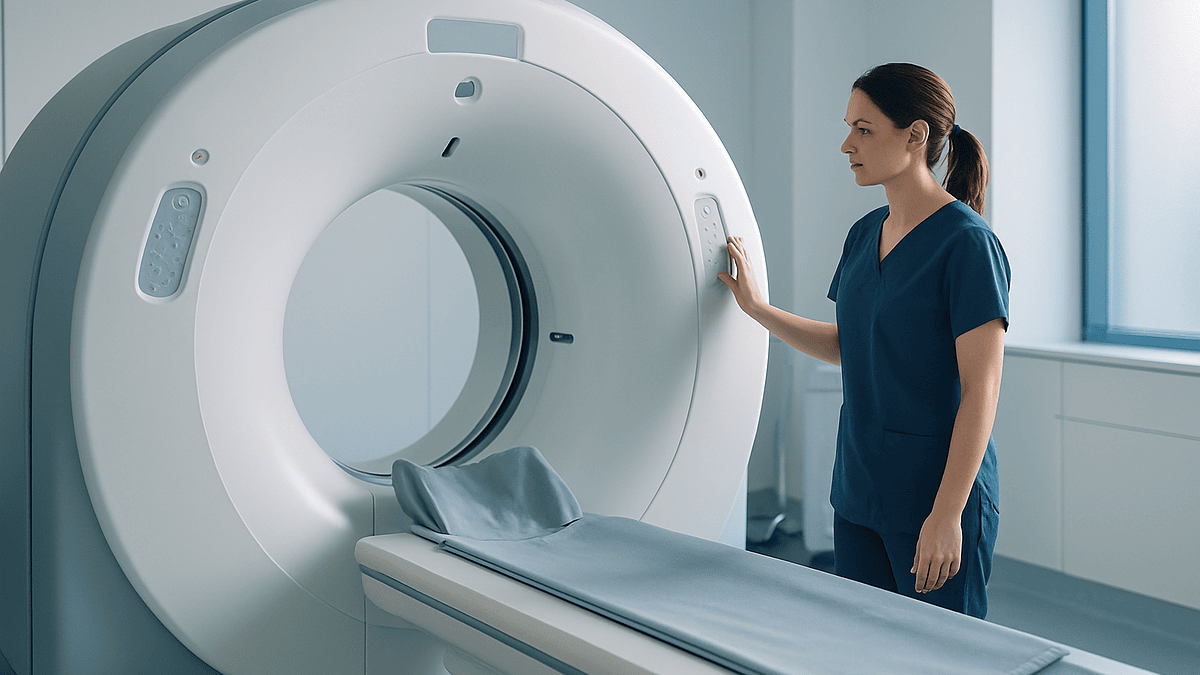
Magnetic resonance imaging with MRCP. MRCP stands for magnetic resonance cholangiopancreatography, which is simply an MRI protocol tuned to show the pancreatic and bile ducts as bright lines against a dark background. No radiation, no sedation, but roughly 30 to 45 minutes lying still in a noisy tube, sometimes with a contrast injection into an arm vein.
Fasting glucose or HbA1c. A yearly blood sugar check, because a sudden rise in glucose in a high-risk person can be an early clue that the pancreas is under stress. HbA1c is a measure of average blood sugar over the previous two to three months.
Most programs alternate EUS and MRI year by year, or use both in the first year and then choose based on what was seen. The interval shortens if something indeterminate turns up: a cyst that has grown, a duct that has widened, an area that looks slightly different from last time. Three- or six-month rechecks are common in those situations, and they are where most of the anxiety of surveillance lives.
CT scans, the workhorse for diagnosing pancreatic cancer once symptoms appear, are generally not used for routine surveillance because of cumulative radiation over decades of yearly scans and because EUS and MRI see small lesions better.
EUS or MRI: how the two surveillance tests differ, and what about cysts?
People in surveillance programs often ask why they need both, and the honest answer is that each test sees something the other misses.
EUS is the more sensitive of the two for small solid lesions, particularly those under a centimeter, and it is the only option that allows a same-day needle sample. Its drawbacks are that it is invasive, operator-dependent, image quality varies with the experience of the person holding the scope, and carries a small risk of complications from sedation or, rarely, from the procedure itself.
MRI with MRCP excels at mapping the duct system and at characterizing cysts. It is non-invasive, reproducible from year to year, and easier to compare side by side. Its weaknesses are cost in time, claustrophobia for some people, and lower sensitivity for tiny solid nodules pressed against normal tissue.
Cysts deserve their own paragraph, because they are the most common thing surveillance finds. Pancreatic cysts turn up in perhaps 2 to 15 percent of adults who have an abdominal MRI for any reason, and the proportion rises with age. Most are harmless. A subset, called intraductal papillary mucinous neoplasms, or IPMNs, fluid-filled growths in the ducts that produce mucus, carry a small but real potential to turn cancerous over years. Features that raise concern include size above about three centimeters, a solid component inside the cyst, or a main duct that has widened.
Here is the important distinction. Someone with an incidentally found cyst and no family history does not enter a high-risk screening program; they enter a separate cyst-surveillance pathway with its own imaging intervals. Someone already in a high-risk program who develops a cyst is watched more closely than an average-risk person with the same cyst would be. Same finding, different context, different plan.
Both tests share one limitation worth saying out loud: neither can distinguish, with certainty, an early cancer from an inflamed patch or a benign nodule. That uncertainty is what sometimes leads to surgery on lesions that turn out not to be cancer, and it is the central unresolved trade-off of the whole enterprise.
What the evidence actually says about pancreatic cancer surveillance
Grading evidence is unglamorous, but it is the difference between a magazine and a rumor. Here is the ladder, from strongest to weakest, and where pancreatic cancer surveillance stands on it.
Randomized controlled trials: none. No study has ever randomly assigned high-risk people to surveillance versus no surveillance and compared deaths. Such a trial would need thousands of rare participants followed for decades, and most researchers consider it ethically difficult now that surveillance is standard for high-risk families.
Prospective cohort studies: this is where the real evidence lives, and it is more encouraging than skeptics sometimes allow. The largest program, the CAPS studies, has followed more than a thousand high-risk people. In their 2022 report covering two decades, most cancers found during scheduled surveillance were stage I, and five-year survival among those patients was roughly three-quarters, dramatically better than the national average. European programs in the Netherlands, Germany and Spain report broadly similar patterns.
The caveats: cohort studies cannot rule out two well-known biases. Lead-time bias means finding a cancer earlier makes survival look longer even if death occurs on the same date. Length bias means surveillance preferentially catches slow-growing tumors that were never going to kill quickly. Together these can inflate apparent benefit without changing outcomes. The Task Force’s 2019 review flagged exactly this, and it is why the recommendation for average-risk adults remains a firm no.
Expert consensus: the CAPS 2020 statement and the 2022 endoscopy society guideline both endorse surveillance for defined high-risk groups. Consensus is the weakest rung, but it reflects the judgment of people who have watched these families for decades.
The summary a careful clinician would give: surveillance in high-risk people finds a meaningful share of cancers at an operable stage, and those patients do well; whether it lengthens life on a population level has not been proven and may never be tested in a trial. It is a reasonable choice, not a proven one, and it should be presented that way.
Does new-onset diabetes signal pancreatic cancer?
This is the one part of the early-detection story where average-risk people are genuinely involved, and it is worth getting the numbers right because the headlines rarely do.
The pancreas makes insulin. A tumor growing in it can interfere with that job before it causes anything else, which is why a small proportion of pancreatic cancers first show up as a new diagnosis of diabetes. Observational studies suggest that among adults over 50 who develop diabetes for the first time, roughly one in a hundred is diagnosed with pancreatic cancer within the following three years. That is about six to eight times the rate in people of the same age without new diabetes.
Read that carefully. One in a hundred means ninety-nine in a hundred do not have cancer. New-onset diabetes in later life is common, overwhelmingly caused by the ordinary metabolic reasons, and is not by itself a reason for pancreatic imaging. Guideline groups do not recommend scanning everyone who develops diabetes after 50.
What researchers are working on is a way to pick out the one from the ninety-nine. Clues that have emerged from cohort data include diabetes that arrives together with unintended weight loss rather than weight gain, blood sugar that rises unusually fast, and glucose control that deteriorates despite treatment in someone who previously had stable numbers. Risk-prediction models combining age, weight change and glucose trajectory are in validation studies; none is yet endorsed for routine use.
For people already in a high-risk surveillance program, the yearly glucose or HbA1c check is there precisely for this reason. A jump in blood sugar in a BRCA2 carrier with two affected relatives carries a very different meaning from the same jump in a neighbor with no family history, and it usually triggers an earlier scan.
The practical message for everyone else is modest but real: if a clinician diagnoses diabetes in later life and the pattern seems unusual, particularly weight loss alongside it, that is worth mentioning explicitly rather than assuming the two are unrelated. The decision about whether imaging is warranted belongs to that clinician, weighing the whole picture.
Can a pancreatic cancer screening blood test replace scans?
Not today, and the reason is a familiar one: the blood test that exists is not good enough, and the ones being studied are not yet proven.
CA 19-9 is the marker most people have heard of. It is a carbohydrate antigen, a sugar-protein molecule, shed by many pancreatic cancers into the blood. Doctors use it to monitor known cancer during treatment, where a falling level is reassuring and a rising one prompts a closer look. As a screening test it fails on three counts. It is often normal in small, early tumors, which are the only ones screening aims to find. It rises in many benign conditions, including gallstones, pancreatitis, liver disease and even a bad cold. And roughly 5 to 10 percent of people cannot produce it at all because of a common genetic trait, so their result is normal whatever is happening in the pancreas. Guidelines from every major group say the same thing: CA 19-9 is not a screening test.
Investigational blood tests are what the viral videos are about. Several research groups have reported assays that measure panels of proteins, fragments of tumor DNA circulating in blood, or patterns of chemical tags on that DNA. In early studies, some distinguish known pancreatic cancer from healthy controls with accuracy in the 80 to 90 percent range. That sounds decisive. It is not, for two reasons. The studies typically compare people who already have cancer, often advanced cancer, against healthy volunteers, which is a far easier task than finding a hidden early tumor in a real screening population. And accuracy in a lab cohort of a few hundred people rarely survives contact with tens of thousands of ordinary adults.
Multi-cancer early detection tests, blood tests marketed as looking for signals of many cancers at once, include pancreatic cancer among their targets. They remain investigational for this purpose in the sense that matters: no regulator has approved any blood test as a stand-alone screen for pancreatic cancer, and large prospective trials to show whether they reduce deaths are still under way.
Where blood tests may find a role first is as a triage layer within high-risk programs, flagging who needs an earlier EUS. That is a sensible hypothesis. It is also still a hypothesis.
What happens if pancreatic cancer surveillance finds something?
Most findings are not cancer. That sentence should be the first thing anyone entering surveillance hears, because the emotional weight of a phone call saying “we saw something” is out of proportion to what that something usually turns out to be.
The common scenario is an indeterminate finding: a small cyst, a slightly dilated duct, a faint change in texture. The usual response is a shorter interval, a repeat MRI in three or six months, or a switch from one test to the other to get a second view. A large share of these findings stay stable for years and are simply logged.
If a lesion looks solid, grows, or develops worrying features, the next step is typically EUS with fine-needle sampling. A pathologist examines the cells, and a multidisciplinary team, surgeon, gastroenterologist, radiologist, oncologist, pathologist, meets to decide together. That committee structure exists because the stakes cut both ways: missing a cancer is catastrophic, but operating on a benign lesion exposes someone to major surgery for nothing.
Surgery for a lesion in the head of the pancreas is usually a Whipple procedure, formally a pancreaticoduodenectomy: removal of the head of the pancreas along with the first part of the small intestine, the gallbladder and part of the bile duct, followed by reconnecting the digestive tract. Lesions in the body or tail are removed with a distal pancreatectomy, sometimes with the spleen. These are among the largest operations in abdominal surgery, with recovery measured in weeks to months.
Which brings up a question people search constantly: can a person live without a pancreas? Yes. A total pancreatectomy is occasionally necessary when disease involves the whole organ. Afterwards the body can no longer make insulin or digestive enzymes, so both must be replaced for life, insulin by injection and enzymes as capsules taken with meals, managed by an endocrinologist and dietitian. Life without a pancreas is demanding and involves careful blood-sugar management, but many people live for years and return to work and travel. Details of that regimen belong entirely to the treating team.
Surveillance data from the large cohorts suggest that a minority of operations turn out to be for lesions that were not cancer and might never have become cancer. That is the accepted price of the program, and it should be part of the informed-consent conversation before anyone’s first scan.
Common myths about pancreatic cancer early detection
The viral versions of this topic tend to circle the same handful of claims. Each contains a grain of truth, which is what makes it spread.
“A simple blood test can now catch pancreatic cancer early.” Research tests exist and some show promising accuracy in small studies. None is approved for screening, none has been shown to reduce deaths, and CA 19-9, the test people can actually get ordered, is unreliable for finding early tumors. Anyone offering a pancreatic cancer blood screen outside a clinical trial is ahead of the evidence.
“If it runs in your family, you should get scanned every year.” One affected relative roughly doubles risk but does not meet surveillance criteria. Two on the same side, with one being a parent, sibling or child, usually does. The route in is a genetics consultation, not a scan request.
“An annual CT would catch it.” CT is excellent once symptoms exist. For yearly surveillance over decades it delivers cumulative radiation and sees small lesions less well than EUS or MRI. No guideline recommends it for routine screening.
“Screening doesn’t work, so it’s pointless for anyone.” For average-risk adults, that is close to what the evidence shows. For defined high-risk groups, large cohort studies find most surveillance-detected cancers at stage I with much better survival than usual. The uncertainty is about lead-time bias and population-level benefit, not about whether early tumors can be found.
“Pancreatic cancer is always fatal, so early detection changes nothing.” Localized disease has a five-year survival around 44 percent versus about 13 percent overall. Early detection is hard, not futile.
“A healthy diet or a supplement can prevent it.” Not smoking, maintaining a healthy weight and limiting alcohol are associated with lower risk in observational studies. No supplement has been shown in trials to prevent pancreatic cancer, and no dietary pattern eliminates inherited risk.
“Genetic testing is only for people who already have cancer.” Testing an affected relative first is most informative, but unaffected people in families meeting criteria are routinely tested, because the result determines whether surveillance is offered to them.
When to see a doctor about pancreatic cancer risk
This article has deliberately avoided handing readers a symptom checklist, because early pancreatic cancer usually has no symptoms and lists of vague signs generate far more fear than diagnoses. Still, there are clear situations in which a conversation with a clinician is the right next step, and a few red flags that should not wait for a routine appointment.
Talk to a doctor soon, for risk assessment, if:
- Two or more blood relatives on the same side of the family have had pancreatic cancer, especially if one is a parent, sibling or child.
- A relative’s genetic test report names STK11, CDKN2A, BRCA1, BRCA2, PALB2, ATM, PRSS1 or a Lynch syndrome gene.
- There is a personal or family history of Peutz-Jeghers syndrome, familial melanoma syndrome or hereditary pancreatitis.
- A pancreatic cyst was found on a scan done for another reason and no follow-up plan was explained.
- Diabetes has been newly diagnosed after 50 alongside unintended weight loss.
Seek prompt medical attention, within days, not weeks, for:
- Yellowing of the skin or the whites of the eyes, particularly with dark urine or pale stools.
- Unexplained weight loss of several kilograms over a few months without trying.
- Persistent pain in the upper abdomen that bores through to the back and does not settle.
- New, severe itching all over the body together with any yellowing.
None of these signs is specific to pancreatic cancer; gallstones, hepatitis and many other conditions cause them far more often. They are listed because they warrant evaluation, not because they permit self-diagnosis.
Every decision described in this piece, whether to pursue genetic testing, whether to enter surveillance, which test to use, how often, when to stop, and what to do about a finding, belongs to the clinicians who know the full history. A magazine can explain the landscape. It cannot, and should not, draw the map for any one person.
Frequently asked questions
How do you detect pancreatic cancer early?
Early detection is currently possible mainly through structured surveillance of people at high inherited or familial risk, using yearly endoscopic ultrasound and MRI. For average-risk adults there is no recommended screening test. Cohort studies show surveillance can find a meaningful share of cancers at stage I, but no blood test or scan has been validated for finding early tumors in the general population.
Who should be screened for pancreatic cancer?
Guidelines reserve screening for people with two or more affected relatives on the same side of the family, including one parent, sibling or child, and for carriers of certain gene variants such as STK11, CDKN2A or PRSS1. Carriers of BRCA1, BRCA2, PALB2, ATM or Lynch syndrome genes qualify only if a first-degree relative has had the disease. A genetics consultation determines eligibility.
Is there a pancreatic cancer screening blood test?
Not an approved one. CA 19-9 is used to monitor known cancer but misses many early tumors and rises in benign conditions, so guidelines do not use it for screening. Experimental blood tests measuring proteins or tumor DNA fragments have shown promise in small studies, but none has been validated in a real screening population or shown to reduce deaths.
At what age does high-risk pancreatic cancer screening start?
Under the 2020 CAPS consensus, surveillance begins at 30 to 35 for STK11 carriers, 40 for CDKN2A carriers, 45 to 50 for other gene carriers with an affected first-degree relative, and 50 for familial cases with no known gene, or ten years before the youngest relative’s diagnosis, whichever is earlier. Continuation is reconsidered around age 75.
Does one relative with pancreatic cancer make me high-risk?
One affected first-degree relative roughly doubles risk but does not by itself meet current surveillance criteria. It is, however, a good reason to ask about genetic counseling, since testing the affected relative may reveal an inherited variant that would change what is offered to you. Two affected relatives on the same side, one of them first-degree, usually does meet criteria.
What are three overlooked pancreatic cancer symptoms?
Clinicians most often cite new-onset diabetes in later life accompanied by weight loss, pale or greasy stools that float, and generalized itching that precedes visible yellowing of the skin. All three are far more often caused by other conditions, and early tumors usually cause no symptoms at all, which is why they are prompts to see a doctor rather than a self-diagnosis tool.
What are usually the first signs of pancreatic cancer?
In many cases there are none until the tumor has grown or spread, which is the central problem of the disease. When signs do appear, tumors in the head of the pancreas often cause jaundice by blocking the bile duct, while those in the body or tail more often cause upper abdominal or back pain and weight loss. Any of these warrants medical evaluation.
Can a person live without a pancreas?
Yes. After a total pancreatectomy the body can no longer make insulin or digestive enzymes, so both are replaced for life under the care of an endocrinologist and dietitian. Blood-sugar management is demanding and dietary adjustments are permanent, but many people live for years, work and travel. The specifics of replacement therapy are decided entirely by the treating team.
How often is pancreatic cancer surveillance done?
Typically once a year, alternating endoscopic ultrasound and MRI with MRCP, alongside an annual fasting glucose or HbA1c. If an indeterminate finding appears, a growing cyst or a widened duct, the interval often shortens to three or six months. Surveillance continues only while a person would be fit for major surgery if a cancer were found.
Does pancreatic cancer early detection actually save lives?
Probably, for high-risk people, but it is not proven. Large observational programs report that most surveillance-detected cancers are stage I with five-year survival around three-quarters, far above the national average. No randomized trial exists, and lead-time and length bias could inflate those figures. For average-risk adults, the evidence indicates screening causes more harm than good.
References
This article is for general information only and is not a substitute for professional medical advice. Please consult a qualified doctor about your individual situation.

More from the Blog

Vitamin D Test: What Level Is Actually Deficient and Who Needs Testing
A vitamin D test measures 25-hydroxyvitamin D in blood. Most US laboratories and the NIH call a level below 12 ng/mL (30 nmol/L) deficient…
Preventive Care Checklist: The Screenings and Vaccines Recommended by Age
Preventive care is the set of screenings, vaccines and counseling that find or prevent disease before symptoms appear. For most adults that means blood…

Whole Genome Sequencing and Polygenic Risk Scores: What Consumer Genomics Can Predict
Whole genome sequencing reads nearly all 3 billion letters of a person's DNA and can reliably identify rare single-gene variants linked to conditions such…

Protein in Urine: What a Urinalysis Finding Means for Your Kidneys
Protein in urine, called proteinuria, means the kidneys' filters are letting protein such as albumin leak through. A single positive result on a urinalysis…
Lynch Syndrome: The Inherited Cancer Risk Worth Knowing About
Lynch syndrome is an inherited condition, caused by a change in one of the DNA mismatch repair genes, that raises lifetime risk of colorectal,…

Genetic Testing: What It Can Detect and How Long Results Take
Genetic testing can detect single-gene conditions such as cystic fibrosis, sickle cell disease and Huntington disease, chromosome differences such as Down syndrome, inherited cancer…